The Woman Who Called His Old Truck Junk Never Asked Why He Kept It Covered
Chapter 1: The Photo She Took Before Asking One Honest Question
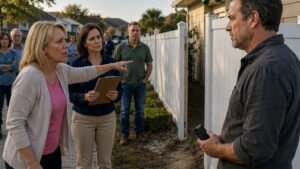
“You can’t leave that old truck in your driveway another week.”
Karen Walker said it loud enough for the man walking his dog across the street to slow down.
Edward Miller kept one hand on the raised hood of the pickup and the other around a socket wrench. The hood had lost most of its original blue shine. Sun had burned the paint flat, and old primer showed through near the left fender like a bruise. A shallow oil pan sat under the engine block, clean except for three dark drops he had been meaning to wipe before anyone saw them.
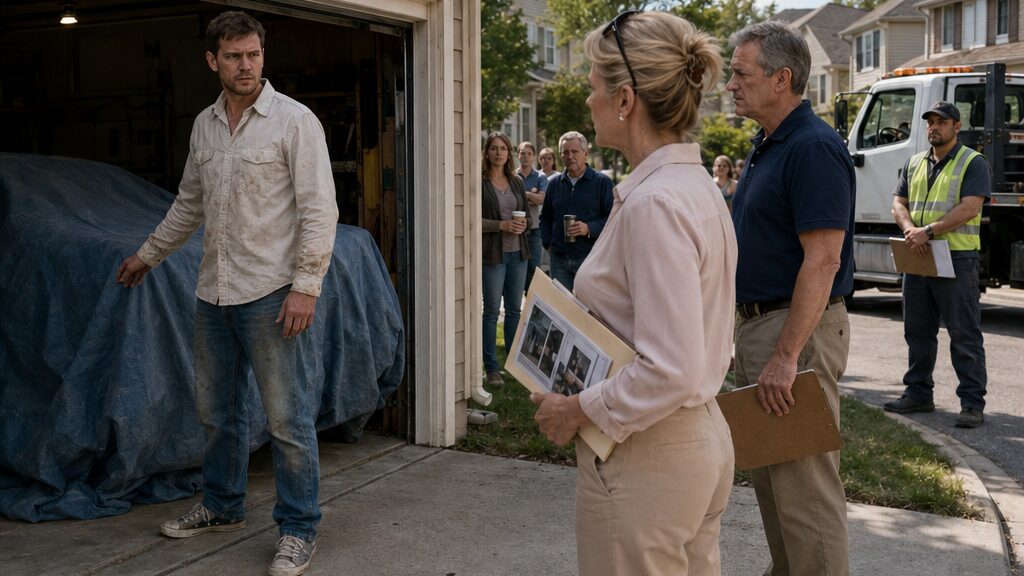
Karen stood at the end of his driveway as if an invisible line had been drawn there for her. Pale yellow polo, pressed beige shorts, white sneakers still bright in the late afternoon light. Her sunglasses were pushed into her hair, and her mouth had the tight patience of someone who had rehearsed being reasonable.
Edward did not answer right away. He tightened the wrench another quarter turn, slower than he needed to.
Karen lifted one hand toward the truck. “It’s ruining the neighborhood.”
The dog walker looked away too quickly.
Edward straightened. His shirt stuck to his back. There was a streak of blue dust along his forearm, and when he wiped his palm against his jeans, it left a faint half-moon of grease.
“It’s not abandoned,” he said. “I’m working on it.”
“That’s what you said in March.”
“It needed more than I thought.”
“It hasn’t moved in months.”
Edward glanced at the front tire. The truck had moved, but only six feet forward and back, in and out of the garage, as he tested brakes he still did not trust on the street. Saying that would invite another question. Another look. Another opinion from someone who thought a thing was only alive if it was polished.
Karen stepped closer without asking. “Edward, we have rules. You signed the same documents everyone else signed.”
“I know what I signed.”
“Then you know vehicles can’t be stored in visible disrepair.”
“It’s not being stored.”
Karen’s eyebrows went up. “It’s in the driveway. With the hood open. With parts under it.”
He looked at the oil pan. It seemed suddenly larger than it was, black and accusing on the clean concrete.
From two houses down, a garage door opened. Edward heard the scrape and roll of it, then nothing. Someone listening without appearing to listen.
Karen lowered her voice, but somehow that made the words sharper. “People notice these things. We all put money into keeping this community looking a certain way. When one person decides the rules don’t apply, it affects everyone.”
Edward’s fingers closed around the wrench until the metal pressed into the bones of his palm.
The truck had been his mother’s before it had been his problem. Before rust. Before cancer. Before a year of unpaid attention disguised as ordinary errands. Before the little envelope of receipts in the glove box and the red paint chip he had not looked at since the funeral.
But Karen had not asked whose it was.
She had asked how it looked.
“I’ll get it under the tarp tonight,” he said.
Karen gave a short laugh, not amused. “The tarp is half the problem. It looks worse covered. Like you’re hiding junk.”
Edward looked past her to the lawns on the cul-de-sac, all of them too green for a dry week. Flags near porches. Solar walkway lights. Two SUVs waxed enough to reflect rooflines. The neighborhood was quiet in the way a courtroom was quiet before someone lost.
“I’m not hiding junk,” he said.
“Then what are you hiding?”
The question hit too close. He should have had an answer ready. He had answers for timing belts and brake lines and stubborn bolts, but nothing for that.
Karen watched the hesitation and mistook it for guilt.
She pulled out her phone.
Edward stepped forward once. “What are you doing?”
“Documenting the condition.”
“This is my driveway.”
“And this is an HOA matter.”
The camera made a small artificial click. Karen angled the phone toward the raised hood, then toward the oil pan, then the faded passenger door where the blue paint had oxidized almost white. She did not photograph the new brake lines coiled neatly on the workbench inside the garage. She did not photograph the polished chrome trim wrapped in towels on the shelf. She did not see the inside of the cab, where the cracked bench seat had been removed and the floor repaired.
She photographed the worst edge of the truth.
“Karen,” Edward said.
She lowered the phone and looked at him with something almost like pity. “I gave you chances. More than one.”
“You didn’t give me a question.”
That stopped her for half a second.
Then she smiled, small and flat. “The question is simple. Are you going to remove it, or does the board need to make you?”
The dog walker had reached the corner but was no longer pretending not to watch. Across the street, blinds shifted in one front window.
Edward felt heat rise up his neck. He could tell her. Right there. He could say Margaret Miller bought the truck in 1986 with cash she had saved from double shifts. He could say she used to sit on the tailgate and drink gas station coffee after work. He could say the last time she came home from treatment, she made him promise not to sell it for parts.
But the words would make his mother small in Karen’s mouth. A reason. An exception. A sad little neighborhood story.
So he only said, “I’ll handle it.”
Karen slid her phone into her pocket. “I hope so. Because if I file this formally, it won’t just be a conversation.”
“It already isn’t.”
Her face tightened. For a moment, he saw something beyond irritation. A flicker of pressure, of someone afraid a boundary had been crossed and everyone would know she had not stopped it. Then the look vanished.
“I’m filing the complaint tonight,” she said. “You’ll hear from James Allen or the board office.”
She turned and walked down the sidewalk, her white sneakers silent against the concrete. At the end of the driveway she paused, looked back at the truck, and took one more photo from the curb.
That one would show the whole thing: the old blue pickup sitting crooked in the late sun, hood open like a mouth caught mid-confession, Edward standing beside it with grease on his hands and nothing useful to say.
When she was gone, the street sounds returned one by one. A lawn sprinkler. A basketball bouncing somewhere behind a fence. The dog walker clearing his throat too late to be casual.
Edward shut the hood halfway, then stopped. His hand stayed on the warm metal.
“Not junk,” he said under his breath.
The truck gave back only its dull reflection. He could see himself warped in the blue paint, thinner than he felt, older around the eyes than thirty should look.
Inside the garage, the air smelled of rubber, dust, and old cardboard. Edward reached through the driver’s side window and opened the glove box, looking for the registration envelope he thought might still be there. Receipts slid forward. A brittle insurance card. A folded map. A pencil with bite marks near the eraser.
Then something taped to the inside panel caught the light.
He peeled it loose carefully.
It was a paint sample, faded at the edges but still bright in the center. Deep red. Not cherry. Not fire engine. Something darker, warmer, almost the color of late summer sun on brick. On the back, in his mother’s handwriting, were three words.
This one, Eddie.
Edward stood with the little square of red between his thumb and forefinger while the complaint Karen had promised seemed to move closer, already written, already believed.
Chapter 2: The Notice That Made the Driveway Feel Smaller
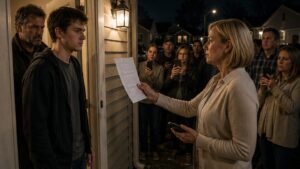
The notice was clipped to his mailbox where anyone walking past could read the red word at the top.
VIOLATION.
Edward saw it before he reached the curb. The white envelope hung from the little black flag like it had been displayed there on purpose, its plastic clip biting through the paper. Saturday morning light made the letters look brighter than they should have.
He crossed the driveway without shoes, gravel pressing into his socks. Two houses away, someone’s irrigation system ticked in neat circles. A delivery truck slowed near the corner, and Edward kept his back to it while he pulled the envelope free.
His name was typed cleanly.
Edward Miller.
His address.
Below that: visible inoperable vehicle, driveway storage, unscreened mechanical repair, possible fluid leakage.
Possible. That word stayed with him longest. Possible was how people made guesses sound responsible.
He carried the notice inside and laid it on the kitchen table beside the red paint sample. The sample looked almost foolish there, a small square of color next to official black print. The letter gave him ten days to remove the truck from visible view or provide documentation of compliance. Failure to cure may result in fines, towing referral, and additional enforcement action.
He read it twice before noticing the second page.
Temporary exterior project request form required prior to visible work exceeding seven days.
Edward closed his eyes.
He knew that form. Or he knew of it. It had come in a packet the year his mother died, folded between pool rules and holiday decoration restrictions. He had meant to look at it. He had meant to do a lot of things before grief turned the house into a place where papers disappeared under other papers.
On the counter, his phone buzzed.
A message preview from the neighborhood group flashed across the screen.
Anyone know what’s happening with the blue truck on Briar Lane?
Edward turned the phone face down.
In the garage, the pickup waited with the hood closed now, tarp pulled over the cab but not the bed. He had meant to secure it after Karen left. Instead he had sat on the garage step with the red paint sample until the house went dark.
He opened the passenger door. It groaned, but less than it used to. The cab smelled like old vinyl, dust, and the lemon cleaner he had used on the dash. He reached under the seat frame and pulled out the metal document box. Margaret had kept everything in there with rubber bands that dried out and cracked.
The title was on top. Beneath it, an old registration.
Margaret Miller.
His mother’s name sat in faded ink like someone had spoken softly from the next room.
Edward touched the paper with the back of one knuckle, careful not to smear anything, though there was nothing left to smear. He could still picture her sitting in the driver’s seat, one wrist hooked over the wheel, telling him he was riding shotgun because a man learned more by watching before touching tools. He had been twelve, maybe thirteen, too young to know the truck would someday feel heavier parked than moving.
A voice startled him from the driveway.
“Edward?”
He looked up too quickly and bumped his shoulder against the doorframe.
Amy Robinson stood near the edge of the concrete, not quite on his property, holding an empty travel mug. She was newer to the neighborhood, less polished than some of the others, with her hair pulled back and one hand shading her eyes.
“Sorry,” she said. “I didn’t mean to sneak up.”
“It’s fine.”
She glanced at the notice on the mailbox, then at the truck, then away. “I saw the post.”
Edward said nothing.
“I didn’t comment.”
“That’s something.”
Amy winced a little, accepting the edge in his voice. “I just wanted to ask before assuming. Is it really abandoned?”
The question should not have bothered him. It was better than Karen’s accusation. It was almost fair.
Still, he felt his jaw tighten.
“No.”
Amy nodded slowly. “Okay.”
He waited for more. For advice. For a story about resale values. For the polite version of Karen’s demand.
Instead she pointed toward the tarp. “My dad used to rebuild motorcycles in our shed. They looked dead until they weren’t.”
Edward looked at her then.
“I’m not saying the HOA won’t be annoying,” Amy added. “They will. But I figured there might be another side.”
Edward held the registration in one hand. He almost showed it to her. Almost said, It was my mother’s. Almost let the sentence out into daylight.
But Amy’s kindness made it harder, not easier. If he spoke, she might soften. If she softened, he might have to feel what he had been keeping bolted down with work.
“It runs,” he said instead.
“Does it?”
He should have left it there. But something in him, pride or anger or the need for one person to know Karen was wrong, made him lean through the driver’s window and turn the key he had left in the ignition.
The starter caught, coughed, and turned once.
The engine fired for a single clean second.
A low, rough sound filled the garage, deep enough to make the tools on the pegboard tremble. Then Edward shut it off before it could settle into idle.
Amy’s eyes widened. “That did not sound abandoned.”
For the first time that morning, Edward felt a thin line of satisfaction.
“No,” he said. “It didn’t.”
But the feeling vanished when he looked back at the notice. Temporary exterior project request form required. Prior to visible work. Prior. The word was a locked door behind him.
Amy followed his gaze. “Can you file it now?”
“I don’t know.”
“You should try.”
“I should have tried months ago.”
She did not argue. That was worse.
After she left, Edward went inside and opened every drawer in the kitchen until he found the HOA packet under a stack of appliance manuals. The form was only one page. Name, address, type of project, expected duration, screening method, board approval signature.
Simple. Stupidly simple.
He could have filled it out in ten minutes.
He sat at the table with a pen and wrote his name. Then he stopped at type of project.
Vehicle restoration.
It looked too small. Too ordinary. Nothing on the form asked whose hands had first held the wheel. Nothing asked whether a promise could expire because the driveway looked bad from the street.
His phone buzzed again.
This time he looked.
Karen Walker had posted three photos.
The oil pan under the engine.
The raised hood.
The worst strip of faded blue paint near the door.
Her caption read: This is what happens when standards are ignored for months. Our neighborhood deserves better.
Edward stared until the letters blurred, the red paint sample lying beside the violation notice like a quiet answer nobody had asked to hear.
Chapter 3: The Neighbors Saw Junk Because She Framed It First
By Monday morning, Edward’s truck had become a story told by people who had never stood close enough to see the work.
Abandoned junk on Briar.
Been there forever.
Oil leaking into the driveway.
Someone said there were parts scattered everywhere.
Someone else said it probably attracted rats, though the truck’s cab was cleaner than Edward’s kitchen.
He read the comments in the garage with the side door half open, thumb moving down the screen even after he knew better. Karen had not lied exactly. That was what made it effective. Her photos showed real things from dishonest angles. The oil pan. The open hood. The oxidized paint. A tarp corner loose from the wind. No shot of the repaired brake drums. No shot of the sanded passenger door. No shot of the red fender hanging under a drop cloth behind his workbench, smooth enough now to catch light like water.
Thomas Green appeared in the doorway before Edward noticed him.
“You going to answer any of that?” Thomas asked.
Edward locked the phone and slipped it into his pocket. “No.”
Thomas gave a tired little nod, like he had expected that. He was in his sixties, square-shouldered, with gray hair cut short and a way of standing that made him seem reluctant to enter any room he had not been invited into. He had taught auto body at the county technical school before retiring, and he could look at a panel gap from twenty feet away and tell you whether somebody cared.
“You mind?” Thomas asked, pointing toward the truck.
Edward stepped back.
Thomas walked around the pickup without touching it. He looked under the front lip, leaned toward the wheel well, then paused near the garage wall where the drop cloth hung. One corner had slipped overnight. Beneath it, the restored fender showed a curve of deep red paint.
Thomas did not smile. He only looked at Edward differently.
“That’s not rattle-can work,” he said.
“No.”
“You sprayed that yourself?”
“With rented equipment.”
“In this garage?”
Edward nodded.
Thomas looked again, longer this time. “Your mother would’ve fussed about the dust in the clear coat.”
Edward’s throat tightened before he could stop it.
Thomas seemed to regret the sentence as soon as he said it. He turned toward the workbench and picked up a piece of chrome trim wrapped in an old towel. “She brought that truck by the school once. Years ago. Said the door was sagging and she didn’t trust any shop that talked to her like she was borrowing her husband’s keys.”
“That sounds like her.”
“It was hers, then?”
Edward’s mouth opened. Nothing came out.
Thomas set the trim down gently. “You don’t have to tell me.”
From outside came the sound of voices.
Edward moved to the edge of the garage. Across the street, Amy Robinson stood near the mailbox cluster with two other neighbors. One of them held a phone. Karen was there too, wearing a coral visor and carrying a folder against her chest. She was speaking in her measured committee voice, the one that made complaint sound like community care.
Amy was listening, but not nodding.
Edward could not hear every word, only pieces.
“Months…”
“Board packet…”
“Abandoned vehicle standard…”
“Not fair to the rest of us…”
Then Amy said, louder than she meant to, “Did you ask him if it runs?”
Karen’s expression shifted. Not much, but enough.
“That isn’t the point,” Karen said.
“It might be part of the point.”
One of the neighbors looked toward Edward’s driveway. Edward stepped back before they could make eye contact.
Thomas watched him do it. “You know hiding just lets other people narrate.”
“I’m not hiding.”
Thomas’s gaze moved to the half-covered truck, the closed side door, the phone in Edward’s pocket. He did not say anything.
That was worse than being challenged.
At noon, Edward drove to the small HOA office beside the community pool, not in the pickup but in his aging sedan with a cracked dashboard and a glove compartment that stuck. The office was a converted meeting room with beige walls, framed landscape guidelines, and a coffee machine that smelled burnt even when empty.
James Allen sat at the folding table with Karen’s printed photos spread in front of him.
Karen sat to his right.
Edward remained standing.
James looked up with the distracted seriousness of a man who had another meeting after this one. “Mr. Miller. Thanks for coming in.”
“You sent a notice.”
“We did. And we need to discuss compliance.”
Karen slid one of the photos closer to James. “As you can see, this has been ongoing.”
Edward looked at the print. It showed the oil pan from a low angle, making it look like a spill had spread across the driveway. There were no drops in the photo. Just the pan. The possibility of mess made into proof of it.
“It doesn’t leak,” Edward said.
Karen folded her hands. “Then why is there a pan?”
“Because I was changing a gasket.”
“In the driveway.”
“In front of my garage.”
James held up one hand, not unkindly. “The issue isn’t whether you know what you’re doing. The governing documents are clear about visible repairs and inoperable vehicles.”
“It’s operable.”
“Can it be driven on public roads today?”
Edward hesitated. The brakes worked. Mostly. The lights still needed final wiring. The inspection sticker was expired.
Karen saw the hesitation. “That answers that.”
Edward looked at her. “No, it doesn’t.”
James sighed. “We’re scheduling an on-site inspection for Saturday morning. That gives you a few days to either remove the vehicle from view, provide proper documentation, or demonstrate that the project complies under the temporary exterior work provision.”
Edward heard the phrase and looked up. “Temporary exterior work provision?”
Karen’s fingers tightened around her folder.
James shuffled through the packet. “There is a form. It should have been filed before the project exceeded seven days.”
“I can file it now.”
“You can submit it,” James said carefully. “Approval is not automatic after a violation.”
Karen leaned forward. “And the truck still cannot remain an eyesore during review.”
Edward wanted to tell them what was under the drop cloth. He wanted to say that the red paint was drying, that the hood had been rebuilt, that the bed wood was stacked in his garage waiting for final seal. He wanted, for one reckless second, to invite them all over and make them watch the engine turn.
Instead he said, “Saturday, then.”
James nodded. “Saturday at nine.”
As Edward turned to leave, Karen spoke behind him.
“I hope you understand,” she said. “Nobody wants this to become unpleasant.”
He stopped with his hand on the door.
It already had, he thought.
But he left without saying it.
Outside, Amy stood near the pool fence with her phone in her hand, pretending badly that she had not been waiting. “What happened?”
“Inspection Saturday.”
“That soon?”
Edward nodded.
“Do you have enough time?”
“No.”
The answer came out before he could make it polite.
Amy looked toward the office window, where Karen’s silhouette moved behind the blinds. “Her photos don’t show everything.”
Edward gave a humorless breath. “They show enough.”
“No,” Amy said. “They show what she wanted people to see.”
For a moment, he almost thanked her.
Then James’s voice carried through the thin office wall, muffled but clear enough.
“Karen, we can’t authorize towing before the inspection.”
Karen answered too quietly for Edward to hear.
But he heard the next sentence from James.
“I said not before Saturday.”
Amy went still.
Edward looked back at the office door, and for the first time the problem no longer felt like a misunderstanding.
It felt scheduled.
Chapter 4: The Rule She Quoted Was Missing One Line
Edward found the missing line because Karen had underlined the wrong one.
Her printed copy of the vehicle standard sat in the HOA packet James had handed him, one sentence highlighted in yellow: No inoperable, unlicensed, disassembled, or visibly unsightly vehicle shall be stored where visible from the street.
But beneath it, half hidden by the fold in the paper, was another sentence with no highlighting at all.
Active restoration projects may receive temporary exterior status if screened from view and registered with the association office.
Edward read it once, then again, standing barefoot in his kitchen with the packet spread across the counter and the violation notice pinned under a coffee mug. The house was quiet except for the refrigerator kicking on. His phone showed six unread neighborhood comments. He did not open them.
He ran his thumb under the unmarked sentence.
Active restoration.
Not storage. Not abandonment. Not junk.
For the first time since Karen had stood in his driveway with her phone raised, the pressure in his chest loosened.
Then he reached the end of the paragraph.
Approval must be requested prior to exterior work exceeding seven consecutive days.
The pressure came back harder.
He drove to the county clerk’s office because paperwork was easier than calling James. The building sat between a tax office and a nail salon in a strip center with cracked parking lines. Inside, the air-conditioning was too cold, and everyone spoke in soft, tired voices as if loudness might summon another form to fill out.
The clerk behind the glass asked for the VIN twice.
Edward read it from a photo on his phone, then from the old title in the metal box, just to be certain.
“It’s still in Margaret Miller’s name on the older registration,” the clerk said, tapping at her keyboard. “Title transferred to you three years ago?”
Edward nodded. “After she passed.”
The clerk’s expression changed, not into pity exactly, but into a slower kind of care. She printed a copy of the current title record, then paused.
“There’s an archived registration card, too. Want that?”
Edward almost said no. He had enough papers. Enough proof. Enough ways to make his mother’s truck into a case file.
But the clerk had already turned toward the printer.
The old card came out faded and slightly crooked from the scan. Margaret Miller’s name sat under the truck’s make and year. At the bottom, barely legible, was her signature. Not the careful signature she used on checks, but the quick one she made when she was impatient, the M rising sharp and high like she had somewhere better to be.
Edward folded the paper once and slid it behind the title.
“Anything else?” the clerk asked.
He looked down at the registration card.
“No,” he said, then corrected himself. “Thank you.”
In the parking lot, he sat in the sedan without starting it. He had proof now. At least some of it. The truck belonged to him. It had been registered. It was being restored. The rule had room for him if he could get the board to admit the room existed.
He should have felt steadier.
Instead he felt the old irritation toward himself rise in the space proof did not fill. The form had been one page. He had let it sit unread because every sentence about temporary exterior projects sounded like permission to strangers, and he hated needing permission for his mother’s truck.
By the time he reached the HOA office, James Allen was stacking folding chairs in the meeting room. Karen’s photos were gone from the table, but Edward could still see where they had been, the arrangement too neat to have been accidental.
James looked up. “Mr. Miller.”
“I found the restoration provision.”
James set a chair against the wall. “I assumed you would.”
“Karen didn’t mention it.”
James’s face stayed neutral. “Karen’s concern was the visible condition.”
“She highlighted the rule and skipped the exception.”
“That may not have been intentional.”
Edward laid the county records on the table, then the project form he had filled out that morning. His handwriting looked stiff, almost childish, in the little boxes.
James picked up the form. “Screening method: fitted full-vehicle cover, garage storage when curing paint, no exterior work after dusk.”
“That’s what I can do.”
“Expected completion?”
Edward hesitated. “Saturday.”
James looked over the top of the page. “This Saturday?”
“If the wiring behaves.”
“That is a narrow window.”
“It’s the one I have.”
James studied him for a moment, perhaps seeing for the first time that Edward had not come to bargain for months. He had come to buy days.
“The problem,” James said, “is prior approval. You didn’t file before the work exceeded seven days.”
“I know.”
“The board can grant temporary status retroactively, but it usually requires review.”
“Karen is trying to have it towed before review.”
James’s jaw tightened slightly. “No towing has been approved.”
“But it was discussed.”
James did not answer quickly enough.
Edward gathered the papers back into order with more force than necessary. “You know this isn’t abandoned.”
“I know there is more here than the photos suggested,” James said. “That is not the same as saying the board can ignore procedure.”
Edward gave a short laugh. “Procedure only seems urgent after she takes the pictures.”
James looked tired then, not offended. “I understand you’re upset.”
“No,” Edward said. “You understand I’m late with a form. That’s the part you like, because it fits in the file.”
The words landed too hard. James’s face closed.
Edward regretted it immediately, but not enough to apologize. He was angry at James, at Karen, at the form, at himself. Mostly at himself.
James slid the project request back across the table. “Bring any supporting materials Saturday. I’ll note that you appeared and submitted documentation.”
“That’s all?”
“For now.”
Edward took the packet. “For now” sounded like a hallway without doors.
Back home, he secured the tarp properly for the first time in days. He pulled it down over the windshield, tied it beneath the frame, and clipped the loose corner to a hook near the front wheel. It did look better. He hated that it looked better. Karen would have said so as if appearance were truth.
In the garage, the restored red fender waited under the drop cloth. He pulled the cloth away and inspected the clear coat. Thomas had been right: there was dust in it. Not much. Enough for Margaret to have noticed. Enough for her to tap the fender and say, Eddie, if you rush the finish, you’ll see it every time you wash the thing.
He smiled despite himself.
On the top shelf above the workbench sat a cardboard box he had avoided for nearly two years. It was not hidden. That was the worst part. It had been in plain sight, labeled in Margaret’s handwriting with a thick black marker.
For the truck show.
He had moved it from her house to his garage after the funeral. He had placed it on the shelf with both hands and told himself he would open it when the truck was ready.
The truck was not ready.
Saturday was coming anyway.
Edward pulled the box down. Dust came with it, dry and gray, coating his fingers. The packing tape had yellowed. One corner had softened from old humidity. He set it on the workbench between the HOA packet and the red paint sample, then slit the tape carefully with a utility knife.
Inside was a folded towel, two unopened polishing cloths, a small envelope of registration materials for the town’s summer car show, and a cardboard placard wrapped in tissue.
Edward lifted the placard out.
The top line read: Margaret Miller.
Beneath that, in lettering she must have ordered before she got too sick to pretend she was only tired, were the truck’s year, model, and a space for the restoration date.
The date was blank.
Edward stood very still, the utility knife still open on the bench, while Saturday stopped being an inspection and became something else entirely.
Chapter 5: The Saturday Crowd Came for a Tow and Got an Engine
The tow truck arrived before James Allen did.
Edward heard it before he saw it, a low diesel idle rolling into the cul-de-sac at 8:47 on Saturday morning. He was inside the garage with both hands on the red truck’s steering wheel, not driving, just sitting there in the dimness while the engine cooled from its final test run. The new paint held the overhead light in long, clean strips. The old blue was gone except for the underside of the dash, where he had left one hidden patch untouched.
Outside, the diesel stopped.
A door shut.
Then another.
Edward looked through the garage window and saw the tow contractor step down from a white truck with no company name on the door, only a magnetic sign and a steel hook assembly that made the driveway feel smaller from the curb. Karen stood beside him with a folder under one arm. She was dressed as if for a board presentation, pressed blouse, sunglasses on her head, phone in hand.
Behind her, two neighbors slowed near the sidewalk.
Then three.
Then Amy Robinson appeared at the mailbox cluster, looking from the tow truck to Edward’s closed garage with her mouth slightly open.
Edward did not move.
On the passenger seat, Margaret’s placard lay face down on a towel. The red paint sample was clipped to the edge of it with a small binder clip, because he had not known what else to do with it. He had slept two hours. Maybe three. His hands still smelled faintly of gasoline and clear coat.
A knock struck the garage door.
Not the side door. The garage door itself.
“Edward?” Karen called. “The board inspection is here.”
The board inspection was one man in a polo shirt walking up behind her with a clipboard and a face that showed he had not expected the tow truck either.
James glanced toward the curb, then at Karen. “Why is he here?”
Karen kept her voice low, but the garage door carried sound. “For standby. In case the vehicle cannot be brought into compliance.”
“That was not authorized.”
“It’s not a tow unless we use him.”
Edward closed his eyes.
There it was. The little space people made between rule and harm. Not a tow. Standby. Not accusation. Documentation. Not shame. Standards.
He got out of the truck.
The side door opened with a metallic click, and every head on the sidewalk turned toward him. Edward stepped out wearing the cleanest shirt he owned, though the cuffs were stained. He had washed his hands twice, but red dust remained at the edges of his nails.
Karen’s eyes moved past him into the garage. The angle showed nothing but shadow.
“Good,” she said. “You’re here.”
“I live here.”
A few neighbors shifted. Someone gave a small cough that might have been a laugh.
James stepped forward before Karen could answer. “Mr. Miller, we’re here for the inspection. As discussed.”
Edward looked at the tow contractor. “Was he discussed?”
James’s mouth tightened. “No.”
Karen lifted the folder. “The photos clearly show an abandoned vehicle in visible disrepair. We need to be prepared if it remains in violation.”
“It isn’t abandoned,” Edward said.
Karen turned slightly, enough for the neighbors to hear. “Then demonstrate that.”
The words were meant to corner him. Edward felt that. She expected him to stammer about forms, to point at paperwork while the old blue shell sat behind him like proof against every sentence. She had brought an audience and a hook truck because she believed the thing in the driveway was still the thing in her photos.
Edward looked toward the curb.
Amy stood with her arms folded, no phone in her hand. Thomas Green had come out onto his porch across the street, coffee mug untouched. More neighbors had gathered in the soft half-distance people chose when they wanted to witness without admitting it.
Edward could have started with the rule. He could have handed James the project request, the registration, the title record, the temporary exterior provision. He had all of it stacked on the garage workbench.
Instead he turned back to Karen.
“Move your car,” he said.
Karen blinked. “Excuse me?”
“You parked across part of my driveway.”
Her white SUV sat close to the apron, angled as if she had arrived in a hurry.
Color rose in her face. “I’m not blocking—”
“You asked me to demonstrate.”
James looked at Karen. “Please move it.”
For one second she did not. That was the first crack. Everyone saw it: the woman who spoke of rules deciding whether a driveway rule applied to her. Then she turned, walked stiffly to the SUV, and moved it ten feet forward.
Edward returned to the garage.
His hand shook once as he reached for the switch. He closed his fingers, waited until the shake passed, and pressed it.
The garage door began to rise.
Panel by panel, morning light slid under the bottom edge and spread across the floor. First it showed the clean concrete he had scrubbed until midnight. Then the stacked blue tarp folded neatly near the wall. Then the polished front bumper.
The murmuring outside changed.
Edward did not look back.
The door lifted higher, revealing the truck’s grille, the rounded hood, the deep red paint Margaret had chosen. Not bright. Not flashy. Warm, dark, alive. The chrome caught the sunlight and threw it toward the sidewalk in brief hard flashes.
Someone whispered, “Oh.”
Karen said nothing.
Edward opened the driver’s door and slid behind the wheel. The seat was newly upholstered, but the steering wheel was original. He had kept the small worn place where Margaret’s thumb used to rest. It fit under his own thumb now.
Karen found her voice as he reached for the key.
“An engine turning over once does not change months of violation.”
Edward looked through the windshield at her. “Good thing that’s not what this is.”
He turned the key.
The starter caught cleanly. The engine fired not with the cough Amy had heard days before, but with a full, steady rumble that settled into itself like an animal waking under a familiar hand. It filled the garage, then the driveway, then the quiet street. The tow contractor lowered his clipboard. Thomas Green’s mouth moved once, not quite a smile, but something close.
Edward let the engine idle.
No smoke.
No stumble.
No leaking pan.
He put the truck in reverse.
James stepped aside quickly. Karen did not move until Amy said, “Karen.”
Then she took one step back.
The red pickup rolled out of the garage under its own power.
The tires crossed the clean concrete, slow and straight. Edward kept both hands on the wheel. The morning sun moved over the hood, and for a second the truck looked less restored than returned, as if it had been somewhere else and had finally found the road home.
He stopped at the end of the driveway and set the brake.
The street was silent except for the engine.
Edward climbed out and left the door open. He walked to the workbench, gathered the papers, and handed them to James without looking at Karen.
“Title record. Registration history. Temporary project request. Restoration provision. Photos from the work log.”
James took the papers. His eyes moved from the documents to the truck and back again. “You did this work here?”
“Most of it.”
Thomas had crossed the street by then, slow but steady. He stopped beside the front fender, not touching it. “Panel alignment’s good,” he said. “Better than good.”
That meant more than applause would have.
The tow contractor cleared his throat. “So am I needed here?”
James looked at him. “No.”
Karen turned sharply. “The issue is not whether he made it pretty today. The issue is that it sat for months as a visible nuisance.”
Edward felt the satisfaction drain before it had fully formed.
Because she was not entirely wrong. It had sat. It had been visible. He had let it look worse than it was because hiding the finished pieces felt safer than showing the unfinished whole. He had let silence become a tarp.
James looked uncomfortable. “We’ll need to review the procedural history.”
Amy stepped closer. “Her photos didn’t show this.”
Karen’s head turned. “Because this wasn’t there when I took them.”
“Yes,” Amy said. “That’s my point. You showed everyone one angle.”
The neighbors murmured again, but it was not the warm sound Edward expected. It was uneasy. People recalculating what they had believed and what they had helped spread.
Edward reached into the cab for the placard. He had not meant to display it. He had brought it only because leaving it in the box had felt wrong.
As he pulled it out, the red paint sample clipped to it fluttered in the engine breeze.
Karen’s gaze fell to the lettering.
Margaret Miller.
Her face changed so quickly Edward almost missed it. The authority slipped, replaced by recognition, then discomfort, then something like memory.
“You knew my mother?” Edward asked.
Karen’s hand tightened around her folder.
For the first time since he had known her, she seemed unable to decide what expression belonged on her face.
“I knew of her,” Karen said.
The engine idled between them, steady and warm, while the name on the placard hung in the open like a second accusation.
Chapter 6: The Truck Was Never Just Parked There
Edward kept wiping the same clean fender until his hand began to shake.
The crowd had thinned. The tow truck was gone. James had left with the paperwork and a promise to “review everything carefully,” which sounded better than a threat and worse than an answer. Karen had walked away without another photo, holding her folder against her ribs as if the papers inside had turned fragile.
The red truck sat halfway in the garage and halfway in the driveway, exactly where the blue one had been judged. Only now the sunlight slid across new paint, and every reflection in it seemed too sharp.
Edward dragged the polishing cloth over the fender again.
The cloth caught on nothing. There was no reason to keep wiping.
He did anyway.
A voice came from the driveway. “You’ll burn through the clear if you keep punishing it.”
Thomas Green stood near the garage opening with his coffee mug, though the coffee had to be cold by then.
Edward lowered the cloth. “I’m not punishing it.”
Thomas looked at the fender, then at him. “No?”
Edward tossed the cloth onto the workbench. It landed beside Margaret’s placard, face up now, her name still exposed.
Thomas stepped into the garage only after Edward nodded. He moved slowly around the truck, taking in the details he had been too polite to inspect in front of the neighbors. The reworked door seam. The bed rails, sanded but not yet installed. The preserved patch of old blue under the dash.
“You left that,” Thomas said.
Edward followed his gaze. “She liked the original color when she bought it.”
“But she chose red.”
“She changed her mind.”
Thomas gave a small sound. “Margaret did that when she had already decided something three months earlier.”
The name in his mouth was familiar enough to make Edward look away.
“She talked to you about it?”
“A little.”
Edward leaned against the workbench. The edge pressed into his hip. “Karen said she knew of her.”
Thomas’s expression tightened. “Most people here knew of your mother. Not the way you mean. She was on a committee years back. Before Karen moved up. Before all this got so stiff.”
“My mother was on an HOA committee?”
“Briefly.”
Edward almost laughed. “She hated being told what to do.”
“That’s why she joined.” Thomas looked toward the street. “There was a fight over sheds. Somebody wanted to make a retired man tear down a workshop because the roof color was half a shade off. Your mother called it nonsense in a room full of people who liked calling nonsense guidelines.”
Edward stared at the truck.
“She never told me that.”
“Parents don’t tell their kids everything that makes them brave.”
The sentence landed too close.
Edward picked up the red paint sample from the placard. He turned it over, saw the handwriting again.
This one, Eddie.
“She bought the paint before she got too sick,” he said. The words came out dry, almost factual. “We were supposed to finish it together. She had this whole plan. Truck show in July. She said if she lost her hair before then, she’d wear a scarf that matched the paint so nobody would look anywhere else.”
Thomas said nothing.
Edward swallowed. “Then she couldn’t get up the garage step anymore. Then she couldn’t stand the smell of primer. Then the truck sat because every time I touched it, I heard her telling me I was holding the sander wrong.”
A faint smile crossed Thomas’s face and disappeared.
“She was probably right,” he said softly.
“She usually was.”
Edward rubbed the paint sample between his fingers. “I thought finishing it would feel like keeping my promise.”
“And now?”
“Now it feels like closing the last door with her still on the other side.”
Thomas looked down at his mug. “I promised her something too.”
Edward went still.
“She called me about a month before she passed,” Thomas said. “Asked me to look in on you after. Not in a dramatic way. Margaret didn’t do dramatic unless a carburetor deserved it. She said you were good with your hands and terrible at asking for help.”
Edward’s throat tightened.
“I should’ve come sooner,” Thomas said.
“You didn’t owe me anything.”
“That’s what I told myself.”
The honesty of it left no room for politeness.
Outside, a car slowed in front of the house, then continued. Edward could feel the neighborhood still looking, even when no one stood there. The truck had changed, but the attention had not gone away. If anything, the reveal had given everyone a better reason to talk.
His phone buzzed on the workbench.
He ignored it.
It buzzed again.
Thomas nodded toward it. “Might be James.”
It was not James.
Amy had sent a screenshot from the neighborhood group.
Karen’s new post was shorter than the first one.
Today’s surprise restoration does not erase months of noncompliance. Rules cannot depend on emotional stories revealed after enforcement begins. I have requested an appeal review so the board can address the precedent this sets.
Below the text was one of Karen’s old photos: the blue truck with its hood open, oil pan beneath it, Edward half visible at the edge of the frame like a man caught doing something wrong.
Then a newer photo someone else had taken that morning: the restored red truck rolling out of the garage.
Side by side, they looked like accusation and answer.
But Karen had written the caption so the answer became another problem.
Thomas read it over Edward’s shoulder and exhaled. “She’s not letting go.”
Edward set the phone down carefully. “Because now it isn’t about the truck.”
“No,” Thomas said. “Now it’s about being wrong in public.”
Edward looked at Margaret’s placard, then the unfinished blank where the restoration date belonged.
He thought the morning would end something. That the engine would speak and the street would understand. Instead the engine had only carried the fight into a room with chairs and rules and minutes typed afterward.
Thomas picked up his mug. “You can let James handle the appeal.”
Edward shook his head.
“You can bring the documents,” Thomas said. “That may be enough.”
“No.”
The word surprised both of them.
Edward picked up the violation notice, folded it once, and placed it beside the red paint sample. For days he had tried to prove the truck was not abandoned without saying why abandoning it would have broken him. He had treated the truth like a weakness Karen could use.
Maybe she still would.
But silence had not protected Margaret’s name. It had left it for Karen to discover on a placard in the driveway, surrounded by people who did not know whether to whisper or stare.
Edward took the project form from the stack and smoothed the crease down with his thumb.
“When’s the board meeting?” Thomas asked.
“Monday.”
“You going?”
Edward looked at the red truck, at the open garage, at the little square of paint his mother had chosen before time became smaller than plans.
“Yes,” he said. “This time I’m going inside.”
Chapter 7: The Hearing Where Silence Stopped Protecting Him
Edward walked into the HOA meeting room holding only two things: the violation notice and the red paint sample.
James Allen looked up from the front table, then glanced past him as if expecting a folder, a lawyer, maybe Thomas Green carrying a stack of technical proof. Edward had all of that in his car. Title record, registration, photos, the restoration provision printed cleanly without Karen’s missing line. He had brought them because he was not stupid.
But he did not carry them in first.
Karen Walker sat two chairs to James’s right, back straight, hands folded over her folder. She looked composed, but one corner of her folder was bent from being gripped too tightly. When she saw the paint sample between Edward’s fingers, her eyes moved away.
The meeting room smelled like old coffee and pool chemicals from the community center next door. Six folding chairs had been set out for residents. Amy Robinson sat in the second row. Thomas sat at the end of the row behind her, arms crossed, looking at the wall as if the wall had made several bad choices.
Edward took the empty chair facing the board.
James cleared his throat. “We’re here to review the appeal filed regarding the vehicle violation at Mr. Miller’s property.”
“Restoration project,” Edward said.
The room went still.
James looked at him. “Yes. The restoration project.”
Karen’s mouth tightened, but she said nothing.
A board member shuffled papers. James looked down at the packet. “The issue before us is whether the vehicle, as documented prior to Saturday’s inspection, violated the community standards, and whether the association should approve temporary exterior project status retroactively.”
Edward placed the violation notice on the table in front of him.
Then he placed the red paint sample beside it.
It looked too small under the fluorescent lights. A little square of color against official paper. But for once, he did not hide it under his palm.
Karen opened her folder. “I want to be very clear. This is not about anyone’s personal grief or sentimental attachment. Everyone has personal circumstances. Rules exist so the board doesn’t have to judge whose story is sad enough to excuse noncompliance.”
Amy shifted in her chair.
Edward did not look back.
Karen continued, her voice measured. “For months, the vehicle sat in visible disrepair. Hood open. Tarp unsecured. Mechanical parts visible. It affected the appearance of the street and created complaints.”
“How many?” Edward asked.
Karen paused. “Excuse me?”
“How many complaints?”
James looked at Karen. “The written complaint was from you.”
“There were verbal concerns.”
“From who?” Edward asked.
Karen’s eyes sharpened. “Residents shouldn’t have to be named to be protected.”
Thomas made a low sound, not quite a laugh.
James raised a hand. “Let’s keep this orderly.”
Edward leaned back. His heart was beating too hard, but his voice stayed even. “Orderly is fine. I’m asking what happened before the violation became official.”
Karen slid two printed photos across the table. “This happened.”
The oil pan. The open hood. The faded blue paint.
There they were again, the three worst angles of a larger truth.
James turned toward Edward. “Mr. Miller, before we discuss Saturday’s inspection, I need to ask why the temporary project notice was not filed before the work exceeded seven days.”
Edward looked at the red paint sample.
That was the narrow place. The place where he could still step around the truth and speak only in acceptable words. Bereavement. Oversight. Miscommunication. He had heard those words from insurance offices and hospital billing departments, words designed to make pain fit in a box without staining anyone’s hands.
He touched the edge of the paint sample.
“Because I didn’t want to ask permission to keep my mother’s truck in my own driveway,” he said.
Karen looked down.
James waited.
Edward swallowed once. “That was my mistake.”
No one moved.
He forced himself to keep going before the silence invited him back into it. “The truck belonged to Margaret Miller. She was my mother. She bought that truck before I was born. She wanted it restored in this color.” He tapped the paint sample lightly. “We were supposed to finish it together for the summer car show.”
His voice threatened to shift on the last word, so he stopped and took a breath through his nose.
“I filed late,” he said. “I should have filed when the project went past a week. I didn’t because every time I tried to explain what I was doing, it felt like turning her into an excuse. So I stayed quiet. That let people believe whatever they wanted.”
His eyes moved to Karen then, not accusing, not forgiving.
“And some people wanted the worst angle.”
Karen’s chin lifted. “The photos were accurate.”
“They were incomplete.”
“They showed what was visible from the street.”
“No,” Edward said. “They showed what you chose to frame.”
A board member looked toward James.
James folded his hands. “Mrs. Walker, did you inspect the vehicle beyond the visible photos before filing?”
Karen bristled. “I am not authorized to go into someone’s garage.”
“That wasn’t the question.”
“I observed a visible violation.”
James nodded slowly. “Did you ask Mr. Miller whether the vehicle was actively being restored?”
Karen’s eyes flicked toward Edward. “He said he was working on it.”
“And did you include that in your complaint?”
She opened her folder, then closed it again. “I included the relevant condition.”
Amy spoke from the second row. “That means no.”
James looked up. “Please, residents will have a chance to speak if needed.”
Amy sat back, but the room had heard her.
Edward looked at the board table. “The truck runs. You saw it Saturday. Thomas can speak to the bodywork if you need him to. The county record shows the title. The rule allows active restoration with screening. I missed the notice. I’m not asking you to pretend I didn’t. I’m asking you not to pretend the truck was abandoned because that made the complaint easier.”
James’s face changed. Not dramatically. Just enough for Edward to know the sentence had landed.
Karen opened her folder again. “If the board allows this, anyone can leave a broken vehicle outside and claim it’s meaningful later.”
Edward almost answered. Then he stopped.
Because there it was: the fear beneath her anger. Not just him. Everyone. Precedent. Slippage. A neighborhood losing the shape she thought she had earned the right to protect.
James turned to her. “There is a difference between an exception and a process.”
“That is exactly my point,” Karen said.
“Then why was a tow contractor present before the inspection was complete?”
The room went quiet enough that Edward heard the air conditioner click off.
Karen’s face emptied.
James looked down at his notes. “I want a direct answer.”
Karen’s fingers pressed against the folder. “He was on standby.”
“Who contacted him?”
“I did.”
“On whose authority?”
“I believed we needed to be prepared.”
James removed his glasses slowly. “The board had not voted to tow. I had specifically stated that no towing was authorized before Saturday’s inspection.”
Karen’s voice tightened. “And if the vehicle had still been in violation, everyone would have expected me to have a solution ready.”
“No,” James said. “They would have expected the board to follow its own procedure.”
For the first time all evening, Karen looked smaller than her chair.
Edward should have felt satisfaction. Some part of him expected it: the clean snap of vindication, the pleasure of watching the person who cornered him become cornered.
Instead he felt tired.
He looked at the photos Karen had brought. The old blue truck did look bad in them. Not because it was junk, but because unfinished things often looked defenseless. He had left it that way. He had let grief spill into the driveway, then resented everyone for seeing only the spill.
“I don’t want her punished,” Edward said.
Karen looked at him sharply.
James did too.
Edward kept his eyes on the paint sample. “I want the record corrected. I want the project approved through the car show. I want the complaint to say active restoration, not abandoned vehicle. And I want the board to require actual contact with the homeowner before public enforcement photos get used.”
Amy’s shoulders lowered, as if she had been holding her breath.
Karen stared at him with something difficult in her expression. Anger, yes. But not only anger.
James leaned back. “That is reasonable.”
Karen’s mouth opened. “James—”
“It is also necessary.” He looked at the other board members, then back at Edward. “The board will vote tonight on temporary project approval through the date of the summer car show, conditioned on proper screening when the truck is not being actively worked on. We will also review the complaint procedure and towing authorization process.”
Edward nodded once.
James turned to Karen. “Mrs. Walker, before we vote, I need you to answer one more question for the minutes.”
Karen’s face had gone pale under the room’s flat light.
James picked up a pen.
“Did you contact the tow company before or after I told you no towing was authorized prior to the inspection?”
The red paint sample sat beside the violation notice, bright and silent, while Karen looked at the minutes sheet and understood there was no angle left to crop.
Chapter 8: The Red Truck Left the Driveway Without Leaving Her Behind
Edward backed the red truck out before dawn, when the neighborhood had no audience.
The engine turned over on the first try. Its low rumble filled the garage, then softened as he eased it down the driveway with one foot hovering near the brake. The headlights washed over the mailbox, the curb, the clean strip of concrete where the oil pan used to sit. For a second, the truck’s red hood caught the first gray light and looked almost black.
He stopped before the sidewalk.
The street was empty. No folded arms at the curb. No phones. No tow truck. No Karen with a folder. Just lawn sprinklers clicking somewhere in the dark and the truck waiting beneath his hands, ready in a way he was not sure he was.
On the passenger seat, Margaret’s placard lay face up now.
Margaret Miller.
Restoration date filled in with Edward’s careful handwriting.
He had written the date three times on scrap paper before trusting himself to put it on the placard. The first two tries had looked too shaky. The third looked like his mother’s if he did not stare at it too long.
The board’s corrected notice had arrived three days after the hearing. No red violation header. No public clip on the mailbox. Just a plain envelope slid properly inside.
Temporary exterior project status approved through summer car show date. Complaint record amended: active restoration project, late notice filing, resolved. Towing referral voided.
A second page announced that future exterior enforcement complaints would require documented homeowner contact before escalation except in emergencies. Edward had read that part twice, not because it fixed everything, but because it meant the next person might get a question before a photograph.
He had expected Karen to avoid him after that.
Instead, the night before the show, he had found another envelope in the mailbox.
No stamp. No return address.
Inside was a copy of the corrected notice and a yellow sticky note in Karen’s tight handwriting.
This should have been handled differently.
No apology exactly. No warmth. No explanation.
Edward had stood at the mailbox for a long time with the note in his hand while the truck cooled in the garage behind him. Part of him wanted to be angry at what was missing. Another part of him understood that some people could only back away from pride one inch at a time.
Now, before dawn, the sticky note was tucked in the glove box behind Margaret’s old registration card.
Edward put the truck in park and sat there at the driveway’s edge.
He had imagined this moment for so long that the real thing felt almost too ordinary. The engine temperature gauge climbing slowly. The smell of new upholstery and old metal. His thumb resting in the worn place on the steering wheel. The street ahead clear.
All he had to do was drive.
His hand moved toward the gearshift, then stopped.
For one sharp second, he wanted to reverse back into the garage. Close the door. Put the placard back in the box. Keep the truck perfect and unseen, where nothing could happen to it and no one could ask what it meant.
Finishing had not ended grief. It had only removed the excuse he had been using to visit it every day.
A porch light came on across the street.
Thomas Green stepped out in a jacket, holding a travel mug. He did not wave dramatically. He only raised the mug once, like a man acknowledging a good repair.
Edward laughed under his breath, surprised by the sound.
Then Amy Robinson appeared from her walkway with a folded chair under one arm and a tote bag over her shoulder. She came to the curb but did not step into the driveway.
“You leaving without us?” she called softly.
Edward rolled down the window. “Us?”
“Thomas said the car show has bad coffee and worse parking. That sounded like a community emergency.”
Thomas crossed the street slowly. “I said the coffee was criminal.”
Edward looked between them. “You don’t have to come.”
Amy smiled. “We know.”
That made it harder to answer.
Behind them, another porch light came on. Not Karen’s. Then another. The neighborhood was waking in pieces, but no one crowded the driveway. No one lifted a phone. Maybe Amy had said something. Maybe Thomas had. Maybe people had simply learned that watching did not always require recording.
A front door opened down the street.
Karen Walker stepped onto her porch in a gray sweater, arms folded against the morning chill. She did not come closer. Her hair was not clipped into committee shape yet, and without the folder she looked less like a rule and more like a woman who had slept badly.
Edward expected her to go back inside.
She didn’t.
After a moment, she gave one small nod.
Not public. Not enough for anyone to make a scene from it.
Enough for him to see.
Edward nodded back once.
Then he shifted into drive.
The red truck rolled over the sidewalk line and onto Briar Lane under its own power. Not pushed. Not towed. Not hidden beneath a half-secured tarp. The engine carried itself smoothly past the mailbox cluster, past the pool office, past the corner where the dog walker had slowed that first Friday.
Thomas followed in his own car. Amy followed behind him. Edward saw their headlights in the mirror, steady and unhurried.
The summer car show was held in the parking lot behind the high school, where orange cones made crooked lanes and volunteers in bright vests directed polished Mustangs, family sedans with sentimental owners, half-finished street rods, and trucks older than the men driving them. Edward parked where a volunteer pointed, then sat for a moment with both hands on the wheel.
A boy walking past with his father stopped and stared. “That one’s cool.”
His father nodded. “That one’s got work in it.”
Edward looked down at the worn place beneath his thumb.
Thomas appeared at the driver’s window. “You planning to sit in there all day?”
“Maybe.”
“Your mother would call that dramatic.”
Edward opened the door.
He set the placard in front of the truck himself. Margaret’s name faced outward. So did the restoration date. So did the red paint, bright now in full morning sun.
People came by. Some asked about the engine. Some asked about the color. One older man asked if the steering wheel was original and looked pleased when Edward said yes. Edward answered what he could. When someone asked if Margaret was his wife, he said, “My mother,” and the words hurt less the third time than the first.
Amy brought him terrible coffee.
Thomas found two dust specks in the clear coat and said nothing until Edward caught him looking.
By noon, the truck had gathered a small, changing circle of attention. Not applause. Not the fantasy version where everyone understood everything and the past became clean. Just people looking closely, asking better questions than the neighborhood had asked at first.
Edward stood beside the fender with a polishing cloth in his back pocket and realized he had not used it once.
Late in the afternoon, when the sun shifted behind the school gym and the red paint deepened toward the color on the old sample, Edward opened the glove box. He took out the sticky note from Karen, the old registration card, and the paint sample.
He left the sticky note inside.
He tucked the registration behind the placard.
Then he pressed the paint sample into the corner of the display frame, where the wind could not take it.
This one, Eddie.
He could almost hear her say it, not from behind a closed door now, but from the open passenger window, impatient and pleased, telling him to stop hovering and let people see the work.
When it was time to leave, Edward did not wait until the lot emptied. He started the truck with people still nearby. The engine caught cleanly, and a few heads turned toward the sound.
He guided the red pickup out between the cones, past Thomas’s raised mug and Amy’s tired smile, and onto the road home.
The driveway would be waiting. So would the garage. So would the street where the truck had once sat blue, faded, and misunderstood.
But the next time Edward parked it there, it would not be because he was hiding from the last thing he had promised his mother.
It would be because every finished thing deserved a place to come home to.
The story has ended.