The Man in 18C
Part I — The Folded Note
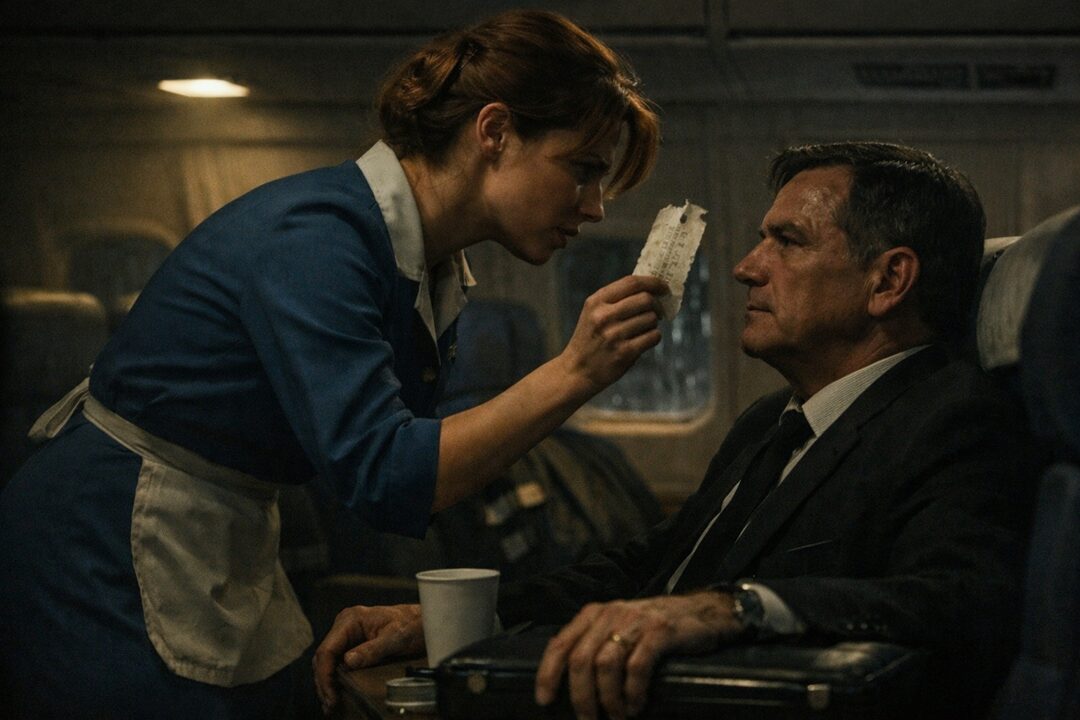
Ellen Voss was halfway down the aisle with the drink cart when the man in 18C slid a folded note onto her tray.
It was the kind of thing that happened often enough to be boring. A businessman who thought a smile during service meant permission. A lonely man mistaking politeness for invitation. Ellen had learned to take those notes with the same face she used for turbulence and crying babies: calm, blank, professional.
She tucked it beneath the napkins without looking at him.
“Coffee?” she asked.
He was in a dark suit with a narrow black tie clipped neatly at the center. Mid-forties, maybe older. Clean haircut. Weathered face. The kind of man nobody remembered twice.
“Bourbon and soda,” he said.
His voice was low and even. Not flirtatious. Not nervous.
She poured. The plane hummed through rain over the Pacific Northwest, lights dimmed for the short night hop from Portland to Seattle. A businessman across the aisle was already asleep with his mouth open. Two college boys in the back were arguing quietly over a football game. A woman in first class had asked for aspirin twice and complained once about the smell of wet wool. Nothing unusual. Nothing that should have stayed with her for years.
The man accepted his drink, then looked up at her.
“Miss,” he said softly, “you should read that now.”
Something in the way he said it made her fingers go cold.
She stepped aside, her back to the other passengers, and opened the note with one hand.
I have a bomb in my briefcase. Sit beside me. You are being hijacked.
For a second, she thought the sentence was too absurd to be frightening. It looked typed, almost formal. Not a desperate scrawl. Not a joke either. She glanced at him.
He gave her the faintest nod, as if confirming a dinner reservation.
“Sit down, Miss Voss.”
He knew her name tag. Of course he did. Everyone did. That was the job. Smile. Serve. Let strangers talk as if they already owned a piece of you.
Ellen parked the cart with careful hands and slid into the empty seat beside him. Her knees felt weak enough to fold wrong. She kept her face arranged because faces were part of the uniform too.
“You’re mistaken,” she said quietly.
“No.” He lifted the briefcase just enough to crack it open.
Inside, in the dim cabin light, she saw red cylinders. Wires. A battery. She couldn’t tell if it was crude or expert or half fake. She only knew the blood left her hands.
He closed it again.
“I want two hundred thousand dollars,” he said. “In cash. And four parachutes. Two main. Two reserve. When we land, nobody gets hurt if nobody gets clever.”
The rain ticked against the windows.
Ellen swallowed. “Sir—”
“Martin,” he said. “You can call me Martin.”
It sounded like a borrowed name. Maybe all names did, in that moment.
“You need to tell the cockpit,” he said. “Quietly. I don’t want panic. I don’t want heroics. I want this handled like adults.”
He picked up his bourbon and took a measured sip.
No tremor in his hand. No thrill in him. No wildness. That was the first thing she would remember later, when people asked what he seemed like. Not evil. Not mad. Just composed in a way that made panic feel childish.
“You understand me?” he asked.
Ellen realized he was watching her with patient attention, as if the important thing in this whole cabin was whether she would keep herself under control.
“Yes,” she said.
“Good.”
She rose on steady legs she did not possess and walked forward.
At the galley door, the junior attendant, Carol, started to ask something. Ellen shook her head once. She must have looked wrong anyway, because Carol went quiet at once.
Captain Ray Donnelly listened without interrupting. His face didn’t change much, but one hand flattened against the instrument panel and stayed there.
“Did you see the device?” he asked.
“Yes.”
“Are you sure?”
“No,” Ellen said. “I’m sure enough.”
That made him look at her.
She had never liked that phrase before. It sounded weak. That night it became the only honest one.
Donnelly radioed the ground. His co-pilot’s jaw worked once, then locked. Procedure moved into place. Ellen could hear it happening in voices that tried very hard not to sound human.
When she returned to 18C, Martin glanced at her empty hands.
“They’re doing it,” she said.
“I assumed they would.”
He shifted a little, making room for her to sit again.
Most men made themselves larger when they wanted power. He did the opposite. He lowered his voice. Narrowed his movements. He made the space around him feel private, and that privacy was more frightening than rage.
The note was still in her hand.
“Keep it,” he said. “You may need to remember how politely I asked.”
She almost laughed then, not because anything was funny, but because terror sometimes arrived dressed as absurdity.
Instead she folded the note again and slipped it into her apron pocket.
Outside, the plane entered a patch of rough air. A ripple went through the cabin. Someone cursed. The woman in first class rang for service again.
Ellen stood automatically.
Martin said, “Go ahead.”
She turned, surprised.
“Routine matters,” he said. “That’s the only reason this works.”
So she walked to the front and handed aspirin to a woman who never knew her life had just been balanced on a sentence folded into four squares.
When Ellen came back, Martin was staring out the window at nothing.
“You don’t seem afraid,” she said before she could stop herself.
He looked at her, then at his drink.
“That’s because I made my decision before boarding.”
It was the first thing he said that did not sound like logistics.
It stayed with her longer than the bomb.
Part II — Everyone Gets Off Except the Story
The landing in Seattle was quiet enough to feel unreal.
No sirens screaming onto the tarmac. No dramatic announcement. Captain Donnelly told the passengers there had been a minor mechanical issue and they’d need to deplane for a short delay. There was grumbling, a few watch checks, one irritated complaint about missed connections. The college boys laughed their way down the stairs. The businessman across from 18C took his briefcase and never once looked at Martin.
Ellen watched them leave with the odd, ringing thought that people could walk straight through the center of somebody else’s disaster and still remain inside their own lives.
Ground crew delivered the money and parachutes. Fuel trucks came and went under floodlights in the rain. Everything looked procedural, almost dull, which was the second strangest part of the night. Terror did not arrive in a burst. It came disguised as compliance.
Martin made Ellen count the money in front of him.
“You think I might short you?” she asked.
“I think everybody is more dangerous when they feel righteous.”
The bills were bundled and damp at the edges from the weather. She counted because her hands needed work. He watched because he trusted nothing performed on faith.
When she finished, he nodded toward the parachutes. “Those too.”
She checked the packs by label because that was all she knew how to do. Main. Reserve. Nylon straps. Metal fittings cold under her fingers.
“Happy?” she asked.
“Not the word.”
By then only four people remained on board: Captain Donnelly and his co-pilot in the cockpit, a flight engineer, Martin, and Ellen.
Carol had cried when they told her to get off.
“You too,” Carol whispered to Ellen on the stairs, clutching her arm. “Tell them you’re getting off too.”
But Martin had looked up from his seat and said, “Miss Voss stays.”
He had not raised his voice. He didn’t need to. The sentence landed like a lock.
Now the cabin felt wrong in a new way. Too empty. The overhead lights reflected off rows of vacant seats, abandoned newspapers, half-finished drinks, a cardigan someone had forgotten in first class. Ordinary leftovers from ordinary people. The kind of debris that made absence feel fresh.
“Why me?” Ellen asked after takeoff.
Martin adjusted the knot of his tie, though it didn’t need adjusting. “Because you listen before you speak.”
“That’s the uniform.”
“No,” he said. “That’s survival.”
The aircraft climbed into dark weather. Rain streaked the windows. Somewhere ahead, over the intercom, Donnelly’s voice came on, controlled and clipped, asking Martin again to confirm the requested altitude and airspeed. Martin answered with the ease of someone who understood aircraft more than he should have.
“Ten thousand feet,” he said. “Slow and low. Landing gear down. Flaps fifteen.”
Donnelly hesitated just long enough to reveal irritation. “You know what that’ll do to our fuel.”
“You’ve got enough.”
Martin clicked off the intercom and leaned back.
Ellen looked at his hands. The fingers were nicotine-stained near the tips. A pale groove cut across the ring finger of his left hand where a wedding band had been worn for years and removed not long enough ago for the skin to forget it.
He noticed her noticing.
“Do they teach you that?” he asked. “To inventory people.”
“They teach us to prevent trouble.”
“And does it help?”
“Sometimes.”
He smiled without warmth. “I doubt it.”
The plane droned on into the night.
At intervals Donnelly called back, asking if Ellen was all right, as if the question itself might do something useful. Each time she said yes because no had nowhere to go.
Martin loosened his tie clip and set it on the armrest. Cheap silver, worn smooth with use. Not elegant. Not meaningful-looking. Just an object that had belonged to him long enough to take the shape of habit.
He caught her glancing at it.
“My daughter gave me one once,” he said.
Ellen turned to him.
He was looking straight ahead.
“What happened to it?” she asked.
“Life,” he said.
That should have ended the subject. Instead it opened one.
“How old is she?”
He took a moment to answer. “Older than twelve.”
“She’s alive?”
The question slipped out before she could stop it.
His mouth moved, not quite a smile and not quite pain. “That’s exactly the kind of question people ask when they want to know something else.”
“What is it I want to know?”
“Whether I’m running toward something,” he said, “or away.”
A tremor of turbulence shook the fuselage. Ellen reached for the seatback automatically. Martin didn’t move.
“You tell me,” he said.
She stared at him. “You hijacked a plane.”
“Yes.”
“You threatened to kill everyone on it.”
“Yes.”
“You have a bomb beside your knee and a bag of ransom money and four parachutes. I don’t think I’m the one who’s hard to read.”
His eyes shifted to her at last. Not angry. Interested.
“Most people are only visible when they become inconvenient,” he said. “Until then, they are functions. Wife. Stewardess. Salesman. Father. Whatever keeps the room arranged.”
“Flight attendant,” Ellen said.
He looked mildly surprised.
“We’re called flight attendants,” she said. “Not stewardesses.”
He dipped his head once. “My mistake.”
That should have felt like a victory. It didn’t. It felt like being seen in one very small place by the wrong man.
The intercom buzzed again. Donnelly this time, voice harder.
“Weather ahead is getting worse. Recommend delaying until we reach clearer air.”
Martin took the handset. “No.”
“Listen to me,” Donnelly said. “You make a mistake back there, everybody pays.”
Martin’s expression did not change. “Then don’t make one up there.”
He returned the handset to its cradle.
Ellen said, “He’s trying to keep us alive.”
“So am I.”
That was when she realized he meant it.
Not in a moral sense. Not in a decent sense. But as part of the plan. He had not chosen blood. He had chosen control, and control required them breathing.
That should have been comforting. Instead it made the whole thing colder.
Because men who had not yet decided whether they wanted to live were often very careful about whether others did.
Part III — The Kind of Man You Forget
Somewhere over Washington, the cabin lights dimmed another shade and the night outside became a mirror.
Ellen could see only fragments in the window glass: her own pinned hair gone loose at the edges, Martin’s face hovering over her shoulder, the empty rows behind them, pale as bones.
He lit a cigarette, then paused.
“Do you mind?”
“Does that matter?”
“It might.”
She almost said yes out of spite. Instead she shook her head.
Smoke curled thinly in the stale cabin air.
“You don’t seem like a man who wants to be remembered,” she said.
“That isn’t the same as wanting to disappear.”
“It sounds close.”
He studied the ember at the cigarette tip. “Being remembered is a public condition. Being seen is private. Most people never get both.”
The line would come back to her later, when strangers in suits asked what exact words he used, and she would hate how inadequate their notebooks seemed beside the feeling of hearing him say it.
He smoked in silence a while, then tapped ash into an empty coffee cup.
“What about you, Miss Voss? You walk down aisles full of people every week. They look right at you. Do they see you?”
The answer came too fast. “No.”
He turned his head.
Ellen surprised herself more than she surprised him. She had not meant to be honest with a hijacker. But honesty had a strange way of slipping loose when fear wore you down.
“They see the tray,” she said. “The smile. The schedule. Whether their drink is cold. Whether I’m pretty enough to tip in words and plain enough to forget.”
“And that bothers you.”
“It should bother anyone.”
“That’s not what I asked.”
The plane shuddered through another pocket of rough air.
Ellen folded her hands in her lap so he wouldn’t see them clench. “It bothers me when people mistake access for knowledge.”
“Good,” he said. “Then we agree on something.”
She almost laughed again. The night kept trying to turn absurd.
“Did you have a wife?” she asked.
He looked at the ring mark on his hand as if he’d forgotten it was visible.
“I had a house,” he said.
“That’s not the same answer.”
“No.”
Outside, rain needled the fuselage. In the cockpit, voices murmured over radio frequencies. Procedure. Weather. Heading. Numbers meant to keep metal in the sky.
Martin ground out the cigarette.
“I used to think a man could leave one life and begin another if he was disciplined enough,” he said. “New city. New suit. Different kind of smile. People call that reinvention. It sounds noble when you say it in magazines.”
“What do you call it?”
He looked at her, and for the first time the exhaustion in him rose near the surface.
“Administrative fiction.”
Ellen felt something cold move through her.
Not pity. Not yet.
Recognition first. Then the fear of recognition.
Because she knew something about administrative fiction herself. About practicing a face until it became easier to wear than your own. About being called sweetheart by men who did not hear your name. About performing calm so well people mistook it for lack of cost.
The trouble was, she had never wanted to disappear. Only to stop being arranged for other people’s comfort.
Martin wanted something harsher.
The engineer came back from the galley then, carrying coffee and trying too hard not to look at either of them. He set one cup near Ellen, one near Martin, and left quickly.
Martin glanced into his. “No cream.”
“That’s what passes for bravery tonight?” Ellen asked.
A flicker of humor touched his face. Real humor this time, thin and gone almost immediately.
“You’re sharper now,” he said.
“I’m tired.”
“So am I.”
He took a sip of black coffee, grimaced faintly, then set it down.
Ellen noticed one of the parachute packs leaned awkwardly against the opposite seat. One strap had been tucked wrong. A paper tag clung half torn to the harness.
She reached toward it. “You should check these.”
“I did.”
“That one doesn’t look right.”
“It will hold.”
“You don’t know that.”
His eyes met hers. “Don’t start taking care of me now.”
The sentence landed wrong. Too intimate. Too tired.
Ellen stood and crossed the aisle under the pretense of straightening the pack. Her training was useless here, but useless people still noticed things. The reserve chute tag read TRAINING UNIT in small stamped letters partly smeared by rain.
Her stomach dropped.
It could mean decoy. It could mean demonstration-only. It could mean not for actual jump conditions. She didn’t know enough to be certain.
Sure enough.
There it was again.
When she turned, Martin was watching her.
“What?” he asked.
She held the tag between two fingers. “Did you read this?”
His gaze dropped to it, then returned to her face.
A beat. Two.
“Yes,” he said.
She stared at him.
“You knew?”
“I noticed it.”
“And you still took it?”
His expression gave nothing away. “I asked for four. They sent four.”
“That isn’t an answer.”
“No,” he said. “It isn’t.”
The plane lurched. Coffee sloshed over the rim onto the armrest. Ellen hardly felt the heat.
In that moment the whole story shifted under her feet. Not the logistics. The meaning.
All night she had been imagining a man trying to get away with something enormous. A man gambling. A man forcing the world to hand him money and sky and chance.
Now another possibility opened like cold air.
He might not be trying to live through this at all.
Or worse—he might not care.
“You planned this,” she said. “You knew the route. The altitude. The speed. You knew enough to ask for four parachutes so nobody would sabotage them on purpose.”
“Yes.”
“And now you’re telling me you’ll jump with a training chute?”
“I’m telling you,” he said quietly, “that some precautions only make sense if the future interests you.”
The words hollowed the cabin.
Ellen sat down slowly because her knees had gone untrustworthy again.
He didn’t look triumphant. He didn’t look suicidal either. He looked like a man who had already stepped away from whatever argument living might make.
That frightened her more than the bomb.
Because she suddenly understood why he had remained calm. Why he was not greedy, not ecstatic, not drunk on danger. Money was leverage. The parachutes were theater and tool. But the thing he wanted most was not waiting in another city.
It was the absence after.
Part IV — What the Storm Was For
Captain Donnelly’s voice crackled over the intercom, stripped now of even the pretense of patience.
“We’re in rough weather. I’m telling you again, conditions are bad. Severe crosswinds. Heavy rain. You wait, or you kill yourself.”
Martin reached for the handset. Ellen caught his wrist before she thought better of it.
His skin was cool.
The room went still.
She should not have touched him. He should have jerked away. Instead he only looked down at her fingers around his sleeve, then up at her face.
“Don’t,” she said.
He let her hold on one second longer than made sense. Then he eased his arm free and answered the intercom.
“Keep flying.”
Donnelly swore softly, forgetting the microphone carried more than orders.
Martin hung up.
“You could still stop,” Ellen said.
“That’s what everyone says to a person once they realize he meant it.”
“You don’t know what I mean.”
“No,” he said. “But I know what they do.”
He rose at last, taking the money bag and two of the parachutes. The cabin seemed smaller when he stood. Not because he was large. Because movement meant countdown.
“Stay here,” he said.
“Why?”
“Because I’m not taking you with me.”
“I didn’t ask you to.”
“No,” he said, almost gently. “You haven’t asked me for anything.”
He moved toward the rear stairs, steady even through the turbulence. Ellen followed anyway.
At the galley threshold he turned.
“Miss Voss.”
“My name is Ellen.”
It came out sharper than she intended, a small rebellion too late to matter.
His face changed—not softened, exactly, but altered by surprise.
“All right,” he said. “Ellen. Stay there.”
Rain hammered the fuselage. Through the small rear window the night looked solid, like something the plane was trying to bore through.
He set down the money bag and one parachute long enough to remove his tie clip. Cheap silver. Forgettable. He placed it on the metal counter beside the folded note he had taken from her apron pocket without her noticing.
“I didn’t know you had that,” she said.
“I’ve had it all night.”
He smoothed the paper once with his thumb, then folded it smaller.
“Why leave those?” she asked.
He considered that.
“Proof I was here,” he said. Then, after a beat: “Or proof I wasn’t who they say.”
The plane bucked hard enough to send her shoulder into the wall. A warning chime sounded from the cockpit.
Donnelly’s voice burst over the intercom. “You open those stairs now, you may rip them clean off.”
Martin ignored him.
He turned to Ellen one last time.
His face was tired now. Not dramatic. Not transformed. Just stripped of the last of its performance.
“Tell me something honestly,” he said. “Is being forgotten worse than dying?”
The question would haunt her because it did not sound philosophical anymore. It sounded personal in the oldest, plainest way. Like a man standing in a doorway and asking whether absence felt different from an end.
Ellen looked at him.
At the rain-dark suit. The ring mark. The smoker’s fingers. The worn tie clip on the counter. The eyes of a man who had become frightening not because he wanted power, but because he had stopped negotiating with loss.
She could lie. Tell him no. Tell him disappearing solved nothing. Tell him someone would miss him. Tell him to wait. Tell him he was sick. Tell him he was cruel. Tell him he was a coward.
All of it might be true. None of it felt precise enough.
“Yes,” she said.
He went still.
She felt the next words tear loose from somewhere deeper than fear.
“But not for the reason you think.”
The engines roared. Rain beat at the skin of the plane.
“If nobody sees you while you’re here,” she said, “being remembered after doesn’t fix it. It just turns you into a story.”
For one second she thought he might smile.
Instead something raw and unreadable crossed his face. Pain, maybe. Relief. Maybe only recognition returning too late to matter.
“That’s right,” he said.
It was the truest thing he said all night, and it told her nothing she could report.
He opened the rear stairs.
The sound that entered the cabin was less like wind than rupture. Cold air. Rain. A violence of motion and noise that made speech ridiculous. The darkness behind him looked bottomless.
Martin clipped on the pack he’d chosen. The one with the damaged certainty.
Ellen shouted something—his name, maybe the false one, maybe stop, maybe wait—but the storm took it whole.
He looked back once.
Not dramatically. Not like a man in a legend. Like a man checking whether the person across the room was still there.
Then he stepped into black air and was gone.
Not a leap. Not a flourish.
One blunt movement. A body where a body had been. Then absence.
Ellen stood in the freezing roar with the note in one hand and the tie clip in the other until Donnelly came running back white-faced and furious and alive.
By then the sky had closed.
Part V — The Shape of an Unanswered Question
The first investigator wanted facts.
The second wanted consistency.
By the third interview, Ellen understood that what they wanted most was certainty dressed as memory.
Agent June Mercer arrived two days later in a gray coat with rain on the shoulders and a legal pad balanced on one knee. She was younger than Ellen expected and less patient than the men.
“Start again,” Mercer said. “From the note.”
So Ellen did.
Mercer interrupted often.
“Exact wording.”
“Exact tone.”
“Which hand did he use for the briefcase?”
“Which hand did he smoke with?”
“Did he seem military?”
“Educated?”
“Drunk?”
“Sad?”
Ellen almost laughed at that one. Sad was not a category on their forms, but it should have been.
“I don’t know,” she said.
Mercer’s pencil stopped. “You were with him for hours.”
“Yes.”
“And you don’t know whether he intended to survive?”
“No.”
“You don’t know whether the bomb was real?”
“No.”
“You don’t know if Martin Vale was his real name?”
“No.”
Mercer exhaled through her nose.
“What do you know, Miss Voss?”
Ellen looked past her at the rain needling the hotel window.
“That he was tired,” she said.
Mercer waited.
“That he was polite,” Ellen added. “That made it worse.”
Mercer wrote neither sentence down.
The newspapers loved the story. A man with cash and parachutes vanishing into a storm was too clean a piece of myth to resist. They printed sketches. Speculations. Theories. Former soldiers. Ex-cons. Dead husbands. Men seen at bus depots. Men not seen again. Every stranger in a raincoat became briefly suspect.
Ellen’s photograph ran beside articles for a week. Auburn airline girl held hostage. Brave stewardess. Key witness. Heroine in blue.
Flight attendant, she corrected one reporter.
He smiled as if she were being difficult.
For a month people recognized her in grocery stores and airport lounges. Men asked if she had been scared. Women asked if he had seemed handsome. One woman took Ellen’s hand and said, “You’re lucky to be alive,” with the solemn intimacy of prayer.
Lucky was another word that had gone wrong.
Captain Donnelly returned to flying after a leave he pretended he didn’t need. Once, during a layover in Denver, he sat across from Ellen at a terminal diner and stirred bad coffee until it went cold.
“I followed procedure,” he said, not looking at her.
“I know.”
“It wasn’t enough.”
“No.”
He nodded once, as if grateful for the honesty.
“We got everybody down,” he said.
“Yes.”
He looked up then, his eyes older than she remembered. “And still.”
And still.
That was the phrase the whole thing had left behind. Procedure, survival, statements, headlines—and still.
Martin became larger in absence. That was the part Ellen hated most. The world had taken the ordinary, tired man from seat 18C and turned him into a legend sharp enough to cut the human edges off him. People loved a mystery more when it could not answer back.
Years passed.
The airline changed uniforms. Routes changed. Men changed the names they used for women in service jobs, but not the entitlement beneath them. Ellen learned how to age out of certain kinds of attention and into others. She married once briefly and did not stay. She stopped smiling on instinct. She got promoted, then left the job before it could turn