The Last Approved Version
Part I — No One Stands That Tall
The old man stopped the rehearsal before the fake blood had time to dry.
“No one stands that tall under mortar fire.”
He did not raise his voice. He did not need to. The line crossed the museum’s black-box stage like a blade.
One of the young actors froze halfway through lifting his fallen scene partner. Another, still in a spotless winter uniform, let his arms fall to his sides. A prop stretcher tilted and hit the floor with a hollow clatter.
Mara Vale felt every eye in the room turn, not to the veteran who had spoken, but to her.
The rehearsal had been running exactly eleven seconds.
She stepped off the riser with her notepad in hand, heart beating harder than the moment should have warranted. The actor playing Captain Lorne was still kneeling in perfect profile, one heroic hand braced in the snow-painted foam.
Snow had a way of looking beautiful indoors. War did not.
Colonel Adrian Kessler had wanted the first pass ready before the advisers arrived. The ministry had called them advisers in every memo, a polite word for the three surviving veterans who had been flown in from three countries to bless the reopening production of the National War Museum. Their presence was supposed to guarantee authenticity.
Instead, within half a minute, authenticity had called the whole room false.
The man who had spoken stood near the back aisle with both hands on the head of his cane. Elias Mercer was taller than Mara had expected, even bent by age. His silver hair was clipped with old military severity. His face held the kind of control that made softness look like an accusation.
He watched the stage with cold concentration.
“You would crouch,” he said. “Or crawl. Or fail to move at all.”
The actor playing the wounded soldier looked toward Mara, embarrassed. “I was just following the script.”
“I know,” she said.
That was the problem.
Kessler descended from the sound booth with a fixed smile that always appeared whenever a situation was one sentence away from becoming a public embarrassment.
“Mr. Mercer,” he said warmly, as if warmth could recover hierarchy, “this is only a blocking run.”
Mercer turned to him. “Then block fear into it.”
Silence spread wider.
Mara had spent six months building this production from surviving records, combat logs, letters, and official citations. She knew where the mud had been deepest that winter. She knew how many men Red Winter Company lost on the ridge and in the retreat below it. She knew which captain’s final order had become a paragraph engraved in bronze in the museum’s east hall.
And still, looking at those clean uniforms and brave, upright bodies, she understood at once that Mercer was right.
Not merely about posture.
About the whole shape of the thing.
The other two veterans had not spoken yet. Ruth Halpern stood beside Mercer in a practical dark coat, compact and sharp-eyed, with a face that looked incapable of indulging nonsense. Benjamin Soriano had seated himself without ceremony in the front row. He leaned both hands on a cane and watched the actors with the wary stillness of a man who had learned long ago that silence was safer than being misunderstood.
Mara drew a breath. “All right,” she said to the cast. “Again. But this time nobody plays courage. Play survival.”
That got their attention.
She crossed to the actor playing Captain Lorne and adjusted the set of his shoulders herself, forcing them inward. “You’re not here to be seen,” she said quietly. “You’re trying not to die.”
Something shifted in his face.
They reset. The wounded soldier no longer reached theatrically toward the sky. The man dragging him stayed low this time, breath ragged. The captain barked shorter commands. The moment lost elegance and gained weight.
Mercer did not approve. He simply stopped objecting.
For now, that felt like permission to keep breathing.
When the scene ended, Ruth Halpern said, “Better.”
It sounded less like praise than an issued ration.
Kessler clapped once, too brightly. “Excellent. This is precisely why we’ve brought in our honored guests.”
Honored guests. Mara almost winced.
Mercer’s gaze drifted past the stage to the projection mock-up above it, where the title of the final sequence glowed in pale letters:
THE LAST STAND OF CAPTAIN MATTHEW LORNE
There it was. The approved version. The sacred version.
Mercer’s expression changed so slightly most people would have missed it.
Ruth did not.
Neither did Mara.
That tiny hardening in his face stayed with her through the introductions, through the coffee brought in untouched, through Kessler’s speech about remembrance and national duty. It stayed with her when Ben Soriano finally stood, looked up at the projected title, and lowered his eyes as though the screen had spoken first.
When the meeting ended, Ruth asked Mara for a copy of the script.
Mercer asked for the radio procedure pages.
Ben said nothing at all.
Then Ruth turned the script over in her hands and asked, “Who wrote the ending?”
“I did,” Mara said.
Ruth looked at her for a beat too long.
“Then you should tell me,” she said, “why the radio transcript you used has lines missing.”
Part II — The Shape of Fear
The first thing the veterans changed was not a line.
It was how the actors held their hands.
“Men in cold weather don’t look dramatic,” Ruth said the next morning, walking between them like a medic on rounds. “They look clumsy. They fumble. They repeat themselves. Their fingers stop belonging to them.”
She took the rifle from one actor, re-positioned his grip, then bent another’s elbow.
“Stop spreading out like you’re in a painting,” Mercer snapped from the edge of the stage. “You bunch. Fear compresses people.”
Ben remained in the front row, hat on his knee, speaking only when asked something concrete. He corrected the angle of a field shovel. He said a man who had been awake for thirty hours would not answer that quickly. Once, he closed his eyes and murmured, “No. The radio operator was coughing blood by then.”
The cast listened to them with a kind of frightened reverence.
So did Mara.
The production improved by the hour. Packs sagged lower. Boots dragged. Dialogue shortened. Heroic pauses vanished. A scene that had once looked polished now felt raw and slightly ugly, which meant it had finally begun to feel true.
And still Mercer guarded one thing.
Every correction, every tactical note, every exhausted breath—he gave all of it freely until Mara reached the final command sequence.
Captain Lorne’s famous order.
Hold the ridge.
It was the line that lived on postcards in the museum gift shop, in history textbooks, in the bronze dedication wall outside the reopened memorial wing. The line that turned a dead officer into a national symbol.
Mara had trimmed it, at first. Mercer put it back.
She removed a second clause that sounded too literary. Mercer restored that too.
“Those were his words,” he said.
“You remember them exactly?” Mara asked.
He met her eyes. “Some things do not blur.”
Ruth, sitting two seats away, gave a soft sound that was not quite a laugh.
“Funny,” she said. “Other things seem to have gone missing.”
Kessler, who had appeared at the exact moment tension became useful to authority, stepped in before Mercer could answer.
“Historical disputes belong in the archives,” he said. “Not in rehearsal.”
Ruth turned toward him. “Then maybe stop putting archives on posters.”
Kessler smiled the way certain men smile when they mean to punish later. “Ms. Halpern, we are trying to preserve memory. Not dismantle it.”
“Memory isn’t porcelain,” she said. “You don’t protect it by lying.”
Mara felt the room tighten.
Kessler looked at her. “You were hired for rigor, Dr. Vale. Don’t confuse authenticity with revisionism.”
It was the kind of warning built to sound reasonable.
After he left, no one spoke for several seconds.
Then Ben said, almost to the floor, “People use big words when they’re afraid of plain ones.”
Ruth looked at him. “You want to say one?”
He shook his head. “Not yet.”
That afternoon Mara went down into the museum’s archive sublevel with two boxes of production notes and the original battlefield records she’d already reviewed twice. She told herself she was only checking the transcript references Ruth had mentioned.
That was not true.
She was checking whether the floor had moved under her.
The museum kept its war records in climate-controlled stacks that smelled faintly of paper, dust, and metal shelving. Mara had always loved the room’s discipline. Here, the dead could still be arranged.
She laid the materials out on a long table and compared the approved radio transcript to the raw communications log.
At first the discrepancies looked minor. Timing gaps. One bracketed phrase omitted. A section marked inaudible in the official copy though the notation beside it suggested the original audio had once been clear enough to classify.
Then she found the casualty list.
Twenty-three military dead.
And beneath them, in a different hand and lighter ink, one name struck through so cleanly it almost seemed formal:
Petra Novák — civilian guide
Mara stared at it.
There was no Petra Novák in the production materials. No Petra Novák in the public exhibit text. No Petra Novák in the citation under Captain Lorne’s likeness.
No Petra at all.
She went back through the script. The company, trapped near the ridge, was shown evacuating local villagers. But in the final version the civilians blurred into nameless desperation, useful only as background for Lorne’s sacrifice.
One had been named once.
One had died.
And someone had removed her.
Mara carried the copies upstairs and found Ruth alone near wardrobe, watching a costumer smear mud onto a sleeve with more care than most people gave to portraits.
“There was a civilian guide,” Mara said.
Ruth did not look surprised. “Yes.”
“Why is she missing?”
“Because civilians are untidy in memorials.” Ruth’s voice stayed flat. “They make the battlefield look inhabited.”
Mara looked down at the copy in her hand. “Petra Novák.”
Ruth nodded once. “Nineteen. Knew the marsh paths.”
The room seemed to sharpen around that single fact. Nineteen. Not symbolic. Not abstract.
Nineteen.
“Why didn’t you tell me on the first day?” Mara asked.
Ruth turned to her then. “Would you have heard it?”
Mara could not answer quickly enough.
Ruth glanced toward the stage where actors were rehearsing fear under borrowed lights. “Captain Lorne’s famous command was not just bravery,” she said. “It covered an error. The ridge was already a trap.”
“Whose error?”
Ruth’s face did not change. “Ask the men who still get medals at dinners.”
That night Mara found Ben in the museum café, alone with untouched soup.
She sat opposite him without asking.
He gave her a tired look. “You’ve got the archive face.”
“The what?”
“The face people wear when paper tells them something they weren’t raised to believe.”
Mara almost smiled, but did not.
“There was a civilian guide,” she said.
Ben’s thumb moved once against the handle of his cane. “Yes.”
“She died in the withdrawal.”
“Yes.”
“And the script says Captain Lorne held the ridge long enough to save everyone else.”
Ben looked past her at the dark museum windows.
“Not everyone,” he said.
She waited.
After a long moment he said, “The boys who lived that night? Some of them lived because somebody lower than a captain stopped obeying.”
He pushed his chair back before she could ask more.
“Mister Soriano—”
He rose carefully. “Don’t call me that. Makes me sound finished.”
“What should I call you?”
He looked at her, old and exhausted and strangely kind.
“Ben,” he said. “And not tonight.”
Part III — The Missing Voice
By the third day, Mara stopped trusting the approved boxes.
That was how she thought of them now—the approved boxes, the approved transcript, the approved grief. Neat things with labels on them. Neat things that made death look orderly enough to dedicate.
She began pulling materials no one had requested.
Storage copy reels. Duplicate signal logs. Clerical overflow. Misfiled donations from families who had sent in letters no one ever cited because the official story had already been decided before the envelopes were opened.
She found the field recording in a carton marked WINTER VEHICLE MAINTENANCE.
For a moment she thought she had the wrong reel.
Then she saw the penciled notation on the side, almost erased: Ridge / comm line / damaged
The audio lab technician had left early. Mara threaded the reel herself.
Static flooded the small listening room. Then wind. Then the jagged concussion of distant shelling.
Voices broke in and out like torn fabric.
Coordinates. Corrections. Someone coughing. Someone shouting for a medic. Then a younger voice, clipped and strained but unmistakably educated in command.
Captain Lorne.
“Hold the ridge,” he said. “Repeat—hold—”
The next section dissolved in noise.
Then another voice came over the line, thinner, urgent. Lieutenant Mercer. Younger by half a century, but still carrying that same precision around the edges.
“Grid update—possible error—”
Another burst of static.
Then nothing for three long seconds.
Then Mercer again, but too late, too uncertain, words colliding with interference.
And over all of it, the terrible clarity of what had happened.
He had known something was wrong.
He had not gotten it through in time.
Maybe because he hesitated. Maybe because he trusted the earlier map. Maybe because in war there is always one second in which a man chooses between protocol and instinct and spends the rest of his life buried under that second.
The recording stumbled on.
A new voice now—rougher, lower-ranked, furious.
Ben.
“Sir, we lose them all if we stay—”
The rest was swallowed.
When the sound cleared again, someone was yelling about the marsh path. Someone else called Petra by name.
Then gunfire, then running breath, then cut.
Mara sat motionless in the dark listening booth while the reel spun out with a dry mechanical whisper.
It was not a heroic recording.
That was what shook her most.
No last noble speech. No clean martyrdom. No perfect captain crowned by history in his final hour.
Only confusion. Delay. Fear. Men trying to choose inside bad information. A rank structure collapsing under weather and error.
And in the middle of it, a private ruin someone had later turned into bronze.
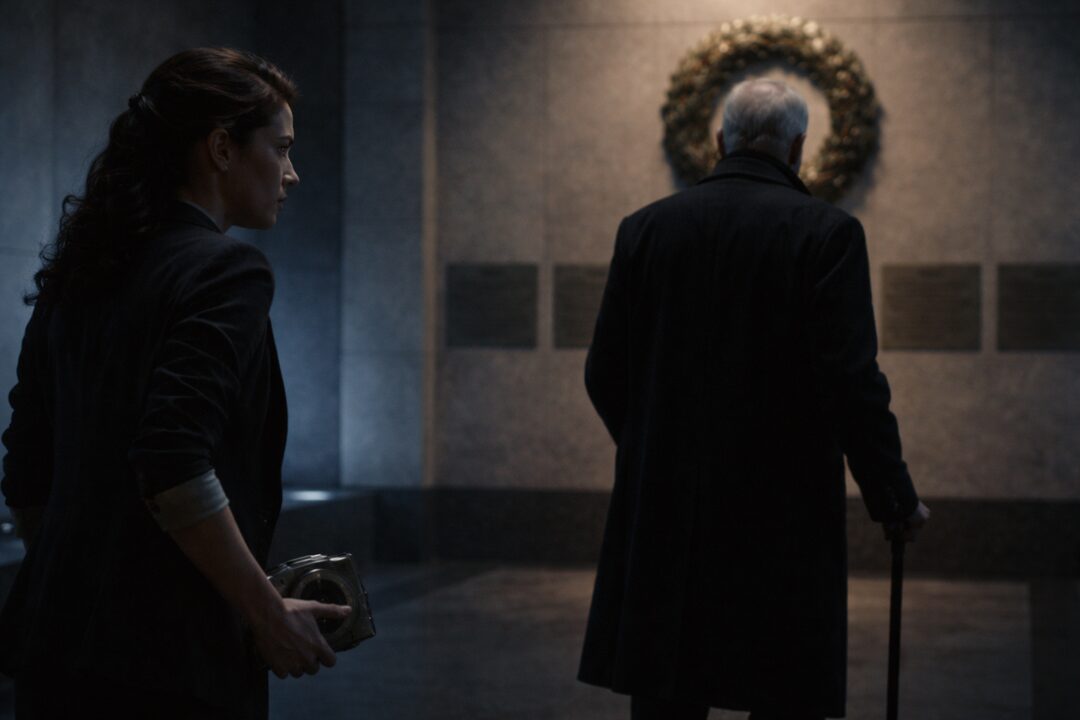
She found Mercer in the memorial wing after closing.
He stood before the wall where Captain Matthew Lorne’s words were engraved above the names of the dead. Winter light from the high windows had gone blue. His reflection hovered over the polished stone like another ghost.
“I found the recording,” Mara said.
He did not turn.
For a long time she thought he might pretend not to know what she meant.
Instead he said, “It should have stayed lost.”
“There was no final stand as the script tells it.”
“No.” His voice stayed controlled.
“You knew.”
“Yes.”
Mara felt anger rise first because anger was easier than pity.
“You let us build an entire production around a lie.”
He turned then.
Up close, age showed most clearly in the skin around his eyes. Not weakness. Just cost.
“We built a memorial,” he said. “That is not the same thing.”
“It should be.”
“No.” His hand tightened around his cane. “It often should not.”
She stared at him. “Ben disobeyed the order.”
“He saved whoever could still be saved.”
“And Petra Novák died.”
Mercer closed his eyes once, very briefly. “Yes.”
“Why was her name erased?”
“Because by then there was already pressure to make meaning from what had happened.”
“That is a coward’s sentence.”
He accepted that without flinching. “Yes.”
The word hit harder than denial would have.
Mara had come prepared to accuse him of vanity, of institutional loyalty, of protecting the dead captain’s prestige because that was the simplest shape for guilt. But Mercer stood in front of the wall like a man who had been standing there inwardly for decades.
“What are you protecting?” she asked.
He looked up at Lorne’s engraved line.
“The family,” he said. “The regiment. The dead. The boys who needed to believe the man in front of them died for the right reason.” His voice thinned, but only slightly. “And perhaps myself.”
The memorial wing went very quiet.
“When did you know?” Mara asked.
“I knew that night that my correction had not gone through. I knew by dawn that Ben had taken men through the marsh against orders. I knew by the funerals which version would survive.”
“You could have spoken.”
“Yes.”
“You didn’t.”
“No.”
“Because you were protecting Captain Lorne?”
Mercer’s face changed.
That was when Mara understood she had still been asking the smaller question.
“He died inside my hesitation,” Mercer said.
Nothing moved in the room.
“I had the corrected coordinates. I mistrusted them for one minute too long. Then the line was chaos. Then he gave the hold order because he believed what I had failed to fix.” Mercer looked at the engraved words above the wall. “Do you know what men do with a dead officer when they cannot bear the chain of errors around him?”
Mara did not answer.
“They purify him,” he said.
The sentence landed between them like a confession that had missed its time by half a century.
When she left him, her anger had not vanished. It had simply become more difficult.
Outside, Ben was waiting on a bench in the corridor, as if he had known exactly where she would come from.
“You found it,” he said.
She sat beside him.
“Yes.”
Ben nodded, eyes on his own hands. “I always thought if the truth came out, people would call me a hero and I would hate it.”
“You aren’t afraid of being blamed?”
He gave a thin, tired smile. “At my age? Blame is lighter than being worshipped by mistake.”
Then he looked at her.
“Petra’s the one who matters,” he said. “If you change anything, don’t turn me into another statue.”
Part IV — What Truth Costs
By morning, the story was no longer about evidence.
It was about permission.
Ruth wanted the record restored fully. Not softened. Not staged around male dignity.
“Name Petra,” she said in Mara’s office, palms braced on the desk. “Say who broke rank. Say the order failed. Say command can be wrong and the dead do not become less dead because people dislike the sentence.”
Mara did not disagree. Not exactly.
But Mercer’s words had lodged under her skin. Not because they excused anything. Because they didn’t.
We built a memorial. That is not the same thing.
It was a terrible defense. It was also not false.
People had built lives around the clean version. Widows. Children. A nation that liked its grief arranged in a straight line. If she tore it open, what exactly was she giving them in return? Justice? Maybe. Clarity? Perhaps. Peace? Certainly not.
Kessler arrived before she had resolved any of it.
He closed her office door behind him with deliberate calm.
“I’ve reviewed your revision request,” he said. “Denied.”
“I didn’t ask for approval.”
“Then I’ll be more explicit. The production is not being rewritten around disputed archival fragments twelve hours before a ministerial opening.”
“The recording isn’t disputed.”
“Everything is disputed when it threatens a national symbol.”
Mara held his gaze. “That’s a remarkable sentence for a military liaison.”
Kessler’s mouth tightened. “You have been given extraordinary freedom here, Dr. Vale. Do not mistake that for sovereignty.”
He laid a folder on her desk. Inside were the public opening schedules, donor names, press credentials, broadcast timings. Careers on glossy paper. Funding. Prestige.
Pressure dressed as logistics.
“You can make small accuracy adjustments,” he said. “Behavioral detail. Weathering. Tactical language. But the ending stands.”
Ruth, waiting by the window, laughed once in disbelief. “There it is. We can dirty the costumes, but not the conscience.”
Kessler ignored her. “A supplemental plaque can be discussed after review.”
“Vague enough to die in committee,” Ruth said.
Mara looked at him. “And if I refuse?”
“You won’t. Because you are serious, and serious people understand scale.”
He left the folder behind like a threat.
Ben came in later, slower than usual, as if the building itself had grown steeper.
“I heard,” he said.
Mara rubbed both hands over her face. “I can blow up the ending. Publicly. Make them stop the opening.”
Ben lowered himself into the chair opposite her. “And then what?”
“Then at least the lie isn’t blessed.”
He studied her. “You still think truth is a hammer.”
She dropped her hands. “What would you have me do?”
He looked toward the rehearsal hall, where faintly, she could hear actors running lines about sacrifice.
“Make room,” he said. “That’s harder than smashing.”
“For what?”
“For everyone.”
It sounded impossible until it didn’t.
The rewrite came in one rush.
Mara did not destroy the reconstruction. She did not replace one legend with another. She kept the ridge. Kept the cold. Kept Captain Lorne making a doomed command under broken information. Kept Ben leading men and civilians through the marsh after disobeying.
But she changed the frame.
The final sequence no longer crowned a single man.
It showed the corrected coordinate message failing to land. It showed fear making bodies smaller. It let the captain be brave and wrong at the same time. It named Petra Novák aloud as the guide who led them toward the marsh before dying there. It refused the fantasy that survival belonged neatly to rank.
And at the end, instead of the bronze line standing alone, the screen cut to the full list of the dead and omitted, military and civilian together.
No speech. No verdict.
Just names.
By evening, the new cut was ready.
Kessler tried once more outside the screening room.
“If you show this version,” he said, low and furious, “you may never work in this institution again.”
Mara looked through the glass panel at the three veterans being helped to their seats.
“Then it should probably be the right version.”
He stepped closer. “You are asking old people to bless their own humiliation.”
“No,” she said. “I’m asking them whether they can live with being seen.”
For the first time, he had no clean response.
Part V — The Private Preview
The screening room was small enough that silence had weight.
Mercer sat in the center. Ruth on his left. Ben on his right. Mara stood at the back with the approval form in her damp hand. Kessler stayed near the door like a man waiting to seize a document before it changed jurisdiction.
The lights went down.
The film began.
At first it was the version everyone had worked toward together. The men moved badly, which was to say correctly. They stayed low. They stumbled in snow thick with smoke. Orders came short and frayed. Fear lived in the hands.
Mara did not watch the screen for long. She watched the veterans watch it.
Ruth leaned forward whenever an injury scene arrived, unconsciously checking the work. Ben’s mouth tightened at certain pieces of terrain, as if his body still knew which ground betrayed the foot. Mercer sat straight until the battle turned.
Then came the failed transmission.
Onscreen, the young lieutenant—Mercer’s younger self—heard the corrected grid, hesitated, tried to confirm, lost the line in static.
In the dimness, Mercer’s hand closed around the chair arm so hard Mara could see the tendons stand up.
Then Captain Lorne gave the hold order.
No swelling music. No stylized martyrdom. Just a tired officer making the wrong decision inside incomplete truth.
Ben lowered his eyes before his younger self spoke.
“Sir, we lose them all if we stay.”
Onscreen, he broke rank.
The marsh sequence followed—brutal, confused, half-blind. A civilian voice cutting through the dark. Petra named. Petra falling. Men not becoming noble, only desperate enough to keep moving.
Ruth made one small sound at the hearing of that name. Not quite grief. Not surprise. More like the pain of a thing finally set down after being carried too long in the wrong hands.
Then the final frame came.
Not Captain Lorne alone.
Not the myth alone.
The names appeared in silence, one by one, military and civilian together.
Petra Novák.
The lights rose slowly.
No one moved.
Mara could hear the projector cooling behind the wall. Kessler shifted near the door, impatient already, frightened already.
Mercer kept his eyes on the blank screen.
Ben’s hands rested on his cane, white at the knuckles. Ruth sat with her chin slightly lifted, as if refusing to rescue anyone from this moment.
Mara thought: this is the verdict.
And still it did not come.
Kessler stepped forward first. “Mr. Mercer, I think we all understand this is an emotional—”
Mercer lifted one hand.
Kessler stopped.
The old man rose with visible effort. For a second Mara thought he might speak to the room, or refuse her, or ask for time that no one had left.
Instead he turned to her.
His face looked older now than it had all week. Not diminished. Stripped.
“It is not how we wanted to be remembered,” he said.
No one breathed.
“It is how we were.”
He held out his hand.
Mara gave him the approval form.
He signed it without flourish, the pen shaking only once. Then he placed the paper back into her hand before Kessler could touch it.
That was all.
No speech about nation. No blessing from history.
Only consent purchased at the highest price in the room.
Beside him, Ruth finally let out a breath that seemed to have been waiting for years.
Ben looked at the signed form, then at Mara.
“Good,” he said softly. “Now let the names stay.”
Part VI — What the Wall Could Hold
The public opening went ahead because institutions are built to continue even when truth slips under the door.
Cameras flashed. Officials praised sacrifice. Some viewers emerged shaken, some confused, some angry in the polished way of people unaccustomed to having grief complicated in public. A columnist from one of the national papers called the production “braver than the memorial architecture around it.” Another said it risked dishonoring a legend.
Kessler spent the afternoon telling donors the revised framing reflected “newly integrated archival nuance.”
Mara let him have the sentence. It did not matter anymore.
The thing itself existed now.
By late afternoon, the crowd had thinned enough for winter light to settle on the museum steps without interruption. The memorial wall outside the east wing had been updated in temporary bronze leaf until the permanent restoration could be cut. Visitors stood before it reading more slowly than they had that morning.
Not because there were many more names.
Because one of them changed the shape of the others.
Petra Novák.
Mara found the veterans a little way off from the entrance, under the bare trees where the wind cut cleanly through the courtyard.
Ben had one gloved hand against the wall. Not pressing. Just touching. Ruth stood beside him, shoulders squared against the cold, face unreadable except for the absence of strain. Mercer stood a few steps back with his cane planted in the frost-hardened ground.
He was watching families enter the museum.
Not proudly.
Not even sadly.
With a kind of difficult attention, as though the public had become heavier now that they were walking toward something less polished and more deserving of them.
Mara stopped beside him.
“Colonel Kessler thinks the press cycle will be unpleasant,” she said.
Mercer’s mouth moved at one corner. “Good.”
She looked at him.
For the first time since she had met him, he did not seem armored. He did not look relieved either. Relief would have been too clean for what had happened.
He looked lighter by one impossible degree.
Behind them, a father bent to read the restored names with his daughter. The child asked a question too soft for Mara to hear. The father took longer to answer than most adults do when speaking to children.
That, she thought, was the real change.
Not scandal.
Not correction.
Burden.
The honest kind.
Ruth came over then, rubbing her gloved hands together. “You did not make it gentle,” she said to Mara.
“I didn’t think I should.”
Ruth nodded once. “Good.”
Ben joined them last. He looked tired enough to disappear into the evening if someone stopped looking directly at him.
“They’ll argue about it for years,” he said.
“Yes,” Mara said.
He gave a faint shrug. “Better than polishing it for another fifty.”
The museum doors opened again behind them. More visitors entered. More paused at the wall first.
Mercer watched them for another moment, then said, almost to himself, “A memorial should be able to bear the people it names.”
No one answered.
There was nothing to improve in the sentence.
The winter light was already fading. In it, the four of them cast long, thin shadows across the stone courtyard—historian, medic, sergeant, lieutenant. The living arranged by chance, by survival, by delay.
Mara looked once more at the wall.
At Captain Matthew Lorne, still honored.
At the others.
At Petra Novák, no longer missing.
Then she watched another family stop and begin to read, not consuming a legend now, but entering something harder and more human.
And for the first time since the rehearsal had been stopped by a single quiet sentence, Mara understood that truth was not the opposite of memory.
It was the price of asking memory to hold.