The Polished Chrome Bumper And The State Commissioner Shield
CHAPTER 1: THE POLISH ON THE ASPHALTThe morning sun over the quiet suburban cul-de-sac of Sycamore Court in Clearview Township, Pennsylvania, gleamed with crystalline perfection. The tree-lined street was framed by modest red-brick ranch homes built during the postwar manufacturing boom, their lawns bordered by marigolds, hydrangeas, and tall red oaks. It was a peaceful haven populated largely by retired machinists, steelworkers, and civil servants who took pride in every square inch of their property.
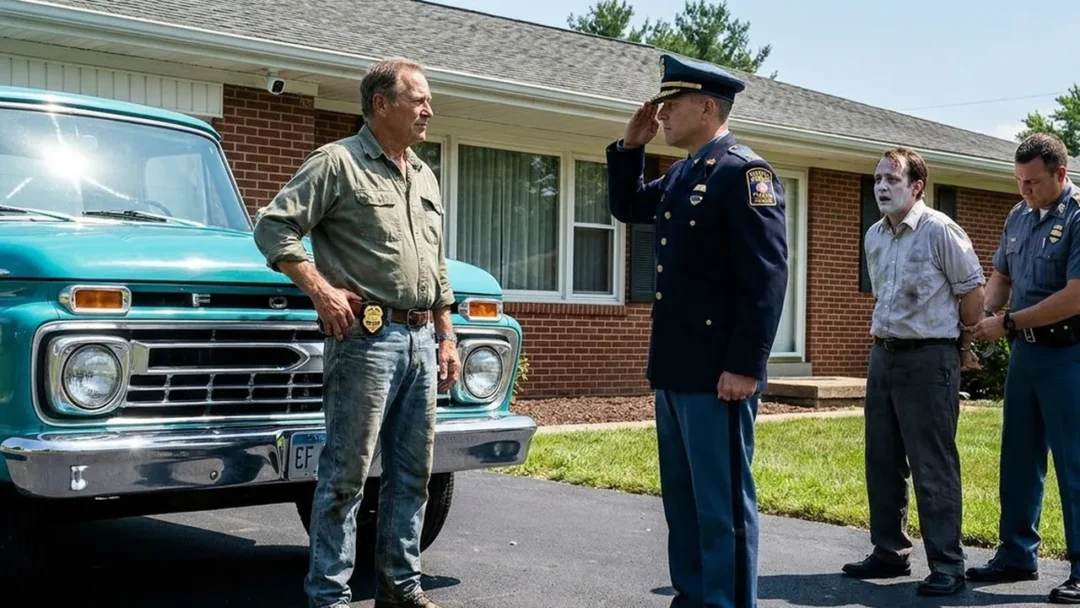
Thomas Hayes knelt on a folded rubber kneeling pad on the immaculate black asphalt of his driveway, five feet from the front bumper of a pristine, collector-grade 1964 Ford F-100 pickup truck. The truck’s turquoise and Wimbledon-white two-tone paint had been hand-rubbed until it mirrored the morning sky like liquid turquoise.
Thomas was sixty-eight years old, broad-shouldered and upright, with thick silver hair cropped close to his scalp, sharp grey eyes, and a quiet, deliberate posture that commanded unspoken respect. He wore a faded olive-drab utility work shirt with the sleeves rolled up, clean denim trousers, and a pair of polished brown leather work shoes. In his right hand, he held a soft flannel buffing cloth, carefully working a dollop of white aluminum paste wax into the mirror-like contour of the heavy stamped-steel chrome front bumper.
A metallic clatter broke the quiet of the morning as an aggressive municipal utility sedan—a white Ford Fusion bearing the vinyl door decals CLEARVIEW TOWNSHIP CODE ENFORCEMENT—pulled directly into the mouth of Thomas’s driveway, blocking his access to the street.
The driver’s door flew open with a sharp, impatient creak.
Bradley Croft stepped out onto the pavement. He was thirty-eight years old, slender and sharp-featured, dressed in an immaculate light-grey municipal uniform shirt with synthetic blue shoulder epaulets, creased navy trousers, and mirror-shined black tactical boots. He wore dark aviator sunglasses and carried a heavy, aluminum-backed citation terminal in the crook of his arm like a submachine gun.
“Hey! Old-timer!” Croft shouted, marching up the driveway with heavy, deliberate footsteps that scuffed loudly against the clean black asphalt. “Put down the rag! We have a major administrative violation on this parcel!”
Thomas didn’t look up immediately. He finished working the paste into the outer curve of the chrome bumper, smoothing the wax into a thin, translucent haze before setting the cloth onto his open red steel toolbox.
Thomas stood up, his six-foot-one frame uncoiling with smooth, effortless authority. “Good morning, Officer. Can I help you with something?”
“You can start by explaining why this commercial junk-heap is parked in plain sight of the public right-of-way,” Croft sneered, tapping the front quarter-panel of the immaculate vintage pickup with the metal corner of his citation terminal. “Section 14-B of the Clearview Township Residential Aesthetic Code strictly prohibits the outdoor storage of non-conforming classic utility vehicles. This vehicle does not meet modern suburban architectural standards.”
Thomas looked at the truck, then looked at Croft with calm, unblinking eyes. “It’s a fully restored 1964 Ford F-100, Officer. It carries historic vehicle registration, valid state safety inspection decals, and historic emissions exemptions under Pennsylvania Vehicle Code Title 75. It isn’t commercial junk. It’s an American historic artifact.”
“I don’t give a damn about your historic plates, granddad!” Croft barked, stepping into Thomas’s personal space. “Under the new township administrative enforcement policy, any vehicle over twenty-five years old parked on an uncovered driveway is classified as an imminent environmental and visual blight hazard. Furthermore, I see an active chemical hazardous spill on your pavement.”
Croft pointed his polished boot at the circular metal tin of white chrome polish sitting on the asphalt next to Thomas’s toolbox.
“Unsealed chemical solvent in an open residential zone,” Croft said, a predatory, gloating smile spreading across his thin lips. “That’s an immediate four-hundred-dollar municipal environmental fine, plus an mandatory towing and impoundment order to Keystone Recovery Systems. Unless, of course, you want to settle this right here.”
Croft lowered his voice, stepping closer and tapping the back of his citation ledger. “Three hundred dollars cash. Administrative waiver fee. You hand me three crisp hundred-dollar bills right now, and I’ll mark this parcel as compliant for the next six months. Otherwise, my flatbed is thirty seconds away, and you’ll be paying fifteen hundred dollars down at the impound yard to see this truck again.”
Thomas looked down at Croft’s boots, then looked up into the officer’s aviator sunglasses. His expression remained completely impassive.
“I don’t pay cash waivers on my own driveway, Officer Croft,” Thomas said softly. “And taking cash to overlook a fabricated code violation is a felony under the Pennsylvania Crimes Code.”
Croft’s face darkened with vicious arrogance. “You think you can lecture me on the law, you old fossil?”
With a sudden, spiteful swing of his right boot, Croft kicked the round metal tin of chrome polish.
CLANG!
The heavy tin skipped across the asphalt, striking the concrete curb. The lid popped off in mid-air, spraying a thick fan of white petroleum-based polishing paste across the clean black driveway—and splashing a broad white streak directly across Croft’s own mirror-shined tactical boots.
“Oops!” Croft mocked, laughing aloud with cruel satisfaction. “Look at that! Now you’ve got an active chemical hazardous waste spill directly on your driveway apron! Let’s see how much your historic registration helps you when the State Police arrive to impound this heap!”
Down the street, the deep, muscular thrum of a heavy twin-turbocharged V8 engine echoed off the brick facades.
A black State Police Command Chevrolet Suburban, equipped with low-profile LED lightbars tucked behind its dark front grille and bearing the gold four-star seal of the State Police Superintendent on its front doors, slid to a halt at the curb directly behind Croft’s municipal car.
The passenger door opened, and a uniformed State Trooper in a crisp grey cavalry uniform and campaign hat stepped out. Behind him, emerging from the driver’s side with tall, commanding precision, was Colonel Robert Vance, the Superintendent of the Pennsylvania State Police, wearing his dark dress uniform adorned with four silver stars on his shoulder boards.
Croft puffed out his chest, waving his citation pad toward the driveway as the Colonel strode up the pavement.
“Colonel!” Croft boasted loudly. “Good timing, sir! Just citing a combative local retiree for an illegal hazardous spill and seizing an unlicensed vintage vehicle!”
The 1964 Ford F-100 was more than a vehicle to Thomas Hayes; it was a testament to American manufacturing resilience. Every weekend for four years, Thomas had disassembled every component in his garage: rebuilding the solid front axle, turning the drum brakes on a bench lathe, and hand-sanding every square inch of the cab sheet metal before laying down four coats of acrylic lacquer. The truck smelled of cured paste wax, leather upholstery, and clean engine oil—the unmistakable perfume of honest, disciplined craftsmanship. To Croft, however, the vintage machine was nothing more than an opportunity for petty extortion, a convenient pretext to bully a senior citizen who he assumed lacked the strength or connections to resist. Croft could not have known that Thomas Hayes possessed an institutional memory that spanned four decades of law enforcement leadership.