The Antique Ledger On The Brick Sidewalk And The Chief Counsel
CHAPTER 1: THE LEDGER ON THE BRICK SIDEWALK
The mid-afternoon sun over downtown Charleston filtered down through the broad, rustling fronds of cabbage palmettos and ancient live oaks, splashing warm golden light across the weathered red brick sidewalks of Church Street. The air was rich with the timeless, layered fragrances of the Lowcountry—the sweet, narcotic perfume of blooming star jasmine climbing up wrought-iron garden trellises, the faint tang of salt marsh drifting in from the Cooper River at low tide, and the dusty, comforting scent of sun-warmed lime mortar that had held the historic district together for more than two centuries. The city moved to a languid, dignified rhythm: horse-drawn carriage tours clip-clopping softly over uneven cobblestones, tourists in linen shirts whispering beneath wide porticos, and the distant, muffled chime of church bells echoing across the harbor.
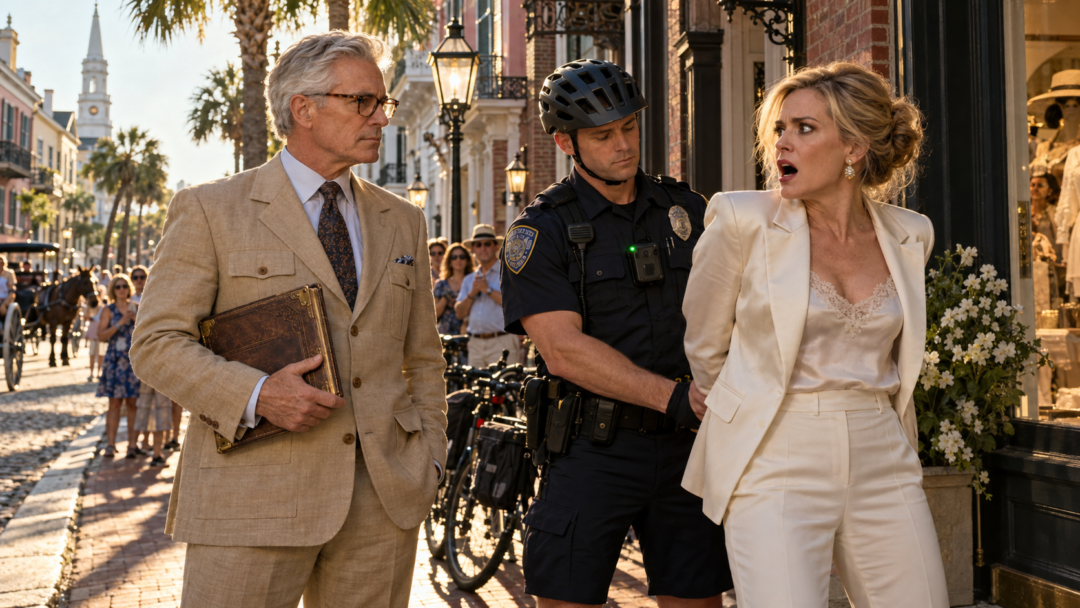
Walking down the sidewalk with the slow, measured stride of a scholar savoring a rare afternoon away from the appellate chambers was Raymond Thorne. He was fifty-five years old, tall, lean, and impeccably maintained, carrying himself with the effortless, centered dignity of an old Virginia family. He wore a crisp, tailored tan linen safari jacket with bone buttons, pressed khaki trousers, and polished chestnut leather loafers. A pair of thin, rectangular tortoiseshell reading glasses was perched upon the bridge of his straight nose. In his left hand, cradled securely against his forearm, he carried a heavy, folio-sized volume bound in cracked dark-brown morocco leather, its corners protected by tarnished brass brackets, its spine embossed in faded gold leaf: COMMISSIONERS OF COASTAL CONVEYANCE — REGISTER OF ESTUARY PATENTS, 1840. The thick parchment pages within were filled with handwritten land grants, boundary surveys, and ancestral probate inventories that had established the legal foundations of the Carolina coastline.
The sudden, violent chime of an antique brass shop bell shattered the quiet murmur of the afternoon.
Bursting through the heavy mahogany and leaded-glass doors of Vance Heritage Antiques came Victoria Vance. She was forty-two years old, sharply handsome, with dyed platinum hair swept into a severe French twist, wearing a tailored ivory silk blazer, charcoal cigarette trousers, and four-inch designer pumps that clicked aggressively against the uneven historic brickwork. Her eyes, magnified behind oversized designer sunglasses, were wide and blazing with calculated, theatrical hysteria. Her manicured hands fluttered with frantic energy as she rushed down the limestone steps of her boutique, scanning the street before locking her gaze onto Raymond Thorne’s back.
Behind her, trembling in the shop doorway, stood a young clerk in a dark apron, while two municipal bicycle patrol officers in high-visibility yellow uniforms paused on their mountain bicycles twenty yards down the street, their radios squawking with routine dispatch chatter.
“Stop that man!” Victoria shrieked at the top of her lungs, pointing a diamond-ringed index finger directly at Raymond Thorne. “Officers! Over here! That man just forced his way behind my private counter, assaulted my floor clerk, and snatched an heirloom ten-thousand-dollar diamond estate brooch directly from my glass showcase!”
Raymond Thorne did not run. He did not quicken his pace, nor did he clutch the antique ledger to his chest in a guilty reflex. He simply came to an unhurried halt on the brick sidewalk, turning around with deliberate, sovereign calm, his slate-gray eyes meeting Victoria’s frantic, pointing finger with quiet, impenetrable gravity. There was no panic in his expression, no flinching, no guilty twitch of his jaw—only the cold, analytical detachment of a veteran jurist observing an erratic witness in open court.
The two bicycle patrol officers dismounted instantly, dropping their kickstands onto the cobblestone gutter with a metallic clatter. The lead officer, Officer Davis, was twenty-nine years old, broad-shouldered and athletic, wearing a chest-mounted body camera with a blinking amber standby light. He unsnapped the retention strap on his duty holster with his thumb, marching briskly toward Thorne, his face tight with tactical tension.
“Sir, keep your hands where I can see them!” Officer Davis demanded, stepping directly into Thorne’s personal space. “Set that leather book down on the curb and step back! Keep your hands out of your pockets!”
“Good afternoon, Officer,” Raymond Thorne said softly. His voice was remarkably deep, smooth, and resonant, carrying the quiet, natural authority of someone who had spent thirty years directing proceedings in high appellate chambers. “There is no need for alarm. I have not set foot inside that boutique today, nor have I laid hands upon any jewelry. I have been walking continuously from the historical society library on Meeting Street.”
“He’s lying! He’s a professional shoplifter!” Victoria shouted, marching right up beside the officer, her expensive perfume mingling harshly with the scent of jasmine. “Look at him! He’s carrying an archival ledger stolen from my private back office! He shoved my assistant against the display case and slipped the heirloom brooch into his jacket pocket! Handcuff him right now before he drops the evidence down a storm drain! My family has operated on Church Street for forty years, and I will not have petty criminals robbing my gallery in broad daylight!”
Officer Davis looked from the frantic, well-dressed boutique owner to the calm gentleman standing before him. Under the pressure of a prominent local merchant’s accusation and the growing crowd of onlookers pausing on the curb, the young officer’s training gave way to immediate tactical compliance. He stepped behind Thorne, placing a firm, heavy hand upon the shoulder of the linen safari jacket, guiding him firmly to stand beside an ornate, black wrought-iron lamppost that rose from the brick sidewalk.
“Face the post, sir,” Officer Davis instructed, his voice rising with official authority. “Place your hands behind your back. You are being detained for grand larceny.”
Raymond Thorne did not resist. He did not pull away, nor did he raise his voice in protest. With graceful, dignified compliance, he allowed the officer to guide him against the iron post. He carefully shifted the heavy 1840 ledger into the crook of his right elbow, resting its brass-bound corner gently against the black metal of the post, and brought his hands together behind his back.
The second officer, Officer Miller, stepped forward and produced a pair of stainless-steel handcuffs from his duty belt. With a sharp, ratcheting click that echoed crisply off the historic brick facades of the street, the steel cuffs snapped shut around Thorne’s wrists.
A small crowd of tourists in linen shirts and straw hats stopped on the cobblestone curb, whispering nervously as they lifted their smartphones to record the scene.
Victoria Vance folded her silk-clad arms over her chest, stepping forward with an ugly, vindictive sneer curling her lips. Her eyes glittered with pure, triumphant malice as she leaned in close to Thorne.
“Let’s see how smart you look behind bars, old man,” Victoria gloated, tossing her head with condescending laughter. “You think you can walk down my street with historical records and stick your nose into my family’s affairs? You’re going to spend the night in the county holding tank, and my attorneys will have your assets frozen before Monday morning. By the time I’m finished with you, you won’t even be able to practice law in this state.”
Raymond Thorne did not look down. He did not lower his head in shame.
He slowly turned his head to the left, his gaze locking directly onto the glowing green optical lens of the chest-mounted body camera pinned to Officer Davis’s uniform vest. His face was an impenetrable mask of granite calm. His voice, when he spoke, was not a shout—it was a chilling, quiet baritone of absolute, sovereign command that cut through the humid street like an icy blade:
“Officer Davis, listen to me very carefully. Make sure that chest camera remains on high-definition recording without interruption.”
Officer Davis blinked, startled by the sheer, unyielding authority in the detained man’s tone. “Sir, you need to remain quiet until the squad car arrives—”
“Do not interrupt me, Officer,” Thorne said softly, his gray eyes piercing into the officer’s conscience with the crushing weight of a high court bench. “Use your tactical radio. Contact Regional Director Miller at the Chief Counsel’s Office immediately. Inform him that Senior Legal Director Raymond Thorne is currently in handcuffs on the sidewalk of Church Street.”