The Archimedes Ironwood Lever And The Lost Armored Transport Discovery
CHAPTER 1: THE QUAGMIRE AT DEVIL’S ELBOW
The torrential mountain cloudburst struck the high switchbacks of Devil’s Elbow like a solid wall of slate-grey water. It was four o’clock on a brutal October afternoon in the Blue Ridge Mountains of Virginia. Sheets of cold rain poured off the jagged granite cliffs, turning the narrow, unpaved logging pass into an impassable trough of viscous, red-clay slurry.
Toby Miller stood shivering in the deluge, his rain-slicked hands gripping the rusted mudguard of his nineteen-sixty-eight John Deere 3020 diesel tractor. Toby was twenty-three years old, a second-generation beekeeper from the Shenandoah Valley, wearing soaked denim work trousers and a yellow rubber rain jacket that was plastered to his back. Hooked to the tractor’s three-point hitch was an eight-foot flatbed timber trailer loaded with forty commercial Langstroth honeybee hives, bound with canvas straps and covered with heavy wax canvas tarps.
The hives represented Toby’s entire livelihood—twenty thousand dollars in borrowed agricultural credit and thirty years of his family’s gentle, disease-free Russian-carniolan queen genetics. He had been transporting the bees up the mountain pass to pollinate three hundred acres of late-season heirloom apple orchards in the high mountain coves. If the hives remained trapped in this freezing rain past sundown, the chilling damp would penetrate the wooden supers, cluster the worker bees into shivering hypothermia, and destroy the colonies before midnight.
Yet the tractor was not moving.
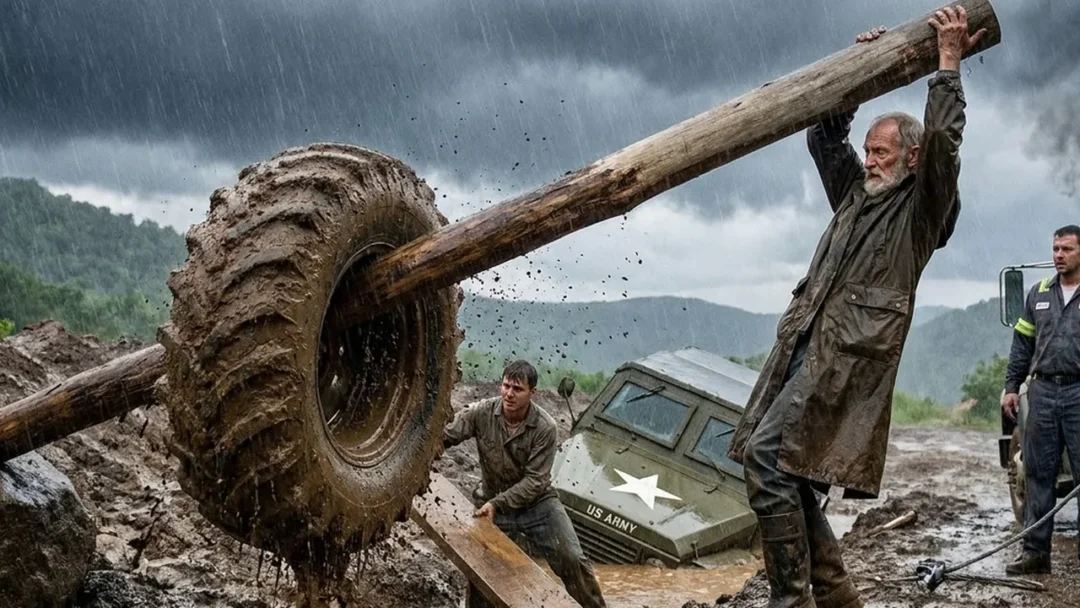
The left rear drive tire—a massive, six-foot-tall, four-hundred-pound agricultural tire loaded with three hundred pounds of calcium chloride ballast fluid for traction—had slipped off the gravel shoulder and plunged straight into an enormous, bubbling mud sinkhole. The tire was buried completely past its cast-iron wheel weights, the axle housing resting dead-flat against a submerged shelf of jagged mountain granite.
The colloidal mountain clay was acting like an industrial vacuum seal. In the Appalachian highlands, wet kaolin clay possesses extreme cohesive suction; when a heavy object displaces the water and seats against the bedrock, the atmospheric pressure and surface tension create a hydraulic vacuum that requires twice the dead weight of the object to break.
Parked twenty feet uphill, blocking the narrow road with its yellow strobe lights flashing violently through the torrential downpour, sat a heavy-duty commercial wrecker truck belonging to Brock Heavy Towing.
Vince Brock, a thick-set, bull-necked man of forty-two with a close-cropped beard and a permanent scowl of aggressive impatience, leaned against his winch controls beneath the wrecker’s steel boom. Vince wore heavy commercial waterproof bibs over a grease-stained hoodie, chewing violently on a plastic toothpick.
Vince had hooked his eight-ton hydraulic recovery winch to the tractor’s front tow eye with a heavy five-eighths-inch braided steel cable. For ten agonizing minutes, Vince had been spooling the cable under maximum hydraulic pressure, trying to yank the three-ton tractor forward out of the mud hole through sheer motorized horsepower.
The steel winch cable was screaming like a banjo string under catastrophic tension.
“Give it more throttle, Vince!” Toby pleaded, yelling over the deafening roar of the rain. “The hitch is digging deeper into the mud! The trailer is starting to tilt into the ravine!”
Vince sneered, jamming the hydraulic lever to its stops. “I’m giving it all eight tons of fluid pressure, kid! If this tractor doesn’t pop, your axle’s coming off!”
The words had barely left his lips when a sound like a three-inch naval cannon echoed through the mountain pass.
KABLAM!
The five-eighths-inch braided steel winch cable snapped violently three feet from the tractor’s tow ring.
The severed steel line whipped through the torrential rain with the lethal speed of a guillotine blade, slicing a two-inch branch clean off an overhanging birch tree before smashing into the side of Vince’s wrecker, caving in the steel tool box with a deafening metallic crunch. Blue hydraulic fluid hissed from the wrecker’s ruptured valve block, spraying into the mud.
Vince Brock stumbled backward, his face turning an alarmed shade of pale white, before his scowl returned with venomous fury. He kicked the severed cable into the ditch and glared at the trembling young beekeeper.
“That’s a fifteen-hundred-dollar high-tensile steel cable you just destroyed, kid!” Vince snarled, pointing a thick, greasy finger in Toby’s face. “The mud in this sinkhole has thirty thousand pounds of suction! No winch on this mountain can pull that tire forward against that rock wall! I’m packing up. If you want this rig out before your bees drown, it’s two thousand dollars cash in advance for me to bring a fifty-ton crane up here from Roanoke tomorrow afternoon. Take it or leave it.”
“Tomorrow afternoon?!” Toby gasped in pure horror. “My hives will freeze tonight! The rain is already seeping under the canvas covers! I don’t have two thousand dollars in cash, Vince! Please, help me reset the line!”
“Cash on the dashboard, kid,” Vince sneered, turning toward his truck cab. “No cash, no crane. Nature doesn’t give refunds.”
“Your cable was pulling sideways into a mud wall, driver,” a deep, quiet voice echoed through the storm. “A horizontal pull only jams the rim harder against the rock. You have to lift straight up.”
Vince and Toby spun around.
Marching down the washed-out logging road through the blinding sheets of rain came a solitary figure. He was seventy-seven years old, standing six feet tall, with a broad, iron-boned frame, a long silver beard that fell over a patched oilskin duster, and heavy leather logging boots that splashed steadily through the rushing mud.
Balanced effortlessly across his right shoulder was a fourteen-foot-long, eight-inch-thick, debarked trunk of solid mountain ironwood—Ostrya virginiana—weighing easily one hundred and eighty pounds. The old man carried the massive timber as casually as a boy carrying a fishing cane.
In his left hand, he carried a heavy five-foot walking staff forged of solid high-carbon iron with a cold-chiseled tip.
Amos Calloway had arrived at Devil’s Elbow.
The geotechnical behavior of Appalachian mountain clay under dynamic saturation is one of the most hazardous soil conditions encountered in civil engineering. Known locally as ‘buckshot clay’ or montmorillonite shale slurry, this colloidal soil expands by over forty percent when saturated with rainwater, transforming from a dense sedimentary bed into an ultra-viscous non-Newtonian fluid. When a vehicle tire sinks into this slurry, it displaces the pore-water pressure, forcing fluid outward until the rubber tread seats directly against the dense, impermeable bedrock underneath. Once the tire comes to a rest, the weight of the vehicle squeezes out all residual boundary lubrication, creating a high-cohesion molecular bond between the vulcanized rubber and the clay matrix. When an external winch pulls horizontally against this seated tire, the shear resistance of the soil matrix acts as an immovable mechanical wall, requiring breakout forces that far exceed the tensile limits of commercial steel tow cables.
The Russian-carniolan honeybee (Apis mellifera carnica) is prized by high-altitude orchardists for its extraordinary cold-hardiness, gentle temperament, and explosive spring brood rearing. Developed over millennia in the Julian Alps of Central Europe, Carniolan bees maintain tight winter clusters that consume minimal honey reserves while regulating brood-nest temperatures to an exact ninety-three degrees Fahrenheit. However, when an entire apiary is trapped on an open trailer during an autumn mountain deluge, the hive boxes become saturated with freezing water, which lowers the internal wood temperature and forces the worker bees to vibrate their thoracic flight muscles continuously to produce metabolic heat. If a colony exhausts its carbohydrate stores while fighting hypothermia, the queen dies, and forty thousand bees freeze within hours. This biological emergency was what drove Toby Miller’s frantic determination to free his tractor before the mountain dusk closed in.