The Biomechanical Bull Lock And The Sabotaged Rodeo Syndicate Secret
CHAPTER 1: THE IRON HORSESHOE
The Texas sun beat down mercilessly upon the caliche dust of the Lonestar Heritage Arena, baking the whitewashed cedar fencing of the Bandera County stock pens until the air smelled of dry cedar, heated manure, and sweet coastal Bermuda hay. It was four o’clock on an electric Friday afternoon. In less than twenty-four hours, the arena would host the annual Texas Cattlemen’s Invitational Bucking Bull Showcase—a high-stakes commercial auction and competition where elite breeding stock fetched six-figure prices from national rodeo stock contractors.
In the shaded corner of the arena forge shop, Jackson Callahan stood beside a massive five-hundred-pound Trenton steel anvil. Jackson was seventy-five years old, standing six feet tall in a faded denim pearl-snap shirt, grease-darkened leather chaps, and an antique silver-belly Stetson hat that had shadowed his piercing grey eyes for forty years. His skin was the color of sun-cured saddle leather, cross-hatched with scars from a lifetime of bulldogging wild steers, branding range cattle, and shoeing heavy draft mules.
Clamped securely in an iron bench vise before him was a newly forged number-three draft horseshoe—a half-inch-thick bar of cold-rolled high-carbon steel designed to shoe a heavy Belgian workhorse.
Jackson did not reach for a twelve-inch pipe wrench or a ball-peen hammer to test the metal’s spring temper.
He placed the thick heel of his bare left palm against the curve of the steel shoe, wrapped his calloused right fingers around the outer branch, and drew a slow, disciplined breath into his diaphragm. His forearms—corded with dense, ropy sinew honed by fifty years of physical mastery—flexed under his faded cotton sleeves.
With a single, unyielding application of raw isometric crushing torque, Jackson bent the half-inch solid steel horseshoe open by an entire inch.
The steel groaned under the immense leverage, its crystalline grain yielding to a crushing grip that exceeded two hundred and fifty pounds of pressure per square inch. Jackson inspected the gap, nodded in silent approval of the metal’s ductility, and tossed the bent shoe into an oil quench bucket with a soft, satisfied sizzle.
Thirty yards away in the holding pens, a chorus of frantic shouting and splintering timber shattered the afternoon quiet.
“Look out! He’s blowing the gate!”
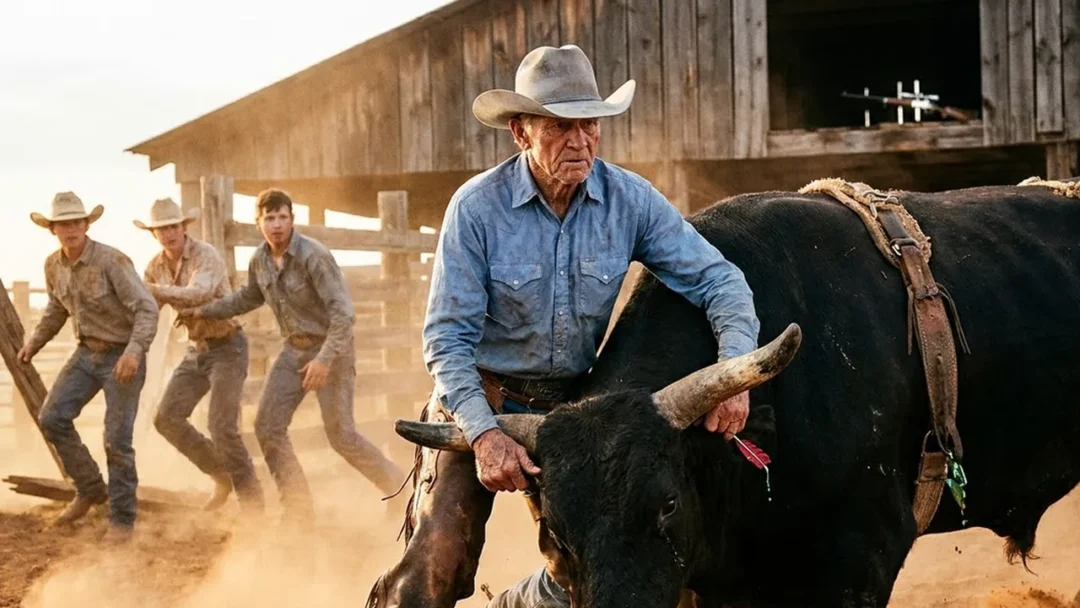
Inside pen four, three burly young ranch hands—led by Jackson’s twenty-four-year-old grandson, Cody Callahan—were locked in a desperate struggle to control the ranch’s prized championship bucking bull, Black Diablo. Black Diablo was an absolute monster of pure bovine genetics: a cross of five-eighths Brahman and three-eighths Black Angus, weighing fifteen hundred pounds of roping muscle, crowned by two sweeping, thirty-inch ivory horns tipped in black horn-iron.
Ordinarily, Diablo possessed the stoic, focused demeanor of an elite competition athlete. But over the past thirty minutes, the massive beast had undergone a terrifying, psychotic transformation.
His nostrils flared with thick, foamy red saliva. His eyes, typically dark and intelligent, were bulging with bloodshot, maniacal fury, the pupils dilated to the rim of the iris. His massive front hooves were tearing trenches into the dirt as he bellowed a deep, guttural roar that shook the corrugated tin roofs of the holding sheds.
“Hold the snub-line, boys! Wrap the post!” Cody screamed, his knuckles white as he leaned his entire two-hundred-pound frame into a fifty-foot braided nylon lead rope tied to the bull’s halter.
Beside Cody, two muscular college rodeo athletes—young men who spent twelve hours a week in university weight rooms—strained with all their might, their boots digging frantically into the caliche dirt.
They were attempting to pull straight back against the animal’s forward momentum—a fundamental, fatal error in bovine biomechanics.
A fifteen-hundred-pound bull driving forward with its hindquarters generates over four thousand pounds of horizontal thrust. Against that massive hydraulic drive, three human beings weighing six hundred pounds combined were nothing more than ragdolls tied to a runaway freight train.
With an earth-shaking snort of enraged fury, Black Diablo threw his massive neck forward and launched his weight directly into the reinforced six-inch cedar corral fence.
CRASH!
The heavy timber rails shattered like toothpicks. Splintered cedar posts snapped in half, showering the dirt with sharp wooden fragments as Black Diablo exploded through the perimeter fence into the open arena staging area.
The three young cowboys were jerked off their feet as if yanked by a speeding semi-truck. Cody, Luke, and Seth were dragged face-first through thirty feet of sharp gravel and manure, their hands burning on the nylon rope, before the violent recoil tore the line from their bleeding fingers and sent them sprawling into the dirt.
“Run, Grandpa! Run!” Cody screamed from the dust, scrambling on his elbows in blind terror. “Get to the chute! He’s gone mad! Nobody can hold him!”
Black Diablo turned his massive horned head toward the open gate leading to the public spectator pavilion. He lowered his snout, kicked up a blinding storm of red dust with his hind legs, and charged directly toward the old blacksmith shop.
Jackson Callahan did not run. He stepped out of the forge into the blinding Texas sun, his hands loose at his sides, his eyes cold and calm as winter ice.
The anatomy and neurophysiology of the domestic bovine (Bos taurus) are heavily governed by specialized cervical reflexes that have evolved over millions of years of herd survival. In an adult bull weighing upwards of fifteen hundred pounds, the skull is anchored to the thoracic spinal column by the ligamentum nuchae—a massive, elastomeric cable of dense yellow fibrous connective tissue capable of supporting hundreds of pounds of downward head weight during grazing. However, the cervical vertebrae—specifically the articulation between the first cervical vertebra (the atlas) and the second cervical vertebra (the axis)—form a specialized pivot joint designed primarily for lateral scanning rather than rotational torsion. When an external force twists the rostral muzzle laterally past forty-five degrees relative to the scapular line, the lateral vertebral ligaments become hyper-extended, immediately triggering an involuntary autonomic spinal reflex known to veterinary neurologists as the ‘tonic neck reflex.’ To prevent catastrophic subluxation of the spinal cord, the brain stem instantaneously inhibits motor nerve firing to the quadriceps and pectoral muscles, causing the animal’s front limbs to collapse in a protective, grounding flaccidity.
The metallurgy of horseshoe fabrication in the Texas Hill Country carried its own unwritten folklore. A number-three draft shoe, forged from low-carbon mild steel with a fifteen-point manganese content, is designed to absorb the crushing concussive impact of a two-ton draft horse traveling over granite riverbed crossings. To bend such a cold piece of steel in a bench vise using only the torque of human hands requires a degree of physiological adaptation that baffles modern athletic trainers. Over forty years of shoeing range horses, Jackson’s wrist flexors had undergone continuous hypertrophic remodeling, with the flexor carpi radialis and palmaris longus fusing into dense, tendonous sheets that could generate over two hundred foot-pounds of direct rotational torque. When Jackson gripped an iron bar or the horn of a fifteen-hundred-pound animal, there was no elastic slippage; the grip was as absolute and unyielding as a cast-steel bench clamp.