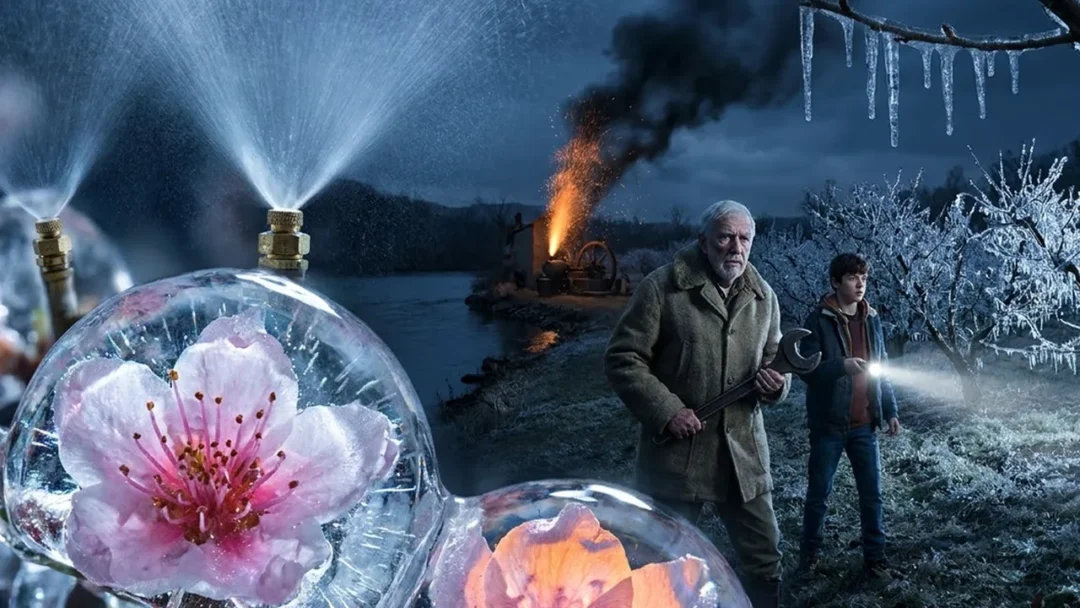
The Black Frost Midnight And The Blooming Peach Orchard Lanterns
CHAPTER 1: THE MIDNIGHT PLUNGE
The north wind screamed through the limestone gaps of the Blue Ridge Mountains like a wounded beast, carrying the dry, merciless bite of an Arctic polar vortex deep into Black Willow Valley. In the center of the seventy-acre heritage orchard, the branches of two thousand century-old Elberta and Belle of Georgia peach trees swayed violently against the black midnight sky. The Elberta and Belle of Georgia cultivars were legendary for their incomparable flavor, delicate velvet skin, and melting freestone flesh, but they were notoriously temperamental in commercial production. Modern industrial growers had largely abandoned them in favor of thick-skinned, flavorless hybrid varieties engineered primarily to survive rough mechanical conveyor belts and cross-country refrigerated freight shipping. Arthur had stubbornly preserved these antique trees because he believed that agriculture without culinary integrity was merely an exercise in industrial logistics. For seventy years, local families had made an annual pilgrimage to Black Willow Valley in late July, waiting in long lines at the packing shed door for wooden bushels of peaches that tasted like pure summer sunshine and wild honey.
Every branch was thick with delicate, five-petaled pink blossoms, bursting with life after an unusually warm Virginia March. But warm weather in early spring was always a treacherous promise.
Toby Pendelton stood beside the weather monitoring mast at the edge of the packing shed, his hands trembling inside heavy sheepskin work gloves. He pulled the collar of his canvas hunting coat up around his ears, his breath pluming in thick white clouds that were torn away instantly by the sub-zero gale.
Mounted on the cedar post before him, the red digital display of the electronic meteorological station flickered with every passing gust.
The history of the Pendelton orchard was bound to the geological quirks of the Shenandoah basin. Planted in nineteen-twenty-two by Arthur’s grandfather following his return from the battlefields of the Meuse-Argonne, the rootstocks had been grafted onto native wild mountain plums, giving them an exceptionally deep taproot system capable of drawing subterranean moisture even through five-month summer droughts. The trees had survived the devastating freeze of thirty-six, the great hail depression of forty-eight, and the catastrophic blizzard of ninety-three. Arthur knew every gnarled trunk as intimately as a master watchmaker knew the gears of a family clock.
“Minus four Celsius…” Toby whispered, his teeth chattering against the inside of his scarf. “Minus five point two… It’s dropping half a degree every ten minutes, Grandpa.”
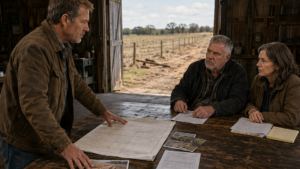
Inside the packing shed, seventy-six-year-old Arthur Pendelton stood over a broad wooden workbench covered with hand-drawn irrigation schematics and brass pressure gauges. Arthur was a tall, stoic man with silver hair cut close to his scalp, deep lines carved into his weathered face from sixty years in the orchard rows, and shoulders that remained broad and unbent despite a lifetime of relentless physical labor. In his youth, before returning to take over his father’s fruit farm, Arthur had served as a naval mechanical technician aboard steam turbines in the North Atlantic. He understood heat, pressure, and the unyielding laws of thermodynamics better than any agronomist in the state.
Arthur picked up a heavy, thirty-six-inch forged-iron valve wrench from the bench. He turned around, his pale gray eyes steady and calm in the yellow glare of the incandescent work light.
“How fast is the wind moving at the ten-foot level, Toby?” Arthur asked, his voice low and deliberate.
“Twenty-two miles an hour sustained, gusting to thirty-two out of the north-northwest,” Toby answered, shining his flashlight onto the anemometer dial. “The humidity is down to eighteen percent. It’s an advective freeze, Grandpa. A black frost. There’s no inversion layer in the valley. No warm ceiling to trap heat.”
A black frost was the most terrifying phrase in the lexicon of an Eastern fruit grower. In a standard radiation freeze, the air was still, cold air settled into low hollows, and growers could use wind machines or low fires to mix the warmer air above. But in an advective black frost, a massive continental polar air mass barreled straight through the canopy with zero moisture, freezing plant tissues so rapidly that the cell walls burst from within, turning delicate pink petals black and brittle before sunrise.
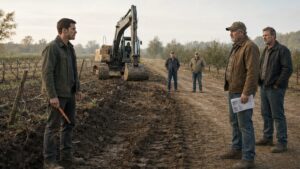
Across the gravel road, the sounds of despair were already echoing through the darkness. The Vance Commercial Fruit Company operated two hundred acres of high-density dwarf peach hybrids. Their diesel tractor engines were roaring, hauling massive flatbed trailers loaded with hundreds of discarded automobile tires and crude fuel-oil smudge pots. Plumes of acrid, greasy black smoke were beginning to billow into the night sky, fouling the freezing wind with the stench of burning petroleum.
Caleb Vance, a heavy-set man in his mid-forties wearing a goose-down parka, walked across the road, leaning against the Pendeltons’ boundary gate. His face was streaked with soot, his eyes red from smoke and panic.
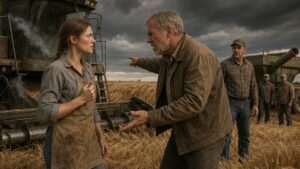
“Arthur! You’re wasting your time standing in the shed!” Caleb shouted over the howl of the wind. “The radio just announced the cold front is stalling right over Winchester! It’s going to hit minus eight before three in the morning! Every blossom in this valley is dead meat! Light your smudge pots or get inside by the stove!”
Arthur stepped out of the shed into the freezing gale, holding the heavy iron wrench across his chest. He looked at Caleb’s smudge fires, watching the useless black smoke get swept away horizontally by the thirty-mile-an-hour wind without warming a single branch.
“Smoke doesn’t stop freezing wind, Caleb,” Arthur said calmly. “All you’re doing is choking your lungs and poisoning your topsoil.”
“Then what are you going to do, old man?!” Caleb yelled back with bitter derision. “Pray for dawn?”
Arthur looked at Toby. “Toby, grab the four-foot cheater pipe from the tractor bay and follow me to the Cedar Creek pump line. We’re opening the main valve.”
Toby froze, staring at his grandfather in sheer disbelief. “The main water line? Grandpa, it’s minus six out here! If we turn on the sprinklers in this wind, we’ll cover the trees in ice! We’ll freeze the entire orchard solid!”
Arthur did not break his stride. “Grab the pipe, son. We’re going to build a fortress of glass.”