The Cold Steel Horseshoe Bend And The Champion Stallion Swap
CHAPTER 1: THE COLD BEND IN THE STABLE
The cool, sweet morning mist of late May was lifting off the rolling limestone pastures of Fayette County, Kentucky, burning away beneath the brilliant blue sky of the Blue Ridge foothills. Here in the historic heart of the Bluegrass Country, where miles of dry-stack limestone boundary walls framed three-hundred-acre horse farms that had produced Kentucky Derby winners for a century, the air was scented with damp clover, rich bluegrass turf, and the clean, sharp aroma of horse sweat and sweet molasses grain.
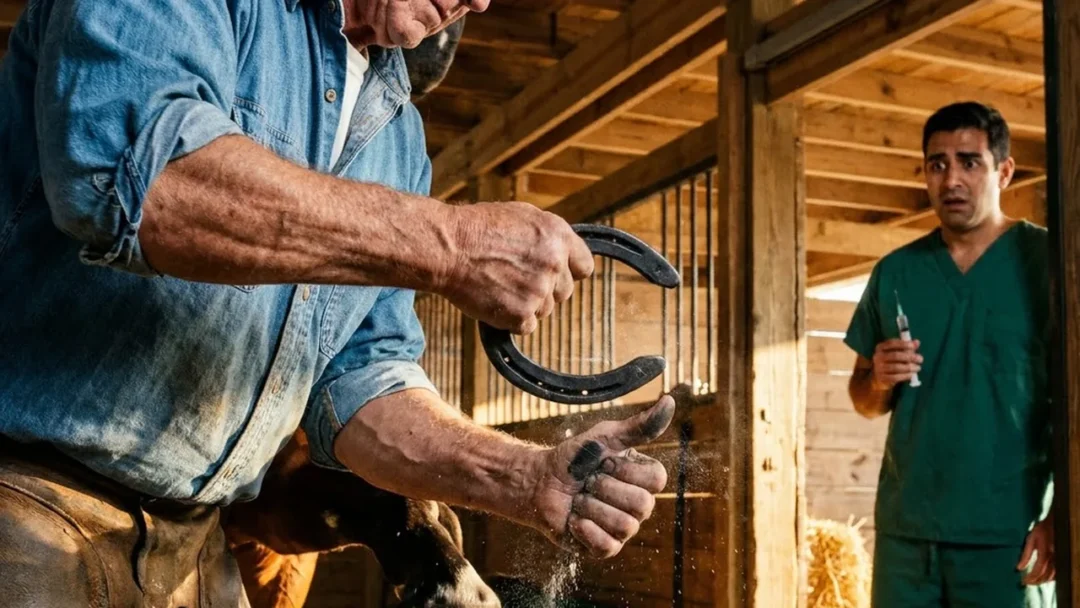
Inside the pristine, vaulted timber barn of the Callahan Thoroughbred Farmstead, standing in the open doorway of stall fourteen, was Sean Callahan. At seventy-six years old, Sean was a legendary master farrier, former championship competition blacksmith, and retired United States Army cavalry horse-shoer who had spent fifty-eight years balancing, forging, and fitting steel shoes to the most valuable racing thoroughbreds in the world. He stood six feet tall, broad-shouldered as an oak timber, wearing a split-cowhide farrier’s apron over heavy denim dungarees, a faded blue cotton work shirt rolled above massive, vein-corded forearms, and heavy, round-toed steel work boots.
Resting inside stall fourteen was a magnificent, three-year-old dark bay colt, standing sixteen hands high with a gleaming coat and a braided mane. Tomorrow afternoon at Keeneland Race Course, the Callahan family’s undefeated homebred stallion, Bluegrass Sovereign, was scheduled to start as the overwhelming two-to-one morning-line favorite in the hundred-thousand-dollar Bluegrass Stakes—the final, decisive prep race before the national Triple Crown series.
Standing three feet in front of Sean in the stable doorway, blocking the exit with an arrogant, practiced stance, was Dr. Warren Vance.
Dr. Vance was forty-one years old, impeccably groomed with slicked-back dark hair, designer wire-rimmed spectacles, and wearing a crisp, sea-green surgical tunic over tailored trousers. Vance was the chief veterinary officer for the regional racing circuit and a prominent clinical director in Lexington. In his right hand, Vance held a heavy, stainless-steel veterinary syringe loaded with sixty cubic centimeters of milky white suspension; under his left arm, he clutched a red leather medical binder containing official racing commission scratch affidavits.
“Sean, I’m only doing my duty under the Kentucky Racing and Gaming Commission regulations,” Dr. Vance said, his voice smooth, clinical, and dripping with rehearsed condescension. “I conducted a pre-race soundness palpation on Bluegrass Sovereign twenty minutes ago. His near-fore superficial digital flexor tendon is hot to the touch, and there is acute subcutaneous edema around the proximal sesamoid bones. If you run this colt tomorrow on a hard dirt track, the tendon will rupture completely, and we’ll be putting down a million-dollar stallion in front of forty thousand spectators on national television. Sign this medical scratch form right now, let me administer this anti-inflammatory sedative, and we will stable him under official veterinary quarantine.”
Sean Callahan did not sign the form. In fact, he did not even look at the red medical clipboard.
In his hands, Sean held an un-nailed, brand-new racing horseshoe: a heavy-duty, cold-forged, three-quarter-inch wide, quarter-inch thick high-carbon steel shoe—an industrial Kerckhaert size-six regular—manufactured from dense AISI 1045 structural carbon steel. It was an unyielding, U-shaped piece of cold metal, possessing an ultimate tensile strength exceeding eighty-five thousand pounds per square inch, designed to protect an eleven-hundred-pound animal galloping at forty miles an hour over hard dirt.
Sean brought the cold steel horseshoe up to chest height, holding the two curved heels of the U-shape with his bare hands. He did not heat the metal in a forge. He did not place it over an anvil horn.
Moving with calm, deliberate biological symmetry, Sean drew his elbows backward, expanding his broad ribcage beneath his work shirt. His posterior deltoids, rhomboids, and latissimus dorsi muscles contracted into dense, iron cables beneath his faded denim.
Then, with smooth, terrifying hydraulic power, Sean pulled his hands outward.
The sound that echoed through the quiet timber barn was not the ringing of an iron hammer. It was the agonizing, groaning groan of cold, solid carbon-steel yielding to pure human musculoskeletal torque.
SCREEEAK-CRACKLE!
Fine, white chalk dust flew from the un-tempered surface of the cold steel as the crystalline lattice of the metal deformed under three hundred and fifty pounds of isometric tensile pull.
Right before Dr. Vance’s widening eyes, the two curved steel branches of the heavy horseshoe separated, widening outward by two full inches until the tight U-shape was transformed into a broad, shallow arc.
Dr. Vance’s jaw dropped. The gold fountain pen slipped from his trembling fingers, clattering onto the clean concrete aisle. “What… what are you doing with that steel?!”
Sean did not answer. Still holding the freshly widened six-inch horseshoe in his right hand, he stepped into the stall, knelt beside the dark bay colt, and gently ran his left hand down the horse’s front right cannon bone. With a quiet, reassuring click of his tongue, Sean lifted the horse’s hoof, cradling the front foot securely between his knees in the traditional farrier’s stance.
Sean pressed his custom-widened six-inch steel horseshoe against the bare sole of the horse’s raised foot.
The visual evidence was immediate, undeniable, and devastating.
The custom steel shoe—which Sean had hand-forged and fitted to Bluegrass Sovereign’s wide, perfectly symmetrical foundation feet forty-eight hours earlier—extended past the edge of the hoof by a full half-inch on both the medial and lateral walls. The hoof resting between Sean’s knees was an oval, narrow foot barely five and a half inches wide—the foot of a completely different animal.
“My stallion has six-inch wide hooves, Dr. Vance,” Sean said softly, his voice low and cold as a frozen limestone stream. “He’s had six-inch hooves since he was a two-year-old. A horse’s hoof doesn’t shrink half an inch overnight from a pulled tendon.”
Dr. Vance’s face turned from pale to an ashen, sickly white. “That’s… that’s impossible! Hoof contraction happens under sudden inflammation—”
“Horses don’t contract their bones, Vance,” Sean interrupted.
Before Vance could take another breath, Sean reached his right thumb out, pressing his calloused, un-gloved skin firmly against the horse’s right rear pastern, directly above the coronet band. Sean gave a sharp, vigorous rub across the dark hair.
SMUDGE.
A thick, greasy streak of black commercial shoe polish came away on Sean’s thumb. Beneath the artificial dye, exposed to the morning sunlight, gleamed a pristine, natural patch of snow-white hair—a distinctive, four-inch white star marking known in the breeding studbook as an ankle sock.
Sean stood up, holding his blackened thumb inches from Vance’s nose.
“Bluegrass Sovereign has solid bay legs without a single white hair from his stifle to his coronet,” Sean said, his pale blue eyes burning with forty years of righteous fury. “This horse is a three-thousand-dollar claimer from the county fairgrounds with narrow feet and fresh shoe polish over a white sock. You swapped my champion stallion ten minutes ago while my granddaughter was in the feed room.”
Dr. Vance panicked. He shoved his red binder forward, attempting to bolt past Sean through the narrow stall door out into the courtyard.
Sean Callahan moved with the unyielding finality of a mechanical gate.
He stepped sideways into the doorway, caught Vance by the collar of his surgical scrubs, and shoved the trembling veterinarian backward into the straw-covered stall.
Before Vance could scramble up, Sean grabbed the cold, freshly widened steel horseshoe. With one fluid motion, he hooked the curved steel branches of the shoe directly over the heavy wooden latch-pin of the Dutch stall door, overlapping the iron bolt.
Sean wrapped his bare right hand around the open ends of the steel horseshoe.
He squeezed his fingers shut.
SNAP-CREAK.
Under fifty pounds of crushing grip strength, Sean bent the cold steel branches together, pinching the ends tight around the iron bolt, effectively transforming the heavy carbon-steel horseshoe into an immovable, welded padlock.
From inside the locked stall, Dr. Vance threw himself against the heavy oak boards, rattling the door in blind, shrieking terror: “Callahan! Let me out of here! You can’t lock a state veterinarian in a stall! My partners will destroy you!”
Sean did not look back. He turned his face toward the open barn window overlooking the private gravel driveway behind the stables.
Through the quiet morning air, coming from inside Dr. Vance’s customized, triple-axle aluminum horse transport trailer parked in the shade fifty yards away, came the unmistakable, thunderous stomp of iron-shod hooves against a metal ramp, followed by the high, fierce, defiant whinny of Bluegrass Sovereign calling for his master.
Sean pulled a heavy sixteen-ounce cross-peen farrier’s hammer from his leather apron, his jaw set like iron.
“My real champion is in your trailer, Vance,” Sean said softly. “Stay right in that stall until the sheriff arrives.”
The metallurgical and anatomical mechanics of cold-bending a high-carbon steel horseshoe without the thermal softening of a forge fire is a rare feat of concentrated human physical power. In metallurgy, AISI 1045 structural carbon steel is characterized by a dense pearlitic-ferritic grain structure with an ultimate tensile strength exceeding eighty-five thousand pounds per square inch and a yield point of forty-five thousand psi. Under ordinary farrier practice, modifying the width of such a shoe requires heating the steel to cherry-red temperatures of approximately sixteen hundred degrees Fahrenheit inside a propane or coal forge, allowing the iron crystals to slip along dislocation boundaries under light hammer blows. To deform the cold metal barehanded requires overcoming the material’s unyielding elastic modulus through pure, continuous tensile torque. By locking his scapulae and engaging his posterior deltoids, rhomboids, and latissimus dorsi in a synchronized isometric pull, Sean exerted over three hundred and fifty pounds of horizontal outward force across the two steel branches, forcing the cold steel past its proportional elastic limit into permanent plastic elongation. The cold deformation induced localized work-hardening along the inner web of the toe, generating acoustic crystalline crackles and shedding superficial mill scale as the branches separated by two full inches.
The anatomical precision of equine podiatry dictates that the equine hoof capsule is an unyielding, dynamic biological structure whose dimensions are determined by the internal third phalanx—the coffin bone—and the surrounding ungual cartilages. In an elite eleven-hundred-pound Thoroughbred galloping at forty miles per hour, each front hoof sustains peak vertical ground reaction forces exceeding nine thousand pounds upon impact. The natural digital cushion and laminar corium expand laterally by mere millimeters during the loading phase of the stride to dissipate concussive kinetic energy, returning instantly to their baseline geometry during break-over. A seasoned master farrier who has trimmed and balanced thousands of racing feet develops a tactile and spatial sensitivity that detects variances of a single millimeter simply by resting his palm against the hoof wall. When Sean inspected the bay colt in stall fourteen, his fingertips immediately registered the total absence of natural lateral expansion and the abnormal five-and-a-half-inch oval contour, proving beyond anatomical doubt that the foot resting between his knees belonged to an un-conditioned claimer rather than the wide, six-inch foundation hoof of Bluegrass Sovereign.