The Desert Sandstorm Gale And The Ancient Stone Aqueduct Canal
CHAPTER 1: THE BLOOD-RED HORIZON
The morning sun over the Chuckwalla Valley rose like a disk of molten brass, casting long, sharp shadows across the eastern slopes of the Eagle Mountains. In the valley basin below, five hundred acres of mature Nonpareil and Carmel almond trees stretched in immaculate, parallel rows of dazzling, snow-white blossom. The air was intoxicatingly sweet, heavy with the perfume of millions of delicate, five-petaled white flowers trembling in the gentle morning thermal. The Nonpareil variety, first bred in California in the late nineteenth century by pioneering horticulturist A.T. Hatch, was the undisputed queen of commercial nut crops, prized across international markets for its smooth, uniform paper-thin shell and exceptionally sweet, pale kernel.
Above the canopy, the continuous, vibrating hum of two million European honeybees filled the desert silence with an industrious, peaceful roar.
Migratory commercial beekeeping was the unsung operational backbone of North American agriculture. Every February, over two million honeybee colonies—representing more than eighty percent of all managed hives in the United States—were loaded onto flatbed semi-trucks from Florida, Texas, and the Dakotas, converging on California’s Central Valley for the single largest coordinated pollination event on the planet. Without these migratory colonies, California’s two-billion-dollar almond export economy would instantly collapse, as almond blossoms were strictly self-incompatible and required cross-pollination by insects to produce nuts. Elijah was one of the few remaining independent operators who owned his own transport fleet and refused to treat his colonies as disposable industrial commodities.
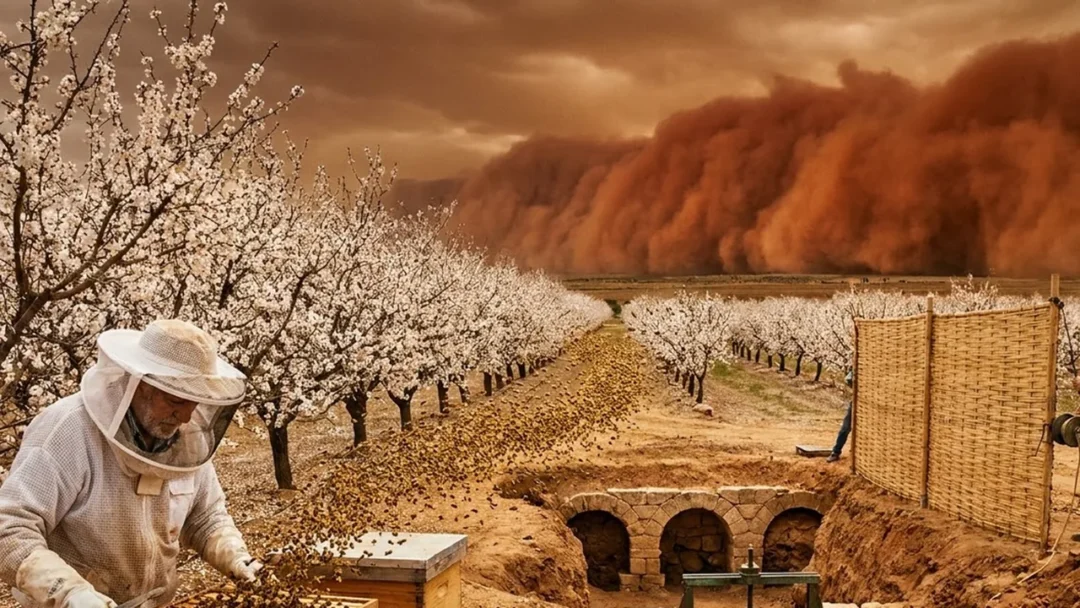
Elijah Sterling stood on the wooden bed of his flatbed apiary truck, wearing his ventilated white cotton beekeeping suit, his mesh veil thrown back over his shoulders. Elijah was forty-two years old, with lean, wiry arms weathered by twenty-five years of migratory commercial beekeeping, dark brown eyes that missed nothing in the field, and fingers calloused from handling millions of stinging insects without flinching. Clustered around the perimeter of the orchard were five hundred heavy, multi-story Langstroth hive boxes, painted in weathered pastel shades of sage green, sky blue, and white, their entrance ramps bustling with thousands of golden worker bees departing on nectar-gathering flights.
Beside him on the access road stood The almond groves of the Chuckwalla Basin represented an extraordinary triumph of modern arid agricultural engineering. Unlike traditional orchards in the Sacramento Valley that enjoyed hundred-inch winter mountain snowpacks and direct federal gravity canals, desert growers along the Interstate 10 corridor operated on the razor edge of ecological viability. The soils were young, coarse aridisols composed of decomposing granite and volcanic ash, which drained with alarming speed and possessed near-zero organic matter. To cultivate five hundred acres of Nonpareil almonds under these brutal conditions required an unwavering commitment to micro-irrigation precision and an absolute dependence on optimal pollination timing during the narrow fourteen-day bloom window in late February.
Mateo Alvarez, the sixty-year-old custodian of the almond ranch. Mateo was leaning against the fender of his battered farm truck, holding an electronic weather tablet connected to the regional agricultural telemetry network.
“The pollination count is breaking records, Elijah,” Mateo smiled, shading his eyes as he looked up into the snowy canopy. “Forty-eight hours of calm weather like this, and we’ll set ninety percent of the nut crop. That’s eight hundred thousand pounds of shelled almonds. The bank was ready to foreclose on my water irrigation assessment, but this crop clears the slate.”
Elijah was about to reply when a strange, unnatural silence swept over the orchard.
It was not a gradual quieting. It was an abrupt, violent cessation of wind. The gentle breeze that had been fluttering the almond petals suddenly died away to absolute, suffocating stillness.
Mateo’s digital tablet began to emit a shrill, rhythmic emergency tone.
Mateo glanced down at the screen. The electronic barometric display was plummeting. The atmospheric pressure had dropped a staggering fourteen millibars in less than six minutes.
“What is that?” Mateo frowned, tapping the screen. “A sensor malfunction? There wasn’t a cloud on the satellite radar at dawn.”
Elijah turned his gaze toward the southern horizon, where the barren alluvial fans of the Chuckwalla basin met the distant volcanic ridges of the Chocolate Mountains.
The horizon had disappeared.
In its place, rising like an apocalyptic wall of solid blood, was a terrifying, three-hundred-foot-tall tidal wave of churning red desert dust and pulverized mineral sand. It stretched for fifteen miles from east to west, a vertical, boiling precipice of dark crimson and ochre, racing across the desert floor at sixty miles an hour. Beneath the advancing cloud, daylight was being swallowed whole, extinguished into an eerie, glowing twilight of suffocating darkness.
The economics of desert almond farming had become an existential tightrope in recent seasons. With state groundwater pumping restrictions tightening under the Sustainable Groundwater Management Act and electric utility rates for deep-well turbine pumps soaring to record highs, small family growers like Mateo were paying upwards of twelve hundred dollars per acre-foot for brackish, mineral-heavy well water that slowly salted the root zones. A successful harvest was not merely an annual payday; it was the sole financial barrier preventing the corporate agribusiness investment funds from swallowing the property and turning centuries of family heritage into automated, faceless industrial acreage.
“Haboob…” Elijah breathed, the blood running cold in his veins. “A high-altitude convective microburst collapsed over the Salton Sea basin. It’s kicking up the ancient dry lakebed.”
Mateo scrambled onto the truck bed, staring at the oncoming red monster in sheer horror. “Sixty-mile-an-hour sandblast! Look at the speed of it! If that sand hits these trees, it’s going to act like an industrial abrasive! It will sandblast the petals right off the wood, shred the leaves into confetti, and tear the wings off every single bee in the field! In fifteen minutes, two million bees will be dead, five hundred hives will be suffocated in red silt, and my entire almond crop is gone!”
Elijah grabbed his heavy leather beekeeping gauntlets, his jaw setting like carved granite. “Get your tractor, Mateo! Start the winch on the eastern bamboo curtains! We have twelve minutes to call two million bees home!”