The Eighty Kilogram Millstone And The Imperial Jade Discovery
CHAPTER 1: THE WEIGHT ON THE KNEE
The late afternoon sun fell in long, golden shafts through the ancient black walnut trees surrounding Cedar Creek Mill, illuminating the polished limestone courtyard in warm amber hues. Built in seventeen-eighty-five along the rushing limestone waters of the Shenandoah Valley, the old grist mill was a monument to early American mechanical engineering—its monolithic four-foot limestone walls cool to the touch, its twelve-foot overshot timber waterwheel turning with a slow, hypnotic rhythmic groan that resonated through the bedrock.
Sitting comfortably on a heavy oak bench beside the mill’s grinding room door was Arthur Pendelton. At seventy-five years old, Arthur was a master stone-cutter, millwright, and veteran naval salvage diver who had spent half a century cutting, dressing, and balancing millstones across the mid-Atlantic. He was lean, straight-backed, and wiry as seasoned mountain hickory, wearing faded canvas trousers, a sleeveless wool undershirt that revealed sinewy shoulders carved by decades of iron chisel labor, and heavy, grease-darkened work boots.
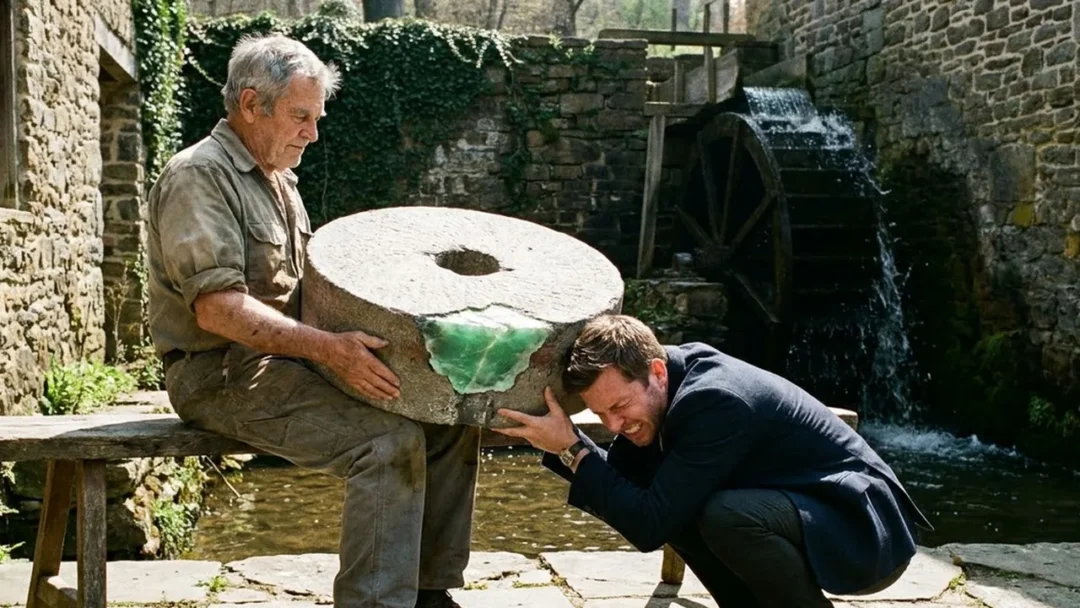
Resting vertically across Arthur’s raised right knee, balanced with effortless biological symmetry, was a solid, twenty-four-inch circular grinding wheel weighing precisely eighty kilograms—one hundred and seventy-five pounds of dense mineral mass. His left hand held an iron wire brush, delicately clearing old grain chaff from the concentric furrows along the perimeter, while his right foot rested flat on the stone courtyard pavers, absorbing the load through a quadriceps tendon that had been conditioned by sixty years of mountain walking.
Standing three feet in front of him on the limestone flags, tapping the polished toe of his Italian leather loafer, was Julian Vance.
Julian was thirty-eight, sleek, tanned, and dressed in an imported linen blazer, tailored chinos, and a platinum chronometer that caught the afternoon glare. Julian operated an exclusive private antiquities gallery in Georgetown, specializing in acquiring architectural salvage and decorative garden stone from distressed Virginia estates before reselling them to wealthy suburban estate owners at obscene markups. For three weeks, Julian had been visiting the mill, badgering Arthur to sell off the antique stone components of the historic race.
“Let’s be realistic here, Arthur,” Julian said, his voice carrying the smooth, condescending cadence of a city dealer speaking to an illiterate provincial. “That stone you’re nursing like an infant is nothing more than modern, cast Portland cement from the nineteen-forties. It’s pitted, it has no historic colonial provenance, and it’s completely unsuited for modern flour production. I’m doing you a personal favor by taking it off your porch to use as a decorative garden pedestal in a client’s courtyard in Great Falls.”
Arthur did not pause his brushing. The rhythmic shhh-shhh-shhh of the steel bristles against the dull grey mineral crust continued without interruption. “The stone isn’t for sale, Mr. Vance. It sits where it belongs.”
Julian let out a theatrical sigh, reaching into his breast pocket and pulling out a slim leather billfold. He extracted two crisp fifty-dollar bills, flicked them between his manicured fingers, and tossed them carelessly onto the wooden bench beside Arthur’s hip.
“A hundred dollars in cash,” Julian sneered, spreading his hands in mock generosity. “That’s five times what the local concrete yard charges for an unreinforced aggregate slab. You can take your grandson to the county fair this weekend and buy him a dozen bags of cotton candy. Now roll it over to the trunk of my sedan before the rain starts.”
Arthur stopped his brush. He looked down at the two crumpled banknotes on the weathered oak plank, then raised his pale, weathered gray eyes to meet Julian’s gaze. There was no anger in Arthur’s face—only the patient, unblinking stillness of an old master craftsman who had watched three generations of smooth-talking speculators come and go along the turnpike.
“You think this stone is hollow concrete, son?” Arthur asked softly, his voice carrying the deep resonance of Cedar Creek’s mill race.
“Of course it’s hollow concrete,” Julian scoffed, taking an arrogant half-step closer. “A solid granite runner of that diameter would require a block-and-tackle hoist and two men just to shift it three inches. You’re seventy-five years old and sitting there with it balanced on your kneecap like a feather pillow. Anyone can see it’s lightweight aggregate.”
Arthur smiled faintly, the deep wrinkles around his eyes crinkling. “Well then. If it’s lightweight aggregate, hold it for three seconds while I tie my bootlace.”
Before Julian could process the invitation, Arthur shifted his posture by a fraction of an inch. With a subtle, calculated tilt of his thigh, he nudged the top rim of the eighty-kilogram stone forward into Julian’s outstretched, confident hands.
Julian grabbed the rough outer rim with both palms, grinning smugly as he prepared to lift the stone and carry it triumphantly to his car.
The reality of eighty kilograms of unadulterated, dead terrestrial mass hit him with the catastrophic violence of a falling safe.
The instant Arthur’s knee dropped away, the crushing, immovable gravity seized Julian’s wrists, ripping his shoulders down with terrifying kinetic acceleration. Julian’s cocky grin vanished, replaced by an expression of pure, uncomprehending horror as his eyes bulged in their sockets.
“Wait—!” Julian gasped, his vocal cords constricting as his breath was slammed from his lungs.
His knees buckled instantly beneath the load. His designer loafers skidded across the smooth limestone flags, and Julian was dragged violently down onto both knees with an agonizing, bone-jarring crash. His face turned a deep, suffocating purple as his elbows collapsed against his chest, the heavy stone rim dragging his knuckles toward the ground.
THUD-CRACK!
The bottom rim of the eighty-kilogram disc struck the hard limestone pavers with a heavy, concussive boom that sent a tremor through the mill porch. Julian cried out in panicked agony, his spine straining under the load: “My back! My wrists! It weighs two hundred pounds! Lift it off me!”
Arthur remained seated calmly on the oak bench. Without standing, he reached out his right hand, curled two calloused fingers around the top rim of the upright stone, and halted its forward momentum with effortless tendon control, keeping the crushing edge exactly two inches away from Julian’s polished leather shoes.
“I told you it wasn’t light, son,” Arthur said quietly.
On the flagstones between Julian’s trembling hands, where the bottom rim had impacted the hard limestone, a triangular two-inch chunk of the outer grey cement crust had fractured and popped cleanly away from the core.
From beneath the dull, powdery grey mortar, struck by the low rays of the setting afternoon sun, gleamed a breathtaking, supernatural spectacle.
The fractured gap did not reveal gravel, crushed rebar, or cheap aggregate. Exposed to the light was a radiant, luminous surface of flawless, semi-translucent Imperial Green Jade—a deep, oily emerald mineral of breathtaking purity that glowed with an internal, vibrant fire as the sunlight refracted through its crystalline depths.
Julian froze on his knees, his physical pain instantly forgotten as his pupils dilated in predatory shock. He stared at the glowing green vein with shaking fingers.
Arthur reached down with his right arm, hooked his fingers under the stone’s rim, and with a smooth, effortless sweep of his shoulder, rolled the eighty-kilogram wheel back up onto his knee, cradling the stone once more as if it were a wooden tambourine.
“My grandfather cast that Portland cement crust around our family jade in Shanghai in November nineteen-forty to smuggle it past the occupying naval inspectors,” Arthur said, his voice dropping into quiet, unshakeable finality. “Take your hundred dollars off my porch, Julian. And do not come back to Cedar Creek Mill.”
Julian scrambled to his feet, clutching his wrenched back, his eyes fixed on the glowing emerald chip on Arthur’s knee. Without speaking, he backed down the courtyard steps, pulled out his smartphone with trembling hands, and spoke frantically into the receiver, gesturing toward a tinted black delivery van idling fifty yards down the gravel mill road.
The physiological mechanics of balancing eighty kilograms of dense granite upon a single human knee without spinal collapse is an extraordinary demonstration of musculoskeletal alignment. Under static gravitational loading, the human femur acts as a rigid biological compression column, transferring the vertical vector directly through the patellar tendon into the tibial plateau. When Arthur positioned the twenty-four-inch runner stone on the apex of his flexed knee, his vastus medialis and rectus femoris muscles entered a state of sustained isometric contraction, neutralizing any medial or lateral rotational shear. His core—honed by decades of carrying hundred-pound sacks of coarse wheat flour and manually hoisting iron gate sluices against the spring freshets of Cedar Creek—formed an unyielding kinetic bridge that directed the seventy-five-pound gravitational force straight down through his heel into the solid limestone flagstones beneath. To an untrained observer like Julian Vance, accustomed only to the artificial resistance of hydraulic gym machinery, the feat appeared supernatural. In truth, it was pure applied Newtonian physics, mastered through sixty years of physical labor where an unbalanced load meant crushed fingers or severed tendons.
The history of Cedar Creek Mill was etched directly into the stone blocks of the surrounding courtyard. In the late eighteenth century, German and Scots-Irish settlers moving down the Great Wagon Road from Pennsylvania had quarried the dense, fossiliferous Ordovician limestone directly from the river bluffs, dressing the blocks with hand-struck cold chisels to construct a four-story grist mill that could withstand both the catastrophic spring floods of the Shenandoah watershed and the bitter winter blizzards of the Blue Ridge. The mill had survived the fiery devastation of General Philip Sheridan’s eighteen-sixty-four Shenandoah Valley campaign, shielded by the sheer mass of its limestone masonry and the stubborn courage of the valley farmers who refused to abandon their ancestral granaries. Arthur Pendelton was the fourth generation of his family to tend the water-gates and dress the French burr runners. He knew the distinct acoustic pitch of every bearing, the precise friction coefficient of damp river oak, and the exact moisture content of grain simply by feeling a pinch between his thumb and index finger.