The Figure Eight Oak Post Pull And The Pasture Wiretap Discovery
CHAPTER 1: THE SHATTERED BUMPER
The morning mist was lifting off the lush, rolling bluegrass pastures of Fauquier County, Virginia, burning away beneath an unyielding late-spring sun. The air was rich with the sweet, clean scent of crushed clover, damp red clay, and honeysuckle. Here in the northern Piedmont, where historic stone boundary walls traced land patents dating back to the Virginia colonial grants, the soil was a deep, dense Cecil clay loam—an ancient, mineral-rich earth that could grow fifty bushels of wheat to the acre, but which hardened into something resembling kilned brick when compacted by drought.
Along the western boundary fence dividing Everett Douglas’s two-hundred-acre cattle farm from a newly cleared three-hundred-acre luxury residential development, a scene of modern, high-horsepower mechanical futility was underway.
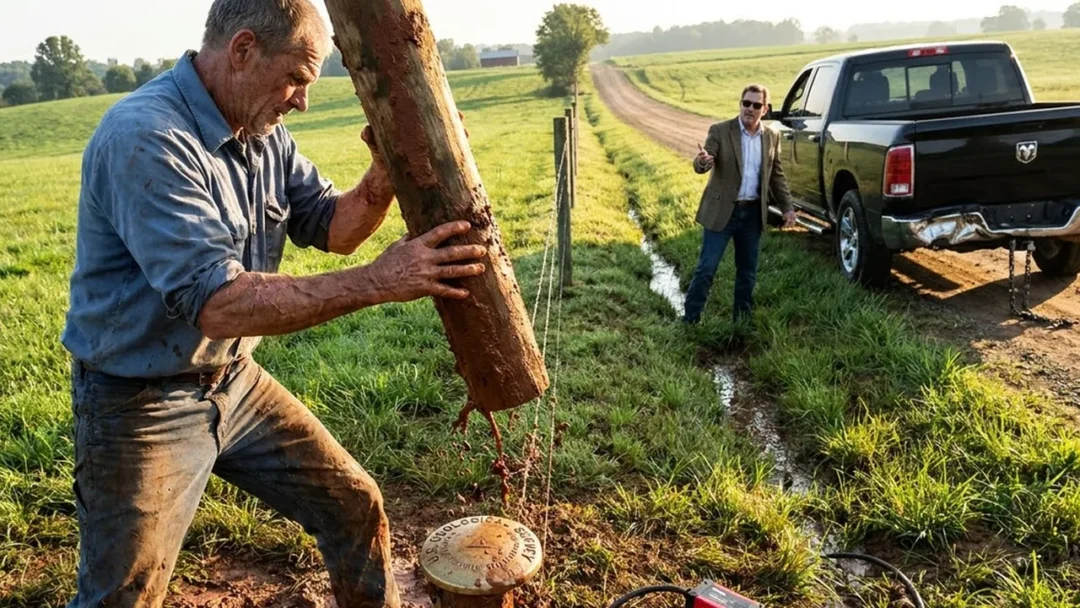
A brand-new, customized midnight-black four-wheel-drive luxury pickup truck sat with its oversized all-terrain tires spinning furiously in the grass, kicking up rooster tails of shredded sod and black loam. Tied to the truck’s heavy-duty steel receiver hitch was a half-inch high-test transport chain, its opposite end wrapped three times around a weathered, six-inch-diameter rough-hewn white-oak fence post.
Behind the wheel, revving the truck’s four-hundred-horsepower V8 engine until the twin exhaust pipes roared like a motorboat, was Julian Sterling.
Julian was forty-one years old, sleek, tanned, and dressed in imported equestrian polo apparel and hand-burnished designer country-club leather boots. Julian was the managing partner of Sterling Crest Estates—a luxury gated residential golf community being constructed on the neighboring parcel. For three months, Julian had been attempting to bully Everett Douglas into signing an easement agreement that would shift the legal property boundary ten feet westward into Everett’s prime grazing pasture, allowing Julian to construct a four-lane paved boulevard and landscaped entrance gate for his multi-million-dollar estate homes.
Everett had refused every cash offer, citing a century of family stewardship. Frustrated by the delay, Julian had brought a commercial landscaping crew and a heavy-duty pickup truck to the property line at dawn, intending to rip out the corner post, reset the wire, and present Everett with a fait accompli before the county courthouse opened.
“Floor it, Mr. Sterling!” shouted Dale Watson, a burly commercial grading foreman standing ten feet back in the pasture. “Give it all the torque you’ve got! If that post doesn’t move, we’ll snap the timber in half!”
Julian mashed the accelerator pedal to the carpet.
ROOOOOAAAR!
The heavy pickup truck lurched forward with violent, four-wheel-drive traction. The half-inch transport chain snapped taut with a terrifying metallic hum, vibrating like a high-tension harp wire.
The six-inch white-oak post—sunk four feet deep into the dense, compressed Piedmont clay—did not yield a single millimeter.
The response from the truck was catastrophic.
Instead of extracting the post, the sudden kinetic shockwave reached the structural shear limit of the pickup’s modern composite frame mounting brackets. With a deafening, explosive tearing crash that sounded like a freight car jumping the rails, the truck’s entire rear plastic bumper assembly, chrome hitch receiver, and spare tire carrier were ripped violently from the chassis.
The severed bumper and chain hurtled through the air, crashing into the tall pasture weeds in a tangle of crumpled plastic, severed electrical wiring, and mangled steel. The truck, suddenly released from the resistance, shot forward fifteen feet across the turf before Julian slammed on the brakes, cursing hysterically as blue radiator steam and smoke poured from beneath the vehicle.
“Dammit to hell!” Julian screamed, kicking open the driver’s door and marching into the weeds, his face flushed scarlet with venomous rage. “What kind of backwater nonsense is this?! That post has to be cemented four feet deep into solid bedrock! Get the commercial backhoe down here from the clubhouse site, Dale! Bulldoze this entire fence line into matchsticks!”
From the edge of the adjacent timber barn fifty yards away, a tall, spare figure walked steadily across the dewy grass.
Everett Douglas was seventy-six years old, standing six feet one inch tall, lean and straight as an old hickory walking staff in a faded denim work shirt, patched canvas trousers, and scuffed leather work boots. His silver hair was cropped close beneath a worn canvas field cap, his face weathered by sixty years of agricultural labor into lines of calm, unshakeable dignity.
In his right hand, swinging gently with his stride, was a simple two-gallon galvanized steel bucket filled with cold water drawn from the farm’s deep limestone well.
Everett walked past the shattered bumper, paused beside the smoking pickup truck, and looked down at the angry developer with pale, calm blue eyes.
“You’re wasting your gasoline, Julian,” Everett said softly, his voice carrying the deep, unhurried resonance of the Blue Ridge foothills. “It’s not cemented in. It’s just four feet of Piedmont clay. You’re trying to fight thirty tons of atmospheric vacuum with horsepower.”
Julian scoffed, kicking a fragment of his broken plastic bumper into the ditch. “Don’t talk down to me, old man! That post broke a six-thousand-pound transport chain! You couldn’t move that post with a team of draft oxen!”
Everett did not answer. He set the water bucket down on the grass beside the weathered oak timber, rolled his sleeves past his scarred, vein-corded forearms, and knelt beside the post.
The geotechnical characteristics of the Piedmont province of Virginia are defined by the Cecil soil series—a deep, well-drained soil formed from weathered felsic igneous and metamorphic rock such as granite, gneiss, and mica schist. Characterized by a high subsoil clay content exceeding fifty percent by weight, Cecil clay possesses a high plasticity index and remarkable shear strength when desiccated. The microscopic clay platelets, consisting of alternating tetrahedral silica and octahedral alumina sheets, align horizontally under overburden pressure, forming an impermeable, highly cohesive matrix. When an un-tapered wooden post is driven into this clay profile, the surrounding soil undergoes intense consolidation, squeezing out moisture and creating an intimate capillary adhesion between the rough cellulose fibers of the oak bark and the colloidal clay particles. Under dry conditions, this adhesion produces skin-friction values exceeding fifteen hundred pounds per square foot of buried surface area, generating an anchor effect that can withstand thousands of pounds of static tensile pull.
The construction methods utilized in boundary fencing along the Blue Ridge Piedmont represent an ancient synthesis of forestry and physical geography. In the early twentieth century, prior to the widespread commercial availability of pressure-treated Southern yellow pine infused with chromated copper arsenate, mountain farmers relied almost exclusively on split black locust and white oak heartwood. White oak (Quercus alba) is renowned for its high concentration of tyloses—balloon-like outgrowths of parenchyma cells that completely plug the vascular xylem vessels during heartwood conversion, rendering the wood virtually impervious to water penetration, fungal colonization, and terrestrial insect rot. When a dense, green oak timber is harvested in the winter dormancy period and cured in a shaded barn, the wood undergoes minimal radial checking, producing a structural column that can endure in saturated subterranean environments for over eighty years without structural decay.
The cultural history of the Piedmont boundary disputes traces back to the early land grants issued by Thomas, Lord Fairfax, the proprietor of the Northern Neck Proprietary. In the eighteenth century, original land patents were surveyed using Gunter’s chains—sixty-six-foot linked iron chains comprising one hundred links—and crude magnetic compasses known as surveyor’s circumferentors. Over two centuries, original oak and chestnut boundary witness trees died, decayed, or were cut down for firewood, leading to complex litigation between farming families and newly arriving suburban estate speculators. To permanently resolve these overlapping metes-and-bounds claims, the Commonwealth of Virginia partnered with the federal government following the first World War, deploying joint engineering corps to re-survey the Piedmont and plant geodetic bronze benchmarks at critical section corners.
The generational conflict between family agriculture and speculative residential sprawl in the northern Virginia Piedmont was an accelerating economic crisis. Over the preceding two decades, soaring land valuations driven by tech executive wealth had increased rural property tax assessments by over four hundred percent, forcing dozens of multi-generation farming families into distressed sales. Speculative developers like Julian Sterling targeted contiguous parcels bordering established transportation easements, utilizing aggressive legal maneuvers, nuisance lawsuits, and questionable easement claims to break the economic resolve of elderly landowners. Everett Douglas had watched three neighboring cattle operations succumb to this pressure, their rolling pastures bulldozed into suburban cul-de-sacs and manicured lawns. But Everett’s roots ran as deep as the white oaks along the creek; he had pledged to his dying father that as long as his boots could walk the fence line, the family pasture would remain open to the Virginia sky.