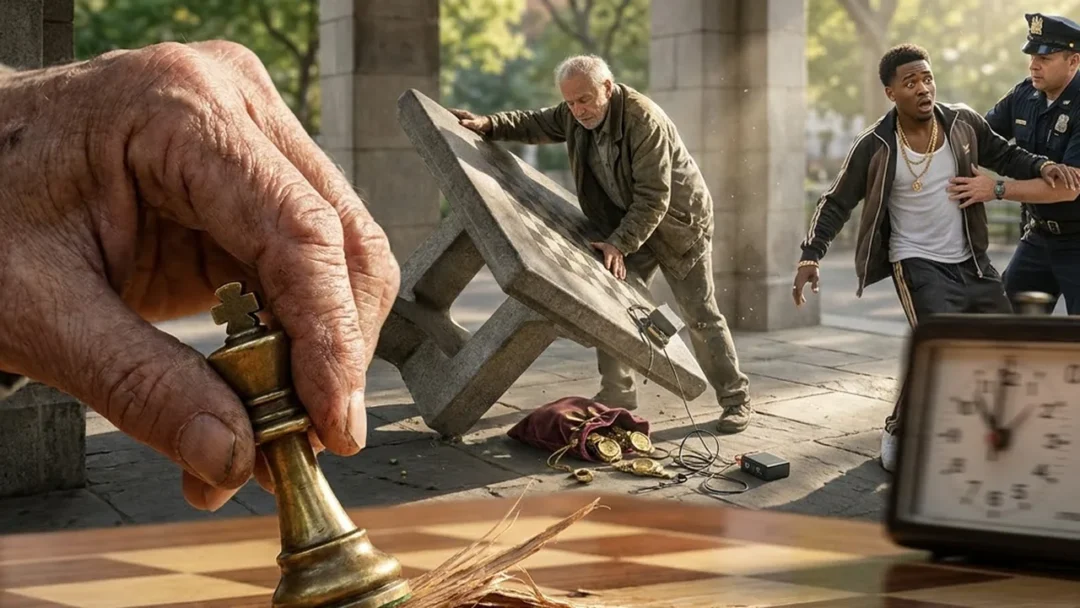
The Four Finger Pushup And The Magnetic Chess Hustler Trap
CHAPTER 1: THE FOUR FINGERS OF WASHINGTON SQUARE
The afternoon sun filtered through the golden autumn canopy of the century-old English elms in Washington Square Park, casting intricate, dancing patterns of light and shadow across the stone chess pavilion at the southwest corner of the grounds. It was three o’clock on a vibrant Saturday in Greenwich Village. The air was alive with the iconic sensory symphony of Manhattan: the distant wail of a siren on Sixth Avenue, the acoustic strumming of a folk guitarist beside the marble arch, the clacking of skateboard wheels against granite curbs, and the rapid, rhythmic, aggressive slapping of analog chess clocks.
Here in the open-air pavilion, where Bobby Fischer and Stanley Kubrick had once tested their minds over wooden boards, twenty heavy picnic tables constructed of cast concrete and reinforced timber slabs played host to a diverse fraternity of grandmasters, NYU mathematics prodigies, tourists, and hardened street hustlers.
Beside table seven, positioned along the perimeter stone retaining bench, an elderly man was engaged in a physical warmup that caused passing students to halt in their tracks.
Leonid Varga was seventy-nine years old, a Hungarian-American whose silver hair and beard were trimmed with meticulous European precision. He wore a tailored charcoal wool tweed vest over a crisp white linen shirt with the sleeves turned back to his forearms, dark wool trousers, and hand-lasted leather oxfords. Despite his advanced age, his posture was as straight and rigid as an architectural plumb line, his shoulders sloping with the dense, functional musculature of an artisan who had spent his life working with physical materials.
Leonid was balanced horizontally above the concrete pavement, his boots elevated three inches off the ground on the curb, his body perfectly straight in a rigid plank.
He was performing slow, deep push-ups. But his palms were not resting flat on the stone.
His entire body weight—one hundred and sixty-two pounds of living bone and sinew—was supported entirely upon the rigid, unbending tips of four digits: the distal phalanges of his left and right thumbs, and the distal phalanges of his left and right index fingers.
There was no tremor in his wrists, no sagging of his lumbar spine, and no strain in his breathing.
His fingertips did not buckle or collapse into hyperextension; they were anchored into the stone like four solid titanium pillars, bearing the compressive load through dense fibrocartilage pads that had been forged across sixty years of professional labor. For half a century, Leonid had served as the chief concert technician and action regulator for the prestigious Steinway & Sons piano manufactory in Queens, spending eight hours a day adjusting the microscopic key-dip tolerances, damper springs, and heavy cast-iron wrest-planks of concert grand pianos. His index fingers and thumbs possessed an unyielding, caliper-like pinch strength that could manipulate fifty pounds of mechanical spring tension without the slightest fatigue.
He lowered his chest until his wool vest brushed two inches above the cold stone, held the static pause for a two-count, and pressed back up with machine-like smoothness.
Ten feet away, leaning against the wooden backrest of table eight, Damon Cross stood watching with an amused, predatory smirk.
Damon was twenty-six years old, sharp-featured, wearing an oversized designer streetwear hoodie, layered gold chains that clinked against his collarbone, and pristine high-top basketball sneakers. Damon had dominated the southwestern tables of the park for three years, styling himself as the undisputed blitz champion of the Village. To the casual tourist, Damon was a flashy speed-chess virtuoso who offered five-minute games for twenty dollars. But to the regular hustlers of the park, Damon was known as a ruthless operator who used speed psychology, continuous verbal badgering, and dirty table tricks to rob unsuspecting visitors of their cash.
Damon pulled a crisp roll of twenty-dollar bills from his pocket, peeling off a hundred-dollar note and slapping it down onto the center of his heavy wooden chessboard.
“Save your fingertips, pops!” Damon called out, flashing a gold-capped canine tooth as he tapped his digital clock with the flat of his palm. “This isn’t a Shaolin monastery! The real game is played with the clock! Two hundred bucks blitz—three minutes on the timer, zero increment! You think your old eyes can keep up with the Village lightning, or are you just here to do gymnastics for the college kids?”
Leonid finished his twelfth repetition, stepped his boots smoothly down to the pavement, and stood upright. He brushed a speck of stone dust from his fingertips, adjusted his silver cufflinks, and looked at the young hustler with calm, analytical grey eyes.
“The mind moves the hand, young man,” Leonid said softly, his voice carrying the rich, melodious lilt of old Budapest. “And the hand reveals the character. Two hundred dollars. I accept your wager.”
Leonid walked over to the concrete table and took a seat on the opposite wooden bench, his hands resting lightly on his knees.
Damon grinned, setting up his pieces with blinding speed. But as Damon reached beneath the table to adjust his chair, his left knee brushed a concealed toggle switch hidden behind the decorative wooden skirt of the tabletop.
Deep within the thin plywood veneer beneath the board, a microscopic circuit closed.
The physiological adaptations required to perform two-finger push-ups represent an extreme manifestation of digital tendon and bone remodeling. In the human hand, the distal phalanges of the thumb and index finger are supported by the flexor pollicis longus and flexor digitorum profundus tendons, which glide through narrow fibrous retinacular pulleys known as the A1 and A2 annular ligaments. In an untrained individual, subjecting these delicate digits to axial compressive loads exceeding forty pounds causes immediate hyperextension of the distal interphalangeal joint, risking acute volar plate avulsion and collateral ligament rupture. However, through six decades of high-resistance manual craft—specifically the repetitive, heavy pin-torque and key-dip regulation required in concert grand piano restoration—Leonid’s annular pulleys had undergone fibrocartilaginous metaplasia, transforming into dense, calloused sheaths capable of sustaining compressive axial stresses that rivaled the cortical bone density of elite gymnast rings specialists.