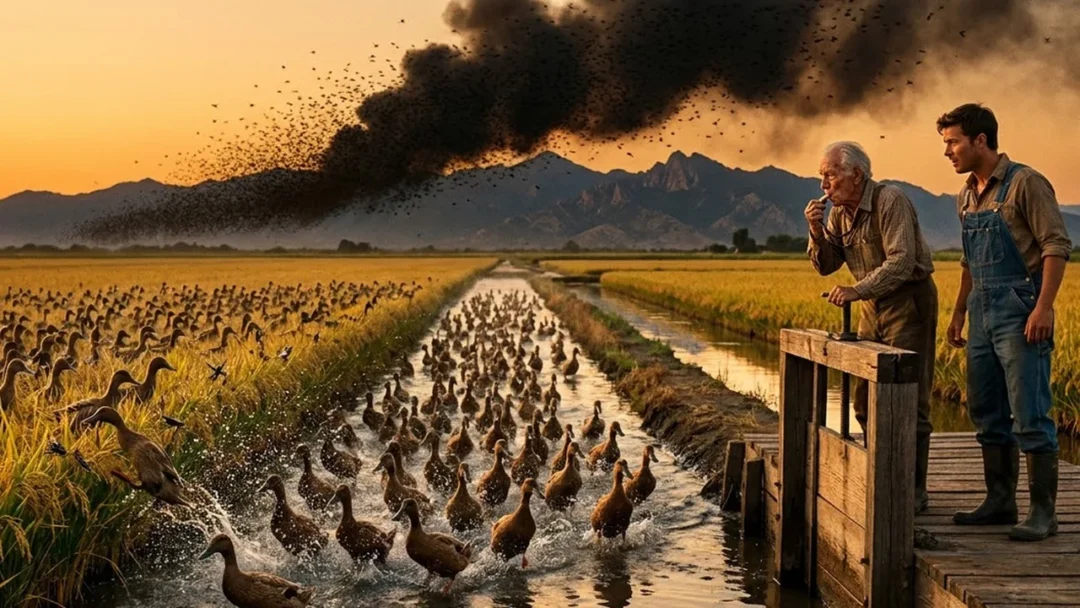
The Golden Rice Harvest And The Battalion Of Runner Ducks
CHAPTER 1: THE DARKENING MERIDIAN
The midday heat over Blackwillow Valley felt like a hot iron pressed against the back of Julian Vance’s neck, thick with the scent of sun-baked silt, wild mustard, and ripening grain. Beneath his heavy rubber work boots, forty continuous acres of heirloom Calrose rice stood in undulating, pristine sheets of pale amber and burnished gold. The water beneath the stalks, drawn from the cold snowmelt canals of the Upper Sacramento basin, was clear enough to reflect the vast, cloudless dome of the California sky. Each heavy head of grain bowed low toward the waterline, swollen with starches that had taken five months of relentless labor to mature.
Three days remained until the custom combine harvesters were scheduled to rumble down the gravel county road from Colusa. Three days stood between Julian and the final release of the mortgage note his late father, Thomas Vance, had carried like a lead weight across his shoulders for twenty-four brutal years. Julian knelt on the narrow dirt berm separating lateral canal four from the main paddy basin. He reached out with calloused, dirt-stained fingers, gently cradling a single drooping panicle of rice. The kernels were plump, pearlescent beneath their dry husks, firm and unyielding under the steady pressure of his thumb.
If the grain dried properly on the stalk and the regional organic grain exchange took delivery by Friday morning, the Vance homestead would finally be free of debt. Julian could clear the property tax liens, replace the cracked intake culvert on the north levy, and purchase certified heirloom seed stock for the coming spring planting. But if anything went wrong—if the moisture dropped too quickly, if the mildew bloomed, or if the market rejected the shipment—the Valley Agricultural Credit Bank would exercise its ruthless default clause by five o’clock Monday afternoon. The foreclosure auction sign was already printed, sitting on the loan manager’s desk in town like a loaded revolver.
The history of Blackwillow Valley was etched into every furrow. Thomas Vance had dug the lateral feeder ditches by hand during the drought of ninety-seven, hauling river rocks in an old wheelbarrow to line the banks and prevent erosion. He had taught Julian that soil was not dirt; it was a living community of fungi, earthworms, and microscopic bacteria that took a century to build and a single careless afternoon of chemical poisoning to extinguish. Every harvest season was a quiet referendum on whether that philosophy could endure against the industrial conglomerates expanding northward from the central valley.
A low, vibrating murmur stirred along the southern horizon, faint at first, like the distant rumble of an overloaded freight train climbing through the basalt cuts of the Coast Range passes. Julian lifted his head, wiping a sleeve across his brow and shading his eyes with the frayed brim of his canvas work cap. The sky over the southern foothills was usually a sharp, piercing sapphire in late September, scrubbed clean by prevailing mountain thermals. Today, however, a greasy, slate-gray smudge crawled along the crest of the scrub ridges, rising in jagged, unnatural billows that defied the wind.
The sound swelled with alarming rapidity. It was not diesel exhaust from highway transport rigs, nor was it wildfire smoke drifting from the dry timber stands of the high country. It was a dry, frantic clicking—the sound of millions of brittle, parchment-thin wings beating against the stagnant heat, amplified into a deafening, metallic roar that made the glassy surface of the irrigation canal tremble with concentric ripples.
“Julian! Shut the headgates! Shut them down right now before they hit the lower basin!”
The frantic scream came from the farm access road. Julian spun around to see a battered, mud-splattered red flatbed pickup skid to a halt against the gravel berm, throwing up a blinding rooster tail of pale limestone dust. Clint Murdock leaped down from the driver’s side, slamming the rusted cab door with a resounding bang that echoed across the water. Murdock was a broad-shouldered man in his late forties, with sun-reddened skin, eyes permanently narrowed from decades of staring into chemical mist, and a heavy aluminum clipboard clutched tightly in his fist like a club. Mounted on the bed of Murdock’s truck, two fifty-gallon polyethylene tanks of commercial pesticide sloshed violently with a pale, sulfurous amber liquid.
“Look at the ridge, boy!” Murdock shouted, pointing a thick, scarred forefinger toward the southern treeline where the tree branches were already vanishing behind a swirling gray haze. “Black-spotted desert locusts. A rogue northern flight out of the Great Basin scrub. They just stripped the Henderson orchards down to bare bark twenty minutes ago! The fruit is gone, the foliage is sawdust, and now they’ve caught the thermal draft straight down into this valley! They’re hitting the valley floor right now!”
Even as Murdock spoke, the leading edge of the swarm struck the perimeter wire fence. The sound was like a sudden, violent downpour of coarse gravel pelting against a dry tin roof. Hundreds of heavy, three-inch insects collided with the pickup truck’s windshield, their dark bodies smearing into greasy yellow paste under the wipers. Millions more dropped into the rice paddies, clinging instantly to the golden grain stalks with sharp, serrated legs that locked like iron clamps. Julian watched in mounting horror as five insects latched onto the very head of rice he had been admiring moments before. In less than three seconds, their powerful mandibles severed the delicate grain stems, chewing through the tender starches and dropping the shattered husks into the muddy water below.
“They’ll eat forty acres in an hour!” Julian yelled, his voice cracking against the overwhelming, deafening roar of insect wings. “The mobile sprayers are parked in the north barn, but the pump lines are clogged with silt from yesterday’s ditch clearing! We can’t build pressure!”
Murdock lunged forward, thrusting the aluminum clipboard directly into Julian’s chest. “I have two pressurized spray trucks idling at the highway junction, loaded with concentrated methyl-parathion. I can blanket this entire forty-acre basin in fifteen minutes flat, Vance. But it’s an emergency priority dispatch. Three hundred dollars an acre, plus a priority lien against the harvest deed. Sign the chemical authorization right here, or watch your family’s forty acres turn into chopped straw before the sun drops behind the willows.”
Julian stared at the contract. The fine print was a spider’s web of predatory legal covenants. Signing Murdock’s lien meant surrendering seventy percent of the crop’s net value before the combines even arrived, leaving the farm unable to meet the bank’s principal repayment. Worse still, methyl-parathion was a persistent organophosphate; spraying it three days before harvest would instantly violate his certified organic grain contract with the San Francisco millers, forfeiting the premium pricing that kept the farm solvent. Yet all around him, the rice stalks were shuddering under the weight of the invaders. Tens of thousands of voracious mouths were already clicking, tearing, and snapping the golden stems like brittle toothpicks. Every second of hesitation sounded like the ticking of an executioner’s clock.
Before Julian’s trembling pen could touch the signature line, a weathered, dirt-encrusted hand clamped down over Murdock’s wrist with the steady, unyielding pressure of a steel vice.
“Put the poison away, Clint,” a quiet, raspy voice commanded. “And get that predatory clipboard off this boy’s land.”
Julian turned. Standing on the canal levy behind them was Silas Thorne. The sixty-eight-year-old state agronomist was clad in faded denim overalls, patched thigh-high rubber waders, and an unbuttoned flannel shirt faded by years of river sun. Around his neck, suspended by a grease-darkened leather thong, hung an antique, notched brass field whistle. Silas looked past Murdock toward the darkening sky, his pale blue eyes utterly devoid of panic.
“You’re out of your mind, Thorne!” Murdock spat, jerking his arm free with an angry snarl. “This isn’t an academic biology class. This is forty acres of dry-ripened grain under attack by five million locusts. Organic fairy tales won’t stop them! If he doesn’t spray poison right now, he loses everything!”
Silas did not even look at Murdock. He kept his calm gaze fixed on Julian. Slowly, the old ecologist raised the brass whistle to his lips. “Chemical spray will kill the spiders, poison the river runoff, and leave your grain condemned by the state organic board, Julian. Open the marsh floodgates. Release the wetland battalion.”