The Iron Tendons Of The Forgotten Commander At Mile Marker Four
CHAPTER 1: THE HORIZONTAL POST
The salty Atlantic wind gusted off the granite cliffs of Penobscot Bay, rattling the rusted sheet-metal awning of the solitary bus shelter at Mile Marker Four. It was ten minutes past seven on an overcast Tuesday morning. Route One stretched north toward Rockland like a ribbon of damp black slate, deserted save for the occasional logging hauler whose Jake brake rattled through the morning fog like distant artillery.
The air along this forgotten stretch of coastal Maine was bitter with the scent of brine, low-tide kelp, and damp pitch pine. For over a century, the families of Knox County had depended on the cold water and the timber barrens, forging men whose bodies were shaped not in heated athletic facilities, but against the brutal, unyielding resistance of wet cordage, iron rigging, and frost-crusted granite.
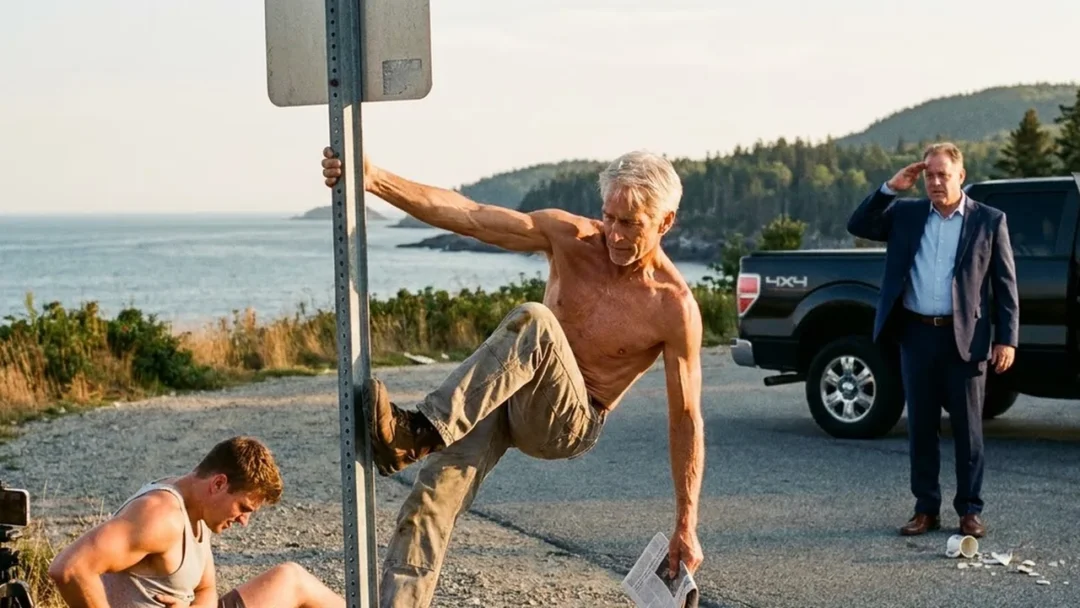
Arthur Vance leaned against the galvanized three-inch steel signpost that anchored the county transit marker into the gravel shoulder. Arthur was seventy-four years old, standing five feet ten inches in patched canvas overalls, heavy wool flannel, and grease-darkened oilskin boots with worn steel toes. His silver hair was cropped close in a style forty years out of date, his skin weathered by decades of North Atlantic spray, diesel exhaust, and winter sleet until it resembled cured bridle leather. In his right hand, he held a folded copy of the weekly coastal rigger’s gazette, casually scanning the classified advertisements for second-hand hydraulic winch assemblies and surplus salvage blocks.
His lower lumbar spine—compressed during an emergency deep-water salvage operation off the Grand Banks decades ago—gave a dull, persistent throb in the damp coastal cold. For forty years, Arthur had worked the heavy rigging yards along the Gulf of Maine, handling three-inch manila hawsers stiffened with frozen sea spray and maneuvering ten-ton steel mooring anchors without the luxury of motorized hydraulics. In those forgotten boatyards, men did not build muscle for display or vanity; they developed an unyielding, dense connective tissue that bound tendon to periosteum like iron bands. An injury on the slipway did not result in six weeks of physical therapy in a climate-controlled clinic; it was walked off against the freezing wind, tempered by salt and stubborn silence. Most men of seventy-four would have reached into their coat pocket for a bottle of anti-inflammatory pills or eased their aching joints onto the splintered wooden bench inside the drafty bus shelter. Arthur Vance did neither.
To Arthur, pain was simply a mechanical indicator—a sensor signaling that the biological machine required decompression and realignment. The human spine was designed to bear compressive loads, but decades of vertical gravitational strain caused the intervertebral discs to flatten and pinch the sciatic roots. To counteract that compression, Arthur had developed an uncompromising daily mobility ritual: he hung from shipyard cranes, suspended his body from cargo nets, and utilized rigid vertical posts to stretch the deep psoas and transverse abdominis under maximal isometric tension.
Instead, he folded the maritime gazette neatly beneath his left armpit, turned squarely toward the vertical steel signpost, and set his hands to the metal.
His technique was born of ancient maritime rigging discipline, completely divorced from the modern gym calisthenics seen on digital screens. His lower right palm locked into the galvanized steel pipe at waist level, the base of his thumb driving directly into the centerline of the cylinder, his wrist locked in a rigid, ninety-degree angle of pure compressive support. His upper left hand caught the steel eighteen inches above his head, his long, calloused fingers wrapping the zinc casing in a vicious opposition clamp. There was no hesitation, no nervous shifting of footing, and no preliminary bobbing of his hips.
Arthur simply drew a measured breath of salt air into the bottom of his diaphragm, engaged the deep fascial sheath of his core, and leaned outward into the void.
To any bystander, the maneuver defied the elementary laws of terrestrial mechanics. Arthur’s heavy oilskin boots lifted cleanly from the crushed limestone gravel with the silent, fluid grace of a counterweighted bridge. His legs came together with military precision, ankles locked, knees straight as steel beams, toes pointed slightly down to align the posterior chain. With zero momentum and zero swinging, his entire torso pivoted ninety degrees into the horizontal plane.
He held his entire body suspended parallel to the gravel highway shoulder, hovering four feet above the dirt like an iron weather vane.
The biological strain required to maintain such an alignment was immense. The human flag is widely recognized as one of the most grueling feats of relative bodyweight strength, placing astronomical rotational shear on the external obliques, the serratus anterior, and the latissimus dorsi. Yet Arthur Vance’s face remained completely smooth. His breath flowed in slow, rhythmic nasal cycles. Beneath the thick wool flannel of his sleeves, the tendons in his forearms stood out like braided wire hawsers, transferring tons of rotational torque from his knuckles directly into his skeletal frame without a quiver.
Still suspended in mid-air on the vertical pole, Arthur casually reached up with his free left hand, retrieved the folded maritime gazette from his armpit, shook it open against the ocean breeze, and calmly resumed reading an article on marine diesel injectors, his heavy boots floating dead-level in the Atlantic gale.
Thirty yards away on the asphalt apron of an abandoned service garage, a customized matte-black four-wheel-drive pickup truck sat idling, its twin chrome exhaust pipes purring with a low, menacing rumble.
Beside the polished front bumper stood Brody Caldwell, twenty-three years old, holding an expensive carbon-fiber stabilization rig mounted with a high-resolution cinematic video camera. Brody stood six feet two inches tall and weighed two hundred and ten pounds of dense, heavily tanned muscle. He wore a neon-green sleeveless compression jersey, tailored athletic joggers, and imported gym lifting shoes. For the past forty minutes, Brody had been recording short-form fitness tutorials for his two million online subscribers, preaching the gospel of cosmetic bodybuilding, protein powders, and machine-isolated hypertrophy.
Brody had stopped mid-sentence when the silver-haired stranger floated horizontally into the air. He lowered his wireless microphone, staring across the highway shoulder with his mouth hanging half-open in utter disbelief.
Then, the modern influencer’s defense mechanism clicked into gear. Brody’s disbelief transformed into a smug, dismissive smirk. In Brody’s worldview, true physical capability was strictly quantified by gym memberships, sponsored protein shakers, and six-figure follower counts. The idea that a scruffy, pensioner-aged dock rigger in muddy boots could perform an advanced calisthenic hold that Brody himself could only maintain for three sloppy seconds was an existential insult.
“Yo, bro, you seeing this garbage?” Brody muttered to his cameraman, turning the camera lens directly toward the bus stop. “Look at the old guy by the bus sign. He thinks he’s slick. Look at his waistline under that baggy coat! There is no way in hell a seventy-something pensioner has that kind of rotational core torque. Look for the hidden wire on his belt! He’s got an industrial climbing harness and a steel foot-bracket hidden under those dirty overalls to fool the tourists for pocket change.”
Brody strutted across the two-lane highway, laughing loudly for the benefit of his live microphone.
“Hey, grandpa!” Brody yelled, crossing the ditch. “Nice carnival trick! Who welded the bracket into your work boots? How much did that suspension harness cost you on Amazon?”
Arthur did not glance down from the newsprint. He reached the bottom of the article, carefully folded the gazette in half, and tucked it securely into his breast pocket. Then, with the same smooth, effortless deceleration of an electric industrial crane, he lowered his boots back to the earth.
His heavy leather soles met the crushed limestone shoulder without kicking up a single grain of dust. He turned his weathered grey eyes upon the strutting young man.
“No wires, son,” Arthur said quietly, his voice carrying the deep, gravelly rasp of an old marine diesel. “Just fifty years of hauling ship ropes, wet hawsers, and anchor chains. Your turn.”