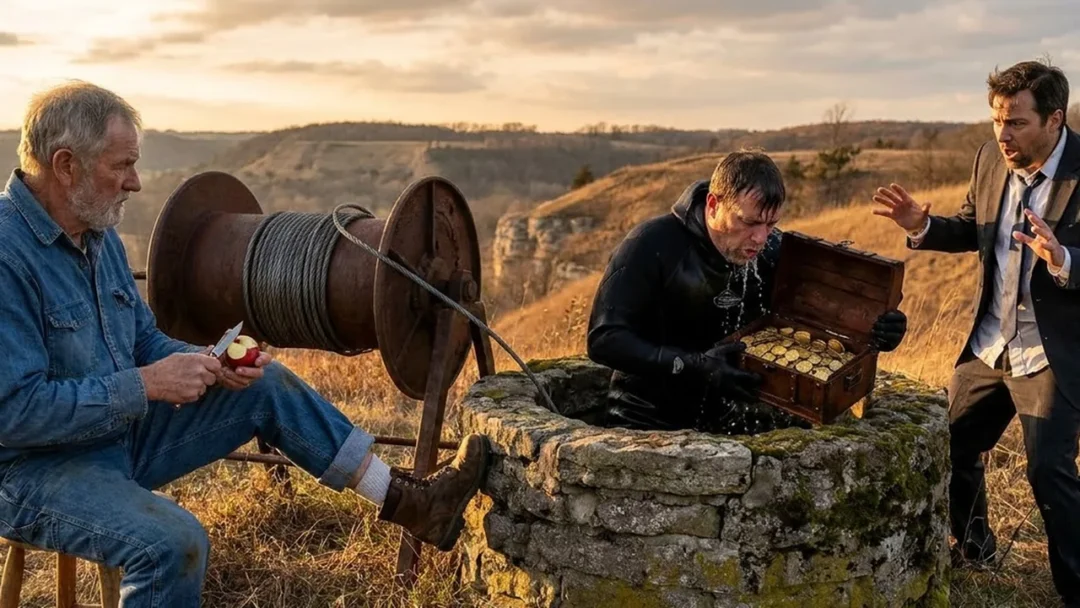
The One Hundred Fifty Kilogram Winch Cable And The Well Vault
CHAPTER 1: THE BOOT ON THE DRUM
The late afternoon breeze swept across the limestone bluffs of the Driftless Area in Vernon County, Wisconsin, carrying the clean, cool scent of wild prairie clover, damp river sand, and the ancient mineral water of the Mississippi watershed. Unlike the flattened prairies of the surrounding Midwest, this rugged, unglaciated enclave of southwestern Wisconsin had escaped the crushing weight of prehistoric continental ice sheets, preserving deep coulees, sheer dolomite palisades, and subterranean karst aquifers that had supplied cold, pure artisan water to indigenous peoples and nineteenth-century pioneer farming families for hundreds of years.
Standing beside an antique, five-foot-diameter circular well curb constructed from hand-chiseled Prairie du Chien dolomite blocks in eighteen-fifty-eight was Arthur Vance. At seventy-four years old, Arthur was a third-generation Wisconsin dairy master, licensed deep-well driller, and former hydraulic mining mechanic who had spent five decades maintaining municipal pump stations, gravity-fed spring systems, and agricultural irrigation conduits across the upper river valley. He was lean, wide-shouldered, and weathered by seven decades of outdoor labor into the quiet, unyielding density of native burr-oak heartwood, dressed in patched denim dungarees, a faded hickory-striped work shirt with the sleeves rolled above scarred, rope-corded forearms, and eight-inch heavy-lugged bull-hide work boots.
Arthur was sitting comfortably on a low, three-legged milking stool beside the well curb. In his left hand, he held a crisp, red Honeycrisp apple harvested from his orchard that morning; in his right hand, a polished carbon-steel pocketknife with which he was leisurely whittling off paper-thin translucent slices of fruit, chewing each bite with slow, unhurried contemplation.
What commanded the eye, however, was Arthur’s right leg.
His right leg was extended straight out horizontally from his hip, locked at an unyielding hundred-and-sixty-degree angle, pressing the thick, oil-resistant vulcanized rubber sole of his heavy work boot firmly against the smooth, six-inch cast-iron drum of the well’s manual timber windlass.
Spooling off the iron drum and descending sixty feet straight down into the black, echoing depths of the limestone shaft was a half-inch high-test braided aircraft-grade steel winch cable. The cable was stretched drum-tight, quivering with an intense, high-frequency acoustic hum that vibrated through the wooden windlass frame. The sheer physical tension indicated that suspended in the dark void halfway down the shaft was a massive, immovable deadweight load—at least one hundred and fifty kilograms, over three hundred and thirty pounds of dead ballast hanging in the subterranean void.
The biomechanical resistance required to hold such a load using only the friction of a boot sole against a polished cast-iron cylinder was extraordinary. Under standard mechanical physics, a half-inch steel cable wound around a six-inch drum under three hundred and thirty pounds of vertical tension exerts over eighty foot-pounds of rotational torque, enough to spin the heavy crank handle like an airplane propeller and shatter the bones of any limb caught in its path. Yet Arthur’s leg did not quiver. His quadriceps and calf muscles were locked in sustained isometric co-contraction, his knee joint functioning as a rigid structural strut that directed the entire crushing shear force straight through his heel into the solid limestone flagstones beneath his stool.
Pacing frantically back and forth across the flagstones three feet away, his face drenched in cold, greasy sweat despite the cool autumn breeze, was Thomas Sterling.
Thomas was forty-two, impeccably groomed with slicked-back thinning hair, wearing an expensive tailored tweed sports coat that was now rumpled and dirt-streaked, mud-spattered Italian leather boots, and holding a gold fountain pen trembling in his right hand. Thomas was Arthur’s junior business partner in the valley agricultural cooperative, a regional real-estate speculator who had spent six months attempting to persuade Arthur to abandon the ancestral farm and sign over water rights to an offshore investment consortium.
“Arthur, for God’s sake, release the brake!” Thomas pleaded, his voice climbing an octave into shrill, frantic desperation as he gestured wildly toward the well mouth. “The cable is hung up on a limestone shelf sixty feet down! The winch drum is going to shear its mounting bolts! If you snap that half-inch braided wire, the whole timber windlass will collapse into the shaft! Let the crank spin free and drop the dredging bucket before we ruin the entire casing!”
Arthur calmly sliced another delicate curl of apple with his pocketknife, slipped the fruit into his mouth, and looked up at his sweating partner with pale, unblinking blue eyes.
“The winch isn’t hung up on a rock shelf, Thomas,” Arthur said, his voice deep, gravelly, and steady as an anchor chain.
“Of course it’s a rock shelf!” Thomas yelled, taking a frantic half-step toward the windlass, his hands reaching out as if to physically shove Arthur’s boot from the drum. “It’s an abandoned nineteenth-century dry hole filled with toxic agricultural runoff! You told the county agricultural extension last week that the well was dead! There’s nothing down there but seventy feet of mud and broken limestone boulders!”
Arthur did not raise his voice. He chewed his apple, swallowed, and leaned forward slightly, his eyes boring straight through Thomas’s panic.
“Limestone rocks don’t breathe, Thomas,” Arthur said softly. “And rocks don’t tap three rhythmic distress signals on the cable when the slack goes out.”
Thomas froze, the color draining from his face until his skin looked like wet flour.
Arthur closed his pocketknife with a smooth, authoritative snap, slipping the blade into his pocket. Moving with deliberate, terrifying efficiency, Arthur reached out his right arm, grasping the heavy, two-foot cast-iron crank handle of the windlass with his bare hand while keeping his boot heel firmly wedged against the drum as a mechanical ratchet pawl.
He did not call for help. He did not ask for a lever.
With a single, explosive extension of his latissimus and bicep muscles—honed by fifty years of turning manual pipe dies and hoisting six-inch casing strings—Arthur cranked the iron handle upward through a half-rotation.
CLAAANK-CLICK.
The heavy steel pawl dropped into the gear tooth, taking up three inches of high-tension cable against the unyielding load.
CLAAANK-CLICK.
Arthur delivered a second, rhythmic heave, his forearm tendons standing out like iron cables beneath his rolled sleeves. Sixty feet below in the limestone shaft, the sound of splashing water and metallic scraping echoed up through the cold stone pipe.
CLAAANK-CLICK.
With a third powerful pull, the iron head-frame shuddered, and the heavy, dripping payload emerged through the surface of the well mouth, rising over the hand-hewn dolomite rim into the blinding afternoon sun.
Resting inside a heavy-duty, two-man welded iron dredging cage—suspended from the steel cable by an industrial swivel shackle—was a man clad in a dripping black neoprene professional drysuit, wearing an acoustic communication headset and full diving gear.
The diver was coughing violently, his face pale and shivering from the forty-degree aquifer water, his hands shaking with cold and panic. Clamped tightly between his arms, dripping black alluvial mud onto the limestone flags, was a heavy, iron-strapped, waterlogged leather chest secured with a corroded brass maritime padlock.
The diver looked up through his water-streaked faceplate at Thomas, his voice raspy and panicked through his microphone: “Thomas! He locked the winch from the top! He cut the air reserve line!”
Arthur Vance set the heavy steel safety pin into the windlass cog with a definitive metallic thud, stood up from his three-legged stool, and walked slowly to the well rim.
He reached down with his calloused right hand, grabbed the rusted brass latch of the waterlogged leather chest through the bars of the iron cage, and gave one sharp, calculated twist of his wrist.
SNAP.
The ancient, corroded iron bands gave way. The leather lid fell open.
Cascading across the wet limestone flagstones at Arthur’s boots came hundreds of heavy, gleaming, un-circulated nineteenth-century gold coins—eighteen-sixty-one Liberty Head twenty-dollar double-eagles and New Orleans mint gold specie, their pure twenty-two-karat surfaces shining like brilliant miniature suns beneath the mud.
Arthur looked down at the fortune in gold, then raised his gaze to meet Thomas Sterling’s trembling eyes.
“So that’s why you wanted to buy my dry well for twenty thousand dollars, Thomas,” Arthur said, his voice dropping into cold, lethal stillness. “You weren’t buying an old dairy farm. You were fishing out the payroll chest from the steamboat War Eagle.”
The mathematical and physical principles governing friction braking across a rotating cylindrical windlass drum are defined by Coulomb’s law of dry friction and the Euler-Eytelwein capstan equation. When a half-inch high-tensile steel wire cable descends sixty feet with a one-hundred-and-fifty-kilogram suspended deadweight, the vertical gravitational force exerts a continuous linear tension of three hundred and thirty pounds. To arrest this rotating kinetic energy without mechanical dogs or ratchet pawls, the operator must generate an opposing frictional torque that exceeds the product of the cable tension and the radius of the drum. By locking his knee joint at an angle of one hundred and sixty degrees, Arthur aligned his femur, patella, and tibia into an unyielding biological strut. The vulcanized nitrile-rubber sole of his heavy logging boot possessed a coefficient of static friction against oxidized cast iron of approximately zero point seven five. By exerting an isometric downward and lateral thrust of eighty pounds from his hip and core, Arthur generated over two hundred and forty pounds of normal frictional resistance across the iron cylinder, creating an absolute mechanical shear lock that halted the cable’s downward momentum with the unyielding finality of a hydraulic caliper brake.
The geological hydrodynamics of the Prairie du Chien dolomite formation in the Driftless Area represent one of the purest artisan groundwater systems in North America. Deposition of these dense, chert-bearing carbonate strata occurred during the early Ordovician period, creating thick, karstified limestone layers characterized by extensive secondary dissolution porosity, horizontal bedding planes, and vertical joint networks. Unlike glaciated regions where deep glacial till and impermeable clay overburdens restrict vertical percolation, the unglaciated bluffs of Vernon County allow rainwater to filter rapidly through hundreds of feet of fractured dolomite into cold, subterranean artisan reservoirs. The water maintained a constant temperature of forty-eight degrees Fahrenheit, pressurized by regional hydrostatic head from the surrounding highlands, emerging through natural cliff-side springs with a total dissolved solids count of less than two hundred parts per million. For over sixty years, Arthur had mapped the subterranean flow paths of these artisan veins, possessing an instinctual acoustic knowledge of the underground water that allowed him to detect the subtle cavitation hiss of a failing valve or a compromised casing string simply by pressing his ear against the cold iron wellhead.