The Sixty Kilogram Mortar Buckets And The Stolen Cement Wall
CHAPTER 1: THE BUCKETS ON THE PLANK
The crisp morning sun burned away the lingering autumn fog off the rolling limestone hills of Chester County, Pennsylvania, illuminating the grand, three-hundred-year-old fieldstone estate known as Brandywine Manor. Situated high above the historic waters of the Brandywine River, the property was a showcase of early American colonial architecture—its four-foot-thick stone barn walls, hand-hewn oak timber frames, and hand-pressed colonial red brick retaining terraces having withstood two centuries of mountain winters and spring floods.
High above the rear terrace, walking with steady, unhurried precision across a flexing, two-inch-thick by ten-inch-wide rough-sawn pine scaffold plank suspended eight feet in the air, was Frank DeLuca.
At seventy-two years old, Frank was a legendary master stone-mason, retired union bricklayer business agent, and veteran restoration contractor who had spent fifty-two years dressing limestone, laying structural brick, and building stone bridges across the mid-Atlantic. He was lean, straight-backed, and corded like an old hickory sapling, wearing washed denim dungarees, a faded gray chambray work shirt rolled past scarred, vein-corded forearms, and heavy, mud-stained red-wing work boots.
Carried in his bare hands—one in his left, one in his right—were two overflowing, heavy-gauge galvanized steel masonry buckets filled to the brim with freshly mixed, dense, wet mortar. Each bucket weighed precisely thirty kilograms—sixty-six pounds—representing a combined deadweight load of sixty kilograms (one hundred and thirty-two pounds) of dense, viscous mineral slurry.
The biomechanical mastery required to carry sixty kilograms of sloshing, semi-fluid mortar across an eight-inch-wide wooden scaffold plank without spilling a single drop was extraordinary. In dynamic physics, liquid and semi-solid slurries exhibit continuous internal hydrodynamic sloshing that creates unpredictable lateral harmonic oscillations, threatening to throw a worker’s center of gravity off a narrow balance beam with every step. To neutralize this momentum, Frank walked with the fluid, calculated cadence of a veteran mountain tightrope walker: his knees slightly flexed, his core abdominal muscles locked in continuous isometric stabilization, his shoulders relaxed to act as shock absorbers, his ankles making split-second micro-adjustments against the flexing timber plank. Not a single splash of gray mix escaped the rolled rims of the steel buckets.
Standing on the flagstone patio below the scaffold, holding a clipboard and checking his gold wristwatch, was Greg Sterling.
Greg was thirty-one, sporting a trimmed beard, a clean yellow safety vest over a designer hoodie, and spotless, expensive commercial work boots that had never touched wet cement. Greg was a fast-talking residential masonry subcontractor who had spent the last three days building a forty-foot-long, five-foot-high decorative brick retaining wall along the edge of the upper garden terrace.
“Hey, Frank! Come down off the scaffolding, man!” Greg shouted, his voice grating and sharp against the quiet valley morning. “The wall is finished! The bricklayers washed down the face at dawn. I’ve got my twenty-thousand-dollar final invoice ready, plus the material markup for the twenty bags of premium high-grade Type S Portland cement I used in the mix. Sign the completion voucher so I can get down to the bank before noon!”
Frank did not answer while on the plank. With smooth, deliberate economy of movement, he crossed the final ten feet of scaffolding, descended the structural steel ladder rungs with the sixty-kilogram load, and set the two steel buckets onto the flagstones beside the new brick wall.
The heavy steel bases met the stone with a dull, resonant thud. Not a drop of mortar had touched Frank’s trousers.
Frank stood up, wiping the cold well water from his palms onto his work apron, and looked down at Greg’s invoice. Then he turned his pale, unblinking blue eyes to the newly erected brick wall.
“Twenty bags of Type S Portland cement, Greg?” Frank asked softly, his voice carrying the deep, quiet gravel of a man who had mixed ten thousand tons of concrete with a square shovel.
“Twenty bags, certified on the delivery ticket!” Greg asserted, thrusting the clipboard forward. “Top of the line Lehigh Portland, four parts sand to one part cement. Strongest retaining wall in Chester County. You could drive a bulldozer into it!”
Frank did not take the clipboard. He walked slowly along the forty-foot length of the wall, his experienced eyes scanning the mortar joints.
The red modular clay bricks were laid in standard running bond, but the three-eighths-inch mortar beds were distinctly pale—a light, dusty yellow-gray rather than the deep, slate-charcoal gray characteristic of rich, properly hydrated Portland cement.
Frank reached the top corner of the wall, where the mortar had been struck late yesterday afternoon and had cured for nearly twenty hours.
He did not reach for an iron hammer. He did not pull an inspection chisel from his belt.
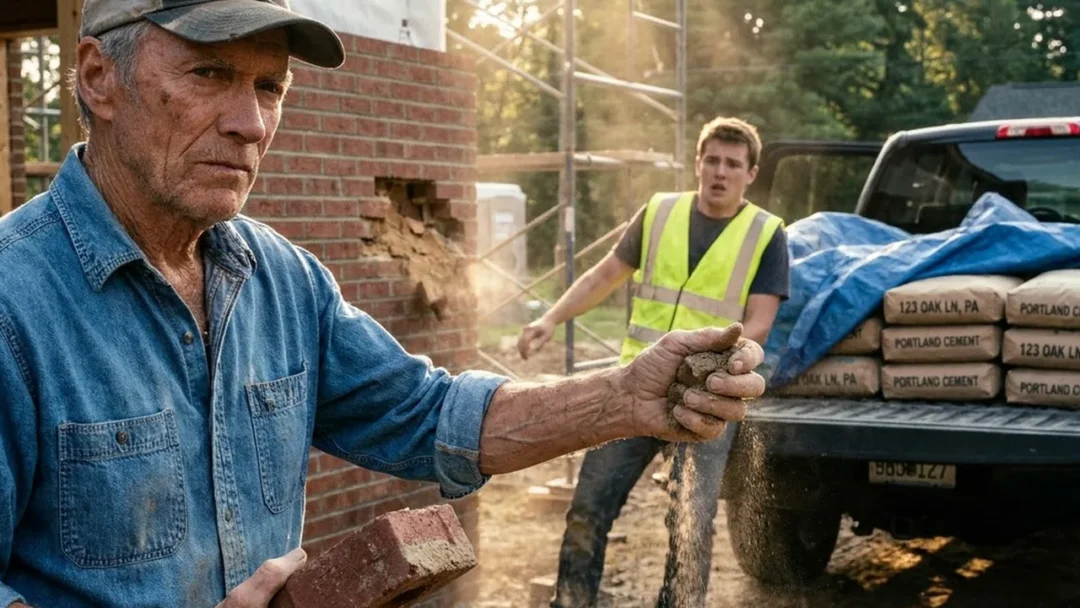
Frank reached out his bare right hand. He placed his broad, calloused thumb on the front face of the corner brick and wrapped his four fingers around the rear edge, clamping the burnt-clay brick with fifty pounds of concentrated tendon grip strength.
With a single, sharp, ninety-degree rotational twist of his wrist—a movement that should have required a cold chisel and a three-pound maul—Frank ripped the top brick cleanly off the wall.
CRUNCH.
The brick did not snap. The underlying mortar bed did not fracture in a clean structural plane.
Instead, the gray mortar joint beneath the brick completely disintegrated. Under the simple mechanical pressure of Frank’s fingers, the dried mix crumbled like a stale sugar biscuit, collapsing into a cascade of loose, dry, powdery yellow river sand that poured through his calloused knuckles and rained down over the toes of Greg’s polished work boots.
The chemical reality was undeniable: the mortar contained virtually zero cementitious binder.
Frank opened his palm, letting the remaining handful of dusty sand blow away in the morning breeze.
“Nine parts sand, one part cement, Greg,” Frank said, his voice dropping into cold, lethal stillness. “You didn’t use twenty bags of Portland cement on this wall. You used four bags to give the surface a gray dusting, and you mixed the rest with common bank sand. A heavy spring frost would have pushed this entire four-foot wall over into the garden, crushing anyone sitting on this terrace.”
Greg’s face turned an ashen white. He stepped backward, his voice cracking: “Wait… that’s impossible! The mixer must have had bad water—”
Before Greg could finish his lie, Frank casually tossed the loose red brick through the air, sending it straight into Greg’s chest.
“Catch,” Frank murmured.
The eight-pound brick slammed into Greg’s arms. The sudden weight caused the contractor to lose his footing, stumbling backward three steps until his spine collided violently with the tailgate of his customized black crew-cab pickup truck parked three feet away on the driveway.
BAM!
The impact of Greg’s body dislodged the blue plastic cargo tarp tied over the truck bed.
The heavy tarp slipped downward onto the gravel, exposing the truck’s cargo bay to the brilliant morning sunlight.
Stacked neatly on two wooden pallets inside the truck bed were twelve unopened, fifty-pound paper bags of high-grade Lehigh Type S Portland cement. And stenciled across the brown paper faces of every single bag in bright red industrial paint were the unmistakable words: BRANDYWINE MANOR RESTORATION — JOB 402.
Frank walked up to the open tailgate, rested his hand on the top bag of stolen cement, and looked into Greg Sterling’s trembling eyes with pale, merciless judgment.
“Unload my twelve bags of cement onto the terrace, Greg,” Frank commanded softly. “Then pack your tools and get off this estate before I call the building commissioner.”
The chemical and structural physics of Portland cement hydration is one of the most remarkable transformations in civil materials science. Certified Type S masonry cement is manufactured from a finely pulverized clinker composed primarily of tricalcium silicate (alite) and dicalcium silicate (belite), interground with precise proportions of natural gypsum and high-calcium hydrated lime. When mixed with potable water, the silicate compounds undergo an exothermic dissolution-precipitation reaction, generating millions of interlocking microscopic needle-like crystals of calcium silicate hydrate—known in materials engineering as tobermorite gel—and calcium hydroxide platelets. These crystalline fibrils grow across the microscopic void spaces between individual angular sand grains, interlocking the aggregate into an impenetrable, artificial monolithic stone with a twenty-eight-day compressive strength exceeding eighteen hundred pounds per square inch. Under ASTM C270 specifications, the volumetric ratio of washed masonry sand to cementitious material must never exceed three to one. When an unscrupulous contractor dilutes the batch to a nine-to-one ratio, the concentration of alite crystals is insufficient to bridge the interstitial voids, resulting in a friable, completely porous sand mass that possesses virtually zero tensile or shear bond strength.
The biomechanics of carrying sixty kilograms of sloshing liquid mass across an eight-inch scaffold plank represents an extraordinary human application of dynamic fluid dampening. In hydrodynamic physics, when a free-surface fluid is accelerated, it undergoes nonlinear sloshing modes that exert oscillating lateral inertial forces against the container walls, producing harmonic resonance that can instantly throw an un-braced human skeleton off balance. To neutralize these dynamic perturbations, Frank DeLuca utilized a gait known in traditional ironworking as the ‘scaffold glide.’ By lowering his center of mass by four inches through controlled flexion of the quadriceps and maintaining continuous isometric co-contraction of his transverse abdominis and erector spinae muscles, his torso functioned as an active mechanical gantry. His shoulders and elbows remained completely relaxed, acting as low-pass biological shock absorbers that dissipated the fluid momentum before it could transmit rotational torque to his ankles. Each step was placed with a rolling heel-to-toe contact that minimized vertical kinetic impact against the two-inch pine timber, allowing him to traverse the narrow catwalk with the absolute physical stability of a locomotive crossing a steel truss bridge.
The operational history of the Bricklayers, Masons, and Plasterers International Union in southeastern Pennsylvania represents an unbroken tradition of working-class craftsmanship that dates back to the building of colonial Philadelphia. In the nineteenth century, master masons established rigorous four-year apprenticeship indentures where candidates were required to master not only manual brick-laying speed, but also the chemical testing of quicklime, the geological identification of sand aggregates, and the complex geometry of segmental arches and groin vaults. A union card was an unyielding guarantee of structural integrity; a journeyman caught watering down mortar or omitting structural header courses was immediately brought before the district trial board and stripped of his trowel. For Frank DeLuca, who had served as local business agent for twenty-four years, the craft was a sacred moral contract between the builder and the public. A wall was not merely an arrangement of fired clay and mortar; it was a civil barrier that protected human lives from landslides, fire, and structural collapse. To violate that trust for a few thousand dollars in skimmed material was a betrayal that struck at the very soul of the building trades.