The Splashed Wine On The Gallery Canvas And The Maestro’s Signature
CHAPTER 1: THE SPLASH OF CRIMSON
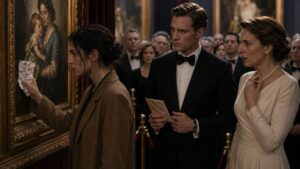
A cold, unrelenting October rain swept across the gas-lit brick sidewalks of Newbury Street, drumming a steady rhythm against the arched leaded-glass windows of the Cabot-Vance Pavilion. Inside the historic Boston gallery, the air was warm and smelled of beeswax, fine linen, antique Turkish wool rugs, and the sharp, intoxicating scent of oil linseed and dammar varnish. Soft track spotlights illuminated the pristine white plaster walls, focusing high-intensity halogen beams onto dozens of gold-leaf frames where New England’s old-money elite mingled in whispered reverence. Waiters in black tuxedos moved silently across the polished Italian marble floor, balancing silver trays of champagne flutes and miniature duck confit tartlets.
At the center of the grand rotunda, resting upon a velvet-draped wrought-iron easel, stood the crown jewel of the evening’s retrospective: a monumental seven-foot oil painting titled The Solitude of Cape Ann. The canvas depicted the granite headlands of Gloucester under a bruised, tempestuous sky, with churning sea foam breaking against jagged dark rocks with such luminous realism that several patrons claimed they could hear the crash of the Atlantic waves. The catalog listed the minimum opening reserve at five million dollars.
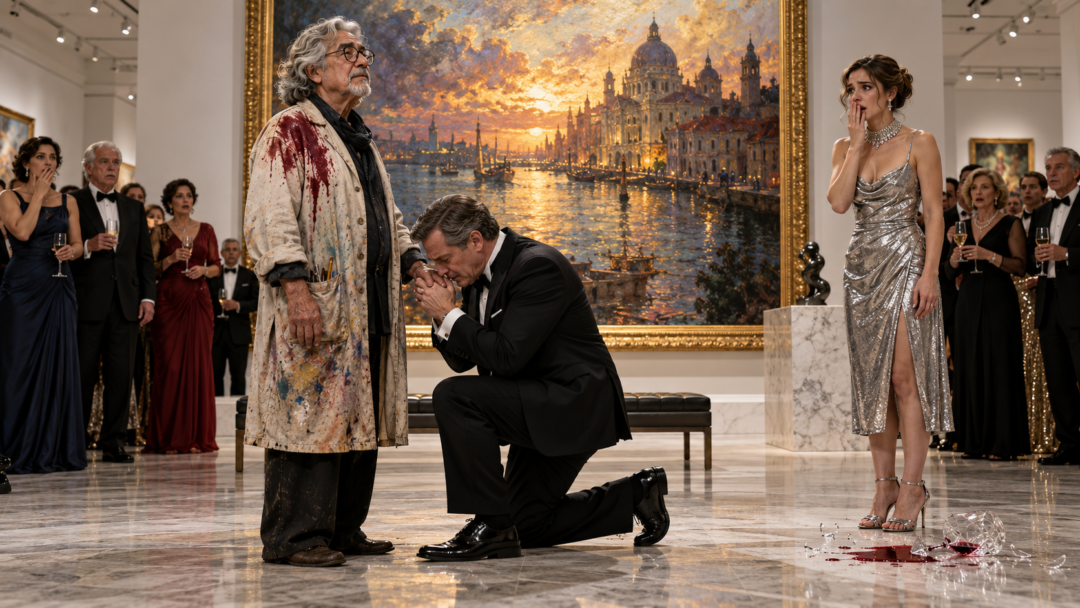
Standing four feet from the masterpiece was an elderly Hispanic man in his early seventies. He had wild, untamed silver hair that curled over the collar of his faded, paint-spattered canvas smock. His corduroy trousers were worn smooth at the knees, his leather work boots scuffed with dry gesso, and a pair of round, wire-rimmed spectacles sat perched on the bridge of his weathered nose. His hands, gnarled by half a century of holding hog-bristle brushes, were clasped behind his back as he stared intently at the brushstrokes near the bottom right corner of the canvas.
The sharp, aggressive clatter of designer heels against the marble floor shattered the hushed gallery ambiance.
“Security! Why is this homeless janitor breathing on a multi-million-dollar masterpiece?”
The voice was high, nasal, and vibrating with theatrical outrage. Bianca Sterling marched into the spotlight, her metallic silver cocktail dress clinging to her slender frame like liquid mercury. She was thirty-one, wearing a heavy diamond choker that glinted coldly in the track lighting, her platinum-blonde hair styled into an immaculate chignon. In her manicured right hand, she swirled a crystal tulip glass filled with a deep, vintage Napa cabernet.
Two uniformed private security guards hesitated at the edge of the rotunda, but Bianca didn’t wait for them. She marched straight toward the old man, her nostrils flaring in theatrical disgust.
“Look at him! He’s tracking alley filth across the marble! He probably sneaked past the catering dock to steal leftover shrimp! Look at those filthy clothes!” Bianca sneered, thrusting her chin forward with venomous arrogance. “Step away from that easel, old man! You couldn’t earn enough in ten lifetimes to buy the dust off this frame!”
The elderly man did not turn around immediately. He leaned in one inch closer to the canvas, his sharp brown eyes studying the texture of the sea foam. When he finally turned to face her, his expression was completely devoid of anger. His gaze was deep, sorrowful, and dignified, like an ancient oak observing a passing storm.
“Madame,” the old man said, his voice a soft, gravelly baritone touched with a subtle Iberian cadence. “A painting is not evaluated by the price of its frame. It is evaluated by the honesty of its light.”
Bianca’s face contorted into pure, venomous spite. “How dare you speak to me! I am Bianca Sterling! My family’s hedge fund is acquiring this canvas tonight to anchor our private estate in Newport! You are vermin!”
With a vicious flick of her wrist, Bianca hurled the contents of her crystal glass directly into the old man’s face.
A dark, heavy splash of vintage crimson wine detonated across the front of the old man’s faded canvas apron, soaking into the rough fibers and dripping down his smock like blood. Several drops splashed against the gold-leaf molding of the five-million-dollar frame, sizzling faintly under the heat of the overhead halogen lamps.
The high-society crowd gasped in collective horror. A dozen socialites covered their mouths with manicured hands, freezing in mortified shock.
The old man didn’t jump. He didn’t curse. He reached into his smock pocket with slow, deliberate calm, pulled out a clean linen cloth, and gently wiped three drops of red wine from the lenses of his wire-rimmed spectacles. He looked at Bianca with the quiet, devastating pity of a sovereign gazing upon a beggar who thought she was a queen.
“Security! Throw this tramp out into the gutter!” Bianca shrieked, waving her empty glass like a weapon.
The two security guards took a synchronized step forward, reaching for the old man’s arms.
“Stop! Don’t you dare touch him!”
A frantic, booming cry ripped through the vaulted gallery. Sprinting across the marble floor was Julian Cabot, the forty-six-year-old Chief Curator of the Cabot-Vance Pavilion and one of the world’s foremost authorities on classical American landscape art. He shoved past the security guards with frantic violence, his tuxedo bowtie askew, his face as pale as gesso.
Julian dropped directly onto one knee on the marble floor before the elderly painter, taking the old man’s paint-stained hand in both of his own with trembling, emotional reverence.
“Maestro Romero!” Julian cried out, his voice cracking with awe and mortification. “Forgive us! By all that is holy, forgive us! We had no idea you would attend your own retrospective in person!”