The Twelve Kilogram Sledgehammer And The Hollow Oak Beam
CHAPTER 1: THE LEVER OF THE SLEDGE
The steady mountain rain of late October drummed relentlessly against the uninsulated cedar roof decking of the High Peaks Community Lodge, filling the cavernous timber structure with a cold, damp resonance. Nestled on a granite bluff overlooking Lake Placid in the northern Adirondacks, the unfinished building was designed as a sanctuary for regional search-and-rescue teams, forestry education, and public gatherings—a two-story monument of traditional American post-and-beam architecture meant to withstand eighty pounds per square foot of mountain snowpack.
Standing beside a heavy maple timber workbench in the center of the Great Hall was Thomas MacIntyre. At seventy-four years old, Thomas was a legendary Adirondack master carpenter, timber framer, and former structural bridge mechanic who had spent fifty-two years building heavy-timber railroad spans and logging trestles across northern New England. He was broad-shouldered and straight-backed, his silver beard trimmed close along an unyielding jawline, wearing a faded red wool buffalo-plaid shirt rolled up past forearms as thick and fibrous as seasoned oak roots, patched canvas duck overalls, and scuffed eight-inch logger boots.
Resting on the workbench before him was an antique finishing hammer and a cardboard box of tiny two-penny finishing nails—slender wire fasteners barely an inch long, designed for delicate interior trim work.
In his right hand, however, Thomas held something far more formidable: a customized, three-foot solid hickory handle fitted with a twelve-kilogram—twenty-six-point-five pound—forged alloy steel sledgehammer head.
What transfixed the air in the room was not the hammer itself, but the way Thomas held it.
He was not gripping the handle near the steel head with both hands like an ordinary laborer swinging for destruction. Thomas held the very bottom tip—the extreme wooden butt—of the three-foot hickory shaft using just one bare right hand. His arm was extended straight out horizontally from his shoulder, parallel to the sawdust-covered subfloor, suspending twelve kilograms of dead steel thirty-six inches out in mid-air on pure, unadulterated wrist radial deviation and forearm tendon strength.
The physics of lever mechanics dictated that holding a twelve-kilogram mass at the end of a three-foot lever arm generated over eighty foot-pounds of rotational torque at the human wrist joint—a crushing rotational shear that would have snapped the tendons or torn the carpal ligaments of an ordinary collegiate athlete. Yet Thomas’s wrist did not tremble. His pulse was steady, his forearm veins standing out like blue hydraulic conduits beneath his scarred skin, his grip as locked and immovable as a machinist’s vise.
Standing four feet away, clutching an aluminum inspection clipboard with sweating fingers, was Damon Vance.
Damon was thirty-six, wearing a pristine white contractor’s hard hat, a spotless high-visibility nylon vest over an expensive technical fleece jacket, and polished designer work boots that had never touched deep mud. Damon was the managing principal of North Ridge Construction and the favored nephew of the county public works commissioner. For four months, Damon had been managing the three-million-dollar municipal bond funded project, billing the town of North Elba for premium materials while subcontracting the actual physical labor to uncertified temporary crews.
“Come on, MacIntyre, stop the circus act!” Damon snapped, his voice sharp, brittle, and edged with growing panic. “We’ve got forty-eight hours before the state architectural commission arrives for the milestone audit! The central support pillar I installed this week is certified grade-A kiln-dried white oak, harvested right here in the Adirondack timber reserve. The timber invoice has been certified by the mill, and the structural engineer’s stamp is on the cover sheet. Sign the stage-three inspection approval so the county can release the three-hundred-and-eighty-thousand-dollar draw!”
Thomas did not look at Damon. His focus remained absolute, centered upon the tiny finishing nail set loosely in the grain of the maple workbench.
Slowly, using only the microscopic articulation of his single right wrist, Thomas lowered the twelve-kilogram steel head through a controlled vertical arc. There was no wobbling, no jerky momentum, no gravitational drop. With the delicate precision of a surgeon holding a scalpel, the flat, four-inch steel face of the massive sledgehammer tapped the head of the tiny finishing nail.
TINK.
The slender wire nail sank three-quarters of an inch straight into the dense maple wood without bending a single fraction of a millimeter.
“You said solid oak, Damon?” Thomas asked softly, his voice low, gravelly, and carrying the unhurried authority of a man who knew every fiber of American hardwood.
“Solid seasoned white oak heartwood!” Damon insisted, stepping closer and jabbing his pen at the clipboard. “Ten-by-ten square timbers, load-rated for sixty thousand pounds of vertical deadweight! Sign the release!”
“Solid oak has density, Damon,” Thomas said, still holding the twelve-kilogram sledgehammer horizontally at chest height with his single wrist. “Forty-eight pounds per cubic foot. When a man walks past a solid ten-by-ten oak column, the air feels dead. The footsteps don’t reverberate. But when you walked past that central king-post two minutes ago, your boots made the wood echo like an empty beer barrel.”
Damon’s face paled. “That’s… that’s just the ambient acoustics of an open timber hall! You’re an old relic who doesn’t understand modern timber-composite engineering! If you don’t sign that paper, my uncle will have you stripped of your county master builder license by sunset!”
Thomas did not argue. Without changing his feet, without shifting his center of gravity, he smoothly rotated his right forearm ninety degrees outward.
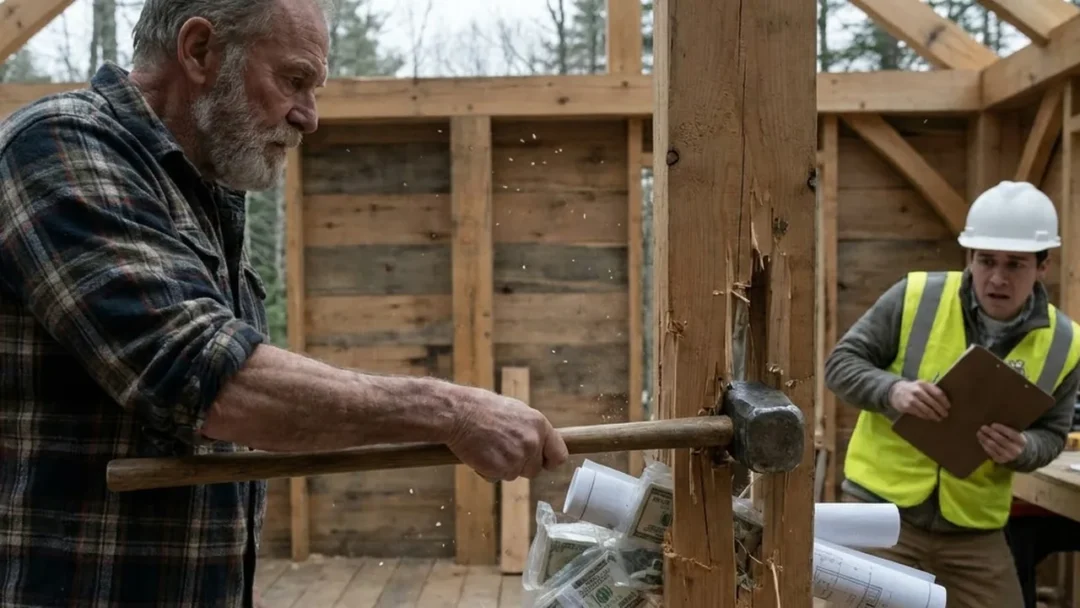
With a fluid, controlled flick of his single wrist, he swung the suspended twelve-kilogram hammer head in a horizontal arc, giving the front face of Damon’s newly installed ‘solid oak’ king-post a moderate, calculated tap at chest height.
CRUUUNCH!
The sound was not the dull, solid thud of an axe meeting impenetrable heartwood. It was the dry, violent shattering of a cardboard box.
The steel hammer head punched cleanly through a quarter-inch fake oak veneer, obliterating a paper-thin exterior skin to expose a completely hollow, rotted, termite-riddled core of salvaged demolition pine.
Damon let out a strangled shriek of terror: “Wait! Don’t hit that beam!”
As Thomas calmly drew the steel sledgehammer back out of the gaping hole, the interior cavity of the fake pillar ruptured under the structural shift.
Tumbling out of the shattered hollow beam in a cascading avalanche came dozens of thick, vacuum-sealed plastic bricks of crisp one-hundred-dollar bills, accompanied by a set of rolled architectural blueprints stamped with the red confidential seal of the New York State Comptroller’s fraud division.
The stacks of cash and stolen files spilled across the sawdust-covered floor, scattering between Damon’s designer boots.
Thomas rested the twelve-kilogram sledgehammer lightly over his shoulder with one hand, looking down at the spilled fortune with cold, unblinking eyes.
“So that’s where the town’s building budget went, Damon,” Thomas murmured. “Now let’s see how well your uncle’s bond signatures hold up under a federal subpoena.”
The physiological conditioning required to lever a twelve-kilogram forged alloy sledgehammer by the extreme handle butt is a testament to the specialized musculoskeletal adaptation of lifelong heavy timber workers. In athletic physiology, holding a front-heavy weight horizontally activates the deep extrinsic flexor tendons of the forearm—specifically the flexor carpi radialis and the pronator teres—subjecting the radio-carpal joint to immense rotational shear. Without decades of gradual tendon hypertrophy and cortical bone thickening along the radius and ulna, attempting such a lever produces immediate carpal tunnel collapse or micro-tears in the annular ligament. For Thomas MacIntyre, whose fingers had gripped cold broadaxes, two-man crosscut saws, and five-pound iron framing slickers since the age of sixteen, his forearm musculature possessed a dense, fibrous texture comparable to aged mountain hickory. The neuromuscular recruitment was so automatic that his pulse did not fluctuate by a single beat per minute, his biological center of gravity sinking into the heavy floorboards with the absolute stability of a bridge caisson.
The architectural significance of traditional timber framing in the Adirondack region represented a direct continuation of early nineteenth-century American civil engineering. When master builders erected heavy-timber structures intended to withstand the extreme climate of the High Peaks, they avoided modern dimensional light-framing and metallic fasteners, relying instead on massive post-and-beam bents joined by precision-cut mortise-and-tenon connections secured with seasoned hardwood trunnels. White oak was the sacred standard for vertical columns because of its exceptional modulus of rupture—exceeding fifteen thousand pounds per square inch—and its innate resistance to compressive buckling. When moisture content was regulated below fifteen percent, seasoned white oak heartwood formed a cellular matrix of closed tyloses that resisted terrestrial rot and fungal decay for over a century. To substitute light, brittle, open-pored salvaged white pine for such a structural column was not merely an act of commercial corner-cutting; it was a catastrophic civil hazard that invited sudden structural collapse under early winter snowloads.