The Twisted Steel Rebar And The Prison Warden Farm Audit
CHAPTER 1: THE SPIRAL IN THE PORCH RAIL
The late afternoon sun hung low over the limestone ridges of Cumberland County, casting long, sharp shadows across the broad white-oak porch of the Halloway farmstead. The valley below was quiet, scented with curing clover hay, damp mountain red-clay, and the crisp, acidic bite of ripening heirloom Rome Beauty apples. For seventy-four years, Samuel Halloway had drawn his drinking water from the same hand-dug limestone well twenty yards from his kitchen door. He was seventy-six years old now, lean and corded as a split hickory post, wearing faded denim dungarees, a washed-out blue chambray work shirt rolled past his sinewy forearms, and heavy, scuffed bull-hide work boots. His hair was cropped short, a stubble of iron gray, framing a face cut from granite by forty years of high-security correctional supervision at Brushy Mountain State Penitentiary.
At the foot of the three wooden porch steps stood a brand-new, customized midnight-black four-wheel-drive pickup truck, its oversized mud tires ticking with cooling engine heat. Standing at the top landing, leaning casually against the square cedar post, was Toby Keller. Toby was twenty-nine, sporting a heavy gym-built physique beneath a tailored polo shirt that strained against his broad chest, mirror-finish aviator sunglasses, and a thick gold watch that caught the slanting glare. Under his left arm he clutched a heavy aluminum contractor’s clipboard clipped with a legal-sized sheaf of watermarked documents.
“Look, Mr. Halloway, I’m not here to debate agricultural economics with you,” Toby said, his voice flat, abrasive, and dripping with rehearsed metropolitan arrogance. “Your grandson Tommy took a forty-five-thousand-dollar machinery advance from Black Ridge Capital last February to purchase that rotary combine sitting in your lower shed. Clause fourteen of the master promissory deed clearly states that in the event of two consecutive missed quarterly amortization schedules, the total debt converts into a balloon demand note with a compounding twenty-four percent default penalty. With accumulated legal fees and municipal filing disbursements, the total balance due as of noon today stands at four hundred and fifty thousand dollars.”
Samuel did not look up from the galvanized steel washbasin sitting on the cedar worktable at the far end of the porch railing. He had just finished washing the red orchard dust from his hands with a cake of homemade lye soap. In his hands he held a thick, triple-ply canvas work towel, soaked through with cold well water, dripping steady rhythmic droplets onto the dry oak floorboards.
“Tommy is twenty-two years old, son,” Samuel said softly, his voice resonant, deep, and measured with the chilling calm of a man who had stood down yard riots in Cellblock C without raising a baton. “The combine was twenty-eight thousand dollars used. The bank advance was seventeen thousand for diesel fuel and pre-emergent seed. I sat across the kitchen table when he signed the note. There was no balloon clause, and there was no extra zero on the principal balance.”
Toby sneered, unhooking a heavy, matte-black tactical pen from his breast pocket and tapping the steel barrel against the top document on his clipboard. “The ink on this paper says four hundred and fifty thousand, old man. It bears Tommy’s signature and a certified county notary seal. Either you sign the voluntary land-surrender affidavit right now, transferring title of the eastern four hundred acres of orchard property to Black Ridge Capital, or by eight o’clock tomorrow morning the county sheriff’s department will be rolling four tow-rigs and three flatbeds through your front gate to seize every head of Angus cattle and every piece of farm machinery on this homestead.”
Toby stepped forward, thrusting the aluminum clipboard and the heavy metal tactical pen toward Samuel’s chest. “Sign the paper, grandpa, or things are going to get remarkably ugly.”
Samuel took a slow, deep breath, expanding his broad ribcage beneath his faded shirt. He did not step back, nor did his pulse accelerate by a single beat. He looked at the clipboard, then glanced down at his dripping canvas towel.
“Hold on a second, son,” Samuel said mildly. “Let me dry my hands first.”
Running along the perimeter of the porch was a heavy protective railing fabricated from half-inch solid structural steel rebar—ribbed carbon-steel rod known in the construction trade as number-four reinforcing bar, with a yield strength exceeding sixty thousand pounds per square inch. Samuel had anchored the rebar horizontally between the six-by-six cedar posts twenty years ago to prevent his young grandchildren from tumbling off the six-foot drop onto the limestone terrace below.
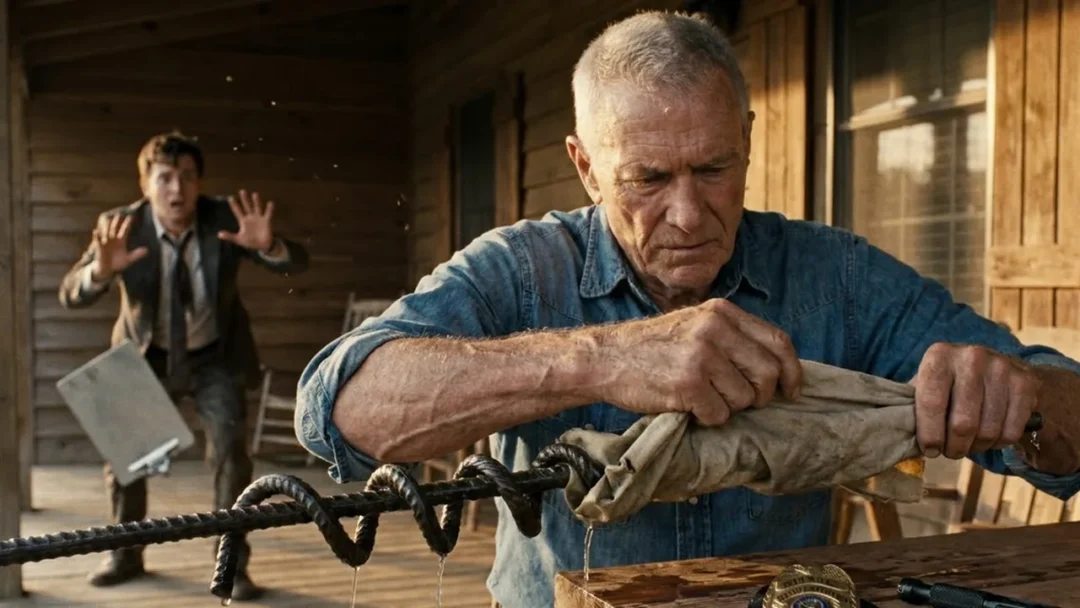
Moving without haste, Samuel wrapped the thick, dripping canvas towel in three tight concentric loops around the horizontal steel bar right beside the cedar post. His right hand—broad, scarred, with calloused skin like tanned steer-hide—gripped the ends of the wet canvas. His left hand rested flat against the cedar beam for leverage.
Then, with no visible wind-up and no groaning effort, Samuel’s right forearm tendons flexed into dense, rigid cables beneath his sun-darkened skin.
He rotated his right wrist forward in a single, explosive, hydraulic wringing twist.
The sound that echoed across the porch was not the soft squelch of drying cloth. It was the terrifying, agonizing groan of high-carbon structural steel being plastically deformed under hundreds of foot-pounds of torsional shear force.
CREEEEEAAAK-SCREEECH!
Streams of cold well water gushed from the twisted canvas weave, splashing over the deck. But beneath the saturated fabric, the solid half-inch steel rebar did not merely bend—it yielded to the monstrous torque of Samuel’s wrist, wrapping into a tight, perfect ninety-degree helical spiral corkscrew, deformed like warm modeling clay inside the towel.
Toby froze mid-breath. The smug smirk on his face dissolved into a mask of pure, unadulterated shock. His aviator sunglasses slid half an inch down his nose.
Samuel calmly loosened his grip, uncoiling the canvas towel from the metal. He shook out the now-dry towel, folded it neatly into quarters, and laid it over the porch rail.
Exposed in the late afternoon glare was the raw structural rebar—twisted into a rigid, permanent steel spiral, warm from the molecular friction of the sudden deformation.
Samuel reached out his right hand, placing his heavy, calloused palm flat on top of Toby’s aluminum clipboard, pinning the metal plate against the young man’s chest with the immovable finality of an industrial clamp.
“You added an extra zero to my boy’s note, Toby,” Samuel said, his voice dropping an octave into pure, lethal stillness. “I know Marcus Vance. I know where Black Ridge Capital keeps its private filing cabinets on Market Street. And I know what cold steel feels like when a man tries to bluff forty years of hard time.”
Toby began to stammer, his breath catching in his throat as his trembling fingers touched the twisted steel bar inches from his hand. “You… you just twisted solid structural rebar… with your bare hands…”
Before Toby could finish, Samuel reached down with his thumb and index finger, pinched the barrel of the solid-milled tungsten tactical pen resting on the clipboard, and squeezed.
SNAP!
The hardened tactical pen fractured cleanly in two, its internal pressurized ink cartridge bursting with a dull click. Samuel opened his fingers, letting the shattered halves tumble onto the cedar worktable, right beside a framed, faded black-and-white photograph of himself in full dress uniform standing in the gatehouse of Brushy Mountain State Penitentiary, flanked by a polished brass warden’s star.
“Take your paperwork off my mountain,” Samuel said quietly, stepping down one stair until his pale blue eyes bore straight through Toby’s sunglasses. “And tell Marcus Vance that his old warden is coming downtown tomorrow morning to audit his books personally.”
Toby dropped the clipboard onto the stairs, turned on his heels, and bolted down the steps toward his truck, scrambling into the cab and spraying gravel thirty feet into the orchard as he backed down the winding driveway in blind terror.
Samuel stood at the railing, watching the cloud of dust drift across the apple trees. He walked down the steps, picked up the dropped clipboard, and flipped past the fraudulent demand note. Fastened to the reverse side of the aluminum plate was a magnetic GPS tracking transponder, its green diagnostic diode pulsing silently in the gathering twilight.