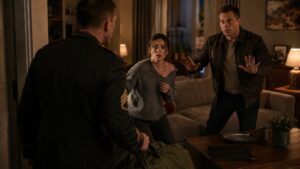
The Day the Cart Became the Line Between All of Them
Part I — The Order in His Hand
“Step away from the cart, ma’am.”
Sandra kept one hand on the metal handle and the other raised between herself and the young officer. Behind her, curled inside the supply cart beneath a gray emergency blanket, Kevin gripped his backpack like it was the last solid thing left in Georgia.
The line outside the relief center went quiet in pieces.
First the old man with the empty gas can stopped talking.
Then the woman holding a pack of diapers lowered her phone from her ear.
Then the two National Guard trucks idling near the entrance seemed too loud, their engines coughing into the wet heat left behind by the flood.
Sandra did not move.
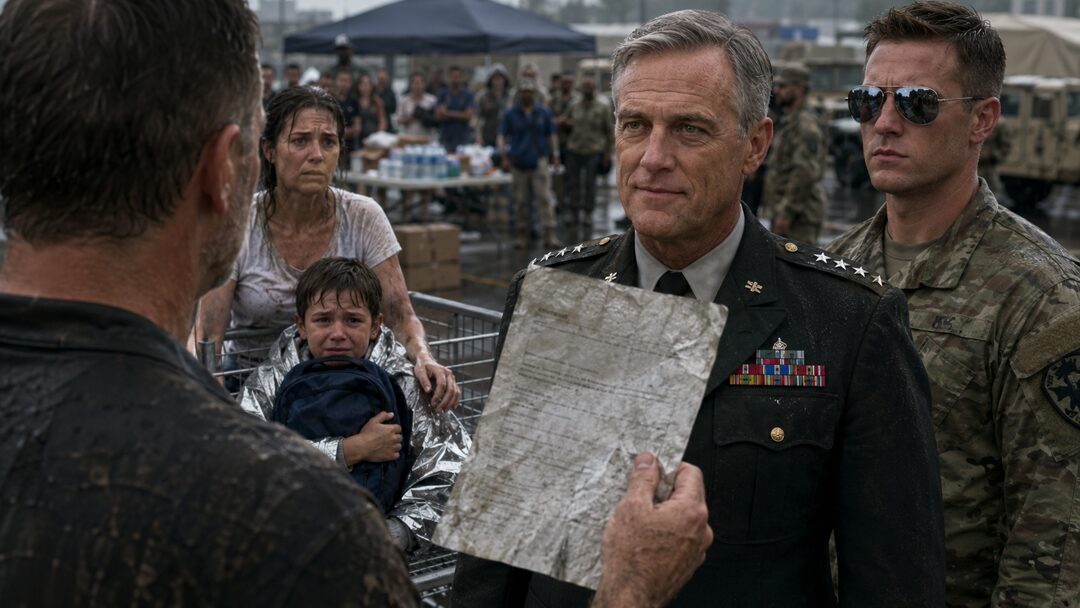
The officer in front of her was young enough to still look surprised by his own authority. His uniform was clean where everyone else’s clothes were streaked with mud. Mirrored sunglasses hid his eyes. One hand rested near the black device clipped at his belt.
“I said step away,” he repeated.
“My son is in this cart,” Sandra said.
“I know who’s in the cart.”
“No,” she said, her voice thinner than she wanted it to be. “You know what a form told you.”
Kevin made a small sound under the blanket. Not quite a cry yet. The kind of sound a child makes when he is trying to obey an adult’s order to stay quiet and failing.
Sandra felt it in her bones.
The officer unfolded a damp sheet of paper and held it up like a shield. “Kevin Carter is flagged for emergency transfer. Registered guardian unavailable. He is to be moved northbound with the priority group.”
Sandra stared at the page.
The words were too clean for the place they were in.
Around them, the relief center looked like the storm had chewed it and spit it back out. Folding tables sagged under bottled water. Cardboard boxes of formula and canned beans sat beneath blue tarps. A handwritten sign pointed families toward fuel vouchers. Another sign, half torn loose by the wind, read FAMILY REUNIFICATION.
Sandra almost laughed at that.
“My name is Sandra Carter,” she said. “I’m his mother. I’m standing right here.”
The officer’s jaw tightened. “Ma’am, the system says—”
“The system is wrong.”
A few people in line shifted. Someone lifted a phone.
The officer noticed.
Sandra saw the change happen. His shoulders squared. His voice dropped. The hand near his belt became less casual.
“Do not interfere with an emergency operation.”
Sandra leaned back just enough to touch Kevin’s blanket with her knuckles.
The boy was shaking.
“He’s six,” she said. “He is not an operation.”
The officer’s radio crackled before he could answer.
A man’s voice came through, flat and controlled. “Status on the priority transfer?”
The officer pressed two fingers to the radio at his shoulder. “Subject located. Civilian female obstructing.”
Sandra flinched at the word subject.
Not Kevin.
Subject.
The voice on the radio said, “Complete the transfer. Convoy leaves in four.”
The officer looked at the phones now pointed at him. The civilians waiting for water had become witnesses. That should have made him careful.
Instead, it made him harder.
Sandra raised her palm higher.
“Don’t touch him,” she said.
The officer stepped closer.
Kevin began to cry.
Part II — The Boy Under the Blanket
The morning had started with Sandra writing Kevin’s name on his wrist in black marker.
Not because she thought she would lose him.
Because everyone at the shelter had been told to do it.
Name. Parent. Contact number.
The marker had dragged over Kevin’s damp skin while thunder rolled far away, tired now, like the storm itself was leaving ashamed. Kevin had asked if it would wash off.
“Not today,” Sandra had told him.
He had held out his other wrist. “Write Dad’s name too.”
Sandra had paused.
There were a hundred reasons not to. Most of them lived in the silence between phone calls. In the empty chair at school meetings. In the years Joseph had belonged to missions, briefings, emergencies, people who needed him loudly while she and Kevin needed him quietly.
But Kevin had looked at her with storm-tired eyes.
So she had written Joseph’s name beneath her own.
Then she had tied Joseph’s old dog tag to Kevin’s backpack because Kevin said the metal sound helped him sleep.
Now that backpack was clutched against Kevin’s chest inside the supply cart.
The tag tapped against the zipper.
Tap.
Tap.
Tap.
Sandra heard it under the officer’s voice.
“Ma’am, I am giving you a lawful instruction.”
“No, you’re reading me a bad piece of paper.”
“You need to step back.”
“You need to listen.”
“I am not debating this in public.”
“That’s exactly why you should.”
His mouth hardened.
For one second, Sandra saw the boy inside the officer. Not Kevin’s kind of boyhood. Something sharper. A young man terrified of being seen as uncertain. A man who had been handed a uniform and told certainty was part of it.
Then his radio crackled again.
“Lieutenant,” the voice said. “Why is this not complete?”
The officer turned slightly away. “Civilian refuses to release the minor.”
Sandra felt cold despite the heat.
“Say son,” she snapped.
He looked back.
“What?”
“Say son. Not minor. Not subject. Not transfer. Son.”
The line behind her gave a low murmur.
The officer’s face reddened above the sunglasses.
“Ma’am, final warning.”
Kevin pushed the blanket from his face. His cheeks were dirty. His hair stuck to his forehead. In one fist he held the dog tag, chain wound through his small fingers.
“I want Mom,” he sobbed.
Sandra moved without thinking. She shifted her body between Kevin and the officer, both hands now on the cart.
The wheels squeaked.
The officer stepped back fast, as if the cart had lunged at him.
“Hands where I can see them.”
“They are where you can see them.”
“Step away from the cart.”
“No.”
The word came out calm.
That seemed to frighten him more than if she had screamed.
Sandra had spent years being reasonable. Reasonable when Joseph missed Kevin’s birthday because a levee had cracked two counties over. Reasonable when he came home with mud on his boots and silence in his mouth. Reasonable when he said, “You know how this works,” and she said, “I do, and that’s the problem.”
She had signed separation papers with a steady hand.
She had learned which disasters were natural and which were chosen.
This one had a printed order.
The officer’s hand closed around the device at his belt.
A woman in the line whispered, “Don’t.”
Sandra did not look away from him.
“His father is coming,” she said.
The officer gave a short, humorless breath. “Everyone’s father is coming when they need five more minutes.”
“You don’t understand.”
“I understand enough.”
“No,” Sandra said. “You understand orders. That is not the same thing.”
His jaw jumped.
Then the radio voice returned.
“Lieutenant Paul, remove the obstruction.”
The name hit the air like another command.
Paul swallowed.
Sandra saw his fingers flex around the device.
The dog tag tapped against Kevin’s backpack again.
Tap.
Tap.
Tap.
The sound became a clock.
Part III — Four Minutes Northbound
Paul had joined because his grandfather kept a folded flag in the hallway and a photograph of himself at twenty-one beside it.
He had joined because people in his town stood straighter when the Guard rolled through after a tornado.
He had joined because he wanted to be useful before anyone could call him ordinary.
None of that helped him now.
Now there was a woman in a muddy T-shirt refusing an order in front of forty civilians with phones. There was a child crying in a supply cart. There was Colonel James on the radio using the calm voice senior officers used when they wanted fear to sound like procedure.
And there was the paper.
Paul looked down at it again.
Kevin Carter. Priority transfer. Guardian unavailable. Northbound list.
The document had a code stamped near the bottom: E-17.
He did not know what it meant. He only knew Colonel James had said those files mattered. Move them fast. Ask no questions at the line. Keep the convoy clean.
Clean.
He looked at Sandra.
There was nothing clean here.
“You are making this worse,” he told her, and hated that his voice shook.
“For who?”
“For your son.”
That did it.
Sandra’s face changed.
Not louder. Not wilder. Worse.
Clearer.
“My son watched a man in a pressed uniform tell a contractor to move supplies before the inspection team arrived,” she said. “My son heard him say the missing records could drown with the east office. My son heard him say northbound children don’t answer local questions.”
Paul blinked.
“Stop talking.”
“No.”
“This is not the place—”
“This is exactly the place. You want to move him before his father gets back.”
The radio hissed.
Paul did not press the button.
Still, Colonel James’s voice came through, as if he had been listening to every word.
“Lieutenant, you are losing control of the scene.”
Paul felt every phone on him.
A teenager near the water table raised his camera higher.
An older woman crossed herself.
One of Paul’s own soldiers looked at him from beside the truck, uncertain.
Control.
That word filled his head until there was no room left for judgment.
“Ma’am,” he said, drawing the stun device, “move away from the cart.”
Sandra’s hand lifted again.
Palm out.
Universal.
Ancient.
Stop.
Please.
Don’t.
Kevin’s cry sharpened. “Mom!”
Sandra did not step back. She put her body closer to the cart, as if she could become a wall by wanting it hard enough.
Paul aimed low. He told himself it was low. He told himself it was controlled. He told himself the manual had rules for this, and rules existed so men did not have to decide everything alone.
But a rule cannot tell you what a child will remember.
Sandra reached back, maybe to steady the cart, maybe to touch Kevin, maybe because the body reaches for love before it reaches for logic.
Paul fired.
The sound was smaller than the silence after it.
Sandra jerked, folded, and hit the wet pavement beside the cart.
Kevin screamed.
The whole relief line froze.
The device in Paul’s hand suddenly felt like it belonged to someone else.
Sandra’s fingers clawed once against the ground, then curled inward. Her face was turned toward Kevin. Even fallen, she was still trying to see him.
Kevin tried to climb out of the cart. The blanket twisted around his legs. His backpack slipped, and the dog tag clattered against the metal basket.
“Mom! Mom! Mom!”
No one moved.
Paul did not move either.
He stood there with the device pointed at the ground, his sunglasses reflecting a woman he had just made smaller than his order.
A camera clicked.
Then came the sound of boots through mud.
Not running.
Walking.
Heavy, controlled, certain.
Paul turned.
A man in a dark field polo crossed the lot with two soldiers behind him. Mud streaked his boots and one sleeve. His face was weathered, calm in a way that did not mean peaceful. It meant contained.
People in the line moved aside before he asked.
Paul recognized him too late.
Major Joseph.
The major’s eyes went first to Sandra on the ground.
Then to Kevin in the cart.
Then to the device in Paul’s hand.
The air changed.
Not louder.
Lower.
More dangerous because it had found its center.
“Lower it,” Joseph said.
Paul’s mouth went dry. “Sir, I was following an active transfer order.”
Joseph stopped beside Sandra.
He did not kneel yet.
That was the first terrible thing Paul noticed.
The major wanted to. Every muscle in his body wanted to drop to the ground and touch her shoulder, check her pulse, say her name.
Instead, he stayed standing.
Command held him upright.
Love nearly broke him in half.
“Lower it,” Joseph said again.
Kevin sobbed, “Dad.”
Paul felt the word go through the crowd.
Dad.
Sandra’s estranged husband. Kevin’s father. The man she had said was coming.
Joseph’s face did not change, but something in his eyes did.
He had arrived as an officer.
Now everyone knew he had arrived as more than that.
Part IV — The Man Who Came Too Late
Joseph had spent the last seven hours pulling people from houses that should not have flooded.
A woman with oxygen tubes.
Two brothers on a roof with a dog between them.
A county clerk trapped in a records office where water had risen to the bottom drawer and stopped, mercifully, before the files turned to pulp.
That clerk had told him something while shaking under a rescue blanket.
“The east levee reports were altered,” she had whispered. “And someone is moving witnesses.”
Joseph had not believed all of it.
He had believed enough.
He had sent two soldiers to secure the records. He had radioed for an independent inspector. He had started back to the distribution center with mud on his boots and a bad feeling tightening under his ribs.
Then he saw Sandra fall.
There are moments the mind refuses to understand in order.
His first thought was not command.
It was the kitchen table at 2:13 a.m., Sandra sitting across from him with divorce papers and swollen eyes, saying, “You keep saving strangers because they thank you louder.”
His second thought was Kevin at four years old, asleep with Joseph’s dog tag in his fist.
His third thought was that Paul still had the device in his hand.
That was the thought he could use.
“Lieutenant,” Joseph said, “put it on the ground.”
Paul hesitated.
Joseph took one step closer.
Not fast. Not theatrical.
Just enough.
Paul lowered the device slowly and set it on the pavement.
“Now the order,” Joseph said.
Paul held out the damp paper.
Joseph took it and read without moving his lips.
E-17.
His stomach turned.
He had seen that code once already that morning on a transfer list attached to three names from the records office.
Not injured people.
Not separated families.
Witnesses.
Sandra coughed on the ground. Her hand trembled toward the cart.
Joseph finally knelt.
“Sandra,” he said, and her name came out rougher than he meant it to.
Her eyes opened halfway. Pain and fury lived together there.
“Kevin,” she whispered.
“He’s here.”
“Don’t let them—”
“I won’t.”
She gave a small, bitter breath. “That’s what you always say after.”
The words landed where they belonged.
Joseph accepted them.
Behind him, Paul said, “Sir, Colonel James authorized the transfer personally. He said the guardian was unavailable.”
Joseph looked at him.
“She was standing in front of you.”
Paul’s face tightened.
“I had an order.”
“You had a mother.”
The crowd heard it.
So did Paul.
His sunglasses hid his eyes, but not the way his mouth changed.
Joseph stood and turned the paper toward him. “Who gave you E-17?”
Paul did not answer fast enough.
The radio answered for him.
“Major Joseph,” Colonel James said, voice calm as polished stone. “You are interfering with a transfer under my authority.”
Joseph pressed his own radio. “I’m securing a contested scene involving use of force against a civilian.”
“You are emotionally compromised.”
Joseph looked down at Sandra, then at Kevin trying to untangle himself from the blanket.
“Yes,” he said. “And still clearer than you.”
A sound moved through the line. Not quite approval. Not quite shock.
Recognition.
The two soldiers behind Joseph shifted their weight.
Paul looked from Joseph to the civilians, then to the cart.
Kevin had stopped screaming, but only because he had run out of breath. His whole body shook around the backpack. The dog tag chain was looped around his fingers so tightly the skin had gone pale.
Joseph wanted to take him out.
He did not.
Not while the scene still had teeth.
A black command SUV rolled in past the water table and stopped too smoothly for the mud. Colonel James stepped out in a pressed uniform, boots shining like he had walked in from another world.
He was older than Joseph by more than a decade, with a controlled smile and the kind of posture that turned every space into his office.
“Major,” he said.
“Colonel.”
James glanced at Sandra on the ground, then at Kevin, then at the phones.
Only then did irritation touch his face.
“Shut this down,” he said quietly.
Joseph did not move.
James’s smile thinned. “That was not a request.”
Part V — The Line No One Could Cross
Colonel James never raised his voice.
That was what made people obey him quickly.
Anger could be challenged. Panic could be forgiven. James offered neither. He made disobedience feel like bad manners.
“Lieutenant Paul acted under emergency authority,” James said. “The civilian obstructed a priority transfer. Your personal relationship to her makes you unfit to assess the matter.”
Sandra pushed herself onto one elbow and nearly collapsed again.
A medic started forward.
Joseph lifted one hand without looking away from James. “Check her.”
The medic moved.
James’s eyes cooled. “I did not authorize—”
“You don’t authorize breathing.”
The line behind them went silent again.
James took one step closer. “Careful, Major.”
Joseph held the damp transfer order at his side. “Why is Kevin on an E-17 list?”
“A clerical designation.”
“For witnesses?”
James’s expression did not change.
But Paul’s did.
It was small. A blink. A tightening around the mouth. A man hearing the second half of a sentence he had been trying not to know.
Joseph saw it.
So did James.
“Lieutenant,” James said. “Return to your vehicle.”
Paul did not move.
James turned his head slowly. “That was an order.”
Paul’s hand twitched toward his sunglasses.
Joseph looked at him. “Before you go, answer one question.”
“Major,” James warned.
Joseph ignored him. “Who told you to remove the boy before I returned?”
Paul swallowed.
The relief center held its breath.
Sandra’s voice rose from the ground, weak but sharp enough to cut through all of them.
“Kevin heard him.”
James looked at her for the first time like she was not debris.
Sandra’s face was pale. The medic’s hand hovered near her shoulder, but she pushed herself higher.
“My son heard you behind the supply trailer,” she said. “You told the contractor to put the boy on the northbound list before his father got back.”
James smiled gently.
It was worse than if he had sneered.
“Mrs. Carter is confused.”
“Sandra,” she said.
James paused.
“My name is Sandra.”
Joseph looked at Paul again. “Lieutenant.”
Paul stood in the mud, trapped between the voice that had commanded him and the image of what that command had made him do.
Kevin sniffed from the cart.
Not loud.
Just enough.
Paul removed his sunglasses.
His eyes were younger than the rest of him had pretended to be.
“I was told,” he said, then stopped.
James turned fully toward him. “Do not continue.”
Paul’s empty hand lifted before his words did.
Palm out.
Not commanding.
Not defending.
Surrendering.
“I was told to complete the transfer before Major Joseph returned,” Paul said. His voice shook, but it carried. “I was told the mother was noncompliant and that the father would interfere with command priorities.”
James’s face hardened at last.
Joseph did not look triumphant.
That mattered.
No one who saw Sandra on the ground could mistake this for victory.
James took a step toward Paul. “You understand what you are saying?”
Paul looked at Kevin.
Then at Sandra.
Then at the phones held by strangers whose names he would never know.
“Yes, sir,” he said. “For the first time today, I think I do.”
James’s voice dropped. “I will have your commission.”
Joseph stepped between James and the cart.
It was not dramatic.
It was final.
“No closer,” Joseph said.
James stared at him. “You are refusing a direct command.”
“I am securing a scene.”
“You are choosing your family over your duty.”
Joseph glanced back once.
Sandra was sitting upright now, barely. Kevin had one leg over the cart’s edge, reaching for her with shaking hands. The dog tag swung from his backpack and caught the light.
Joseph turned back to James.
“No,” he said. “I’m remembering what duty is for.”
He handed the transfer order to one of his soldiers. “Call the state emergency inspector general. Preserve this document. Secure the radio logs.”
James laughed once. “You don’t have the authority.”
Joseph looked at the phones, the civilians, the soldiers, Paul, Sandra, Kevin.
Then he looked back at James.
“You gave me witnesses.”
For the first time, Colonel James looked around and seemed to understand that the crowd was not disorder.
It was record.
One of Joseph’s soldiers stepped forward. Another moved to the command SUV. Paul bent slowly, picked up the device from the pavement, and handed it grip-first to the nearest sergeant.
His hand was shaking.
Sandra reached toward the cart.
“Kevin,” she whispered.
The boy climbed out awkwardly and stumbled into her arms.
She made a sound when his weight hit her, pain breaking through her face, but she did not let go.
Joseph’s hands clenched at his sides.
He wanted to help.
He waited until Sandra looked at him.
Only then did he kneel.
Part VI — Until He Stops Shaking
By late afternoon, the relief center had changed without looking different.
The water tables were still there. The tarps still snapped in the damp wind. Families still needed diapers, fuel, medicine, paperwork, rides.
But the command SUV was gone.
Colonel James had been escorted into another vehicle with two officials from the state office who arrived with closed faces and clipboards they did not wave around. No one announced justice. No one clapped. The world rarely repaired itself with ceremony.
It only shifted weight.
Paul stood near the back of a truck, no sunglasses now, no device at his belt. A sergeant stayed beside him, not cruelly, not kindly. Just there.
Before they took him away from the scene, Paul asked to speak to Sandra.
Joseph looked at her.
Sandra was seated on the edge of the emptied supply cart with a blanket around her shoulders. Kevin sat pressed against her side, both arms locked around her waist. His backpack rested on his lap. The dog tag lay across his small knuckles.
Sandra nodded once.
Paul came close enough to be heard, not close enough to make Kevin flinch.
For a moment, he had nothing to hide behind. No glasses. No paper. No radio voice.
“I should have listened,” he said.
Sandra looked at him for a long time.
Her face was tired beyond anger, but anger had not left. It had simply become something colder and more useful.
“You should have looked,” she said.
Paul lowered his head.
There was no forgiveness in it.
There was also no performance.
He accepted the sentence because it was smaller than what he deserved and larger than what he could answer.
When he stepped away, Kevin whispered, “Is he bad?”
Sandra closed her eyes.
Joseph waited for her answer, because he needed it too.
Finally she said, “He did a bad thing when he had time not to.”
Kevin looked down at the dog tag.
“Did Dad do bad?”
Joseph felt the question before he heard it.
Sandra did not rescue him from it.
Joseph crouched in front of the cart, keeping his hands where Kevin could see them.
“I did some wrong things by being gone too much,” he said. “And today I got here late.”
Kevin’s chin trembled. “But you came.”
Joseph nodded once.
It was almost too much.
“I came.”
Sandra looked away, toward the wet parking lot, toward the lines of people trying to keep their lives together with bottled water and forms. She had wanted Joseph to come for years. Not as a uniform. Not as the man everyone else called when the worst happened.
Just as himself.
And still, when he had appeared, he had been too late to stop the first harm.
That was the part no ending could polish.
A medic checked the small burn marks at Sandra’s side and told her she needed monitoring. Sandra nodded without seeming to hear. Kevin had not released her shirt.
Joseph removed his field jacket.
He did not drape it over Sandra as if that could fix anything.
He held it up first, a question.
Sandra watched him.
Then she gave the smallest nod.
Joseph wrapped the jacket around Sandra’s shoulders and Kevin’s back together. The fabric was too large for them, still carrying mud, sweat, and the faint outdoor smell of the levee.
Kevin pulled one side of it close.
The dog tag disappeared beneath the jacket, then slipped out again, bright against the dark cloth.
Joseph sat on the pavement beside the cart instead of beside Sandra.
Close enough to stay.
Far enough not to claim what had not been returned to him.
For several minutes, none of them spoke.
The relief line began moving again. A volunteer called out numbers. Someone laughed too loudly and then stopped. A helicopter passed far overhead, low enough to vibrate through the puddles.
Sandra finally looked at Joseph.
“You’re not coming home because of this,” she said.
“I know.”
“You don’t get to turn one decent choice into a door.”
“I know.”
Kevin leaned heavier against her, eyelids fluttering, exhausted but afraid to sleep.
Joseph looked at his son’s hands. Still shaking.
He swallowed.
“I’m not asking to come home tonight,” he said. “I’m asking to stay until he stops shaking.”
Sandra’s mouth tightened.
For a moment, Joseph thought she would say no. Maybe she had earned the right. Maybe the cleanest justice she could claim was distance.
Then Kevin reached one hand out from under the jacket.
Not far.
Just enough to catch two of Joseph’s fingers.
Sandra saw it.
So did Joseph.
No one named it forgiveness.
No one made it bigger than it was.
Sandra turned back toward the parking lot, her shoulder barely touching the jacket he had placed around them.
“Until he stops shaking,” she said.
Joseph nodded.
He sat beside the cart as the sun lowered behind the damaged relief center, his son’s small hand holding two of his fingers, his wife wrapped in his jacket but not in his promises.
The order that had almost taken Kevin away lay sealed in an evidence bag.
The man who signed it was gone from the lot.
The officer who obeyed it had finally looked.
And still, long after the trucks quieted and the line thinned and the first evening insects began to sing over the flooded grass, Kevin’s hand trembled around the dog tag.
Joseph stayed.
Sandra let him.
For that night, it was not enough to heal what had happened.
But it was enough to keep the cart from being a line between them anymore.