What Stayed in the Room
Part I — The Water
The room was still laughing when Captain Sarah Mitchell stopped breathing.
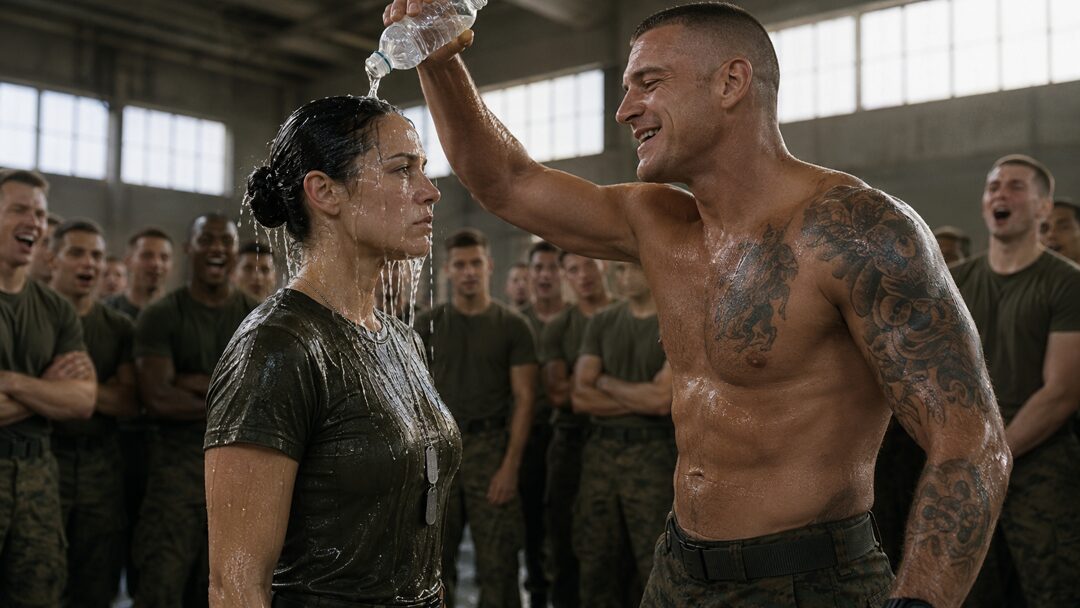
Not for long. Less than a second. Long enough for the water to run cold over her scalp, down her face, under the collar of her olive-green shirt. Long enough for every man in the training hall to see Sergeant Mark Harris standing over her with a plastic bottle raised in one tattooed hand, grinning like he had just won something.
“What’s wrong, Captain?” Mark called, loud enough for the room to hear.
The water kept coming.
It splashed off Sarah’s cheekbones and dog tags. It darkened her shirt against her chest and stomach. It dripped from her jaw to the concrete floor in sharp little strikes.
A few soldiers bent over laughing.
Corporal Brian Lewis laughed the loudest.
Mark leaned in, all muscle and sweat and confidence, his buzz cut still damp from the drill they had just finished. His black watch caught the light as he tipped the last of the bottle over her head.
“Can’t handle it?”
The laughter hit the high windows and came back thinner.
Sarah’s hands had lifted halfway to her mouth before she stopped them. A reflex. A human one. Shock, maybe. Embarrassment, maybe. For one ugly second, she looked like someone who had been caught unguarded in front of people who were waiting to see if she would break.
Then her hands lowered.
The room changed before anyone moved.
Sarah wiped one line of water from her eyes with two fingers. Her dark hair, still pulled tight in its bun, shone black under the industrial lights. Droplets clung to her lashes. Her jaw tightened once.
Mark’s grin faltered, but only at the edge.
“Relax,” he said, still playing to the room. “It’s just water.”
Sarah looked at him.
Not up at him. Not around him. At him.
The laughter died in sections. First the men closest to her. Then the ones by the pull-up bars. Then Brian, whose open-mouthed smile collapsed when he realized nobody else was carrying it anymore.
Lieutenant Emily Carter stood near the supply table with a clipboard pressed to her chest. She took one step forward, face pale with anger.
Sarah lifted one hand without looking at her.
Emily stopped.
The training hall became so quiet that the water dripping from Sarah’s shirt sounded like a clock.
“Sergeant Harris,” Sarah said.
Her voice did not rise. That made it worse.
Mark straightened a little. “Ma’am.”
“You will report to the final readiness course at 0500.”
His eyebrows twitched. “Captain, I already cleared—”
“You will report,” she repeated, “at 0500.”
A small shift moved through the room. Not laughter this time. Calculation.
Mark glanced at the soldiers watching him. He could still save face if he played it right. He spread his hands with the bottle crushed lightly in one fist.
“Yes, ma’am.”
Sarah stepped closer.
She was shorter than him. Everyone could see that. He had nearly sixty pounds on her, most of it built in shoulders and arms. His chest was inked with names, dates, a coiled snake across one rib cage, a cross near his collarbone. He looked like the kind of man young soldiers studied when they wanted to know what power was supposed to look like.
Sarah looked like command.
Wet shirt. Silver dog tags. Black belt. Left wristwatch. No smile.
“You will bring Lewis,” she said.
Brian’s head snapped up. “Me, ma’am?”
Sarah turned just enough for him to feel the full weight of being noticed.
“Yes, Corporal. You enjoyed the lesson. You can attend the next one.”
Brian swallowed.
Mark’s jaw shifted.
Sarah took the empty bottle from his hand. He let her. He seemed surprised that he had.
She held it for one second, then placed it upright on the floor between them.
“Dismissed,” she said.
Nobody moved.
Sarah’s eyes swept the room once.
“Now.”
Boots scraped. Men cleared their throats. Someone pretended to adjust a weight plate. Someone else looked at the floor like it had suddenly become important.
Mark stayed a second longer than the rest, trying to make his face easy again.
But Sarah did not give him anything to perform against.
She walked toward the locker room with water still dripping behind her.
Emily followed her only after the door swung shut.
Inside, the fluorescent light buzzed above the sinks. Sarah stood in front of the mirror, both hands braced on the counter, watching water run from her chin.
Emily shut the door hard.
“Captain, that was insubordination. In public. We need to file it.”
Sarah picked up a towel and pressed it to her face.
“I handled it.”
“With respect, ma’am, he poured water on you in front of half the company.”
Sarah lowered the towel.
Her eyes in the mirror were not calm. They were controlled.
“There’s a difference.”
Emily looked at her, frustrated and loyal and too young to hide either one well.
“He thinks you let him get away with it.”
Sarah wrung water from the end of her sleeve into the sink.
“No,” she said. “He thinks punishment is push-ups.”
Emily said nothing.
Sarah hung the towel over the edge of the sink. Her dog tags had stuck to her skin. She peeled them loose and let them fall back against her chest.
“Tomorrow,” she said, “he learns what pressure means.”
Part II — The Course
Mark arrived at 0447 because arriving early was part of the performance.
He wore a fresh olive-drab shirt, cargo pants, boots polished enough to catch the first gray light, and the same black watch. His tattoos disappeared under fabric now, but he still carried himself shirtless somehow. Shoulders wide. Chin loose. Smile ready.
Brian arrived at 0458 looking like he had not slept.
Sarah was already there.
She stood at the entrance to the readiness course with Emily beside her and a thermos in one hand. Beyond them stretched the training lanes: concrete barriers, rope walls, a low tunnel, weighted litters, smoke machines waiting cold, and a marked extraction zone at the far end.
Mark glanced at the setup and smirked.
“All this for a bottle of water?”
Sarah checked her watch.
“No. This is for deployment clearance.”
His smirk went still.
“You can’t pull my slot.”
“I can delay my signature.”
The words landed cleanly.
Mark looked past her toward Emily, then back. “Captain, I cleared this rotation two weeks ago.”
“You cleared it as a participant. Today you lead it.”
Brian’s face drained.
Sarah continued. “Three-person team. Conflicting instructions. Simulated casualty. Heat load. Communication stress. You will make decisions under observation.”
Mark’s eyes sharpened. This was not extra discipline. This was a gate.
“You’re turning a prank into a career problem?”
Sarah took one slow sip from the thermos.
“You turned command into entertainment.”
Brian stared at the gravel.
Mark’s smile returned, thinner now. “Fine. I lead it.”
“You follow instructions first,” Sarah said.
That cut deeper than he wanted it to.
At 0500, she handed him a laminated card.
His team was Brian and a quiet specialist named David who had been pulled from the morning rotation. The first task was simple: move through the barriers, retrieve a radio code, and return with all three men accounted for.
Mark made it look easy.
Too easy.
He vaulted the first wall and turned back with a grin. “Move, Lewis. Don’t make me carry you before breakfast.”
Brian scrambled after him, face red.
Sarah watched without comment.
Mark found the radio code in under two minutes. He took the left lane when the card said hold for signal. He waved Brian through before Emily had finished calling the route change. He reached the return marker thirty seconds faster than the best time from the previous week.
When he crossed the line, breathing hard but smiling, he clapped Brian on the shoulder.
“See? Pressure handled.”
Sarah marked something on her sheet.
Mark’s smile thinned again. “Problem?”
“You left your third man behind the second barrier.”
Mark turned.
David stood fifty yards back with one hand raised, exactly where Sarah had instructed him to stop when Mark failed to confirm team count.
Mark exhaled through his nose.
“He was fine.”
Sarah looked at him.
“Was he?”
The morning grew warmer. The course grew crueler.
Mark was good. That was the problem. He climbed fast. Carried weight fast. Read terrain fast. Made men want to follow him because he seemed sure the world would move for him if he hit it hard enough.
But he cut corners when waiting made him feel watched.
He answered before listening.
He joked when Brian hesitated.
He turned every correction into a grin for the men standing near the observation line.
Sarah did not raise her voice once.
“Count your team.”
“Wait for signal.”
“Say the order back.”
“Your speed is not the standard.”
The fourth time she said it, Mark’s face tightened.
“With respect, Captain, the standard is mission completion.”
Sarah’s pen stopped.
“With respect, Sergeant, completion without control is luck.”
A few soldiers nearby heard it. Mark knew they heard it.
His neck reddened.
Brian looked between them, wanting to laugh and afraid to.
The casualty lane came at 0730.
By then the sun had pushed through the high windows of the auxiliary structure, turning the air heavy. Sweat darkened every shirt. The simulated smoke scratched at throats. A weighted mannequin lay behind a low concrete wall, one leg twisted under a training pallet.
Sarah handed Mark the final instruction card.
He read it once.
“Retrieve casualty after full green signal. Maintain team integrity. Confirm route before movement.”
He said it like a man reciting something beneath him.
Sarah heard that too.
The first flare went up yellow.
Mark crouched behind cover with Brian and David. The mannequin lay twenty yards ahead. Brian’s breathing was loud.
“Green signal,” Sarah called from behind the glass line.
Mark bounced once on the balls of his feet.
The second flare stayed yellow.
Brian whispered, “We wait, right?”
Mark’s eyes stayed on the mannequin.
“Signal’s coming.”
“Captain said full green.”
Mark’s jaw flexed.
The third flare snapped up.
It was not green. It was yellow with a green band, part of the course trick. Wait for full signal. Confirm route. Do not move early.
Mark moved.
“Go.”
Brian followed because Mark moved like certainty.
David hesitated because he had heard the order.
Mark reached the mannequin fast. Beautifully fast. He hooked the harness, lifted, dragged, adjusted grip, and got the dead weight moving in one clean sequence.
Then the alarm sounded.
One hard tone.
Sarah’s voice cut through the speaker.
“Stop.”
Mark froze with the mannequin halfway to the extraction line.
The smoke thinned.
Brian stood exposed in the wrong lane, chest heaving. David remained behind cover, eyes down.
Sarah walked onto the course.
Mark dropped the mannequin harder than he needed to.
“What?” he demanded.
“You moved before signal.”
“I had the casualty.”
“You lost Lewis.”
Brian blinked. “Ma’am?”
Sarah pointed to the red marker Brian had crossed without clearance.
Brian looked down at his own boots as if they had betrayed him.
Mark laughed once, sharp and humorless. “This is a technicality.”
“No,” Sarah said. “This is the drill.”
“I got there faster than anyone in this company could’ve.”
“And you brought back a body with no team.”
The words hit the room in a way nobody expected.
Even Mark had no answer for one second.
Sarah stepped closer to him. Not close enough to provoke. Close enough to make him listen.
“Fast isn’t the same as ready.”
Mark’s face hardened.
There it was again. Public correction. Eyes on him. Men watching to see if he would take it.
He looked past Sarah and saw Brian looking ashamed.
That made it worse, not better.
Sarah turned to Emily.
“End the rotation.”
Mark’s voice dropped. “You’re ending it because I beat the clock?”
Sarah did not turn around.
“I’m ending it because you still think the clock was the test.”
Part III — The Name He Didn’t Say
By noon, the story had already changed shape across the facility.
Some men said Mark pushed too hard.
Some said Sarah had been waiting for an excuse.
Some said no one should pour water over a captain unless they were ready to drown in paperwork.
Brian said nothing.
Mark found him behind the equipment shed, sitting on an overturned tire with his elbows on his knees.
“You good?” Mark asked.
Brian looked up fast. “Yeah. Fine.”
“You froze after she called it.”
“I didn’t freeze.”
Mark gave him a look.
Brian swallowed. “I didn’t know if I was supposed to keep going.”
“You follow your team lead.”
“I did.”
The words came out small, but they landed.
Mark looked away.
On any other day, he would have laughed it off. Told Brian to toughen up. Made the kid shove the embarrassment down until it turned into something useful.
Today, the words stuck.
I did.
Mark kicked a pebble across the dirt.
“You shouldn’t have laughed yesterday,” he said.
Brian stared at him.
Mark’s mouth tightened, like he had surprised himself.
“At the Captain,” he added.
Brian looked down. “You laughed first.”
Mark had no clean reply to that either.
He left before the silence could make him smaller.
He found Sarah in the training office just after 1300. Emily stood outside the door with her clipboard, blocking the way without looking like she was blocking the way.
“She busy?” Mark asked.
“Yes.”
“I need to talk to her.”
Emily’s eyes were sharp. “Do you?”
Mark leaned slightly to see past her. “Lieutenant.”
“Sergeant.”
They stood in a hallway that smelled like floor polish and old coffee.
Emily lowered her voice. “You embarrassed her in front of her command.”
Mark’s face closed. “I know what I did.”
“No,” Emily said. “You know what people saw. That’s not always the same thing.”
Before he could answer, Sarah’s voice came through the door.
“Send him in.”
Emily stepped aside.
Sarah was at her desk, dry now, hair still tight, fresh shirt, dog tags tucked under the collar. The empty water bottle from the training hall sat on the corner of her desk.
Mark noticed it before he noticed anything else.
It stood upright.
Not crushed. Not thrown away.
That bothered him.
Sarah did not invite him to sit.
“Sergeant.”
“Captain.” He looked at the bottle again. “You keeping evidence?”
“I’m keeping a reminder.”
“Of what?”
Her eyes lifted.
Mark regretted asking.
He shifted his weight. “I want to rerun the lane.”
“No.”
“I made one call early.”
“You made several.”
“I can pass it.”
“I know.”
That stopped him.
Sarah leaned back slightly. “You’re physically capable. That was never in question.”
“Then what are we doing?”
“Finding out whether capable is enough.”
His hands curled once at his sides.
“My brother’s unit leaves in six weeks.”
Sarah watched him carefully.
Mark’s mouth tightened. “That slot was supposed to be his before he got sent home. I’m not missing it because you want to make a point.”
There it was. Not the whole wound, but the edge.
Sarah’s gaze shifted briefly to the bottle.
“What’s his name?”
Mark looked annoyed by the softness of the question.
“John.”
“What happened to him?”
“He came back.”
That was all he gave her.
But it was enough to change the air.
Sarah did not press. That made him angrier somehow.
“He can barely sleep,” Mark said, then stopped, hating that he had said even that. “He used to be the toughest person I knew.”
Sarah looked at him for a long moment.
“And now?”
Mark’s jaw worked.
“Now people talk softer around him.”
The sentence hung there.
Mark looked at the floor, furious with the room, with her, with his own mouth.
Sarah stood and walked to the side cabinet. She poured water from a metal pitcher into a paper cup. The sound was small.
Mark’s eyes flicked toward it.
Sarah noticed.
So did he.
She held the cup but did not drink.
“Do you know why readiness drills use casualty delays?” she asked.
“To make sure people don’t run blind.”
“That’s the polite version.”
He waited.
Sarah looked at the water inside the cup.
“I once had a soldier ask me for water while command was telling me to leave the checkpoint.”
Mark went still.
She did not look at him.
“The structure was compromised. Visibility was bad. Two wounded still moving. One trapped under debris. Orders were to withdraw with who we could carry.”
The room seemed to narrow.
Sarah’s voice remained flat, but not empty.
“One man broke formation early because he thought speed would save us. It exposed the route. We got two out.”
Mark understood the missing part before she said it.
Sarah set the full cup on the desk beside the empty bottle.
“The third kept asking for water.”
Mark looked at the two containers: one empty, one full.
His face changed in a way he could not perform through.
“I didn’t know,” he said.
“No.”
The word was not forgiveness.
It was fact.
Mark swallowed. “Captain—”
Sarah cut him off, not harshly. “Knowing does not make you ready. Feeling bad does not make you disciplined.”
His shame flashed into defensiveness because that was where he knew how to live.
“So what does?”
Sarah looked at him then.
“Stopping when every part of you wants to prove you don’t have to.”
He had no answer.
Outside the office, boots passed in the hall. Life going on. Men laughing somewhere far enough away that the sound had no shape.
Sarah picked up the cup and drank half of it.
Then she said, “Final simulation at 1600.”
Mark’s head lifted.
“You get one more lane. Lewis stays on your team.”
He nodded once.
At the door, she stopped him.
“Sergeant.”
He turned.
“If you make this about your pride again, I will not delay your clearance.”
His eyes narrowed.
“I will deny it.”
Part IV — The Still Point
By 1555, the observation line was full.
Word traveled faster than orders. Everyone knew Mark had been given another chance. Everyone knew Brian was on the team. Everyone knew Sarah had ended the morning rotation early, and most had opinions they were careful not to say too loudly.
The final simulation used the indoor hall.
Same concrete floor. Same high windows. Same lights.
The room where Mark had poured the water.
Sarah had chosen it on purpose.
Mark knew that the moment he stepped inside.
The empty bottle was gone from her desk, but he could still see it. Upright. Accusing. Patient.
Brian stood beside him, trying to look ready. His hands would not stay still.
Mark leaned close. “Listen to my voice. Not theirs.”
Brian nodded.
Then a soldier near the back whispered, not quietly enough, “Guess Harris needs permission to breathe now.”
A few men laughed.
Not loud.
Enough.
Mark’s shoulders tightened.
Sarah saw it from across the mat.
Emily saw Sarah see it.
The scenario began with a burst of noise from the speakers. Static. Shouted coordinates. A casualty call. Smoke crawling low across the floor. Strobe lights flickering against the walls.
Mark moved slower this time.
Not slow. Controlled.
He counted his team at the first barrier.
“Lewis?”
“Here.”
“David?”
“Here.”
He waited for the full signal.
Green.
“Move.”
Sarah watched without expression.
The first two checkpoints went clean.
Then Brian froze at the low tunnel.
It was narrow, dark, filled with smoke and noise. Nothing dangerous. Everything designed to feel dangerous.
Brian crouched at the entrance and stopped.
Mark turned back. “Lewis. Move.”
Brian stared into the tunnel. His breathing went wrong.
“Move,” Mark repeated, sharper.
Brian did not move.
The observation line shifted. Someone muttered. Someone gave a short laugh that tried to become a cough.
Mark felt the room tilt toward him.
He saw the old path open.
Grab Brian. Haul him through. Finish the lane. Make the room remember who he was.
Sarah’s voice came from the side.
“Hold position. Assess. Communicate.”
Mark shut his eyes for half a second.
The strobe flashed red against his eyelids.
Brian whispered, “I can’t.”
The words were barely sound.
Mark heard them anyway.
Behind him, the same voice from before said, “Captain broke him.”
The laugh that followed was louder this time.
Mark turned.
Not toward Brian.
Toward the sound.
His face went hot. The room sharpened around the edges. Every eye on him became a hand pushing between his shoulder blades.
He had obeyed. He had slowed down. He had listened. And they were laughing anyway.
Something old and ugly rose in him.
The part that had watched his brother sit silent through family dinners while relatives said at least he came home.
The part that had built muscle because nobody whispered around muscle.
The part that believed being laughed at was a kind of death.
He stepped out of formation.
Sarah’s voice cut in. “Sergeant. Hold.”
He kept moving.
“Sergeant Harris.”
He reached the soldier who had laughed and shoved him once in the chest.
Not hard enough to injure. Hard enough to cross the line.
The room inhaled.
Sarah was already moving.
Mark turned back too late.
She caught his wrist with her left hand, stepped inside his reach, and used his own forward weight against him. His arm locked at an angle that erased strength. His shoulder dropped. He twisted to recover, but she had already taken the space behind him.
For one second, he fought on instinct.
Then the concrete rushed up.
Sarah drove him down onto the mat so hard the room felt it.
Not wild. Not reckless.
Controlled.
His cheek hit the surface. His breath left him in a rough sound. He tried to push up, humiliation exploding through him hotter than pain.
Sarah’s knee planted beside his ribs. Her hand pressed between the back of his neck and shoulder, precise enough to hold him, not harm him.
“Stop fighting,” she said.
He bucked once.
She tightened the hold.
The room had gone silent.
No coughs. No whispers. No laughter pretending to be anything else.
Mark’s face burned against the mat. His arms shook. Every muscle he trusted had become useless under the calm weight of someone who had not needed to look stronger to be stronger.
“Stop,” Sarah said again.
He heard Brian breathing behind him. Ragged. Scared.
He heard Emily’s boots shift.
He heard his own heartbeat.
He stopped.
The pressure on his shoulder remained.
Mark closed his eyes.
Two words came out before pride could catch them.
“Please. I’m sorry.”
Sarah leaned closer, her voice low enough that the front row had to strain to hear.
“You should have thought of that before.”
The sentence landed in the same room as the water.
Only this time, nobody laughed.
Sarah held him one second longer.
Then she released him and stood.
Mark stayed on the mat, breathing hard, cheek red, hands flat under his shoulders.
Sarah looked at the observation line.
“Disrespect is not pressure,” she said. “It is noise.”
Nobody moved.
She turned to Brian, still crouched at the tunnel entrance.
“Corporal Lewis.”
Brian looked up.
“Name what is happening.”
His mouth opened. Closed. Opened again.
“I’m scared, ma’am.”
The room did not laugh.
Sarah nodded once.
“Good. Now communicate through it.”
Brian swallowed. He looked at Mark.
Mark pushed himself to his knees.
For a second, everyone waited to see which version of him would stand up.
He looked at Brian, and the old grin was gone.
“I’m here,” Mark said. His voice was rough. “We go slow. You tell me when to move.”
Brian stared at him.
Then he nodded.
They finished the lane without breaking the clock.
They did not set a record.
Nobody mentioned that.
Part V — The Desk
Sarah signed three forms that evening.
She did not sign Mark’s clearance.
She delayed it by thirty days and assigned him to the next recruit training cycle under supervision. Emily drafted the paperwork with careful language and a face that tried not to show surprise.
When she placed the folder on Sarah’s desk, she looked at the empty space where the bottle had been.
“You could have ended his deployment path,” Emily said.
Sarah read the top page.
“I know.”
Emily waited.
Sarah capped her pen. “He failed the test. Then he learned inside the failure. That matters.”
“He put hands on another soldier.”
“And I addressed it.”
Emily’s mouth tightened, but not in disagreement. More like discomfort with a world where right action still left residue.
Sarah understood that discomfort. She had lived in it for years.
Emily glanced at her. “Was it worth not filing the first incident immediately?”
Sarah looked toward the training hall through the interior window. The room was empty now. Clean mats. Coiled ropes. Light fading across the concrete.
“No,” she said.
Emily blinked.
Sarah continued, “It wasn’t worth it. It was necessary. Those aren’t always the same.”
That answer stayed with Emily longer than any lecture would have.
Mark reported to the recruit cycle the next morning at 0500.
He did not arrive smiling.
The new recruits looked at him the way Brian used to look at him: like strength was something that could be copied from the outside.
Mark stood before them with a clipboard he clearly hated holding.
Brian stood at the back of the group, assigned as assistant for the first lane. He looked nervous, but not ashamed.
Sarah watched from the observation line.
Mark caught her eye once.
Then he turned to the recruits.
“First rule,” he said. “You count your team.”
One recruit smirked.
Mark saw it.
The room waited for the old version of him.
Mark let the silence sharpen.
“Second rule,” he said, “if someone tells you to hold, you hold. Not because you’re weak. Because somebody else may be depending on your discipline.”
Sarah looked down at her watch.
Emily, beside her, said nothing.
The morning went on.
Men stumbled. Recruits rushed. Brian froze once at a command prompt, then recovered when Mark gave him time instead of volume.
Nobody became perfect.
That was not the point.
Near noon, Sarah returned to her office and found a sealed bottle of water on her desk.
No note.
No joke.
Just the bottle, placed upright beside her nameplate.
For a moment, she did not touch it.
The room was quiet enough that she could hear the air conditioner click on. Outside, someone called cadence in the distance. Boots struck ground in uneven rhythm, then steadier.
Sarah picked up the bottle.
It was full.
Cold from the vending machine, condensation gathering at the sides.
Her thumb rested against the cap.
For one sharp second, she was not in the office. She was somewhere hotter. Smaller. Full of dust and broken concrete. A voice asking for water. A command in her ear telling her to leave. A hand slipping from hers because another man had moved too soon.
She set the bottle down beside her dog tags.
Not away from them.
Beside them.
A knock came at the door.
Mark stood in the hallway, shoulders squared but not inflated.
“Captain.”
“Sergeant.”
His eyes dropped once to the bottle, then lifted back to her.
“I’ll be ready tomorrow.”
Sarah studied him.
There were things he had not said. Things he probably did not yet know how to say. Shame was not the same as change, and apology was not the same as discipline.
But he had shown up.
He had counted his team.
He had left the bottle sealed.
Sarah picked up her pen.
“0500,” she said.
Mark nodded.
“Yes, ma’am.”
He turned to leave, then stopped.
“Captain?”
She looked up.
His voice was quieter this time.
“I thought pressure meant not feeling it.”
Sarah did not answer right away.
Outside, the recruits were laughing at something. Young laughter. Nervous, foolish, alive.
Finally, she said, “No. It means feeling it and still not making it someone else’s burden.”
Mark absorbed that like an order he would have to spend years carrying correctly.
Then he left.
Sarah sat alone for a while after that.
The bottle stayed where it was.
The dog tags rested beside it, dull silver against the desk, holding names no one in the room had spoken.
When Emily came in later with the next set of training rosters, she saw Sarah looking at both objects and slowed at the doorway.
“Ma’am?”
Sarah capped the bottle without opening it and moved it to the corner of the desk where the morning light could reach it.
“Add Harris to the 0500 rotation,” she said.
Emily wrote it down.
Outside, another group of recruits entered the hall, voices too loud, confidence too new, not yet understanding what the room remembered.
Sarah stood, adjusted her watch, and walked toward them.
This time, when the room went quiet, nobody needed to be told why.