The Pen on Her Side
Part I — The Line That Would Not Move
“Captain, you will certify the package now.”
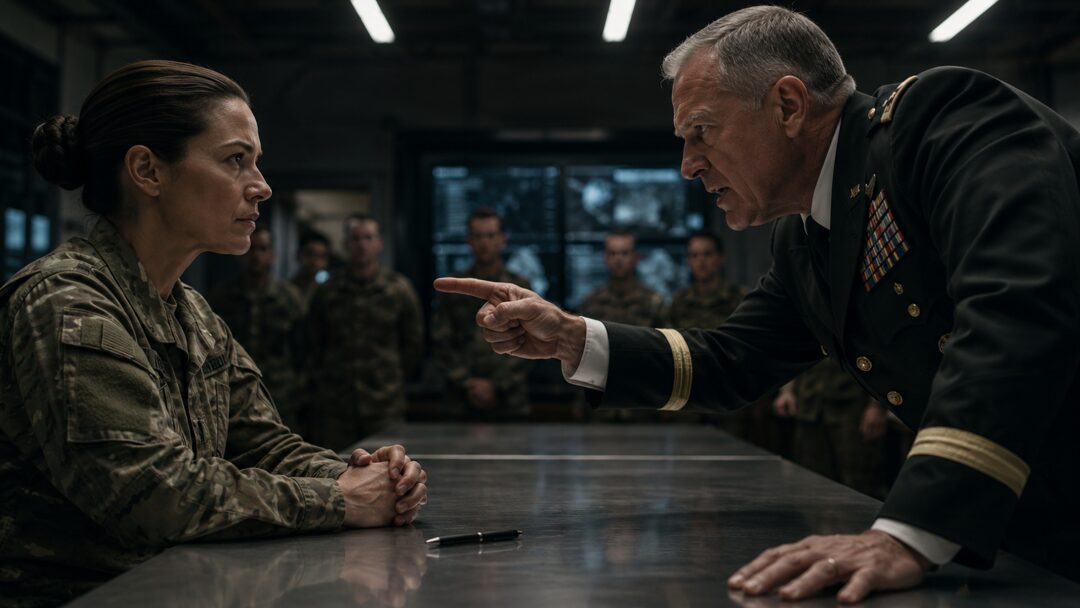
General Robert Brady’s finger came down toward Jennifer Walker like it could pin her to the chair.
The room went still.
Not quiet. Never quiet. The command floor beneath Washington had too many machines for that—too many screens whispering, phones pulsing, clocks measuring what no one wanted measured. But the people stopped moving. Officers froze with cups halfway to their mouths. Analysts stared into glowing maps and pretended not to listen.
Across the metallic table, Jennifer kept her hands folded.
Beside them lay a black pen.
She had not touched it.
On the wall display behind Brady, the countdown kept falling.
08:11.
08:10.
08:09.
Brady leaned farther over the table. His dress uniform looked too bright for the room: ribbons, medals, polished buttons, four stars at his shoulders. His face was heavy and gray, carved by decades of rooms where other people waited for him to decide.
Jennifer’s uniform was clean, sleeves exact, name tape straight. The only disorder was the faint crease at her shoulder, where her own hand had gripped the fabric hard enough to leave a mark before Brady entered.
“Sir,” she said, “I can’t certify a package built on a broken identification chain.”
A few heads turned.
Brady’s eyes narrowed. “You can’t, or you won’t?”
Jennifer looked at the pen.
Then back at him.
“I won’t certify what I can’t verify.”
The words landed badly. Not because they were loud. Because they were calm.
Major Mark Ellis stood two seats down, pale in the blue light from his console. His glasses had slid to the end of his nose. He pushed them back up with one finger and said nothing.
Brady heard the silence and used it.
“Captain Walker is delaying a national response recommendation because she thinks the system may have hurt her feelings.”
A few officers stiffened.
Jennifer did not blink.
“That is not what I said.”
“No,” Brady snapped. “What you said was worse. You said every platform, every relay, every confirmed read from three separate channels is wrong because you don’t like one timing discrepancy.”
“One repeated timing discrepancy,” Jennifer said. “In the satellite relay. Not the defensive grid.”
“Which you have already logged.”
“Twice.”
“And I have acknowledged.”
“You dismissed it.”
“I prioritized it,” Brady said. “There’s a difference.”
The countdown reached 07:32.
Above it, a red track line moved across an ocean map toward the eastern seaboard. Beside the map, evacuation alerts crawled across a narrow feed. Coastal counties. Harbor closures. Transit suspension.
Names of places that, under other lighting, would have sounded like summer.
Brady turned his hand palm up, as if inviting the room to witness her impossibility.
“The President needs a recommendation inside seven minutes. The National Security Advisor is waiting. The civilian chain is waiting. Our allies are waiting. And you are asking the room to pause because a relay packet offended your sense of elegance.”
Jennifer’s jaw tightened.
One breath.
Then another.
The first rule of the room was speed. The second was confidence. The third was that doubt could exist only if it wore the right uniform.
Jennifer’s was not the right one.
“Sir,” she said, “the track signature is misaligned by one-point-eight seconds across each relay confirmation.”
“Negligible.”
“It repeats.”
“Systems repeat.”
“Errors repeat too.”
Brady’s finger lifted again. Not pointing at the screen. At her.
“This is your first live strategic cycle.”
There it was.
Not the data. Not the discrepancy.
Her.
Jennifer felt the room receive it. A small shift in posture. A tiny release from officers relieved that someone had finally named what they were already afraid of.
New enough to hesitate.
Young enough to doubt.
Female enough for composure to look like emotion if a man needed it to.
She looked Brady straight in the face.
“I have run the alternate scenario twice. The anomaly appears before the track enters our defensive grid. That means our response package may be answering a picture that was drawn for us.”
Brady’s expression did not change, but his hand closed.
“Major Ellis.”
Mark flinched like his own name had struck him.
“Sir?”
“Route certification through Systems Liaison. Bypass Captain Walker’s station.”
No one breathed.
Mark looked from Brady to Jennifer, then down at his console. His fingers hovered over the keys.
“That chain requires Watch Officer concurrence,” Mark said carefully.
Brady stared at him.
Mark swallowed. “For this response class, sir.”
“I know the class.”
“Yes, sir.”
“Then open the route.”
Mark’s fingers did not move.
The room watched him fail to be invisible.
Jennifer kept her hands folded beside the pen. She could feel its presence like heat.
Brady turned back to her.
His voice dropped.
“Captain, people may die because you needed to be certain.”
Jennifer’s eyes moved to the red track line.
Then to the evacuation feed.
Then to him.
“No, sir,” she said. “People may die because everyone in this room wanted certainty badly enough to pretend we had it.”
The countdown reached 06:04.
And for the first time, Brady looked surprised.
Part II — The Cost of a Clean Answer
The secure line chimed.
A communications officer touched her headset. “Deputy National Security Advisor Mitchell is requesting status.”
Brady did not look away from Jennifer.
“Tell her we are resolving an internal delay.”
The officer’s eyes flickered. “Yes, sir.”
Internal delay.
Jennifer almost smiled. Not because anything was funny. Because every institution had a phrase for the moment truth became inconvenient.
On the wall, a split feed opened. No face. Just an encrypted audio channel and a white line pulsing with each breath on the other end.
Sarah Mitchell’s voice filled the room, clipped and dry.
“General Brady, I need your recommendation.”
“We are finalizing certification,” Brady said.
“How long?”
“Under five.”
“We do not have under five.”
“We are aware.”
“No,” Sarah said. Paper shifted near her microphone. Somewhere behind her, another alarm sounded and cut off. “I don’t think anyone on any end of this line is allowed to say that sentence casually right now.”
Brady’s mouth tightened.
Jennifer watched him absorb that. Brady did not like being corrected from above any more than he liked being challenged from below.
That should have made him more careful.
It made him harder.
“Mitchell,” he said, “we have an incoming object with hostile characteristics and limited intercept confidence. If we wait out the decision window and this is real, the President loses options.”
“And if the package is wrong?” Sarah asked.
Brady’s eyes stayed on Jennifer. “That question is being used aggressively at the moment.”
Jennifer leaned toward the table microphone.
“Ma’am, Captain Walker. The identification chain contains a repeated relay anomaly. I recommend a verification hold before certification.”
Brady’s head turned slowly.
Sarah paused.
“How long a hold?”
“Ninety seconds.”
Brady laughed once. It was not amused. “She is asking for an eternity in a burning room.”
Jennifer said, “I am asking for ninety seconds in a room built for exactly this kind of doubt.”
A few people looked down.
That line had crossed something.
Not disrespect. Not quite.
Worse.
It had made sense.
Sarah’s voice came back lower. “General, is her objection logged?”
“Yes.”
“Is it technically material?”
Brady did not answer fast enough.
Jennifer did not look at him. She looked at Mark Ellis.
Mark noticed too late.
His shoulders tightened.
Sarah repeated, “Is it technically material?”
Mark touched his console, as if permission might be hiding there.
“Major Ellis,” Sarah said, voice sharpening through the speaker, “you are Systems Liaison?”
“Yes, ma’am.”
“Answer.”
Mark’s throat moved.
“The anomaly is small but repeated.”
“Material?”
He glanced at Brady.
Brady’s stare was a locked door.
Mark looked at Jennifer.
She gave him nothing. No rescue. No pleading. No command.
Just the silence of someone who had already chosen where to stand.
Mark said, “Potentially.”
Brady’s fist hit the table.
Not hard enough to be theatrical.
Hard enough to remind everyone that the table belonged to him.
“Potentially,” he said, “is where decisions go to die.”
Jennifer finally unfolded her hands. Not toward the pen. Toward the screen.
“The object hasn’t behaved like a live inbound threat since first relay acquisition. It has behaved like a track trying to convince us it is one.”
“That is interpretation.”
“That is analysis.”
“That is fear.”
Jennifer looked back at him.
“No. Fear is needing the answer to be clean.”
Brady’s face changed. The smallest fracture. A muscle near his eye pulled tight.
For a second, Jennifer saw something behind his anger. Not softness. Not guilt, not yet.
Recognition.
Then it vanished.
The evacuation feed changed.
A live municipal alert appeared in a corner of the wall display. Roads marked red. A harbor bridge closed. Shelters opening in schools and churches. A camera from a coastal traffic system showed headlights crawling inland through early darkness.
No one in the room said the city’s name.
They all read it.
They all imagined people moving without knowing whether movement mattered.
Brady turned toward the feed.
His voice came quieter.
“You think I don’t know what delay costs?”
Jennifer did not answer.
He looked at her then, and the anger in him was different. Older. Heavier.
“There are families on those roads because we have not ended this yet.”
“If we answer a false track,” Jennifer said, “we don’t end it. We begin it.”
“You don’t know it’s false.”
“You don’t know it’s true.”
“That is not equivalence, Captain.”
“No,” she said. “It’s responsibility.”
The room held there.
Between them, the pen lay untouched.
A small black object.
A signature waiting to become history.
Part III — The Pattern That Came Back
The first time Jennifer had seen the timing signature, she was twenty-nine and too junior to be listened to in a room that smelled like burnt coffee and wet canvas.
The memory did not arrive whole.
It came in pieces.
A desert border station under bad light. Rain ticking on corrugated metal. A screen full of drone tracks that did not move like drones. Her own voice saying, too carefully, “The interval repeats.”
No one had shouted at her then.
That had been worse.
They had been kind. Busy. Tired. Senior.
They had told her to log it.
She had logged it.
By morning, there was a report she had not written and a line in it she had never said: no objection raised at time of response.
For three years, she had told herself the chain had not used her silence.
Only her rank.
Now, in the room beneath Washington, the numbers lined up again.
Not exactly. Never exactly.
But close enough for the body to know before the mind admitted it.
Jennifer’s hand moved to her shoulder. She stopped herself halfway and placed both palms flat on the table instead.
Brady saw it.
So did Mark.
Jennifer enlarged the relay comparison on her station and sent it to the main display.
The wall changed.
Three stacked timing bars. Three relay captures. Three tiny offsets repeating with mechanical grace.
Mark leaned forward before he could stop himself.
Jennifer saw his eyes sharpen.
Brady saw it too.
“What?” Brady demanded.
Mark adjusted his glasses. “The offset progression isn’t random.”
“Say that again in useful English.”
Mark hesitated. “It steps.”
Jennifer said, “Like a generated pattern.”
Brady stared at the display.
For a moment, his face emptied.
Not of thought.
Of defense.
Jennifer knew then that he saw it. Maybe not all of it. Maybe not enough.
But he saw the shape.
The old shape.
She said, quietly, “It’s Echo Ridge.”
The room did not know the name.
Brady did.
His eyes snapped back to hers.
“Do not.”
Jennifer held his gaze. “Sir—”
“Do not bring that into this room.”
“It’s already here.”
“No.” His voice dropped into something almost private, which made it more dangerous. “You do not get to weaponize old grief during a live cycle.”
The room seemed to lean toward them.
Old grief.
So he remembered the file.
He remembered the rain, the bad light, the report that cleaned itself by morning. He remembered the civilians who had been called collateral because no one could bear to call them by the simpler word.
Jennifer’s throat tightened once.
She did not let it reach her voice.
“I’m not grieving,” she said. “I’m identifying a pattern command promised would never repeat.”
Brady’s hand went to the pen.
Not picking it up.
Just touching it.
Jennifer watched his fingers close around the barrel and felt, absurdly, the old report in her hands again. The version with her name in the appendix. The version that made her carefulness look like consent.
Brady said, “Echo Ridge was reviewed.”
“Echo Ridge was buried.”
A sound moved through the room. Not speech. A collective intake that people tried to swallow.
Mark looked down at his screen.
Jennifer knew he had heard of it. Not the classified details, maybe, but the rumors. Every institution had ghosts, and every ghost had people trained not to say its name.
Brady’s face hardened.
“That operation is not yours to summarize.”
“No,” Jennifer said. “It was mine to warn.”
The line struck him. She saw it.
For one second he was not a general, not a wall of command authority, not a man with the President waiting behind him.
He was an old officer in a room where a younger one had said the interval repeats.
And he had moved on.
Sarah Mitchell’s voice cut through the speaker.
“General Brady. Captain Walker. I need clarity now.”
Brady looked away first.
That was the room’s first real shift.
It did not make Jennifer powerful.
It made everyone aware that Brady was no longer the only person carrying history.
The countdown reached 03:18.
Jennifer’s pulse slowed.
Not because she was calm.
Because some part of her had finally stopped asking permission to know what it knew.
Part IV — The Perfect Shape
A new packet arrived with a chime so clean it sounded almost gentle.
Then the wall turned worse.
The single red line split into three.
Then five.
Then seven.
Around the table, bodies moved at once. Analysts called confirmations. A deputy officer cursed under his breath and caught himself too late. Someone asked for intercept confidence. Someone else said the words no one wanted: “multiple tracks.”
Brady straightened.
The old room came back around him like armor.
“There,” he said.
Jennifer stared at the display.
The data looked damning.
Seven objects. Consistent separation. Acceleration within hostile profile. The kind of picture that removed debate and left only response.
Brady turned toward her.
“You wanted confirmation.”
Jennifer did not answer.
“Captain.”
She kept looking.
The tracks spread across the map with terrible elegance.
Too elegant.
The thought arrived before fear could crush it.
Not chaos.
Design.
Jennifer leaned toward her console. Her fingers moved. She overlaid the first relay capture with the new separation pattern and stripped out the response projections.
The wall display changed again.
Seven red lines became seven pale curves.
Mark whispered, “No.”
Brady heard him.
“What?”
Mark’s face had gone almost colorless.
Jennifer said, “It’s too clean.”
Brady’s eyes flared. “Do not do this.”
“Natural separation jitters. This doesn’t.”
“You are watching hostile multiplication and calling it tidy?”
“I’m watching a simulation behave like a simulation.”
“You are out of line.”
“No, sir. The line moved.”
Brady reached for the pen.
This time, he picked it up.
The room seemed to shrink around the object.
A black pen between a city and a decision.
Brady turned to the communications officer. “Prepare certification override.”
Jennifer’s hand moved before anyone else’s.
She placed her palm over the certification block on the table pad, directly in front of the pen.
Not dramatic.
Not shaking.
Just there.
Brady looked at her hand as if it had appeared from nowhere.
“Remove your hand.”
“No, sir.”
The words were soft enough that some people might have missed them if the room had not been so hungry for them.
Brady leaned over the table.
His voice dropped to a blade.
“Captain Walker, you are obstructing a lawful response process.”
“I am preventing my name from being used as decoration on a decision I do not endorse.”
“You are one officer.”
“Yes, sir.”
“You are not the chair.”
“No, sir.”
“You are not command authority.”
“No, sir.”
“Then understand your place.”
Jennifer looked up from the pen to his face.
“My place is on the certification line.”
No one moved.
Not even Brady.
The sentence did not raise her rank. It did something more dangerous.
It made her rank matter.
Sarah’s voice entered again, sharper now. “I need the recommendation.”
Brady said, “Recommendation is retaliatory certification pending final concurrence.”
Jennifer leaned toward the microphone.
“Formal objection remains.”
Brady’s eyes cut to her.
Sarah said, “On what basis?”
“The track separation pattern is generated.”
Brady barked, “Unproven.”
Jennifer said, “So is the threat.”
Sarah was silent.
The countdown reached 01:52.
Somewhere behind them, a junior officer began to cry without making sound. Jennifer saw only the hand pressed over the mouth, the eyes still fixed on the screen.
Brady saw it too.
His face shifted.
Anger could cover many things.
Not that.
Jennifer wondered if he was seeing the coastal roads again. The headlights. The schools becoming shelters. Or maybe he was seeing another place, another morning, another report that had made language do the work of mercy.
He lifted the pen higher.
Jennifer did not remove her hand.
Brady said, “If you force me to remove you, that will follow you for the rest of your career.”
Jennifer’s chest tightened.
There it was. The cost, finally said plainly.
Not discipline. Not process.
Her future.
The promotion board. The command track. The careful years. The reputation she had built after Echo Ridge by becoming exact enough that no one could call her emotional again.
She thought of the old report.
No objection raised.
She thought of herself reading it in an empty office, understanding for the first time that silence could be forged.
Then she said the line that ended the old version of her life.
“Sir, if you need my name on this, then you need my judgment with it.”
Mark closed his eyes.
Brady’s hand tightened around the pen until his knuckles paled.
Sarah Mitchell said, “General Brady. Is Captain Walker’s concurrence required?”
Brady did not answer.
Sarah said, “General.”
He looked at Jennifer.
For the first time, she could see the question he hated.
Not whether she was right.
Whether he already knew she might be.
Part V — Ninety Seconds
Brady lifted the pen over the table pad.
Jennifer stood.
Chairs shifted. Someone said her name under their breath. The old rules of the room broke around the simple fact of her body rising.
She was not tall.
She did not need to be.
“I am entering formal dissent into the national command record,” she said.
Her voice was steady, but not cold now. There was heat in it. Human heat. The kind restraint could not hold forever.
Brady stared at her.
Jennifer continued before he could stop her.
“My objection is based on repeated relay offset, nonrandom separation geometry, and historical match to a prior misidentification event reviewed under Echo Ridge. I do not certify retaliatory action at this time.”
Mark’s hands hovered over his keyboard.
Brady turned on him.
“Major Ellis.”
Mark looked up.
This was the room’s second choice.
The first had been Jennifer’s.
The second belonged to the man who had spent his career telling himself that accuracy was not courage, only competence.
Brady’s voice was quiet. “Confirm or deny.”
Mark’s fingers trembled once.
He pushed his glasses up.
Then he looked at the wall display, not at Brady.
“The anomaly is present,” Mark said.
Brady’s face hardened.
Mark’s voice almost failed. Then it didn’t.
“The separation pattern is inconsistent with natural fragmentation. Captain Walker’s objection is technically valid.”
A tiny sound escaped somewhere in the room.
Not relief.
Recognition.
Courage did not flood the room. It moved through it like a crack in glass.
Sarah Mitchell said nothing for two seconds.
Then, “General Brady, I need final recommendation.”
The countdown reached 00:59.
Brady looked at the screen.
Then at Jennifer.
Then at the pen in his own hand.
The room waited for the old machinery to finish what it had been built to do.
Jennifer waited too.
She understood, with sudden clarity, that Brady was not deciding whether she had embarrassed him.
He was deciding whether to become the kind of man who could stop.
That was harder than starting.
His medals caught the overhead light. For a strange second, they looked less like honors than weights.
Brady opened his mouth.
Nothing came out.
Jennifer saw Echo Ridge pass through his face. Not as confession. Not as apology. Just impact. A remembered room. A younger officer. A warning logged and swallowed.
The countdown reached 00:43.
Sarah’s voice came again, tight now. “General.”
Brady lowered the pen.
“Verification hold,” he said.
The room did not understand at first.
He turned toward communications. “Ninety seconds. Cross-check relay origin, strip external injection, isolate first acquisition. Now.”
The room erupted into motion.
Mark bent over his console, suddenly alive. Analysts called confirmations. The communications officer relayed the hold in a voice that almost broke on the word hold.
Sarah Mitchell said, “You are recommending delay?”
Brady looked at Jennifer while he answered.
“I am recommending verification.”
“That is not what I asked.”
“No,” Brady said. “It’s what we have.”
For ninety seconds, no one in the room belonged to themselves.
Jennifer stayed standing.
Brady stayed seated.
The pen lay between them, no longer in his hand.
The red tracks kept moving on the wall.
00:31.
A technical officer called, “Relay origin mismatch.”
00:24.
Mark said, “External injection signature possible.”
00:18.
Someone behind Jennifer whispered, “Please.”
Not to God, exactly.
To the machines.
To the room.
To whatever part of history could still be interrupted.
00:11.
Mark’s fingers slammed across his keys.
His voice came out raw.
“Confirmed spoof architecture.”
The room stopped.
Not because the crisis was over.
Because for one suspended second, everyone understood what almost had their signatures on it.
The red lines vanished from the main threat display.
A new classification appeared.
HOSTILE SIMULATION EVENT.
Jennifer sat down slowly.
Her knees had not been weak until then.
Part VI — What Remained on the Table
No one cheered.
That was the first thing Jennifer noticed.
In movies, rooms erupted when disaster stepped back from the door. In real rooms, people stared at the space where the terrible thing had been and felt the shape it had left behind.
Sarah Mitchell’s voice returned, quieter.
“General Brady.”
He did not answer immediately.
His eyes remained on the cleared display.
“General,” Sarah repeated.
Brady touched the table with both hands. Large hands. Old hands. Hands that had signed too much to believe paper was harmless.
“I am removing myself from the recommendation chain pending review,” he said.
The room went still again, but differently this time.
Sarah was silent long enough for the line to pulse three times.
“Understood,” she said. “Captain Walker remains available for record?”
Jennifer looked up.
Brady did not turn toward her.
“She does.”
Sarah said, “Captain Walker.”
Jennifer leaned toward the microphone.
“Yes, ma’am.”
“That dissent will be attached to the cycle record.”
“I understand.”
“There will be questions.”
“I understand.”
The words were clean. Almost easy.
Jennifer knew better.
Questions meant boards. Closed rooms. Men and women asking why she had stood when seated disagreement would have been sufficient. Asking whether Echo Ridge had impaired her objectivity. Asking why she had not trusted the general officer in the room. Asking whether being right once had made her dangerous forever.
Truth survived.
It did not protect you from paperwork.
Sarah’s voice softened by one degree. “Your objection has been noted.”
Jennifer almost laughed.
Noted.
The same word that had buried her once.
This time, though, there were too many witnesses.
This time, Mark Ellis had spoken.
This time, Robert Brady had ordered the hold.
“Thank you, ma’am,” Jennifer said.
The secure line cut.
The room began to exhale in pieces. Chairs rolled back. Officers spoke in low voices. Someone wiped both hands over their face and stared at nothing. A young analyst took off her headset and pressed it against her chest like she needed to feel something solid.
Mark came to Jennifer’s side but did not know what to do when he got there.
So he stood too close and said, “I should’ve said it sooner.”
Jennifer looked at him.
His glasses were crooked again.
“Yes,” she said.
The answer hit him. He accepted it.
Then she added, “You said it in time.”
Mark nodded once, but his face did not clear.
Good, Jennifer thought.
Let it stay there.
Some things should.
Across the table, Brady remained seated.
He looked smaller without motion. Not weak. Never that. But reduced to human size.
For a while, he said nothing.
No one approached him.
Jennifer expected him to leave without looking at her. That would have been easier for both of them. A senior man walking away from the piece of himself he had almost had to meet.
Instead, Brady picked up the black pen.
Jennifer’s hand tensed before she could stop it.
He saw.
Of course he saw.
He carried the pen around the end of the table. Every step seemed louder than it should have been. The room noticed, then pretended not to.
He stopped beside her chair.
For the first time all night, Jennifer had to look up at him from close range.
The medals were still there. The rank was still there. The years. The command. The damage.
So was the silence between them.
Echo Ridge stood in it.
Tonight stood in it.
Brady placed the pen on the table in front of her.
Not gently.
Not ceremonially.
Just deliberately.
Jennifer looked at it.
Then at him.
His eyes were tired in a way anger had hidden before.
He did not say he was sorry.
She had not expected him to.
Maybe she would have hated it if he had.
Apology was too small for what had happened three years ago. Too easy for what had nearly happened now.
Brady’s mouth moved once before any sound came.
“Captain.”
That was all.
But it was not the same word he had thrown at her across the table.
It no longer meant know your place.
It meant he had seen where she stood.
Jennifer did not answer right away.
Then she gave him the smallest nod.
“General.”
He turned and walked toward the far door.
No one stopped him.
When it closed behind him, the room did not feel victorious. It felt awake, and being awake hurt.
Jennifer looked down at the pen on her side of the table.
The certification block was still open on the pad. Her name still waited beside the line. A record would be made. Careers would bend around it. Some doors would close quietly. Some people would call her careful in the tone they used for difficult.
She picked up the pen.
It was lighter than she expected.
For three years, she had believed the worst thing she had ever done was fail to be heard.
Now she understood the harder truth.
Being heard was not the end of the cost.
It was the beginning of it.
On the wall, the countdown had disappeared. The map had returned to blue. Along the coast, evacuation orders were being revised, road by road, shelter by shelter, ordinary life crawling back toward people who would never know the name of the woman who had refused to sign too soon.
Jennifer set the pen down again.
Not away from her.
In front of her.
And when the next officer entered with a fresh report and a careful voice, she did not fold her hands.
She reached for it.