What the Room Remembered
Part I — The Open Case
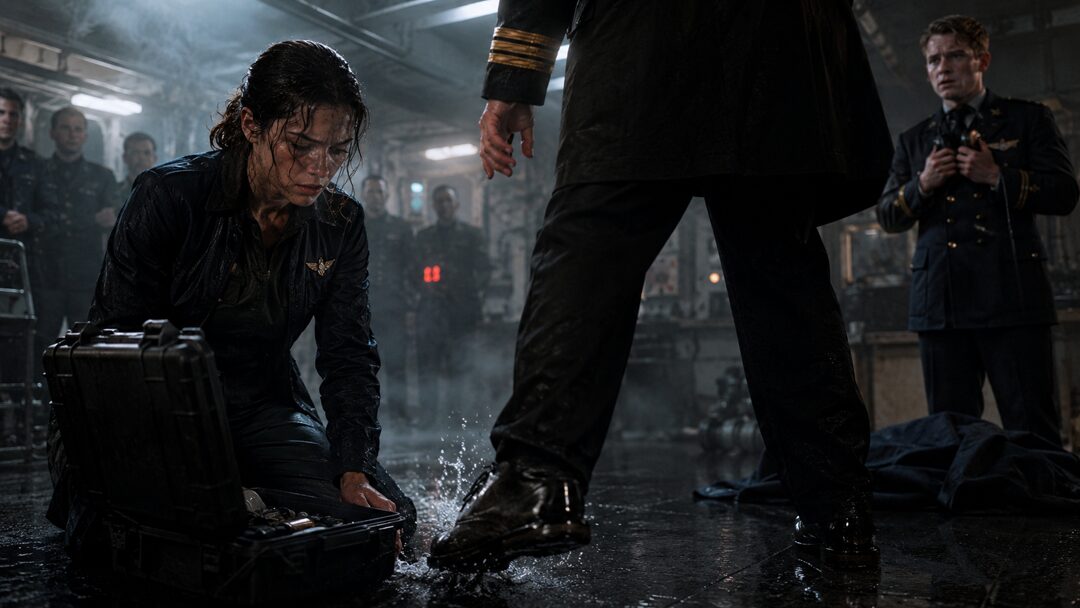
Sarah Mitchell was on her knees when Captain Robert Hayes threw her jacket onto the flooded deck.
It landed beside her open black kit with a wet slap, one sleeve folding over the gold wings pinned to the chest. Around them, water rolled with the slow tilt of the vessel, carrying flakes of paint, oil shine, and a strip of torn insulation past Sarah’s gloved hand.
No one moved to pick it up.
Not the officers standing along the bulkhead.
Not Lieutenant Mark Daniels, pale and sleepless near the comms console.
Not Hayes, whose face was red under the harsh overhead lights, whose medals trembled every time he breathed.
“You are done,” Hayes said.
His voice filled the compartment like another leak.
Steam pushed from a ruptured pipe above the tactical table. The air smelled of hot metal and salt. Somewhere beyond the sealed hatch, alarms clicked in short, tired bursts, as if even the ship had lost the strength to scream.
Sarah kept one hand inside her kit.
She had packed field gloves, a cracked helmet visor, two sealed data pouches, a rolled flight map, and a square of dark cloth folded under the foam lining. She moved with the careful slowness of someone disarming a device.
Hayes bent over her.
“Look at me when I’m relieving you.”
Sarah closed the side pocket without looking up.
The room heard it.
The tiny metallic click.
It should not have sounded louder than his voice, but somehow it did.
Hayes took one step closer, boots splashing water against her knee. “Commander Mitchell, you will surrender your equipment, your access card, and any material connected to Operation Lantern. Then you will remove yourself from my flight deck before your judgment gets anyone else killed.”
A few of the men behind him shifted.
Nobody spoke.
They had seen Sarah fly into weather that made younger pilots pray into their masks. They had seen her bring aircraft home with half the panel dark and one engine coughing smoke. They had seen her sit beside wounded crew until they stopped shaking.
Now they watched her kneel like a reprimanded recruit.
Sarah lifted her eyes only as far as Hayes’s hand.
He held her access card between two fingers.
It was still damp from where he had taken it off the console.
“You hear me?” he said.
“I heard you.”
Her voice was quiet.
That made him angrier.
He wanted the room to see her break. He wanted the anger, the protest, the brittle denial. Something loud enough to justify the way he stood over her.
Sarah gave him nothing.
Hayes pointed at the jacket. “Take your souvenirs and get out.”
The word landed badly.
Souvenirs.
The officers along the wall looked at the jacket again, at the gold wings catching in the shallow water, at the name tape darkening as the cloth soaked through.
Mark Daniels swallowed.
Sarah saw it.
A small motion. One pulse in the throat.
He knew better than to look at the kit, so of course that was how she knew he was thinking about it.
Hayes turned sharply toward him. “Daniels.”
Mark straightened. “Sir.”
“Seal Commander Mitchell’s kit. Log it for transfer.”
Mark hesitated only half a second.
But in a room like that, half a second had a shape.
Hayes saw it. Sarah saw it. Two officers near the hatch saw it and looked away.
“Now, Lieutenant.”
Mark stepped forward. Water rippled around his boots. He wore his headset around his neck, the cord twisted from too many hours of nervous hands. His uniform was too clean for the room, too neat for what everyone had survived.
He crouched beside Sarah’s kit and reached for the lid.
Sarah’s gloved hand came down on the case.
Not hard.
Just enough.
Mark froze.
She finally looked up.
“That case leaves with me,” she said, “or nobody launches.”
The compartment went still.
Hayes stared at her as if she had finally given him the thing he had been waiting for.
“Insubordination,” he said softly.
Sarah did not remove her hand.
The water around her sleeve trembled with the engine vibration below deck. She could feel the case under her palm. The hard outer shell. The dent in the left corner. The hidden seam beneath the lining.
The thing inside it was smaller than a fist.
It was heavy enough to sink everyone in the room.
Hayes leaned closer. “You want witnesses, Commander? Good. Let them hear this.”
Sarah said nothing.
He raised his voice.
“You broke formation. You ignored recall. You led two aircraft across a line we had no authorization to cross. Operation Lantern had a clean withdrawal window until you decided your instincts outranked command.”
His words struck the room in practiced order.
Not because they were true.
Because they had been repeated so often that they had become easier to carry than the truth.
Sarah watched water slide off the edge of her kit.
Hayes kept going.
“You cost us aircraft. You cost us personnel. You cost families their sons, husbands, brothers—”
His voice caught.
Only for a second.
But Sarah heard it.
So did Mark.
Hayes forced the rest out harder. “And now you think you can threaten my launch authority?”
Sarah looked at the jacket on the deck.
The gold wings were half-covered by water.
She remembered the day they had been pinned to her chest by a woman with silver hair and scarred hands who told her, Don’t ever let them make you grateful for what you earned.
Sarah had been twenty-four then.
She had believed earning something meant it could not be taken.
Hayes followed her gaze and smiled without warmth.
“You don’t get to wear those today.”
Sarah looked back at him.
“No,” she said. “Not like this.”
That was when the radio cracked.
Everyone turned.
At the comms console, the emergency channel hissed through static.
Mark lunged for the receiver, grateful for the interruption and terrified of it.
A voice came through, thin and broken.
“Raptor deck, this is Carter… repeat, this is Carter… three alive at relay marker seven… moving east… signal failing…”
Sarah’s hand tightened on the kit.
Hayes went still.
Mark looked at the console, then at Hayes. “Sir, that’s a Lantern field frequency.”
The static surged.
Then the voice came again.
“Need extraction. Sweep line less than ninety out. If anyone can hear me—”
The signal cut.
No one breathed.
Sarah stood halfway, one knee still in the water, her hand still on the case.
“That’s Emily Carter,” she said.
Hayes did not look at her. “Operation Lantern has no recoverable personnel.”
Sarah’s eyes hardened.
“She just told you otherwise.”
Part II — The Voice That Returned
Hayes crossed the room to the comms console so fast that two officers stepped out of his path.
“Authenticate,” he snapped.
Mark’s hands moved over the panel. “Signal degraded. I can try to pull the burst signature.”
“Do it.”
Sarah rose fully, water running down the front of her flight suit. Her hair, tied back at the start of the day, had loosened in dark strands against her cheek. A smear of grime cut across her jaw.
Hayes did not turn around. “You stay where you are.”
Sarah stayed.
But not because he told her to.
Mark listened through the headset, one hand pressed to the earpiece. “It’s Carter’s code series, sir. Or someone with her transmitter.”
Hayes’s jaw worked. “The area was swept.”
“Not all of it,” Sarah said.
He turned on her. “You don’t know that.”
“I know Carter. If she says three alive, there are three alive.”
“She also said less than ninety.”
“Then we have less than ninety.”
A low murmur moved along the wall and died quickly under Hayes’s glare.
He went back to the console. “Request relay confirmation from fleet.”
Mark’s fingers paused.
Hayes saw it. “What?”
Mark cleared his throat. “Fleet already marked the sector closed.”
“Then request an override.”
Sarah stepped forward. “They’ll deny it.”
“You don’t know that.”
“Yes, I do.”
Hayes faced her fully now. “Because you know everything, don’t you? You knew better than flight command at Lantern. You knew better than recall. You knew better than the map, the signal, the chain of authority—”
“The map was wrong.”
The words came out clean and low.
They did what shouting could not.
They stopped him.
Hayes stared at her.
Sarah could have said more. She had carried more for thirty-six hours. It had sat behind her teeth during debrief, during the loss count, during the quiet moment in the corridor when someone had turned away rather than salute her.
But truth released too early could become debris.
It could scatter.
It could be collected by the wrong hands.
Hayes took a slow step toward her. “Say that again.”
Sarah looked at Mark.
He looked down.
Hayes followed her gaze.
Something changed in his face.
Not understanding.
Suspicion.
“Lieutenant Daniels,” he said. “Is there something you want to add?”
Mark’s lips parted.
No sound came.
The emergency channel spat static again.
Emily Carter’s voice returned in pieces.
“—second man can’t walk… I can keep him awake… marker seven compromised… please advise…”
Under the static, there was wind. Metal tapping. Someone breathing too quickly.
Sarah moved to the console.
Hayes blocked her.
“You are relieved,” he said.
“They are alive.”
“They are beyond the line.”
“They are within range.”
“They are inside a zone command has declared unrecoverable.”
Sarah leaned closer, not to intimidate him, but to make sure every word had to pass through his grief before it reached the room.
“Command declared them unrecoverable when command needed them silent.”
Hayes’s face darkened.
For a second, Sarah thought he might strike her.
Not because he was that kind of man.
Because grief sometimes looked for the nearest wall and called it justice.
“Open the kit,” he said.
Sarah did not move.
Hayes laughed once, without humor. “There it is.”
He turned to the room. “You see? She makes accusations, then hides evidence. She threatens launch operations, refuses lawful transfer, and expects her rank to shield her from consequence.”
Sarah looked at the jacket on the deck.
The sleeve had drifted in the water until the gold wings faced up.
They did not shine now.
They looked drowned.
“Captain,” she said, “if I open that kit in front of this room, you will have to choose what kind of officer you are before you’re ready.”
His eyes narrowed.
“Open it.”
Mark whispered, “Commander…”
Hayes rounded on him. “Quiet.”
Sarah walked back to the kit.
Every eye followed her.
She knelt again, but this time the posture had changed. The first time, the room had seen defeat. Now they saw choice.
She released two visible latches.
Then she pressed her thumb beneath the torn foam lining and found the hidden catch.
A narrow compartment opened under the base.
Mark closed his eyes.
Hayes saw him do it.
Sarah removed a damaged black recorder, its casing cracked, one corner burned, the serial strip scratched almost white. Beside it lay a folded navigation patch, darkened along one edge, and a thin encrypted data wafer sealed in clear plastic.
Hayes stared at the objects.
For the first time since Sarah had entered the compartment, he did not look angry.
He looked older.
“What is that?” he asked.
“Lantern flight recorder,” Sarah said.
“That was logged destroyed.”
“No. It was logged destroyed after I stopped it from being transferred.”
His eyes moved to the navigation patch.
Sarah did not touch it.
“It came from the marker board at the first landing zone,” she said. “The corrected one.”
Hayes’s voice dropped. “There was no corrected landing zone.”
Sarah looked at Mark again.
This time, he did not look away.
Hayes turned slowly.
“Lieutenant.”
Mark’s hands began to shake.
“I logged the correction,” he said.
The words were barely there.
Hayes took one step toward him. “Speak clearly.”
Mark forced air into his chest. “I logged the correction, sir. Twenty-two minutes before launch.”
The compartment seemed to tilt harder beneath them.
Hayes said, “No.”
Mark shook his head once. Not denial. Surrender.
“Yes, sir.”
Sarah lifted the data wafer.
“The assigned zone had enemy movement. Carter’s team flagged it. Daniels entered the warning. The map updated for eleven minutes.”
Hayes looked at the recorder as if it were a live thing.
“Then it disappeared,” Sarah said.
No one asked who made it disappear.
That was the worst part.
Everyone in the room understood that some orders did not need signatures.
Part III — The Name He Couldn’t Hear
Hayes took the recorder from Sarah’s hand.
For a moment, she almost stopped him.
Then she let him have it.
He needed to feel its weight.
He turned it over, reading the damaged serial number. His thumb brushed the cracked edge. His hand was steady, but the skin around his mouth had gone tight.
“Why didn’t you bring this to me?” he asked.
“I tried.”
“When?”
“After debrief.”
His eyes sharpened. “You said nothing at debrief.”
“I asked for a private review.”
“You stood there and let the record show you broke formation.”
“I stood there while fleet legal sat behind you with a sealed transfer order already written.”
Hayes looked down at her kit.
Sarah saw the moment he understood that his outrage had not started the punishment. It had only performed it.
He hated that.
People like Hayes could survive being wrong.
They could not easily survive being used.
The radio hissed again.
Emily’s voice came through weaker.
“Raptor deck… Carter… one unconscious… second responsive… moving too slow…”
A pause.
Then, softer, almost ashamed:
“I can’t carry both.”
Sarah shut her eyes for half a second.
One strong detail from Lantern came back before she could stop it: Emily Carter laughing over the crew channel, twelve hours before the operation, saying she trusted Sarah’s flying more than she trusted the coffee.
Then the channel full of shouting.
Then the recall order.
Then the wrong map.
Then a young male voice saying, Mitchell, corridor’s yours. Go.
Sarah opened her eyes.
Hayes was watching her.
“You heard him,” he said.
It was not a question.
Sarah said nothing.
His face changed in a way the room could not read, but Sarah could.
Because she had been waiting for this part.
Because it had always been coming.
Hayes stepped closer. His voice lowered until only Sarah and Mark could hear clearly.
“My son was flying Falcon Two.”
“I know.”
The words cost him.
“Do you?”
Sarah did not answer quickly enough.
Hayes’s grief came back as anger because anger was the shape he trusted.
“You crossed out of formation. Falcon Two moved to cover you. He never came back.”
Sarah held his stare.
“That is what happened,” she said. “But it is not why it happened.”
His eyes went flat. “Careful.”
“No.”
The word surprised even Mark.
Sarah’s voice stayed quiet, but the silence around it sharpened.
“No, Captain. You told me to look at you when you relieved me. So look at me while I tell you this.”
Hayes did not move.
Sarah pointed to the recorder in his hand.
“Your son heard the correction before launch. He knew the first zone was compromised. When the map reverted, he questioned it twice.”
Hayes’s jaw clenched.
“He was ordered to proceed.”
“By whom?”
Sarah glanced toward the ceiling, toward decks above them, toward rooms where voices came through secure channels and left no fingerprints.
“Not by anyone standing here.”
Hayes’s grip tightened on the recorder.
Sarah continued.
“When recall came, I had Carter’s team on emergency beacon. Falcon Two was closest to my west corridor. Your son could have turned back clean.”
Hayes’s face twisted.
“He didn’t.”
Sarah reached into the kit and removed a small audio lead. She connected it to the recorder with hands that did not shake.
Mark looked at her in warning.
Sarah ignored him.
She did not play the whole file.
Only twelve seconds.
Static first.
Then Sarah’s voice from thirty-six hours earlier, strained but controlled: “Falcon Two, break off. I have corridor.”
Then another voice, young and breathless, but steady.
“Negative, Mitchell. You pull them out. I’ll hold the door.”
The compartment went silent.
The recording crackled.
Then the young voice again, softer:
“Tell my father I stayed on purpose.”
Sarah stopped it.
Hayes did not move.
His face had drained of color so completely that the red anger seemed like something that had happened to another man.
No one looked at him directly.
Some griefs were indecent to witness.
Sarah removed the lead and placed it back in the kit.
“I didn’t bring that to you in front of a room,” she said. “I was trying to leave your son more than an argument.”
Hayes stared at the recorder.
For one terrible second, Sarah thought he would break.
Instead he rebuilt himself badly.
Brick by brick.
Rage first.
Then rank.
Then the old lie, because it was familiar.
“You expect that to absolve you?”
“No.”
“Good.”
“I expect it to matter.”
His eyes rose to hers.
“It matters that he died.”
Sarah nodded once.
“Yes.”
“It matters that you lived.”
Sarah took that without flinching.
“Yes.”
He stepped closer. “And it matters that I have buried better officers than you.”
Sarah’s mouth tightened.
“Then stop letting them be buried under false reports.”
Mark made a sound.
Not quite a gasp.
Not quite a warning.
Hayes looked at him.
“What else?” he said.
Mark looked at the floor.
Sarah did not help him.
That was the hardest kindness.
If she dragged his truth out for him, it would still belong partly to her.
Mark had to choose.
Outside, the vessel groaned.
The emergency channel hissed.
Emily Carter said, “If anyone copies… we’re at marker six now. I lied before. I can’t keep pressure much longer.”
Sarah’s face changed.
Only a little.
But Hayes saw it.
So did Mark.
Sarah could carry accusation.
She could carry grief.
She could not carry delay.
Mark took one step forward.
“Sir,” he said, and his voice cracked. “Fleet command ordered me to delete the correction after launch.”
Hayes stared at him.
Mark swallowed.
“I kept a backup.”
“Where?”
Mark looked at Sarah’s open kit.
“In there.”
Part IV — The Choice in the Room
Hayes moved so fast that the recorder nearly slipped from his hand.
“You put classified fleet traffic inside her personal kit?”
Mark’s eyes shone with fear. “Yes, sir.”
“Why?”
Mark looked at Sarah, then at the officers behind Hayes, then at the wet jacket on the deck.
“Because no one was going to search her kit for truth,” he said. “They were only going to search it for blame.”
The line hung in the room.
Hayes flinched as if Mark had raised a hand.
Sarah did not look at Mark, but something inside her loosened. Not enough to feel like relief. Just enough to breathe.
Hayes turned back to the kit.
He saw it now.
The open case he had treated like surrender.
The jacket he had thrown like trash.
The woman he had put on her knees in front of everyone.
Not as one act.
As a sequence.
A useful sequence.
Make her look unstable.
Make her look proud.
Make her look guilty.
Seal the kit.
Transfer the evidence.
Close the sector.
Let the sea take the rest.
The comms console chimed.
Mark looked down, and whatever color remained in his face vanished. “Incoming fleet order.”
Hayes did not answer.
Mark read it anyway, because training sometimes moved faster than fear.
“Commander Sarah Mitchell is formally relieved of flight authority pending review. All materials connected to Operation Lantern are to be secured for legal transfer. No extraction attempt authorized beyond closed sector boundary.”
A second line appeared.
Mark’s voice weakened.
“Personnel at relay markers five through eight remain classified non-recoverable.”
The word seemed to poison the air.
Non-recoverable.
Sarah thought of Emily holding pressure on a wound with one hand while lying to keep another person calm. She thought of Falcon Two holding the door. She thought of the dead being made into paperwork before their voices had even faded.
Hayes looked at the order.
This was the moment, Sarah knew.
Not the shouting.
Not the jacket.
Not even the recording of his son.
This was the moment where a man found out whether his obedience had a bottom.
Hayes turned toward her.
“You are relieved,” he said.
Sarah bent down and picked up the wet jacket.
Water streamed from the hem.
The room tightened.
Hayes’s voice hardened. “Commander.”
Sarah shook it once, not to dry it, but to free the sleeve from the deck.
“Do not put that on,” he said.
Sarah slid one arm into it.
The cloth was cold against her shoulder.
Hayes stepped forward.
Mark whispered, “Captain…”
Hayes raised a hand without looking at him.
Sarah slid in the other arm.
The jacket settled badly at first, twisted over the damp flight suit, heavy with water. She pulled the front straight. Her hands found the zipper.
Hayes came close enough that she could see the burst veins in his eyes.
“I gave you an order.”
Sarah looked up at him.
“You gave me three,” she said. “Leave the room. Surrender the kit. Let them die.”
A muscle worked in his cheek.
“I gave you lawful orders.”
“No, sir.”
She took the zipper tab between two fingers.
“This is the part you should be careful with.”
Hayes reached for her wrist.
He did not grab it.
Not quite.
His hand stopped in the air between them.
Sarah waited.
So did everyone else.
The whole room seemed balanced on that unfinished gesture.
The radio cracked again.
Emily’s voice barely made it through.
“Mitchell… if you’re hearing this… don’t come pretty. Come fast.”
A rough laugh broke under the static.
Then nothing.
Sarah pulled the zipper upward.
Slowly.
The sound was small and absolute.
At the center of her chest, the gold wings lifted out of the shadow, wet at the edges, catching the hard white light from above.
They did not glow like magic.
They did something worse to Hayes.
They reminded him.
Of flight decks in clear weather.
Of young officers who believed rank meant responsibility.
Of ceremonies where families clapped.
Of a son who had once stood straighter because those same wings meant he had earned the sky.
Sarah stepped close.
Not shouting.
Not pleading.
“Captain Hayes,” she said, “I am Commander Sarah Mitchell, qualified rescue lead, current aircraft commander of the only crew on this vessel with the range, weather clearance, and night extraction rating to reach Carter’s signal. Under emergency recovery authority, when command delay will cost recoverable lives, I am permitted to launch unless you physically prevent me.”
Hayes’s hand remained suspended.
Sarah looked down at it.
Then back at his face.
“So decide,” she said.
No one in the compartment breathed.
Hayes’s eyes moved from her face to the wings.
Then to the kit.
Then to the live signal line still pulsing weakly on Mark’s screen.
Sarah did not fill the silence.
That was the power.
He had to walk across it himself.
At last Hayes lowered his hand.
For a moment, he looked smaller. Not weak. Smaller in the way a man looks when the thing holding him upright has been taken away and replaced with something heavier.
He turned to Mark.
“Prepare launch clearance.”
Mark stared at him.
Hayes barked, “Now.”
The room moved.
Not loudly.
No cheering. No sudden forgiveness. No clean repair.
Only bodies remembering their jobs.
Mark bent over the console, fingers flying. Two officers near the hatch grabbed headsets. Someone opened the emergency channel. Someone else called the flight deck.
Hayes faced Sarah again.
His voice was rough.
“Bring them back.”
Sarah reached down, closed the visible latch on her kit, and handed it to Mark.
“Guard this.”
Mark took it like it was alive.
Sarah paused at the hatch.
Hayes still held the recorder.
She looked at it, then at him.
“Your son did not run,” she said.
Hayes’s face tightened.
Sarah stepped through the hatch before he could answer.
Part V — What Returned
The compartment felt larger after Sarah left.
That was the first thing Hayes hated.
Her absence created space where his certainty had been.
He stood with the recorder in his hand while the ship worked around him. Launch prep rattled through the speakers. Mark relayed coordinates in a voice that steadied with every order.
Outside the sealed bulkheads, aircraft engines wound up.
Hayes listened.
There were sounds a captain learned to read without thinking: the pitch of readiness, the vibration of risk, the mechanical prayer of people about to leave a safer place for a worse one.
He had loved those sounds once.
Before they became the sounds his son never came back from.
Mark kept Sarah’s kit beside his station. One hand rested near it even while he worked, as if someone might still try to take it.
Hayes noticed.
He said nothing.
The emergency channel sputtered.
Sarah’s voice came through from the aircraft, calm and clipped.
“Carter, this is Mitchell. I have your signal. Mark me with one burst if you can hear.”
Static.
Then one broken pulse.
Mark closed his eyes briefly.
Hayes looked away before anyone could catch him hoping.
Minutes became objects.
Hard ones.
They hit the room one at a time.
Sarah crossed the boundary line.
Fleet demanded confirmation.
Hayes ignored the first call.
The second came through priority command.
He picked up.
“This is Hayes.”
The voice on the other end was smooth, distant, dry. It asked why an unauthorized aircraft had launched into a closed sector.
Hayes looked at Sarah’s wet jacket mark still on the floor.
Then at Mark.
Then at the recorder in his hand.
“Correction,” Hayes said. “Authorized emergency recovery.”
A pause.
“By whose order?”
Hayes did not close his eyes.
“Mine.”
Mark looked up.
The voice became sharper. “Captain, you are instructed to recall immediately.”
Hayes cut the channel.
It was not dramatic.
It was only a button under his finger.
But everyone in the room understood the size of it.
Sometimes a career ended without a raised voice.
Sarah’s aircraft signal moved across the display.
Closer to marker six.
Closer.
Then the screen flickered.
Mark leaned in. “Weather interference.”
Hayes said, “Hold the track.”
“I’m trying.”
Static filled the channel.
Then Sarah’s voice, strained but clear.
“Visual on flare. Two walking, one down. Carter is mobile.”
A sound went through the room.
Not relief.
Not yet.
Hayes gripped the back of the console.
Sarah again: “Taking fire from east ridge. No clean hover.”
Hayes’s breath stopped.
Mark glanced at him, then forced his eyes back to the instruments.
Sarah’s voice hardened. “Carter, you have twenty seconds. Leave what you can’t carry.”
Another voice came through.
Emily Carter.
Weak. Furious.
“Don’t you dare make that sound easy.”
Sarah answered, “I didn’t.”
There was shouting in the background. Wind. The thud of equipment. A harsh burst of static that made everyone flinch.
Then Emily again, softer.
“Third is gone.”
No one in the compartment moved.
Sarah did not answer at once.
When she did, her voice had changed.
Not broken.
Changed.
“Copy. Bring the living.”
Hayes lowered his head.
For the first time, he understood the cruelty of calling people recoverable and non-recoverable from a clean room.
In the field, those words had faces.
The aircraft signal turned.
Mark whispered, “She’s coming home.”
Nobody corrected him.
Nobody said almost.
They watched the line crawl back across the screen while fleet command hammered the channel and Hayes refused to answer.
When Sarah landed, the compartment did not cheer.
The first stretcher came through twenty minutes later. A young medic Hayes did not know, gray-faced and shaking. Then Emily Carter, walking only because two crewmen had her under the arms and she was too stubborn to be carried.
Her sleeve was dark. Her jaw was clenched. Her cropped blonde hair stuck to her forehead beneath a cracked helmet.
She saw Hayes first.
Then Mark.
Then the black kit beside the console.
Then Sarah behind her, soaked, hollow-eyed, still wearing the jacket.
Emily gave Sarah a tired half-smile.
“Told you not to come pretty.”
Sarah looked at her.
“I followed half the order.”
Emily laughed once, then winced so hard the crewman beside her tightened his grip.
Hayes stepped aside.
It was the only apology he could make in front of the room, and it was not enough.
Emily passed him without saluting.
No one corrected her.
Sarah came last.
For a second, she and Hayes stood facing each other in the same place where he had towered over her less than two hours before.
The water had been mostly cleared from the deck, but the floor still shone under the lights. Her jacket clung dark and heavy to her shoulders. The gold wings on her chest were scratched now.
Still there.
Hayes held out the recorder.
Sarah took it.
Their fingers did not touch.
“Carter confirmed the warning,” Hayes said.
Sarah nodded.
“She also confirmed your son’s transmission.”
His face tightened at that, but he did not look away.
“Then it goes in the report,” Sarah said.
Hayes looked toward the hatch where Emily had disappeared.
“And the third medic?”
Sarah’s throat moved.
“His name was Paul.”
Hayes absorbed that.
A name was heavier than a number.
A name refused to become a category.
Sarah opened the kit and placed the recorder inside. Mark handed her the data wafer. His hand shook less now.
“Commander,” he said.
She looked at him.
He straightened. “I’ll testify.”
The sentence frightened him. Everyone heard that too.
Sarah nodded once.
“Then make it clean.”
Mark almost smiled.
Hayes turned to the tactical table. A report form waited on the screen, blank except for the operation name. He stared at it for a long moment.
Then he began to type.
Not quickly.
Not like a man eager to redeem himself.
Like a man carrying something down a long corridor because no one else should have to.
He entered the corrected warning.
He entered the deleted log.
He entered Sarah’s lawful emergency authority.
He entered his own authorization.
When the signature field appeared, the room seemed to recognize the old hierarchy trying to return.
Hayes could still step back.
He could still soften the language.
He could still say pending review.
He could still protect himself with fog.
Instead, he typed his name.
Captain Robert Hayes.
Then he removed something from his inner pocket.
A small flight pin.
Not regulation issue. Older. Worn at the clasp. The kind pilots kept after the shine was gone because touch mattered more than polish.
Sarah knew whose it was before he said anything.
Hayes held it for a moment, and in that moment his face changed again. Not into kindness. Not into peace.
Into the expression of a father standing in a room where his son’s last choice had finally been allowed to exist.
He placed the pin inside Sarah’s open kit.
Not on top of the recorder.
Not over the evidence.
Beside it.
Sarah looked down at it.
The black case had held gloves, maps, broken data, proof, grief, and now this.
Hayes said, “He said you would bring them home.”
Sarah closed her eyes for one breath.
When she opened them, she closed the kit.
The latches clicked.
This time, nobody reached to take it from her.
Hayes stepped back.
Sarah lifted the case by its handle. Her arm was tired enough that the weight showed.
She did not hide it.
At the hatch, she paused.
Behind her, the room was still damaged. The pipe still leaked in slow drops. The officers still stood among the consequences. Mark still watched the report uploading as if courage might vanish if he looked away.
Hayes stood alone by the table, his hand empty now.
Sarah did not salute.
Not yet.
She only looked at him, and he gave a small nod that did not ask forgiveness.
Then she carried the kit out of the room.
The gold wings on her chest caught the light once before she turned the corner.
After that, the room had to remember her standing.