What the Silence Kept
Part I — The Black File
Captain Emily Carter played the file for the seventh time because six times had not made it less impossible.
The screen stayed black.
No shapes. No shadows. No broken pixel flare. Nothing that could be paused, enlarged, cleaned, mapped, or believed. Just a flat rectangle of darkness on a government monitor in a windowless operations room, and beneath it a forensic note that felt almost insulting in its certainty:
VIDEO STREAM: UNRECOVERABLE.
EXTRACTABLE VISUAL FRAMES: 0.
AUDIO DURATION: 00:00:15.
Fifteen seconds.
That was all that remained of Patrol Lark.
Four personnel missing after a classified reconnaissance assignment near the eastern ceasefire line. Three body cameras, one vehicle-mounted feed, two helmet cams, and a drone relay had all gone dark within the same minute. Officially, it was a synchronized equipment failure followed by hostile contact.
Unofficially, Emily had heard her brother breathe.
She leaned closer to the speakers.
The file began with static, thin and dry, like wind scraping over a microphone.
At second four, there was a faint shuffle.
At second seven, metal struck metal once.
At second ten, someone inhaled sharply.
At second twelve, through a seam in the noise, a voice said, “Don’t reconstruct what you can’t prove.”
Emily did not move.
Daniel had always sounded calm when he was afraid.
That was the first thing she hated herself for remembering. Not his laugh. Not the way he used to leave one bite of food on his plate just to annoy her. Not the easy grin he carried into every family photograph like he had wandered into joy by accident.
His calm.
She stopped the file.
The room hummed around her. Servers behind smoked glass. Fluorescent lights. A clock above the sealed door that had not been right in three months because no one had cared enough to fix it.
Emily cared about correct things. Timestamps. Chain of custody. Clean transcripts. Verified sources. She had built a career out of not guessing.
Now she had fifteen seconds of blackness and the voice of her younger brother telling her not to do the one thing grief demanded.
She replayed it.
Static.
Shuffle.
Click.
Breath.
“Don’t reconstruct what you can’t prove.”
This time she wrote down the sentence by hand.
Not because the system needed it.
Because she did.
The door opened behind her without a knock.
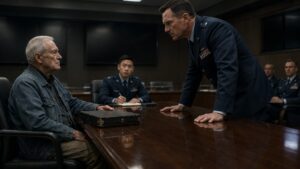
Colonel Thomas Blake stepped in, silver hair immaculate, uniform pressed to a severity that made the air seem less casual around him. He glanced at the black screen, then at Emily’s notebook.
“Captain Carter.”
She closed the file window but did not close the notebook.
“Sir.”
“You were sent that material for authentication, not for personal review.”
“It includes my brother’s voice.”
“It includes a distorted voice in a corrupted file from an active classified matter.”
Emily looked at him then.
Blake’s face held no cruelty. That made it worse. He was not enjoying this. He was managing it.
“The report says Patrol Lark encountered hostile action after equipment failure,” Emily said.
“The report says that because all available indicators support it.”
“All available indicators are missing.”
His jaw tightened by a fraction.
“That is exactly why we do not build stories inside gaps.”
The words landed too close to the audio.
Emily felt something in her chest fold inward.
Blake set a sealed folder on the table. “The families will be briefed tomorrow. The personnel will be listed as killed in hostile action. No remains recovered. No further inquiry until the ceasefire review is complete.”
“Tomorrow?”
“The longer uncertainty continues, the more damage it does.”
“To whom?”
“To everyone still alive.”
Emily looked past him to the black monitor.
Fifteen seconds sat between them like a fifth missing person.
Blake softened his voice. “Your brother served honorably.”
“Then let the record wait long enough to know what honor looked like.”
For the first time, Blake’s expression shifted. Not anger. Warning.
“Captain, you are an intelligence officer. You know the difference between evidence and need.”
Emily lowered her eyes to the notebook.
On the page, Daniel’s sentence looked naked.
“I do,” she said.
But after Blake left, she did not delete the copy.
She moved it to an offline drive, labeled it as equipment noise, and placed it behind a folder of training clips no one had opened in years.
Then she played the file one more time in the dark.
At second twelve, her brother asked her not to invent him.
At second fifteen, the file ended as if someone had put a hand over his mouth.
Part II — The Man Who Heard the Click
Staff Sergeant Michael Hayes did not look surprised when Emily found him behind the motor pool at 0430, sitting on a concrete barrier with a paper cup of coffee cooling beside him.
He looked like a man who had been waiting for something bad to arrive.
He was broad-shouldered, older than the records made him seem, with a weathered face and a pale scar near his right eyebrow. His uniform was regulation, but it carried the looseness of someone who had stopped believing fabric could make him look orderly.
Emily stopped three feet away.
“Staff Sergeant Hayes.”
He did not salute. He looked at her hands first.
“You brought it.”
She had not told him what she wanted.
That was answer enough.
“You were the patrol liaison,” she said.
“I built their route packet.”
“You weren’t with them.”
“No.”
“But you know the terrain.”
His mouth tightened. “I know what they told me to know.”
Emily took the small recorder from her pocket. No network connection. No storage label. No official existence.
“I need you to identify background sounds.”
Hayes stared at it for a long second.
“You have authorization?”
“No.”
“Then why ask me?”
“Because you already know something.”
He let out a short breath that was not quite a laugh.
“Ma’am, that’s a dangerous way to start a conversation.”
“So is lying to a family tomorrow.”
That reached him.
His eyes moved from the recorder to her face. He knew who she was. Everyone attached to the Lark file knew, even if they pretended not to.
Emily pressed play.
The static lifted into the cold morning.
Hayes did not react to Daniel’s voice. Not visibly. But at the metallic click, his coffee hand froze.
Emily noticed.
When the file ended, he said nothing.
She played it again.
This time he closed his eyes.
At the click, he flinched.
Emily stopped the recorder. “What is it?”
Hayes looked toward the vehicle bays. Two mechanics were working under harsh white lights, too far to hear.
“That’s not contact.”
“Not gunfire?”
“No.”
“Equipment failure?”
“No.”
“What is it?”
He rubbed a hand down his face, leaving exhaustion in its wake.
“It’s a manual comms cut.”
Emily waited.
Hayes looked at her as if hoping she would not understand.
“Someone closed the channel from inside the system,” he said. “Not out there. Not from damage. Not from weather. A hand did that.”
The motor pool seemed to go still.
Emily heard the file again without playing it.
Static. Shuffle. Click.
A hand.
“Could it have been Daniel?”
Hayes shook his head. “Not that sound. That’s relay-side.”
“Meaning?”
“Meaning somebody with access shut off what was coming back.”
Emily kept her voice flat because it was the only way to keep it from breaking. “You should have put that in your statement.”
“No one asked me about the sound.”
“I’m asking now.”
He looked down at the coffee he had not drunk.
“Then now I’m telling you.”
She stepped closer. “Why didn’t you come forward?”
His face hardened.
“Forward to who? The same people who labeled it before the file cooled?”
“That’s not an answer.”
“No,” he said. “It’s the reason I’m still breathing normally.”
The words were bitter, but not cowardly. That unsettled her more than fear would have.
Emily placed the recorder back in her pocket.
“I need the original route packet.”
Hayes stared at her.
“That packet is sealed.”
“So is the truth.”
He stood slowly. Up close, he looked less like a witness and more like wreckage that had learned discipline.
“You want my advice, Captain?”
“No.”
“You’re going to take it anyway. Don’t go looking for the whole picture. There isn’t one left.”
The same warning again. Different mouth.
Emily hated that.
“Then I’ll start with the piece someone tried to hide.”
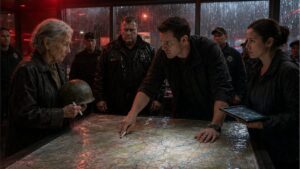
Hayes reached into his jacket and pulled out a folded, sweat-soft map. Not the official packet. A working copy. Hand-marked. Creased at the eastern corridor.
He held it between two fingers.
“I should burn this.”
“But you didn’t.”
His eyes were tired.
“No,” he said. “I guess I wanted somebody cleaner than me to touch it first.”
Emily took the map.
There were four route options marked in blue.
One in red had been crossed out twice.
Then circled.
She looked up. “Who changed the path?”
Hayes did not answer quickly enough.
That was answer enough too.
Part III — The Complaint Without a Voice
Colonel Blake did not raise his voice when Emily placed the altered route map on his desk.
He did not touch it either.
“That is not an authorized document,” he said.
“It matches the patrol’s final GPS ping.”
“Unofficial drafts often resemble final plans.”
“The red route was rejected for proximity to a protected settlement.”
Blake’s eyes lifted.
There it was. Not surprise. Calculation.
Emily felt the floor shift beneath the conversation.
“Protected by whom?” she asked.
“Captain.”
“Sir, if we sent Patrol Lark near a protected settlement while calling it empty corridor reconnaissance, then the mission brief was false.”
“The mission brief contained what the patrol needed to complete its objective.”
“My brother filed a complaint before departure.”
Blake’s face did not move.
Emily placed the second document beside the map. A printout of a system entry pulled from a restricted archive she should not have accessed.
SUBMISSION: CARTER, DANIEL J.
TYPE: ENCRYPTED FIELD CONCERN
ATTACHMENT STATUS: CORRUPTED
TIME STAMP: 19:42, NIGHT BEFORE DEPLOYMENT
No text.
No attachment.
Another blank.
Emily hated how many blank spaces were beginning to look deliberate.
Blake sat back.
“You are walking into a room you do not understand.”
“Then explain it.”
“There are civilian arrangements along that line that do not exist on paper for a reason.”
“Arrangements with civilians or informants?”
Silence.
Emily’s pulse struck once, hard.
Blake looked toward the closed door as if even the walls deserved caution.
“The ceasefire is fragile,” he said. “There are people alive because certain facts remain unannounced.”
“And there are four missing because certain facts were concealed.”
“You don’t know that.”
“No,” Emily said. “I don’t. That is the problem.”
Blake stood.
He had a way of rising that made disagreement feel childish.
“Your brother understood orders.”
“My brother questioned them before he vanished.”
“Your brother may have misunderstood conditions on the ground.”
“Then why erase the ground?”
For a moment, neither of them breathed comfortably.
Then Blake said, “Be careful, Captain. Grief can make a pattern out of dust.”
Emily gathered the papers.
“And command can make dust out of people.”
She saw the line strike him. Not because it hurt his feelings. Because it was too close to something he had already told himself in better language.
At the door, Blake spoke again.
“If you continue, you may damage the very people you think you are defending.”
Emily turned.
“The missing?”
“The living.”
He did not elaborate.
He did not have to.
Back in the operations room, Emily loaded the audio into isolation software. She told herself it was analysis, not obsession. She adjusted frequencies. Removed wind hiss. Split channels. Marked noise patterns.
The file resisted her.
It was too short. Too damaged. Too empty.
Still, under Daniel’s line, something else flickered.
She replayed the segment until the words stopped sounding like language.
Static.
Breath.
A second voice? No. Maybe.
She narrowed the range.
At second nine, before Daniel’s warning, beneath the scrape of movement, someone said three words.
Or two.
Or none.
Emily’s eyes burned.
She almost typed what she wanted to hear.
Then she stopped.
She had trained analysts out of that mistake. A mind under pressure would complete what the ear could not. Fear made subtitles. Love made transcripts.
She deleted the line.
She marked it:
UNCONFIRMED VOCALIZATION.
Then she played it again.
This time the words came through just enough to hurt.
“They’re not enemy.”
Emily sat back.
The room did not change.
The case did.
Part IV — The Things People Leave Out
Hayes refused to sit when Emily confronted him.
They were in a records annex no one used after 1800, surrounded by shelves of old training binders and obsolete radios. Rain ticked against a high narrow window. Somewhere in the building, someone laughed at something ordinary.
Emily put the cleaned audio transcript on the table.
00:09 — POSSIBLE: “THEY’RE NOT ENEMY.”
00:12 — CARTER, D.J.: “DON’T RECONSTRUCT WHAT YOU CAN’T PROVE.”
00:15 — MANUAL RELAY CUTOFF.
Hayes read it once.
Then he looked away.
“You knew,” Emily said.
“No.”
“You suspected.”
“That’s not the same thing.”
“It was enough to keep you awake.”
His jaw tightened. “A lot keeps me awake.”
“Don’t dodge me.”
He stepped toward the table, then stopped himself.
“I helped prep the route. I saw the red line. I knew that corridor had history.”
“What history?”
“Families moving through at night. Informants. People who talk to both sides because talking is the only reason their kids eat. Nobody writes that down clean.”
“And command sent Daniel’s patrol through it.”
“I didn’t know they’d disable cameras.”
“But you knew they wanted deniability.”
Hayes looked at her then, and for the first time his anger came fully alive.
“Everybody wants deniability. They just call it flexibility until someone doesn’t come back.”
Emily flinched despite herself.
He saw it and looked ashamed.
“Your brother came to me the night before,” Hayes said. “Asked why the red route was back.”
Emily’s throat tightened. “What did you tell him?”
“I told him to follow the brief.”
“That’s all?”
“That’s what I told him.”
“And what did he say?”
Hayes took a long time.
“He said, ‘A blank map is still a choice.’”
Emily closed her eyes for one second.
Daniel, who used to draw monsters in the margins of her school notebooks. Daniel, who had once taken apart their father’s radio and rebuilt it with two screws left over. Daniel, who had never trusted silence when it came from someone powerful.
She opened her eyes.
“You should have come forward.”
Hayes nodded.
“Yes.”
“You should have warned them.”
“Yes.”
“You should have refused the packet.”
“Yes.”
The answers were too simple. They gave her nowhere to put the anger.
Hayes pressed both hands against the edge of the table.
“You want me to say I’m innocent? I’m not. I thought it was politics. I thought it was one of those routes that looked worse on paper than on ground. I thought the cameras would keep everybody honest.”
“And when they went dark?”
“I knew honesty had left before they did.”
Emily looked at the transcript again.
“They’re not enemy.”
The words changed everything and solved nothing.
If Daniel’s patrol had encountered civilians, protected informants, or unlisted contacts, then the official story was not merely incomplete. It was pointed in the wrong direction.
But if Emily exposed everything, she could endanger people whose names had never been allowed to exist.
Blake had not been lying about that.
That was the cruelty of it.
Not all secrecy was evil.
Not all truth was safe.
Hayes lowered his voice. “Leak it.”
Emily looked up.
“All of it,” he said. “Route map. Audio. Complaint log. Make them answer outside rooms they control.”
“And the civilians?”
“If we keep protecting the file, we protect what they did.”
“If we release too much, we may punish the people Daniel tried to protect.”
Hayes’s face changed.
There it was—the part he had been avoiding. Not fear for himself. Fear that his guilt wanted a loud solution more than a right one.
Emily folded the transcript.
“My brother said not to reconstruct what we can’t prove.”
Hayes looked at the floor.
“He also tried to stop something.”
“Yes,” Emily said. “So we find out what.”
That night, Emily returned to the audio.
Not to complete it.
To listen for what was actually there.
She stopped chasing the voice under the static and studied the space before it. The shuffle. The breath. The metal click before the relay cut.
There was another sound, almost swallowed by the damaged channel.
Not a weapon. Not wind.
A child crying?
Emily froze, hand above the keyboard.
No.
She would not write that.
She marked it:
BACKGROUND AUDIO: HUMAN DISTRESS, AGE/IDENTITY UNCLEAR.
The restraint felt like betrayal.
It also felt like the only honest thing left.
Part V — The Offer
Colonel Blake’s office was brighter than the operations room, which made it feel less truthful.
He had the blinds open. Afternoon light fell across the polished desk, the folded flag in the corner, the photographs of men in formal lines, all smiling as if history had behaved.
Emily stood before him with her hands behind her back.
Blake slid a sealed envelope toward her.
“What is that?”
“A commendation recommendation for Sergeant Daniel Carter.”
She did not touch it.
“It acknowledges exceptional conduct under uncertain operational conditions,” Blake said.
“Uncertain.”
“It is the strongest language available.”
“Available to whom?”
He looked tired then. Older than rank usually allowed.
“To the record that can exist without breaking what remains.”
Emily understood before he said the rest.
Private closure for the families. No public correction. No reopened inquiry. Daniel honored. The file retired. The blanks sealed.
A clean grief.
A polished lie.
Blake kept his voice low. “Your brother’s name can be preserved.”
“My brother’s name is not the part at risk.”
“Captain.”
“No. Say it plainly.”
His eyes hardened.
“You want plain? Fine. If you force this into the open, protected contacts near that corridor may be exposed. The ceasefire review may collapse. People who trusted us may disappear. Families who have already lost enough may learn there is no body, no final image, no complete account, only a damaged file that raises more questions than it answers.”
Emily swallowed.
Blake leaned forward.
“You think I am asking you to choose between truth and lies. I am asking you to choose between harms.”
That was the first honest thing he had given her.
It was not enough.
“Who cut the relay?”
Blake did not answer.
Emily’s chest went cold.
“Who cut it?”
His silence was almost gentle.
She nodded once, as if he had spoken.
“You knew they encountered protected civilians.”
“I knew the corridor was sensitive.”
“You knew after.”
“I knew enough to prevent a wider disaster.”
“And not enough to prevent a false report.”
His mouth tightened.
“You are young enough to think those are separate categories.”
Emily looked at the envelope.
Daniel’s commendation waited inside like a bribe wrapped in honor.
“Did he die protecting them?”
Blake looked away.
That was the first crack.
Emily stepped closer. “Sir.”
Blake’s voice dropped.
“The patrol reached the corridor. They encountered unlisted civilians moving under an informal protection arrangement. The mission parameters did not account for them.”
“Meaning the mission was false.”
“Meaning the ground changed.”
“Did Daniel refuse an order?”
Blake closed his eyes briefly.
“He challenged identification. He delayed engagement. Others followed his lead.”
Emily felt the room tilt.
Her brother had not been calling for help.
He had been buying time.
“What happened after?”
“Contact came from outside the corridor.”
“From whom?”
“Unclear.”
There it was again. The word that held everything and gave nothing.
Emily wanted to hate him cleanly.
But Blake looked like a man who had spent years turning human cost into controlled language and was finally hearing how small the words were.
“Why erase the footage?”
“To protect the civilians’ identities.”
“And command’s.”
He did not deny it.
Emily picked up the envelope.
For one second, she imagined taking it home. Giving her mother something official to hold. Telling herself Daniel had been honored, that perhaps that was enough.
Then she set it back down.
“No.”
Blake’s face closed.
“You intend to leak classified material?”
“No.”
“That is the only alternative you seem to understand.”
Emily shook her head.
“I won’t bury it. I won’t burn the people he protected. And I won’t invent the parts I can’t prove just to make the story satisfying.”
Blake stared at her.
For once, he did not have the next sentence ready.
“There is a memorial hearing tomorrow,” Emily said. “You asked me to authenticate the file. I will.”
“You will stay within evidence.”
“Yes,” she said. “That is what should worry you.”
Part VI — What the Record Could Hold
The memorial room was too small for the grief it had been asked to contain.
Four framed photographs stood on easels near the front. Four folded flags rested beneath them. Families sat in the first two rows with the stiff posture of people who had been told how to receive devastation in public.
Emily’s mother sat beside an empty chair.
She did not look back when Emily entered.
That hurt more than Emily expected.
Hayes stood near the rear wall, hands clasped in front of him. Blake sat at the front beside two senior officers and a civilian liaison with a face trained for sympathy.
Emily had not slept.
The file sat on a government laptop connected to the room’s speakers. Fifteen seconds. No images. No heroic montage. No final frame to soften into meaning.
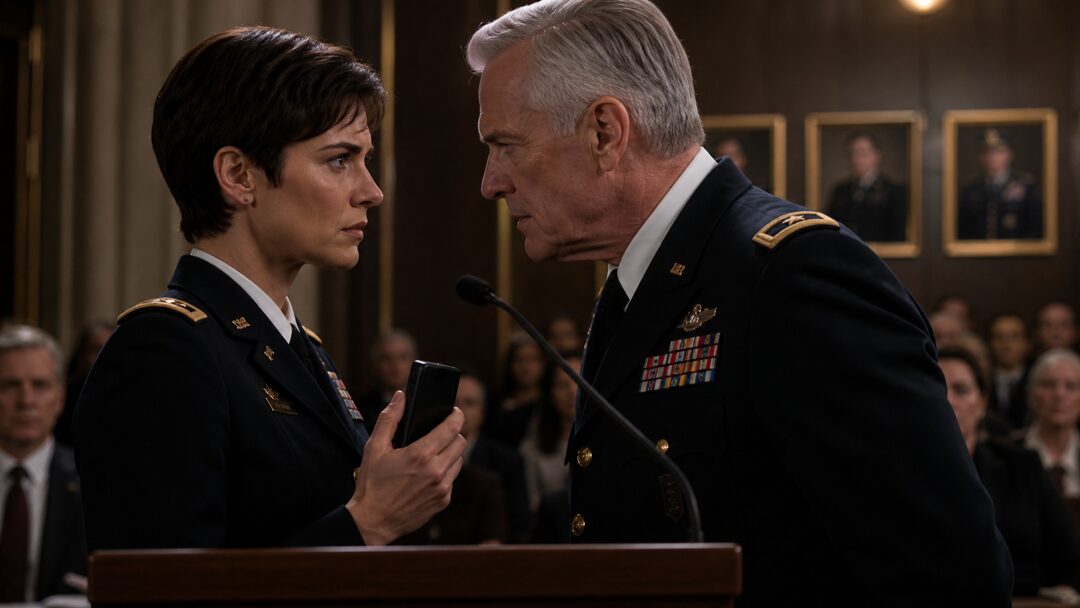
When her name was called, she walked to the podium.
Her uniform was perfect. Her hands were steady.
Only Hayes, watching from the back, seemed to know what steadiness was costing her.
Emily looked at the families.
Then at the four photographs.
Then at Daniel.
He was smiling in his picture. Of course he was. Someone had chosen the easiest version of him.
She began before anyone could mistake her silence for obedience.
“My role in this matter was to authenticate recovered media connected to Patrol Lark.”
The room held its breath.
“The recovered file contains no usable video. No visual frame could be extracted.”
A murmur moved through the families.
Emily did not look at Blake.
“The official report describes a synchronized equipment failure followed by hostile action. The evidence does not support that conclusion as complete.”
The civilian liaison shifted in his chair.
Blake remained still.
Emily continued.
“The audio lasts fifteen seconds. It contains static, movement, one relay-side manual cut, and two identifiable vocal elements.”
A woman in the front row covered her mouth.
Emily pressed one key.
The room filled with static.
It sounded smaller in public.
More fragile.
More terrible.
At second nine, the buried phrase passed through the speakers, almost lost.
“They’re not enemy.”
Several people looked around, uncertain whether they had heard words or grief making language out of noise.
At second twelve, Daniel’s voice entered the room.
“Don’t reconstruct what you can’t prove.”
Emily’s mother made a sound that did not become speech.
Then the click.
Then nothing.
Emily stopped the file.
No one moved.
That was the power of the black screen. It did not show people what to feel. It left them alone with what had been withheld.
Emily gripped the sides of the podium.
“The phrase at second nine is partially degraded but sufficiently recoverable to challenge the hostile-only characterization in the report. The final sound is consistent with a manual relay cut, not random failure. The speaker at second twelve is Sergeant Daniel Carter.”
Her voice almost broke on his name.
Almost.
“I cannot tell you everything that happened in that corridor. I cannot identify every person present. I cannot tell you the final sequence with certainty. I will not fill those spaces with guesses.”
She looked at Blake then.
He did not stop her.
“But I can say this: the available evidence does not support closing the record as a simple equipment malfunction followed by hostile action. The record must state that material was lost, that the relay was manually cut, that civilian presence was indicated, and that key facts remain unresolved.”
A man in the first row stood halfway up.
“My son,” he said. His voice cracked. “Are you saying he didn’t run?”
Emily turned to him fully.
“No, sir.”
It was the only answer she could give him that was both merciful and true.
“I am saying there is no evidence that he deserted. No evidence that Patrol Lark abandoned duty. What evidence remains suggests they paused because the situation was not what they had been told.”
The man sat down as if his bones had been removed.
Emily looked back at the photographs.
“They deserved more than a completed story. They deserved an honest one.”
No one applauded.
That would have been unbearable.
Blake rose after a long silence and approached the podium. For a moment, Emily thought he would correct her, contain her, fold the room back into acceptable language.
Instead, he faced the families.
“The report will be amended,” he said.
His voice was controlled, but not untouched.
“Certain details remain restricted to protect living persons connected to the corridor. But Captain Carter is correct. The initial characterization was incomplete.”
Incomplete.
The word was small.
In that room, it was also enormous.
Emily stepped back.
Her mother was crying silently now, one hand pressed flat against the empty chair beside her.
Emily did not go to her yet.
If she did, she might become only a sister.
She needed to remain a witness until the room released her.
Part VII — The Blank Spaces
Hayes found Emily outside after the hearing, beneath the concrete overhang where rain fell in straight silver lines beyond the steps.
For a while, he stood beside her without speaking.
Then he held out Daniel’s service tag.
Emily stared at it.
“Where did you get that?”
“Recovered from his locker before they sealed personal effects.” Hayes swallowed. “I kept it because I was a coward. Then I kept it because I didn’t know how to give it back.”
Emily took it carefully.
The metal was warm from his palm. Chipped at one edge. Daniel’s name stamped into the face in letters that suddenly seemed too shallow to hold him.
“There’s something inside,” Hayes said.
Emily turned the tag over.
Daniel had scratched tiny words into the back, uneven and almost hidden beneath wear.
Don’t fill in the dark.
Emily closed her hand around it.
The sentence did not comfort her.
It steadied her, which was harder.
Hayes looked out at the rain. “I wanted you to burn them down.”
“I know.”
“You didn’t.”
“No.”
“Was that mercy?”
Emily watched water gather at the edge of the concrete, hesitate, then fall.
“I don’t know yet.”
Hayes nodded as if that was the only answer he trusted.
Her mother came out a few minutes later.
She looked smaller than Emily remembered, but not weaker. Never weaker. She stopped in front of Emily and looked at the tag in her hand.
“Is that his?”
Emily nodded.
Her mother reached for it, then stopped herself.
“What did he do?”
The question contained every version of Daniel she needed to keep alive: son, brother, soldier, witness, boy with a screwdriver and too much confidence.
Emily could have said he was brave.
She could have said he protected people.
She could have said he had known better than the men above him.
All of that was true.
None of it was complete.
So she said, “He refused to let them write the wrong story.”
Her mother took the tag then.
She held it like it might answer what no report ever would.
Weeks later, Emily filed the amended record herself.
Not because she trusted the system.
Because she wanted to see the blanks remain.
Where the original report had said hostile action confirmed, she entered:
HOSTILE ACTION: UNDETERMINED.
Where it had said equipment failure, she entered:
RELAY TERMINATION: MANUAL, SOURCE UNRESOLVED.
Where it had said no civilian presence, she entered:
CIVILIAN PRESENCE: INDICATED, IDENTITIES RESTRICTED.
Where it asked for final sequence, she did not write a story.
She wrote:
UNKNOWN.
The cursor blinked after the word.
For a moment, Emily wanted to add something. One sentence for Daniel. One final shape for her mother. One clean line for herself.
She heard his voice again.
Don’t reconstruct what you can’t prove.
She saved the report.
The system accepted it without ceremony.
Outside the secure office, evening had softened the windows to gray. Emily walked down the corridor with Daniel’s sentence still in her pocket, still unfinished, still refusing to become comfort.
Four people were still missing.
Some names were still protected.
Some choices would never be admitted by the people who made them.
But the record no longer lied smoothly.
That was not justice.
It was not closure.
It was a place where truth could stand without pretending to be whole.
Emily stepped into the fading light and let the door close behind her.