What the Silence Remembered
Part I — The Empty File
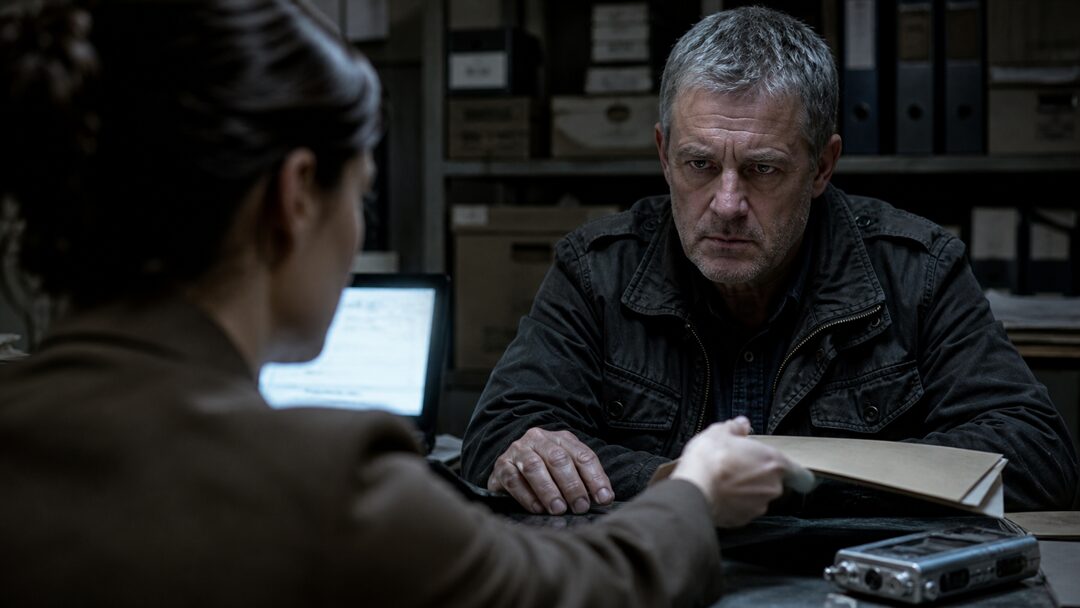
James Carter knew the file was wrong before Emily Ross pressed play.
It sat on the monitor like a harmless mistake: a gray icon, a timestamp, a duration of 15.07 seconds, and one blunt warning in red text.
Video stream not detected.
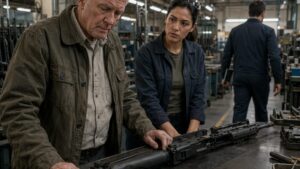
Emily watched him from across the narrow archive table. She was young enough to still believe that records behaved if you handled them carefully. Her blazer was neat, her folder squared to the edge of the desk, her dark hair pinned back like she had prepared herself for patience.
James had not prepared for anything.
“Mr. Carter?” she asked. “Are you ready?”
He looked at the screen, not at her.
“No,” he said.
Emily’s hand paused above the mouse. “I’m sorry?”
James forced his fingers flat against the table. They were steady. That bothered him more than shaking would have.
“If it has no video,” he said, “then you don’t need me.”
“That’s what we need to confirm.”
He almost laughed. Confirm. As if the past was a form with one empty box left unchecked.
Emily clicked play.
At first there was only static.
Then a breath.
Then silence.
James’s chest tightened so fast he had to swallow against it.
A tiny radio click came next, buried under wind. Another pause. A scrape. Someone too far from the recorder said something that was almost a word and then wasn’t.
Emily leaned closer, listening for technical value.
James listened like a man hearing a door open inside a room he had locked twelve years ago.
The second pause came at 3.31.
He knew it without looking.
The third came just after five seconds.
His mouth went dry.
By the fourth pause, the one near the end, James was no longer in the archive. He was back under a white-hot sky with dust in his teeth and a radio pressed to his ear, waiting for an order that would make one kind of man out of him and leave another kind behind.
The file ended.
Fifteen seconds.
Nothing visible.
Almost nothing audible.
Emily turned to him. “Mr. Carter?”
James stood too quickly. The chair legs scraped the floor.
“Classify it as unusable,” he said.
She blinked. “You haven’t even reviewed the metadata.”
“I heard enough.”
“You heard static.”
James looked at the red words on the screen.
Video stream not detected.
For twelve years, that had been the mercy.
No image. No face. No proof.
Just enough silence to know exactly what had been left out.
Part II — A Record With No Picture
Emily did not chase him into the hallway. That was the first thing James noticed.
Most people, when they wanted something from an old soldier, used urgency as a weapon. They called after him. They reminded him of duty. They said words like service, honor, closure, record.
Emily let him reach the door.
Then she said, “The recorder was assigned to Sergeant Mark Ellis.”
James stopped with his hand on the knob.
The name did not strike him loudly. It did something worse. It landed softly, like it belonged there.
Emily waited.
James turned.
She had opened the folder now. A single printed page lay under her hand. He could see the header from where he stood.
Operation Northlight. Recovered Media Review.
His throat worked once.
“That recorder was destroyed,” he said.
“It was listed as unrecoverable.”
“That means destroyed.”
“It means unrecoverable.”
James stared at her.
Emily did not look triumphant. That made her harder to dismiss. Her voice stayed level, but there was a tension in it now, a thread pulled tight.
“The device was found in a damaged equipment crate that came out of long-term storage last month,” she said. “Most of the memory was corrupted. This is the only playable file.”
“Then it tells you nothing.”
“It tells us fifteen seconds survived.”
“Fifteen seconds of noise.”
“Then why did you leave before it finished?”
James’s hand tightened on the knob.
A younger man would have answered too fast. An angrier man would have raised his voice. James had spent his life learning the usefulness of a controlled face.
He let go of the door.
“Sergeant Ellis died before that recording matters,” he said.
Emily looked down at the page. “The timestamp suggests otherwise.”
The room changed shape around him.
Archive shelves. Fluorescent light. Computer fan. Paper. Civilian carpet.
All of it thinned until he could hear the old wind again.
James walked back to the table. He did not sit.
“Who sent for me?”
“I did.”
“You don’t have the authority.”
“I have enough to request subject-matter assistance.”
“You requested the wrong subject.”
“No,” Emily said. “I requested the signals officer assigned to that convoy.”
There it was.
Not retired veteran. Not consultant. Not decorated guest.
The man who had been there.
James looked at her folder. “Official record says Northlight ended clean.”
“I read the official record.”
“Then use it.”
“That’s the problem.”
Emily turned the page toward him. It was a summary, black lines and sterile terms. Extraction completed. Threat level elevated. One service member deceased. Civilian transfer delayed. No further hostile engagement confirmed.
No further hostile engagement confirmed.
James almost admired the sentence. It had survived twelve years without saying a single true thing.
Emily tapped the file name on the page.
“This recovered clip was marked for automatic disposal as ‘audio only, no narrative value.’ I need a human review before I sign that.”
“Sign it.”
“I can’t.”
“Why not?”
“Because you recognized something.”
James leaned over the table just enough for his shadow to cross the folder.
“Listen carefully, Ms. Ross. There are records that exist to preserve truth. There are records that exist to prevent people from drowning in it. This one belongs to the second kind.”
Her expression changed, barely.
Not fear.
Interest.
“That sounds like something a person says when the file matters.”
James picked up the printed page. His eyes caught on Mark’s name despite himself.
Mark Ellis had been twenty-six. Broad shoulders. Sunburned nose. A radio strapped too high because he said it made him look taller in photos he never sent home. He smiled at bad coffee. He whistled when everyone else got quiet.
And he had once told James, “Sir, the thing about orders is that people hide inside them.”
James had told him to shut up and check the channel.
James set the page down.
“Seal it,” he said. “Or bury it in whatever digital grave you keep for broken files. But don’t transcribe it.”
Emily’s voice dropped. “What happens if I do?”
James looked at the monitor.
The file sat there, small and patient.
“What already happened,” he said. “Only slower.”
Part III — The Four Pauses
Emily did not seal it.
The next morning, she called him back.
James almost ignored the number. He had spent the night sitting in his kitchen with the lights off, listening to the refrigerator hum and trying not to count.
1.48.
3.31.
5.02.
9.22.
The pauses had found him again.
When he returned to the archive, Emily had two coffees on the table and the file open on a waveform display.
James did not touch the coffee.
“You enhanced it,” he said.
“I cleaned it.”
“You altered evidence.”
“I made a copy. The original is intact.”
He stared at the jagged blue lines on her screen.
The file looked innocent in waveform. Peaks and gaps. Noise pretending to be measurable.
Emily pointed to the first break. “There’s a pause here.”
“No,” James said.
She glanced up.
“That’s not a pause. That’s wind drop. Recorder was shielded.”
Emily studied him. “Shielded by what?”
James said nothing.
She moved to the second gap. “This one?”
“Radio wait.”
“You know that from the sound?”
“I know it from the absence.”
Her eyes sharpened.
James hated himself for saying it.
Emily clicked into the waveform. “The third gap has a low-frequency shift. Maybe movement?”
“Someone turned.”
“Who?”
James looked away.
Emily sat back. “You keep saying the file has no value, but you’re correcting me by tenths of a second.”
“I was good at my job.”
“This isn’t your job anymore.”
“No,” James said. “That’s why I can still sleep sometimes.”
It was too honest. The words remained between them.
Emily lowered her voice. “Mr. Carter, I’m not trying to hurt you.”
“That’s what people say before they ask you to bleed neatly on paper.”
She absorbed that. Then she turned the monitor slightly toward him.
“I need to know whether these gaps correspond to anything operational.”
“They correspond to waiting.”
“For what?”
James stared at the third pause.
The room disappeared again.
Dust pressed against his goggles. The convoy sat half-covered behind a low wall. Children cried somewhere beyond the checkpoint. The road ahead had gone empty in the unnatural way roads go empty when someone wants you to notice.
Command had gone silent.
James had one hand on his radio and one hand lifted toward Mark Ellis, telling him without words to hold.
Mark had not held.
He had looked past James toward the civilians trapped near the gate. A woman in a blue scarf. Two old men. A boy gripping a plastic bag to his chest.
“Sir,” Mark had said, “we can’t leave them there.”
James had heard the order before it arrived.
Withdraw.
Not rescue. Not advance. Not wait.
Withdraw.
Back in the archive, Emily watched his face.
“The team was waiting for clearance,” James said.
Emily did not move.
“Clearance for what?”
“To move.”
“Forward or back?”
James took a breath through his nose.
“That depended on whether command wanted the truth or the clean version.”
Emily looked down.
For the first time, she seemed less like a professional and more like someone standing at the edge of a family story she had been warned not to enter.
“Northlight was described as a humanitarian extraction,” she said.
“It was.”
“Successful?”
James looked at the file.
“Depends who got counted.”
Emily’s fingers stilled on the keyboard.
There are sentences that make a room colder. That was one of them.
She clicked play again.
Static.
Breath.
Wind.
The first pause.
Emily watched him instead of the screen this time.
“What’s there?” she asked.
James closed his eyes.
“Mark waiting for me to say yes.”
The second pause came.
“And there?”
“Command not answering.”
The third.
James’s jaw tightened.
“That one?”
“Mark turning away from me.”
Emily did not ask the fourth.
Maybe she was learning mercy.
Maybe she was saving it.
Then, through the cleaned audio, a voice surfaced for half a second.
Thin. Broken. Almost swallowed.
“Don’t leave—”
Emily froze.
James sat down.
He had not meant to. His knees simply stopped agreeing to carry him.
Emily replayed the fragment.
“Don’t leave—”
She whispered, “Was that Sergeant Ellis?”
James covered his mouth with one hand.
She leaned closer to the speaker. “It sounds like he’s saying, ‘Don’t leave me.’”
James shook his head once.
Emily looked at him.
“No,” he said.
His voice was not his own anymore.
“He didn’t say me.”
The archive was silent except for the computer fan.
James lowered his hand.
“He said them.”
Part IV — The Name on the Paper
Emily did not speak for a long time after that.
James wished she would. He wanted an accusation. Anger would have been easier. Professional outrage. A clean civilian horror at what command decisions looked like when the dust settled.
But Emily only sat there, eyes fixed on the waveform, as if the blue lines had become a road she could not stop walking down.
Finally she said, “Who were they?”
James stood and moved to the window. It looked out on the parking lot. Employees came and went with badges clipped to belts, lunch bags in hand, ordinary lives moving through automatic doors.
“Civilians,” he said.
“How many?”
“I don’t know.”
“You don’t know?”
He turned back. “That’s the point.”
Emily flinched, but she did not look away.
James forced the words out before courage could leave him.
“The convoy was supposed to extract registered workers and their families from the north checkpoint. By the time we arrived, the list had stopped meaning anything. People heard trucks were coming. They came with children, bags, papers, no papers. Some had worked with us. Some hadn’t. Some were just desperate enough to stand where desperate people stand.”
“And command ordered you out.”
“Command believed the convoy had been compromised.”
“Was it?”
James thought of the empty road. The dead radios. The way every window seemed to hold its breath.
“We had reason to think so.”
“That’s not an answer.”
“It’s the only answer I have.”
Emily pushed back from the table. “And Mark stayed?”
James nodded.
“He disobeyed you?”
“Yes.”
“To help them?”
James looked at the waveform again.
“To not become the kind of man who could drive away.”
Emily’s face changed then.
Not shock.
Recognition.
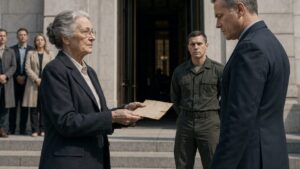
She opened her folder with hands that were no longer quite steady and removed a small plastic sleeve. Inside was a scrap of paper, old and softened at the folds.
She placed it on the table between them.
James did not touch it.
The handwriting was uneven. Not Mark’s.
Two words were written there.
Mark Ellis.
James stared until the letters blurred.
“Where did you get that?”
“My father kept it in his wallet for eleven years,” Emily said. “He died last spring. I found it behind his driver’s license.”
James looked at her.
She swallowed. “He was evacuated from the region three days after Northlight.”
The air left him slowly.
“He never talked about it,” she said. “Not really. He just said there was a man who stayed when others left. He didn’t know the man’s face. He didn’t know if he lived. He only knew the name because someone kept saying it.”
James sat down again.
The scrap of paper lay there like something far heavier than paper.
“You didn’t request me for classification,” he said.
“I did.”
“Emily.”
Her name landed differently now.
She looked down.
“I requested you because of the file,” she said. “But I kept going because of that name.”
James closed his eyes.
For twelve years, he had believed the story had stayed where it belonged: in sealed summaries, private dreams, and the part of his chest that tightened every time someone called Northlight clean.
But the story had traveled.
A scrap of paper in a wallet.
A daughter in an archive office.
A file with no image and a voice that would not finish dying.
Emily’s voice was quiet. “I’m not trying to ruin anyone.”
“People always say that before records ruin someone.”
“I’m trying to know whether my father remembered a real person.”
James opened his eyes.
“He remembered the realest one there.”
That hurt her. He saw it.
Then it hurt him that it hurt her.
Emily touched the plastic sleeve, not the paper itself.
“My father used to sit in the garage some nights,” she said. “Just sit there. My mother said it was because he missed home. But he never called that place home after he came here. Not once.”
James said nothing.
“He would take this out and look at it,” she continued. “I thought it was a friend. A sponsor. Someone who helped with paperwork.”
“He helped with more than paperwork.”
Emily’s mouth tightened.
“Then why does the official record say one casualty and no unresolved civilian incident?”
James almost answered with the old language.
Elevated threat level. Command uncertainty. Force protection. Incomplete manifests.
He could have built a wall out of those words.
Instead he said, “Because records can be written by people who left.”
Emily’s eyes shone, but her voice stayed steady.
“And what about people who stayed?”
James looked at Mark’s name.
“They become static,” he said.
Part V — The Easier Sentence
Robert Hayes arrived at three o’clock wearing a gray suit and a silver watch that caught the archive lights every time he moved his hand.
James had not seen him in six years.
Hayes had aged into polish. Heavyset now, but not soft. His voice still carried the quiet authority of someone accustomed to rooms arranging themselves around him.
“James,” he said, as if they were meeting at a luncheon.
“Colonel.”
“Robert is fine.”
“No, sir,” James said. “It isn’t.”
Emily stood near the table, folder closed against her chest. The file waited on the monitor.
Hayes glanced at it once.
“So this is the ghost in the machine.”
Emily stiffened.
James did not.
Hayes smiled faintly. “Forgive me. Poor choice of phrase.”
No one forgave him aloud.
He turned to Emily. “Ms. Ross, I’ve reviewed the preliminary note. Damaged media, no video, minimal audio value. It should be straightforward.”
“It became less straightforward,” Emily said.
Hayes’s eyes moved to James.
Something passed between the two men. Not friendship. Not hatred. A shared knowledge of what language could hide.
Hayes lowered himself into the chair across from James.
“Northlight has been reviewed,” he said. “Repeatedly.”
“By people who weren’t listening to this,” Emily replied.
Hayes gave her the patient look powerful men save for younger people with inconvenient precision.
“Operational records from unstable environments are often imperfect.”
“This isn’t imperfection,” Emily said. “It may be testimony.”
Hayes’s smile disappeared.
James heard it then—the command voice underneath the civilian one.
“From whom?”
Emily hesitated.
James answered. “From Mark.”
Hayes looked at him fully.
For one second, he was not polished. He was back in the command tent, sleep-starved and furious, holding six impossible facts in his head and choosing the one that kept the convoy intact.
Then the mask returned.
“Sergeant Ellis disobeyed a direct order,” Hayes said.
James’s hands curled.
“He refused to leave civilians behind.”
“He broke formation during a threat escalation.”
“That is the sentence you wrote.”
“It is the sentence that fit the facts available.”
James leaned forward. “No. It is the sentence that fit the ending you needed.”
Emily’s gaze flicked between them.
Hayes’s jaw tightened. “Careful.”
James almost smiled.
There it was.
Not anger at the past. Fear of the record.
Hayes turned to Emily. “Ms. Ross, you are dealing with fragments. Static. Stress memory. A retired officer’s trauma response. You cannot reopen an operation because a damaged recorder produced half a phrase.”
Emily’s face reddened, but she held her ground. “I’m not reopening anything. I’m asking whether the file should be classified as having narrative value.”
“It has none.”
James laughed once, quietly.
Hayes looked at him.
“You heard it?” James asked.
“I read the transcript.”
“There is no transcript.”
“Then there should not be one.”
The room went still.
Emily’s fingers tightened around her folder.
Hayes adjusted his watch.
“James,” he said softly, “we made the decision that brought most of them out.”
“Most.”
“Yes. Most. That is sometimes the only word command gets to keep.”
James stared at him.
For years, he had hated Hayes for that order. Then he had defended him. Then hated himself for defending him. Then done the veteran’s trick of calling the whole thing complicated whenever the simpler word became too sharp.
Hayes was not a monster.
That was the ugliest part.
He had made a decision under pressure with bad information and lives in every direction. He had chosen the convoy. James had obeyed. Mark had not.
And twelve years later, only one of those choices still sounded clean when spoken aloud.
Hayes slid a document across the table.
“Sign the classification,” he said. “Audio only. No narrative value. Attach your technical note and let it end.”
James looked at the line waiting for his name.
The easier sentence sat there.
It was so small.
A signature. A date. A professional conclusion.
Emily said nothing.
That silence did what argument could not. It left James alone with himself.
He picked up the pen.
Hayes exhaled through his nose, almost relieved.
James held the pen over the paper.
Then he heard Mark again, not from the speaker this time, but from memory.
Sir, the thing about orders is that people hide inside them.
James set the pen down.
Hayes’s face hardened.
“Don’t make an old wound into a public record,” he said.
James looked at him.
“It was always a public record,” he said. “We just kept it private.”
Part VI — What Could Be Heard
Emily gave him the room alone.
James asked for that much.
The archive office after hours felt different. Without voices, without footsteps, without the daily machinery of preservation, it became what it really was: a place where the past waited for someone to label it.
James sat before the microphone.
On the screen, the file remained open.
15.07 seconds.
Audio only.
No video stream detected.
He played it once.
Static.
Breath.
Wind.
The first pause.
He stopped the playback and began recording.
“My name is James Carter,” he said. “At the time of Operation Northlight, I served as signals officer attached to the extraction convoy.”
His voice sounded older than he expected.
He continued before he could hate it.
“The recovered file linked to Sergeant Mark Ellis has limited technical content. It has no video stream. The audio is damaged. However, the pauses in the recording correspond to events I witnessed.”
He looked at the waveform.
First pause.
“At approximately 1.48 seconds, the recorder is shielded. Sergeant Ellis was positioned behind the eastern wall near the checkpoint approach. He was waiting for my signal to move toward civilians gathered beyond the gate.”
James’s throat tightened.
He did not stop.
“At approximately 3.31 seconds, the silence corresponds to a radio wait. We were awaiting clearance from command. The convoy had been flagged for possible compromise. No clear forward authorization was given.”
He pressed his thumb into the side of his hand until the pain steadied him.
“At approximately 5.02 seconds, Sergeant Ellis turned away from my position. I had signaled him to hold. He did not comply.”
There it was.
Not heroism yet.
Not betrayal.
A man turning.
A choice becoming visible without a camera.
James looked at the door. No one entered.
He kept going.
“The partial phrase recovered near the midpoint of the file is not, in my judgment, ‘Don’t leave me.’ Sergeant Ellis was not requesting extraction for himself. He was referring to civilians still outside the secured convoy line.”
His voice broke on civilians.
He waited until it returned.
“He said, ‘Don’t leave them.’”
The room seemed to absorb the words.
James played the final seconds.
Static rose. A scrape. A breath. That last pause near 9.22, deeper than the others.
He had avoided that one longest.
“At approximately 9.22 seconds, I issued the withdrawal relay.”
He closed his eyes.
“I followed the order to withdraw.”
No legal phrase came after it. No defense. No explanation dressed as context.
Just the sentence.
“Sergeant Ellis remained behind. I did not see his final moments. I did not see what became of the civilians at the gate. The official record does not contain their names.”
He opened his eyes.
The red text on the monitor blurred.
Video stream not detected.
James leaned closer to the microphone.
“This file has no video because the only people who saw what happened were either dead or chose not to look.”
The last word left him quietly.
He stopped recording.
For several seconds, James sat in the archive room without moving.
He did not feel forgiven.
He did not feel clean.
But something had shifted.
The silence was no longer only inside him.
When Emily returned, she did not ask if he was all right.
That was kind of her.
She listened to the statement once with her hands folded in front of her. When it ended, she wiped one tear quickly, almost angrily, as if grief had interrupted her work.
“Do you want to revise it?” she asked.
James shook his head.
“No.”
She saved the file. Then she attached it to the record.
Her cursor hovered over the classification field.
The old label waited.
Audio only. No narrative value.
Emily deleted the second sentence.
In its place, she typed:
Audio only. Witness statement attached.
James watched every letter appear.
It was not enough.
It was the first honest thing the file had ever been allowed to say.
Part VII — A Small Piece of Paper
The cemetery was quiet the next morning.
James found Mark Ellis in the third row beneath a maple tree that had grown wider than the last time he came. He had visited before, always on days when he could pretend he was honoring a fallen subordinate instead of asking a question from a stone.
This time he brought no flowers.
No coin.
No medal.
Only a folded archive slip in his jacket pocket.
He stood before the headstone and read the name as if it might answer differently now.
Mark Ellis.
Twenty-six years old forever.
James thought of the young man with the crooked radio strap and the bad jokes. The soldier who had wanted to follow orders until an order asked him to leave human beings outside the line.
For twelve years, James had told himself that Mark died because he disobeyed.
Now the sentence had changed.
Mark died because he stayed.
James took out the paper.
It was plain white, printed from an archive office, cut to fit in his pocket.
Recovered media file. Duration: 15.07 seconds. Audio only. Witness statement attached.
He folded it once and placed it at the base of the stone.
A breeze moved through the grass.
James waited for something that did not come.
No voice.
No release.
No hand on his shoulder from the past.
Only morning light and the small, stubborn paper.
He lowered himself slowly until one knee touched the ground. Age made the motion awkward. He let it.
“I’m sorry,” he said.
The words were too small. Of course they were. They always had been.
He stayed there anyway.
Behind him, somewhere near the cemetery path, a car door closed. James did not turn. He knew before he looked that it would be Emily.
She approached quietly and stopped several feet away, giving him the dignity of not pretending she had not seen him kneel.
After a while, she said, “My father used to say names mattered because they were the last thing people could carry when they had nothing else.”
James looked at Mark’s name.
“He carried the right one.”
Emily stood beside him now.
She held the old scrap of paper in its plastic sleeve. Not offering it. Not asking anything of him. Just letting it exist in the same place as the printed slip.
For a moment, the two papers seemed to speak across all the years between them.
One had carried a name without proof.
The other carried proof without an image.
Neither could restore what had happened.
Together, they made it harder to call nothing nothing.
Emily slipped the old paper back into her folder.
“What happens now?” James asked.
“The record changes,” she said.
“How much?”
“Enough that anyone looking will know there was more.”
James nodded.
Enough was a dangerous word. Hayes had used it too. Most. Clean. Successful. Enough.
But this enough was different.
It did not end the story.
It stopped the lie from ending it first.
Emily looked down at the archive slip by the stone.
“He won’t be just static anymore,” she said.
James closed his eyes.
For years, silence had felt like respect.
Now he understood it had also been a room where the dead were left waiting.
When he stood, his knee hurt. His back hurt. His chest hurt in the old familiar place. None of that surprised him.
Emily walked back toward the path first.
James remained one moment longer.
The paper trembled lightly in the grass.
Fifteen seconds. Audio only.
No picture would ever come back. No missing face would sharpen into view. No final moment would arrive clean enough to save him from imagining it.
But somewhere, in a record no longer empty, Mark Ellis had turned again toward the gate.
And this time, someone had looked.