The Chair by the Wall
Part I — The Place No One Sat
“You don’t sit with him.”
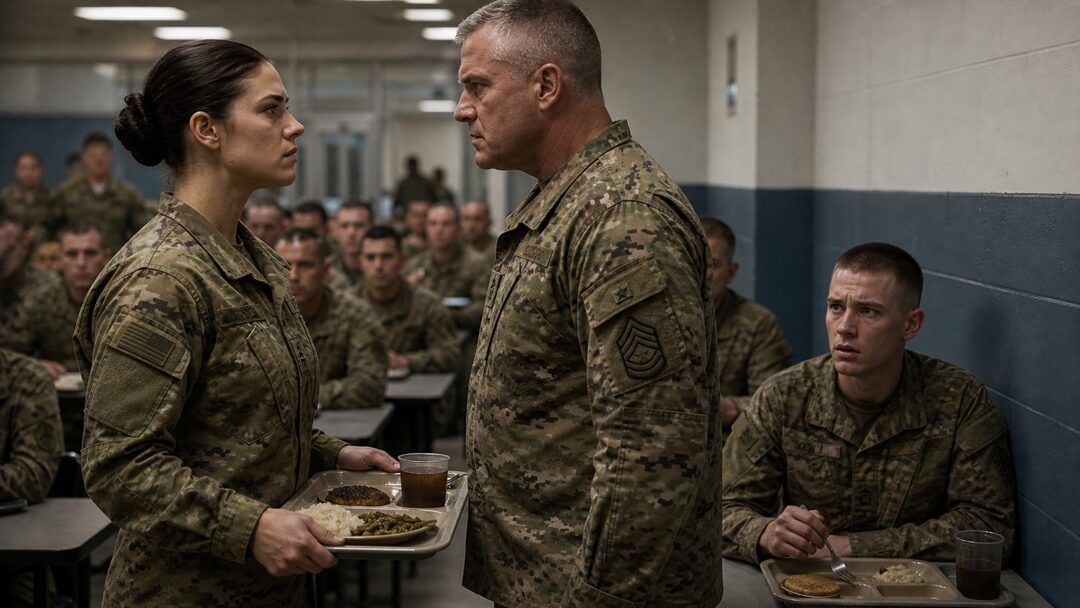
Sergeant Major Robert Hayes said it before Sarah Mitchell had even cleared the lunch line, before she had found a fork, before the steam had finished rising off the mashed potatoes on her tray.
He stepped directly into her path and filled it.
The mess hall did what rooms like that always did when rank entered the air. It tightened. Conversations cut off mid-sentence. Metal forks stopped against plastic trays. Men and women in uniform looked down at their food as if food had suddenly become fascinating.
Sarah kept both hands under her tray.
Across the room, at a table near the beige wall, Private Daniel Carter froze with his fork halfway to his mouth.
He looked younger than twenty-two in that moment. Pale. Too clean. Too still. His buzz cut had grown out unevenly because no one had told him when to go get it fixed, and no one had cared enough to remind him. His tray sat in front of him like an accusation.
Sarah looked from Daniel back to Hayes.
“Sergeant Major?”
Hayes did not raise his voice. He didn’t need to. His voice had been trained by years of rooms obeying it.
“I said,” he repeated, “you don’t sit with him.”
Behind Sarah, someone in line shifted his weight. A tray knocked softly against a belt buckle. No one spoke.
Sarah could feel the heat of her lunch through the plastic. Salisbury steak. Potatoes. Green beans. A roll wrapped in thin film.
A stupid, ordinary lunch.
That was what made it worse.
Hayes stood close enough that she could see the gray at his temples, the sharp press of his collar, the clean shine on boots that had walked through worse places than this room. His uniform looked carved onto him. He was the kind of man people obeyed before they understood the order.
Sarah had obeyed men like him for years.
Not today, she thought.
But what she said was, “Is that a written restriction?”
A ripple passed through the line.
Not a sound. Not quite.
Just bodies registering danger.
Hayes’s eyes narrowed. “Specialist Mitchell.”
“Yes, Sergeant Major.”
“Don’t get clever with me.”
“I’m not trying to be clever.” Sarah’s voice stayed even. She had learned early that anger was most dangerous when it sounded calm. “I’m asking if Private Carter has been formally restricted from eating in the dining facility.”
Daniel lowered his fork to the tray without taking the bite.
Hayes tilted his head a fraction, as if he had expected her to fold sooner.
“Carter has been instructed not to eat with the platoon until the investigation is complete.”
Sarah glanced at Daniel’s table. One chair. One tray. No one within six feet of him.
“He’s not eating with the platoon,” she said.
Hayes leaned closer.
The room stopped breathing.
“He’s eating where everyone can see him,” Hayes said. “And you walking over there makes it a statement.”
Sarah felt something cold move under her ribs.
So that was it.
Not food. Not discipline.
A statement.
She looked at Daniel again. He stared down at his tray now, his shoulders curled forward, his right hand wrapped around the fork so tightly his knuckles had lost color.
Three nights ago, that same hand had been shaking against a radio handset.
Sarah could still hear him saying, “There’s someone shouting. Wait. I hear someone shouting.”
She could still hear Emily Ross’s voice cutting through static and dust.
Wait.
Then everything after that had become noise.
Hayes turned his head toward Daniel and pointed.
“His presence has already cost this unit enough.”
Daniel stood so fast his chair scraped backward across the floor.
The sound was sharp enough to make three people flinch.
Sarah turned her head.
“Sit down, Daniel.”
He stopped.
Everyone heard her use his first name.
His mouth opened once. Nothing came out.
Sarah did not soften her voice. Softness would have broken him in public.
“Sit down,” she said again.
Slowly, Daniel lowered himself back into the chair.
Hayes’s stare returned to her like a door slamming shut.
“You are out of line.”
Sarah adjusted her grip on the tray.
“No, Sergeant Major,” she said. “I’m in the lunch line.”
A few eyes lifted.
No one smiled.
Hayes’s face did not change, but Sarah saw the muscle in his jaw move once.
That was when she knew he had not crossed the room because of Daniel.
He had crossed it because of her.
Part II — The Name No One Used
Three nights earlier, Sarah had been half asleep in the medevac bay when the call came in.
At first it sounded like every bad call sounded: location, number of personnel, confusion, urgency. Words clipped down to function because full sentences wasted time.
Checkpoint. Civilian vehicle. Interpreter down. Possible friendly casualty. Possible hostile driver.
Possible.
That word lived in every report after something went wrong.
Possible threat. Possible misunderstanding. Possible failure.
By the time Sarah reached the aid station, Daniel Carter was sitting on the floor outside the treatment area with someone else’s blood dried across the front of his uniform. His radio headset hung around his neck. He was staring at his palms as if they belonged to someone who had betrayed him.
“What happened?” Sarah had asked.
He looked up at her, and she saw that he was still hearing it.
“She said wait,” he whispered.
“Who?”
He swallowed.
“Emily.”
No one else said Emily’s name that night.
They said interpreter. Civilian liaison. Attached personnel. Female casualty. They said her last name once, in a tone that made her sound like paperwork.
Ross transported.
Ross stabilized.
Ross pending transfer.
But Sarah knew Emily Ross. Everyone did, even if they pretended not to.
Emily had a practical ponytail, a field notebook always tucked under one arm, and a way of talking to soldiers like she expected them to become smarter while she was speaking. She had worked between patrols and villages, between fear and orders, between men with weapons and civilians who did not understand where to stand when frightened.
Sergeant Major Hayes had been the one who recommended her for the assignment.
“She knows how to keep people alive,” Sarah had once heard him say.
He had said it proudly.
After the checkpoint, he stopped saying her name.
Now, in the mess hall, Sarah watched Hayes point at Daniel as if blame could be aimed like a weapon.
“Private Carter signed his statement,” Hayes said. “He understands where he stands.”
Daniel’s shoulders bent lower.
Sarah felt the words land in the room. Signed his statement. The phrase had been chosen for witnesses.
A few soldiers at nearby tables stared harder into their trays. One of them, Corporal Mark Evans, had been at the checkpoint too. He had not looked at Daniel once since breakfast.
Sarah had read the official summary that morning because she had been asked to initial her own medical timeline.
Radio operator hesitated during escalation.
Delay contributed to confusion.
Interpreter entered unsafe zone.
The sentences were clean. Too clean.
They left out Emily’s voice.
They left out Daniel saying, “Wait, she’s saying wait.”
They left out the second truck horn, the dust, the driver who may not have understood the command, the way everyone later chose one version because one version was easier to carry.
Sarah had submitted a supplemental statement at 0800.
By noon, Hayes was standing in front of her tray.
That was not coincidence.
Hayes knew.
She looked at him and saw, under the rigid polish of his face, something more dangerous than anger.
Fear.
Not fear of Sarah.
Fear of what a room might remember if one person refused to forget.
“Private Carter has not been found responsible for anything,” Sarah said.
Hayes’s voice dropped. “You don’t know what he’s responsible for.”
“I know what I heard.”
His eyes changed.
There it was.
The room did not know what had passed between them, but Sarah felt it like the click of a lock.
Hayes knew about the statement.
He had come to stop it from becoming contagious.
“Specialist,” he said, each syllable clipped flat, “you have mistaken grief for evidence.”
Sarah’s fingers tightened under the tray.
Daniel looked up.
For the first time, his fear was not for himself.
It was for her.
Part III — A Clean Version
Hayes had once been kind to Emily in the way hard men were kind when they did not want anyone to notice.
He corrected soldiers who talked over her. He made sure she had transport when civilian contractors were being forgotten. He once stood in the rain outside a briefing tent while Emily argued with a captain twice her size about changing a patrol route.
The captain had asked Hayes, “You letting your interpreter run the operation now?”
Hayes had said, “No, sir. I’m letting the person who understands the road speak about the road.”
Sarah remembered that because Emily had told the story afterward with a grin she tried to hide.
“He’s not soft,” Emily had said. “But he listens when listening saves face.”
Sarah had liked Hayes then.
Most people did.
That made the mess hall worse.
A cruel man doing cruel things was easy to understand. A loyal man making cruelty sound like order was harder.
Hayes lowered his hand from pointing at Daniel.
“You submitted a supplemental statement,” he said.
The room went even quieter.
Sarah felt Daniel flinch without looking at him.
“Yes, Sergeant Major.”
“You were not at the checkpoint.”
“I was on medevac support.”
“You arrived after.”
“I arrived while people were still bleeding, still talking, and still trying to understand what happened.”
A faint scrape came from somewhere behind her. Someone had forgotten not to move.
Hayes held her gaze.
“This is not a courtroom.”
“No,” Sarah said. “It’s lunch.”
His face hardened.
The simple word had cut closer than she meant it to. Or maybe exactly as close as she meant it to.
Hayes stepped half a pace nearer, shrinking the space between his rank and her body.
“You think this is brave?” he asked quietly. “Turning a hard night into a performance?”
Sarah’s cheeks warmed.
That was the line meant to work on her.
Performance.
Not courage. Not statement. Performance.
Make her sound dramatic. Emotional. Out of place. A woman making a scene in a room trained to distrust scenes.
For a second, she wanted to throw every word she had at him.
She wanted to say Emily’s name so loudly he would have to hear it.
She wanted to say that Daniel’s guilt looked convenient because his rank was low enough to carry it.
She wanted to say that Hayes was not preserving order. He was preserving a clean version of himself.
But wanting to punish him was not the same as telling the truth.
Sarah breathed once through her nose.
“My statement says what I heard Daniel say before the medical team moved Emily,” she said. “That’s all.”
Hayes’s mouth tightened at Emily’s name.
It was small. Almost nothing.
But Sarah saw it.
So did Daniel.
Hayes did not look toward the table.
“You heard a traumatized private repeating fragments after an incident,” Hayes said.
“I heard him repeat a warning no one wrote down.”
“Because it doesn’t change the outcome.”
“It changes the meaning.”
A few heads lifted at that.
Hayes’s eyes flashed.
Sarah knew she had stepped past the invisible line now. Not the official one. The real one. The one built out of fear, loyalty, and shared exhaustion.
The one that said some truths were bad for morale.
Hayes reached for her tray.
“Hand it over.”
Sarah did not move.
“Report to my office,” he said. “Now.”
The tray stayed level in her hands.
Steam rose from the potatoes, absurd and fragile.
“After lunch,” Sarah said.
A sound moved through the room again. Not surprise this time.
Shock.
Hayes looked at her as if she had slapped the flag off the wall.
“You are making a spectacle of yourself.”
Sarah looked down at the tray.
Then she looked past him, at Daniel’s empty chair beside his table.
“No,” she said. “You are.”
She stepped around Hayes.
For one breath, no one understood that she was actually doing it.
Then the room watched her walk across the floor.
Every step sounded too loud.
Daniel stared up at her, eyes wide, as though she were carrying something dangerous instead of overcooked lunch.
Sarah reached his table.
She set her tray down across from his.
The plastic made a soft, final click.
That was all.
No speech. No gesture. No raised chin.
Just a tray placed where everyone had agreed no one should place one.
Part IV — What Guilt Chooses
Daniel whispered, “Sarah, don’t.”
She pulled out the chair.
Behind her, Hayes had not moved.
That made the room worse. If he had shouted, everyone could have known what to do. Shouting gave people roles.
Silence made them choose.
Sarah sat.
Daniel’s eyes flicked toward Hayes, then back to her.
“You can’t do this,” he said.
“I’m eating lunch.”
“You know what I mean.”
“Yes.”
His hand trembled around his fork again. Up close, he looked like someone who had not slept inside his own body for days. His face had the gray cast of fluorescent light and bad dreams.
Sarah unwrapped her roll.
A meaningless action. A necessary one.
Across the room, Hayes finally turned.
His boots came toward them.
Each step carried authority with it. Not loud. Worse than loud.
He stopped at the edge of the table.
“Stand up,” he said.
Sarah did not.
Daniel did.
Or tried to.
Sarah’s hand moved once, palm down on the table.
Not touching him.
Just there.
Daniel stopped halfway out of his chair.
Hayes saw the gesture.
His voice turned cold.
“You’re risking your career for a man who can’t even defend himself.”
Daniel shut his eyes.
The words hit him harder than any shout could have.
Sarah looked at Hayes. “That was unnecessary.”
“No,” Hayes said. “It was accurate.”
Daniel sat back down slowly.
His face had changed.
The fear was still there, but now it was mixed with something that looked like surrender.
“She should stop,” Daniel said.
Sarah turned to him.
The room leaned closer without moving.
Daniel stared at his tray.
“I signed it,” he said.
Sarah’s stomach dropped.
Hayes did not smile. He did not need to. The room had heard enough.
Sarah kept her voice low. “Daniel.”
“I signed the statement.”
“I know.”
“No, you don’t.” His throat worked. “I signed it because it was true enough.”
True enough.
The phrase opened something in Sarah she had no name for.
Hayes looked away.
Only for a second.
But he looked away.
Daniel’s fork rolled from his fingers and tapped against the tray.
“I hesitated,” Daniel said. “I heard her. I told them I heard her. I lowered my hand from the call button because I thought—” He stopped, breathing hard. “I thought if Emily was saying wait, then we had to wait.”
Sarah saw the night again in fragments.
Daniel on the floor.
Emily behind the treatment curtain.
Hayes standing outside the door, straight-backed, asking only once, “Will she live?”
No one had answered fast enough.
Daniel rubbed both palms against his pants.
“Then everyone started moving. Everyone started yelling. The truck kept coming. I didn’t know what was happening anymore.” His voice cracked, and he forced it flat. “So if they need the delay to be mine, it’s mine.”
Sarah felt anger rise in her.
Not clean anger.
Grief-soaked. Useless. Late.
“That is not accountability,” she said.
Daniel gave a small, broken laugh.
“What else do I have?”
Hayes’s eyes came back to him.
For a moment, the older man’s face was not hard. It was worse. It was old.
Then the mask returned.
“You have the responsibility to stop dragging this room through something it cannot change,” Hayes said.
Sarah looked up at him.
There he was. Not a cartoon tyrant. Not an easy villain.
A man building a wall out of discipline because the alternative was grief.
But a wall could still crush someone.
“Emily was not something,” Sarah said.
Hayes’s eyes cut to her.
No one moved.
Sarah had not meant to say it like that.
But once Emily’s name was in the room, the air changed.
Daniel’s lips parted.
Hayes’s face went still.
At a table near the center aisle, Mark Evans looked down at his hands.
Sarah understood then that Emily had not vanished because no one cared.
She had vanished because everyone did.
And caring had made cowards of them.
Part V — The Line That Stayed
Hayes spoke first.
“Specialist Mitchell, this is your final instruction. You will stand up. You will report to my office. You will stop interfering with an active inquiry.”
Sarah looked at her tray, then at Daniel’s.
Two lunches going cold.
Two people sitting under the weight of a room that had decided safety meant distance.
She thought about all the ways she could lose.
A bad evaluation.
A stalled promotion.
The kind of reputation that followed women longer than it followed men: difficult, emotional, not a team player, thinks she knows better.
She was not brave because she did not fear those things.
She feared them exactly.
That was the cost of staying seated.
Sarah placed her napkin beside the tray and stood.
For one second, Daniel’s face emptied.
He thought she was leaving.
Hayes thought she was obeying.
The room thought the moment was over.
Sarah faced Hayes.
“I will report to your office after lunch,” she said.
Hayes’s voice was soft. “Now.”
“No.”
The word did not echo. It did not need to.
Sarah felt her own pulse in her throat.
“I will answer for my statement,” she said. “I will answer for where I was, what I heard, and why I wrote it down.”
Hayes took one step closer.
“Repeat that carefully.”
Sarah did.
Only stronger.
“I said I’ll answer for my statement. I won’t answer for your silence.”
No one breathed.
Hayes’s face did something then Sarah had never seen before.
It opened.
Not much. Not kindly. Not safely.
But enough.
The words had reached where rank could not protect him.
Daniel pushed his chair back.
This time, Sarah did not tell him to sit.
The scrape was softer than before, but every person in the room heard it.
Daniel stood with one hand flat on the table. His knees looked unsteady. His eyes were fixed somewhere above Hayes’s shoulder, not because he was avoiding him, but because he was looking at a place none of them could see.
“She said wait,” Daniel said.
His voice was barely above normal, but it carried.
Hayes turned toward him.
Daniel swallowed. His face shone with sweat.
“Emily,” he said. “She shouted wait before anyone fired.”
The room took the name like a blow.
Mark Evans covered his mouth with one hand.
Daniel kept going, though every word seemed to cost him.
“She was waving both arms. She was running toward the truck, not away from it. She said the driver didn’t understand. She said—” His breath hitched. “She said, ‘Wait, he’s confused.’”
Hayes’s jaw clenched.
Daniel looked at him then.
Not with accusation.
That would have been easier.
With grief.
“I wrote that I hesitated,” Daniel said. “I did. But I hesitated because she told us to.”
Sarah felt the room shift.
Not all at once.
Not into courage.
Just out of certainty.
That was enough.
Hayes stared at Daniel for a long moment.
Then he looked at Sarah.
His voice, when it came, was rougher than before.
“My office,” he said.
Sarah nodded once.
“After lunch.”
A few seconds passed.
Hayes could have ordered her removed. He could have made an example so severe no one would ever confuse a cafeteria table for a place of conscience again.
Instead, he looked at the two trays.
Then at Daniel’s shaking hand.
Then at the soldiers pretending not to be changed.
“Fifteen minutes,” he said.
He turned and walked out.
The room did not exhale.
Not immediately.
Some kinds of silence had to learn what they were becoming.
Sarah sat back down.
Daniel remained standing for another second, as if he did not know what his body was allowed to do now.
Then he sank into the chair.
His eyes filled, but he did not cry.
Sarah pushed the wrapped roll toward him.
He looked at it.
Then at her.
“I don’t deserve this,” he whispered.
Sarah picked up her fork.
“Lunch isn’t a medal.”
Daniel stared at her for a long moment.
Then, with trembling fingers, he took the roll.
Part VI — Room Enough
Hayes’s office smelled like coffee, paper, and old restraint.
Sarah stood in front of his desk while he read formal language from a page neither of them believed contained the whole truth.
Failure to follow direct instruction.
Conduct creating disruption.
Undermining command climate.
He did not look at her when he read the last phrase.
Sarah accepted the reprimand. She signed where he told her to sign. Her hand did not shake until afterward, when she was already outside and no one could see it.
Daniel’s statement was reopened the next day.
Not loudly.
Nothing happened loudly after that.
There were interviews behind closed doors. Revised timelines. Men who had been certain on paper becoming less certain in person. Emily Ross’s name returned to official sentences, still careful, still inadequate, but present.
Sarah heard she had regained consciousness two days after transfer.
She heard she asked for a notebook before she asked for a mirror.
That sounded like Emily.
Sarah did not see Hayes for three days except in passing. When she did, he nodded once, the way he nodded at everyone.
No apology.
No confession.
No softness.
But he did not stop at Daniel’s table anymore.
The mess hall changed slowly, which was the only honest way a room like that could change.
At first, Daniel still sat alone.
Then Mark Evans sat two tables away instead of across the room.
Then another private asked Daniel to pass the salt, though the salt was closer to his own hand.
Small things.
Cowardly things, maybe.
Human things, certainly.
On Friday, Sarah entered the lunch line and picked up a tray.
The food looked no better than it ever had. Potatoes under a heat lamp. Beans too soft. Chicken with more confidence than flavor.
She almost smiled.
Almost.
Daniel was already near the wall.
Not in the same chair.
That mattered to Sarah for reasons she did not examine too closely. He had chosen a different one, angled slightly toward the room instead of away from it.
His tray sat in front of him.
His fork was in his hand.
This time, it reached his mouth.
As Sarah walked toward him, Mark Evans stood from the next table.
For one sharp second, Sarah thought another confrontation was coming.
Instead, Mark dragged an empty chair over with one hand.
The legs scraped across the floor.
He did not look at Sarah. He did not make a speech. He did not say Emily’s name or Daniel’s or sorry.
He just set the chair across from Daniel’s table and walked back to his food.
Daniel stared at the chair.
Sarah stopped beside it.
A doorway opened behind her.
She knew without turning.
The room knew too.
Sergeant Major Hayes stood at the entrance to the mess hall, one hand on the doorframe, his expression unreadable.
For a moment, he was exactly as he had been before.
A body in the path.
A man made of rank and memory.
Sarah held her tray.
Daniel watched him.
So did half the room.
Hayes looked at the chair Mark had moved. Then at Daniel. Then at Sarah.
Something passed over his face too quickly to name.
Not forgiveness.
Not defeat.
Maybe only recognition.
He stepped aside.
No one applauded.
No one should have.
Sarah walked through the space he left open and sat across from Daniel.
She set her tray down.
The plastic clicked softly against the table.
Daniel looked at her, then at the chair Mark had placed, then at the doorway where Hayes no longer stood.
For the first time in days, his shoulders lowered.
Sarah unwrapped her roll.
Daniel took a bite of his lunch.
Around them, forks began moving again. Conversations returned carefully, like people entering a room after a storm and finding the roof still there.
Sarah did not know what would happen to her reprimand.
She did not know whether the reopened statement would fix anything.
She did not know whether Hayes would ever say Emily’s name without looking away.
But Daniel was eating.
And no one in the room could pretend not to see him.
That was not justice.
It was not enough.
It was the first chair pulled back from the wall.