The Letter on the Porch
Part I — The Man Who Didn’t Move
Daniel Price was halfway up the cracked front path when he realized the old man had been waiting for him.
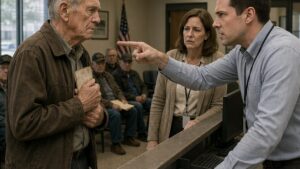
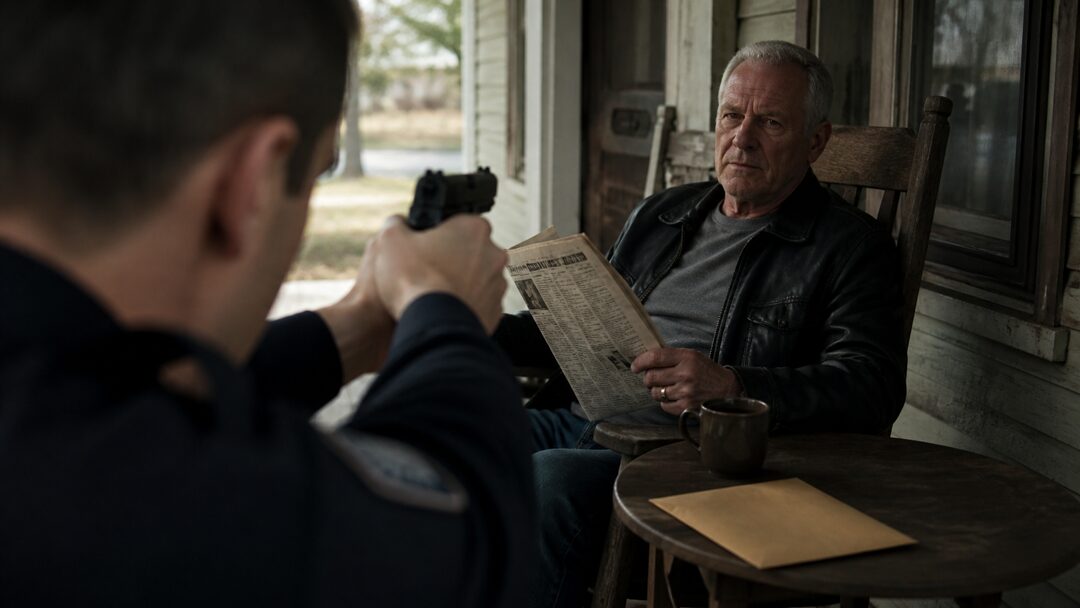
Robert Hayes sat on the porch in a metal chair, one ankle crossed over the other, a newspaper open in both hands. A white paper cup rested on the small table beside him. Steam no longer rose from it. The house behind him was pale blue, with peeling trim and curtains drawn across the front windows like tired eyelids.
Daniel kept both hands locked around his sidearm.
His orders had been simple.
Do not let Hayes reach into his jacket.
Do not let Hayes enter the house.
Do not engage in conversation.
The last instruction was the one repeating loudest in Daniel’s mind, because Robert looked exactly like a man who knew conversation was the only thing he needed.
“Robert Hayes,” Daniel called.
The newspaper did not lower.
Daniel took another step. Gravel shifted under his boot.
“Put your hands where I can see them.”
The old man turned a page.
The sound was small and dry.
Daniel’s finger rested along the frame, not the trigger. He had been trained well enough to know the difference. He had also been briefed well enough to know that Robert Hayes, sixty-two, former staff sergeant, decorated twice and discharged under a cloud of misconduct, was considered unstable, evasive, and in possession of restricted government property.
The briefing photo had shown a harder man.
This man had gray hair cropped close, a weathered face, and a black leather jacket over a plain gray shirt. His expression, when he finally folded one corner of the paper down, was not hard.
It was tired.
Then his eyes moved over Daniel’s uniform, his stance, his face.
Robert said, “They sent a kid.”
Daniel felt the words hit where they were meant to hit.
“I said hands where I can see them.”
Robert looked down at the paper again. “I heard you the first time.”
“Then do it.”
One of Robert’s hands came up slowly.
Palm out.
Not high. Not surrendering. Just visible.
The other hand remained on the newspaper.
Daniel’s mouth went dry.
“Both hands.”
“If I wanted to run,” Robert said, “I wouldn’t have made coffee.”
The cup sat beside a sealed tan envelope with official markings along the top edge. Daniel had noticed it the moment he reached the walk, because he had been told to retrieve documents. He had also noticed the old ring on Robert’s hand.
A service ring.
The kind men wore when they no longer had a unit but could not take off the years.
Daniel took one more step.
“Mr. Hayes, you are being detained under federal authority for unauthorized possession of classified material. Stand up slowly.”
Robert did not stand.
He folded the newspaper one clean inch lower.
The headline across the front page read:
KANDARI MEMORIAL DEDICATION SET FOR TODAY
Daniel saw it and looked away too quickly.
Robert noticed.
That was the first thing Daniel hated about him.
The noticing.
“You know what Kandari was?” Robert asked.
“I’m not here to discuss that.”
“No,” Robert said. “I suppose not.”
“Stand up.”
Robert looked at the sidearm, then at Daniel’s face.
“Did they tell you what happened at Hill 41?”
Daniel tightened his grip.
The radio clipped to his shoulder gave a soft burst of static.
He did not answer.
Robert’s one raised hand stayed steady.
That steadiness did something worse than defiance. It made Daniel feel like the one losing control.
Part II — The Name on the Envelope
Daniel had been awake since 4:18 that morning.
The call came before sunrise. The voice on the line was clipped, official, and already moving on to the next task.
Report to regional office.
Special transport assignment.
Subject to be detained quietly.
Retrieve all documents.
He did not ask why they were sending him instead of civilian authorities. He had learned early that good officers did not ask why before they understood what. He shaved, dressed, checked his gear, and drove through the gray morning with the packet sealed beside him on the passenger seat.
At a red light outside Dayton, he opened it.
Robert Hayes.
Former staff sergeant.
Service history redacted in blocks so heavy the page looked bruised.
Known agitation around Kandari campaign commemorations.
Possible threat to personnel records.
That line had made Daniel sit still until the light turned green behind him and someone honked.
Kandari was not just an old campaign name to him.
It was the word carved into the underside of his childhood.
His father, Mark Price, had died there when Daniel was five. Daniel’s mother had kept the folded flag in a walnut case over the mantel until she remarried, then moved it to the hallway, then to Daniel’s bedroom when he was twelve and old enough to understand that grief could be inherited like furniture.
Staff Sergeant Mark Price had died a hero.
Daniel knew the sentence because grown men had repeated it over him for years.
Your father died a hero.
He had built a life around not asking what else a man might have been before he became a sentence.
Now Robert Hayes watched him from the porch like he knew exactly which word had lodged under Daniel’s ribs.
“Mr. Hayes,” Daniel said, “this is your final warning.”
Robert glanced at the sealed envelope beside the cup.
“Final warnings sound different when you’ve heard real ones.”
Daniel stepped closer to the bottom stair. “Do not reach for that.”
“I won’t.”
“Then move your hand away from it.”
Robert’s fingers stayed on the edge of the newspaper.
“Read the name first.”
“I said move your hand.”
Robert did, slowly.
The newspaper slipped lower in his lap.
The tan envelope sat fully visible now. Its upper corner bore a government return address. Beneath the printed line was a handwritten notation in black ink, neat and old-fashioned.
Hill 41 — Observation Team Letters
Under that, four names.
Daniel read them against his will.
Carter.
Mills.
Hernandez.
Price.
The porch seemed to drop an inch beneath the world.
Daniel’s arms remained raised because training held them there after thought failed.
Robert saw the recognition pass through him.
Not surprise. Recognition.
“You’re Mark’s boy,” Robert said quietly.
Daniel’s voice came out flat. “Do not say his name.”
“I was wondering when they’d try this.”
“Do not say his name.”
Robert’s face changed then. Not much. A small closing around the eyes, as if some old hope had been confirmed and killed in the same breath.
“They didn’t send you by accident.”
The radio crackled again.
“Price, status.”
Daniel pressed the side button without taking his eyes off Robert.
“Subject located. Subject noncompliant. Continuing verbal commands.”
A pause.
Then the voice of Colonel James Whitaker came through, calm and clean.
“Do not prolong contact. Secure Hayes and retrieve all materials.”
Robert smiled without humor.
“There he is.”
Daniel lowered the radio. “You know Colonel Whitaker?”
“I know the sound of a man who learned to bury things with good grammar.”
“Enough.”
“Ask him about Hill 41.”
Daniel felt anger then, and he was grateful for it. Anger was easier than confusion.
“My father died in an ambush.”
Robert looked at the envelope.
“No,” he said. “Your father died waiting for help we were ordered not to send.”
Daniel moved up the first porch step before he knew he had done it.
“Stand up.”
Robert raised his hand a little higher.
Palm still open.
“You can hate me after you hear it.”
“I don’t need to hear anything from you.”
“Yes, you do,” Robert said. “That’s why they sent you with a sidearm and no questions.”
Part III — Hill 41
Daniel had grown up with one photograph of his father that mattered.
Not the official portrait. Not the one in dress blues, chin lifted, eyes pointed at a future he would never reach.
The real one was folded at the corners and kept in Daniel’s wallet until the crease split across Mark Price’s shoulder. In that photo, Mark was sitting on a crate somewhere bright and dusty, helmet pushed back, sleeves rolled, smiling like someone had just said something stupid behind the camera.
He looked young.
Not legendary.
Just young.
Daniel remembered being fifteen when he first realized his father had been younger than some of his teachers when he died. That had disturbed him more than the folded flag ever had.
Robert’s voice pulled him back to the porch.
“Hill 41 was an observation post north of the Kandari road. Four men. Bad radios. Worse maps. Command said the ridge was clear enough to hold for twelve hours.”
Daniel said nothing.
Robert glanced toward the street, listening.
No vehicles yet.
He continued.
“When the withdrawal order came, their transport didn’t arrive. The first report said enemy contact cut the route. That was the clean version.”
Daniel’s jaw locked.
Robert’s eyes did not leave him.
“The ugly version is that command rerouted the convoy to pull out personnel with better names attached. Your father’s team was told to hold until dark.”
“You’re lying.”
“I wish I were.”
Daniel almost laughed. It came out as air.
“My father was killed in an enemy ambush.”
“Enemy fire came later.”
The words hung there.
Daniel had been trained to notice hands, posture, exits, windows, shadows behind curtains. Now he noticed the tiny tremor in Robert’s left ring finger, the only part of him not perfectly still.
Robert was not performing calm.
He was containing something.
“Why should I believe you?” Daniel asked.
“You shouldn’t. Not yet.”
That answer did more damage than a plea would have.
Robert looked down at the envelope.
“There’s a box in my hall closet. Letters from the observation team. Last things they wrote when they understood nobody was coming before dark. Your father wrote one too.”
Daniel’s throat tightened before he could stop it.
“No.”
Robert nodded once, almost gently.
“He wrote to you.”
Daniel stepped fully onto the porch.
“Don’t.”
Robert did not flinch.
“He called you Danny.”
Daniel felt the name like a hand closing on the back of his neck.
Nobody called him Danny anymore. His mother had stopped when he enlisted. His stepfather never had. The officers who spoke at ceremonies used Daniel because Daniel sounded cleaner in a room full of polished shoes.
But in the photograph, on the back in faded ink, his father had written:
For Danny, when he asks where I went.
Daniel had never told anyone about that line.
His sidearm dipped half an inch.
Robert noticed that too.
“Your father was scared,” Robert said. “He was brave too. People think those cancel each other out. They don’t.”
“Stop talking.”
“I tried to reach them.”
Daniel’s eyes sharpened.
Robert swallowed.
That was new.
“I was ordered to hold south of the ridge. I went anyway with two men and a truck that should’ve died ten miles earlier. By the time we got close, the whole slope was lit up. We pulled one body out before command called us back.”
Daniel could barely hear the neighbor’s wind chime ticking in the morning breeze.
“Was it him?”
Robert’s silence answered first.
“No,” he said. “Not your father.”
Daniel hated him for making him ask.
He hated him more for answering.
“You survived,” Daniel said.
Robert’s eyes lowered to the coffee.
“I did.”
Two words. No defense.
That was the second thing Daniel hated about him.
He did not make himself easy to dismiss.
Part IV — The Order Behind the Voice
The radio burst alive.
“Price, confirm subject secured.”
Daniel’s finger moved to the button.
Robert said, “If you answer too fast, he’ll know.”
Daniel looked at him.
Robert’s hand was still up. His other hand rested open on the newspaper now, empty and visible.
The absurdity of it hit Daniel all at once.
A trained officer stood on a porch with his sidearm drawn on an old man holding nothing but yesterday’s grief and today’s newspaper.
Still, Daniel pressed the radio.
“Subject contained. Awaiting transport.”
Colonel Whitaker’s response came back instantly.
“Negative. You are to restrain Hayes now and enter the residence. Retrieve all documents before additional personnel arrive.”
Daniel’s eyes flicked to the front door.
Closed.
Old brass knob.
No movement inside.
Robert said, “They told you I had something dangerous in there.”
Daniel did not answer.
“That I had a weapon close. That I’d run. That I’d make you choose.”
Daniel felt the air change.
Whitaker’s voice returned, sharper under the polish.
“Price, be advised, Hayes has a documented history of unstable conduct. Do not permit delay tactics. Secure all written materials.”
Robert let out a breath that was almost a laugh.
“Unstable conduct,” he repeated. “That’s what they called it when I asked why four names were missing from the movement log.”
Daniel said, “What’s in the house?”
“A cardboard box.”
“What else?”
“Dust. Bad plumbing. A chair I keep meaning to throw away.”
“What is in the box?”
Robert looked at him for a long second.
“Their letters. Copies of the radio transcript. The first report before Whitaker’s office cleaned it. A photograph of Hill 41 taken the next morning.”
Daniel’s hand tightened again.
The sidearm rose without him meaning to raise it.
Robert saw the movement and did not react.
“You’re trying to make me hesitate,” Daniel said.
“Yes.”
The honesty stunned him.
Robert’s expression hardened, but not with cruelty.
“I am trying to make you hesitate before you become useful to men who already used your father.”
Daniel’s mouth opened. No words came.
From somewhere down the block came the low approach of engines.
Backup.
Robert heard it before Daniel turned his head.
The old man finally lowered the newspaper completely and set it on his lap.
The article on the front page showed a rendering of a memorial wall. Names etched in clean rows. Flags on both sides. A smiling colonel quoted beneath it.
Daniel did not read the quote.
He did not have to.
Robert picked up the tan envelope between two fingers and slid it toward the porch edge.
Slowly.
Carefully.
As if any sudden motion might break something that had survived too long already.
Daniel’s sidearm stayed up, but his hand was no longer steady.
Robert looked at him then—not through him, not past him, but at him.
“You can detain me,” he said. “But don’t let them take your father from you twice.”
The line landed harder than command.
Harder than accusation.
Daniel heard the engines turn onto the street.
He saw Robert’s raised hand.
He saw the envelope.
He saw the coffee gone cold beside it.
Then he saw, for one terrible second, his father not as a portrait, not as a folded flag, not as the sentence men handed him when they did not know what else to say.
He saw a young man on a ridge, writing to a five-year-old boy while waiting for help that had been redirected somewhere more convenient.
Daniel lowered the sidearm halfway.
Not enough to be clean.
Enough to be seen.
Robert’s eyes flicked to the movement.
He did not smile.
That would have ruined it.
Daniel stepped forward and took the envelope.
It was lighter than he expected.
That made it worse.
Part V — Custody
The first vehicle stopped hard at the curb.
Two officers got out, then a third. Their boots struck pavement in a rhythm Daniel had always found reassuring.
Today it sounded like a countdown.
Daniel kept the envelope in his left hand and the sidearm low in his right.
“Stand up,” he told Robert.
Robert obeyed.
For the first time all morning, he moved like an old man.
His knees took a second. One hand touched the chair arm. His shoulders were still square, but the effort showed through. Daniel saw then what the porch had hidden: Robert’s calm had been expensive. Every second of it had cost him.
Daniel holstered his sidearm.
The click was small.
Everyone heard it.
The lead officer, a broad man Daniel knew only as Sergeant Mills, reached the bottom of the steps.
“Price?”
“Subject secured,” Daniel said.
Mills glanced from Robert to the envelope in Daniel’s hand.
“Was there resistance?”
Daniel felt Robert watching him.
Not pleading.
Just present.
“No,” Daniel said.
Mills frowned. “Command said—”
“Subject was seated on arrival. Verbal noncompliance only. No physical resistance.”
Robert’s face did not change, but something in him settled.
Mills came up the steps with restraints.
Daniel moved first.
“I’ve got him.”
It was a small claim. Almost nothing. A sentence that could disappear into a report.
But Mills paused.
Daniel took Robert’s wrists and brought them behind his back. The old man did not make him fight for it. When the restraints closed, Robert looked toward the newspaper still lying on the chair.
The memorial headline faced up.
Daniel saw it.
So did Robert.
“Inside documents?” Mills asked.
Daniel lifted the envelope. “Initial materials are under my custody. Residence still needs formal inventory.”
“Whitaker wants everything removed immediately.”
“It’ll be logged,” Daniel said. “Correctly.”
Mills studied him.
The engines idled below them. Somewhere a dog barked once, then stopped.
Robert spoke quietly, almost too quietly for anyone else to hear.
“That’s how it starts.”
Daniel did not look at him.
“What?”
“Correctly.”
Mills gestured toward the vehicles. “Move him.”
Daniel guided Robert down the porch steps.
At the bottom, Robert slowed. For a moment Daniel thought he was stumbling, but the old man was looking back at the house.
Not dramatically. Not like a man leaving a beloved home forever.
More like a man checking that a door had finally closed behind him.
The cup still sat on the table.
The paper still lay open.
The empty chair faced the street.
Daniel helped Robert into the back of the vehicle. Before Mills shut the door, Robert leaned forward slightly.
“Your father’s letter is the one with the blue fold.”
Daniel looked at him.
Robert’s eyes were tired now. Fully tired.
“He wrote it twice,” Robert said. “First version was for a hero. Second was for his son.”
Mills shut the door.
The sound ended the conversation.
The vehicles pulled away one by one. No neighbors came out. The curtains across the street shifted once and went still. The morning returned to its ordinary shape, but Daniel could not step back into it.
He stood alone on Robert Hayes’s porch with an envelope in his hand and the radio still speaking against his shoulder.
“Price,” Whitaker said. “Confirm document recovery.”
Daniel watched the last vehicle turn the corner.
Then he looked at the coffee.
Cold now.
Untouched.
“Initial recovery complete,” Daniel said.
“All materials?”
Daniel looked at the front door.
The house seemed to wait.
“No, sir,” he said. “Not yet.”
There was a pause.
“Explain.”
Daniel slid the envelope under his arm and picked up the newspaper from the chair. The memorial rendering stared up at him with its polished names and clean stone.
He folded it once.
Then again.
“Subject is secured,” Daniel said. “Residence will be inventoried under chain of custody.”
Whitaker’s voice lowered.
“Lieutenant Price, you were given a direct instruction.”
Daniel’s hand tightened around the folded newspaper.
“Yes, sir.”
“Then follow it.”
For a moment, Daniel almost did.
That was the part he would remember later. Not the courage. Not the decision. The almost.
The lifelong instinct to obey rose in him like a second spine.
Then he saw the handwritten name again.
Price.
Not Staff Sergeant Mark Price.
Not hero.
Not casualty.
Just Price, written by an old man who had carried it for years.
Daniel pressed the radio button.
“I am following it,” he said. “Correctly.”
He released the button before Whitaker could answer.
Part VI — The Blue Fold
Daniel waited until the formal inventory team arrived.
He did not let Mills enter first. He did not let anyone carry out the box without signing for it. He did not raise his voice. He did not accuse anyone. He became, for the next two hours, exactly what the system had trained him to be: precise, disciplined, difficult to move.
The box was in the hall closet, just as Robert had said.
Cardboard.
Soft at the corners.
A strip of old tape hung loose across the top.
Inside were folders, copied logs, photographs sealed in plastic, and letters bundled by name.
Carter.
Mills.
Hernandez.
Price.
Daniel did not open his father’s bundle in the house.
He logged it. Signed for it. Placed it in the evidence case himself.
Every movement felt watched, though Whitaker never arrived.
That was his power.
He did not need to stand in the room to make men feel the shape of him.
By early afternoon, Robert’s porch was empty except for the chair, the table, the cup, and the newspaper Daniel had left folded beside it. The memorial dedication would begin in less than an hour. Somewhere, a podium would be waiting. Someone would say sacrifice. Someone would say honor. Someone would say names in a voice meant to smooth the edges off absence.
Daniel sat in his car three blocks away and stared at the sealed evidence case on the passenger seat.
He should not open it.
Not yet.
Not alone.
Not without a witness, a form, a camera, a reason that could survive review.
He knew all that.
He also knew his father had called him Danny.
The bundle marked Price was tied with cotton string. The top letter had a blue fold along one edge, where the paper had once been bent too sharply and flattened again.
Daniel held it for a full minute before opening it.
The handwriting was smaller than he expected.
Not heroic.
Not polished.
A little rushed.
Danny,
If you ever read this, it means somebody kinder than the situation got stubborn.
Daniel stopped there.
His eyes burned so suddenly he looked out the windshield as if traffic had caused it.
The street was quiet.
A woman pushed a stroller past the corner. A mail carrier crossed a lawn. The world continued with unbearable confidence.
Daniel looked back down.
I need you to know I was scared. I need you to know I wanted to come home. Those two things are not the opposite of love.
He pressed the heel of his hand against his mouth.
The letter blurred.
He did not read the rest. Not then. There were truths a person could only receive in pieces.
For most of his life, Daniel had believed his father’s story was finished before he was old enough to ask questions. It had been handed to him complete, sealed by ceremony, polished by men who spoke in full sentences and never looked at the empty chair beside his mother.
Now the story was open in his lap.
Messy.
Human.
Unfinished.
His radio sat silent on the dashboard.
His phone vibrated twice.
He did not look at it.
Instead, Daniel folded the letter along the blue crease and placed it back in the envelope with hands that no longer felt steady but finally felt like his own.
On Robert Hayes’s porch, the coffee would still be cold.
At the memorial, the names would still be read.
Robert would still be in custody.
Whitaker would still have rank, office, language, and time.
Nothing had been fixed.
Not really.
But something had changed hands.
Daniel started the car, then stopped before shifting into drive. He looked once more at the first line of his father’s letter through the open flap.
Somebody kinder than the situation got stubborn.
Daniel closed the envelope.
For the first time that day, he understood Robert’s calm.
It had never been peace.
It had been a man holding a door open as long as he could, waiting for someone else to decide whether to walk through.