What Stayed Steady
Part I — The Line Everyone Watched
“Did she even hit the berm?”
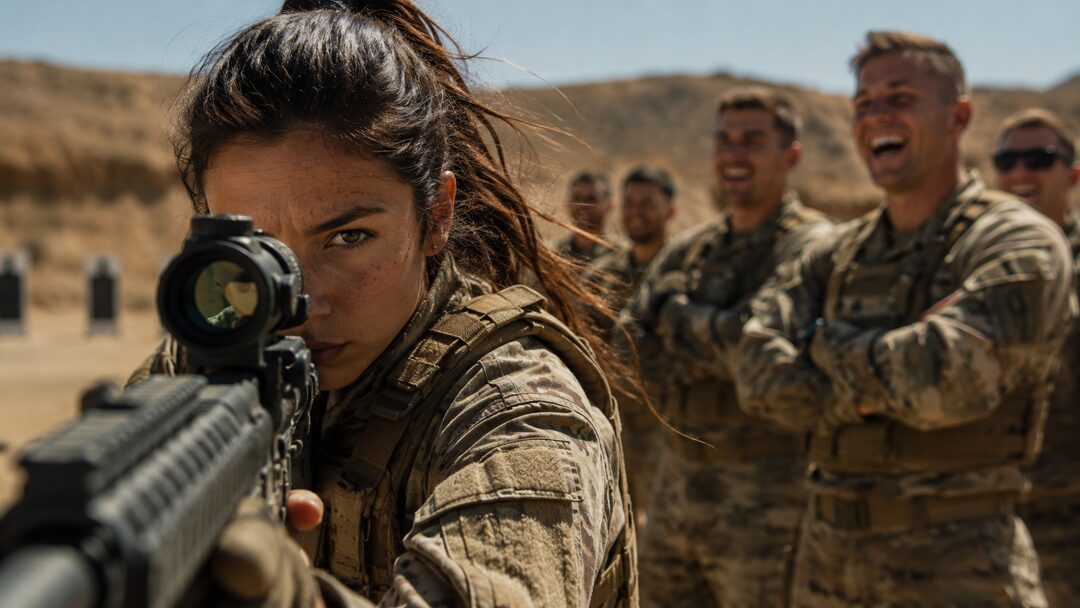
The laugh came from behind Harper Collins while her cheek was still pressed to the rifle stock.
She did not turn.
The sun was already sharp over the range, white and hard against the dusty firing line. Wind moved across the open ground and tugged at the end of her brown ponytail. Sweat gathered under the edge of her helmet. The rifle stayed firm against her shoulder.
Behind her, Sergeant Ryan Miller laughed louder.
Not because the joke was that funny.
Because he wanted the others to know it was safe to laugh too.
A few men did. First one, then three, then the loose, easy sound of a group deciding that someone else had become the entertainment.
Harper exhaled halfway and held the rest.
Her eye stayed inside the optic.
The target downrange was small, flat, and patient. It did not laugh. It did not care who believed in her. It only kept record.
That was the one mercy of paper.
“Somebody check the hill behind it,” Miller called. “She might’ve scared the dirt.”
More laughter.
Harper’s finger stayed indexed, disciplined, still.
She had been hearing versions of it since her first week with the platoon.
You sure you want to carry that?
Don’t worry, Collins, we’ll slow down for you.
Pretty good, for you.
The words were never enough on their own to report. That was the trick. Each one could be dismissed as a joke. Each one could be folded under morale, pressure, banter, unit culture. The men who said them always knew where the line was.
They liked to put their boots on it.
Harper adjusted her breathing by a fraction.
Not her posture. Not her face.
Just the breath.
Her first instructor had taught her that the body told the truth before the mouth did. If she let Miller change her breathing, he had already entered the shot.
So she kept him out.
At the next firing point, Private Daniel Price shifted with a clipboard tucked to his chest. He was assigned to run targets and record scores. Thin, pale, helmet sitting a touch too low, he watched the target lane like he wanted to say something and did not know whose permission he needed.
Harper saw none of that directly.
She felt it.
There were different kinds of silence on a range. Safe silence. Focused silence. The silence before a command.
And then there was the kind that formed when everyone waited to see whether one person would break.
Miller stepped closer behind her.
“You’re shooting blind, Harper.”
Her jaw tightened.
Only that.
He caught it anyway.
“There it is,” he said, pleased. “She heard me.”
Harper’s sight picture steadied again.
She did not answer because there was no answer that helped.
If she snapped back, she was emotional.
If she joked, she accepted the terms.
If she explained, she begged.
So she held the rifle like it was the only honest thing in her hands.
Another soldier muttered, “Clean target, guaranteed.”
Miller laughed. “Price, don’t waste the walk. We already know.”
Daniel had taken one step toward the targets.
He stopped.
His eyes moved from Miller to Harper, then toward the far side of the line.
Staff Sergeant Michelle Grant was walking in from the right.
She had dark hair pulled into a tight bun, gloves on, face severe under the brim of her cap. She did not hurry. She did not need to. Some people announced authority by making everyone look at them.
Grant did it by making everyone check themselves before she arrived.
Miller saw her too.
His grin stayed up, but it thinned.
Harper did not lower the rifle.
She waited for the command that mattered.
Miller leaned just close enough that his voice slid under her ear protection.
“Come on, Collins,” he said. “Show us where you think the target is.”
The laughter rose again.
Then Grant’s voice cut through it.
“Hold.”
It was not loud.
It stopped everything.
Miller’s mouth closed.
Daniel froze with one boot half-turned downrange.
The men behind the line straightened as if somebody had pulled wire through their spines.
Harper stayed locked in position until Grant’s gloved hand came up beside her field of vision.
“Collins,” Grant said, “safe and clear.”
Harper obeyed.
Only then did she lower the rifle.
Her arms felt the weight at once. Not because the weapon was heavy, but because the moment had been.
The range held its breath.
Grant looked past Harper at Miller.
“What exactly was funny?”
No one laughed after that.
Part II — The Joke That Needed Witnesses
Miller recovered first.
He always did. That was part of his power. He could throw a stone into a room, then act surprised by the broken glass.
“Staff Sergeant,” he said, “just range banter.”
Grant’s expression did not change. “I asked what was funny.”
Miller gave a small shrug, glancing at the men behind him like he was inviting them to remember the rules.
No one helped.
“She was struggling,” he said. “Keeping the mood light.”
Harper stood with her rifle pointed down, safe, eyes on the berm. She did not look at Miller. Looking at him would have made the moment about him, and that was what he wanted.
Grant turned slightly toward Daniel.
“Private Price, were you about to verify the target?”
Daniel swallowed. “Yes, Staff Sergeant.”
“Why did you stop?”
His eyes flicked to Miller.
It was fast.
Not fast enough.
Miller’s grin disappeared.
Daniel looked back at Grant. “I was told to wait.”
“By whom?”
The range seemed to grow hotter.
Daniel’s fingers tightened around the clipboard. “Sergeant Miller.”
Miller let out a small breath through his nose. Almost a laugh. Almost not.
“Come on,” he said. “We’re really doing this?”
Grant looked at him.
“We are if you keep talking.”
That shut him down for three seconds.
Harper almost admired the efficiency.
Grant turned back to Daniel. “Check the target.”
Daniel moved immediately.
Miller watched him go with the irritation of a man who had expected the room to stay arranged around him.
He was popular because he knew how to make younger soldiers feel included—as long as someone else was outside the circle. He remembered names. He shared energy drinks. He could run hard, shoot well, curse creatively, and make a miserable training day feel like a story people would tell later.
He was not useless.
That made him harder to challenge.
Useless men were easy. Everyone saw the problem eventually.
Useful men with ugly habits became traditions.
Harper had learned that in pieces.
The first time Miller mocked her, she thought it was a test.
The fifth time, she knew it was a pattern.
By the fifteenth, the other soldiers had learned to look at her after he spoke. Not always with cruelty. Sometimes with apology. Sometimes with curiosity. Always with waiting.
Would she take it?
Would she complain?
Would she prove him right?
Grant stepped closer to Harper, but did not soften her voice.
“Collins.”
“Staff Sergeant.”
“Status?”
“Safe and clear.”
“Did Sergeant Miller’s comments affect your firing?”
It would have been easy to say no.
It would have been safer too.
Harper could feel Miller listening.
She could feel every soldier behind him listening harder.
“No, Staff Sergeant,” Harper said. “But they were intended to.”
The sentence landed flatter than anger.
That made it worse.
Miller’s head turned.
Grant’s eyes held on Harper for one beat, not warm, not proud, just exact.
“Noted.”
The word was small.
Miller heard the size of it.
“Staff Sergeant,” he said, “with respect, pressure is part of training.”
Grant faced him fully. “Pressure is not the same as interference.”
“I wasn’t interfering.”
“You stepped behind a shooter and started performing for an audience.”
Miller’s nostrils flared.
One of the soldiers behind him looked down at his boots.
There it was again. That strange group shame that only appeared after someone with rank named the thing everyone had already seen.
Miller shifted his weight. “If Collins can’t handle a little noise—”
Harper almost smiled then.
Not because it was funny.
Because he could not help himself. Even now, with Grant watching him, even with Daniel downrange and proof coming back, he still needed to turn the story before the story arrived.
Grant raised one finger.
“Finish that sentence carefully.”
Miller stopped.
Wind moved dust along the firing line.
Downrange, Daniel reached Harper’s target.
He paused.
From where they stood, no one could see what he saw.
But they could see his body change.
He leaned closer to the paper.
Then closer again.
Miller folded his arms.
“See?” he said, quieter now. “Probably trying to find one.”
Grant did not look away from Daniel.
Harper felt her heartbeat once in her throat.
Not doubt.
Anger.
She had known her shots. Not perfectly—nobody knew perfectly until the target told them—but enough. She knew what her breathing had done. She knew what her sight picture had done. She knew the small corrections she had made between rounds.
But certainty did not stop the old fear.
The fear was not that she had missed.
The fear was that even if she had not, they would find another way to make it smaller.
Daniel pulled the target from its holder.
He stared at it.
Then he started walking back.
Not fast.
Not slow.
Like he was carrying something heavier than paper.
Part III — Paper Does Not Laugh
Daniel returned with the target held against his clipboard.
He did not hand it to Miller.
He gave it to Grant.
That choice made the range go quiet in a new way.
Grant looked down.
Her face did not move.
Harper watched only Grant’s eyes. Not the target. Not Miller. Grant’s eyes gave nothing away, and somehow that steadied Harper more than a smile would have.
Miller shifted again.
“Well?” he said.
Grant looked at Daniel. “Score?”
Daniel cleared his throat.
“Centered group. Clean hits.”
A few men blinked.
One whispered, “What?”
Miller stepped forward. “Let me see.”
Grant did not give it to him.
“Private Price,” she said, “read it again.”
Daniel’s voice shook at the edge, but it did not break.
“Centered group. Clean hits.”
The wind moved through the range flags.
Miller stared at the target in Grant’s hands like it had personally betrayed him.
“That’s not—” He stopped. Restarted. “There’s no way.”
Harper finally looked at him.
Only once.
Long enough.
Then she looked back downrange.
Miller saw the look and hated it because it contained no victory. It gave him nothing to fight.
Grant turned the target slightly so the nearest soldiers could see. The holes were tight, clustered close enough that from a distance it could look like less than it was. That was the part that settled into the men’s faces.
They had not seen failure.
They had assumed it.
Miller’s ears had gone red.
“Could be a scoring issue,” he said. “One target doesn’t prove—”
Grant’s voice cut in. “You were certain a minute ago.”
“I was joking.”
“No,” Harper said.
Every head turned.
It was the first thing she had said to him all morning.
Miller’s face hardened, grateful for something to push against. “Excuse me?”
Harper kept her voice level. “You were not joking. You were deciding.”
The words held.
Grant did not rescue them from the silence.
Miller’s jaw worked. “You want a medal for one decent group?”
“No.”
That answer seemed to frustrate him more than any insult.
Grant handed the target to Daniel. “Log it.”
Daniel nodded, but Miller stepped toward him.
“Hold up. If we’re making a whole ceremony out of this, let’s confirm it.”
Grant looked at him slowly.
Miller raised his hands. “Her group is good, fine. Great. Let her run another string with everyone watching. That fair enough?”
The men behind him stayed still.
Miller thought he was recovering ground.
He did not understand the ground had changed.
Grant looked at Harper.
The choice was there.
Harper could take the score. She had earned it. The paper had spoken. The smart thing would be to leave Miller standing in the silence he had made for himself.
But smart was not always complete.
Harper looked down at the rifle in her hands. Dust clung to the sling. Her right glove had a worn seam near the thumb. A single spent casing lay near her boot from the last string, dull brass against pale dirt.
A small, ordinary thing.
Proof always looked smaller than the noise that tried to bury it.
She thought of every time she had let a comment pass because the work mattered more. Every time she had said nothing because she did not want to become “the problem.” Every time silence had kept her professional but left the room unchanged.
Then she looked at Grant.
“I’ll fire again,” Harper said.
Miller smiled too quickly.
Grant saw it.
“Under my command,” she said.
The smile faded.
Grant stepped back into position behind the line.
“Miller,” she said, “behind the safety marker.”
“Staff Sergeant, I—”
“Behind it.”
This time, everyone watched him obey.
It was a small thing.
It felt enormous.
Harper returned to the line.
The rifle came up.
The world narrowed.
Sun. Dust. Breath.
No laughter now.
That was almost worse.
Before, the noise had given her something to shut out. Now the silence had weight. Every soldier behind her was waiting for proof. Waiting to see whether the first target had been luck, mistake, or truth.
Harper settled her cheek to the stock.
Her anger wanted speed.
Her discipline refused.
Grant’s voice came from behind her.
“Shooter ready?”
Harper inhaled.
“Ready.”
Part IV — The Quietest Proof
The first round cracked across the range.
Dust jumped from the berm behind the target.
Harper did not chase the sound. She let it leave her.
Breath.
Sight.
Pressure.
Second round.
She did not think about Miller. Thinking about him would give him space inside the work.
Third.
The rifle settled back exactly where she expected.
Fourth.
A strip of hair loosened from her ponytail and pressed against her cheek. She ignored it.
Fifth.
The string ended.
The silence after was so complete Harper could hear brass settling in the dirt.
Grant waited one beat.
“Safe and clear.”
Harper lowered the rifle.
Her hands were steady.
Her heart was not.
That was fine. Steadiness was not the absence of feeling. It was deciding which part of you got to move.
Daniel had already started downrange before Miller could speak.
This time no one stopped him.
Miller stood behind the safety marker, arms crossed, mouth flat. He looked less like a leader now and more like a man waiting on a door he could not open.
Grant stood beside Harper.
Neither of them looked at each other.
For a moment, Harper wondered how many times Grant had stood where she stood now. Not literally at this firing point, not with this target, but in the long invisible line of being watched harder, doubted faster, forgiven less.
Grant’s face gave no memory away.
But when Miller had called it banter, something old had moved behind her eyes.
Harper had seen it.
Some wounds became regulations inside a person. Grant had learned to survive by becoming exact. Maybe too exact. Maybe so exact that she had once believed younger women should learn to endure the same weather.
But today she had said hold.
That mattered.
Daniel reached the target.
He did not pause as long this time.
He pulled the paper, looked once, and turned back.
The range waited.
Miller tried to look bored.
Nobody believed him.
Daniel walked straight to Grant and handed her the target.
Grant looked down.
Then she held it out to Harper.
Not Miller.
Harper took it.
The group was tighter than the first.
For half a second, the range disappeared.
There was only the paper in her hand, the clean proof, the small round absences arranged exactly where her breath had placed them.
She had imagined feeling satisfaction.
Instead she felt tired.
Not weak tired.
Old tired.
The kind that came from having to make the obvious undeniable.
Miller stepped forward before he remembered he had been told not to.
“So she can shoot,” he said. “Great. That was never the point.”
Grant turned to him.
“What was the point?”
He opened his mouth.
Nothing clean came out.
The men behind him waited for the joke that would save him.
It did not arrive.
Harper lowered the target.
Miller’s face had changed. Not broken. Not humbled in some neat storybook way. He was too proud for that and too practiced. But the certainty had gone out of him. The room he usually built with laughter had collapsed, and he was standing in the open without it.
Grant let him stand there long enough to feel the weather.
Then she said, “The point is you mocked a soldier before you checked the record.”
Miller’s eyes flashed. “Staff Sergeant—”
“The point,” Grant continued, “is you called it pressure after the proof came back.”
He said nothing.
“The point is discipline does not mean making someone carry your insecurity.”
That line hit the range harder than the shots had.
No one moved.
Harper looked at Grant then.
Grant still was not looking at her.
She was looking at Miller, but the words belonged to more than one person.
Miller’s face reddened.
Grant turned to Daniel. “Log Specialist Collins’s score.”
“Yes, Staff Sergeant.”
Then she faced Miller again.
“You’re assisting target resets for the next rotation.”
Miller stared. “I’m a squad leader.”
“Then lead from where the work is.”
A few soldiers looked down fast.
Not laughing.
Never laughing.
That was better.
Harper handed the target back to Daniel. He accepted it carefully, like paper could bruise.
Grant stepped beside Harper.
Low enough that only she could hear, she said, “Good work.”
Harper wanted that to feel like triumph.
It did not.
It felt like water after a long dry march.
Necessary. Not enough. Still welcome.
“Thank you, Staff Sergeant,” Harper said.
Grant nodded once and moved on.
The range resumed around them in pieces. Commands. Movement. Boots in dust. Targets changing hands. Soldiers clearing throats and pretending they had not been part of what had just happened.
Harper picked up her gear.
Miller was already walking downrange with Daniel, jaw set, stripped of the easy distance from which he usually judged everyone else.
Harper did not watch him long.
She had nothing to prove to his back.
Part V — What the Silence Kept
By noon, the sun had burned the range flat and bright.
Harper sat on an ammo crate near the equipment table, drinking warm water from a canteen and letting the heat press into her shoulders. Her score was logged. Her gear was clean enough. Her hands had stopped carrying the echo of recoil.
The men did not avoid her exactly.
They adjusted around her.
That was different.
One soldier gave a small nod as he passed. Another asked if she needed extra water, then looked embarrassed by the question and kept walking. The loudest laughers from the morning had become very interested in straps, magazines, gloves, anything that did not require eye contact.
Harper did not need apologies from men who had laughed because it was easier than thinking.
She needed the next woman on the line to hear less laughter.
That was harder to measure than a target.
Across the range, Miller bent to reset a frame while Daniel held a stack of paper targets against his chest. Miller said something Harper could not hear. Daniel did not laugh.
Good.
A shadow fell beside her.
Michelle Grant stood there, gloves tucked under one arm.
“You all right, Collins?”
Harper almost said yes automatically.
Instead she said, “I’m tired.”
Grant nodded. “That tracks.”
It was the closest thing to tenderness Harper had ever heard from her.
For a few seconds, they watched the target line together.
Then Grant said, “You shouldn’t have had to fire twice.”
Harper looked down at her canteen.
“No, Staff Sergeant.”
Grant’s jaw tightened once. “But you chose to.”
“Yes.”
“Why?”
Harper watched Miller lift a target frame under Daniel’s direction.
“Because if I walked away with the first score, he’d call it luck by dinner.”
Grant said nothing.
Harper added, “And some of them would believe him.”
Grant’s gaze stayed downrange.
“That’s the part people pretend not to know,” she said.
Harper looked at her.
Grant did not explain further.
She did not have to.
A few minutes later, Daniel approached alone.
He had removed his helmet. His hair was flattened and damp. He looked nervous in a different way now, not afraid of Miller exactly, but afraid of doing a decent thing badly.
“Specialist Collins?”
Harper stood. “Price.”
He opened his hand.
A spent casing rested in his palm.
“I, uh…” He cleared his throat. “This was near your boot after the second string.”
Harper stared at it.
Small. Brass. Ordinary. Already cooling.
Daniel held it out like he expected her to laugh.
She took it.
“Why are you giving me this?”
His eyes moved downrange, then back.
“I thought maybe you’d want it.”
“It’s not a trophy.”
“I know.”
That answer made her close her fingers around it.
Daniel shifted his weight. “I should’ve checked the first target when I was supposed to.”
Harper looked at him.
He was young enough to still think every failure had a clean opposite.
“You checked it,” she said.
“Late.”
“Yes.”
He winced.
She did not soften it. Soft lies were still lies.
Then she said, “But you brought it back.”
Daniel nodded once, fast, like if he moved slowly the moment might get worse.
“Your group was better than Miller’s last month,” he said.
Harper blinked.
Daniel immediately looked horrified that he had said it out loud.
Harper laughed once.
Not loud.
Not sweet.
Just enough to let the air change.
Daniel’s shoulders dropped.
“Don’t tell him I said that,” he muttered.
“I won’t need to.”
For the first time that day, Daniel smiled.
Then Grant called for the next rotation, and the range returned to motion.
Harper slipped the casing into the small pocket near her vest strap. She did not know if she would keep it forever. Maybe it would sit in a drawer. Maybe she would find it months later and remember the heat, the laughter, the silence after.
Maybe that was enough.
Miller walked past once, carrying a target stand with both hands.
He did not look at her.
Harper did not look away.
There was no dramatic apology. No sudden respect. No clean ending where everyone understood what they had done and promised to be better.
The range did not become fair because one target told the truth.
But the next time a woman took the firing line, no one laughed before the paper came back.
That was not everything.
It was something.
Harper returned to her lane when Grant called her group forward to clear equipment. The dust shifted under her boots. The wind tugged one loose strand of hair against her cheek.
Downrange, the targets waited.
Patient.
Silent.
Ready to keep record.
Harper touched the casing in her pocket once, then let it go.
She had nothing to announce.
The truth had already arrived.