The Note She Took Back
Part I — The Man Who Smiled First
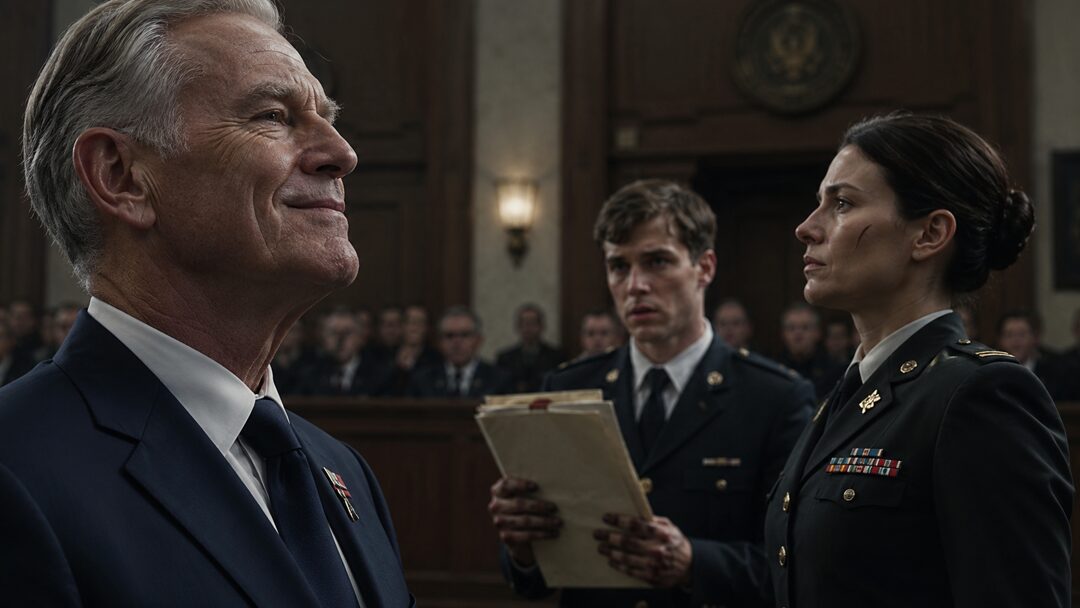
Robert Hayes smiled before Judge Margaret Collins finished reading the charge.
It was not a large smile. Nothing theatrical. Just a slight lift at one corner of his mouth, polished and practiced, the kind of smile a man wore when he had already measured the room and found everyone in it smaller than himself.
Across from him, Sergeant Sarah Mitchell stood in dress uniform with her hands flat at her sides.
Hayes turned just enough for the gallery to see his profile, the silver hair, the neat navy suit, the old campaign ribbon pinned discreetly to his lapel like a reminder that he had once given orders no one questioned.
“Sergeant Mitchell,” he said, his voice smooth, “has always been very good at standing still when other people needed her to move.”
The room changed temperature.
A woman in the second row shifted in her seat. A veteran near the aisle looked down at his folded hands. Somewhere behind Sarah, a chair leg scraped softly against the floor.
Sarah did not blink.
Judge Collins lifted her eyes over her reading glasses. “Mr. Hayes.”
“My apologies, Your Honor,” Hayes said, though nothing in his face apologized. “I’ll keep my remarks within the matter before the court.”
Daniel Price, Sarah’s assigned counsel, rose too quickly. His folder bumped the edge of the table, spilling a yellow tab halfway out of place.
“Objection,” he said.
The word came out correctly, but thin.
Hayes glanced at him with faint amusement, as if Daniel were a young waiter who had interrupted the wrong table.
Judge Collins looked from Daniel to Hayes, then to Sarah.
Sarah’s face gave her nothing.
The judge’s robe was black, severe, and perfectly still around her shoulders. “The court will hear relevant testimony only. This proceeding concerns Sergeant Mitchell’s conduct during Operation Red Harbor. It will not become a theater.”
Hayes bowed his head. “Of course.”
Then he turned back toward Sarah.
That was the thing Daniel noticed first: Hayes never looked at the judge for long. He always came back to Sarah. As if the court were not the battlefield. She was.
“Sergeant Mitchell acknowledged a direct instruction to move Convoy Three through Checkpoint Nine,” Hayes said. “She then failed to execute that instruction. The delay compromised the extraction window and left Field Team Bravo exposed.”
Daniel felt Sarah beside him, still as a locked door.
Hayes let the words settle.
“People were waiting on her.”
Sarah’s eyes lowered.
Only for a second.
But Hayes saw it. So did Daniel. So did half the courtroom.
Hayes’s smile almost returned.
Daniel wanted her to look angry. Wanted her to look wounded. Wanted her to look like a woman being lied about, not a woman being sentenced by memory.
Instead Sarah raised her eyes again and stared straight ahead.
It was the first thing she had told Daniel when he met her two weeks earlier.
“I don’t need you to make me look innocent,” she had said.
Daniel had asked, “Then what do you need me to do?”
Sarah had looked past him, toward the small window in the interview room.
“Keep the record clean.”
At the time, he thought she meant legal procedure.
Now, watching Hayes hold the room like a man gripping a leash, Daniel was no longer sure.
Judge Collins tapped one finger against the bench. Not the gavel. Just her finger.
“Proceed,” she said.
Hayes lifted a document from the table before him.
Daniel recognized it immediately. The partial command-channel transcript. He had requested the full mission record three times and received the same packet three times, each copy thin in exactly the same places.
Hayes put on reading glasses he did not need.
“Page fourteen,” he said. “Command channel, 19:42 hours. Colonel Hayes: ‘Sergeant Mitchell, proceed to Checkpoint Nine. Repeat, proceed to Checkpoint Nine.’ Sergeant Mitchell: ‘Acknowledged.’”
He paused.
Sarah’s breathing did not change.
Hayes continued.
“19:49 hours. Colonel Hayes: ‘Convoy Three, confirm movement.’ No response from Sergeant Mitchell. 19:52 hours. Colonel Hayes: ‘Sergeant Mitchell, you are delaying the extraction.’ No response.”
The courtroom heard the absence as if it were a confession.
Daniel looked down at his copy.
Page fourteen ended there.
The next page in his packet was page nineteen.
He had noticed it before. Of course he had. But every official copy matched. Every clerk had shrugged. Every answer had arrived dressed as procedure.
Hayes lowered the paper.
“Sometimes silence is not dignity,” he said. “Sometimes it is the only defense left.”
Daniel stood again.
This time his voice was steadier. “Objection.”
“Sustained,” Judge Collins said sharply. “Mr. Hayes, you will not editorialize.”
Hayes inclined his head.
Sarah’s hands remained flat at her sides.
But Daniel saw the pressure now. Not on the record. Not in the room.
On her.
Every unanswered sentence was being placed on her shoulders, one by one, and she was letting them stack.
Part II — The Missing Pages
At recess, Daniel took the transcript into the corridor and counted the pages again.
Fourteen.
Nineteen.
Twenty.
Twenty-one.
He counted as if numbers might become different if he made his finger slow enough.
They did not.
The courthouse corridor was quiet except for low voices behind closed doors and the soft mechanical hum of the air vents. Sarah stood near the window, shoulders squared, looking out at a parking lot she did not seem to see.
Daniel approached her with the packet open.
“Pages fifteen through eighteen are still missing.”
“I know.”
“You knew?”
Sarah did not turn. “Everyone who was there knew something was missing.”
“That’s not the same thing.”
“It is in rooms like this.”
He stepped closer, lowering his voice. “Sergeant, if those pages help you, I need to know what’s on them.”
Sarah looked at him then.
Her eyes were tired in a way that had nothing to do with sleep.
“The road was not clear,” she said.
“You said that in there.”
“Because that’s what I can say.”
Daniel almost laughed, not from humor but from the pressure of trying to defend a person who kept handing him closed doors.
“Sarah, he’s making you look like you froze.”
Her jaw tightened once. Barely.
“He knows I didn’t freeze.”
“Then help me prove it.”
She looked past his shoulder.
Daniel followed her gaze.
Robert Hayes stood near the clerk’s office, speaking to a man in a gray suit. He was smiling again, but not the courtroom smile. This one was smaller. Private. More dangerous.
Daniel looked back down at the transcript.
“Who sealed the missing pages?”
Sarah did not answer.
That was answer enough.
Daniel walked to the clerk’s desk before he could talk himself out of it. The clerk was a woman with silver-rimmed glasses and a voice that suggested she had survived every young attorney’s panic before breakfast.
“I need the complete mission record for Operation Red Harbor,” Daniel said.
She did not look up. “You have the admitted record.”
“I need pages fifteen through eighteen of the command transcript.”
Now she looked up.
Only for a moment.
“Those pages are not in the admitted record.”
“Where are they?”
“Sealed.”
“By whose order?”
The clerk glanced past him, toward Hayes.
Then she said, “Contractor security review.”
Daniel felt the words enter him slowly.
Not classified command review.
Not operational protection.
Contractor security review.
He thanked her, though she had not helped him, and turned away.
Hayes was waiting.
He had the talent of appearing casual in places where no casual man would stand.
“Lieutenant Price,” Hayes said. “You’re very diligent.”
Daniel held the transcript against his chest. “I’m doing my job.”
“Of course you are.” Hayes’s eyes flicked to the folder. “A word of advice. Sealed intelligence has a way of punishing the hands that mishandle it.”
Daniel said nothing.
Hayes stepped closer. He smelled faintly of aftershave and expensive wool.
“You are young enough to think a missing page is a mystery,” Hayes said. “It is often just a door that was closed for a reason.”
Daniel felt heat rise in his neck.
“Is that why Sergeant Mitchell won’t talk?”
For the first time, Hayes’s smile thinned.
“Sergeant Mitchell understands consequences.”
Then he walked away.
Daniel stood there with the transcript in his hand and hated the small part of himself that wanted to put it down.
When he returned to Sarah, she was still by the window.
“You’re afraid of him,” Daniel said.
“No.”
“Then what?”
Sarah watched Hayes enter the courtroom again.
“I’m afraid he’s right about one thing.”
Daniel waited.
Sarah’s voice stayed flat.
“Truth punishes whoever carries it.”
The bailiff called them back in.
Sarah moved first.
Daniel followed, the missing pages suddenly heavier than the ones he had.
Inside, Judge Collins had resumed her place at the bench. Hayes sat with one ankle crossed, relaxed again. He looked at Sarah as she entered, and Daniel understood something he had not understood before.
Hayes was not trying to win the case.
He was trying to make her choose silence in public.
Part III — Checkpoint Nine
The afternoon session lasted forty-three minutes before Daniel asked for another recess.
Judge Collins granted it with visible irritation.
“Counsel,” she said, “when we return, this court will proceed on the record before it unless you provide a lawful basis to expand that record.”
“Yes, Your Honor.”
Daniel hated how young he sounded.
In the empty consultation room, Sarah stood instead of sitting. She always stood when the room was too small.
Daniel placed the transcript on the table between them.
“Tell me what happened at Checkpoint Nine.”
“No.”
“Then tell me why you won’t.”
Sarah’s expression did not change, but something behind it moved.
Daniel softened his voice.
“He’s using your silence.”
“I know.”
“He’s going to win with it.”
Sarah looked at the closed door.
For a moment, Daniel thought she would leave.
Instead she said, “Emily Carter wrote a field note.”
Daniel went still.
“The medic?”
Sarah nodded.
“Where is it?”
“With the missing pages.”
Daniel waited, afraid to interrupt whatever had opened.
Sarah looked down at her hands. They were steady. That made it worse.
“Checkpoint Nine was flagged before Hayes gave the order. Not officially. Not through the channel they kept. But Emily had eyes on the eastern road. She saw civilians trapped near the old market. Twenty-three of them. Two wounded from our side. One vehicle down. No clean movement.”
Daniel kept his face still because she needed him to.
“Hayes ordered us through anyway.”
“Why?”
Sarah’s mouth tightened.
“There was an asset beyond the checkpoint. Tracking equipment. Something tied to a private recovery contract after deployment. He changed the priority.”
Daniel felt the room narrow.
“You’re saying he rerouted an evacuation convoy for contractor intelligence.”
“I’m saying he knew the road was bad and ordered movement anyway.”
“That’s not the same thing.”
“No,” Sarah said. “It’s worse if I say it wrong.”
The line landed between them.
Daniel understood then why she spoke like someone crossing ice.
“What did you do?”
“I held the convoy.”
“How long?”
“Seven minutes.”
Seven minutes.
It sounded too small to ruin a life.
Sarah continued. “Emily moved the civilians and the wounded through the alley behind the market. She sent me one note through a runner because the channel was jammed. Then I moved.”
Daniel looked at the transcript.
“And Field Team Bravo?”
Sarah closed her eyes.
Not long. Not dramatically.
Just long enough for Daniel to wish he had not asked.
“They were exposed when the extraction shifted,” she said. “Four never made it back.”
The room held the number.
Daniel lowered himself into the chair.
Sarah remained standing.
“So Hayes blamed the delay on you.”
“The report narrowed the casualty window. Removed the civilians. Removed Emily’s warning. Removed the first compromised-route flag.”
“And Emily?”
Sarah looked at him.
Her face was composed.
Her eyes were not.
“She stayed behind with the last wounded man.”
Daniel did not ask the next question.
He did not need to.
Sarah answered it anyway.
“She wrote the note before she went back.”
The air in the room seemed to fold.
Daniel had read casualty summaries before. Names in columns. Times. Units. Notifications. He had believed grief could be filed without becoming smaller.
He knew better now.
Sarah reached into her jacket pocket and touched nothing there. A habit. A missing object.
“She said the note was just facts,” Sarah said. “No blame. No argument. She hated dramatic people.”
A faint movement crossed Sarah’s mouth. Not a smile. The memory of one.
“She used to say, ‘If the truth needs decorations, it’s probably not the truth.’”
Daniel looked at the door.
“Sarah, that note could clear you.”
“It could turn her last words into ammunition.”
“He already turned your silence into ammunition.”
That struck.
Sarah looked at him sharply.
Daniel held her gaze, though every instinct told him to look away.
“You asked me to keep the record clean,” he said. “It isn’t clean. It’s missing the part that mattered.”
Sarah said nothing.
Outside, someone knocked once. Five minutes.
Daniel gathered the transcript.
“I’m going to ask Judge Collins for an in-camera review of the sealed packet.”
Sarah’s voice came quietly.
“If you do that, Hayes will come for you.”
Daniel tried to make a joke of it and failed.
“He already did.”
“No,” Sarah said. “He introduced himself.”
Part IV — The Packet
Judge Collins listened without moving.
Daniel stood before her bench with the partial transcript in one hand and his pulse in his throat.
“Your Honor, the admitted record contains a gap in the command-channel transcript. Pages fifteen through eighteen are absent from all copies provided to the defense. I am requesting an in-camera review of the sealed mission materials related to Operation Red Harbor.”
Hayes rose before Daniel finished.
“Your Honor, those materials remain restricted under security review. Counsel is fishing.”
Judge Collins looked at him. “Sit down, Mr. Hayes.”
Hayes sat.
Slowly.
Daniel felt the first small shift in the room.
Judge Collins extended one hand. “Bring me the transcript.”
Daniel passed it to the clerk, who carried it up.
The judge read page fourteen. Then looked at page nineteen.
The silence lasted long enough for Hayes to uncross his ankle.
Judge Collins looked down at Daniel.
“When did defense counsel become aware of the gap?”
“This morning, Your Honor.”
Hayes gave a soft laugh.
Daniel turned. “I noticed the numbers before. I became aware of their significance this morning.”
Judge Collins’s eyes sharpened.
Hayes stopped laughing.
The judge closed the packet. “The court will recess for review.”
Hayes stood. “Your Honor—”
“Mr. Hayes.” Her voice cut through the room without rising. “You may object after I have something to object to.”
That time, several people in the gallery looked up.
Sarah did not.
Twenty minutes later, the sealed packet arrived in a gray envelope with two signatures across the flap.
Daniel saw it pass from clerk to judge and felt fear so sudden it was almost physical.
He had wanted the packet when it was missing.
Now that it existed, he understood why Sarah had not wanted to touch it.
Judge Collins read in silence.
Once, she paused.
Once, she removed her glasses and rubbed the bridge of her nose.
Hayes watched her the way men watch locked doors they believe they own.
Sarah stood beside Daniel, breathing evenly.
Then Judge Collins looked up.
“Counsel will approach.”
Daniel stepped forward.
Hayes did too.
The judge did not hand them the packet. She kept one palm over it.
“There is material here relevant to the defense,” she said.
Hayes’s face hardened. “There is material here that remains sensitive.”
“There is also material here that appears to have been omitted from the admitted record.”
“Under necessary review.”
Judge Collins looked at him for a long second.
“Necessary for whom?”
No one moved.
The judge turned to Daniel. “I will allow defense counsel limited review under court supervision. You will not copy, remove, or discuss contents outside these proceedings without further order.”
“Yes, Your Honor.”
Hayes leaned in slightly. “Judge Collins, I must strongly caution—”
“You have.”
The judge handed Daniel the packet.
His fingers left a faint ink mark on the gray paper.
Inside were four transcript pages, one grainy overhead image, and a folded field note in blue ink.
Daniel read the transcript first.
Page fifteen: route status flagged.
Page sixteen: civilian presence confirmed.
Page seventeen: Hayes changing evacuation priority after receiving private asset coordinates.
Page eighteen: Hayes ordering Sarah through Checkpoint Nine anyway.
Then the line.
COL HAYES: Proceed through Nine. Compromised status acknowledged. Delay not authorized.
Daniel read it twice.
Compromised status acknowledged.
His hands went cold.
He unfolded Emily Carter’s note last.
The handwriting was cramped, hurried, practical.
Twenty-three civilians moved from market alley. Two wounded stabilized. Mitchell held convoy seven minutes. Road Nine blocked east side. Hayes notified before second order. This is not on her.
No decoration.
Just facts.
Daniel looked up.
Sarah was watching him.
Not pleading.
Not hoping.
Waiting to see whether he now understood the weight of what he had asked her to carry.
Before he could speak, Hayes moved close enough that only Daniel could hear.
“You read that into open record,” Hayes said softly, “and you won’t be saving her. You’ll be opening every grave Red Harbor left behind.”
Daniel’s throat tightened.
Hayes smiled without warmth.
“Ask her why she stayed quiet. She knows what men like you don’t. Sometimes the clean record is the merciful lie.”
Daniel looked at Sarah.
For one terrible second, he wanted that to be true.
Part V — What the Paper Knew
Outside the courtroom, Daniel found Sarah near the same window.
The sealed packet was still in his hands.
He had not meant to carry it like something fragile, but he was.
Sarah looked at the gray envelope.
“You read it.”
“Yes.”
“And?”
Daniel did not answer quickly enough.
Sarah nodded once, as if she had expected that too.
“Now you know why I didn’t want it used.”
“He buried it,” Daniel said.
“He buried parts of it.”
“He blamed you.”
“He blamed the part he could name.”
Daniel stared at her. “Sarah.”
Her composure cracked at the edges, not enough for anyone else to see, but enough for him.
“Don’t make it simple because you need courage,” she said.
The words hit harder because they were not cruel.
Daniel looked down at the packet.
He thought of Hayes saying every grave.
He thought of Emily’s handwriting.
He thought of the missing pages sitting sealed while Sarah stood in that courtroom and let strangers wonder if she had been too afraid to move.
“I don’t need it to be simple,” Daniel said. “I need it to stop being useful to him.”
Sarah turned toward the courtroom doors.
Through the narrow glass, Hayes was visible inside, speaking calmly with a senior officer. His hands moved in small, controlled gestures. Already shaping the next version.
Sarah saw it too.
“He’ll say Emily misunderstood the channel.”
“Her note matches the transcript.”
“He’ll say the civilians were outside mission scope.”
“The transcript says he knew.”
“He’ll say exposing it harms the institution.”
Daniel’s voice lowered.
“Maybe the institution should survive the truth if it expects you to.”
Sarah looked at him then.
For the first time that day, Daniel saw not discipline, not silence, not the accused soldier.
He saw a woman standing at the edge of a decision she had made every morning for two years and could no longer make alone.
The bailiff opened the door.
“Judge is ready.”
Inside, Judge Collins waited with her hands folded on the bench.
Hayes stood when Sarah and Daniel entered. He watched Daniel first, then Sarah.
The smile was gone.
That frightened Daniel more.
Judge Collins spoke plainly. “Defense counsel has reviewed sealed material. The court requires a decision. Either you move to admit limited portions into the record, subject to my ruling, or we proceed on the admitted record as it stands.”
Daniel stood.
His mouth went dry.
Sarah did not move beside him.
He could feel Hayes watching, could feel the gallery waiting, could feel the full weight of procedure pressing down like a ceiling.
Then Sarah touched his sleeve.
Only once.
Barely.
Daniel turned.
Her voice was almost too quiet.
“Read the facts. Not more.”
He nodded.
“Not for me,” she said.
Daniel understood.
Not for heroism. Not for revenge. Not for applause. Not to make the dead useful.
For the record.
He faced the bench.
“Your Honor, defense moves to admit pages fifteen through eighteen of the Red Harbor command transcript and the contemporaneous field note by Medic Emily Carter, limited to route status, civilian presence, evacuation timing, and command knowledge.”
Hayes stood so fast his chair struck the table behind him.
“Your Honor, this is reckless.”
Judge Collins did not look away from Daniel. “On what basis do you object?”
“National security. Operational integrity. Protection of sensitive assets.”
Daniel heard his own heartbeat.
Judge Collins turned to Hayes.
“Mr. Hayes, this court has reviewed the material. Your objection is preserved. It is not sustained.”
Hayes’s face changed.
Only slightly.
But the room saw it.
Judge Collins looked at Daniel.
“You may proceed.”
Daniel opened the packet.
The paper trembled once in his hand.
Then steadied.
Part VI — The Line That Changed the Room
Daniel read page fifteen first.
His voice was not loud, but the courtroom had become so quiet that every word seemed to arrive alone.
“Route status update. Checkpoint Nine east approach obstructed. Civilian presence unconfirmed but probable.”
Hayes said, “Your Honor—”
Judge Collins raised one hand.
Daniel continued.
“Page sixteen. Civilian presence confirmed near old market alley. Two friendly wounded awaiting movement.”
Sarah stood beside him, eyes forward.
Daniel turned the page.
“Page seventeen. Colonel Hayes receives private asset coordinates beyond Checkpoint Nine. Evacuation priority amended.”
Someone in the gallery whispered.
Judge Collins looked up, and the whisper died.
Daniel’s throat tightened as he reached page eighteen.
He did not look at Sarah.
If he looked at her, he might stop.
“Colonel Hayes: ‘Proceed through Nine. Compromised status acknowledged. Delay not authorized.’”
The room did not react loudly.
It reacted worse.
With silence.
The kind that meant everyone had heard.
Hayes stepped forward. “That line is being taken out of operational context.”
Judge Collins’s voice was quiet. “Mr. Hayes, sit down.”
“It involves sensitive judgment under pressure.”
“Sit down.”
Hayes did.
Daniel picked up Emily’s note.
The paper was creased along old folds. The ink had blurred in one corner where water or sweat had touched it. Daniel wondered if Sarah had ever held it. Wondered if Emily had known her hand would travel this far, into this room, into this silence.
He read only what Sarah had allowed.
“Twenty-three civilians moved from market alley. Two wounded stabilized. Mitchell held convoy seven minutes. Road Nine blocked east side. Hayes notified before second order.”
His voice caught before the last sentence.
He forced it steady.
“This is not on her.”
Sarah closed her eyes.
Not long.
But long enough.
Hayes looked at her then, and for the first time all day, his face held something close to fear.
Not regret.
Fear.
Because the room had turned.
Because the silence he had used against her had become the place where Emily’s words landed.
Judge Collins sat back slowly.
“Mr. Hayes,” she said, “did you have knowledge of the compromised route status before issuing the second order?”
Hayes adjusted his cuff.
It was such a small gesture. Such a polished one.
“I had multiple streams of information, Your Honor. Red Harbor was a fluid situation.”
“Answer the question.”
He looked at Sarah.
She looked back.
No anger. No victory.
Just witness.
Hayes’s mouth opened.
No answer came.
Judge Collins did not wait forever.
“The charge against Sergeant Mitchell is suspended pending formal review of the complete Red Harbor record. This court will refer the omissions in the admitted record for further inquiry.”
A sound passed through the gallery, not applause, not relief. Something held too long and released badly.
Daniel lowered the note.
His hand was shaking now.
Sarah’s was not.
Hayes stood very still as two officers approached him. They did not grab him. They did not drag him. Men like Hayes were not removed that way.
They simply stood near him, and for once, he understood the meaning of being guided by a room that no longer belonged to him.
As he passed Sarah, he stopped.
For a moment Daniel thought he might speak.
Sarah did not give him the mercy of looking away.
Hayes moved on.
After the door closed behind him, Judge Collins remained seated.
She looked at Sarah for a long moment.
“Sergeant Mitchell,” she said, “this ruling does not erase what happened during Operation Red Harbor.”
Sarah’s jaw tightened.
“No, Your Honor.”
“It does alter what this court is permitted to say about it.”
Sarah gave a single nod.
Judge Collins’s voice softened by almost nothing.
“You may step down.”
Sarah did not move immediately.
Then she turned to Daniel.
“The note,” she said.
Daniel looked down.
Emily Carter’s field note rested on top of the packet, no longer hidden, no longer entirely Sarah’s.
He carried it to the clerk, who looked to Judge Collins.
Sarah stood at the evidence table.
For the first time all day, she asked for something.
“Permission to hold it, Your Honor.”
Judge Collins did not answer right away.
Then she nodded.
The clerk handed Sarah the folded paper.
Sarah took it with both hands.
Not like evidence.
Like something that had waited too long to come home.
Part VII — The Quiet Corridor
No one applauded when Sarah walked out.
That was good.
Applause would have made it unbearable.
The corridor outside the courtroom was almost empty now. The afternoon light had shifted across the floor, pale and ordinary, as if the building had not just listened to a lie lose its shape.
Daniel followed her at a distance.
He wanted to say something. He had wanted to say something since the moment he read Emily’s note. Something useful. Something worthy. Something that would make the ending feel less like a wound with paperwork around it.
But every sentence he found sounded too clean.
Sarah stopped by the window.
The same window.
The parking lot beyond it was full of cars belonging to people who would go home and tell the story badly. They would say she had been cleared. They would say Hayes had been exposed. They would say justice had happened, because people liked short endings.
Sarah unfolded the note once.
Daniel looked away before he could read it again.
“I’m sorry,” he said.
Sarah did not answer.
He regretted it immediately. Sorry was too small. Sorry was what people said when they needed a bridge and had no materials.
After a moment, Sarah folded the note along the same old lines.
“She would’ve hated that room,” Sarah said.
Daniel looked at her.
“Emily?”
Sarah nodded. “She hated polished floors. Said any place that shiny was probably hiding dirt somewhere.”
Daniel almost smiled.
Almost.
Sarah placed the note inside her jacket pocket. This time, when her hand touched the spot, something was there.
“You did what you came to do,” Daniel said.
“No,” Sarah said. “I did what I stopped being able to avoid.”
The line stayed between them.
Down the corridor, Judge Collins emerged from a side door without her robe. She looked older without the bench beneath her, but not smaller.
She paused when she saw Sarah.
For a second neither woman spoke.
Then Collins gave the slightest nod.
Not absolution.
Recognition.
Sarah returned it.
The judge walked on.
Daniel held his folder against his side. “What happens now?”
Sarah looked through the glass.
“Now they review. They question. They narrow. They protect what they can.”
The answer was not bitter.
That made it heavier.
“And you?”
Sarah watched a flag move in the wind outside, its reflection faint on the courthouse window.
“I breathe,” she said.
Then she did.
One breath.
Not the measured inhale of a soldier waiting for instruction. Not the silent control she had used while Hayes smiled and the room judged and the missing pages sat sealed.
Just a breath.
Human. Uneven. Hers.
Daniel looked down at the transcript in his folder. Pages fourteen through nineteen now sat together, but he knew paper could only repair paper. It could not walk backward into Red Harbor. It could not bring Emily Carter through the courtroom doors. It could not make seven minutes simple.
Sarah turned from the window.
Her dress uniform was still sharp. Her posture still held. The small scar along her jaw caught the light for an instant and disappeared again.
She looked neither victorious nor broken.
Only present.
At the end of the corridor, the exit doors opened to the soft noise of the outside world.
Sarah walked toward them with Emily’s note in her pocket.
No one stopped her.
No one called her name.
And this time, when she moved, the silence followed differently.