The Old Veteran With The Plain White Card Was Stopped Before The Ceremony
Chapter 1: The White Card That Would Not Scan
The white card failed with a flat, ugly beep.
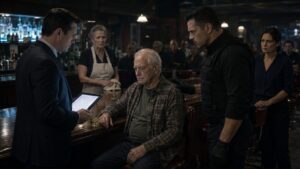
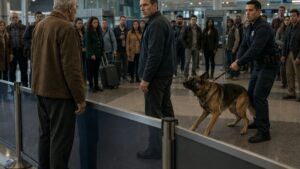
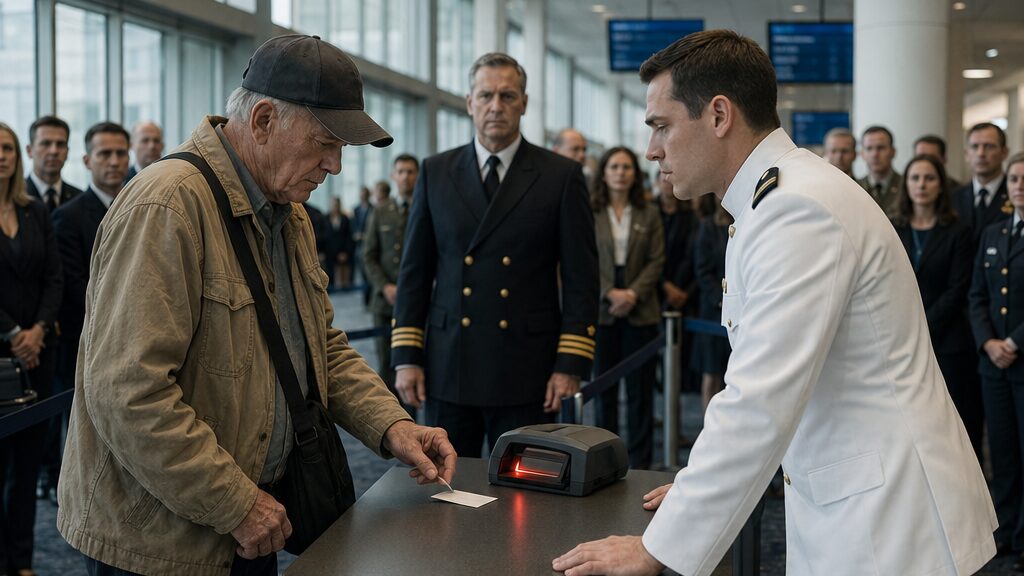
Samuel Harris heard it before he saw the red light blink on the small scanner mounted beside the checkpoint desk. The sound cut through the bright terminal corridor, sharper than the rolling luggage wheels, sharper than the announcements drifting from the ceiling speakers, sharper than the soft murmur of uniformed guests gathering near the rope line.
He kept his hand still.
The card lay between his fingers, plain and thin, its corners softened from being taken in and out of his breast pocket too many times. His name had been typed on it in uneven black letters. No photograph. No barcode. No shining seal. Just a visitor number, a date, and a little printed line that had once seemed official enough when it arrived in the mail.
The young officer behind the checkpoint looked down at the scanner, then up at Samuel.
“Sir, this pass isn’t valid.”
Samuel nodded once, as if the words had been expected.
The officer wore a white dress uniform so clean it seemed to hold the terminal lights on its sleeves. His shoes were polished black. His cap sat square under one arm. A nameplate read CLARK, and above it his face was tight with the kind of alertness Samuel remembered from men who had been given responsibility and not yet learned what to do with it.
“My name is Samuel Harris,” Samuel said quietly. “I’m on the invitation list.”
The officer took the card again between two fingers and turned it over. Samuel watched the motion more closely than he meant to. His right hand moved toward the counter and stopped.
“Invitation list is digital,” Tyler Clark said. “This doesn’t have a scan code.”
“It came by mail.”
“That’s not how today’s access works.”
Behind Samuel, a woman with a rolling suitcase slowed, glanced at his tan jacket, and then looked past him toward the rows of sailors and guests near the glass wall. A pair of young enlisted personnel stood together by the blue overhead monitors. One of them stopped talking. Samuel could feel the stillness beginning to gather, as it always did when one person was being corrected in public and everyone else was deciding how much to watch.
He adjusted the strap of his black shoulder bag. The strap had cut a faint groove across his jacket during the bus ride in. The bag was heavier than it looked.
“There’s a number on the back,” Samuel said. “They told me to call that if there was trouble.”
Tyler flipped the card over. Samuel’s fingers tightened on the bag strap.
The back of the card had a printed phone number, faded from his thumb. Beneath it, in Samuel’s own careful hand, were words Tyler could not have understood from where he stood. Tyler did not read them long. He made a breathy sound through his nose and set the card down.
“Sir, I can’t let people through a controlled corridor because they bring a piece of paper with a phone number on it.”
Samuel looked past him.
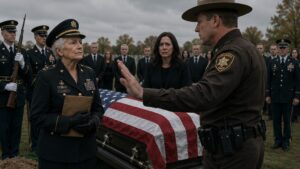
Beyond the checkpoint, the corridor opened into a smaller ceremonial area. A dark blue banner hung near the entrance. He could only see part of it from where he stood: DEDICATION, SERVICE, MEMORY. Folding chairs had been arranged in neat rows. A table near the front held programs in cream-colored stacks. He had seen enough.
“I’m not asking for special handling,” Samuel said. “Just the call.”
Tyler’s jaw moved. He leaned forward, and the distance between them narrowed in a way that made Samuel’s shoulders remember other crowded rooms, other counters, other men who thought volume made truth.
“Sir, step aside. You’re holding up invited guests.”
The words were not shouted. They did not have to be. They carried.
A man in a dark uniform near the rope line turned. Two guests with program envelopes in their hands paused behind Samuel. The young enlisted personnel no longer pretended not to listen. Samuel felt the heat of attention move across the back of his neck.
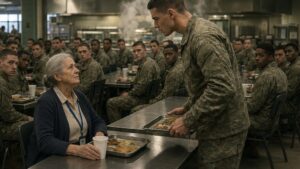
He glanced down at himself as if from someone else’s eyes. The tan jacket, brushed clean but worn at the elbows. The dark cap, plain except for old sun fading. The black shoes, polished that morning but creased at the toes. The shoulder bag that had been repaired twice at the same seam. He did not look like the men in framed photographs. He did not look like the guests who had arrived in pressed suits with printed invitations and parking passes.
Tyler held out the card.
“You may be at the wrong event,” he said.
Samuel did not take it.
The card remained in Tyler’s hand, exposed under the terminal lights. A small object. A useless object, maybe, to anyone who did not know why it had crossed three states in an envelope, why Samuel had placed it under a dictionary overnight to keep it flat, why he had checked its pocket four times before leaving home.
“I’m not at the wrong event,” Samuel said.
His voice was so even that it made Tyler frown.
“Sir, I need you to lower the attitude.”
Samuel looked at him then. Not sharply. Not with anger. Just directly enough that Tyler seemed to mistake the steadiness for defiance.
The officer leaned closer.
“I have a ceremony starting in less than an hour,” Tyler said, louder now. “I have families, active-duty personnel, senior staff, and invited survivors coming through this corridor. I cannot stop every time someone walks up with an old card and a story.”
A small silence followed.
Samuel heard the word old more clearly than the rest.
A younger man somewhere behind him gave an uncomfortable cough. The woman with the suitcase shifted her handle from one hand to the other. The terminal announcement overhead blurred into a soft metallic echo.
Samuel reached for the card. Tyler placed it on the counter instead, flat beneath his palm.
That did it.
Not the doubt. Not the impatience. Not even the word old. It was Tyler’s hand covering the card, pressing it down as if it were scrap paper waiting to be thrown away.
Samuel placed his own hand on the counter beside it. The skin across his knuckles had thinned with age, and one finger did not straighten all the way anymore. He did not touch Tyler. He did not raise his voice.
“Please don’t put your hand on that.”
Tyler looked at Samuel’s hand, then at his face.
“Sir, step away from the checkpoint.”
Samuel stood still.
For one sharp second, he almost did as he was told. He could turn, take his bag, ride the bus back, tell Virginia the pass had not worked, put the card in the top drawer where he kept things he did not look at unless the weather was bad. He could leave the ceremony to its clean programs and correct badges. He could let the name remain where it had been for too many years: folded, carried, and unheard.
Then his thumb found the edge of the bag strap. The weight of the bag steadied him.
“I will step aside,” Samuel said. “But I won’t leave until someone calls the number.”
Tyler’s eyes hardened.
“You don’t get to dictate procedure here.”
“No,” Samuel said. “I know.”
Something in that answer seemed to irritate Tyler more than argument would have. He lifted the card and held it toward Samuel, not gently.
“You need to understand something. Wearing a cap and carrying an old piece of paper does not grant access to a secure military event.”
The corridor seemed to contract around the words.
Samuel took the card between two fingers. He wanted to check the back, but he did not. Not in front of them. Not while Tyler’s voice still hung in the air.
A dark-uniformed officer stepped away from the rope line.
Samuel noticed him only because the watching faces shifted. The man was taller than Tyler, older by two decades, with a controlled expression that did not hurry and did not soften. He crossed the carpeted strip between the waiting guests and the checkpoint with the kind of quiet that made room for itself.
Tyler saw him and straightened.
“Commander Moore,” Tyler said. “I’m handling a bad credential.”
Joseph Moore did not look at Tyler first. He looked at the card in Samuel’s hand.
Then he looked at Samuel’s face.
“May I see that, sir?”
Samuel hesitated. The title landed differently from Tyler’s. Not because it proved anything. Because it asked.
He placed the card flat on the counter, turning it carefully so Joseph could read it without touching the handwritten line on the back.
Joseph leaned close.
The polished hallway, the waiting guests, the blue monitors, the white uniform beside him—all of it seemed to hold its breath.
Tyler reached toward the card as if to explain.
Joseph’s hand came down between Tyler’s fingers and the counter.
“Don’t touch that card again.”
Chapter 2: The Man In The Tan Jacket
Joseph Moore did not say the words loudly, but Tyler’s hand stopped as if the counter had become hot.
For a moment no one moved. Samuel kept his eyes on the plain white card because looking at faces would make the moment larger than he wanted it to be. He had not come to make a young officer look small. He had not come to gather witnesses. He had come because an envelope had arrived with the wrong kind of hope inside it, and because he had promised himself, after three nights of not sleeping, that he would at least try.
Joseph turned the card over by its edges.
Samuel watched his fingers. Careful fingers. That mattered more than Joseph knew.
“This was mailed from the dedication office?” Joseph asked.
“Yes.”
“When did you receive it?”
“Eleven days ago.”
Tyler cleared his throat. “Commander, it’s not in the current access system. The guest list moved to digital verification last week. We were told not to accept—”
Joseph raised one hand, not sharply, but enough.
“Mr. Harris,” he said, “would you come with me for a moment?”
Samuel slipped the card back into his fingers before Joseph could offer it. The old instinct rose in him: keep the important thing where you can feel it. He placed it in his shirt pocket and pressed it once through the fabric.
“I can wait here,” Samuel said.
“I’d prefer you didn’t.”
That drew Tyler’s eyes downward.
Joseph guided Samuel to a side waiting area near a row of tall windows. The terminal opened there into a quieter pocket, separated from the checkpoint by a waist-high barrier and a line of potted plants. Beyond the glass, service vehicles moved slowly across the tarmac. Their yellow lights blinked without urgency.
Samuel lowered himself into a chair by the wall, keeping the shoulder bag between his shoes. Joseph remained standing until Samuel sat, then took the chair beside him instead of across from him.
The choice did not escape Samuel.
“I apologize for the confusion,” Joseph said.
Samuel looked at the corridor. Tyler was speaking quietly to the terminal security clerk now, his white uniform bright against the blue monitor light.
“Confusion is common in terminals,” Samuel said.
Joseph studied him for half a second. “That was more than confusion.”
Samuel gave no answer.
“I’m Joseph Moore,” the officer said. “I’m overseeing the dedication today.”
“I figured you had something to do with it.”
“You were invited as a surviving member of the operations group?”
Samuel took the card from his pocket and held it in his lap, faceup.
“I was invited because I wrote a letter.”
Joseph waited.
Samuel rubbed his thumb once along the lower edge of the card. “The first letter came back. The second went to a different office. The third got answered by a woman who said she’d look again. Then this came.”
“The access card.”
“Yes.”
“And the issue is the card?”
Samuel turned it over, but not far enough for Joseph to see the writing. “The issue is the program.”
Joseph’s expression changed only slightly, but Samuel saw the change. Men who handled ceremonies learned how to keep their faces arranged. Samuel had spent years reading small movements across mess tables, loading rooms, and late-night offices where bad news was never delivered all at once.
Joseph lowered his voice.
“What about the program?”
“There’s a name missing.”
The words had sat inside Samuel for so long that hearing them in the terminal made them sound too plain.
Joseph leaned back. Outside the window, a service cart pulled away from the curb. “The printed program was verified against the final memorial list.”
“I know what lists can do.”
Samuel had not meant to say it that way. The sentence came out with an old edge, not loud but worn thin.
Joseph let it settle.
Samuel looked toward the ceremony entrance. Guests were beginning to collect cream-colored programs from the table. He saw a man in a suit open one, scan the names, then fold it neatly. A woman touched the sleeve of someone beside her. A young sailor laughed softly, then stopped when a senior officer passed.
“You have the missing name?” Joseph asked.
Samuel nodded.
“May I see it?”
Samuel’s hand closed over the card. He heard Tyler’s voice again: an old card and a story.
Joseph did not reach for it.
That was why Samuel finally turned the card over.
The handwriting on the back had been done in blue ink, careful and narrow.
Jack Robinson. Logistics Support. Service number.
Below it, in smaller letters, Samuel had written the date of the evacuation and the name of the terminal as it had been known then, before renovations, before glass walls and scanners and blue digital screens. The ink had smudged slightly at the final digit where his hand had trembled.
Joseph read without speaking.
Samuel watched his face and hated that he needed to.
“Jack Robinson,” Joseph said.
Samuel looked at the card.
“They put him under another Robinson,” he said. “Different middle initial. Different unit. The woman on the phone said it might just be an administrative merge. That was the phrase. Administrative merge.”
Joseph’s jaw tightened.
Samuel almost smiled, but it would not have been kind. “A man can live his whole life and get turned into an administrative merge after he’s gone.”
Joseph looked toward the ceremony room.
“Mr. Harris, if this is accurate, I need to take it to the coordinator immediately.”
“It is accurate.”
“I didn’t mean—”
“I know.”
The two words carried less forgiveness than Samuel intended.
Joseph folded his hands. “I can bring you inside now. I’ll seat you near the front. We’ll make sure you’re treated properly from here.”
Samuel looked at him then.
“That’s not what I need.”
Joseph paused.
“I don’t need a front seat because a young man got embarrassed,” Samuel said. “I don’t need anyone whispering over me. I don’t need a special escort.”
“You were publicly disrespected.”
Samuel looked down at his jacket sleeve, at the worn thread near the cuff. “That happens when you get old. People think they’ve discovered something true about you because your coat is tired.”
Joseph did not interrupt.
Samuel slipped the card halfway back into his pocket, then stopped.
“I need to know if the name can be changed before they read it.”
Joseph’s eyes moved toward the stack of programs at the ceremony entrance. The cream covers were already being placed into hands. A public affairs assistant was aligning a microphone. The ceremony coordinator stood near the podium with a tablet, touching the screen with quick, anxious movements.
“The printed programs are already out,” Joseph said.
“I’m not asking about the paper.”
Joseph turned back.
Samuel’s voice stayed low. “I’m asking about the room.”
The older officer seemed to understand. Not fully, but enough to make him stand.
“I’ll check.”
Samuel nodded.
Joseph took one step, then looked back. “Mr. Harris, I may need documentation beyond the card.”
Samuel touched the shoulder bag with the side of his shoe.
“I brought what I have.”
Joseph’s eyes dropped to the bag. “Letters?”
“And a photograph.”
“May I send someone to sit with you?”
“No.”
The answer came too quickly. Samuel softened it with a breath. “No, thank you.”
Joseph accepted that. He turned toward the ceremony entrance, his dark uniform cutting through the bright corridor.
Samuel remained by the window. He watched Tyler Clark glance toward him once from the checkpoint, then away. The young officer looked smaller from a distance, though not young enough to be excused by it.
Samuel drew the white card from his pocket again. He checked the back, just as he had done on the bus, in the kitchen, beside the bed at two in the morning.
Jack Robinson.
He pressed his thumb under the name.
Joseph returned ten minutes later with the ceremony coordinator at his side. The coordinator’s face held professional sympathy, which Samuel trusted less than impatience.
Joseph did not sit this time.
“Mr. Harris,” he said, “the ceremony program has already been locked.”
Chapter 3: Virginia Begged Him Not To Go
The night before, Virginia Harris had stood in Samuel’s kitchen with both hands around a mug of tea she had not touched.
“You don’t have to do this,” she said.
Samuel had been at the table with the white card in front of him, the black shoulder bag open on the chair beside him. The kitchen light hummed above them. Outside, rain tapped softly against the back steps, turning the small yard silver in the dark.
He had already laid out what he needed: the card, his reading glasses, two folded letters in a plastic sleeve, a worn photograph, his bus schedule, and the dark cap he wore when he did not want people asking whether he had served.
Virginia looked at the objects as if they were medicine he should not take.
“I said I’d go,” Samuel said.
“You said that before you knew it would be this kind of event.”
“What kind is that?”
“The kind with uniforms and speeches and people who don’t know what they’re asking from you.”
Samuel slid the card a fraction of an inch to align it with the edge of the table.
Virginia noticed. She always noticed small things when she was worried. She had inherited that from her mother, not from him. Her mother had been able to read the change in a room by the sound of one drawer closing.
“It’s a dedication,” Samuel said.
“It’s a memorial dedication at a military terminal where you haven’t been in years.”
“I’ve been in terminals.”
“Not that one.”
He did not answer.
Rain thickened against the window. The house was quiet except for the old refrigerator clicking on and off. Samuel’s jacket hung on the back of a chair. The tan fabric looked almost yellow under the kitchen light.
Virginia set down the mug.
“Dad, you stopped going to reunions. You stopped opening the newsletters. You wouldn’t even let me hang that certificate in the hallway after Mom passed.”
“It wasn’t a certificate worth hanging.”
“That’s not the point.”
“It usually is.”
She closed her eyes for a moment, gathering patience. She was not a girl anymore. Samuel knew that. She had gray at her temples now. But when she worried over him, he still saw the child who used to wait at the window when thunder came, pretending she was watching for birds.
“This isn’t about pride,” Virginia said. “I know that. But I also know what happens after you start looking through that bag.”
Samuel’s hand moved to the strap of the black shoulder bag.
He had bought it at a hardware store after the original sea bag became too stiff to use. It was plain and practical, with a zipper that caught near the corner. Inside were documents that had survived basements, moves, one leaking roof, and all the years when he had told himself paper was only paper.
Virginia reached into the bag before he could stop her, then paused.
“May I?”
He nodded once.
She took out the photograph first.
It showed two young men standing beside a terminal sign that no longer existed. One was Samuel, though the face seemed borrowed from a stranger: narrow, unsmiling, his hair dark under a cap. The other was Jack Robinson, grinning in a way that made the photograph feel warmer than the room in which it had been taken. Jack had one hand lifted as if he had been caught mid-joke.
Virginia had seen the photo before. Not often.
“He looks happy,” she said.
“He was tired.”
“He looks happy anyway.”
Samuel almost answered, then did not.
Virginia placed the photo carefully on the table. “Is this the name?”
Samuel looked at the white card.
“Yes.”
“And they left him out?”
“They merged him with someone else.”
“How does that happen?”
“Easily, if the person doing it never knew him.”
Virginia sat across from him. The tea between her hands had gone still.
“What happens if you don’t go?”
Samuel looked at the photograph. Jack’s grin stayed fixed in the old paper, unreasonable and young.
“The ceremony happens.”
“That isn’t what I asked.”
He took off his glasses and folded them.
“If I don’t go, they read what they have. People nod. Someone says all the right words. The missing part stays missing.”
Virginia’s voice softened. “And if you go?”
Samuel looked at the rain on the dark window.
“Maybe nothing changes.”
She reached across the table and touched the edge of the card, not covering it, only touching one corner. “Then why put yourself through it?”
Because Jack had been nineteen when he learned how to make frightened people laugh.
Because Jack had once given Samuel the last dry pair of socks in a flooded storage room and pretended not to be cold.
Because Jack’s mother had stood on a porch years later, holding Samuel’s letter with both hands, and asked in a voice that did not accuse him of surviving, “You’ll remember him, won’t you?”
Because remembering in private had begun to feel like hiding.
Samuel said none of that.
“I told somebody I would carry his name,” he said.
Virginia’s face changed. The argument left her slowly, not because she agreed, but because she had reached the place where love could no longer protect him without taking something from him.
“When did you promise that?”
“A long time ago.”
“To Jack?”
Samuel shook his head. “To his mother.”
Virginia looked down at the photograph again. “You never told me that.”
“No.”
“Why not?”
He rubbed his thumb along the frame of his glasses. “Some promises get smaller when you explain them too much.”
She let out a breath, almost a laugh but not quite. “That sounds like something you say when you don’t want to answer.”
“It can be both.”
For the first time that evening, she smiled. It did not last.
“Let me drive you.”
“The bus is easier.”
“It is not easier.”
“It lets me arrive alone.”
That hurt her. He saw it and hated that he had said the truth plainly enough to wound.
Virginia looked toward the hallway where her mother’s old coat still hung on the end hook because neither of them had ever been able to move it. “You don’t have to be alone for everything.”
“I know.”
“But you choose it.”
Samuel folded the bus schedule and placed it into the front pocket of the bag. “Tomorrow I need to.”
Morning came gray and cold. Virginia arrived before sunrise anyway, carrying coffee and a paper bag with two biscuits wrapped in foil. She found him already dressed in the tan jacket, the dark cap on the table, the white card inside his shirt pocket.
She did not argue again.
Instead, she checked the weather, tightened the loose button on his cuff, and stood beside him at the front door longer than necessary.
“When it gets too much,” she said, “you call me.”
“It won’t get too much.”
“Dad.”
He looked at her then.
She was not asking him to be strong. That was what made it hard.
“I’ll call,” he said.
At the bus stop, the morning wind pressed the jacket flat against his chest, and the card inside it gave a faint stiff edge against his ribs. He kept one hand on the shoulder bag. The photograph rested between the letters, inside the plastic sleeve, where rain and age could not reach it.
Now, sitting in the terminal waiting area with Joseph Moore’s words still hanging in the air, Samuel thought of Virginia’s untouched tea and the way she had looked at the photograph.
The ceremony program has already been locked.
He lowered his head and unzipped the shoulder bag.
The zipper caught at the corner, as it always did. He worked it loose with care. Beneath the bus schedule and the folded invitation envelope, beneath the plastic sleeve with the letters, the photograph waited.
Samuel drew it out just enough to see Jack Robinson’s face.
The terminal around him had changed. The sign in the old photograph was gone. The walls were glass now. The screens were blue. The young men wore different cuts of uniform, and the scanners made small, indifferent sounds at the entrance.
Jack still grinned from a place no renovation could reach.
Samuel touched the edge of the photograph with one finger.
“Jack Robinson,” he whispered.
Chapter 4: The Name Missing From The Program
Joseph Moore had overseen enough military ceremonies to know the difference between a mistake and a stain.
A mistake was a misspelled title caught before printing. A misplaced chair. A microphone battery that failed during rehearsal. A guest list entry that had not synced properly from one system to another.
A stain was quieter. It stayed beneath the polished surface until someone put a finger on it.
He carried Samuel Harris’s white card into the preparation room with more care than he would have admitted aloud. The room sat behind the dedication area, separated from the terminal corridor by a gray service door and a strip of carpet that had not been vacuumed as neatly as the public side. Inside, folding tables were crowded with program boxes, water bottles, cable ties, floral stands, and a tablet that kept lighting up with reminders.
The ceremony coordinator looked up as he entered.
“Commander, we’re six minutes behind on seating,” she said.
“I need the final name list.”
She blinked. “For the dedication?”
“For the memorial roll.”
“It’s in the program.”
“I need the source list.”
Her face tightened with the first sign of real concern. “Was there a family complaint?”
Joseph set the white card down on the table, faceup first. Samuel Harris. Visitor access. The plainness of it seemed almost accusing among the laminated schedules and embossed folders.
“Not a complaint,” Joseph said. “A correction.”
The coordinator drew the tablet toward her. “Corrections closed last week.”
He looked at her.
She stopped talking.
Outside the partially open door, the terminal carried on with its soft machinery of movement: rolling wheels, shoe soles on carpet, boarding announcements, the distant laughter of people who had arrived for something other than memory. Joseph could see part of the ceremony area through a gap in the door. Guests were filling the seats. A few older men and women had already settled near the front, some with canes, some with adult children beside them. Several younger service members stood along the wall, hands folded, eyes forward.
He thought of Samuel in the side waiting area, tan jacket zipped crookedly, black shoulder bag between his shoes, refusing a front seat as if comfort offered for the wrong reason would become another kind of insult.
The coordinator scrolled through the tablet. “What name?”
Joseph turned the card over.
“Jack Robinson.”
She typed it into the search field. One result appeared, then another. Her brow drew inward.
“We have a Robinson,” she said.
“Read it.”
She touched the screen. “Jack R. Robinson. Shore support attachment. Different date.”
Joseph leaned closer. The date did not match the one on Samuel’s card. Neither did the service number. The unit field had a note beside it: merged record, duplicate review completed.
“There,” she said, though her voice had lost certainty. “That may be the same person with inconsistent records.”
Joseph picked up Samuel’s card again. The handwriting on the back was small, but clear. Jack Robinson. Logistics Support. Service number. The old terminal name. The evacuation date.
“It is not the same person.”
“We don’t know that.”
“Mr. Harris does.”
The coordinator exhaled through her nose, not rudely, but with the pressure of someone watching a schedule crumble. “Commander, I understand this is sensitive. But the printed program has already gone out. The speaker script has been loaded. The roll call list is on the podium. If we change one name now, it raises questions about the whole verification process.”
Joseph looked at the stacked boxes beneath the table. Each one held programs printed on thick cream paper, sealed, delivered, arranged. Weeks of planning. Briefings. Approvals. The kind of work that made institutions feel orderly.
And still, somehow, a man had vanished into another man’s line.
“Then the process needs the question,” Joseph said.
The coordinator looked toward the door, lowering her voice. “Is the old gentleman the source?”
Joseph did not answer quickly enough.
She read his silence. “Commander, with respect, we need more than memory. If he has documents, we can submit a post-ceremony amendment. We can recognize the correction later.”
“Later where?”
“In the digital memorial archive. In the official record.”
“And today?”
She looked away.
Joseph knew the answer before she gave it.
“Today’s ceremony should proceed as approved.”
He picked up the card again. It was absurdly light. That was what unsettled him most. A life could become light in the hands of strangers. A name could weigh less than a lanyard, less than a tablet, less than a schedule running six minutes behind.
“Where did the merged record come from?” he asked.
The coordinator tapped through screens. “Old personnel import. Some handwritten records, some scanned copies. It looks like two Robinson entries were reviewed during consolidation.”
“By whom?”
“Records team. Not here.”
“Who approved it locally?”
She hesitated. “Public affairs confirmed against the memorial database.”
Joseph turned toward the ceremony area. A base public affairs assistant stood near the podium, testing the microphone with two fingers on the stand. The sound system gave a faint thump.
“Bring me the script,” Joseph said.
“Commander—”
“The roll call script.”
She left the room without another protest, but her shoulders carried all the arguments she was no longer making.
Joseph remained by the table.
He had built part of his career on the belief that order protected people. A secure corridor protected families from disruption. A schedule protected old guests from waiting. A script protected the ceremony from careless improvisation. He still believed those things.
But he also knew order could become a wall if no one asked who had been left outside.
The coordinator returned with a dark folder. She opened it to the memorial roll. Names, ranks, assignments, dates. Each line clean. Each pause marked. Joseph followed the list with his finger until he reached Robinson.
Jack R. Robinson.
Shore support attachment.
Wrong date.
Wrong unit.
A complete line. A false comfort.
The coordinator said softly, “It might be better not to put him through this publicly.”
Joseph looked at her.
“Mr. Harris,” she clarified. “If we can’t verify it in time, bringing him forward could embarrass him.”
Joseph thought of Tyler’s white sleeve, his hand covering the card, Samuel’s quiet request: I’m asking about the room.
“He has already been embarrassed,” Joseph said. “Publicly. By us.”
She accepted that without defending it, which made him respect her more.
A knock sounded on the open door. Tyler Clark stood in the hallway, cap tucked under one arm, posture stiff enough to seem rehearsed. His eyes flicked to the white card on the table and stayed there.
“Commander,” he said. “Security clerk said you asked for me.”
“I didn’t yet.”
Tyler swallowed. “Then I came because I thought I should.”
The coordinator gathered the folder and stepped aside, making herself busy with the tablet. Joseph did not invite Tyler fully into the room. He wanted him close enough to see the card, not close enough to hide behind procedure.
“Do you remember what you said at the checkpoint?” Joseph asked.
Tyler’s face tightened. “Yes, sir.”
“Which part?”
A flush rose from the collar of Tyler’s dress uniform. “I told him the credential wasn’t valid.”
“That was procedure. What else?”
Tyler looked toward the ceremony area. Guests were nearly seated now. A wheelchair attendant guided an elderly woman through the aisle. Samuel was not among them.
“I said he may have been at the wrong event,” Tyler said.
“And?”
Tyler’s jaw worked. “I said wearing a cap and carrying an old piece of paper didn’t grant access.”
The coordinator stopped typing.
Joseph picked up the card and turned it so Tyler could see the back. “That old piece of paper may be the only reason we know this ceremony is about to read the wrong name.”
Tyler looked down.
Joseph did not raise his voice. “Jack Robinson was not a duplicate. He was not an administrative merge. He was a separate sailor with a separate service number, and Mr. Harris appears to have carried that correction here himself because our system did not.”
Tyler stared at the handwritten lines.
“He didn’t say that,” Tyler said, but the sentence sounded weak even to him.
“He asked you to call the number.”
Tyler said nothing.
Joseph set the card down again. “He also asked you not to put your hand on it.”
Color left Tyler’s face in a slow, visible way.
From the ceremony room came a short burst of feedback, then a voice apologizing into the microphone. Guests laughed politely.
Joseph looked past Tyler toward the terminal windows. In the side waiting area, Samuel Harris sat alone. The black shoulder bag rested between his shoes. His head was bowed, and one hand held the edge of an old photograph.
The sight lodged somewhere Joseph did not have a name for.
He had wanted to prevent an incident. He understood now that the incident had already happened. The only question was whether the institution would call it resolved because the corridor had gone quiet.
Tyler followed Joseph’s gaze.
“Is he leaving?” Tyler asked.
Joseph did not know.
The coordinator checked the time and whispered, “Commander, we start in twelve minutes.”
Joseph took the roll call script from her and folded Samuel’s white card inside the front cover, not to hide it, but to keep it from being lost among the paperwork.
“Find out whether Mr. Harris is still willing to come inside,” he said.
Tyler looked at him. “Me?”
Joseph held his eyes. “You should know whether the old man you embarrassed may be the only reason this ceremony can still be made honest.”
Chapter 5: Tyler Clark Could Not Take Back His Voice
Tyler Clark had been trained to project.
He had been trained to make instructions clear in crowded spaces, to keep lines moving, to separate confusion from threat, to avoid hesitation when guests looked to him for order. At twenty-nine, he had learned that a uniform could steady a room if the person wearing it seemed certain enough.
No one had trained him for the sound of his own voice after it was too late.
Wearing a cap and carrying an old piece of paper does not grant access to a secure military event.
The sentence replayed as he walked away from the preparation room. It followed the rhythm of his steps. Secure. Military. Event. Each word now seemed polished and empty, like something a man said when he wanted everyone nearby to know he was in charge.
The terminal windows threw afternoon light across the carpet in long pale rectangles. Outside, baggage carts moved beyond the glass. Inside, the dedication area had softened into ceremony hush. Guests were being guided to chairs. A young enlisted person offered programs at the entrance. Near the checkpoint, the scanner gave another quick beep, green this time, and a guest passed through without looking up.
Tyler stopped at Joseph Moore’s temporary desk near the side corridor.
The white card was not there anymore. Joseph had taken it with the script. But the image of it remained too clear: Samuel Harris’s name typed unevenly, the handwritten back, the careful pressure of blue ink. Tyler had handled it as if it were an inconvenience. Worse, as if the man attached to it were an inconvenience.
He looked down at his own hands.
Clean nails. No tremor. White cuffs. Gold buttons. Everything arranged.
Samuel’s hands had been thin and steady beside the card. Not weak. Tyler understood that now and hated that the understanding had come late.
“Lieutenant?”
The terminal security clerk stood near the checkpoint, holding a tablet. “Do you still want me to flag paper credentials?”
Tyler opened his mouth to say yes automatically.
Then he saw, beyond the clerk’s shoulder, an elderly man with a cane approaching the general seating entrance. The man wore a sport coat a size too large and had his invitation folded in half. A young sailor moved toward him quickly, ready to redirect him.
Tyler heard himself from before: Step aside. Holding up invited guests.
“No,” Tyler said.
The clerk looked uncertain. “No?”
“Not like that.” Tyler took the tablet and adjusted the note on the access page. “If a paper credential doesn’t scan, seat the guest in the waiting area and call the listed contact. Quietly. No public challenge unless there’s a security concern.”
The clerk nodded slowly. “Yes, sir.”
Tyler handed back the tablet. It was a small correction, and he disliked how small it felt. A man had been humiliated in front of half the corridor, and Tyler had changed a line on a tablet.
He walked toward the side waiting area.
Samuel Harris was not in the chair by the window.
For one second Tyler felt relief so sharp it nearly became gratitude. If Samuel had left, Tyler would not have to face him. He could report it to Joseph, regret it privately, carry the shame into the next briefing, improve next time. The institution would move on because institutions were very good at moving on.
Then he saw the black shoulder bag.
It rested on the chair Samuel had used, zipped closed, strap looped over the arm as if placed there deliberately. Beside it lay the old photograph, face down.
Tyler stopped.
A wheelchair attendant approached from the corridor. “Sir, is this someone’s bag?”
“Yes,” Tyler said too quickly. “Don’t touch it.”
The attendant stepped back.
Tyler looked around. The restroom entrance stood across the small waiting area. A water fountain gleamed beneath the window. Samuel was not visible.
He had told Samuel not to dictate procedure. Now he stood frozen because an old man’s bag had been left unattended in a terminal and every rule in Tyler’s head had begun shouting at once.
Unattended bag. Secure corridor. Public event.
But the bag had a person now. A person he had already misread.
Tyler moved closer without touching it. The zipper was closed. The worn seam near the corner had been repaired by hand with black thread. The strap was frayed where a shoulder would rub it smooth over years.
The photograph lay partly under the strap. Tyler crouched and turned it over by the edge.
Two young men looked back at him from another time. One, he realized after a moment, was Samuel Harris, though the face was almost impossible to reconcile with the man in the tan jacket. The other young man grinned as if the photographer had just missed the best part of a joke.
On the back, in the same narrow handwriting as the card, were two names.
Samuel Harris. Jack Robinson.
Tyler set it back exactly where it had been.
The restroom door opened. Samuel stepped out slowly, one hand braced against the wall for only a moment before he saw Tyler and straightened.
His eyes went first to the bag.
“I didn’t touch it,” Tyler said.
Samuel walked over and lifted the strap from the chair. He checked the photograph with a glance, then slid it into the front pocket.
Tyler stood with his cap under his arm. The apology he had shaped on the walk over seemed too polished now, too much like a report.
“Mr. Harris,” he said. “Commander Moore asked me to see if you’re still willing to come inside.”
Samuel zipped the bag.
“Did he.”
“Yes, sir.”
Samuel looked toward the ceremony entrance. Music had begun inside, low and instrumental. The sound reached the waiting area softened by the carpet and the bodies settling into chairs.
Tyler waited for Samuel to move.
Samuel did not.
“Mr. Harris, I owe you an apology.”
Samuel’s hand stilled on the bag strap.
Tyler felt his throat tighten, which angered him because it was not his right to be overcome. “The way I spoke to you was wrong. I made assumptions. I handled your card carelessly. I embarrassed you.”
Samuel watched him without helping.
Tyler forced himself not to fill the silence too quickly.
“I was trying to keep the event secure,” he said, then stopped. The explanation had come out like a shield. He lowered it. “That doesn’t excuse it.”
Samuel looked at the white corridor beyond him. “No. It doesn’t.”
The answer landed cleanly.
Tyler nodded once. He deserved that.
“I’m sorry,” he said.
Samuel slipped the bag strap over his shoulder. “Are they going to read the name?”
Tyler had expected anger, maybe refusal, maybe the hard dignity of a man who would make him stand there and feel every second of what he had done. The question caught him unprepared.
“Commander Moore is working on it.”
“That wasn’t what I asked.”
Tyler looked down.
“I don’t know,” he said. “The program was already locked.”
Samuel gave the smallest nod, as if he had known that answer before Tyler spoke.
The music inside shifted. A voice at the podium welcomed guests to take their seats.
Tyler glanced toward the room. “They’re about to begin.”
Samuel looked at the entrance, then at the terminal windows. Light moved over his face, showing age without weakening it. Tyler understood suddenly that Samuel was deciding whether to leave, and that no apology from him could carry enough weight to stop it.
“Mr. Harris,” Tyler said, “if you go, I’ll tell Commander Moore.”
Samuel looked at him.
Tyler heard how useless that sounded.
He tried again. “If you stay, I’ll make sure no one stops you.”
Samuel’s mouth tightened, not quite a smile. “That is a low bar, Lieutenant.”
“Yes, sir.”
The old man’s eyes returned to the ceremony entrance. For a moment Tyler thought he would turn away. Instead, Samuel reached into his shirt pocket and touched the space where the white card had been before Joseph took it.
“I didn’t come for the seat,” Samuel said.
“I know that now.”
Samuel studied him. “Knowing late is still knowing, if you do something with it.”
Tyler felt the sentence settle into him with more force than rebuke.
The ceremony coordinator appeared at the doorway, scanning the waiting area. When she saw Samuel, relief crossed her face, followed by embarrassment at showing it.
“Mr. Harris,” she said, “we have a place ready for you.”
Samuel picked up his bag. “By the wall, if there is one.”
“Sir, we can seat you closer.”
“By the wall.”
The coordinator looked at Tyler, unsure.
Tyler stepped aside. “By the wall,” he said.
Samuel walked past him toward the ceremony entrance. His steps were measured, not slow enough to invite help, not fast enough to pretend the morning had not taken something from him.
Tyler remained near the windows until Samuel disappeared inside.
Then the terminal security clerk hurried over, keeping his voice low. “Lieutenant, Commander Moore wants you near the entrance.”
Tyler nodded.
The clerk added, “He said Mr. Harris might leave before the ceremony begins.”
Tyler looked into the room, where Samuel’s tan jacket had just become visible beside the wall.
“No,” Tyler said softly. “He stayed.”
But he was no longer sure that staying meant he had forgiven any of them.
Chapter 6: Samuel Chose The Seat By The Wall
Samuel chose the seat where he could see the door.
The ceremony coordinator tried twice to guide him toward the front row, where a folded card marked RESERVED had been placed on an aisle chair. Samuel shook his head both times. Not rudely. Not with explanation. He simply moved toward the wall and sat in the last chair of the third row, near a framed photograph of the terminal before its renovations.
The picture showed lower ceilings, older signage, darker floors. It was not the same photograph Samuel carried, but it was close enough to make his chest tighten. The old terminal had been less clean, less bright. It had smelled of coffee, fuel, wet wool, and floor wax. People had still gotten lost in it. People had still waited for names to be called.
His black shoulder bag rested against his left foot. The cream-colored program lay on his lap. He did not open it at first.
Around him, guests settled into their own silences. A woman in a dark dress unfolded a tissue before anything had begun. A man with a cane adjusted his hearing aid. Two young sailors stood near the back wall, eyes moving over the room with solemn curiosity, as if trying to borrow gravity from the occasion.
Tyler Clark took a position near the entrance.
Samuel did not look at him long.
At the front, Joseph Moore stood beside the podium with the dark folder in one hand. He seemed composed, but Samuel noticed the way his thumb pressed against the folder’s spine. Pressure. Decision. Maybe disagreement still happening under the surface.
The ceremony began with welcome remarks from the base public affairs assistant. Her voice was clear and careful. She spoke of service, sacrifice, continuity, and memory. The words were not wrong. That made them harder to listen to. Wrong words could be dismissed. Right words, spoken around an absence, became something else.
Samuel opened the program.
The paper was thick. Cream-colored. Elegant. The memorial roll had been printed in two neat columns. He moved down the names slowly, though he already knew what he would find. He stopped at Robinson.
Jack R. Robinson.
Different unit.
Different date.
He closed the program.
In his shirt pocket, the white card was gone because Joseph had taken it with the script. Samuel felt its absence as a physical thing. For most of the morning, he had resented how much he needed that small rectangle. Now his pocket felt too soft without it, as though a brace had been removed.
He slid one hand into the black shoulder bag instead and found the plastic sleeve.
The letters were folded inside, fragile at the creases. He did not take them out. He touched the sleeve through the fabric and let memory do what paper could not.
Jack’s mother had lived in a narrow white house with a porch that sagged at one corner. Samuel had gone there after the official letter, after the officers, after the language no mother should have to hear from men trained to stand straight while saying it. He had gone because Jack had once said, If anything happens, don’t let my mama think I was scared the whole time.
Samuel had been twenty-three. Too young to carry such a sentence, old enough to know he had no right to put it down.
She had served him coffee he did not drink. She had held his letter in both hands. When she asked whether Jack had suffered, Samuel told her the truth he could bear to give: that Jack had not been alone. That he had helped others first. That people remembered him.
Then she had asked, “You’ll remember him, won’t you?”
Samuel had said yes.
At twenty-three, yes had seemed like a word he could carry.
At seventy-eight, it had become a weight that shaped the way he stood.
The public affairs assistant introduced Joseph. He stepped to the podium, placed the dark folder down, and looked over the room. His eyes found Samuel near the wall.
Samuel did not nod.
Joseph began with measured remarks about the terminal’s history. The site had served as an arrival point, a departure point, a waiting place, and, at times, a place where families received news that changed everything. He spoke better than Samuel expected. Not beautifully. Carefully. That counted for more.
Still, the program remained unchanged in Samuel’s lap.
When Joseph mentioned the memorial archive, the ceremony coordinator shifted near the side table. Tyler stood straighter by the entrance. Samuel noticed both movements and understood there had been discussions he would never hear.
A speaker followed Joseph. Then another. The room moved through its order: welcome, history, dedication, moment of silence. Each piece fit. Each transition was smooth. The institution knew how to make grief presentable.
Samuel watched the young sailors along the wall. One of them looked no older than Jack had been in the photograph. He wondered whether the young man had called home that morning. He wondered whether his mother knew how polished his shoes were.
The final portion began with Joseph returning to the podium.
“We will now read the memorial roll,” he said.
Samuel’s fingers closed around the program.
The first names were read slowly, each followed by a pause. The room accepted them one by one. A few guests bowed their heads. Someone near the front quietly cried. There was no drama in it, only the steady placing of names into shared air.
Samuel tried to listen properly.
He owed that to the others.
But as the list moved closer to Robinson, his body began to betray him. His breath shortened. His right knee ached from holding still. His hand tightened so much the program bent along the spine.
He thought of leaving.
The thought came cleanly, without panic. He could stand before the wrong name was read. He could walk out through the side door, past Tyler, past the scanner, past the bright windows. He could take the bus home. Virginia would see his face and not ask immediately. Later, he would put the white card and the program in the drawer. Jack’s name would remain in his handwriting, which had been enough for many years.
Joseph read another name.
Then another.
Samuel looked down at the printed program. Jack R. Robinson waited in the second column.
He heard Virginia’s voice from the kitchen: You don’t have to be alone for everything.
He heard Jack’s mother: You’ll remember him, won’t you?
He heard Tyler: An old piece of paper.
And he understood, with a sadness that settled rather than struck, that silence could be dignity in one moment and surrender in the next. At the checkpoint, silence had kept him from answering disrespect with disrespect. Here, silence would protect the room from discomfort at the cost of the truth.
Joseph reached the Robinson line.
He paused.
It was a small pause. Most people might have missed it. Samuel did not.
Joseph looked toward the wall.
The room waited.
Samuel felt for the white card that was no longer in his pocket, then placed both hands on the arms of his chair.
His knees resisted him. The chair gave a faint scrape against the floor.
A few heads turned.
Tyler Clark looked over from the entrance.
Samuel stood.
Chapter 7: He Asked Them To Read The Name
Samuel did not stand quickly.
The room gave him time because it did not know what else to do. Chairs creaked softly as people turned. A woman near the front lowered her tissue. One of the young sailors along the wall shifted his weight, then froze when Tyler Clark lifted one hand just enough to keep him from moving.
At the podium, Joseph Moore kept his finger on the line in the script.
Samuel felt every inch between his chair and the front of the room. It was not a long distance. Twelve steps, maybe fifteen if he favored the knee. But the aisle looked longer from the wall, with faces on both sides and the program bent in his left hand.
He did not walk forward.
He stood beside his chair and looked at Joseph.
“That is not the man,” Samuel said.
His voice was quiet. The microphone did not catch it. The people nearest him heard, and the words traveled in the old way, by attention.
Joseph closed the folder.
The ceremony coordinator took one small step from the side table, alarm and sympathy fighting across her face. Samuel saw the decision forming in her: interrupt, smooth, protect the ceremony. Tyler saw it too. He moved before she could.
“Ma’am,” Tyler said under his breath, “wait.”
She looked at him, startled.
Samuel held the program open now, the page trembling slightly despite his effort. “The name printed there belongs to another record.”
Joseph’s eyes did not leave him. “Mr. Harris,” he said, “would you come forward?”
The room shifted again.
Samuel almost sat back down.
The invitation to come forward was kind, but kindness could become a spotlight. He had not wanted the front row. He had not wanted an introduction. He had not wanted strangers to look at his jacket and then at his face, searching for a story they could understand quickly enough to feel good about themselves.
His hand moved to his shirt pocket.
Empty.
Then Joseph reached into the front cover of the dark folder and lifted the white card.
The sight of it steadied Samuel more than the chair had. Plain. Small. Slightly bowed at the corners. The thing that had failed at the scanner, the thing Tyler had covered with his palm, now rested in Joseph Moore’s hand at the podium.
Samuel started down the aisle.
No one applauded. No one spoke. The silence was not the empty kind. It made space.
His steps sounded too loud to him. The black shoulder bag brushed against his hip. When he reached the front, Joseph stepped away from the microphone, offering him room.
Samuel shook his head.
“I don’t need to speak into that.”
Joseph understood. He lowered the microphone slightly anyway, not toward Samuel’s mouth, but toward the space between them.
Samuel looked at the card. “May I?”
Joseph handed it to him.
This time, no one touched the card except Samuel.
He turned it over. His thumb rested beneath Jack Robinson’s name. The ink looked smaller than it had in his kitchen, smaller than it had in the terminal waiting area, but still there. Still legible. Still refusing to be merged with the wrong man.
“The name on the program,” Samuel said, “is Jack R. Robinson from a shore support attachment. I do not know that man. I mean no disrespect to him.”
The room remained still.
Samuel looked at the card because the faces were too much.
“The man I came for was Jack Robinson. Logistics Support. Same last name. Different service number. Different date. Different life.”
Joseph stood beside him, the folder closed against his chest.
Samuel heard Virginia then, not as a memory of words but as the feeling of her standing in the kitchen, trying to protect him from this exact moment. He wished she were there. He was grateful she was not.
“He was nineteen,” Samuel said. “He laughed when he was tired. He gave away things he needed. When people panicked, he made them look at him first, because he knew if they looked at him, they could breathe. That does not fit in a database field.”
A few heads lowered.
Samuel stopped. He had said more than he intended. The room had grown heavier, and he did not want to use that heaviness against anyone.
He held the card out to Joseph.
“I am asking that his name be read. Correctly. Not because I carried it here. Because he had it before I did.”
Joseph took the card with both hands.
The gesture was small. It was not ceremonial. That was why it reached Samuel.
Joseph turned to the microphone. He did not explain the administrative error. He did not defend the process. He did not make Samuel into an honored surprise guest. He simply placed the card on the podium, looked down at the handwriting, and read.
“Jack Robinson. Logistics Support.”
He paused.
The room heard the name settle.
Joseph read the service number, then the date Samuel had written beneath it. His voice held steady, but the pause after the date was longer than the printed script required.
Samuel closed his eyes.
For years, Jack’s name had lived in drawers, envelopes, records requested and returned, conversations Samuel did not finish, and the back of a card because he had no better place to put it. Now it had entered the room. It had passed through another man’s mouth and been heard by people who had not known him. It was not everything. It did not repair the years. But it was not nothing.
When Samuel opened his eyes, Tyler Clark was standing near the entrance with his head lowered.
The ceremony continued after that, but differently. Not dramatically. No one rushed to make a speech. The public affairs assistant adjusted the order with quiet efficiency. Joseph read the remaining names. The moment of silence that followed seemed less polished than the one originally planned, and for that reason, more honest.
Afterward, people rose slowly. Some approached the front to look at the memorial display. Others remained seated, as if standing too soon would disturb something still unfinished.
Samuel slipped the white card back into his shirt pocket.
Joseph came to him near the wall.
“Mr. Harris,” he said, “the record will be corrected.”
Samuel nodded. “Good.”
“And the access procedure will be reviewed. Paper credentials, older guests, unscanned invitations. No one should have to argue for dignity at a checkpoint.”
Samuel looked toward the corridor. “Make sure it is not only reviewed.”
Joseph accepted the correction. “Changed.”
“That would be better.”
Joseph held out his hand.
Samuel looked at it for a moment, then shook it. Joseph’s grip was firm, careful, and brief.
“I’m sorry,” Joseph said.
Samuel did not ask which part he meant. There were too many possibilities, and some did not belong to Joseph.
“Thank you for reading the name,” Samuel said.
In the corridor, Tyler stood beside the rope line, speaking quietly to an elderly guest with a cane. The man’s paper invitation had been folded so many times the crease nearly split the center. Tyler did not take it from him. He bent slightly, read it where the man held it, and gestured toward a chair near the waiting area.
“I’ll call and confirm this for you, sir,” Tyler said. “You can sit while we do that.”
Samuel watched long enough to see the guest’s shoulders ease.
Then Tyler turned and saw him.
For a moment, the young officer looked as he had at the checkpoint: straight, formal, trapped inside the brightness of his own uniform. Then he walked over, stopped at a respectful distance, and removed his cap from under his arm.
“Mr. Harris,” Tyler said.
Samuel waited.
“I’m sorry,” Tyler said. “Not because Commander Moore corrected me. Not because the card mattered. I should not have needed to know what it meant to treat it carefully.”
Samuel looked at him for a long time.
Around them, the terminal resumed itself. Wheels rolled. Monitors changed. A boarding announcement called passengers toward a different gate. The world had no talent for holding still after private revelations.
“No,” Samuel said. “You should not have.”
Tyler nodded once, eyes lowered.
Samuel adjusted the strap of the black shoulder bag. “But you can learn it now.”
“I will.”
“That is not enough either.”
Tyler looked up.
Samuel’s voice stayed even. “You will have another old man at a counter. Or an old woman with the wrong paper. Someone slow. Someone tired. Someone who cannot explain quickly why the thing in their hand matters.” He touched the pocket where the card rested. “Do not make them earn patience by proving they deserve it.”
Tyler’s face changed then. Not with shame alone. Shame could fade into self-pity if left unattended. This looked more useful. It looked like weight.
“Yes, sir,” he said.
Samuel almost told him not to call him sir. Instead, he let the word stand, not as rank, not as victory, only as courtesy finally arriving without being forced.
He walked toward the main terminal exit.
At the glass doors, he paused and took out his phone. Virginia answered on the second ring.
“Dad?”
“It’s done,” Samuel said.
A long breath moved across the line. “Are you all right?”
He looked back once.
Joseph was speaking with the coordinator near the podium. Tyler was helping the elderly guest through the side entrance, one hand held near the man’s elbow but not touching unless asked. The white card rested against Samuel’s chest, no longer proof, no longer plea, simply something carried.
“No,” Samuel said gently. “But I’m better than I was.”
Virginia was quiet.
“They read his name,” he said.
Her voice softened. “Jack Robinson?”
Samuel looked through the glass at the buses moving along the curb.
“Yes,” he said. “Jack Robinson.”
He ended the call and stepped outside.
The afternoon air smelled of fuel, rain on pavement, and coffee from a cart near the curb. Samuel buttoned his tan jacket against the wind. The black shoulder bag hung lighter than it had that morning, though nothing had been removed from it.
At the bus stop, he took the white card from his pocket one last time.
The front still bore his own name, unevenly typed. The back still held Jack’s. Samuel ran his thumb beneath the blue ink, then returned the card to his pocket with the care of a man putting something where it belonged.
When the bus arrived, he climbed aboard slowly. The driver waited without comment.
Samuel took a seat by the window. As the terminal slid past, bright and glass-walled and full of people hurrying toward their own departures, he saw the entrance to the ceremonial corridor one final time.
A young officer in white stood there now, not blocking the way, but bending close to listen to an old man holding a folded paper.
Samuel faced forward.
Jack’s name was on the record.
The card was still in his pocket.
And for the first time in years, silence did not feel like the only way to keep a promise.
The story has ended.