The Old Man With the Brown Wallet Returned to the Jet They Told Him He Never Touched
Chapter 1: The Old Man Waiting Beside the Gray Jet
The gate security clerk looked at Ryan Carter’s card, then at Ryan’s face, then back at the card again as if one of them had to be a mistake.
Behind the glass, the morning sun flashed off the runway hard enough to make the small booth feel hotter than it was. Beyond the gate, past two rows of orange cones and a temporary sign for the open-house event, the gray jet sat with its nose pointed toward the empty sky. Its paint had faded since Ryan last saw it up close. The numbers on the tail looked clean now, ceremonial, no longer smudged with soot and handprints.
Ryan kept one hand on the counter and the other around the old brown wallet.
The wallet was not really a wallet anymore. Its corners had softened, the stitching had darkened, and the leather had taken the shape of everything it had carried too long. A faded white card showed from one inside fold. Ryan had placed it there that morning with fingers that took longer than they used to. He had not eaten much breakfast. He had checked the card twice before leaving the motel, then checked the folded note behind it once, though he knew every crease by feel.
“This is old,” the clerk said.
Ryan nodded.
“I mean, sir, this is very old.”
“I know.”
The clerk was young enough that his shave still looked fresh by accident. He wore a visitor-control badge on a blue lanyard and tapped Ryan’s card against the desk, not hard, but enough to make the brittle paper flex.
Ryan reached slightly toward it.
The clerk stopped tapping.
“I’m not trying to be difficult,” the clerk said. “We have an open-house list. Veterans’ groups, families, vendors, school guests, local press. Your name isn’t coming up.”
“It may not be.”
“Then who invited you?”
Ryan looked past him. A maintenance cart crossed the distant concrete, making a flat whining sound. Near the jet, two crewmen in green flight suits walked under the wing, their shoulders loose, their laughter carrying in the open air. One of them pointed at something on the aircraft’s belly, and Ryan’s eyes followed the gesture before he meant to.
A panel seam. Still there. Lower starboard side, aft of the forward gear.
His thumb pressed into the worn leather.
“An old friend,” he said.
The clerk waited for more. When none came, he glanced at the open-house binder. “Name?”
“Ryan Carter.”
The clerk dragged a finger down the printed list. Ryan could see the columns upside down. Sponsors. Demonstration pilots. Families of active personnel. Honored guests. The old names were not there. Most of them had never been on lists like that.
“No Carter,” the clerk said. “Could your friend have registered you under a group?”
“No.”
“Unit association?”
Ryan almost smiled. “Not anymore.”
The clerk shifted in his chair. He was trying to be patient. Ryan could see it and was grateful for it, though patience had a way of becoming pity if a man stood too long in the wrong place.
“Sir, the public entrance opens at ten. You can park in the south lot and come in with everyone else. There’ll be a rope line around the aircraft, but you can take pictures from the marked area.”
“I need to stand closer than the rope.”
The clerk’s expression changed by only a little. Procedure entered his eyes.
“That won’t be possible without clearance.”
Ryan placed the brown wallet flat on the counter. “That card used to be clearance.”
“Used to be is the problem.”
The clerk looked past Ryan at the truck idling behind him. The driver lifted both hands from the wheel, impatient. Ryan stepped slightly aside, though there was nowhere to go inside the narrow visitor lane. His left knee complained from the movement. He made no sound.
“I can wait,” Ryan said.
“That’s not really the issue.”
“It never is.”
The clerk did not know what to do with that, so he looked down again. Ryan could see the moment the young man decided not to argue with an old man at a gate before seven in the morning.
“I’ll call public affairs,” the clerk said. “Maybe they can sort it out.”
“Thank you.”
Ryan took his card back before the clerk could set it near the coffee ring on the desk. He slid it inside the brown wallet with care. The wallet closed with a tired bend, not a snap.
The clerk pointed toward a painted line beside the booth. “Pull over there and stay in the marked pedestrian area. Don’t approach the aircraft unless someone escorts you.”
Ryan nodded.
He walked slowly, not because he wanted to appear fragile, but because his body no longer trusted sudden movements on concrete. The base smelled of hot dust, cut grass, jet fuel, and something metallic that seemed to rise from the ground after sunrise. It was a smell he had not forgotten. It reached him before memory did.
A line of temporary flags snapped beside the visitor route. Volunteers were setting up folding tables. A museum display truck sat near the hangar, its side door open, framed photographs leaning against plastic crates. Someone tested a speaker, and a burst of feedback startled a child near the parking lot. Ryan turned toward the sound, then back toward the jet.
There it was.
Not exactly the same, of course. Nothing that survived long enough remained exactly itself. The aircraft wore fresh markings now, polished for the open-house crowd. Its canopy reflected the pale morning. The wheel chocks were painted bright yellow. A sign on a stand read RETIREMENT DISPLAY in large blue letters, with smaller text below that Ryan did not try to read from that distance.
He did not need the sign.
He had known the aircraft by the way its shadow fell.
Ryan stopped at the painted line, as instructed. He could have stood there until ten. He had stood longer in worse places. His right hand moved to the brown wallet inside his jacket pocket and found its edge. He did not take it out. Not yet.
A young woman in a public-affairs polo hurried across the concrete with a clipboard under one arm. Two enlisted workers carried a rolled banner behind her. Farther out, near the wing, the flight-suited crewmen had gathered around a young officer who stood with his helmet tucked under his arm. Ryan watched them laugh at something. The officer had the posture of a man used to being heard.
The gate clerk emerged from the booth and called out, “Sir?”
Ryan turned.
“They said someone will come over. Just stay here.”
“Who did you call?”
“Public affairs. Or operations. I’m not sure who they’re sending.”
Ryan nodded again.
The clerk softened his voice. “Were you stationed here?”
“A long time ago.”
“With that aircraft?”
Ryan looked toward the gray jet. The morning glare made the metal seem almost white at the edges.
“For a while.”
The clerk waited. Ryan did not continue.
A utility cart buzzed toward them from the flight-line side. The driver slowed near the booth, spoke briefly with the clerk, then stared at Ryan. Not rudely. Just long enough to measure the tan cap, the pale blue polo, the dark trousers, the worn shoes, the careful way Ryan held himself upright without asking for a chair.
“You’re the visitor with the old pass?” the driver asked.
“I’m Ryan Carter.”
“That’s not what I asked.”
“No,” Ryan said. “It isn’t.”
The driver looked annoyed, then uncertain, then pointed to the back of the cart. “Public affairs wants you brought over to the holding tent until they figure it out.”
Ryan looked at the jet again. The distance was not great. Maybe forty yards from where he stood to the rope line. Another twenty to the panel seam. In his younger days he would have crossed it without thinking.
“I can walk.”
“Sir, it’s easier if you ride.”
“I can walk,” Ryan repeated, and this time the driver heard the end of the conversation.
He walked beside the cart rather than behind it. The driver moved slowly enough to make it obvious he was slowing down for him. Ryan let him. Pride, he had learned, was not always refusing help. Sometimes it was refusing to become angry at help badly given.
As they approached the aircraft, more faces turned. The flight-suited men looked first with curiosity, then with amusement when they saw Ryan was not part of any official group. One of them murmured something. Another smiled into his hand.
Ryan kept his eyes on the gray jet.
Up close, the years became less kind. Fresh paint could not hide every old repair. A line of rivets dipped slightly where the skin had once been replaced. The lower access panel was clean, but Ryan knew where the edge could bite if a man rushed. He had cut his thumb there once. He could almost feel it.
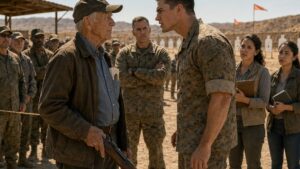
The young officer with the helmet stepped forward.
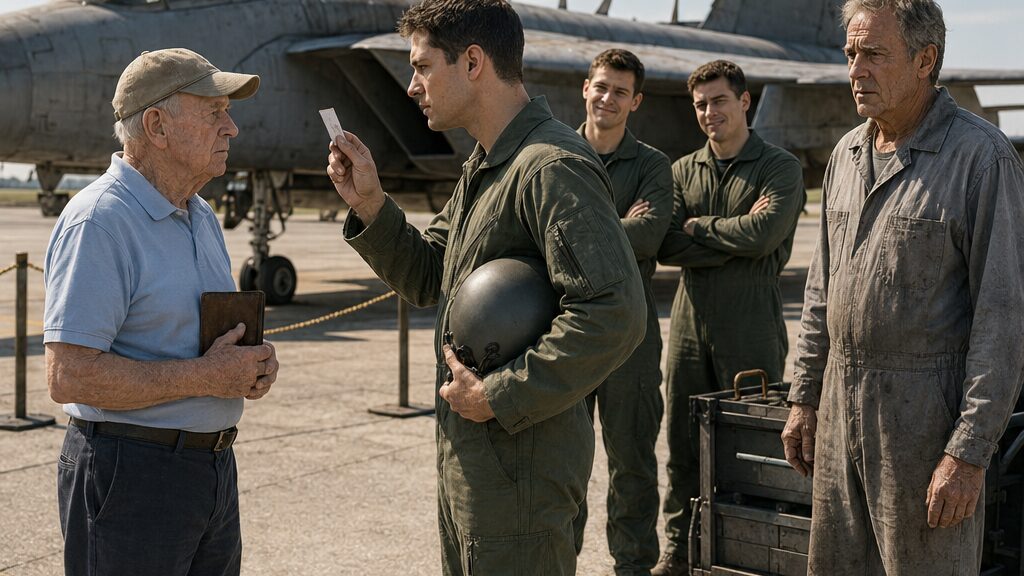
He was tall, square-jawed, clean in the way flight suits made young men look cleaner than they were. His name tape read YOUNG.
Matthew Young looked Ryan over, then looked at the driver.
“What’s this?”
The driver said, “Gate sent him in. Public affairs said holding tent.”
“I didn’t ask where he’s going. I asked what he’s doing on the line.”
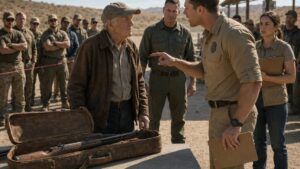
Ryan took the brown wallet from his jacket pocket. “I’m here to see that aircraft.”
Matthew’s eyes moved to the wallet, then back to Ryan’s face.
“The public viewing area opens later.”
“I was told someone could check my card.”
“Your card?”
Ryan opened the wallet. The white card sat in the fold like a thin old bone.
Matthew reached for it without asking.
Ryan’s hand tightened once, then released. The young officer pulled the card free and held it between two fingers.
Behind him, the two flight crew observers stepped closer.
Matthew read the card. His mouth bent, not quite a smile.
“Sir,” he said, “who let you onto my flight line?”
Chapter 2: The Card They Laughed At in the Sun
For a moment, Ryan heard only the wind moving under the wing.
It came low across the concrete, carrying the smell of fuel and sun-warmed rubber. The old white card trembled between Matthew Young’s fingers. Ryan watched the corner bend and wanted, with a force that surprised him, to reach out and flatten it with his thumb.
He did not.
Matthew turned the card toward one of the young crewmen behind him. “You ever seen one of these?”
The crewman leaned in. “Is that paper?”
“It’s older than half the people on this line.”
The other crewman laughed under his breath.
Ryan stood with the open brown wallet in his palm. Without the card in it, the wallet looked exposed, like a mouth missing a tooth. The folded note remained hidden behind the inner flap. He kept his thumb over that place.
Matthew looked back at him. “Mr. Carter, this isn’t valid. Whatever this got you into before, it doesn’t get you near an aircraft today.”
“That paper got me here once.”
The words came out quieter than Ryan intended. They were not a defense. They were not meant for Matthew. But the young officer heard them and took them as argument.
“Here?” Matthew said. He lifted the card closer to Ryan’s face. “This paper got you here?”
Ryan looked at the card, not at him.
The card had once been stiff. Cream white, with a blue bar across the top and a typed authorization code near the bottom. Years had yellowed it. The edges were soft. A small brown stain touched the lower corner, not coffee, though no one looking at it now would know the difference.
“Sir, this is not a museum ticket,” Matthew said. “It’s not a magic key. It’s not even readable in places.”
“I can read it.”
“I’m sure you can.”
The crewman on Matthew’s left smiled openly now. The other crossed his arms and looked toward the public-affairs tent, as though hoping someone else would arrive before the scene became boring.
Ryan felt the heat gather at the back of his neck. Not anger. Something older and more humiliating because it had no place to go. He had been shouted at by men with more authority than Matthew. He had taken correction in rain, in dark, under sirens, with hands slick from hydraulic fluid and fear. That had been different. A young man could yell when something was burning. This was just sunlight and spectators.
Matthew flicked the card once with his finger. “You can’t walk up to a restricted aircraft waving something from another century.”
“I wasn’t waving it.”
“No. You handed it to the gate like it meant something.”
“It does.”
“To you, maybe.”
The words landed cleanly. No shouting. No insult that anyone could report. Just a little blade, polished by confidence.
Ryan closed the wallet halfway. His fingers moved slowly because he told them to. Behind Matthew, the gray jet’s skin shone so brightly that Ryan had to blink. Near the lower panel seam, a crew ladder had been set aside. The access cover was shut but not sealed. Someone had cleaned around it that morning.
“You have a public event,” Ryan said. “I understand that. I’m not here to cause trouble.”
“Then help me out.” Matthew held up the card again. “Tell me who told you this would work.”
Ryan’s eyes moved toward the aircraft. “A man who isn’t here to answer you.”
The smirking crewman made a small sound, then stopped when Matthew glanced back.
“Name?”
Ryan remained still.
“Sir, I need a name.”
“No,” Ryan said. “You need a procedure.”
Matthew’s expression cooled. “I don’t need advice on my line.”
Ryan looked at the name tape on Matthew’s chest. “Your line.”
“That’s right.”
Ryan almost said something then. Not much. Just enough. He could have named the panel that stuck in cold weather. He could have told the young officer the left main gear had once needed three men and a prayer in crosswind season. He could have told him where the skin had been replaced, where the smoke had come from, where a man had called for water when there was no water close enough.
Instead he looked at the card.
“May I have that back?”
Matthew did not hand it over. “Not until we verify what you’re doing here.”
“You’ve already decided what I’m doing here.”
“I decided you don’t belong inside the rope.”
The brown wallet flexed under Ryan’s hand.
A maintenance cart rolled to a stop several yards away. Ryan saw it only from the corner of his eye: gray coveralls, stained sleeves, boots dusty with runway grit. The driver stepped down and stood beside the cart.
Matthew noticed him too. “Steven, you know anything about this?”
Steven Allen did not answer right away.
He was older than the flight crew but not as old as Ryan. His face had the lined, sun-browned look of a man who had spent years squinting into wind. Grease marked one sleeve from wrist to elbow. He held a clipboard against his hip, but his attention was fixed on the card in Matthew’s hand.
“Let me see it,” Steven said.
Matthew looked amused. “You collect antiques?”
“Let me see it.”
Something in Steven’s tone took the smile from the crewman’s face.
Matthew hesitated, then held the card out. Steven stepped close enough to read it without taking it. His eyes moved across the faded top line, then stopped near the lower corner where Ryan’s thumb had worn the paper thin over the years.
The maintenance code sat there, half faded: A-17 / R-FIRE / LINE AUTH.
Steven’s expression changed so slightly that only a man used to watching faces would have caught it. Ryan caught it. He wished he had not.
“You okay?” Matthew asked.
Steven looked at Ryan for the first time.
Ryan closed the wallet fully around the folded note and held it at his side.
“Where did you get this card?” Steven asked.
Ryan’s voice stayed even. “It was issued to me.”
“When?”
“A long time ago.”
Matthew gave a short laugh. “That part we figured out.”
Steven did not laugh with him. His eyes stayed on Ryan’s face. “Were you maintenance?”
Ryan looked at the gray jet.
“Crew chief,” he said.
The two crewmen behind Matthew shifted. One of them whispered, “Of course he was.”
Matthew heard it and, maybe embarrassed by it, turned sharper. “A lot of men were crew chiefs. That doesn’t mean they walk into active areas during event setup.”
Ryan nodded once. “That’s true.”
The agreement seemed to irritate Matthew more than an argument would have. He stepped closer, the card still between them.
“Then why are you here?”
Ryan looked at the card. The stain at the corner had darkened with age until it almost matched the leather of the wallet.
“I need five minutes beside the aircraft.”
“For what?”
Ryan’s thumb pressed against the wallet flap.
“For something I should have done before.”
Matthew stared at him. There was no place for an answer like that in his morning. It was neither request nor explanation. It carried weight without giving him anything to file.
“Sir, that’s not good enough.”
“It may be all I have.”
“No,” Matthew said. “It’s all you’re choosing to give.”
Ryan met his eyes then.
Matthew was not cruel, Ryan decided. Not at the root. He was young, watched by other young men, carrying a little authority in public. That was a dangerous mixture. Ryan remembered being young enough to mistake volume for certainty. He remembered men who had paid for that mistake.
He lowered his gaze first.
Matthew mistook that for surrender.
“Until public affairs clears this, you’re going to wait away from the aircraft.” He turned and pointed toward the holding tent. “Over there.”
Ryan held out his hand. “My card.”
Matthew looked at the old paper. For one second, Ryan thought he might fold it by accident.
Steven stepped forward. “Give it back to him.”
Matthew turned. “What?”
“It’s his.”
Matthew’s jaw tightened. “I’m not stealing it.”
“Then don’t hold it like that.”
The air shifted.
The two crew observers went quiet. A tug vehicle beeped in reverse somewhere near the hangar. From the public area came the clatter of folding chairs being opened.
Matthew looked from Steven to Ryan, then pushed the card toward Ryan with two fingers.
Ryan took it carefully. The paper brushed his skin. He slid it into the brown wallet, making sure the corners did not catch. His hands did not shake until the card was hidden.
Matthew saw the small tremor anyway. His face flickered, then hardened again.
“Wait at the tent,” he said.
Ryan nodded.
He turned away from the aircraft before anyone could tell him twice. Each step toward the tent seemed longer than the last. He did not look back at the crewmen. He did not look back at Matthew.
But near the maintenance cart, Steven Allen was still staring at the spot where the card had been.
Ryan felt the man’s eyes on him and knew the morning had changed.
Chapter 3: The Maintenance Man Who Stopped Smiling
Steven Allen waited until Ryan Carter reached the shade of the holding tent before he moved.
He had spent most of his adult life learning not to hurry on a flight line unless something was wrong. Men who hurried for pride dropped tools. Men who hurried for fear missed details. Steven walked back to his cart with the same pace he used for inspections, though his stomach had gone tight in a way no checklist could explain.
Matthew Young called after him. “You want to tell me what that was?”
Steven opened the cart’s side box and took out a grease-stained notepad. “What what was?”
“Don’t do that.”
Steven looked up.
Matthew stood with the helmet still tucked under one arm. The two younger crewmen had drifted a few steps away, close enough to hear but pretending not to. Steven knew the formation. He had watched men arrange themselves around embarrassment all his life.
“You saw something on that card,” Matthew said.
“I saw a code.”
“What code?”
Steven wrote from memory before it faded. A-17 / R-FIRE / LINE AUTH. He printed it carefully, then underlined R-FIRE once.
Matthew frowned. “That supposed to mean something?”
“Maybe nothing.”
“That’s not an answer.”
“It’s the only one I’ve got until I check.”
Matthew glanced toward the holding tent. Ryan sat on a metal folding chair under the canvas edge, the brown wallet resting across both knees. He had taken off his tan cap and was holding it in one hand. From a distance he looked smaller without it.
“He said he was crew chief,” Matthew said.
“A lot of men were.”
“That’s what I said.”
Steven closed the notepad. “I heard.”
Matthew’s face tightened again. “If he had real clearance, it would be in the system.”
“Not everything old made it into the system clean.”
“That’s convenient.”
“No,” Steven said. “It’s usually a mess.”
He climbed into the cart and drove toward the maintenance trailer before Matthew could keep him there. He did not drive fast. The trailer sat in the aircraft’s shadow, a beige box with a dented step, two air-conditioning units, and a door that never shut right unless shouldered from the inside. A laminated schedule for the open house flapped beside it. At ten, school buses. At eleven, aircraft walkaround. At noon, remarks from the base commander. At one-thirty, retirement photo.
No Ryan Carter.
Steven parked and went inside.
The trailer smelled of coffee, dust, and old paperwork, which was to say it smelled like every maintenance room Steven had ever trusted. Binders lined one shelf. Current inspection forms sat in labeled trays. The older stuff had been digitized or boxed or forgotten depending on who had been in charge at the time.
He sat at the computer and typed the code.
Nothing.
He tried A17 without the dash. Nothing.
He tried R FIRE, RUNWAY FIRE, LINE AUTH, then the aircraft tail number with incident filters. The system gave him public maintenance summaries, event preparation notes, retirement display restrictions, fuel status, tow logs. Clean records. Useful records. Records that looked too clean because records made for display always did.
Steven leaned back and rubbed one hand over his mouth.
On the wall above the desk, a framed photograph showed the gray jet from years ago, taken at an angle that made it look faster than it had ever looked on the ground. Steven’s father had kept a similar photograph in a shoebox. Not of the jet itself, but of men around it: coveralls, helmets, half smiles, arms thrown over shoulders with the careless closeness of people who had nearly died together and were trying not to say so.
When Steven was a boy, his father had told him about a fire on a runway. Not the whole story. Never the whole story. Just fragments that came out when he was tired or when thunder sat over the house.
A man went back in when nobody ordered him to.
A panel jammed.
Smoke sat under the wing like a living thing.
Somebody carried somebody who should not have made it.
Steven had asked for names once. His father had said, “Names are heavy. Don’t ask for them unless you’re ready to carry them right.”
Steven had not understood then.
He opened the bottom drawer and took out an old contact sheet, the kind nobody was supposed to use anymore because all the official numbers had changed. A retired mechanic’s name was written in the margin beside a home number. Steven had copied it years ago because old men who knew old aircraft were often faster than databases.
He looked through the trailer window.
Ryan was still seated under the tent, not leaning back, not relaxing. Nicole Thomas stood near him with a clipboard, speaking in the brisk, angled way people spoke when they were trying to move a problem without touching it. Ryan listened. He did not interrupt.
Matthew stood several yards away, arms folded now, watching them both.
Steven picked up the phone.
The first call went to voicemail. He hung up before the message finished and tried again. On the fourth ring, a rough voice answered.
“This better not be about the reunion raffle.”
“It’s Steven Allen.”
A pause. “Allen?”
“Maintenance. Base open house. I need to ask you about an old code.”
“You boys still using codes? Thought computers fixed all your sins.”
“Do you remember A-17 slash R-FIRE slash LINE AUTH?”
The silence on the other end changed the room.
Steven sat straighter.
The retired mechanic breathed once into the phone. “Where did you see that?”
“On an old card.”
“What old card?”
“A visitor authorization, maybe. White paper. Blue bar. Carried by an elderly man named Ryan Carter.”
The old man on the phone did not answer.
Steven turned the notepad under his hand. “Do you know the name?”
“Say it again.”
“Ryan Carter.”
Another silence. Longer this time.
Outside, a crewman laughed near the aircraft, too loud and too young for the quiet that had settled over the line.
The retired mechanic’s voice came back lower. “Is he standing there now?”
“He’s in the holding tent. Public affairs is trying to move him off the line.”
“Who put him there?”
“A young officer.”
The old man on the phone made a sound that was not quite a curse and not quite grief. “Listen to me. If that man is Ryan Carter, don’t let him leave angry.”
Steven’s hand tightened around the receiver.
“What happened?”
“You got the jet there?”
“Yes.”
“Then you’ve got more than a display sitting on your concrete.”
Steven looked through the trailer window at the gray aircraft. Sunlight ran along the panel seams and vanished under the wing.
“I need details,” Steven said.
“You need the sealed incident supplement. The public report won’t tell it right.”
“Where would that be?”
“Old maintenance archive if nobody cleaned too well. Maybe under runway fire, maybe under ground rescue, maybe under names they didn’t want printed big. But I’ll tell you this much.” The retired mechanic’s voice thinned. “There was a man who went under that aircraft when the rest of us were being held back.”
“Ryan?”
“I said find the supplement.”
Steven glanced again at the tent. Nicole had stepped aside to speak into her radio. Ryan sat alone now. He had put his cap back on. The brown wallet lay on his knees under both hands, as if he were keeping it warm.
“What if he won’t talk?” Steven asked.
“Then don’t make him talk in front of boys.”
The line clicked softly, followed by the hum of distance.
Steven remained still with the receiver in his hand.
Outside, the open-house speakers crackled to life, and a cheerful recorded voice welcomed guests who had not yet arrived. The gray jet waited in the sun. Ryan Carter waited under the tent, his name absent from every printed schedule Steven had seen.
Steven set down the phone, tore the page with the code from his notepad, and folded it into his shirt pocket.
Then he went to find the archive.
Chapter 4: The Ceremony List Without His Name
Nicole Thomas found Ryan Carter sitting in the shade with his cap on his knee and his hands folded over a wallet that looked older than the folding chair beneath him.
She had three radios talking at once.
One clipped to her belt was carrying security chatter. One in her hand kept breaking with stage setup problems. Her phone buzzed every few minutes with messages from vendors, volunteers, and someone in the commander’s office asking why the retirement display banner had not been centered in the official photo area.
The old man was not on any of her lists, which made him the kind of problem nobody had time to own.
“Mr. Carter?” she said.
He looked up. His face was lined, pale in the heat, and steadier than she expected. Most misplaced visitors became apologetic or defensive once they reached the holding tent. He seemed neither. He looked like a man waiting for weather to pass.
“Yes.”
“I’m Nicole Thomas with public affairs.” She shifted the clipboard against her hip. “I understand there’s been some confusion about your access.”
“No confusion on my end.”
That gave her pause. “All right.”
She turned a page on the clipboard. Names, schedules, sponsor blocks, guest movements. Everything had a box beside it except this man. “Were you registered with a veterans’ organization?”
“No.”
“Family of active personnel?”
“No.”
“Contractor?”
“Not now.”
Nicole glanced toward the flight line. Matthew Young stood near the jet with two crewmen, his posture still tight from whatever had happened before she arrived. Steven Allen had disappeared toward maintenance. That was not helpful. Steven usually did not disappear unless something mechanical or inconvenient had pulled him away.
“Mr. Carter, we’re happy to have veterans attend the open house. Truly. But restricted aircraft access is different.”
“I know.”
“The public area opens at ten. You’ll be able to view the aircraft from the rope line.”
“I need closer than the rope.”
“You told them that.”
“I did.”
“Can you tell me why?”
Ryan looked at the gray jet. The aircraft sat in the sun with flags beyond it, polished and harmless for families who would point cameras at it in another hour. Nicole had spent two weeks making it look like history without letting history interfere with traffic flow.
Ryan placed one thumb on the edge of the brown wallet.
“There’s something I need to leave there.”
Nicole’s stomach tightened. “Leave?”
“In the aircraft.”
“No, sir. That’s not possible.”
“I don’t mean damage. I don’t mean anything unsafe.”
“I can’t authorize anyone placing anything in or on a military aircraft. Even a retired display aircraft.”
He nodded as if she had given the answer he expected.
She softened her voice. “If it’s a letter or commemorative item, we may be able to route it through the museum office.”
“It doesn’t belong in an office.”
The reply was so quiet that for a moment Nicole did not know whether to treat it as stubbornness or grief.
Behind her, the first group of open-house volunteers crossed from the parking area in matching shirts. A vendor wheeled a cooler past the tent. The morning was turning public. Problems that had been private at seven would become visible by ten.
“Mr. Carter,” Nicole said carefully, “who invited you here?”
Ryan’s eyes lowered to the wallet. “A maintenance man told me the jet was being retired today.”
“Name?”
“He didn’t give me one over the phone.”
“When did this call happen?”
“Three weeks ago.”
Nicole made a note, though it would not help. “We don’t invite guests that way.”
“I didn’t think he was inviting a guest.”
“What did you think he was doing?”
Ryan looked up at her. “Keeping his word for someone else.”
The radio on Nicole’s belt crackled. “Public affairs, banner crew needs placement confirmation.”
She pressed the button without looking away from Ryan. “Stand by.”
He seemed embarrassed by the interruption, not for himself but for her. “You’re busy.”
“Yes.”
“I can wait.”
That was the problem. He seemed built to wait. Men like him could sit in a chair all day and make everyone else feel impatient around them. But an old man sitting alone beside the restricted line with no badge and no escort would draw questions. Worse, he would draw sympathy from guests and irritation from security in equal measure.
Nicole crouched slightly so she did not tower over him. “Can I see the card?”
Ryan’s fingers closed.
“I’m not taking it,” she said. “I just need to understand what you showed the gate.”
For several seconds, he did nothing. Then he opened the brown wallet. The leather bent reluctantly. Inside lay the faded white card Matthew had already held up in the sun. Nicole saw creases, old type, a blue strip worn almost gray, and a code near the bottom partly obscured by age.
She had expected nonsense. Instead, it looked official in the way old things sometimes did—not current, not usable, but once handled by people who believed it mattered.
“May I photograph it?” she asked.
“No.”
The answer came fast.
Nicole straightened. “That makes this harder.”
“I know.”
“Mr. Carter, without documentation, without a sponsor, without your name on the ceremony list, I don’t have a way to justify letting you remain near the aircraft.”
A shadow moved across the tent opening.
Steven Allen stood there, holding a manila folder he had not been carrying earlier. His coveralls were still stained, and a thin line of dust marked one sleeve where he had been digging through storage.
“Nicole,” he said, “don’t move him yet.”
Matthew, who had followed from several yards away, stopped just outside the shade. “Steven.”
Nicole looked from one man to the other. “What is going on?”
Steven’s eyes moved to Ryan. “I’m still checking.”
“That is not an answer,” Nicole said.
“It’s the only one that won’t make things worse.”
Matthew stepped closer. “This is getting out of hand. We have guests arriving, and he’s not cleared.”
Ryan closed the wallet. “I don’t want trouble.”
“You keep saying that,” Matthew said, “but you won’t explain yourself.”
Nicole lifted one hand. “Enough.”
The word surprised all of them, including her. She turned toward Ryan. “Sir, I can offer you a seat in the veterans’ section once the event opens. I can have someone bring water. If we verify more, we’ll revisit the aircraft request.”
Ryan’s face changed then, only slightly. Not anger. Not offense. Something duller.
“A seat,” he said.
Nicole heard herself too late. A chair instead of access. Comfort instead of purpose. Management instead of listening.
“It’s not meant as an insult,” she said.
“I know.”
That made it worse.
Ryan put his cap back on and rose carefully, one hand braced on the folding chair. Steven moved as if to help, then stopped when Ryan steadied himself alone.
“I’ll stand by the rope,” Ryan said.
Nicole glanced at Steven. His jaw tightened.
“Sir, you don’t have to—”
“Yes,” Ryan said. “I do.”
He walked out from the tent, not toward the veterans’ seating area, but toward the public perimeter. The brown wallet remained in his left hand, held low at his side. A few early guests had begun to gather beyond the rope, speaking softly, pointing at aircraft, lifting phones. Ryan stopped where the rope curved closest to the gray jet and stood there like any other visitor.
Except he did not look at the whole aircraft.
He looked at one lower panel seam.
Nicole felt a prickle of discomfort she could not file under security or event flow.
A woman near the museum table turned from a display board and stared at Ryan. She was in her forties, maybe older, wearing a simple blouse and carrying a folded program. Her expression shifted from curiosity to recognition, not of his face, but of something she had heard before.
She approached slowly.
“Excuse me,” she said.
Ryan turned.
The woman looked at the name tag Nicole had clipped to the visitor lanyard only minutes ago, the temporary one with black marker on white tape.
“Are you Ryan Carter?”
Ryan hesitated. “Yes.”
Her hand tightened around the program.
“My father used to say that name,” she said. “But he never told me the whole story.”
Chapter 5: The Story Hidden Behind the Panel Seam
Ryan had imagined many things on the drive to the base, but not Laura Mitchell standing in front of him with her father’s unfinished questions in her hands.
She had her father’s eyes. Not the color exactly, but the way they searched a face before trusting it. The last time Ryan had seen that look, smoke had been moving sideways across the runway and a young man had been trying not to scream because he knew others were listening.
Ryan folded his fingers around the brown wallet.
“Who was your father?” he asked, though he already knew.
“Daniel Mitchell,” she said. “He was ground crew here years ago. Before I was born.”
The name struck with no drama from the outside. No one nearby stopped speaking. No flag lowered. A child laughed near the museum truck. Somewhere under the wing, a tool clinked against metal. But Ryan felt the concrete shift under him as if the old runway lay beneath the new one, burned and wet and shouting.
He took off his cap.
“Yes,” he said. “I knew him.”
Laura watched him carefully. “He kept a photo of this aircraft. My mother said he couldn’t throw it away. He didn’t like talking about that time, but when he got sick, he said if I ever heard your name, I should listen.”
Ryan looked toward the gray jet. Matthew stood nearby, close enough to hear if voices rose. Steven had moved to the opposite side of the rope with the manila folder held against his chest. Nicole remained behind them, half in public-affairs mode and half out of it, unable to leave.
Ryan said, “Your father was a good man.”
Laura gave a small, practiced smile, the kind people used when they had heard kind sentences that did not answer anything. “He died believing something was missing from the record.”
Ryan’s throat tightened.
“There are always things missing from records.”
“Were you there?”
“Yes.”
The word seemed to travel farther than he intended. Matthew’s head turned. Nicole lowered her clipboard. Steven closed his eyes briefly, as if something he had guessed had become heavier now that it had a voice.
Laura looked past Ryan to the aircraft. “Was it this one?”
Ryan nodded.
She stepped closer to the rope, but did not cross it. “He used to touch his right hand when he mentioned it. Here.” She pressed two fingers against the back of her own hand near the knuckles. “He said a panel caught him. He laughed when he said it, like it was nothing.”
Ryan looked at the lower seam.
“It wasn’t nothing.”
Laura’s voice dropped. “Then what was it?”
Ryan could feel Matthew listening now. He could feel the young man’s discomfort from several feet away, the way pride becomes uncertainty but has no safe place to stand.
The old wallet warmed in Ryan’s palm. Inside it, behind the faded card, lay the folded note. He had written it decades ago on base stationery with fingers that smelled of smoke no matter how many times he washed them. He had not delivered it because Daniel Mitchell had lived. Then Daniel had been transferred. Then years had stacked up, and shame had learned to wear the mask of patience.
“Your father was under the wing when the fire started,” Ryan said.
Laura did not move.
“We had a fuel leak after a hard return. Nothing dramatic at first. Just enough wrong things at the same time. Men were moving fast. Too fast in some places. Not fast enough in others.”
A memory came up with the heat: a shouted warning cut short, boots slipping, the sudden orange lick beneath the fuselage. Ryan pushed it down before it became visible on his face.
“Your father went back for a tool bag,” he said.
Laura frowned. “A tool bag?”
“It had chocks and pins that should have been cleared. He thought if they stayed where they were, the aircraft would trap another man in the wrong place. He was probably right.”
Matthew’s face changed at that. It was the first thing Ryan said that belonged to the work itself, not sentiment. The young officer looked toward the wheel assembly, as if imagining the sequence.
“The panel jammed,” Ryan continued. “He got his hand caught when he tried to force it. Then the smoke dropped.”
Laura had gone very still.
Ryan did not look at her. He looked at the seam.
“I was crew chief on shift. I was outside the marked zone when I heard him. They were trying to pull the line back because the heat was moving. Someone shouted to wait for the fire team.”
“Did you?” Laura asked.
Ryan’s mouth tightened. “No.”
The answer hung there.
Matthew took one step closer, then stopped.
Ryan ran his thumb along the wallet’s cracked edge. “I went under. Got low enough to reach the latch from the back side. Burned my sleeve. Cut my hand. Your father kept telling me to leave him because he thought the tank would go.”
“He told you that?”
“Several times.”
Laura’s eyes shone, but she did not cry.
Ryan could still hear Daniel’s voice, hoarse with smoke and fury. Get out, Carter. That’s an order if nobody else is smart enough to give one.
“He was angry at me for not listening,” Ryan said. “That helped. Angry men breathe.”
Steven made a small sound, almost a laugh, almost grief.
Laura looked at him, then back to Ryan. “The report said he was extracted by emergency response.”
“That’s true.”
“But not the whole truth.”
“No.”
“Why?”
Ryan’s fingers stopped moving on the wallet.
Behind them, the event speakers began playing soft patriotic music too early. Nicole turned sharply toward the sound, irritated, then did not move to fix it. The music drifted over the concrete in a thin, polished layer that made the silence beneath it feel rougher.
Ryan said, “There was a young airman who missed a step before the fire. Not because he was lazy. Not because he didn’t care. Because everyone was tired and the return came ugly and a supervisor pushed to clear the line faster than he should have.”
Matthew looked down.
“The official report blamed process. Equipment. Timing. It left names small.” Ryan swallowed once. “Your father lived. The airman stayed in service. The supervisor carried it privately. That was enough blame for one accident.”
Laura studied him. “And you?”
Ryan looked at the card hidden in the wallet. “I carried what was left.”
Steven stepped forward with the manila folder. “Mr. Carter.”
Ryan turned.
Steven held the folder carefully, but his eyes asked permission before his hands did. “I found the supplement.”
The world seemed to narrow to the folder’s bent corners.
Matthew came nearer now. “The old incident report?”
Steven did not answer him. He watched Ryan.
Nicole’s voice was soft. “Does it name him?”
Steven looked at the top sheet inside, then closed the folder halfway. “It names actions.”
Matthew reached for it. Steven pulled it back.
“I need to see that,” Matthew said.
“No,” Steven said.
Matthew’s face flushed. “Steven—”
Ryan lifted one hand.
Both men stopped.
“Let him see enough,” Ryan said. “Not all.”
Steven hesitated, then opened the folder so Matthew could read the first page without taking it. Ryan watched Matthew’s eyes move across the typed lines. The young officer’s posture changed before his face did. Shoulders first. Then jaw. Then the grip on his helmet loosened until he held it by the strap.
Matthew looked up at Ryan.
“You went back under an active fuel fire.”
Ryan said nothing.
Matthew looked down again. “It says you refused medical until Mitchell was clear.”
Ryan glanced at Laura. Her lips parted, but no words came.
“It says—” Matthew stopped.
Ryan knew what line he had reached. Recommended for formal commendation pending review. The review had never become the thing young men later pinned in boxes. Paper moved. Men transferred. Daniel lived and did not wish to be made a crippled symbol at ceremonies. Ryan did not push. Life went on, which was both mercy and theft.
Matthew read another line. His color drained.
“This lists your name,” he said.
Ryan’s eyes moved to the open folder. Then to the young man who had held his old card in the sun like trash.
“Close it,” Ryan said.
Matthew stared at him.
Ryan’s voice remained even, but it carried enough weight that Steven shut the folder at once.
Laura looked from Ryan to the folder. “Why not let them say it?”
Ryan turned the brown wallet in his hands until the inner flap opened. For the first time that day, he slid out the folded note behind the card. The paper was smaller than Laura expected, yellowed at the creases, protected so long that even the air seemed too rough for it.
“Because I didn’t come for them to say my name,” Ryan said.
He looked at the gray jet, then at the seam below the wing.
“I came to put this where your father asked me to leave it, if the aircraft ever made it home.”
Matthew’s eyes dropped to the note.
Steven held the folder against his chest.
Laura whispered, “What does it say?”
Ryan closed his fingers around the old paper.
“Not yet,” he said.
Behind him, Matthew opened the folder again, just enough for his own eyes, and found the line Steven had not read aloud.
Then Ryan turned and saw him.
“Don’t,” Ryan said.
Matthew froze.
Ryan’s voice lowered, but everyone near him heard it.
“Do not read it aloud.”
Chapter 6: The Truth He Would Not Use
Matthew Young carried the folder into the hangar as if it had become heavier since the last time he touched it.
The hangar was cooler than the flight line, but only by a little. Shadows gathered under the rafters. A row of folding chairs waited for the noon remarks, still empty. Beyond the open doors, guests moved in bright patches of sun, their voices softened by distance. The gray jet remained outside, roped off and shining for photographs.
Ryan sat near a side wall on a metal chair Nicole had brought without asking again. This time he accepted it because his legs had begun to tremble and because refusing the chair would have made the moment about pride instead of purpose.
The brown wallet rested open in his lap.
Matthew stood in front of him, the folder held against his flight suit. Steven waited near the door. Nicole had stepped away to stop the ceremony crew from calling guests forward too soon. Laura stood under the hangar’s edge, not close enough to press, not far enough to abandon the question her father had left her.
Matthew looked younger indoors.
“I was wrong,” he said.
Ryan slid the folded note back behind the card. “Yes.”
The answer struck Matthew harder than comfort would have. He nodded once.
“I need to correct it.”
“No.”
Matthew blinked. “Sir, I mocked your card in front of my crew.”
“I remember.”
“They heard me. Other people may have seen it. If I say nothing, it looks like I’m hiding it.”
Ryan looked at the open hangar doors. Sunlight framed the jet so brightly that its edges seemed cut from white fire.
“You want to fix your embarrassment,” he said.
Matthew’s face tightened, then fell.
Ryan let the words sit, not cruelly. A tool placed where it belonged.
Matthew looked down at the folder. “That’s part of it.”
“It’s the loudest part right now.”
“I disrespected you.”
“You did.”
“I treated you like you were confused.”
“I know what I looked like.”
“That doesn’t excuse it.”
“No.”
Matthew exhaled. His eyes moved to the wallet. “Then why won’t you let me say what’s in here? Why shouldn’t they know?”
Ryan closed the wallet halfway, then opened it again. The motion was slow, practiced, almost unconscious.
“Because men become stories faster than they become understood.”
Matthew did not answer.
Ryan touched the edge of the white card. “If you walk out there and tell your crew what you read, what do they learn?”
“That they were wrong.”
“For a minute.”
Matthew frowned.
“They learn an old man they laughed at turned out to have a record. They feel ashamed. Maybe they apologize. Maybe someone tells it later with better lighting and worse truth. Then what?”
Matthew looked toward the doorway, where the two young crewmen were visible outside, standing awkwardly near the aircraft now that laughter had left them.
“They learn not to do it again,” he said, less certainly.
“Maybe,” Ryan said. “Or they learn to wait until the old man has proof.”
The words moved through the hangar quietly.
Steven looked down at his boots.
Matthew’s grip loosened on the folder.
Ryan lifted the old card from the wallet. This time he held it himself. The paper seemed smaller indoors. Without the sunlight behind it, the faded code near the bottom was harder to see.
“This was never proof of my worth,” Ryan said. “It was proof that somebody once trusted me to be where I was needed.”
Matthew swallowed. “I made it a joke.”
“Yes.”
“I’m sorry.”
Ryan looked at him then. Not past him. Not through him. At him.
The apology had no audience except those who already knew the damage. That made it better. It also made it harder for Matthew to stand inside it.
Ryan held out the card.
Matthew reached automatically, then stopped. “I shouldn’t—”
“Take it.”
Matthew took the card with both hands this time.
Ryan watched his fingers. No flicking. No careless bend. Matthew turned the card toward the wallet and slid it back into the fold as if returning something borrowed from a grave. He adjusted the corner so it would not catch. Then he handed the wallet back.
Ryan accepted it.
The reversal did not repair the morning. It did not erase the laughter. But something in the air settled, as if a loose panel had finally been seated properly.
Matthew looked at the folder. “The supplement says you were recommended.”
“Many men were recommended for many things.”
“Did you refuse it?”
“No.”
“What happened?”
Ryan rubbed one thumb along the leather seam. “Life. Transfers. A report nobody wanted reopened. A man who survived but didn’t want ceremonies. A young airman whose mother already had one son buried. Men telling themselves quiet was kindness.”
“Was it?”
Ryan looked toward Laura.
She had not moved, but her face had changed. She was hearing not only what had been hidden, but why someone might hide it badly and lovingly at the same time.
“I don’t know,” Ryan said. “I’ve had a long time to not know.”
Matthew set the folder on the chair beside Ryan, but did not open it. “You came for the note.”
“Yes.”
“Not for the report.”
“No.”
“Not for anyone to restore your name.”
Ryan gave a faint smile. “My name never left me.”
Matthew looked away.
Outside, Nicole’s voice rose briefly, directing guests toward the seating area but away from the aircraft. She had bought time. Not much, but enough.
Matthew said, “Will you tell me where it goes?”
Ryan looked at the jet’s lower side through the hangar opening. “Behind the starboard access panel. There’s a seam inside, above the old conduit bracket. If you don’t know it’s there, your hand passes right over it.”
Matthew studied him. “That area’s restricted.”
“I know.”
“I can ask Nicole.”
“You can.”
Matthew hesitated. “And if she says no?”
Ryan closed the wallet around the note and card. “Then I’ll stand by the rope until the ceremony ends and go home.”
“You’d come all this way and leave?”
“I’ve left harder things than a note.”
The sentence made Laura lower her head.
Matthew turned toward Steven. “Can we safely open that panel?”
Steven answered without hesitation. “Yes.”
“Should we?”
Steven looked to Ryan, not Matthew. “That depends who we’re doing it for.”
Matthew understood then. The action itself was easy. A panel, a tool, a few minutes inside a rope. The hard part was not turning Ryan’s grief into their chance to feel noble.
Nicole entered the hangar with her clipboard pressed to her chest. Her briskness had thinned around the edges.
“Guests are being held near the seating area,” she said. “The commander wants to know why the retirement walkaround is delayed.”
Matthew stepped forward. “Because I delayed it.”
Nicole looked at him.
“I mishandled a visitor,” he said. “I want to correct that.”
Ryan’s eyes sharpened.
Matthew glanced back at him, then changed the words before they became a performance. “Privately.”
Nicole absorbed that. Then she looked at Steven, at Laura, at the folder on the chair, and finally at Ryan’s wallet.
“What do you need, Mr. Carter?”
Ryan stood slowly.
For the first time that day, nobody reached to hurry him.
He slid the wallet into his jacket pocket with the note still inside. “I need to stand where old hands used to work.”
Nicole looked through the hangar doors toward the rope line, the guests, the aircraft polished for its final public day. Her radio crackled at her belt. She turned it down.
Then she walked outside.
The others followed at a respectful distance. At the edge of the restricted area, Nicole unhooked the rope from its silver stand and held it open.
No announcement came. No one clapped. Most guests did not even notice.
Nicole looked at Ryan and said, “Show us where you need to stand.”
Chapter 7: The Note Left Where Only Old Hands Would Look
Ryan Carter crossed the rope line as if he were stepping into a room where someone was sleeping.
The guests nearest the aircraft noticed only a small delay in the program. A few turned their heads when Nicole Thomas lifted the rope and Matthew Young stood back to let an old man pass. No one cheered. No one asked for a photograph. The base speaker crackled once, then went quiet. The gray jet held the sun on its skin and gave nothing away.
Steven Allen walked ahead with a small tool pouch. Matthew followed on Ryan’s right, not close enough to guide him, close enough if he stumbled. Laura Mitchell remained near the rope, both hands around the folded program.
Ryan stopped beneath the wing.
The shadow cooled his face. Above him, the aircraft’s metal belly smelled faintly of cleaner, dust, and old heat. It was not the same smell as that night. Nothing could be. But beneath the polish, beneath the open-house shine, something of the machine remained: hydraulic ghosts, rubber, metal warmed and cooled too many times, the narrow patience of rivets holding what they had been told to hold.
Ryan reached into his jacket and took out the brown wallet.
Matthew looked away to give him privacy. Steven did not. Steven watched the wallet the way a mechanic watched a hand near a live edge.
“The panel’s here,” Ryan said.
Steven crouched beside the lower starboard seam. “This one?”
“Half an inch aft.”
Steven moved his fingers. “Here?”
Ryan nodded. “Careful with the lower lip. It bites.”
Steven glanced up at him.
The words had come without effort, as if no years had passed at all. Ryan felt the old knowledge in his hands before he felt it in his mind. Where the weight sat. Where the hinge resisted. Where a man had to press, then pull, not fight the machine like a fool.
Steven removed two fasteners and set them in his palm instead of on the concrete. Matthew noticed and took off one glove, holding out his hand. Steven dropped the fasteners into it without a word.
The small courtesy struck Ryan harder than it should have.
When the panel loosened, Steven held it open just wide enough. Inside, the space was dark and shallow, with a conduit bracket running along the inner frame. Fresh inspection marks crossed old metal. A newer label covered part of what Ryan remembered, but not all of it.
“There,” Ryan said.
He lowered himself slowly.
Matthew stepped forward. “Sir—”
Ryan lifted one hand without looking. Matthew stopped.
The crouch hurt. His knee complained first, then his hip, then the old place in his back that always remembered cold mornings. He braced one hand against the aircraft skin. It was warm under his palm.
For a second, he was not on display day.
He was on the runway with smoke scraping his throat and Daniel Mitchell swearing at him from under the wing.
Get out, Carter.
Ryan’s hand found the wallet.
That’s an order if nobody else is smart enough to give one.
He opened the brown leather fold and took out the white card first. It rested against his fingers, thin and tired, the faded code still visible if someone knew how to look. For decades he had kept it because it was the only thing that proved where he had been that night. Then, over time, it had become something else. Not proof. Permission to remember.
Behind it was the note.
Ryan slid it free.
The paper had been folded small and flat, protected by leather and habit. The crease lines had browned. One corner had softened almost to cloth. He held it carefully, but not as if it were fragile. Fragile things broke from being handled. This had survived because it had been carried.
Laura’s voice came from behind him, barely above the wind.
“Was it for him?”
Ryan looked back.
She stood at the rope now, no longer pretending she did not want to cross. Nicole had not stopped her, but Laura did not enter the restricted space. She waited where the line told her to wait, eyes fixed on the paper.
Ryan said, “Yes.”
“What did you write?”
He looked down at the note.
The truth was short. Too short for the years around it.
Daniel—
You were right about the pin. I was wrong about the latch. We both got stubborn and both got lucky, except luck is a poor word for what some men pay. If this bird ever comes home, I’ll put this where the smoke found us and where it failed to keep us.
—Ryan
He had written it when Daniel was still alive, when the doctors said his hand might heal better than expected and his lungs would take longer. He had meant to give it to him. Then Daniel had refused visitors for a while. Then he had been transferred. Then Ryan had told himself there would be time.
Time was a liar when handled casually.
Ryan folded the note once along its old crease. “I wrote that I owed him the truth about a latch.”
Laura’s mouth trembled, but she nodded like that was enough. Maybe it was not. Maybe enough was not something anyone got.
Ryan turned back to the open panel.
His hand slipped inside the seam. For a moment his fingers found only cold bracket and shadow. Then there it was: the narrow pocket behind the conduit, the place maintenance hands used to tuck temporary tags so they would not blow loose on the line. Not regulation. Not official. Just a small habit among men who trusted each other to remember.
He placed the note there.
The paper disappeared almost completely. Only the edge showed until he pressed it flat. Then even that vanished.
Ryan kept his hand inside a second longer.
“I came back,” he whispered.
No one answered.
He withdrew his hand and sat back on his heel. Steven closed the panel with care. Matthew replaced the fasteners one at a time, letting Steven guide the pressure so he did not strip old metal trying to be useful. The small work took less than a minute. It felt longer.
When it was done, Ryan stood. He needed both legs, one hand on the aircraft, and a breath he did not want anyone to hear. Matthew stepped closer, then stopped again. This time Ryan reached out and took the young man’s forearm.
Not for balance only. For permission.
Matthew held steady.
When Ryan was upright, he let go.
“Thank you,” Matthew said, then looked embarrassed because he had spoken first.
Ryan placed the white card back inside the wallet. The space behind it was empty now. The wallet looked thinner. He ran his fingers across the leather before closing it.
Laura came forward only after Nicole unhooked the rope for her. She did not rush. When she stood in front of Ryan, she looked at the panel, then at him.
“My father thought nobody remembered that night correctly,” she said.
“He remembered enough.”
“He remembered you.”
Ryan looked at her then.
Laura reached into her program and took out a small photograph, worn at one edge. She did not hand it to him immediately. She turned it so he could see. A younger Daniel Mitchell stood beside the same aircraft, grinning with a bandaged hand held half out of frame. Next to him stood a younger Ryan Carter, thinner, dark-haired, looking away from the camera as if someone had called his name.
Ryan had never seen the photograph.
“He kept it in a toolbox,” Laura said. “My mother found it after he died.”
Ryan touched the edge of the photo, not the faces.
“He hated pictures.”
“He wrote on the back.”
Laura turned it over.
The handwriting was faded but clear enough.
Carter wouldn’t leave me. Don’t let them make quiet men disappear.
Ryan closed his eyes.
The runway wind moved around them. Somewhere behind the crowd, a child asked why the man was standing under the airplane. An adult murmured an answer Ryan could not hear.
Laura held the photograph out.
Ryan shook his head. “That belongs to you.”
“He wanted me to listen if I heard your name.”
“You did.”
“I think he wanted you to know he remembered too.”
Ryan looked at the back of the photograph again. The words blurred, then steadied.
Matthew turned away slightly, but not before Ryan saw his face.
Nicole stood near the rope with her clipboard lowered at her side. She had stopped checking the time. Steven had one hand resting on the closed panel, not possessive, not ceremonial. Just present.
Ryan placed the brown wallet inside his jacket.
The ceremony began late.
The base commander spoke about service life, aircraft history, community ties, and the generations of hands that kept machines in the air. He did not name Ryan. Ryan had asked him not to after Nicole quietly explained enough. The words were general, but one sentence had Steven’s fingerprints on it: Not every person who saves a mission stands in the photograph.
Ryan stood at the back of the crowd beside Laura. Matthew remained with the flight crew near the aircraft, helmet tucked under one arm, eyes forward. When the commander invited guests to view the aircraft from the rope line, Matthew moved before the first group pressed in too close.
An elderly visitor in a faded windbreaker approached slowly with a cane and an old camera hanging from his neck. A younger volunteer gestured quickly, trying to keep the line moving.
“Sir, just from behind the marker, please. We need to—”
Matthew stepped between them, not sharply.
“Give him a minute,” he said.
The volunteer blinked.
Matthew moved the rope stand a few inches to make the path easier, then looked back toward Ryan.
Not for approval. Not exactly. More as a man checking whether a repair held.
Ryan gave the smallest nod.
The old visitor lifted his camera with both hands and took his picture.
Near the aircraft, the panel seam showed nothing. No mark. No sign. No proof for the crowd.
That was all right.
Ryan felt the empty place in the wallet against his chest. It was lighter now, but not hollow. The card remained. The leather remained. The years remained. But the note no longer waited on him.
Laura stood beside him, holding her father’s photograph.
“Mr. Carter,” she said.
“Ryan.”
She nodded. “Ryan. Would you tell me about the latch sometime?”
He looked at the gray jet. Sunlight moved along the lower panel and slipped under the wing.
“Yes,” he said. “But not all at once.”
“That’s fine.”
He put on his tan cap and adjusted the brim. The day had grown warm. Guests moved around them, reading signs, taking pictures, carrying children on shoulders. The world had resumed its ordinary noise.
Ryan turned from the aircraft.
He did not feel forgiven. Not fully. He did not feel honored, not in the way programs and speeches used the word. He felt tired, and old, and more steady than he had been when he arrived.
Behind him, the gray jet waited in the sun with a note hidden where only old hands would think to look.
The story has ended.