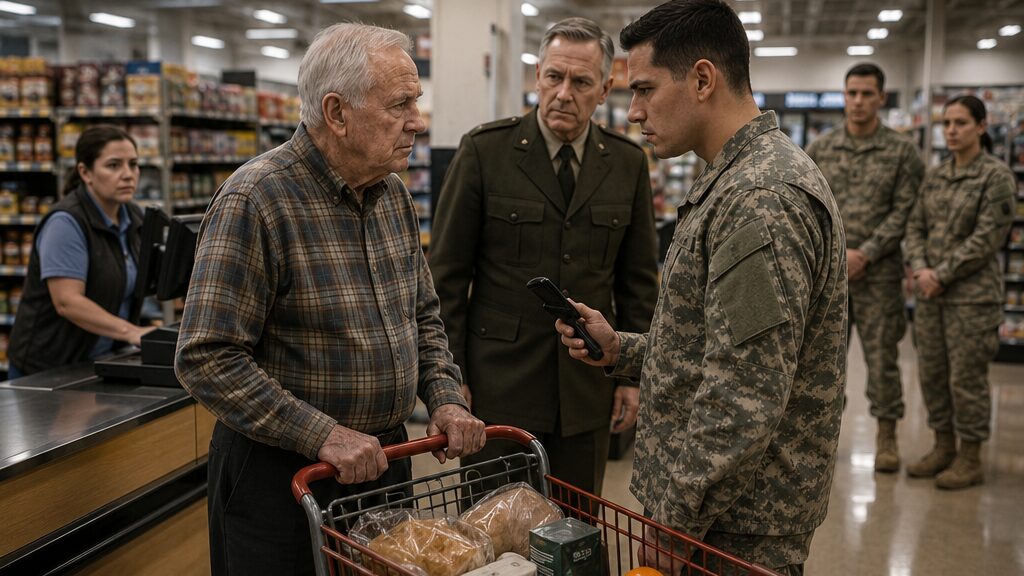
The Old Man With The Grocery Cart Was Asked To Prove He Belonged
Chapter 1: The Error At The End Of The Aisle
Ronald Campbell knew something was wrong when the young soldier looked at the phone, then looked at him as if the screen had accused him of stealing.
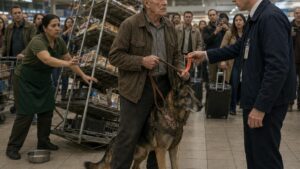
The commissary was fifteen minutes from closing. The lights over the frozen section hummed with a tired white glare, and the last shoppers moved with the careful impatience of people trying not to be the reason employees stayed late. Ronald stood at the end of checkout lane four with both hands wrapped around the red plastic handle of his grocery cart.
He had chosen the cart with the stiff left wheel because he knew how to guide it without fighting it. Weight forward. Elbows loose. Small corrections before the wheel jerked sideways. That was how you moved supplies through narrow spaces. That was how you kept a line from breaking.
Inside the cart were two cans of low-sodium soup, a loaf of wheat bread, a bag of oranges, a carton of eggs, a pack of coffee, dish soap, and the small box of tea Lisa kept telling him was too expensive. He had added it anyway. She worked double shifts now. She said she did not mind. He knew when people did mind and said otherwise.
The checkout clerk had scanned everything quickly, barely looking up until Ronald gave his name and veteran access card. The card was old enough that the corners had gone soft. It still worked most days. It had worked last week for coffee and batteries. It had worked the week before for oatmeal.
Today the clerk frowned.
“Just a second, sir.”
Ronald nodded.
The clerk scanned again. The register gave a small flat sound, not loud, not dramatic, just final. The clerk glanced toward the young soldier near the lane ropes.
“Torres?”
The soldier turned. He was young enough that his uniform still looked newly issued even after a day’s wear. He carried himself with the tight confidence of someone who had been told responsibility was weight and had decided to wear it on his shoulders. On his chest, the name tape read TORRES.
Kevin Torres stepped over with a black phone in one hand. “What’s the issue?”
“Access won’t validate.”
Kevin took the card from the clerk, then looked at Ronald. “Is this yours?”
Ronald’s fingers tightened on the cart handle. “Yes.”
Kevin held the card under the phone camera. The device chirped and rejected him. He tapped twice, waited, then tapped again. His mouth made a line.
“Do you have another form of authorization?”
“No,” Ronald said.
“No current ID? No dependent card? No updated retiree credential?”
Ronald looked at the groceries on the belt. The eggs were closest to the scanner. He had checked each one before putting the carton in the cart, lifting the lid with a thumb, turning it slightly under the aisle light. None cracked. Small things mattered when the week was going to be long.
“That card has been enough,” he said.
Kevin’s eyes did not soften. “It’s not enough if the system says it isn’t.”
Behind them, two uniformed shoppers slowed near the candy racks. A woman with a basket of produce paused at the end of the lane. Ronald heard the clerk shift his feet. A cooler motor started somewhere behind the wall of milk.
Kevin turned the phone outward for Ronald to see. The screen showed his name spelled correctly, which felt worse than if it had been wrong. Under it, in plain red letters, was a status message Ronald did not understand fast enough.
No current standing.
Kevin lowered the phone. “Sir, this says you are not currently authorized for commissary privileges.”
Ronald felt the words before he answered. Not anger. Not yet. Something smaller and colder. The old feeling of standing at a gate while somebody younger held a clipboard and believed the clipboard knew more than the road did.
“I’ve shopped here for years,” he said.
“I understand,” Kevin said, in a tone that meant he did not. “But we’ve been told to verify all access manually when there’s a mismatch. There have been incidents.”
Ronald watched his thumb press into the rubber seam of the cart handle. The seam was split, and a small edge of plastic had lifted. It bit gently into his skin.
“What kind of incidents?” he asked.
Kevin glanced at the two uniformed shoppers. “People using old credentials. Family members after eligibility ends. Expired records. Things like that.”
“Things like that,” Ronald repeated.
The clerk looked down at the register. No one reached for the groceries. The oranges sat in their net bag, bright and foolish under the light.
Kevin shifted closer. Not threatening, exactly. Just close enough that Ronald had to lift his chin to hold the younger man’s eyes. “I’m not saying you did anything intentionally, sir. But I can’t let the transaction continue unless you can prove current standing.”
Ronald had once moved crates through a landing zone while men shouted three different orders at once. He had once counted bandages by touch in blackout conditions. He had once told a driver to leave two pallets behind because fuel weighed less than guilt only until the trucks stopped moving.
He said none of that.
“I don’t have anything else with me.”
“Then we’ll need to suspend the purchase.”
The clerk’s face tightened. The woman with produce looked away too late. One of the uniformed shoppers whispered something Ronald could not hear, then stopped when Kevin turned his head.
Ronald looked at his groceries. The coffee. The soup. Lisa’s tea.
“How much of a problem is it,” he asked quietly, “if I pay regular price?”
Kevin blinked. “That’s not how it works.”
“I’m asking if I can pay and go.”
“This isn’t about the discount. It’s about access.”
Ronald’s hands stayed on the cart handle. His left knuckle had gone pale. He made himself release one finger, then another. He did not want his hands to shake where people could see.
The aisle behind him seemed longer than it had when he walked in. He knew this building too well. Produce left. Dry goods center. Meat counter at the back. Bread near the far wall because soft goods crushed easy and should be picked late. Seasonal displays near the entrance, bad for traffic flow. The commissary had changed its signs over the years, changed its checkout lanes, changed the coffee brands and the cereal boxes and the uniforms of the people who passed through, but Ronald still moved through it by pattern.
Kevin saw only a man with an old card.
“Sir,” Kevin said, louder now, “do you understand that the record shows no current standing?”
The words traveled. A man near the self-checkout turned. The clerk stopped pretending not to listen.
Ronald nodded once.
He reached for the loaf of bread and placed it back in the cart. Then the soup. Then the coffee. Each item moved carefully from belt to basket, not thrown, not snatched, just returned as if he had changed his mind about buying it. The clerk opened his mouth, then closed it.
Kevin watched him. “You don’t have to do that yet.”
Ronald picked up the box of tea. He held it a moment longer than the rest. Lisa liked it with honey when her feet hurt. He set it beside the oranges.
“No,” he said. “I think I do.”
The phone remained in Kevin’s hand, screen still bright, red words still visible. Ronald put both hands back on the cart handle and turned the stiff left wheel away from the checkout lane.
It squealed once across the polished floor.
Chapter 2: The Young Soldier With The Black Phone
Kevin Torres had been warned about being too soft before he had ever been trusted with anything important.
Not in those words. Nobody said soft. They said careful. They said squared away. They said don’t assume. They said the new verification procedures existed because people took advantage of gaps when no one wanted to look like the bad guy.
So when the old man began putting groceries back into the cart, Kevin felt the eyes before he felt the doubt.
Two uniformed shoppers stood near the gum and batteries, watching. The checkout clerk had gone still behind the register. The woman with produce had moved to another lane, though that lane was already closed. Somewhere behind Kevin, a senior voice asked a low question, but Kevin did not turn.
He had been at the base commissary support desk only three weeks. It was not glamorous work, and it was not what he had imagined when he enlisted, but his sergeant had made the assignment sound like a test. You represent the uniform even when the task is small. Especially when the task is small.
The old man did not look like trouble. That was the problem. People who caused trouble rarely arrived looking like trouble. He had a plaid shirt buttoned unevenly near the collar, gray hair combed back with no interest in style, and shoes polished out of habit rather than pride. His hands were thin but not weak. They held the cart like they had held rougher things.
Kevin looked back at the phone.
No current standing.
He opened the verification app again, entered the name from the card, and waited. The same message returned. Ronald Campbell. Status unresolved. No current standing.
“Sir,” Kevin said, “I need you to stop moving items until we determine what has to be logged.”
The old man lifted a carton of eggs, paused, and placed it gently in the cart anyway.
Kevin stepped closer. “Mr. Campbell.”
That made the old man look at him.
For one second Kevin saw something in his face that did not match the grocery aisle. Not fear. Not confusion. Weariness, maybe. A long kind. Then it was gone.
“I heard you,” Ronald said.
“Then I need you to leave the purchase as it is.”
“I’m not purchasing.”
“That still has to be documented.”
Ronald’s jaw moved once, as if he had set aside a sentence before it reached his mouth. “Document it.”
Kevin felt heat rise behind his ears. The two soldiers near the candy rack were still watching. One of them was older than Kevin by maybe five years, with corporal stripes and an unreadable expression. Kevin imagined the story later: Torres let an expired card slide because the guy looked old. Torres got handled by a grandfather in a checkout lane.
He angled the phone toward Ronald. “This is what I’m looking at. Your record isn’t active. If this card belongs to a family member, if it was retained after a status change, or if there’s a mistake, we still have to treat it as unresolved.”
The word mistake seemed to land somewhere in the old man’s chest.
“It belongs to me,” Ronald said.
“Then there should be a current record.”
“There was.”
“But there isn’t.”
The clerk gave Kevin a quick warning glance, the kind that said the volume had risen. Kevin lowered his voice, but not enough.
“Sir, I’m asking you to prove you belong in the system.”
Ronald’s hand closed around the cart handle again. His thumb settled over the split in the rubber, pressing into the same place as before.
“Belong,” he said.
Kevin did not like the way the word sounded when the old man said it. It sounded less like access and more like a door.
From the back of the checkout area, a tall older officer in uniform stepped into view. Kevin recognized him after a heartbeat and straightened almost automatically. Samuel Johnson had visited the commissary twice that week, not for groceries, but for the retirement reception planning that nobody was supposed to call a retirement reception in front of him.
Samuel did not interrupt at first. He stood beyond the lane rope, looking not at Kevin but at Ronald’s hands.
Ronald lifted the box of tea from the belt. It was the last item. He set it into the cart with the others. For a moment he looked at the groceries as if making sure they had not been bruised by the scene.
Then he murmured, almost to himself, “Cold shelf, warm hands.”
The phrase meant nothing to Kevin. It was the kind of odd thing old people said when they were tired, maybe a reminder from some kitchen or warehouse job. He nearly ignored it.
Samuel did not.
The older officer’s head came up.
“What did you say?” Samuel asked.
Ronald turned slightly. He seemed to notice Samuel for the first time. His face closed.
“Nothing.”
Samuel took one step forward. “Sir, did you say cold shelf, warm hands?”
Kevin looked between them. The two uniformed shoppers stopped pretending to browse. The clerk’s fingers rested on the register keys.
Ronald’s eyes moved toward the exit. “Just an old habit.”
Samuel’s posture changed. It was not dramatic. He did not salute. He did not announce anything. He simply stood straighter, the way a man stands when a room has become more serious than it was a second before.
“Kevin,” Samuel said quietly.
Kevin turned. “Sir?”
“Lower your voice.”
The correction was soft enough that it should not have embarrassed him. It did anyway.
Kevin swallowed. “Yes, sir.”
Samuel came closer, but unlike Kevin, he stopped with space between himself and Ronald’s cart. He did not touch the old man’s card. He did not reach for the groceries. He looked at Ronald as if waiting for permission to ask the next question.
“May I see the name again?” Samuel asked.
Kevin checked the phone. “Ronald Campbell.”
Samuel’s face did not change much, but Kevin saw the moment something moved behind his eyes.
“Full name,” Samuel said.
Kevin looked at the record. “Ronald E. Campbell.”
The old man’s hand shifted on the cart handle. Barely. Enough.
Samuel’s voice lowered further. “Mr. Campbell, were you ever attached to an evacuation logistics unit out of Da Nang?”
Ronald looked at him for a long breath.
The checkout lane seemed to empty of sound. The hum of the lights, the coolers, the distant roll of a cart near produce—all of it thinned until Kevin heard only the faint buzz of the phone in his hand.
Ronald did not answer the question.
He reached for the cart and turned it away from the register.
“I should go,” he said.
Kevin, still holding the black phone, almost stepped into his way. Samuel’s hand lifted, palm down, stopping him without touching him.
“Ask him his full name again,” Samuel said.
Kevin stared at him.
“Sir?”
Samuel did not look away from Ronald.
“Ask him respectfully.”
Chapter 3: The Name Samuel Johnson Had Heard Before
Samuel Johnson had heard the name Campbell first from a hospital bed, spoken by a man whose lungs never fully recovered from the smoke that should have killed him.
His father had been old by then, all bone and stubbornness beneath a white blanket, telling stories in pieces whenever the medicine loosened something in him. Not war stories the way strangers wanted them. No polished bravery. No shining flags. Just fragments. A truck that would not start. A road marked wrong. A supply sergeant who counted water cans by hand because the paperwork lied. A voice in the dark saying cold shelf, warm hands before passing crates forward like lives depended on the order of small things.
Samuel had been thirty-two then, already in uniform, already certain he understood service. His father had laughed once at that certainty, then coughed until a nurse came in.
“Remember this,” his father had said later, gripping Samuel’s sleeve with surprising strength. “The men who keep you alive don’t always stand where the pictures are taken.”
Now, in the commissary manager’s office, Samuel sat across from the man his father may have remembered for forty years.
Ronald Campbell did not look like a story waiting to be honored. He looked like a tired old man who wanted his groceries back in the trunk before the eggs warmed. The office was too bright and too small, with a beige desk, a wall calendar, and a filing cabinet that clicked whenever the air conditioner rattled. The black verification phone lay face down on the desk between them, as if even Kevin Torres understood it had done enough damage for one evening.
Anna Perez stood near the door, arms folded loosely, professional worry pressed into her mouth. Kevin stood beside the filing cabinet, no longer close to Ronald. He had taken half a step back when Samuel entered the room and had stayed there.
Ronald had accepted the chair only after Anna said, twice, that the groceries were being held in a cooler. He sat straight but not comfortably, knees together, hands resting on his thighs. Samuel noticed the hands most. They had left the cart handle at last, but the grip remained in them, tendons raised beneath spotted skin.
“Mr. Campbell,” Samuel said, “I apologize for the way this was handled.”
Ronald looked at the face-down phone. “Your soldier followed the screen.”
Kevin flinched, though Ronald had not sounded cruel.
Samuel said, “The screen didn’t require him to crowd you.”
Kevin’s eyes dropped.
Anna cleared her throat. “The record is still unresolved. I don’t mean to press, Mr. Campbell, but if we can confirm the proper status, we can complete the transaction and update the local note.”
“I don’t need the groceries,” Ronald said.
Samuel glanced toward the office window. Through the blinds he could see the checkout lanes, the shine of polished floor, the cart waiting off to the side with Ronald’s items bagged but not paid for. The tea box sat on top.
“You came for them,” Samuel said.
Ronald’s eyes moved to him, sharp for the first time.
Samuel accepted the warning in that look. Do not make me grateful for what should have been ordinary.
He nodded once. “Yes, sir.”
The sir changed the room. Anna looked at Samuel. Kevin looked at Ronald.
Ronald did not seem pleased by it. If anything, his face tightened.
Samuel leaned back slightly, giving the question room. “My father served in an evacuation support unit when I was a boy. He didn’t speak often about it. When he did, there was a Sergeant Campbell in the story.”
“There were a lot of Campbells.”
“He said this one used to say, ‘Cold shelf, warm hands.’”
Ronald looked at the filing cabinet, then the door, then the floor. “Your father had a good memory.”
“He said Sergeant Campbell got people out when the lists were wrong.”
Ronald’s fingers curled, then opened. “Lists are always wrong when people are scared.”
Anna’s face changed. Not recognition. Attention.
Samuel kept his voice even. “Were you that Sergeant Campbell?”
Ronald did not answer right away. Outside the office, someone laughed near the registers, then quieted. The ordinary sound felt misplaced.
“I moved supplies,” Ronald said. “That was all.”
“My father said men lived because of those supplies.”
“Men died because there weren’t enough.”
No one spoke.
The air conditioner rattled again. The filing cabinet clicked.
Samuel felt the old hospital room return for a second: his father’s thin hand, the smell of antiseptic, the voice reduced by years and still insisting that names mattered.
Kevin shifted against the cabinet. “Mr. Campbell, I didn’t—”
Ronald lifted one hand, not sharply, but enough to stop him.
“Don’t make it easy on yourself yet.”
Kevin’s mouth closed.
Samuel looked down at the phone. “Your record should not have shown no current standing.”
“Records do what people tell them to do.”
Anna moved toward the desk and turned a folder around. “There may be duplicate entries. The system sometimes separates older records when the federal update doesn’t match local access history. It can happen with name suffixes, middle initials, old dependent conversions—”
Ronald’s expression made her stop. He had heard enough explanations from institutions.
Anna tried again, quieter. “It should not have happened in the checkout lane.”
“No,” Ronald said. “It should not have.”
Samuel saw Kevin absorb the sentence. Not as a scolding. As fact.
“Mr. Campbell,” Samuel said, “with your permission, I can contact base records tonight. If you served where I think you served, this can be corrected.”
Ronald’s eyes fixed on him. “If I served where you think I served?”
Samuel knew then that he had made the first mistake of respect: he had reached for proof before listening.
“I’m sorry,” he said. “That came out wrong.”
Ronald’s gaze did not soften, but it stayed.
Samuel continued carefully. “I would like to help correct the record. Only that.”
Anna nodded. “And your groceries are secured. No charge will be run until the access issue is corrected or until we arrange another way.”
Ronald almost smiled, but there was no humor in it. “Another way. That’s what we called the roads after the first ones washed out.”
Samuel felt the phrase settle into him. “My father mentioned roads.”
“He remembered the roads?”
“He remembered a man who knew which ones not to take.”
Ronald turned his head toward the office blinds. Through the gaps, the commissary lights cut across his face in thin bars.
“Your father remembered the wrong part,” he said.
Samuel waited.
Ronald’s hands rested open on his knees now, but they looked less released than emptied.
“The ones who got through always did.”
Chapter 4: The Groceries Lisa Told Him Not To Carry
Lisa Campbell knew her father had not bought everything on the list because the tea was on top of the grocery bag.
He always hid the expensive thing in the middle, as if a loaf of bread could disguise it from her. Tonight it sat in plain sight beside the eggs, the box slightly bent at one corner. The bag itself was on the kitchen table instead of the counter. He had carried it no farther than necessary.
That was the first sign.
The second was his coat. Ronald had hung it on the back of the chair instead of the hook by the door. The sleeves drooped toward the floor, and one cuff had turned inside out, showing the pale worn lining Lisa had been meaning to mend. Her father did not leave clothes like that. He had routines for everything: keys in the blue dish, shoes angled beneath the bench, grocery receipt folded into the jar by the microwave, perishables unpacked before canned goods.
Tonight the milk was still out.
“Dad?”
“In here.”
His voice came from the kitchen, too even.
Lisa stepped in wearing her work shoes, one heel already loose because she had kicked it halfway off in the hallway. Ronald stood at the sink with his back to her, running water over his hands though there was no soap in them. The water streamed clear across his knuckles and disappeared.
“You forgot the chicken,” she said, because sometimes ordinary words opened doors better than careful ones.
“They were out.”
“The commissary was out of chicken?”
“Of the kind you like.”
She looked at the bag. Soup. Bread. Oranges. Eggs. Coffee. Tea. Dish soap. No chicken. No rice. No apples, though he knew she took one to work every morning.
“Were they out of rice, too?”
Ronald turned off the faucet. He dried his hands on a towel, slowly, each finger. “I’ll go tomorrow.”
“You shouldn’t have gone today.”
“It was on the way.”
“It is not on the way to anywhere you needed to be.”
He folded the towel and laid it flat beside the sink. “You were sleeping.”
“I was sleeping because I worked last night.”
“And you needed groceries.”
“I needed you not to carry groceries.”
His mouth twitched, not quite a smile. “The groceries were lighter than your tone.”
Lisa did not smile back. She crossed to the table and touched the milk carton. Still cool, but not enough. She put it in the refrigerator, then the eggs, then stood with the door open longer than necessary. The light inside the fridge made the kitchen seem dimmer.
“What happened?” she asked.
“Nothing happened.”
“That answer stopped working when I was twelve.”
Ronald pulled out the chair and sat. He lowered himself carefully, but not because his knees were the problem. Lisa had watched pain take many shapes in him. This one was not in the joints.
“There was an issue with the card,” he said.
“What issue?”
“The system didn’t like it.”
She shut the refrigerator door. “The system didn’t like it.”
“That’s about right.”
“Did they fix it?”
“Not yet.”
“Not yet? Did they let you buy the groceries?”
Ronald glanced at the bag. “Eventually.”
That word carried weight. Eventually meant after something. Eventually meant he had waited somewhere while someone decided if he belonged.
Lisa leaned both hands on the back of the chair across from him. “Tell me.”
He rubbed his left palm with the thumb of his right hand. The skin was marked red where he had gripped something hard. Cart handle, she thought. She could see it as clearly as if she had been there: his hands on the cart, his shoulders quiet, his face taking the hit so nobody else had to look at what they were doing.
“A young soldier was following procedure,” Ronald said.
“Don’t do that.”
“Do what?”
“Clean it up for him.”
Ronald looked tired then. Truly tired. “He was young.”
“That is not an answer.”
“It is part of one.”
Lisa sat down slowly. The kitchen table between them still held one paper grocery bag, the box of tea, and the receipt folded into a small white square. Ronald’s grocery list lay beside it. His handwriting had grown smaller over the years, but it was still straight, still disciplined. Milk. Eggs. Soup. Bread. Tea for L.
She picked up the list and held it. “Did he embarrass you?”
Ronald’s eyes moved to the window over the sink. It was dark outside, and the glass reflected the kitchen back at them: daughter, father, bag, table, old yellow light.
“He asked for proof.”
“Of what?”
“That I had standing.”
Lisa stared at him. “Standing?”
“That was the word on the phone.”
“Who was he?”
“Kevin Torres.”
She pushed the grocery list away. “I’m calling the commissary.”
“No.”
“Dad.”
“No.”
“They can’t do that to you.”
“They already did.”
“That’s why we call.”
He lifted his eyes to hers then, and she saw the old firmness she had grown up with. It did not come often anymore, but when it did, it still stopped her.
“I won’t have you turn me into a complaint someone files under customer relations.”
“So you’re just going to let it go?”
“I am going to sleep.”
“You won’t sleep.”
He did not deny it.
Lisa stood and began unpacking the rest of the bag because her hands needed a job. Soup into the cabinet. Bread into the drawer. Oranges into the bowl. Coffee beside the machine. Dish soap under the sink. Tea left on the table because she did not know where to put the tenderness of it.
“You stopped going to the veterans’ breakfast,” she said.
Ronald looked down.
“You stopped answering the reunion letters. You stopped wearing the cap Mrs. Hernandez gave you from the parade. You don’t go to the memorial on base. Now you won’t file a complaint because that might make someone look at your record too closely.”
“It isn’t about the record.”
“What is it about?”
He pressed his thumb once more into the red mark on his palm.
“People remember the part that makes them feel better,” he said.
Lisa had no answer for that. She had heard versions of it before, always from the side, never from the center. Her father had given her facts across the years like rations: enough to live on, never enough to understand the hunger. He had served. He had moved supplies. He had known men who did not come home. He did not want ceremonies. He did not want thank-yous from strangers. He did not want her pity, which made loving him sometimes feel like standing outside a locked room with warm food.
She reached for the folded receipt to put it in the jar by the microwave.
Something was written on the back.
The ink was old, faded blue, not from tonight. The receipt itself was not tonight’s receipt either. The paper had yellowed, its edges soft from being folded and unfolded. Across the back, in her father’s careful hand, were four words.
Cold shelf, warm hands.
Lisa held it still.
“Dad?”
Ronald’s face changed before she asked the question. Not much. Just enough for her to know the locked room had a light on inside.
“Where did this come from?”
He looked at the old receipt for a long moment.
Then he said, “A place where groceries would have been a miracle.”
Chapter 5: The Record That Would Not Stay Open
Anna Perez arrived at the commissary before sunrise and found Kevin Torres already sitting outside her office with the black verification phone balanced on his knee.
He stood when she came down the hall.
“You’re early,” she said.
“Yes, ma’am.”
The commissary was different before opening. No carts rattling. No register beeps. No customers comparing prices under bright aisle lights. The building smelled faintly of floor wax, cardboard, and refrigerated air. From the loading area came the low thud of crates being moved by people who knew the work well enough not to speak much.
Anna unlocked her office. “Did someone tell you to report?”
“No, ma’am.”
“Then why are you here?”
Kevin looked at the phone. “Because I handled it wrong.”
Anna did not soften immediately. She had managed enough people to distrust easy remorse, especially when it arrived before consequences. She pushed the door open and turned on the light.
“Come in.”
Kevin entered but did not sit until she pointed to the chair. He looked younger without the audience from the night before. Still uniformed, still straight-backed, but the sharpness had lost its shine. He placed the phone on the desk screen down.
Anna set her bag beside the filing cabinet. “The record still shows unresolved?”
“Yes, ma’am. I checked twice before the app locked me out.”
“You should not be checking customer files off shift.”
“I know.”
“Then why did you?”
He swallowed. “Because Colonel Johnson called base records last night, and I wanted to understand what I missed.”
Anna sat behind the desk. The name Johnson made this larger than a checkout complaint. She had felt that already when the senior officer stood in her office and changed the room simply by asking everyone to lower their voices. Not because he outranked them. Because he had recognized harm before procedure could hide it.
“What did you miss?” she asked.
Kevin looked toward the blinds that covered the interior office window. “That the screen wasn’t the only thing in front of me.”
Anna held his gaze for a second, then turned to her computer. “Good. Keep that answer. You may need it.”
The base records clerk arrived at eight, carrying a paper cup of coffee and the guarded expression of someone asked to fix a problem caused by four systems, three policy changes, and one old file nobody wanted to own. Anna brought Kevin only because Samuel had requested that he see the process rather than simply hear the result.
They met in a narrow records office behind the administration wing, where file cabinets stood beside humming servers as if two centuries of paperwork had been forced to share one room. Samuel Johnson was already there. He nodded to Anna, then to Kevin. Kevin straightened.
“Sir.”
“Torres.”
No more. No less.
The clerk typed Ronald Campbell’s name into one system, then another. The first showed commissary access unresolved. The second showed an inactive dependent-era conversion. The third showed a service record with partial data sealed behind an old category Anna had never seen.
“That can’t be right,” the clerk murmured.
Anna leaned closer. “Which part?”
“There are two Ronald E. Campbells in the archive index. Same birth year. One with a local access history. One with a service file cross-reference. They should have been merged when the retiree verification update happened.”
“Why weren’t they?”
The clerk gave her a look that meant the answer was too long and too dull to be satisfying. “Middle initial mismatch on one form. Hand-entered discharge date on another. Old paper file scanned with a damaged service number. The system treated them as separate people.”
Kevin’s face tightened.
Anna asked, “So when he came through checkout—”
“The app pulled the access history without the service eligibility,” the clerk said. “It saw an old local profile with no current standing.”
Samuel stood very still near the wall. “Can it be corrected?”
“Yes. But not from the commissary side alone.”
“What do you need?”
The clerk scrolled, then stopped. “Authorization from Mr. Campbell to link the archive record to the current profile. Possibly a release, depending on the restricted notation.”
Samuel stepped forward. “Restricted?”
The clerk hesitated. “There’s a commendation reference attached to an evacuation support operation. The summary line is incomplete. It doesn’t display details, just enough to show the source file exists.”
Kevin looked up. “A commendation?”
Anna watched Samuel’s face, but the officer gave away little.
“Does the record confirm service?” Anna asked.
“Yes,” the clerk said. “It confirms service. It just doesn’t confirm the access profile until the files are linked.”
Anna heard how absurd that sounded before anyone said it. The man had served, but the store could not sell him soup until a system admitted he was the same man who had served.
Kevin looked at the phone in his hand as if it had become heavier. “So he was right.”
Samuel turned to him.
Kevin corrected himself. “Mr. Campbell was right.”
The records clerk printed a packet, each page warm from the machine. Anna took it and read through the highlighted sections: local identity confirmation, archive merge request, consent to review restricted status marker, temporary commissary access override pending resolution. All reasonable. All humiliating, if handed to the wrong person in the wrong way.
“No one is taking this to his house like a citation,” Anna said.
Samuel nodded. “Agreed.”
Kevin looked between them. “I should apologize.”
“Yes,” Anna said.
Samuel added, “But not before you understand what you’re apologizing for.”
Kevin’s jaw worked once. “I treated him like he was trying to get away with something.”
“That’s part of it,” Samuel said.
Anna placed the packet in a plain folder. “You also made him explain himself in front of people who had no right to hear it.”
Kevin took that one quietly.
They found Ronald late that morning not at home, but in the commissary parking lot, sitting in his car with both hands on the steering wheel. Lisa Campbell stood outside the driver’s side door with her arms folded, anger and worry held in equal measure.
Ronald had not come in. He had driven to the edge of the lot and stopped.
Anna approached first, folder held at her side, not out front like a demand. Samuel and Kevin stayed a few steps back.
“Mr. Campbell,” Anna said, “I’m Anna Perez, the commissary manager. We met briefly last night.”
Ronald looked at her through the open window. “I remember.”
Lisa glanced at the folder. “Is that more proof he has to provide?”
Anna accepted the edge in her voice. “It is paperwork that should have been handled without embarrassing him.”
Ronald’s eyes shifted toward Kevin. Kevin did not look away, but he did not step forward either.
Anna said, “Your service and access records were split by an archive error. We can correct it, but we need your permission to link the files.”
Ronald looked toward the commissary entrance. The automatic doors opened for an employee carrying an empty basket, then closed. He watched them as if they were farther away than they were.
“What else opens if I sign?” he asked.
Samuel answered from behind Anna, carefully. “Only what is needed to confirm the record.”
Ronald gave him a dry look. “Needed by whom?”
No one answered too quickly.
Anna held the folder lower. “By the system, officially. By us, practically. But you have the right to refuse.”
Lisa turned to him. “Dad, let them fix it.”
Ronald’s fingers tightened around the steering wheel. Not the cart handle this time, but the same grip. Same pressure. Same place to put what he would not say.
Kevin stepped forward one pace, then stopped. “Mr. Campbell, I’m sorry for how I spoke to you.”
Ronald looked at him.
Kevin continued, voice controlled but stripped of yesterday’s hardness. “I thought being strict meant I was doing it right. I didn’t think about what I was asking you to carry in that lane.”
Ronald studied him long enough to make him stand inside the words.
Then Ronald looked at Anna’s folder.
“If I sign,” he said, “does it just fix me?”
Anna hesitated. “It would correct your record.”
“That isn’t what I asked.”
The parking lot was quiet except for a cart rattling in a return stall.
Anna closed the folder. “No,” she said. “Not unless we change how we handle the next unresolved record.”
Ronald gave a faint nod, as if she had finally reached the beginning of the matter.
“Then I’m not signing yet.”
Lisa turned. “Dad—”
“Not yet,” he repeated.
And no one in the parking lot mistook the softness of his voice for uncertainty.
Chapter 6: What Sergeant Campbell Refused To Say
Ronald had always trusted rooms with back doors.
The commissary break room had one, a gray metal door beside the soda machine that led to the loading area and then out toward the dumpsters and the service road. He noticed it before he sat. He noticed the three chairs, the coffee maker with burnt glass at the bottom of the pot, the bulletin board crowded with shift schedules and safety reminders, and the narrow window high on the wall that admitted light but no view.
He did not notice these things because he was afraid.
He noticed because once, for a long time, noticing had been the difference between moving and stopping.
Samuel Johnson sat across from him at the small table. Anna Perez stood near the counter, the folder under one arm. Kevin Torres waited by the wall, not hiding, not pushing forward. Lisa had wanted to stay, but Ronald had asked her to get coffee from the machine in the lobby and take her time.
She had looked at him as if she knew the trick.
Still, she had gone.
Ronald rubbed the base of his left palm. The mark from the cart handle had faded overnight, but he could still feel it under the skin. The wheel’s pull. The young soldier’s voice. No current standing. Strange how a little phrase from a little screen could find old places in a man.
Samuel did not start with the folder.
“Mr. Campbell,” he said, “you don’t owe us a story.”
“That’s true.”
“You don’t owe my father’s memory anything either.”
Ronald looked at him then.
Samuel held steady. “But if I’m going to ask you to let us correct this, I need to understand what I’m asking you to reopen.”
Anna shifted slightly. Kevin did not move.
Ronald let the silence stay long enough to test them. Most people rushed to fill silence around old men. They mistook quiet for vacancy. Samuel did not fill it. Anna did not. Kevin looked as if he wanted to apologize again and had learned that wanting did not entitle him to speak.
So Ronald began where he could.
“Supplies are promises,” he said.
Samuel’s eyes lowered briefly, then returned.
“People think they’re things,” Ronald continued. “Rice. Water. blankets. fuel. bandages. But when a person is waiting, a supply is a promise that somebody remembered they were alive.”
The soda machine hummed against the wall.
“In Da Nang,” Ronald said, “we had shelves that stayed cold at night. Metal racks. Damp air. You’d reach for a crate and your hands would sting before you could feel the wood. Men complained. I told them cold shelf, warm hands. Keep moving and you’ll earn the heat back.”
Kevin looked at his own hands.
“It became a joke,” Ronald said. “Then it became a rule. If your hands were warm, you had stopped too long.”
He did not look at Samuel while he spoke. He looked at the table, where someone had carved a shallow line into the laminate years ago. The line curved like a road on a bad map.
“There was an evacuation push after the roads started failing. Too many people for too few trucks. Too many lists. Every list said something different. Names copied wrong. Ages guessed. Units moved twice before the ink dried. Somebody up the chain wanted clean numbers.”
Samuel said softly, “My father said the numbers were never clean.”
“Your father was right.”
Ronald’s thumb found the mark in his palm again.
“We had one route west that was supposed to stay open. It didn’t. Rain took part of it, and the rest belonged to whoever had a rifle and hunger. The alternate route was longer. Bad bridge. Narrow turn by a burned schoolhouse. I told command the convoy should split.”
Anna listened with the stillness of someone realizing procedure was only the top layer of things.
“They said no,” Ronald said. “Splitting made the numbers harder to track. So I changed the loading order instead. Water forward. medical crates middle. fuel split between trucks instead of riding in one. Children and wounded on the trucks least likely to break an axle. Drivers who knew how to reverse under pressure got the narrow route positions.”
Kevin looked up.
“You disobeyed?” he asked, then seemed to regret the bluntness.
Ronald did not mind. “I adjusted.”
A faint breath escaped Anna, almost a laugh, but not from humor.
“The first convoy made it through,” Ronald said. “Not clean. Nothing was clean. But it got through. Your father may have been there.”
Samuel’s face held, but his hand tightened once on the edge of the table.
“He was,” Samuel said.
Ronald nodded.
“The second convoy was delayed.”
No one asked why. He heard the questions gather anyway.
“Somebody wanted one more truck loaded from the east stores. Blankets, powdered milk, radio batteries. Good things. Needed things. Things that looked right on a report. I argued. Not loudly enough, maybe. Maybe too loudly in the wrong direction. There’s no honest way to tell it where I come out clean.”
The break room seemed to shrink around him. The air tasted faintly of old coffee and metal.
“They waited thirty-two minutes,” he said. “That was the delay. Thirty-two minutes for a truck that broke down before it reached the gate.”
Kevin closed his eyes briefly.
“The road changed in thirty-two minutes?” Samuel asked.
“The road was always changing. That day it changed faster.”
Ronald saw it then, not as a full memory but as pieces, the way it usually came: mud on a tire tread, a boy’s bare foot against a crate, a driver with blood under his fingernails from fixing a latch, rain blowing sideways through headlight beams, someone shouting that the rear truck had stopped, someone else shouting not to stop, not there, not now.
He pressed his palm flat to the table.
“Some got through. Some didn’t. The report said logistical constraints under hostile and deteriorating conditions. That was the phrase. Long enough to sound like truth. Short enough to leave out the people.”
Samuel bowed his head, not theatrically. Just enough to take the words in.
“My father said Sergeant Campbell saved his life,” he said.
Ronald looked at him. “Maybe.”
“He believed it.”
“Men believe what lets them sleep.”
“And what do you believe?”
Ronald almost answered too quickly. The old answer was ready. It had worn a path in him. I believe I counted wrong. I believe I should have blocked the gate. I believe the truck with the blankets cost more than blankets. But those sentences had become grooves, and he was tired of mistaking grooves for truth.
“I believe,” he said slowly, “that I remember the second convoy more than the first.”
Samuel’s eyes shone, but he did not reach for Ronald’s grief.
Anna set the folder on the table. Not between them like a barrier. Beside Ronald’s hand.
“This release,” she said, “does not require you to open that story to customers, staff, or anyone else. It links the record. It allows the access correction. The restricted note remains restricted.”
Ronald looked at the folder.
Kevin stepped away from the wall. “Mr. Campbell, if you sign it, I’ll make sure the local note says unresolved records get handled privately. Not at the register.”
Anna glanced at him. “That will be a management decision.”
“Yes, ma’am,” Kevin said. “I mean—I’ll write the incident statement. Honestly.”
Ronald looked at him for a long moment. “Honest is heavier after you’ve been wrong.”
Kevin accepted that with a nod.
The break room door opened softly. Lisa stood there holding two paper cups of coffee, one in each hand. She had returned quietly enough to hear at least the last part. Her face was pale, but she did not come in until Ronald motioned with two fingers.
She set one cup in front of him.
“I didn’t know,” she said.
“I worked hard at that.”
Her mouth trembled once. She pressed it still. “You shouldn’t have had to.”
Ronald looked at the coffee. Steam rose through the small opening in the plastic lid. Warm hands, he thought. After all this time.
He took the pen Anna offered.
The release form had too many lines and too many boxes. He read them all. No one rushed him. Kevin stood with his hands behind his back. Samuel waited. Anna answered only the questions asked. Lisa stayed beside him, close enough that her sleeve brushed his shoulder, not holding him up, just there.
At the signature line, Ronald paused.
“If I sign this,” he said, “I don’t want a ceremony.”
Samuel said, “Understood.”
“I don’t want my picture on a wall.”
Anna said, “No picture.”
“I don’t want him punished so everybody else can feel corrected.”
Kevin’s face changed, but he said nothing.
Ronald looked up at Anna. “I want the next old man with a cart taken aside before someone reads a red line out loud.”
Anna’s expression settled into something firmer than apology. “Yes.”
“I want them asked if they need a chair.”
“Yes.”
“And I want your people taught that a screen can be right about a file and wrong about a person.”
Kevin lowered his eyes.
Ronald signed his name.
The pen made a small sound against the paper, a scratch no louder than a cart wheel turning at the end of an aisle.
Chapter 7: The Cart Was Waiting By The Door
The cart was waiting by the commissary entrance two days later, its handle wiped clean, its left front wheel steady.
Ronald stopped when he saw it.
He had not asked for a cart to be set aside. He had not asked Lisa to drive him, either, but she had taken his keys from the blue dish after breakfast and put them in her purse without a word. He had let her. Some arguments were only habits pretending to be principles.
Now she stood beside him outside the automatic doors, watching his face instead of the cart.
“You can still go home,” she said.
Ronald looked through the glass. The commissary was not crowded yet. Morning light came through the high windows and struck the polished floor in pale rectangles. A clerk straightened baskets near the entrance. A uniformed shopper compared apples near produce. At checkout lane four, Kevin Torres stood with his hands clasped in front of him, not behind his back, not crossed, not holding the phone.
Ronald noticed that first.
“Did you tell them I was coming?” he asked.
“No.”
Lisa’s voice was too quick.
He turned his head.
She sighed. “I told Anna you might come. That is not the same thing.”
“It is close enough to wear the same shoes.”
“She asked if you wanted the store cleared. I said no before she finished the sentence.”
Ronald looked back at the cart. A folded paper had been placed in the child seat. Not a sign. Not his name. Just a plain sheet with three printed lines.
If verification assistance is needed, please ask at customer service.
Private review available.
Chairs available on request.
No flag. No photograph. No thank-you banner. No announcement.
Ronald read it once, then again.
Lisa’s hand brushed his sleeve. “That was your idea.”
“Part of it.”
“Good part.”
The doors slid open with a soft mechanical sigh. Cold commissary air touched his face, carrying the clean smell of produce, cardboard, coffee from somewhere near the front, and floor wax. For a second, his palm remembered the split rubber handle from the other cart. His fingers curled by themselves.
He did not reach for this cart immediately.
Anna Perez came from customer service with a folder held at her side. She was dressed the same as before, manager badge straight, hair pinned back, expression professional enough to protect them both.
“Good morning, Mr. Campbell,” she said.
“Morning.”
“Your access correction is active locally. The federal merge is pending, but it won’t affect your shopping today.”
Ronald glanced at the folder.
Anna noticed and lowered it farther. “This is not for you unless you ask for it.”
“Then why bring it?”
“So I would remember that paper is not the first thing a person should see.”
Ronald accepted that with a small nod.
Kevin stepped away from lane four but stopped several feet from Ronald. The distance was deliberate. So was the way he held the black verification phone flat against his own chest rather than outward like evidence.
“Mr. Campbell,” he said.
Ronald looked at him.
Kevin’s face had not transformed into something pure and shining. He still looked young. Still looked like a man trying to stand correctly inside a mistake. There were shadows under his eyes, and his jaw held itself too tight. Ronald respected that more than easy softness.
“Your record is cleared for checkout,” Kevin said. “If you’re willing, I can verify it now. Here, or at customer service. Your choice.”
Ronald looked toward the checkout lanes. Two shoppers glanced over, then looked away when Anna’s eyes moved across the front of the store. Not sharply. Just enough.
“Here is fine,” Ronald said.
Kevin did not move closer right away. “May I see your card?”
Ronald drew the old card from his wallet. Its corners were still soft. Its surface still cloudy. For years he had handed it over without thinking, as if an object could stand in for all the years behind it. This time he held it a moment longer.
Then he gave it to Kevin.
Kevin took it with both hands.
That small act struck Ronald harder than he expected. Not because the card was sacred. It was plastic. Worn plastic, bad laminate, outdated format. But Kevin held it as if it belonged to someone before it belonged to a system.
The phone scanned.
A quiet chirp.
No red line.
Kevin looked at the screen, then turned it slightly so Ronald could see without thrusting it toward him.
Verified.
No announcement followed. No one clapped. The register did not sing. The world did not correct itself in a grand motion. It simply allowed one old man to stand where he had already earned the right to stand.
Kevin handed back the card. “Thank you, Mr. Campbell.”
Ronald put it away. “For what?”
Kevin’s throat moved. “For coming back.”
Ronald reached for the cart handle. The rubber was smooth beneath his palm. No split seam. No bite. For a strange second he missed the old cart, the honest roughness of it. Then he pushed forward, and the wheels moved straight.
Lisa stayed near the entrance. “I’ll be by the coffee.”
“You’ll inspect my cart before checkout.”
“Yes.”
“Thought so.”
She smiled, but her eyes were wet. He pretended not to see because she needed him to.
He went first to bread. He did not need bread, but he went there because that was where he had started the other day before the line, before the phone, before the red words. He chose a loaf and set it in the cart. Then soup. Coffee. Oranges. Eggs. Rice this time. Chicken, because Lisa had been right. Apples, because she would not ask.
At the tea shelf, he stopped.
The box she liked was still too expensive.
He put two in the cart.
Near the end of the aisle, an elderly veteran stood with a basket in one hand and a card in the other, facing the new sign by customer service. The man read it with a frown, then looked toward Anna.
Anna did not wave him to the checkout line. She walked over and spoke quietly. A clerk brought a chair without being asked twice. Kevin saw it from lane four and did not interfere. He only turned the phone screen down on the counter while the man sat.
Ronald watched long enough to understand that the rule had become a behavior.
Then he kept moving.
By the time he reached checkout, Kevin was waiting at lane four. The black phone lay beside the register, screen dark. The clerk scanned the bread, the soup, the oranges, the eggs. Ordinary sounds returned one by one: beep, bag rustle, cart wheel, distant freezer hum.
Kevin did not ask unnecessary questions. He did not explain the record again. He did not apologize again. When the clerk lifted the tea boxes, he glanced at Ronald’s face and said nothing.
That was respect, Ronald thought. Not silence exactly. Restraint with attention inside it.
The total appeared. Ronald paid. The receipt printed, curled, and stopped. The clerk handed it to him.
Ronald turned it over before folding it.
Blank.
For reasons he did not fully understand, that made him breathe easier.
Outside, Samuel Johnson waited near the row of cart returns, in uniform but without an audience gathered around him. He stood beside Lisa, who held one grocery bag and pretended not to be watching both men.
Ronald pushed the cart through the doors.
The morning had warmed. Cars moved slowly through the lot. Somewhere beyond the base buildings, a flag moved in a light wind, but Ronald did not look at it for long. He had seen flags in too many kinds of weather to ask one to carry what people would not.
Samuel stepped forward. “Mr. Campbell.”
“Colonel.”
“I heard the correction went through.”
“Locally.”
“Federal systems take longer than grace.”
Ronald almost smiled. “Most things do.”
Samuel looked at the grocery bags, then at Ronald, not past him. “My father would have wanted to thank you better than I knew how to.”
Ronald’s hands rested on the cart handle. “Your father got home.”
“Yes.”
“Then he thanked me every day he lived.”
Samuel’s face tightened with the effort of receiving that without turning it into ceremony.
After a moment, he stood a little straighter. Not for the parking lot. Not for Kevin, who was visible through the glass helping the other elderly veteran at customer service. Not for Lisa. For the man in front of him.
Samuel raised his hand in a restrained salute.
Ronald did not return it. He was not in uniform. He was not twenty-four in the rain. He was not Sergeant Campbell at a loading point counting crates with cold hands. He was a father with too much tea in his cart and apples his daughter would pretend not to want.
But he did not look away.
He let the salute stand long enough to be accepted, not displayed.
Then Samuel lowered his hand.
Lisa came beside Ronald and reached for one of the bags.
“I can carry that,” he said.
“I know.”
She took the lighter one anyway.
Ronald looked back through the commissary doors. Kevin had set the phone aside and was leaning slightly toward the seated veteran, listening before touching the man’s card. Anna stood nearby, not supervising so much as making sure the new habit held.
Ronald felt the cart handle under his palms. Smooth. Steady. Waiting for direction.
He pushed it forward.
The story has ended.