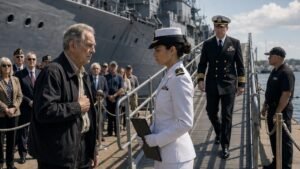
The Young Officer Scanned Her Old Barracks Card And Learned Who She Used To Command
Chapter 1: The Old Woman Beside the Green Blankets
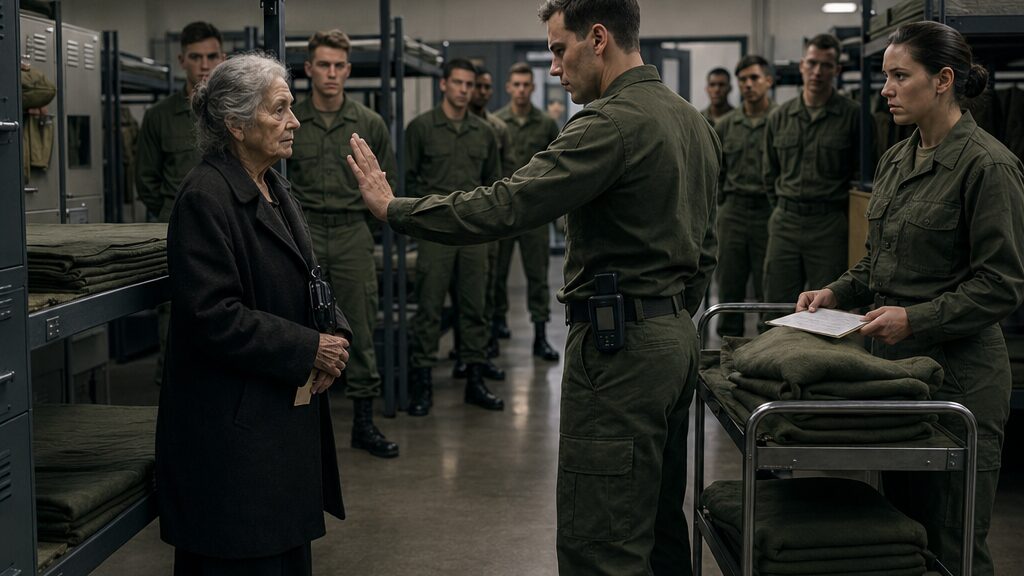
The old woman stood in the middle of the barracks aisle as if she had walked into the wrong decade.
Every young soldier in the room had turned toward her.
Boots stopped against the polished concrete. Locker doors hung half-open. A blanket slipped from one soldier’s hands and landed across the edge of a metal bunk without anyone reaching to fix it. The long room carried the sharp smell of floor wax, detergent, old pipes, and folded wool. Rows of bunks ran toward the far wall, each made with the same tight green corners, each footlocker squared beneath it, each blanket marked for inspection.
Maria Hall kept both hands on the strap of her small black purse and did not move.
Her coat was plain and dark, too heavy for the warm room, brushed thin at the cuffs. One shoulder sat slightly lower than the other from age and old strain. Her gray hair was pinned back, but not neatly enough for a place where everything had to be aligned. The soldiers looked at her shoes first, then the coat, then her face. No badge hung from her neck. No visitor pass clipped to her lapel. No escort walked beside her.
At the end of the aisle, a young officer stepped away from a clipboard.
“Ma’am,” he said, with a patience that had already decided she was a problem. “This is a restricted training barracks.”
Maria looked past him.
Third row. Left side. Lower bunk.
The green blanket there was folded tighter than the others, squared into a block with a paper inventory strip tucked under the top edge. A gray disposal cart waited beside it, already holding old pillow covers, torn mattress protectors, and a roll of stained canvas. A soldier with a scanner stood near the cart, waiting for instructions.
Maria felt the small tan card inside her coat pocket press against her ribs.
“I know where I am,” she said.
The young officer’s expression changed by a fraction. Not anger yet. Warning.
He had a narrow face, close-cropped hair, and the careful posture of a man being watched by someone who might grade him later. His name tape read CARTER. The silver bar on his uniform caught the overhead light whenever he shifted.
“Then you know you can’t be here without clearance,” he said.
A few soldiers glanced toward one another. Someone near the lockers lowered his voice, but the words still carried.
“Is she lost?”
Maria heard it. She let it pass.
She had heard worse things in places with no beds, no lights, no clean floor beneath her boots. She had waited in rooms where the air shook and the walls had no names left on them. A whisper from a boy too young to understand his own uniform did not deserve the last of her strength.
She took one careful step toward the third row.
Lieutenant Mark Carter moved across the aisle and blocked her.
“Ma’am. Stop there.”
The word struck harder than it should have. Not because he said it sharply. Because of where he said it. Right there, five feet from the bunk where the folded blanket waited like a sealed mouth.
Maria’s fingers tightened around the strap of her purse.
A young female soldier stood beside the disposal cart with an inventory sheet hugged to her chest. Her name tape read MILLER. Her eyes moved from Mark to Maria, then to the third-row bunk. She looked uncomfortable but held still.
“We’re preparing for command inspection,” Mark said. “Every item in this room is accounted for. Visitors need to check in at the duty desk.”
“I did check in.”
“With whom?”
“The desk sergeant.”
“Then where is your escort?”
Maria did not answer immediately. The desk sergeant had been called to the phone after looking at her old card too long. He had told her to wait. Maria had waited. Then she had seen the disposal cart through the glass panel in the inner door and walked in when no one stopped her. It was not the first rule she had broken. It was not close to the worst.
Mark read her silence as confusion.
“Ma’am, are you here for a family day event?”
“No.”
“Are you looking for a soldier?”
Maria’s eyes went to the folded blanket.
“Yes,” she said.
The room shifted. A small answer, but it changed the air.
Mark softened his voice by duty, not feeling. “What’s the soldier’s name?”
Maria looked at the blanket again. The paper inventory strip covered most of the cloth tag, but not all of it. At the lower edge, under a line of faded numbers, she saw three letters.
PER.
Her throat closed before the rest of the name could form inside her.
“Ma’am,” Mark said.
She lifted her chin. “That blanket is not to be removed.”
The soldier by the cart looked down at the inventory sheet. Jessica Miller’s grip tightened around her pen.
Mark took one step toward Maria, careful not to touch her. “You don’t have authority over barracks property.”
Maria turned her face toward him then. For the first time, she looked at him fully.
He was younger than Linda had been the year everything changed. That startled her more than his tone. His skin still had the smoothness of someone whose worst nights had been described to him in briefings by men who slept afterward. He smelled faintly of starch and coffee. He had probably spent an hour making sure his belt sat straight.
“I’m asking you not to remove it,” she said.
“And I’m asking for identification.”
Maria held his gaze.
Around them, the barracks had gone too quiet. The soldiers had stopped pretending to work. A boot squeaked near the lockers and then stilled. The young woman beside the cart lowered the inventory sheet just enough to see Maria’s hand move toward her coat.
Maria reached inside slowly.
Mark’s right hand went to the small handheld scanner clipped to his belt. The motion was practiced, quick. His face hardened as though her age had become a trick.
“Keep your hand where I can see it.”
The words traveled down the aisle and landed in every ear.
Maria paused.
For a moment, the room was not Fort Bell. It was another narrow room, another line of bunks, green wool folded for soldiers who had stopped believing morning would come on time. She saw a younger woman sitting cross-legged on a lower bunk, boots unlaced, laughing because she had written her last name too large on the cloth tag and gotten scolded for it.
Perez, ma’am. Five letters. Hard to miss me now.
Maria breathed once through her nose.
Then she drew out the card.
It was tan, laminated long ago, its edges soft and clouded from years inside pockets, drawers, glove compartments, and once, for three months, beneath a family Bible because Maria had not wanted to see it. A faded stripe ran across the top. A magnetic band, scratched nearly dull, cut along the back. The photograph was too old to be useful to anyone who judged faces by skin and hair alone.
Mark looked at it, and she saw him decide against it before he read a word.
“That isn’t a current access card,” he said.
“No.”
“Then it doesn’t authorize you.”
“It may still answer your question.”
Jessica Miller leaned slightly to see it, then caught herself and straightened.
Mark held out his hand. “I’ll need to examine it.”
Maria did not give it to him right away. Her thumb rested over the lower corner, where time had worn a crescent into the plastic. The old card felt warmer than the room.
“You can check the name again,” she said.
Mark’s eyes narrowed. “Ma’am, I have not checked any name yet.”
“No,” Maria said quietly. “You haven’t.”
The line settled between them with a weight he did not understand.
A soldier near the second row made a small sound, almost a laugh, then swallowed it. Mark’s jaw tightened. He was being watched. Maria saw the exact moment pride joined protocol.
He took the card from her hand.
His fingers were clean. No tremor. No hesitation. He turned the card over, saw the magnetic strip, and frowned.
“This does not look like any credential I’ve seen,” he said.
Maria looked past him, toward the folded green blanket on the lower bunk.
“It was issued before you were taught what credentials look like,” she said.
Chapter 2: The Blue Scanner Refused to Dismiss Her
Mark Carter raised the handheld scanner as if the small black device could settle the old woman in front of him into one of two clean categories: authorized or removed.
Maria Hall watched the scanner, not his face.
It had a rubberized grip, a glass strip no longer than a finger, and a status light that blinked red while it waited. The newer devices were smaller than the old ones. Faster, too. That was what people always promised when they replaced memory with systems. Faster. Cleaner. Less room for human error.
Less room for human mercy, too, if no one asked where the missing names had gone.
Mark held the tan card between two fingers. “For the record, you are presenting an obsolete credential for access to a restricted facility.”
Maria did not respond.
“For the record,” he repeated, louder, glancing toward the soldiers who had become his audience, “you entered without escort and interfered with active inventory.”
A few faces stiffened. Jessica Miller looked down at her sheet.
Maria kept her hands folded around the strap of her purse.
“Do you understand what I’m saying?” Mark asked.
“Yes.”
“And you’re refusing to provide a current ID?”
“I gave you the card I came with.”
“That’s not what I asked.”
“It may be what you need.”
His lips pressed thin. He slid the card through the scanner.
Nothing happened.
The device gave a dull chirp and flashed red.
Mark looked almost relieved.
“There,” he said. “Invalid.”
Maria’s eyes lowered to the card. “Again.”
The word was soft enough that only the first row should have heard it, but the silence carried it to the lockers.
Mark stared at her. “Excuse me?”
“The strip is worn. Slow the angle.”
A soldier near the back shifted his weight. Mark’s neck colored slightly.
“You familiar with this scanner, ma’am?”
“No.”
“Then please don’t instruct me on security equipment.”
Maria looked at his hand, not his rank. “I’m familiar with worn things that still work.”
Jessica Miller’s mouth moved as if she might speak. She did not.
Mark dragged the card through again, faster this time. Red.
He gave a humorless breath. “Ma’am, this is exactly why we don’t let unauthorized visitors wander into—”
“The other direction,” Maria said.
That did it. Mark’s eyes sharpened.
“You need to understand something. This room is under inspection status. I have cadets arriving this afternoon, command staff tomorrow morning, and every item you have touched now has to be reverified. I don’t know who told you to come in here, but I’m not going to risk a security failure because someone’s grandmother thinks an old card gives her special access.”
The room absorbed the words.
Someone looked away.
Jessica Miller’s face changed first—not toward Maria, but toward Mark, as if he had stepped over a line she had seen but could not yet name.
Maria stood very still.
Grandmother.
She had been called worse. She had been called ma’am with hatred, General with fear, Hall with anger, and once, from under a collapsed roof, a word that was not her name at all but had meant help. Yet this one struck a quiet place because Mark had used it to make her small.
She looked at the folded blanket again.
Linda Perez had never become anyone’s grandmother.
Mark seemed to hear his own sentence after it had already left him. He swallowed, but pride kept him upright.
“I’m going to scan once more,” he said. “Then you’re going to the duty desk.”
He turned the card over, examined the magnetic strip, and swiped it in the opposite direction.
The scanner did not chirp.
It went silent.
The red light vanished.
For three full seconds, nothing moved.
Then a blue glow spread across the face of the device, sharp and cold, bright enough to touch Mark’s fingers and reflect in the plastic of the old card. The scanner vibrated once in his palm.
Jessica Miller took half a step closer.
Mark looked down.
The device screen populated slowly, one line at a time.
LEGACY CREDENTIAL DETECTED.
Mark’s brows drew together.
The soldiers nearest him leaned without meaning to. Maria did not.
NAME: HALL, MARIA.
STATUS: VALID.
The room changed around that single word.
Valid.
It did not reveal much. It did not explain her coat, her age, her silence, or the way she had looked at a blanket as if it might breathe. But it took the easy explanation away. It took “lost” away. It took “confused” away. It took “fake” away.
Mark’s thumb moved over the scanner, searching for the next page.
ACCESS CLASS: COMMAND ARCHIVE.
RANK FIELD: RESTRICTED.
ASSOCIATED FILE: LEGACY HOLD / FORT BELL.
The device produced a second tone, lower than the first.
INSUFFICIENT CLEARANCE FOR FULL DISPLAY.
Mark stared at the screen.
Maria saw calculation enter his face. Not shame yet. Not respect. Calculation. A young officer trying to decide whether the strange thing in his hand was a mistake in the system, a test from command, or a trap with his name on it.
Jessica Miller whispered, “Sir?”
Mark angled the screen away.
“Back to your inventory,” he said.
She did not move immediately.
“Private,” he said, sharper.
Jessica returned her eyes to the sheet, but her attention stayed with the card.
Mark looked at Maria. “Where did you get this?”
“It was issued to me.”
“When?”
“A long time ago.”
“By whom?”
Maria’s gaze drifted again to the blanket. “This installation.”
“That’s not specific.”
“No.”
The answer was not defiance, exactly. It was refusal. Mark knew the difference, and it made him angrier because refusal required confidence.
He held up the scanner. “This says command archive.”
“So it does.”
“You understand that restricted rank fields don’t appear on ordinary credentials.”
“I do.”
“Then you understand why this raises concerns.”
Maria looked at him with something like sadness. “Lieutenant, concerns are not the same as accusations.”
He stiffened. He had not told her his rank.
His eyes dropped to his uniform, as if checking whether she could have seen it. Of course she could. Anyone could. But something about the way she said Lieutenant made it sound less like reading and more like remembering.
Mark lowered his voice. “Who are you?”
The question came too late to sound respectful and too early to be honest.
Maria held out her hand for the card.
Mark did not return it.
A murmur moved through the back of the room. It was not loud, but it spread. The old woman’s card had worked. The old woman’s file was restricted. The old woman knew how to stand in a barracks without flinching.
Mark heard it, and his shoulders tightened.
“Until this is verified,” he said, “I’m retaining the credential.”
Jessica Miller looked up fast. “Sir, can we do that?”
Mark turned on her. “Are you advising me on security procedure?”
“No, sir.”
“Then continue inventory.”
Maria’s hand remained extended for a moment longer. Empty. Steady. Then she lowered it.
“You should not separate old soldiers from the only proof people left them,” she said.
Mark’s face hardened again, but something in his eyes flickered.
“I’m not separating you from anything. I’m verifying access.”
Maria looked toward the third row. “Then verify that blanket before you remove it.”
“That blanket is not your concern.”
“It has been my concern longer than you have been alive.”
The words landed. Not loud. Not dramatic. But every soldier in the aisle heard them.
Mark stepped closer, enough that his voice could drop without losing force. “Ma’am, I tried to handle this politely. Now I need you to come with me to the duty desk. If your credential is legitimate, records will confirm it. If it isn’t, we will have a different conversation.”
Maria looked at the card in his hand.
Then at the blanket.
Then at Jessica Miller, whose eyes were still lowered but whose pen had stopped moving.
“Do not let them throw away the tag,” Maria said.
Jessica’s head lifted.
Mark followed Maria’s gaze and saw the exchange.
“That’s enough,” he said.
He pocketed the tan card in the breast pocket of his uniform, clipped the scanner back to his belt, and gestured toward the barracks entrance.
Maria did not move until the soldiers parted.
They did not part much. Just enough. But enough meant something. Ten minutes earlier, they had stared at her as if she had wandered into a place she could not understand. Now they watched her as if the room had failed to recognize someone it should have known.
Maria walked between them slowly.
As she passed the third-row bunk, the folded green blanket sat untouched beneath the inventory strip. Its faded tag showed only the same three letters.
PER.
At the doorway, Mark turned back to the room.
“No one removes anything from that bunk until I say so,” he ordered.
For a second, Maria almost thanked him.
Then he added, “If this is a credential breach, everything she asked for becomes evidence.”
He led her out with her old card still in his pocket, and the blue scanner light seemed to remain in the room after the device had gone dark.
Chapter 3: The Missing Name Under the Folded Blanket
Jessica Miller found the old woman staring at the disposal cart through the glass of the duty desk window as if the cart were carrying a person away.
Maria Hall sat on the wooden bench outside the desk office, coat still buttoned, purse on her lap, hands folded over it. Lieutenant Carter had left her there with instructions not to move. The desk sergeant sat inside making calls, his voice low, his eyes flicking toward her every few seconds as if she might vanish if he stopped watching.
Jessica had been sent back to finish inventory.
She should have been relieved.
Instead, she stood at the end of the third row with a pen in her hand and could not bring herself to mark the lower bunk cleared.
The barracks had resumed its noise, but not its rhythm. Soldiers worked too carefully now. They folded and refolded blankets that were already tight. They opened lockers and checked serial numbers twice. No one joked. The inspection deadline still hung over the room, but the old woman’s card had made every simple task feel attached to something hidden.
Jessica looked down at the inventory sheet.
BUNK 3L / LOWER
BLANKET, WOOL, GREEN / AGED / REMOVE
TAG ILLEGIBLE / DISPOSAL AUTHORIZED
She crouched beside the bunk.
The green blanket was heavier than the newer ones, dense with years of washing and use. Its edges had softened, but the fold was precise, almost ceremonial. Jessica slid the inventory strip away with one finger and found the cloth tag sewn near the corner.
The writing had faded into gray thread and ghost lines.
PEREZ, L.
Jessica’s pen hovered.
It was not fully illegible. It was right there.
She looked toward the doorway. Maria sat beyond the glass, too far to read the tag, yet her gaze had not left the cart.
Jessica touched the stitched letters with her thumb.
PEREZ, L.
A name did not belong in a disposal pile if someone still knew how to look at it like that.
“Private Miller.”
Jessica stood too fast and hit her shoulder against the bunk frame.
Lieutenant Carter had returned to the aisle. He carried Maria’s tan card in a clear evidence sleeve now, which made Jessica’s stomach tighten for a reason she could not explain. The card looked smaller behind plastic. More helpless.
“Status?” he asked.
“Inventory nearly complete, sir.”
“Nearly?”
She looked at the blanket. “The tag isn’t illegible.”
Mark glanced at the sheet in her hand. “What does it say?”
“Perez, L.”
He took the sheet and read it, then looked at the blanket with the impatience of someone who had hoped the room would stop producing problems.
“Is Perez on the active roster?”
“No, sir.”
“Current training company?”
“No, sir.”
“Transfer list?”
Jessica checked the second page though she already had. “No, sir.”
“Then it’s legacy material not attached to a current soldier. Disposal or archive, depending on condition. What’s the condition?”
Jessica hesitated.
The correct answer sat on the form. Aged. Remove.
“The blanket is intact.”
“That isn’t the condition category.”
“No, sir.”
Mark lowered the sheet. “Private, I need clean answers today.”
Jessica felt heat climb her throat. “Aged, sir.”
“Disposal authorized.”
He reached for the pen clipped to his sleeve.
Jessica heard herself speak before she planned to.
“She asked us not to throw away the tag.”
Mark stopped writing.
A soldier at the next bunk froze with a pillowcase in both hands.
Mark looked at Jessica, not angrily at first. Worse. Disappointed.
“Private Miller, do you understand what just happened in this room?”
“Yes, sir.”
“An unauthorized visitor entered a restricted barracks with an obsolete credential that triggered a restricted archive flag. Until records confirms her identity, we do not take instructions from her.”
“She knew the tag was there.”
“She could have seen it.”
“Not from where she was standing.”
Mark’s jaw shifted.
Jessica knew she should stop. Her father had warned her when she enlisted that her face talked before her mouth did. Right now both were betraying her.
Mark stepped closer. “Do you want to be responsible for holding up inspection over a blanket with a dead inventory number?”
The word dead made Jessica glance at the tag.
Mark noticed.
His voice softened, but not kindly. “I understand this feels unusual. But unusual is exactly when we follow procedure. We don’t invent meaning because someone looks sad.”
Jessica looked toward the duty desk window. Maria had turned away now. Maybe she could not bear to watch.
“Sir,” Jessica said carefully, “what if procedure is the reason it got marked wrong?”
That was too much.
Mark’s expression closed.
“Sign the disposal transfer,” he said.
He handed her the pen.
Jessica took it because refusing a direct order in front of the room was not courage. It was collapse. Her fingers felt stiff around the barrel. She signed her initials in the box marked inventory verified.
Mark took the sheet back and added his own signature beneath the disposal authorization.
The pen scratched once across the paper.
The sound seemed louder than the scanner had been.
“Move it to the cart,” he said.
Jessica folded the blanket around the tag instead of over it. A small rebellion, useless and private. She lifted it from the bunk, surprised by its weight, and set it on top of the cart rather than under the torn covers.
As she straightened, she saw Maria through the glass again.
The old woman had risen from the bench.
The desk sergeant held one hand up, telling her to sit. Maria did not. She had seen the blanket leave the bunk.
Jessica’s stomach twisted.
Mark walked back toward the duty desk, carrying the evidence sleeve and the signed sheet. Jessica followed with the cart because it gave her a reason to be near enough to hear.
At the doorway, Maria’s eyes went first to the blanket, then to Jessica.
Not accusing. That was worse.
Jessica stopped the cart by the wall.
Maria stepped toward it.
The desk sergeant said, “Ma’am, please remain seated.”
Maria did not touch the blanket. She only looked at the folded corner where Jessica had left the tag barely visible.
“Private,” Maria said.
Jessica straightened. “Ma’am.”
Mark turned. “Do not engage.”
Maria kept her eyes on Jessica. “May I ask you something?”
Jessica felt Mark’s stare like pressure between her shoulders. “Ma’am, I—”
“Do not throw away the tag.”
The words were not a command. They were barely more than breath.
Jessica looked down. PEREZ, L. The threads were frayed but legible.
Mark stepped between them. “That property has been processed.”
Maria’s face remained calm, but something behind it withdrew.
“Processed,” she repeated.
“It is not assigned to current personnel.”
“It was assigned.”
“To whom?”
Maria’s mouth tightened.
Mark waited.
The desk sergeant looked from one to the other. The soldiers near the entrance pretended not to listen.
Maria’s hand rose toward her coat pocket, then stopped when she remembered the card was gone.
For the first time since Jessica had seen her, the old woman looked not weak, but cornered by her own silence.
“Ma’am,” Mark said, quieter now, “if there is a legitimate reason to preserve that item, say it.”
Maria looked at him for a long moment.
Jessica silently begged her to answer. One sentence. One rank. One document. Anything.
But Maria’s gaze shifted back to the blanket.
“That name,” she said, “was never supposed to be missing.”
Her lips parted as if another sentence stood behind it.
Then she closed her mouth.
The hallway held still around what she had not said.
Chapter 4: The File That Proved Less Than Expected
The records terminal accepted Maria Hall’s old card before it rejected Mark Carter.
That was the part that made his mouth go dry.
He had expected the machine to save him. He had expected a clean denial, an expired record, a dead badge number, some archived visitor code that would let him walk back to the duty desk and say he had handled a minor breach before inspection. Instead, the terminal in the base records office swallowed the magnetic stripe data, blinked blue across the screen, and displayed Maria’s name as if the old woman’s card had been waiting decades for someone to stop doubting it.
Then the system asked for clearance Mark did not have.
He stood with one hand braced on the metal desk, the evidence sleeve beside the keyboard. The records office was narrow, windowless, and crowded with file cabinets that hummed softly under fluorescent light. The heritage office clerk sat at a side station, pretending not to watch while watching everything. Behind Mark, the desk sergeant leaned against the doorframe with his arms crossed.
Maria sat in a chair against the wall.
She had not asked for water. She had not asked for her card back again. She had not asked to call anyone. That silence bothered Mark more than demands would have. People who were caught usually explained too much. People with authority usually announced it too quickly.
Maria Hall had done neither.
Mark tapped the screen again.
INSUFFICIENT CLEARANCE.
He entered his code a second time.
INSUFFICIENT CLEARANCE.
The heritage office clerk cleared their throat. “Sir, if it’s legacy command archive, your active barracks access may not open the rank field.”
Mark looked over. “Why would a barracks credential be tied to command archive?”
The clerk glanced at Maria, then back to the terminal. “Old system. Some senior personnel had installation-wide credentials before the newer access categories.”
“Senior personnel,” Mark repeated.
Maria looked at the floor.
Mark hated the small shift that went through him. Not fear exactly. Not yet. But the start of an unease that could not be solved by standing straighter.
He clicked into the file summary.
NAME: HALL, MARIA
SERVICE NUMBER: PARTIAL MATCH
ASSOCIATED INSTALLATION: FORT BELL
ASSOCIATED FILE: OPERATION LANTERN GATE
ACCESS STATUS: SEALED / LEGACY HOLD
RANK FIELD: RESTRICTED
RELATED PERSONNEL: PEREZ, LINDA
The last line held his eyes.
Perez.
He turned his head before he could stop himself. Maria was already looking at the screen. Her face had not changed, but her fingers had curled around the edge of her purse so tightly that the knuckles showed pale beneath thin skin.
Mark heard Jessica Miller’s voice from the barracks again: The tag isn’t illegible.
“What is Operation Lantern Gate?” he asked.
No one answered.
The clerk typed at the other station, searched, frowned, searched again. “I’m only getting a sealed incident shell. No full report.”
“Casualty file?”
“Blocked.”
“Personnel roster?”
“Partially corrupted.”
Mark straightened. “Corrupted?”
The word helped him. It gave him something firm to grip. A corrupted file meant uncertainty. Uncertainty meant he had not been wrong to hold the card. It meant this was not simple.
The clerk continued, “Not exactly corrupted. More like transferred through older systems. Some fields are missing because they were never migrated cleanly.”
Mark looked at Maria. “Is that why you came? Because of a file error?”
She did not answer.
“Mrs. Hall.”
Her eyes lifted. “Maria is fine.”
“That’s not what I asked.”
“No.”
He waited for more. She gave him nothing.
The desk sergeant shifted at the door. “Lieutenant, command wants clean barracks by seventeen hundred. If we’re holding property, we need a reason in the log.”
Mark looked back at the screen.
RELATED PERSONNEL: PEREZ, LINDA.
He clicked the name.
A warning box opened.
NO ACTIVE RECORD FOUND.
Then, beneath it, a smaller line:
ARCHIVE FRAGMENT EXISTS. CLEARANCE REQUIRED.
Mark exhaled through his nose.
To his right, another pane loaded unexpectedly. It was a thumbnail, blurred from age or poor scanning. A black-and-white photograph, grainy, showing a line of young soldiers in a barracks aisle. Same metal bunks. Same low ceiling. Same window spacing. At the edge of the image stood a woman in uniform, younger than Maria by decades, her hair dark beneath a cap, her posture straight enough to cut the room in two.
The face was not clear.
But the way she stood was.
Mark glanced at Maria before he meant to.
She was not looking at the photograph. She was looking past it, as if the image had opened a door she refused to walk through.
The clerk leaned closer. “That looks like this building.”
“It is this building,” Maria said.
Everyone turned toward her.
The words had come out quietly, but they were the first direct answer she had given since entering records.
Mark stepped away from the terminal. “You recognize the photo.”
“Yes.”
“Were you stationed here?”
Her mouth tightened. “For part of my service.”
“What part?”
Maria looked at the evidence sleeve on the desk, at the tan card trapped inside clear plastic.
“The part that matters today.”
Mark rubbed a hand over his jaw. The room felt too small. He could feel the desk sergeant watching him, could feel the clerk waiting for permission to be curious, could feel Maria refusing to make this easier.
He opened the personnel fragment again. No active record. Archive fragment. Clearance required.
“You understand how this looks,” he said.
Maria’s eyes came to him.
It was the wrong sentence. He knew it as soon as it left his mouth, because her expression did not sharpen. It only tired.
“How does it look, Lieutenant?”
“It looks like an obsolete card tied to a sealed file and a missing personnel record. It looks like you came into the barracks during inspection and targeted an item marked for disposal. It looks like you know more than you’re willing to say.”
“I do.”
That stopped him.
The honesty was too clean.
Mark lowered his voice. “Then say it.”
Maria’s fingers relaxed from her purse one by one. “No.”
The desk sergeant made a small sound under his breath.
Mark leaned both hands on the desk. “You don’t get to refuse and then expect us to rearrange procedure around your silence.”
“I did not ask you to rearrange procedure.”
“You asked us to preserve a blanket.”
“Yes.”
“Because of Linda Perez?”
Maria’s eyes closed for half a second.
There it was. Not rank. Not access. Not the card. A name.
When she opened her eyes, they were damp but controlled. “Because her name should still be attached to what was hers.”
Mark looked at the screen again, at the blocked file, the restricted rank field, the missing active record. He could feel his earlier words replaying in the back of his mind.
Someone’s grandmother.
He did not apologize. Not yet. Apology would mean admitting he had been wrong before he knew what wrong was. He still had a barracks to secure, an inspection to pass, and a sealed file on his screen that could become his responsibility if he mishandled it.
He chose the part he could defend.
“Until this is verified,” he said, “I have to treat the card and the blanket as controlled items.”
Maria looked at him. “You signed the blanket for disposal.”
“That can be paused.”
“Can be.”
“It will be, pending review.”
The desk sergeant pushed off the doorframe. “I’ll notify supply.”
“No,” Mark said quickly. Too quickly. “Not yet. If we move this through supply, the whole thing goes into standard property chain. I want it held locally.”
The clerk looked at him. “Sir, if it’s attached to a legacy archive, there may be an automatic notification requirement.”
“What requirement?”
The clerk pointed to the lower corner of the screen, where a small icon had begun blinking amber.
Mark had not noticed it.
LEGACY REVIEW CONTACT PENDING.
He clicked it.
A form opened with a prefilled recipient line:
WILLIAMS, FRANK / HERITAGE VOLUNTEER / COMMAND HISTORY REVIEW.
Mark stared. “Who is Frank Williams?”
The clerk’s posture changed. “Retired command sergeant major. He helps maintain old Fort Bell records. Comes in twice a week.”
“Why is a volunteer tied to a sealed command file?”
“Because half the old records office was built out of men like him remembering what the systems lost.”
The sentence annoyed Mark because it sounded like a lesson and because it might be true.
He tried to cancel the pending notice.
The system denied the request.
The amber icon turned blue.
LEGACY ALERT SENT.
In the chair against the wall, Maria’s hand lifted toward the place over her heart where the card had once rested. When she realized it was not there, she lowered her hand into her lap.
Mark looked from the sent alert to the old woman, and for the first time that day, he wondered whether he had not contained a breach at all.
He had opened one.
Chapter 5: The Cadet Who Heard the Wrong Silence
The wheels of the disposal cart rattled down the hallway, and Maria Hall knew the sound before she saw it.
Metal wheels with one bad bearing. A loose front bracket. The soft drag of wool against canvas. Soldiers thought every cart sounded the same until they had waited for one to carry away what was left of a person.
She sat alone now on the bench outside the quiet waiting room, no longer inside the records office but not free to return to the barracks. The desk sergeant had asked her to wait while Lieutenant Carter “resolved the archive question.” That was what he had called it. The archive question. As if Linda Perez had become a filing problem with a polite name.
The cart drew closer.
Maria’s right hand moved to her coat pocket and found nothing. No tan card. No worn edge beneath her thumb. The absence felt physical, like a tooth missing from the mouth. She had told herself for years she did not need that card. She had left it in drawers, hidden it under papers, almost thrown it away twice. But without it now, with the blanket somewhere beyond the corner, she felt exposed in a way rank had never made her feel.
The cart stopped.
Maria lifted her head.
Jessica Miller stood at the end of the hallway, one hand on the cart handle, the other clenched around something small. She looked behind her once, then came forward quickly, her boots careful against the floor.
“Ma’am,” she whispered.
Maria stood slowly. “Private.”
Jessica’s face flushed. “I’m not supposed to be here.”
“No.”
“I shouldn’t have signed it.”
Maria looked at the cart. The folded green blanket sat on top, but the corner where the tag had been visible was bare now.
For one terrible second, Maria could not breathe.
Jessica opened her hand.
A small cloth tag lay across her palm. Frayed at the edges, unevenly cut, threads loose where it had been removed from the seam. The letters were faint, but there.
PEREZ, L.
Maria did not reach for it.
Jessica’s voice shook. “I didn’t throw it away. I cut it out. I know that’s probably worse by the book, but if they sent the blanket to disposal, the tag would go with it, and I—” She stopped, swallowed. “You asked me not to.”
Maria looked at the young soldier’s hand.
So small a thing. A scrap of cloth. Five letters and an initial. The army had preserved engines, walls, weapons, procedures, and photographs of men who had stood in front of flags. But this had nearly been thrown under torn mattress covers because a box on a sheet said aged.
Maria took the tag carefully.
Her fingers trembled once, then steadied.
“Thank you,” she said.
Jessica looked almost pained by the gratitude. “Who was she?”
Maria closed her hand around the tag. “A soldier.”
“I know that. I mean—”
“I know what you mean.”
A voice sounded from inside the records office. Mark Carter, sharp, contained, asking someone to confirm a hold status. Maria looked toward it.
Jessica followed her gaze. “He isn’t trying to be cruel.”
Maria said nothing.
“He’s scared,” Jessica added, then looked embarrassed by the admission. “He made lieutenant last month. The base commander is walking the barracks tomorrow. Everyone keeps saying one missed security issue can end a career before it starts.”
Maria folded the tag inside a clean handkerchief from her purse. “Fear is not rare in uniform.”
“No, ma’am.”
“It can make people careful.”
Jessica nodded.
“It can also make them small.”
The young soldier lowered her eyes.
Maria regretted the words at once, not because they were untrue, but because Jessica had brought her the tag at risk to herself and deserved more than a lesson sharpened by an old woman’s grief.
“I was small too,” Maria said.
Jessica looked up.
Maria kept her eyes on the folded handkerchief. “Once.”
The hallway seemed to narrow around the confession. The sound from the records office faded behind the hum of lights.
Jessica did not speak. That was why Maria went on. Not because she wanted to. Because the young soldier did not rush to fill silence with comfort.
“There was an evacuation,” Maria said. “A bad one. Too many wounded. Too little time. Too many reports that did not agree with one another. I gave an order.”
Her throat tightened. The words had lived inside her for so long they resisted air.
“Linda Perez carried it out.”
Jessica’s face changed. “She died?”
Maria closed her eyes.
She could still see Linda’s hands pulling two recruits through smoke, her sleeve torn, her mouth bloody where she had bitten through her lip and kept moving. Maria could see the map table under shaking light. She could hear the radio breaking apart with static and voices. She could hear herself saying the words that had sounded necessary until a young woman did not come back.
“Yes,” Maria said.
Jessica’s voice lowered. “Was it your fault?”
The question came too honestly to offend.
Maria opened her eyes. “That depends on which night I answer from.”
Jessica’s brow creased.
“The official answer is no,” Maria said. “The order saved more than it cost. That is what the report said. That is what the men above me accepted. That is what they put in files before the files began losing names.”
“And your answer?”
Maria looked toward the cart. “My answer is that Linda Perez was not an acceptable cost.”
Jessica held still.
Maria had not meant to say that much. She felt the old door closing inside her, the one she had used for years to keep the rest contained. But the tag sat in her hand now. The old card was gone. The blanket had been moved. Her silence had not protected Linda. It had helped make her easier to process.
“Why didn’t you tell Lieutenant Carter who you are?” Jessica asked.
Maria almost smiled. “You think that would have helped?”
“Yes.”
“It would have changed his behavior.”
“That’s helping.”
“No,” Maria said. “That is fear wearing better manners.”
Jessica looked away.
Maria softened her voice. “He should have checked before he mocked. He should have listened before he assumed. My name should not have been the price of basic decency.”
The young soldier’s eyes came back to her, unsettled.
From the records office, a chair scraped.
Jessica quickly reached for the cart handle. “I need to get this back before he sees.”
Maria touched the cart lightly, stopping her.
“Private Miller.”
“Yes, ma’am?”
“If they ask why you cut the tag, tell the truth.”
Jessica’s lips parted. “That I disobeyed?”
“That you heard a name being erased.”
Before Jessica could answer, footsteps sounded from the far end of the corridor.
Not Mark’s stride. Not the desk sergeant’s. Slower, heavier, with the faint scrape of a cane or old boot heel at every third step. The heritage office clerk appeared first, walking fast, face pale with the strain of escorting someone important without knowing how important. Behind the clerk came an elderly man in a faded blazer with a veterans’ pin on the lapel and a folder clutched under one arm.
Frank Williams stopped when he saw Maria.
All the hallway noise seemed to fall away from him.
The folder slipped half an inch in his grip.
His eyes moved from her face to the handkerchief in her hand, then back again. For a moment, he was not an old man in a base hallway. He was a soldier standing at attention in a place the past had not finished with.
“General Hall,” he said, his voice rough.
Jessica’s hand flew from the cart handle to her side.
Maria closed her eyes for the briefest second, as if the title itself had touched a bruise.
Chapter 6: The Photograph on the Barracks Wall
“General Hall,” Frank Williams said again, and Mark Carter turned so sharply that the evidence sleeve crinkled in his hand.
The hallway froze around the title.
Jessica Miller stood beside the disposal cart with her shoulders rigid, one hand still near her seam as if she wanted to salute but did not know whether the moment permitted it. The desk sergeant had stepped out of the records office and gone still in the doorway. The heritage office clerk looked as though some private fear had just been confirmed.
Maria Hall did not correct Frank.
That was what struck Mark first.
She did not look surprised. She did not straighten into the title. She did not claim it, explain it, or enjoy the way it cracked open the air. She only looked at the old man who had spoken it, and the tiredness in her face deepened.
“Frank,” she said.
The name landed differently from the title. Softer. Older.
Frank Williams took one step forward, then stopped himself, as if approaching her too quickly might break whatever fragile permission had allowed her to appear at all.
“I got the legacy alert,” he said. “I thought it was another system ghost.”
Maria looked down at the handkerchief in her hand. “Not this time.”
Mark heard himself speak. “You know her?”
Frank turned then, and Mark saw the retired command sergeant major beneath the blazer. It was in the eyes first. Then the jaw. Then the way he measured Mark’s uniform in a single glance and seemed to know exactly which parts of him were polished and which parts were untested.
“Yes, Lieutenant,” Frank said. “I know her.”
Mark waited.
Frank did not continue.
The silence became unbearable because it now belonged to someone else.
Mark lifted the evidence sleeve. “Her credential triggered a restricted command archive. I need confirmation before I can release property or access.”
Frank looked at the tan card trapped in plastic.
His expression changed.
“Don’t hold it like that,” he said.
Mark glanced down. “It’s evidence.”
“No,” Frank said. “It’s older than your evidence bag.”
A flush rose under Mark’s collar.
Maria spoke before he could answer. “Frank.”
The old man stopped. His anger did not leave, but it obeyed her.
She had not raised her voice. She had not used his rank. Yet he stopped at once.
Mark saw Jessica notice it too.
Frank drew a breath. “The archive room. Now. The barracks wall will answer what your terminal won’t.”
Mark hesitated. Procedure resisted him. So did pride. But the situation had moved beyond the small authority of his clipboard. He nodded once.
They walked back toward the old section of the barracks in a strange procession: Frank first with the folder, then Mark with the evidence sleeve, then Maria with the handkerchief, Jessica pushing the cart behind them because no one had told her what else to do. The desk sergeant followed at a distance.
The heritage wall stood in a side room off the main barracks aisle, behind a glass door usually kept locked. Mark had passed it twice that morning without looking inside. He had assumed it held faded photographs, old guidons, plaques no one read unless command inspection required dusting them.
Frank unlocked the door.
The room smelled of old paper, brass polish, and trapped air.
On the far wall, under a row of unit photographs, hung a large black-and-white image of the barracks from decades earlier. Metal bunks in the same rows. Green blankets folded the same way. Young soldiers standing beside footlockers, faces solemn for the camera. At the left edge of the photograph stood a woman in uniform.
Mark moved closer.
The image from the terminal had been blurred. This one was not.
The woman in the photograph was younger, dark-haired, severe around the eyes, but the face was unmistakable once age was stripped away from the mind. The same long line of the cheek. The same mouth that seemed built to hold words until they mattered. The same posture Maria still carried beneath the old coat.
Below the photograph, a brass plate read:
BRIGADE COMMAND REVIEW, FORT BELL
COMMANDING OFFICER: MAJ. GEN. MARIA HALL
Mark stared at the plate.
The room behind him had gone quiet enough for the fluorescent hum to sound loud.
Jessica’s breath caught softly.
Mark felt the evidence sleeve in his hand become absurd. A little plastic bag around a card belonging to the woman whose name was on the wall of the building he had blocked her from entering.
Frank opened his folder on the display table.
“Fort Bell was almost decommissioned after the Lantern Gate drawdown,” he said. “General Hall’s final recommendation kept the training wing open. Half the readiness program you’re preparing for tomorrow exists because she argued this place still had use.”
Maria looked at the photograph without expression.
Frank placed a second document under the table light. “Operation Lantern Gate. Evacuation and casualty routing. Much of it remains sealed, but the installation copy confirms command responsibility.”
Mark found his voice, though it sounded thinner than he wanted. “The system blocked the rank field.”
“Because the file was transferred badly,” Frank said. “Because old records were moved by people who thought a name already known did not need protecting. Because systems lose what people stop repeating.”
Maria’s fingers closed around the handkerchief.
Frank turned a page.
There were typed lines, stamps, blacked-out sections, lists of personnel moved from one location to another. Mark recognized none of the places. He did recognize the names of categories: wounded, recovered, unassigned, deceased, pending verification.
Frank tapped a line with one thick finger.
“Perez, Linda.”
Jessica moved closer without permission.
Mark looked down.
PEREZ, LINDA — STATUS: UNASSIGNED / TEMPORARY BARRACKS HOLD
Below it, a note in a different typeface:
CROSS-REFERENCE INCOMPLETE.
Frank’s face tightened. “That’s the error.”
Maria did not look away from the page.
Mark swallowed. “Unassigned?”
“She was not unassigned,” Maria said.
No one spoke.
Her voice was calm, but the room changed around it. The title had made people silent. This sentence made them listen.
Frank turned another page, older and thinner, protected inside a clear sleeve.
“Linda Perez was attached to General Hall’s evacuation command,” he said. “Her bunk tag remained here after the unit rotated out. The blanket should have been archived with her personnel effects until next-of-kin transfer. It was never processed correctly.”
Jessica’s hand went to the cart handle. Her face looked stricken.
Mark thought of his signature beneath the disposal authorization.
Aged. Remove.
He felt heat rise behind his eyes and forced it down.
Frank looked at him. “Where is the blanket?”
Jessica answered before Mark could. “Here.”
Her voice shook, but she pushed the cart forward.
Frank looked down at the folded wool. He saw the cut seam where the tag had been removed. For one second his face hardened. Jessica went pale.
“I cut it out,” she said. “I thought disposal would destroy it.”
Frank looked from her to Maria.
Maria opened the handkerchief and showed him the tag.
PEREZ, L.
Frank’s anger shifted into something sadder. “Good.”
Jessica blinked.
“Messy,” Frank added. “But good.”
Mark stood with the evidence sleeve still in his hand. His mind kept trying to organize the sequence into a report: unauthorized entry, obsolete credential, restricted archive, misfiled personnel effect. But no report could soften the plain fact that Maria Hall had stood before him in the barracks she once commanded, asking him not to throw away a dead soldier’s name, and he had treated her like an inconvenience.
He stepped toward her.
“General Hall,” he began.
Maria’s eyes moved to him.
He stopped.
There was no anger in her face. That made it worse.
“I owe you—”
“No,” she said.
The word was quiet, but it cut the apology cleanly in half.
Mark’s throat tightened. “Ma’am?”
Maria looked at the wall, at the photograph of her younger self standing near the same bunks. Then she looked down at the tag in her hand.
“Do not correct my title before you correct her name.”
Chapter 7: The General Who Chose the Hard Truth
Maria Hall was offered the honored seat, and she left it empty.
The chair had been placed at the front of the barracks assembly area before morning formation, centered beneath the heritage wall photograph that had been moved from the archive room to a temporary display stand. Someone had draped a fresh green cover over the seat. Someone else had positioned a small table beside it with her tan card, now out of the evidence sleeve, resting on a clean white cloth.
The gesture was careful.
That made it harder.
Maria stood three feet away from the chair in the same dark coat she had worn the day before. The folded green blanket lay across the front lower bunk, restored to its place, though the cut edge where the tag had been removed was still visible if one knew where to look. Beside it, in an archive sleeve, lay the cloth tag Jessica Miller had saved.
PEREZ, L.
The entire training company stood in two rows facing her. Boots aligned. Hands still. No one whispered now.
Mark Carter stood near the front with his cap tucked under one arm. His uniform was as precise as it had been the day before, but the certainty had gone from his face. He had not slept much. Maria could see it in the skin beneath his eyes. He held a folder with both hands, the way he had held her card after Frank Williams returned it to him for presentation.
The base commander stood at the side, waiting for Maria to sit before beginning the inspection remarks.
Maria did not sit.
Frank Williams watched from near the display wall, his jaw set, his old hands folded over the head of his cane. Jessica stood with the company, her eyes fixed on the tag as if afraid it might vanish again if she looked away.
The base commander leaned slightly toward Maria. “General Hall, whenever you’re ready.”
The title moved through the room again. This time no one looked confused. That was the problem.
They knew now.
They knew the old woman in the coat had once commanded more than this barracks. They knew her name had sat on the wall before many of them were born. They knew Fort Bell’s training wing still existed in part because she had argued for it. They knew enough to stand straighter.
But not enough to understand why she had come.
Maria looked at the empty chair.
It would be easy to sit. Too easy. Sit, accept the formal apology, let the room feel cleansed by its own recognition. Let Mark suffer an appropriate shame. Let Frank read a corrected paragraph from an archive form. Let everyone believe the wrong had been repaired because the general had been identified.
Maria had spent years refusing honors because she feared this exact comfort.
She touched the folded handkerchief in her pocket.
“No,” she said.
The base commander blinked. “Ma’am?”
Maria turned toward the company. “Not yet.”
The chair remained empty behind her.
Mark’s grip tightened on the folder.
Maria’s voice did not rise. The barracks did not require volume from her. It never had.
“Yesterday,” she said, “Lieutenant Carter stopped me in this aisle because he believed I did not belong here.”
Mark’s face drained, but he kept his eyes forward.
“A scan proved my card was valid. A photograph proved my title. A file proved part of my history.” She looked at the rows of soldiers. “None of that is why I should have been treated with respect.”
No one moved.
Maria let the sentence stand long enough to do its work.
“Rank can explain access,” she said. “It cannot be the price of decency.”
Mark lowered his eyes.
The base commander started to step forward, perhaps to soften the moment, perhaps to take control of it. Frank gave him one look, and the commander stopped.
Maria turned slightly toward Mark. “Lieutenant.”
He stepped forward at once. “Ma’am.”
His voice carried shame, discipline, and fear in equal measure.
“You tried to apologize yesterday.”
“Yes, ma’am.”
“Say what you were apologizing for.”
Mark’s jaw worked once. He looked at the company, then back at Maria. For a second, the young officer who had blocked her in the aisle returned—not with arrogance, but with the old reflex to protect himself.
Then he opened the folder.
“I treated you as a security problem before I treated you as a person,” he said. “I mocked your age. I questioned your card publicly before I finished verifying it. I signed property connected to Linda Perez for disposal without understanding what it was.”
Maria watched him.
He swallowed. “And I started to apologize because I found out you were a general.”
The room held still.
Maria nodded once. “That is the part you must correct.”
His face tightened as if she had put a weight in his hands and told him not to drop it.
“I was wrong before I knew your rank,” Mark said.
The words were not polished. They were better for that.
Maria looked away before kindness could make it easier for him.
“Read her name,” she said.
Mark opened the folder to the corrected record Frank had prepared through the night. The paper trembled slightly in his hands. He steadied it against the folder.
“Specialist Linda Perez,” he read. His voice caught on the first attempt, and he began again. “Specialist Linda Perez, attached to evacuation command under then-Brigadier General Maria Hall during Operation Lantern Gate. Temporary barracks assignment, Fort Bell, third row, lower bunk. Personnel effect: green wool blanket, tag preserved. Status corrected from unassigned to assigned and accounted for.”
Jessica’s lips pressed together.
Maria closed her eyes for one breath.
Assigned and accounted for.
It was not enough. It could never be enough. But it was no longer nothing.
Mark lowered the page.
Maria opened her eyes. “There is one more line.”
Frank shifted behind her. He knew. He had argued with her before formation, quietly and fiercely, that she did not have to say it in front of them. Maria had thanked him and refused.
Mark looked at the page. His voice dropped. “Command note pending.”
Maria held out her hand.
He brought her the folder.
The company watched as the elderly woman in the old coat took the corrected record. Her fingers rested for a moment on Linda’s printed name. She did not look at the title above her own.
“I gave the order that sent Linda Perez back,” Maria said.
A ripple passed through the room, not sound exactly, but breath and muscle and surprise.
“She was not alone. She went with a team to retrieve two trapped recruits and a field radio that still had contact with wounded personnel. The order was mine. The evacuation window was closing. We had minutes. I chose the chance to save more lives.”
She looked at the folded green blanket.
“Linda carried out the order. She pulled the recruits out. She sent the radio coordinates that allowed the next convoy to reach the wounded. Then she did not make it back.”
No one looked away now.
Maria had expected to feel exposed. Instead, the words felt like lifting something rotten out of a sealed room.
“The report said the order was justified,” she continued. “The commendation said courage. The casualty note said loss in action. Later, after transfers and closures and system changes, her name drifted into a wrong category. Unassigned.” Her mouth tightened. “I let my own guilt make me quiet. I avoided ceremonies. I avoided rooms like this. I told myself staying away was humility.”
She looked at Jessica. “It was also cowardice.”
Jessica’s eyes filled, but she did not move.
Maria turned back to the company. “A commander does not get to disappear from the names that still need guarding.”
The base commander lowered his head.
Mark stood with the folder against his chest, no longer performing apology, no longer searching for the proper posture that would make the moment end.
Maria took the cloth tag from her pocket and placed it on top of the corrected record.
“Private Miller heard a name being erased,” she said. “She acted before she had permission. Lieutenant Carter followed procedure before he understood what procedure was about. Both of those choices matter.”
Jessica looked startled.
Mark looked as if he had been struck more gently than he deserved.
Maria faced him again.
“Lieutenant Carter.”
“Yes, ma’am.”
“Read her corrected name once more. Not to me. To them.”
She gestured toward the soldiers standing between the bunks, young faces framed by the same rows of metal Maria remembered from another life.
Mark turned toward the company.
This time, he did not look at Maria’s title. He looked at the tag.
“Specialist Linda Perez,” he said, clearly now, “assigned and accounted for.”
The words traveled down the aisle, touched every bunk, and came back changed.
Chapter 8: The Same Old Coat Leaving the Barracks
Mark Carter held the tan card with both hands before returning it to Maria Hall.
No evidence sleeve. No pinched fingers. No careful distance as if age itself might be contamination. Just the old card resting across his palms, its clouded edges catching the pale barracks light.
Maria looked at it for a long moment before taking it.
The card was warm from his hands.
Around them, the barracks had begun to move again, but differently. Soldiers spoke in low voices near the third row. The inspection had been delayed, then reshaped into something no one had planned. The green blanket had been removed from the disposal cart and placed on a clean table beside the archive materials. The old chair at the front remained empty, its green cover folded now and set aside.
Maria slipped the card into her coat pocket.
For the first time since entering Fort Bell, the weight of it did not feel like a punishment.
Mark stood before her with his cap under his arm. “General Hall.”
Maria looked at him.
He corrected himself. “Mrs. Hall.”
She almost smiled at the uncertainty. “Maria will do.”
He nodded once, but the name did not come easily to him. “Maria.”
It sounded less like familiarity than effort.
Behind him, Jessica Miller stood at the archive table with Frank Williams and the heritage office clerk. Jessica held the cloth tag in gloved hands now. Frank had found an acid-free sleeve, a small label, and a flat archival folder that seemed too formal for such a battered piece of cloth. But Jessica handled the tag as if it were fragile bone.
PEREZ, L. disappeared into the sleeve.
Then the clerk typed the corrected label.
PEREZ, LINDA — BARRACKS TAG / FORT BELL / PRESERVED WITH CORRECTED RECORD
Jessica read it twice before sealing the folder.
Maria watched her shoulders loosen.
A small thing done properly could steady a room.
Mark followed Maria’s gaze. “She saved it.”
“Yes.”
“I almost made sure there was nothing left to save.”
Maria did not rescue him from the sentence.
He inhaled. “The base commander wants a formal review. Of my conduct.”
“I know.”
“I won’t contest it.”
“That is wise.”
He flinched a little, then accepted it. “I expected you to ask for more.”
“More?”
“Punishment.”
Maria turned the old card inside her pocket with her thumb. The worn corner found its familiar place against her skin.
“I did not come here to punish you.”
“No, ma’am.”
“But I did not come here to excuse you either.”
He looked up.
Maria nodded toward the barracks entrance. “Yesterday, you had power over a woman whose name you had not bothered to understand. That power was temporary. The habit beneath it will last longer unless someone trains it out of you.”
Mark’s eyes shifted toward the company still gathered in small groups between the bunks. A few of them watched him openly now. Not with contempt. With attention. That was harder to bear.
“What should I do?” he asked.
It was the first question he had asked her that did not sound like an interrogation.
Maria took a breath. The room smelled of wool again, and floor wax, and paper warmed under lights. Not smoke. Not dust. Not the iron taste of a radio message breaking apart.
“Start with the next person who looks inconvenient,” she said. “Verify privately when you can. Correct publicly only when safety requires it. And teach your soldiers that procedure is not a license to strip someone of dignity.”
Mark nodded slowly.
The base commander approached from the side, holding a thin folder. “General—Maria,” he said, correcting himself under her look, “I’ve signed the interim order.”
He handed the folder to her.
Maria opened it. The words were plain, administrative, almost cold. Effective immediately, legacy credentials and elderly veteran visitors would be verified away from public formation areas whenever safety allowed. Items with personal names found in barracks disposal streams would be held for heritage review before destruction. Training staff would receive instruction on respectful access control before the next inspection cycle.
It was not grand. It would not make headlines. It did not bring Linda Perez back or erase the sound of Mark’s voice calling Maria someone’s grandmother in front of a room.
But it was real.
Maria closed the folder and handed it back. “Make sure it survives longer than today’s embarrassment.”
The commander’s face colored. “Yes, ma’am.”
Frank Williams gave a rough little cough that might have been approval.
Jessica came over carrying the archive folder with both hands. She stopped before Maria.
“It’s sealed,” she said.
“Thank you, Private Miller.”
Jessica looked down, then forced herself to meet Maria’s eyes. “I was afraid to speak sooner.”
“So was I,” Maria said.
Jessica’s face changed at that.
Maria touched the edge of the archive folder. “Courage is not always early. Sometimes it is late and still needed.”
Jessica nodded, holding the folder a little tighter.
Frank moved beside Maria as Jessica returned to the table. For a while, the two old soldiers stood without speaking.
“You could stay for the corrected wall entry,” Frank said.
“I know.”
“They’ll do it properly.”
“I know that too.”
He looked at her. “Still leaving before they can make a ceremony out of you?”
Maria’s mouth softened. “You know me.”
“I know you hide when people try to thank you.”
“I stayed long enough to say her name.”
Frank’s eyes went to the archived tag. “You did.”
The words seemed to reach some tired place in him. He had carried his own silence, Maria realized. Not the same as hers, but shaped by it. He had respected her absence for years while the records decayed around them. Loyalty could become another form of neglect when it protected pain more carefully than truth.
“Frank,” she said.
He looked at her.
“Next time a name is missing, do not wait for me.”
The old command sergeant major straightened, not quite to attention, but close. “No, ma’am.”
Maria accepted it.
She walked once more to the third row, left side, lower bunk.
The mattress was bare now except for a folded clean sheet. The green blanket would not return to use. It belonged to the archive, to Linda, to a record no longer marked unassigned.
Maria placed her hand briefly on the metal bunk frame.
Cold. Solid. Still here.
She thought of Linda Perez laughing over a too-large name on a cloth tag. She thought of two recruits pulled out alive. She thought of the years she had mistaken absence for penance.
“Assigned and accounted for,” Maria whispered.
No one interrupted her.
When she turned, Mark Carter stood near the aisle, not blocking it this time. He moved aside before she reached him.
Then he did something that was almost too small to notice.
He looked first at her face, not her card.
Maria paused beside him.
“Lieutenant,” she said.
“Yes, Maria.”
The use of her name still sounded careful, but no longer forced.
“You will remember this badly for a while.”
His throat moved. “I should.”
“Remember it usefully.”
He nodded.
She walked past him, past Jessica, past Frank, past the soldiers who stood quietly between the bunks. No one applauded. No one crowded her. No one made the moment larger than it needed to be.
At the door, the desk sergeant held it open.
Maria stepped into the exterior walkway, where late light touched the old coat at her shoulders. Behind her, inside the barracks, the scanner on Mark’s belt gave a soft status chirp as it reconnected to the network.
This time, no one reached for it.
Maria kept walking, the tan card in her pocket, the same old coat around her, and Linda Perez’s name no longer missing behind her.
The story has ended.