The Day His Quiet Promise Finally Reached the Desert
Part I — The Bench Under the Shade
The young man at the range spoke to Richard like age had made him deaf, careless, and dangerous all at once.
“Sir, I need you to keep your hands away from the case until someone responsible signs the waiver.”
The word responsible landed harder than the desert heat.
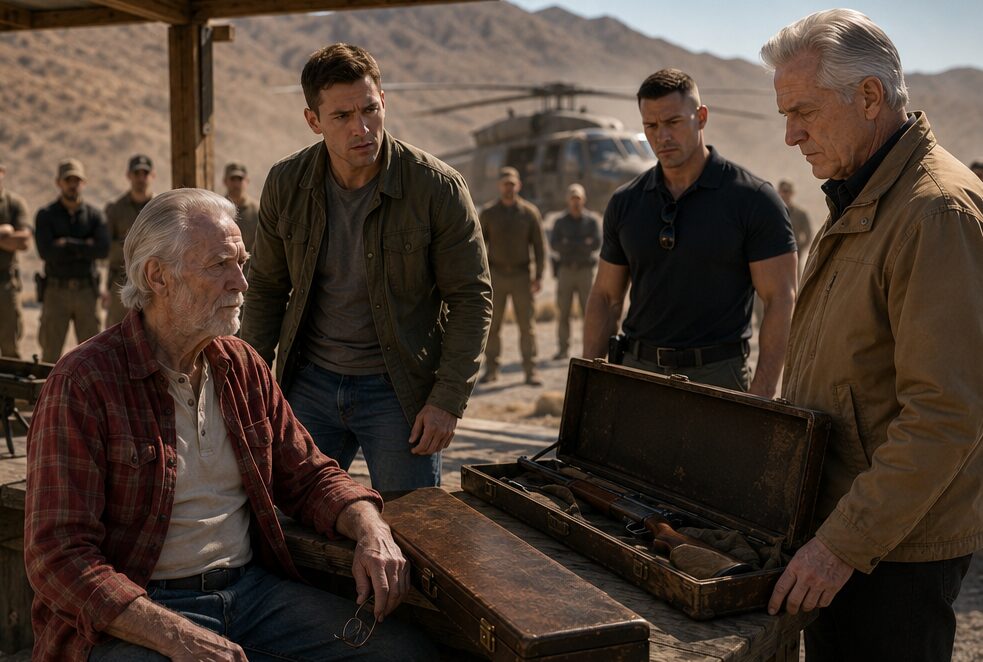
Richard sat beneath the cracked wooden shade structure at the far end of the firing range, his faded red plaid shirt buttoned crooked at the collar, his old shooting glasses folded in one sun-spotted hand. He did not look at the range officer. He looked past him, toward the dry mountains beyond the berm, where heat shimmered above the sand like something trying to escape the earth.
Beside him, his grandson Joshua shifted on his feet.
“Come on,” Joshua said, forcing a polite laugh that sounded more like an apology. “He knows what he’s doing.”
The range officer, Mark, was broad-shouldered, close-cropped, wearing a black polo with the range logo over his chest and sunglasses hooked at his collar. He glanced at Richard the way people glanced at unsteady ladders.
“I’m sure he did,” Mark said. “At some point.”
A couple of younger men two lanes over turned their heads. One of them smirked into his water bottle.
Joshua’s jaw tightened. Richard noticed, but said nothing.
That was one of the things Joshua hated most.
His grandfather could absorb a slap and make the room feel like it had imagined the sound.
“Sir,” Mark continued, softening his voice in the way people did when they wanted to seem kind while stripping someone of dignity, “we just have protocols. I can’t have an elderly guest handling a firearm without confirming basic safety.”
Richard’s thumb moved once across the edge of his shooting glasses.
“I’m not a guest,” he said.
Mark blinked. “Excuse me?”
Richard looked at the rifle case on the bench.
“I called ahead.”
Joshua closed his eyes for half a second. This was exactly why he had come. Not to protect the range from Richard, not really. To protect Richard from moments like this.
His grandfather had insisted on driving out here before dawn. Not the indoor range near town. Not the veterans’ club basement with its coffee urn and faded flags. This place. Two hours into the desert, past gas stations with handwritten signs, past sun-bleached trailers, past the old boundary markers of a government training corridor everyone knew not to ask too much about.
Richard had carried the long, weathered case himself from the truck to the bench.
He had refused help.
Then, at the counter, when the girl asked for ID, he had forgotten which pocket held his wallet.
That was all Mark needed to decide what kind of old man he had in front of him.
Joshua had seen it happen too many times. A pause became confusion. A tremor became incompetence. Silence became emptiness.
“Grandpa,” Joshua said quietly, “let me handle the paperwork.”
Richard did not answer.
The case sat between them, dark, scarred, and old enough to look like it belonged in a museum. Its latches were worn silver at the edges. A strip of faded yellow tape clung to one side, nearly peeled away. There was a stencil burned or stamped into the lid, too faint for Joshua to read.
Mark leaned closer.
His expression changed.
“What is that number?” he asked.
Richard’s hand went still.
Mark bent over the case, squinting at the stencil. “Where did you get this?”
“It was issued to me,” Richard said.
The younger men at the other lane laughed under their breath.
Mark straightened. “Issued.”
Richard finally turned his face toward him.
His eyes were pale and tired. But there was something behind them Joshua rarely saw anymore. Not anger. Not confusion.
Warning.
“Yes,” Richard said. “Issued.”
Mark looked at Joshua as if asking whether this was part of the problem.
Joshua felt heat rise up his neck. “He served,” he said.
“A lot of people served,” Mark replied. “That doesn’t mean they can bring restricted property onto a civilian range.”
Richard’s fingers closed around the shooting glasses.
Joshua stepped forward. “Watch your tone.”
Mark’s own posture hardened. “I’m doing my job.”
“No,” Joshua said. “You’re talking down to him because he’s old.”
The range went quieter.
Richard did not move.
Mark looked at the case again, then at the stencil. His confidence shifted from casual authority to concern. He pulled a small radio from his belt and turned away.
Joshua caught only pieces.
“Old range-marked case… serial looks like restricted corridor inventory… yes, decades old… no, he says issued…”
Richard watched the mountains.
“Grandpa,” Joshua whispered, “what is this?”
Richard’s mouth moved as if forming an answer.
Then he stopped.
“Leave the case shut,” he said.
That was all.
Within five minutes, the range manager cleared the far lane.
Within seven, Mark was no longer smirking.
Within ten, a sound rolled over the desert from beyond the ridge, low and mechanical, like the sky clearing its throat.
Everyone looked up.
A helicopter appeared above the mountains.
Joshua turned toward his grandfather.
Richard was still seated beneath the broken shade, his old glasses in his hand, the case unopened in front of him.
For the first time that morning, Joshua wondered if the range had not been chosen because of the rifle.
Maybe it had been chosen because something buried here had been waiting for him.
Part II — The Man From the Dust
The helicopter came in low, sweeping dust across the far side of the range until the targets disappeared behind a brown wall.
Mark stood straighter before the aircraft had even touched down.
Joshua almost hated him for it.
Five minutes ago, Mark had spoken to Richard like he was a child in a grocery store aisle. Now, because someone official was arriving, his chin lifted, his shoulders squared, and his voice tightened into respect.
Richard watched the dust without blinking.
“What did you do?” Joshua asked.
His grandfather’s face did not change.
“I got old,” Richard said.
It was the kind of answer that ended a conversation without satisfying it. Joshua had heard those all his life.
Where were you stationed?
“Hot places.”
Did you ever get scared?
“Everybody worth trusting gets scared.”
Why did Dad say you were gone even when you were home?
Richard had never answered that one.
The helicopter settled beyond the berm. Two aides stepped down first, then a silver-haired man in a tan field jacket. He moved with a controlled economy that made the range seem suddenly sloppy around him. Even the dust appeared to give him room.
Mark hurried to meet him.
The man did not hurry back.
Joshua read authority before he read the name tape. David. Colonel David, if the insignia meant what Joshua thought it meant. He looked to be in his fifties, maybe older, with the hard calm of someone used to being obeyed and the harder exhaustion of someone who had paid for it.
Mark spoke quickly, pointing at the case.
The colonel’s eyes moved to Richard.
For a moment, nothing happened.
Then he walked over.
“Sir,” the colonel said. Not warm. Not rude. Careful. “I’m Colonel David. I command the installation north of here.”
Richard lifted his chin a fraction.
“I know where it is.”
David looked at the case. “May I ask where you obtained that?”
Richard’s answer was quiet.
“It was issued to me.”
Behind the colonel, Mark muttered, “A lot of old guys say things like that.”
Joshua heard it.
So did David.
So did Richard.
Only Richard seemed willing to let it pass.
The colonel turned his head just enough for Mark to understand that he had stepped beyond his place.
Then he looked back at Richard. “May I open it?”
Richard’s hand rested on the lid.
“No.”
The answer was so immediate that everyone froze.
Joshua stared at him. He had never heard his grandfather use that voice with anyone outside the family. Not loud. Not threatening. Just final.
David studied him.
“This property may still belong to the Department of Defense.”
“It belonged to a man,” Richard said.
The words cut the air cleanly.
Joshua’s irritation faltered.
A man.
Not a unit. Not a department. Not a memory.
A man.
David’s expression tightened. “What man?”
Richard looked back to the mountains.
“One who doesn’t get to answer you.”
The aides shifted. Mark swallowed.
Joshua felt the story opening beneath his feet, and for the first time, he was afraid of what might be inside it.
David lowered his voice. “Sir, if this case is connected to restricted range inventory, I’m obligated to identify it.”
Richard was silent.
Joshua leaned toward him. “Grandpa. Just tell him.”
Richard turned to him then.
There was no anger in his face. That was worse.
“You’ve wanted me to talk for years,” Richard said.
Joshua’s throat closed.
“I’m asking now,” Joshua said.
Richard looked at the case.
Then he lifted his hand from the lid.
The colonel opened the first latch.
The sound was small.
Joshua heard it like a door unlocking somewhere inside his family.
The second latch clicked.
The lid rose.
Inside lay an old rifle wrapped in dark cloth, a folded range card stiff with age, and a small cloth patch faded almost gray. No medals. No photographs. Nothing impressive enough for the silence it created.
But David saw the patch.
His face changed.
Not dramatically. He was too disciplined for that. But something retreated behind his eyes, and something else came forward.
“You were attached to this unit?” he asked.
Richard said nothing.
David reached into the case and lifted the range card. There was writing on the inside flap, dark and cramped, as if someone had written it in poor light.
The colonel read the name.
“Jason.”
Richard’s hand tightened around the shooting glasses.
Joshua saw it.
The tremor was gone.
This was not age.
This was impact.
The colonel looked up slowly. “Jason was with you?”
Richard closed his eyes.
For one second, the desert range, the men, the helicopter, the dust, the smirking shooters, Joshua’s embarrassment, all of it seemed to lose shape.
When Richard opened his eyes, they were no longer tired.
They were somewhere else.
“Yes,” he said.
The word cost him.
Joshua had heard hundreds of names in his grandfather’s house. Neighbors. Nurses. Repairmen. His late grandmother’s friends. Men from church. The guy who delivered propane.
Never Jason.
Not once.
David looked toward his aides. “Step back.”
Mark moved too.
Richard turned. “Joshua stays.”
Joshua blinked.
David paused. “This may involve classified material.”
Richard did not look away from the colonel.
“He’s earned the burden of knowing.”
The words struck Joshua harder than any apology would have.
Because they were not gentle.
And because, somehow, they were love.
Part III — The Name Inside the Case
The range was silent now except for the helicopter ticking down in the distance.
No one fired. No one laughed.
The younger shooters had stopped pretending not to watch.
David stood across from Richard at the bench, the old range card in his hand. Mark hovered several feet away, suddenly unsure whether he was allowed to exist loudly.
Joshua felt trapped between wanting answers and fearing what those answers would do to the grandfather he thought he knew.
“Jason served under my father,” David said.
Richard’s face shifted, just barely.
“Your father was Paul David?”
The colonel nodded once.
Richard looked down. “He had steady hands.”
David’s jaw worked. “He came home believing you left Jason behind.”
The sentence landed in the dust.
Joshua turned toward his grandfather.
“What?”
Richard did not defend himself.
That was the part that hurt. Not the accusation. Not even the possibility that it was true.
It was that Richard received it like an old bill finally being presented.
David’s voice remained controlled, but something personal had entered it.
“My father carried that story for the rest of his life. Jason was his friend. He told me Richard was the officer who made the call and left him.”
Joshua’s ears rang.
His grandfather had been hard to love sometimes. Quiet at birthdays. Late to graduations. Absent in the middle of conversations. He had stood at Joshua’s father’s funeral like a man waiting for orders no one would give.
But abandonment?
No.
Joshua looked at Richard and waited for outrage.
Richard only said, “Your father deserved someone to blame.”
The words were so calm that Joshua almost hated him for them.
“That’s it?” Joshua asked. “That’s all you’re going to say?”
Richard looked at him.
There were years in that look. Years Joshua had mistaken for coldness because no one had given him another language for it.
“You want me to say I didn’t?” Richard asked.
“Yes.”
“Then what?”
Joshua opened his mouth.
Nothing came.
Richard turned back to David. “Your father was a good man.”
“He thought you weren’t,” David said.
“I know.”
“You let him.”
“Yes.”
Joshua stepped away from the bench, then stepped back because distance did not help. “Why would you let people believe that?”
Richard’s gaze dropped to the open case.
“The truth had names in it.”
David’s expression tightened.
Richard touched the edge of the folded cloth but did not lift it from the rifle.
“Names of people who had no uniforms,” he said. “Families. Guides. A woman who carried messages inside bread baskets because no one searched her twice. A boy who knew every dry wash between the border and the old road.”
Mark’s face had gone pale.
Richard kept his voice level, almost too level.
“Some of them had children. Some of them had brothers who would have sold them for less than a blanket. The report said one man was abandoned. That was easier to bury than the list of everyone who got us out.”
Joshua felt something inside him turn and fail to settle.
“You could have told us,” he said.
Richard’s eyes moved to him.
“Could I?”
The question was not cruel.
That made it worse.
Joshua thought of his father, angry and drunk on certain anniversaries, saying Richard had chosen the Corps over his own family. Thought of his grandmother shutting cabinet doors too hard whenever someone mentioned service records. Thought of Richard sitting alone on the porch at dusk, not asleep, not awake, just gone somewhere no one else could follow.
Joshua had grown up believing silence was something Richard did to them.
Now he was beginning to understand it might have been something Richard did to himself first.
David looked toward one of his aides. The aide, a young woman with a tablet and a sealed folder under one arm, hesitated until he nodded.
She handed him the folder.
David stared at it for a moment before opening it.
“This was attached to the inventory alert after the serial number matched,” he said. “Recently declassified addendum. I had not read it before I landed.”
Richard did not reach for it.
David scanned the first page.
His face changed again.
This time, the discipline did not fully hold.
He read silently for too long.
Joshua could not stand it.
“What does it say?”
David did not answer immediately.
When he looked up, the authority in him had altered. It had not disappeared. It had become heavier.
“It says the extraction order was compromised,” he said. “It says Jason was separated during the withdrawal. It says Richard remained behind after the team pulled out.”
Mark looked at Richard.
Joshua stopped breathing.
David continued, voice lower now.
“It says he redirected the pursuing forces away from the extraction route. Created a false trail through the southern wash. Drew attention to himself long enough for the rest of the team to cross.”
Richard closed the case lid halfway, then stopped, as if he had forgotten what his hand had meant to do.
David turned the page.
“It also says he requested that the official record remain unchanged until all civilian assets connected to the operation were confirmed safe or deceased.”
The dust moved across the range in a thin sheet.
No one spoke.
Joshua stared at his grandfather.
All those years.
All those dinner tables.
All those unanswered questions.
All the anger passed down like furniture no one wanted but everyone kept.
“You chose that?” Joshua asked.
Richard’s voice was barely audible.
“Yes.”
“For strangers?”
Richard looked at him then, and the sharpness returned.
“No one is a stranger after they risk their life for yours.”
Joshua had no answer.
David lowered the folder.
“My father died believing you left him.”
Richard nodded once.
“I know.”
“You could have corrected him later.”
“I could have.”
“Why didn’t you?”
For the first time, Richard’s control almost broke.
Because he smiled.
Not with humor. With grief.
“Because by the time I could speak safely, your father had built a life around hating me. I was not going to take Jason from him twice.”
David looked as if the sentence had struck him physically.
Mark took a step back.
Joshua saw him now—not the range officer, not the man who had talked down to Richard—but a younger man discovering too late that the old are not empty simply because they do not explain themselves on demand.
David closed the folder.
His voice was different when he spoke again.
“What do you want done with the record?”
Richard looked at the open case.
“I came to return something,” he said.
“That isn’t what I asked.”
“It’s the only answer I have.”
Part IV — What Could Be Corrected
The sun had climbed higher, flattening every shadow until the world seemed made of glare.
Richard sat at the bench while men half his age stood around him waiting for permission to understand his life.
Joshua hated how much that image hurt.
He had come to the range annoyed. He had spent the drive glancing at his grandfather every few miles, wondering if Richard should still be allowed to live alone, still drive, still keep old keys whose locks no longer existed. He had been kind on the surface and doubtful underneath.
That doubt now tasted like shame.
David placed the folder on the bench beside the case. “This addendum can be entered into the installation archive. I can also send it to the veterans’ registry. There may be a formal correction.”
Richard’s mouth tightened at the word formal.
“No ceremony.”
David nodded slowly. “No ceremony unless you request one.”
“No speeches.”
“No speeches.”
“No newspaper.”
Joshua looked at him. “Grandpa—”
Richard did not turn.
“No newspaper,” he repeated.
Joshua swallowed the argument.
Because now he understood enough to know that his grandfather’s dignity could not be repaired by putting it on display.
Mark stepped closer, then stopped.
“Sir,” he said.
Richard looked at him.
Mark’s face was red under the desert sun. His confidence had not vanished, but it had changed into something smaller and more human.
“I owe you an apology.”
Richard waited.
Mark seemed to realize that apology was not a performance either.
“I spoke out of turn,” he said. “Worse than that. I made assumptions.”
Richard looked at him for a long second.
Then he said, “You enforced a rule.”
Mark’s face twisted. “I hid behind one.”
No one rescued him from the silence that followed.
Richard nodded once.
It was not forgiveness exactly. It was permission for Mark to carry the lesson without making Richard carry his shame too.
David glanced at the case. “You said you came to return something.”
Richard opened the lid fully.
This time, Joshua watched his hands.
They trembled, yes. The skin was thin. The knuckles were swollen. The tendons stood up like cords beneath paper.
But there was no confusion in them.
Richard unwrapped the rifle with the care of someone uncovering a sleeping face. It was old and maintained, the wood darkened by oil and time. Joshua knew nothing about rifles except what movies had taught him, and even he understood this was not an object Richard had brought for sport.
“This was Jason’s,” Richard said.
No one corrected the name. No one asked for a last name. The way Richard said it made the rest unnecessary.
David’s aide looked toward the colonel. “Sir, range authorization would need—”
“I can authorize it,” David said.
Richard looked up. “One round.”
Mark cleared his throat. “The range is cold right now. We’d need to reset safety.”
The old Mark might have made that sound like a barrier.
This Mark made it sound like a promise to do it properly.
David looked at Richard. “Is this what you want?”
Richard’s eyes moved to the mountains.
Joshua followed his gaze and wondered how many ghosts could fit in a line of hills.
“No,” Richard said.
Then he picked up a single round from inside the case.
“It’s what I owe.”
Joshua’s throat tightened.
For most of his life, he had thought owing meant debt. Money. Time. Apologies. Calls returned too late.
Richard used the word like it meant keeping company with the dead.
Mark cleared the range himself.
The other shooters were moved back, not angrily, not dramatically. They went quiet as they understood, even without understanding. Dust dragged itself across the ground. The helicopter blades sat still now, their silence somehow larger than their noise had been.
Richard placed the rifle on the bench.
Joshua instinctively reached forward.
Richard stopped him with two fingers raised.
“Don’t steady me.”
Joshua froze.
His grandfather’s voice softened.
“Stand behind me.”
Joshua stepped back.
Not beside him.
Not over him.
Behind him.
Witness, not handler.
That was the difference, and it nearly broke him.
Richard settled into the chair. His body moved slowly, but every motion had purpose. He checked the rifle, placed the round, lowered his cheek, then paused.
His breathing changed.
David stood to the side, folder in hand. Mark stood near the safety line, rigid, eyes forward.
Joshua saw the entire morning fold back on itself.
The same bench.
The same case.
The same old man.
But nothing meant what it had meant before.
Richard lifted his head before firing.
For a moment, Joshua thought he had changed his mind.
Then David stepped forward.
The colonel’s boots stopped in the dust.
He brought his hand up in a formal salute.
No one told him to.
No one announced it.
The gesture simply entered the day and remade it.
Richard did not look at him at first.
His eyes stayed on the rifle, on the old wood, on the thing that had outlived the man who owned it.
Then slowly, he turned.
The salute held.
David’s face was not ceremonial now. It was stripped down to something older than rank.
Recognition.
Mark stared. Then, awkwardly, as if afraid he had no right and more afraid not to, he raised his own hand.
The younger shooters stood still behind the line.
Joshua did not salute.
He placed one hand on the back of Richard’s chair.
The wood was hot under his palm.
Richard looked at David for a long time.
Then he gave the smallest nod Joshua had ever seen.
It was enough.
He turned back to the berm.
The rifle sounded once across the desert.
Sharp.
Brief.
Final.
Dust lifted from the far rise and drifted away.
Richard kept his cheek against the stock for one breath, then another.
When he sat back, his eyes were wet, but he did not wipe them.
He whispered one word.
“Jason.”
Joshua heard it.
So did David.
So did the desert, if the desert remembered anything at all.
Part V — The Record and the Road
Richard refused the photograph.
He refused the handshake line before anyone could form one.
He refused the offer to be flown back to town.
What he accepted was quieter.
David would correct the archive.
The sealed addendum would no longer sit in a file waiting for someone else’s accident to open it. The official record would not become a story for the news. It would become accurate. That was enough, or at least it was all Richard would permit.
David stood with him beside Joshua’s truck while Mark carried the empty range flag back to its hook.
“My father should have known,” David said.
Richard looked tired now. Truly tired. The kind of tired that had nothing to do with age and everything to do with having held a door shut for too long.
“Yes,” Richard said.
David’s mouth tightened.
“But not at any cost,” Richard added.
The colonel looked away toward the mountains.
“My father hated you.”
“He was allowed.”
“I’m not sure I know what to do with that.”
Richard leaned one hand against the truck door.
“Neither did he.”
David nodded, and this time the gesture had no authority in it.
Only a son receiving a smaller inheritance than he had expected and a heavier one than he wanted.
Mark approached last.
He did not offer another apology. That was wise.
Instead, he held out the shooting glasses Richard had left on the bench.
“Sir,” he said.
Richard took them.
“Thank you.”
Mark hesitated. “Will you come back?”
Joshua expected Richard to say no.
Richard looked toward the range, then at the case in Joshua’s hands.
“No,” he said.
Mark accepted it.
Then Richard added, “But don’t talk to the next old man like you know what he’s carrying.”
Mark’s eyes dropped.
“No, sir.”
Joshua helped the case into the truck bed, then stopped himself.
Helped was not the word.
He placed it there carefully, both hands beneath it, as if setting down something that could still feel.
Richard watched him.
For once, Joshua did not fill the silence.
The drive back began without music.
The road unspooled through the desert, pale and long. Joshua kept both hands on the wheel. Richard sat beside him, shooting glasses in his lap, looking out the window.
An hour passed.
Then Richard said, “Pull in there.”
Joshua followed his gaze to a roadside diner with a sun-faded sign, two pickups out front, and a row of dusty windows reflecting the afternoon.
“You hungry?” Joshua asked.
“No.”
They went in anyway.
A waitress named Katherine, according to her tag, poured coffee without asking too many questions. Richard ordered toast. Joshua ordered pie he did not want.
For a while, they sat across from each other in a booth patched with silver tape.
Joshua wanted to ask everything.
He wanted names. Dates. Places. Why his father had never known. Why his grandmother had stayed. Why Richard had let the family turn his silence into accusation and then inheritance.
But he had learned something at the range.
Some questions were doors.
Some doors were graves.
So he waited.
Richard tore the corner from a piece of toast.
“He hummed,” he said.
Joshua looked up.
“Who?”
Richard’s eyes stayed on the toast.
“Jason.”
The diner noise seemed to thin around them.
“When he was scared, he hummed off-key. Same three notes. Drove everybody crazy.” Richard’s mouth moved, almost a smile. “He said if he ever stopped, we should worry.”
Joshua did not speak.
Richard looked out the window at the highway.
“That last night,” he said, “I heard him humming before I saw him. Dark as a closed fist. Couldn’t see my own hands. But I heard those three bad notes and thought, good, Jason’s still scared. Scared meant alive.”
His voice held.
Then it lowered.
“That’s the part I kept.”
Not the file.
Not the accusation.
Not the report.
Three bad notes in the dark.
Joshua felt his eyes burn. He turned his coffee cup between his hands so he would not reach for a grief that did not belong to him.
“Why tell me that?” he asked.
Richard looked at him then.
“Because the record can hold what happened.”
He pushed the toast aside.
“But somebody should hold who he was.”
Joshua nodded, because he could not trust his voice.
Outside, the desert light softened. The truck waited near the door with the old case in the back, no longer looking like evidence or danger or proof.
When they finally left, Richard walked slower than he had that morning.
Joshua did not take his elbow.
He walked beside him.
At the truck, Joshua lifted the case again, careful with its weight. Richard watched, then opened the passenger door himself.
Before getting in, he looked once toward the west, where the road ran back through miles of dust and heat and silence.
Joshua waited.
Richard put on his old shooting glasses.
Not because he needed them.
Because they were his.
Then he climbed into the truck, and Joshua carried the case the rest of the way home.