Where She Stood
Part I — The Pin
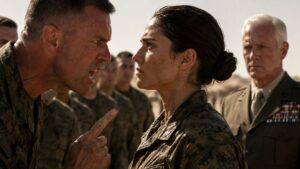
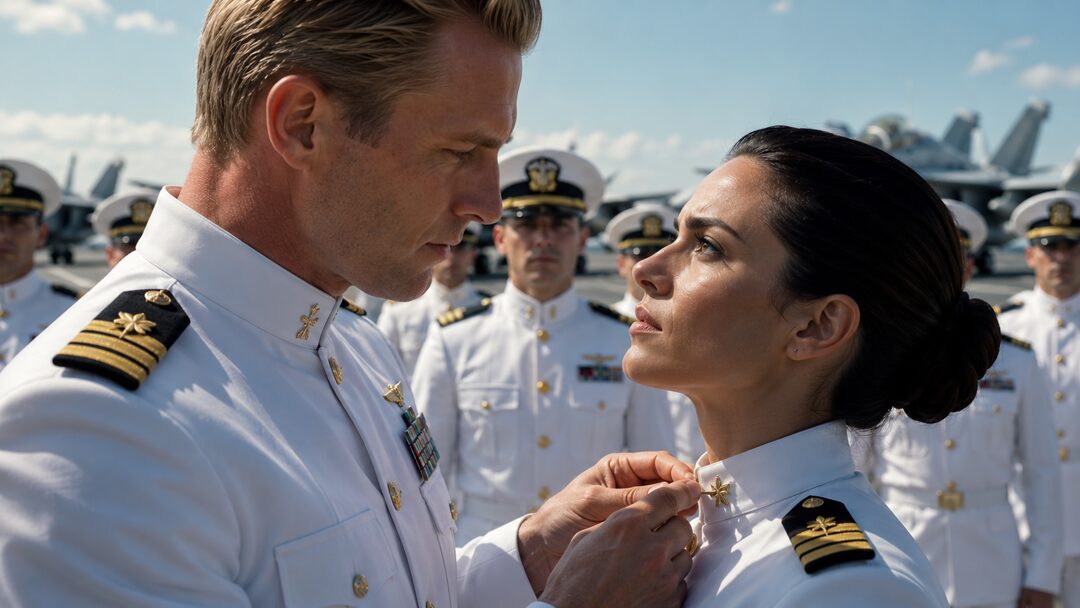
Captain William Saffron stood close enough for Lieutenant Sarah Mitchell to feel the heat of his hand before he touched the new insignia to her collar.
The entire flight deck watched.
White uniforms. Gold stripes. Parked jets gleaming under a hard blue sky. A ceremony built to look clean, controlled, unquestionable.
Sarah did not move.
Saffron’s fingers worked with perfect care at her collar, fastening the small bright symbol into place as if he were honoring her. His face was inches from hers. Blond hair slicked back. Blue eyes steady. A mouth that knew how to smile without giving anything away.
For three seconds, nobody could have said whether he was promoting her, warning her, or daring her to breathe first.
Sarah kept her eyes on his.
He finished the pin, stepped back, and smiled.
It was not a kind smile.
It said, I know exactly what you are.
It also said, I know where you belong.
“Lieutenant Mitchell,” he said, voice carrying across the deck, “your performance under review has been noted.”
A few officers shifted. Not enough to break formation. Enough for Sarah to feel the deck change under her feet.
Saffron’s gaze dropped briefly to the insignia he had just pinned, then returned to her face.
“You should have remembered your place.”
The sentence landed harder because he did not raise his voice.
The carrier seemed to go quiet around it. Jet engines in the distance. Wind pulling at flags. A hundred trained faces pretending they had not just watched a public humiliation dressed as ceremony.
Sarah’s jaw tightened once.
Not enough for anyone but Saffron to notice.
Her old self would have swallowed it. Her old self had swallowed worse from men with cleaner records and dirtier hands. Her old self had learned that discipline meant silence.
But silence had a sound.
It sounded like static over a radio.
It sounded like a hull groaning in black water.
It sounded like a name she had not said aloud in eight months.
Sarah lifted her chin.
“No, Captain,” she said. “You should have remembered mine.”
The deck froze.
Saffron did not blink.
For one dangerous second, they looked less like captain and lieutenant and more like two people standing on opposite sides of a door that had just been kicked open.
Then his smile disappeared.
“Dismissed,” he said.
The officers snapped into motion. The ceremony dissolved with military precision, but whispers moved faster than boots.
Sarah turned first.
She walked away with her shoulders square, the new insignia bright on her collar, and every eye on her back.
She did not look down.
She could not afford to.
Not when she knew the worst mistake of her life had started the same way.
With everyone watching.
And no one speaking.
Part II — The Report No One Wanted
Saffron summoned her before she reached the inner passageway.
Not personally. He would not give her that.
A junior officer appeared at her side, too young to hide his discomfort. “Captain requests you in compartment three, Lieutenant.”
Requests.
Sarah almost smiled.
On the U.S.S. Resolute, a request from William Saffron had the weight of a locked door.
She followed.
The compartment was narrow, windowless, and too bright. Saffron was already there when she entered, his cap set on the table, his white uniform immaculate enough to make anger look like a stain on anyone else.
The door shut behind her.
He did not invite her to sit.
“You embarrassed yourself out there,” he said.
Sarah stood at attention. “I answered a statement, sir.”
“You challenged your commanding officer in front of crew.”
“You promoted me in front of crew, then used the moment to remind them I was still beneath you.”
A muscle moved in his cheek.
There it was—the part of him that lived under the polish.
Saffron stepped closer. “Careful.”
“I have been careful for weeks.”
“No,” he said. “You have been disruptive.”
Sarah’s eyes cut to the folder on the table. Her folder. Thin. Marked internal. Marked reviewed. Marked, in the language of institutions, buried.
“You read it,” she said.
“I read your report.”
“And dismissed it.”
“I evaluated it.”
“You buried it.”
His gaze hardened. “Lieutenant.”
She heard the warning.
She also heard the ocean beyond the steel walls.
“The sensor grid showed unstable pressure behavior along the southern approach lane,” she said. “Current distortion outside forecast range. Repeating wave interference along the projected exercise path. I flagged it before we entered the zone.”
“This exercise has been planned for months.”
“The sea did not sign off on the plan.”
His eyes flashed.
It should have frightened her.
Instead it made something in her go very still.
Saffron’s voice lowered. “You are newly promoted. You are talented. You are also developing a reputation for mistaking personal alarm for operational insight.”
Sarah felt the words enter the room before he said the rest.
He knew enough.
Not all of it. But enough to use.
“Is that what this is?” she asked. “You think I’m seeing ghosts?”
“I think your last deployment affected your judgment.”
Her breath caught once.
Small. Controlled.
But Saffron saw it.
Of course he did.
That was the thing about him that made him dangerous. He noticed everything except what he did not want to believe.
“The Edisto was not a ghost,” Sarah said.
His expression changed. Not softer. Not exactly.
More guarded.
“I never said it was.”
“No. You just built your conclusion on it.”
The compartment hummed around them. Somewhere overhead, boots crossed metal. The ship kept moving, steady and enormous, through water that did not care who commanded it.
Sarah looked at the folder again.
“You promoted me because removing me would raise questions,” she said. “Keeping me close looks cleaner.”
Saffron’s eyes narrowed.
“You think highly of your importance.”
“No, sir. I think you do.”
For a moment, the air between them felt as close as it had on the deck.
This time there was no sun. No crew. No ceremony.
Only the two of them and the thing neither wanted to name.
Saffron reached for the folder, closed it, and slid it away from her.
“The exercise proceeds,” he said. “You will perform your assigned role. You will not undermine command cohesion again.”
Sarah looked at the folder under his hand.
Then at the insignia he had pinned on her collar.
“Command cohesion,” she said, “doesn’t mean everyone agrees to be wrong at the same time.”
Saffron’s mouth tightened.
“Dismissed.”
Sarah turned.
At the door, he said her name.
Not Lieutenant.
“Sarah.”
She stopped.
It was too personal. Too late. Too dangerous.
His voice was quieter now. “If you are wrong, this ends your career.”
She did not look back.
“If I’m right,” she said, “careers won’t be the problem.”
Part III — The Wrong Shape in the Water
By late afternoon, the sky had turned the color of old steel.
The Resolute moved into the exercise zone with escorts spread beyond visual range, their signals flickering across displays in controlled patterns. Officially, the weather remained within acceptable limits. Officially, the readings were noisy but manageable. Officially, nothing Sarah had warned about was happening.
Chief Daniel Harper stood behind the bridge console with one hand braced on the rail.
He had the face of a man who had seen enough official statements drown in real weather.
“Pressure dropped again,” Sarah said.
Harper glanced at the display. “How much?”
“Too fast.”
“That a technical answer, Lieutenant?”
“That’s the polite one.”
His mouth twitched, but his eyes stayed on the numbers.
Rain began as a tap against reinforced glass. Then another. Then a thousand. The horizon blurred until sea and sky became one dark sheet.
Ensign Emily Carter sat at communications, pale under the green glow of her screen. A strand of hair had escaped under her headset and stuck to her cheek. She kept pushing it back, then forgetting it.
“Signal delay from escort group two,” Emily said.
Saffron stood center bridge, jacket still crisp, posture untouched by weather. “Cause?”
“Interference, sir. Could be storm scatter.”
“Could be exercise masking,” another officer added. “Simulated hostile disruption.”
Sarah looked at the sea-state model.
The pattern was wrong.
Not dramatic. Not obvious. Not the kind of wrong that let a person pound the table and be believed.
It was worse than that.
It was familiar.
A line of numbers tilted in a way she had seen once before, on a smaller screen, in a smaller ship, under a darker command.
Eight months ago, the Edisto had been running support off a remote station when the data first bent out of shape. Sarah had been junior enough to be quiet and experienced enough to know better. A senior officer had dismissed the warnings as sensor lag. Sarah had looked at the sea. Looked at the man in charge. Looked at the sailor beside her, Mark Ellis, who had nudged her boot under the console and whispered, “Say it again.”
She hadn’t.
Not hard enough.
Not loud enough.
Not in a way that cost her anything before it cost him everything.
A burst of static snapped her back.
Emily pressed one hand to her headset. “Repeating distortion on channel six.”
Saffron turned. “From?”
“Unclear, sir.”
“Define unclear.”
Emily swallowed. “It’s registering like a moving contact, but it’s broad. Too broad.”
Sarah moved before she meant to.
Harper saw her cross the bridge. He did not stop her.
“Show me,” she said.
Emily hesitated.
Saffron’s voice cut across the bridge. “Lieutenant Mitchell is not in command of communications.”
Sarah kept her eyes on the screen. “No, sir. But I can read what it’s trying not to say.”
No one moved.
Then Harper leaned in just enough to make his choice visible.
“Put it up, Ensign.”
Emily’s fingers trembled once, then obeyed.
The display expanded.
A smear of signal moved across the edge of the screen. Not a dot. Not a formation. A wide, unstable return pushing through noise.
Sarah’s stomach went cold.
The room around her narrowed until there was only shape, speed, pressure, direction.
“No,” she whispered.
Saffron heard. “Report.”
Sarah looked at the numbers again, hoping she had misread them.
She had not.
The contact was not coming at them like an object.
It was arriving like a wall.
“Unknown contact,” Emily said, voice tightening. “Closing fast.”
The bridge changed in a breath.
Officers straightened. Defensive systems chatter began. A simulated hostile platform was part of the exercise. Everyone knew it. Everyone had been waiting for the trick.
Saffron moved toward command mode instantly.
“Confirm classification.”
“Signal unstable.”
“Range?”
“Closing. Very fast.”
“Prepare defensive posture.”
Sarah turned sharply. “Belay that.”
The bridge went silent in the wrong way.
Saffron faced her.
“Excuse me?”
“It’s not hostile hardware.”
“We don’t know what it is.”
“I do.”
His eyes held hers, cold and bright. “Then say it clearly.”
Sarah felt the old room. The old screen. Mark’s boot against hers.
Say it again.
She did.
“It’s water.”
For half a second, nobody understood.
Then someone exhaled.
Saffron’s voice was flat. “Explain.”
“The pressure drop, the current distortion, the false return. It’s not a contact in the water. It’s the water itself. A rogue formation moving ahead of the storm line.”
An officer near navigation muttered, “That size? Impossible.”
Sarah did not look at him.
“Impossible is not a measurement.”
Saffron stepped closer. Rain hammered the glass behind him. “You are asking me to alter course in a classified exercise based on an unconfirmed interpretation.”
“I’m asking you to clear exposed decks and reduce angle exposure now.”
“Without confirmation?”
“With every confirmation that matters.”
His face tightened. “Your history is not confirmation.”
The words hit.
Not because they were cruel.
Because part of her had feared they were true.
The bridge waited for her to break.
Sarah did not.
“My history is why I checked twice,” she said. “Your pride is why we’re still talking.”
Harper’s eyes flicked toward Saffron.
Emily went very still at communications.
Saffron’s voice dropped into command steel. “Lieutenant Mitchell, stand down.”
The ship groaned beneath them.
Not loudly.
Enough.
Sarah turned to the forward glass.
Far out in the blackening distance, past the sheets of rain, the horizon lifted where it should have stayed flat.
Her pulse slowed.
That was always how fear came to her now.
Not as panic.
As clarity.
“Captain,” she said, “clear the deck.”
Saffron did not answer.
And that was the moment she understood he would wait too long.
Again.
Part IV — The Order
Sarah crossed to communications.
Emily looked up at her with wide eyes.
“No,” the young ensign whispered before Sarah said anything.
Sarah leaned down. “Open deck channel.”
Emily’s hands hovered above the controls. “He didn’t authorize it.”
“I know.”
“I can’t.”
“You can.”
Emily’s eyes flicked to Saffron.
The captain was already moving toward them.
“Lieutenant,” he said, each syllable sharp enough to cut.
Sarah did not turn. “Emily. Look at me.”
Emily did.
The girl looked impossibly young.
Sarah hated that she had to ask this of her.
But the deck outside was full of people in foul-weather gear fastening equipment, checking aircraft restraints, doing exactly what duty had told them to do.
Duty would keep them there until water took them.
“Open the channel,” Sarah said. “Or spend the rest of your life remembering the second you didn’t.”
Emily’s face changed.
Not brave.
Not yet.
Just awake.
Her hand came down.
The channel clicked live.
Sarah took the mic.
“All exposed deck personnel, this is Lieutenant Mitchell. Clear flight deck immediately. Repeat, clear flight deck immediately. Secure nearest access. Move now.”
Saffron ripped the mic from her hand.
“Cancel that order,” he snapped.
Emily stared at him.
Her lips parted.
No sound came.
Harper stepped beside her.
“Too late,” he said quietly.
Outside, through the rain-streaked glass, yellow-coated crew began to run.
Saffron turned on Sarah with a fury so controlled it looked almost calm.
“You have just committed a breach of command on my bridge.”
Sarah met his eyes. “Yes.”
“No defense?”
“Plenty. Not enough time.”
The first surge hit before he could answer.
It was not the great wave.
It was only its hand reaching ahead.
The carrier lurched with a violence that threw one officer into the console and knocked Emily’s headset loose. Alarms shrieked. The deck beyond the glass vanished under white water for a breath, then appeared again, slick and emptying fast.
A service cart tore loose and slammed sideways into a parked aircraft. A restraint cable snapped like a whip. Two crewmen barely reached the hatch before spray swallowed the place they had been standing.
Emily made a small broken sound.
Harper gripped the console and looked at Sarah.
Not gratitude.
Not surprise.
Confirmation.
Saffron stared through the glass.
For the first time all day, he looked less like a man commanding the ship and more like a man realizing the ship had been answering to something else.
“Report,” he said.
Voices collided.
“Partial steering lag.”
“Flooding reported below deck.”
“Aircraft restraints compromised.”
“Contact still closing.”
“Visual distortion forward.”
Sarah moved to the central display.
The numbers were worse now.
The main formation had accelerated.
No, not accelerated.
Revealed itself.
The storm had hidden the scale until scale was all there was.
Emily got her headset back on with shaking hands. “Captain, flight deck reports multiple injuries. But most personnel reached cover.”
Most.
Not all.
Sarah absorbed the word without letting it touch her face.
Leadership did not mean being untouched by consequence.
It meant not collapsing before consequence finished speaking.
Saffron turned to her.
There was anger still. There had to be. But beneath it something had shifted, unwilling and raw.
“How long?” he asked.
Everyone heard it.
He had asked her.
Sarah looked at the display. “Three minutes, maybe less.”
“Options?”
An officer at navigation said, “We can turn off face angle—”
“No,” Sarah said. “We’ll roll broadside before we complete.”
The officer flushed. “Then we hold—”
“We won’t hold.”
Saffron’s eyes stayed on Sarah. “Your recommendation.”
There it was.
Not surrender. Not trust.
A crack.
She stepped into it.
“We take it forward at a controlled angle. Not straight. Not broadside. We use the storm drift instead of fighting it.”
“That maneuver risks losing more steering.”
“Everything risks something now.”
Harper said, “She’s right.”
No one had asked him.
That was why it mattered.
Saffron looked at the chief. “You’re certain?”
Harper’s weathered face did not change. “No, sir. I’m experienced.”
Outside, the storm deepened until the flight deck disappeared in red emergency light and rain. The carrier shuddered again. Far ahead, something glowed beneath the dark.
At first it looked like a line of turquoise fire.
Then the line rose.
And rose.
And became a wall.
Emily whispered, “Oh my God.”
Nobody corrected her.
The wave was too large for language. It carried its own pale light, not clean or beautiful but living, dragged up from disturbed water and storm-charged air. Foam tore from its crest in long white strips. It seemed not to approach the ship but to erase the world between them.
Saffron’s face hardened back into command.
But his eyes changed.
He was not looking at Sarah as a problem anymore.
He was looking at her as time.
“How long do you need?” he asked.
Sarah understood the question beneath it.
How much of my authority do you require?
“Ninety seconds,” she said.
A murmur went through the bridge.
Saffron held her gaze. “To do what?”
“To put the ship where it should have been ten minutes ago.”
The old insult moved between them.
Place.
This time neither of them said it.
Not yet.
Part V — Ninety Seconds
The wind hit Sarah the moment she stepped onto the exposed access platform.
It shoved rain into her face, down her collar, under the edges of her storm jacket. Her white dress uniform was gone now, replaced by olive-green fabric soaked dark at the shoulders. But the insignia remained on her collar, bright and absurd against the chaos.
Saffron followed her out.
Harper stayed inside, relaying between bridge stations. Emily’s voice trembled through the open channel but held.
“Lieutenant, you’re live to navigation.”
Sarah gripped the rail.
The deck below was a nightmare of motion. Crew ran in broken lines. Red lights flashed across slick steel. A loose panel skidded past like a thrown blade of darkness. Far forward, water burst over the bow and spread in sheets.
And beyond it, the wave climbed higher than the ship’s island.
For one second, Sarah saw the Edisto instead.
A smaller deck. A smaller crew. Mark Ellis laughing because he had stolen the last decent coffee packet and split it with her anyway. Mark’s voice under the console: Say it again.
Then the radio static.
Then the silence.
Sarah blinked rain from her eyes.
The past stayed behind her.
The wave did not.
Saffron shouted over the wind. “Final confirmation, Lieutenant.”
She turned.
His blond hair was plastered to his forehead now. His dress-perfect control had been stripped down to something more human and more dangerous. Pride was still there. Fear too. Responsibility most of all.
He was not a villain.
That made what he had done harder to hate.
He had believed order would save them.
Sarah had believed speaking would.
Now the ship needed both.
“Final confirmation,” he repeated.
The wave’s glow painted his face blue-green.
Sarah looked at him, then past him, at the crew moving because of the order she had not been allowed to give.
Some had not moved fast enough.
She knew that already.
She would carry it later.
Not now.
Now was for the living.
A faint smile touched her mouth.
Not joy.
Not arrogance.
Recognition.
“You wanted me to remember my place,” she said.
Saffron went still.
Sarah faced the wave.
“This is it.”
For half a breath, nothing happened.
Then Saffron turned toward the open channel.
“Bridge, Captain Saffron. Lieutenant Mitchell has operational timing. Execute her commands until I say otherwise.”
The bridge went silent for one shocked second.
Then Harper’s voice came through, steady as iron. “Acknowledged.”
Sarah moved.
“Navigation, bring heading four degrees starboard on my mark. Not before. Engineering, hold thrust response until second mark. Deck control, seal all forward access. Emily, confirm closed channels only.”
Emily answered quickly now. “Closed channels confirmed.”
The carrier groaned under them.
Sarah watched the wave.
Not the height. Height lied.
She watched the base. The pull. The dragging water in front of it. The strange hollow forming where the ship would either climb or be taken wrong.
Timing became everything.
The whole world narrowed to seconds.
Saffron stood beside her and said nothing.
That, more than the command, almost broke her.
He trusted her silence.
Not because she had won.
Because the ship needed him to.
“Stand by,” Sarah said.
The wave filled the sky.
Emily’s breathing came over the line, then cut off as she muted herself.
Harper said, “All stations waiting.”
Sarah’s hand tightened on the rail.
The ship dipped.
There.
“Mark. Four starboard.”
“Four starboard,” navigation answered.
The deck tilted beneath her boots.
The wave rushed closer, glowing like the ocean had opened its eyes.
“Hold,” Sarah said.
The bow climbed.
Too slow.
For one terrible second, she thought she had misread it.
All her certainty cracked open, and behind it was Mark, and the Edisto, and the folder under Saffron’s hand, and Emily’s pale face at the console, and the crew running because Sarah had made them run.
Being right was not clean.
Being right was not safe.
Being right did not promise forgiveness.
“Sarah,” Saffron said.
Not Lieutenant.
Not this time.
She heard no doubt in it.
Only the question every commander fears asking.
Are you still there?
She was.
“Second mark,” she said. “Now.”
Engineering answered. The ship drove forward at the angle she had chosen.
The wave hit.
It did not crash like a thing falling.
It arrived like a country.
Water swallowed the bow, the deck, the lights. The world became white force and black sound. Sarah lost the rail. Saffron’s arm caught her before she went down, and then both of them slammed against the platform wall as the carrier rose into violence.
Steel screamed.
Something tore loose below.
The red lights vanished.
For a moment there was no ship, no rank, no breath.
Only water trying to teach the ocean its own authority.
Then the Resolute broke through.
Not cleanly.
Not heroically.
But through.
The deck dropped hard beneath them. Sarah hit her knees. Saffron went down beside her. Water poured past in rivers. Alarms shrieked from somewhere deep inside the ship.
Sarah coughed, dragged air into her lungs, and looked toward the bow.
The flight deck was still there.
Damaged. Torn open in places. Half-drowned in foam.
But there.
The ship was there.
Emily’s voice crackled through the channel, thin and shaking.
“Bridge to Lieutenant Mitchell. We’re still here.”
Sarah closed her eyes for one second.
Only one.
Then she opened them.
“Damage reports,” she said.
Saffron looked at her from the wet steel.
There was something in his face she had not seen before.
Not apology.
Not yet.
Something harder.
Respect, arriving late and soaking wet.
Part VI — What Remained
Dawn came without beauty.
The sky paled slowly over the U.S.S. Resolute, revealing damage darkness had been kind enough to hide. Twisted railings. Torn panels. A flight deck scraped raw by water and metal. One aircraft sat crooked, nose down, like it had bowed under the weight of the night.
The sea had calmed with insulting ease.
Sarah stood near the forward section, wrapped in a dry jacket someone had pushed into her hands. She did not remember who.
Her collar was still damp.
Her insignia was bent.
One edge had lifted from the fabric, salt crusted around it, the metal no longer polished enough to reflect the morning. She had touched it once after the storm and stopped.
Replacing it would have been easy.
That was why she didn’t.
Behind her, crews moved in quiet lines. Not the clean precision of ceremony. The other kind. The kind people use after surviving something they are not ready to name.
Some names had already been confirmed.
Others had not.
Sarah knew the numbers.
She had asked for them first.
Then she had wished, uselessly, for one more minute before knowing.
Harper found her just after sunrise.
He looked older than he had the day before. Everyone did.
“Lieutenant,” he said.
Sarah did not turn. “Chief.”
He stood beside her, both of them facing the ruined deck.
“You saved a lot of them.”
She nodded once.
It was not enough.
It was also true.
Harper seemed to understand that both facts had to stand.
After a moment, he said, “Ensign Carter wants to know if she’s in trouble.”
Sarah looked over.
Emily stood near the bridge access, headset gone, hair loose and rain-stiff around her face. She looked terrified again, now that terror had time to become consequences.
Sarah’s chest tightened.
“Tell her,” Sarah said, “she followed a lawful order.”
Harper’s eyebrow lifted.
“Was it?”
Sarah looked at him.
He almost smiled.
“I’ll tell her,” he said.
He turned to go, then stopped. “For what it’s worth, Lieutenant, I should’ve spoken sooner too.”
Sarah looked back at the sea.
There were a hundred things she could have said.
About age. Rank. Regret. Men who survived by knowing when to shut up.
Instead she said, “Next time, don’t wait for me.”
Harper nodded.
“Aye.”
He left her with the morning.
For a while, Sarah listened to the ship breathe.
Metal settling. Pumps working. Boots crossing damaged steel. Voices low. The living making small sounds because the alternative was silence.
Then the deck grew quieter behind her.
Not empty.
Quiet.
The kind of quiet that happens when people notice the same thing at once.
Sarah turned.
Captain William Saffron was walking toward her.
His uniform was no longer immaculate. No one’s was. His sleeve was torn at the cuff. There was a bruise darkening near his temple. The man who had pinned her insignia under a perfect sky looked like someone the night had taken apart and returned without polish.
He stopped a few feet away.
Close enough to speak softly.
Far enough not to own the space.
For a moment, neither of them said anything.
Sarah expected an apology and did not want one.
Not because she was above it.
Because words could make things smaller than they were.
Saffron looked at the bent insignia on her collar.
His face changed.
Barely.
But she saw it.
He remembered his fingers fastening it there. He remembered what he had made it mean. He remembered every officer watching.
So did she.
“I have reports to file,” he said.
It was not what she expected.
“Yes, sir.”
“They will include your breach of command.”
Her throat tightened.
Of course.
“And,” he continued, “the lives preserved because of it.”
Sarah held his gaze.
There it was again.
Not clean. Not easy.
Truth, refusing to arrive alone.
Saffron glanced toward the surviving crew gathered at a distance, pretending not to watch.
Then he did something Sarah would remember longer than the wave.
He straightened.
Not as captain to subordinate.
As one officer before another.
He raised his hand.
And saluted her first.
The deck went still.
Sarah felt the gesture strike every place the ceremony had bruised.
No speech could have done it. No private apology. No soft confession about fear or pride or the way he had said her name in the storm.
This was public.
This was visible.
This could not be taken back without everyone knowing.
Sarah returned the salute.
Her hand did not shake.
When Saffron lowered his, his eyes stayed on hers for one more second.
Whatever had lived between them before was still there, but changed. Stripped of glamour. Stripped of game. Too costly now to be simple.
He looked as if he wanted to say something.
He did not.
That was the first mercy he gave her.
He turned and walked back toward the bridge.
The crew began moving again.
Slowly at first.
Then fully.
Sarah remained where she was, the morning wind cold against her face, the damaged insignia pressed against her collarbone.
Yesterday, it had been a symbol someone pinned on her.
Today, it was something the night had tried to tear away and failed.
She looked out over the water.
The sea was calm now.
Almost innocent.
Sarah knew better.
She knew calm was not proof of safety. Rank was not proof of wisdom. Silence was not proof of discipline.
And place was not where someone told you to stand.
Sometimes it was the spot everyone else ran from.
Sometimes it was the second before consequence arrived.
Sometimes it was a ruined deck at dawn, wearing a bent piece of metal, carrying the names that did not make it into speeches, and still choosing to stand.