The Empty Chair
Part I — The Doorway
“The dog can’t go in.”
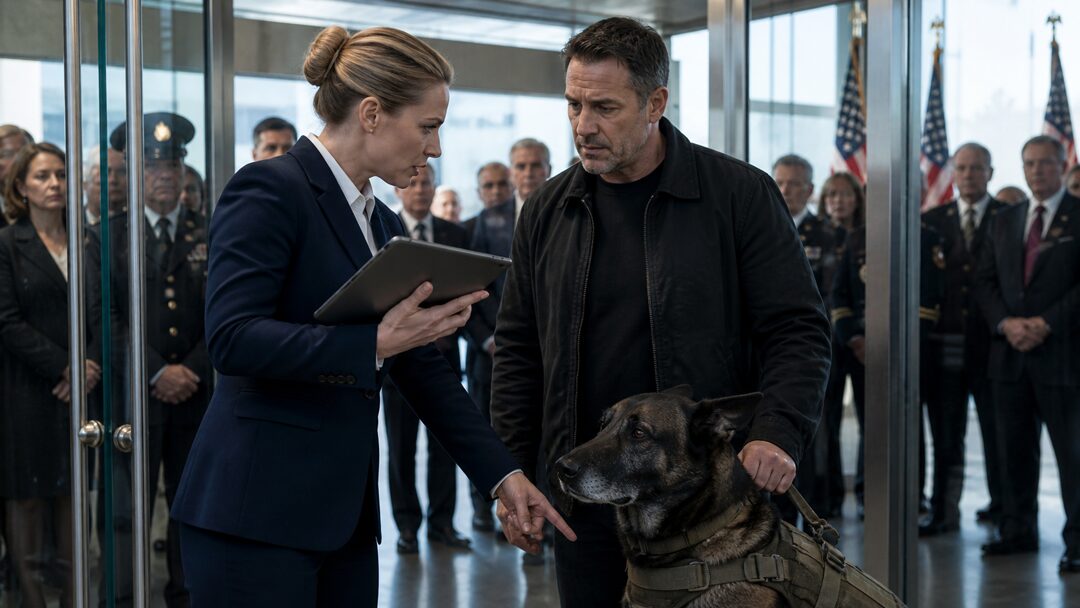
Karen Wallace said it quietly enough to sound professional, but not quietly enough to keep the people behind Mark Reynolds from hearing.
Mark stopped with one hand resting beside Ranger’s harness. He did not step back. He did not look toward the guests beginning to gather at the glass-walled entrance. He only looked at the woman in the navy suit who had moved into his path with a tablet in one hand and a federal badge hanging from her neck.
Behind her, through the glass, the private reception room glowed with soft lights and polished floors. Men in dark suits stood near silver coffee urns. Officers in dress uniforms spoke in low voices. Reporters checked their phones. Older women held folded programs in their laps.
Ranger sat at Mark’s left boot, straight-backed, still, his graying muzzle pointed forward.
The old dog had been limping since the parking garage.
He had not made a sound.
Karen glanced down at him, then back to her tablet. “Sir, this is a protected event. Only cleared attendees and approved support animals are allowed past this point.”
“He was invited,” Mark said.
His voice was low. Not angry. Not pleading.
Karen scrolled. “I have Mark Reynolds listed as a recipient and guest speaker.”
“I’m Mark Reynolds.”
“I understand that.”
Mark waited.
Karen lifted her eyes. “I do not have clearance for the animal.”
A man behind Mark shifted his weight. Someone else gave a short, uncomfortable cough. The automatic doors at the end of the corridor opened and closed with a soft hiss, letting in the smell of jet fuel and rain.
Ranger’s ears rose.
His body angled half an inch toward the sound, placing himself just slightly between Mark and the opening doors.
Karen saw it. Her mouth tightened.
“Sir,” she said, “I’m going to need you to move out of the entry lane while we resolve this.”
Mark’s hand lowered until two fingers touched the worn leather strap across Ranger’s shoulders.
“He goes where I go.”
The sentence landed harder than he intended.
Karen straightened. “That may be your preference, Mr. Reynolds, but preferences do not override security protocol.”
Mark looked past her for the first time.
Inside the room, in the front row, an older woman with silver hair sat beside an empty chair.
Her hands were folded around a program.
She had not seen him yet.
Mark looked away before she could.
Karen followed his gaze, then stepped farther into his line of sight.
“I need you to answer a few questions,” she said. “Is he a certified service animal?”
Mark looked down at Ranger.
The dog stared ahead with the old patience of creatures trained to wait through chaos.
“Yes,” Mark said.
Karen tapped the tablet. “Retired service animal?”
“Yes.”
“Former government property?”
Mark’s jaw shifted once.
“Yes.”
“Personal pet?”
The hallway seemed to go thinner around him.
Ranger’s tail did not move.
Mark said, “No.”
Karen paused, as if the answer irritated her because it did not fit anywhere useful.
“Mr. Reynolds,” she said, “you understand the difficulty here.”
“I understand lists.”
“Then you understand he is not on mine.”
Mark said nothing.
The people behind him had stopped pretending not to watch.
Part II — Not on the List
David Miller noticed the name before he noticed the dog.
Reynolds.
It was printed on the event program tucked under his arm, the one he had been given during briefing. He had skimmed it twenty minutes earlier while standing beside the security podium.
Mark Reynolds. Recipient. Former Army K9 handler. Operation Night Bridge.
David was twenty-six, new enough to still read every packet, old enough to know when his supervisors ignored half of them. He stood near the wall, earpiece buzzing with updates, watching Karen Wallace do what Karen Wallace did better than anyone in the building: hold a line.
No one crossed Karen casually.
That was why they put her at doors.
She was not cruel. David had seen her calm down donors, redirect senators, and stop a television crew from wandering into a restricted hallway with nothing but a look. She believed in procedures the way some people believed in weather reports. Not because they were perfect. Because ignoring them got people hurt.
But the man in the black jacket was not pushing.
That was what bothered David.
People who wanted exceptions usually filled the air with reasons. They leaned in. They raised their voices. They named someone important.
Mark Reynolds stood like he was already carrying the consequence.
Karen’s voice sharpened. “If the dog is retired government property, there should be documentation. If he is a service animal, there should be current certification. If he is neither, then he cannot enter a secure room with restricted attendees.”
Mark’s eyes stayed on hers.
“He’s Ranger.”
The old dog blinked at the sound of his name, then went still again.
Karen exhaled through her nose. “That is not a category.”
A woman near the back of the small crowd whispered, “Oh, come on.”
Karen heard it. Everyone did.
Her shoulders set.
David took one step forward, then stopped. He did not outrank Karen. He barely outranked the sign-in table.
Karen turned slightly, enough to address the gathering without taking her attention off Mark. “Ladies and gentlemen, please keep the entrance clear. We’ll have everyone inside shortly.”
The words were calm.
The corridor was not.
A retired officer with a white mustache looked down at Ranger, then away. A reporter lifted her phone, thought better of it, and lowered it again. One of the event coordinators pressed two fingers to her earpiece and frowned toward the closed room.
The automatic door hissed again.
This time, Ranger’s head moved faster.
Not much. Just enough.
His ears sharpened. His front paws pressed into the floor. His body leaned into Mark’s leg, not afraid, not confused, but ready.
Mark’s fingers closed once around the harness.
Then opened.
Karen saw that too.
“Is he reactive?” she asked.
Mark’s face changed so slightly that only Ranger seemed to feel it. The dog’s shoulder brushed his knee.
“No.”
“Because if sudden sounds are going to be an issue—”
“He heard a door.”
“He responded.”
“He did his job.”
Karen lowered the tablet. “His job today is not the question. His clearance is.”
Mark’s gaze dropped to the badge on her lanyard, then returned to her face.
“Sometimes,” he said, “the paper comes after the truth.”
Karen’s eyes cooled.
“That is exactly the kind of thinking that creates problems at secured events.”
David felt the hallway tighten.
He looked at the program again.
Operation Night Bridge.
He remembered the briefing slides. Not much detail. A classified evacuation. Names withheld until family approval. A memorial plaque to be unveiled. One surviving recipient asked to attend quietly. No press questions about mission specifics.
Asked to attend quietly.
David looked back at Mark Reynolds and saw, suddenly, that the man had been trying to do exactly that.
Karen touched her earpiece. “Entry delay at west corridor. Credential mismatch with attendee support animal.”
A voice crackled back. David could not make out the words, but Karen’s expression told him enough.
Inside the reception room, people were beginning to turn toward the glass.
Mary Carter, though David did not know her name yet, still sat in the front row.
The empty chair beside her seemed deliberate.
Mark saw it again.
This time, he did not look away quickly enough.
Karen followed the direction of his eyes.
“Mr. Reynolds,” she said, a little softer but not soft enough. “You may enter. The dog may not.”
Mark’s hand dropped fully onto Ranger’s harness.
“Then I’m not entering.”
A murmur moved through the corridor.
Karen’s face hardened, not with anger exactly, but with the public pressure of being challenged at a door she was responsible for.
“If you choose to leave, that is your decision.”
“Yes,” Mark said.
But he did not move.
Neither did Ranger.
Part III — The Line He Would Not Cross
Karen had built her career around bad moments that began with small exceptions.
A missing credential. A side entrance opened for someone’s convenience. A bag waved through because the owner had the right last name. A visitor too polite to question until it was too late.
She had learned to distrust emotional stories at checkpoints.
People always had one.
A sick parent. A delayed flight. A senator waiting. A photographer on deadline. A ceremony that could not start without them.
She had heard hundreds.
She had also been the person blamed when someone else’s exception became her failure.
So she kept her voice level when Mark Reynolds stood in front of her with tired eyes and a dog old enough to need patience rising from the floor.
“Sir,” she said, “I am not questioning your service.”
Mark gave her a look then.
Not dramatic.
Not wounded.
Just direct enough to make her wish she had chosen different words.
“I didn’t say you were.”
Karen felt heat rise under her collar.
“That animal is not on the list.”
The sentence came out sharper than she meant it to.
The corridor went quiet.
Even the people inside the glass room seemed to still.
Ranger did not react to the word animal. He only turned his head slightly, as if the silence itself required attention.
Mark looked down at him.
For a second, the hard line of his mouth loosened.
Then he looked back at Karen.
“He was on the mission.”
David’s head snapped up.
Karen blinked.
“What?”
Mark did not repeat himself.
He did not have to.
David opened the program with hands that suddenly felt clumsy. He scanned the front page, the schedule, the acknowledgments. Near the bottom, under the formal language about courage and sacrifice, he found it.
Operation Night Bridge.
Recipients: Mark Reynolds. James Carter. Classified unit citation pending public release.
There was no dog listed.
David looked at Ranger’s harness.
A metal tag hung beside the service patch, dulled from years of use. It had rubbed smooth at the edges. Not decorative. Not new. Not made for ceremonies.
Karen saw David looking.
“Officer Miller,” she said, “do you have something?”
David hesitated.
He hated that he hesitated.
Mark noticed.
So did Karen.
David stepped forward. “Ma’am, the event program references Operation Night Bridge.”
Karen’s mouth tightened. “I’m aware of the event we’re staffing.”
“He said the dog was on the mission.”
“The program does not list a dog.”
Mark’s voice cut in, quiet as before.
“That’s the problem.”
No one spoke.
Karen looked at him. “If there is documentation, you should have presented it at check-in.”
Mark reached toward the inside of his jacket.
Karen’s hand rose.
“Sir.”
The word came out fast.
Too fast.
Mark froze.
For the first time, something like pain moved across his face.
Not fear.
Recognition.
A hallway. A command. A hand moving where someone could not see it. The world holding its breath.
Ranger stood.
It happened with difficulty. His back leg dragged for half a second before he found balance. But once he was up, he placed himself between Mark and Karen, not lunging, not growling, just there.
A wall with a heartbeat.
Karen lowered her hand.
Her face changed.
Mark slowly removed his hand from his jacket and let it hang open at his side.
“I have a letter,” he said. “But that’s not what you need.”
“What do I need?” Karen asked.
Mark looked at David.
“The tag.”
David stared at him.
Mark nodded toward Ranger’s harness. “Left side. Under the strap.”
Karen did not object.
That mattered.
David crouched carefully. Ranger watched him, amber eyes steady. The dog did not move away. Up close, David could see the gray in his muzzle, the cloudy edge of one eye, the faint tremor in one front leg from the effort of standing.
“Easy, buddy,” David whispered.
Ranger’s ear flicked.
David found the tag.
It was colder than he expected.
He lifted it into the light.
The letters were worn, but readable.
RANGER — MWD — NIGHT BRIDGE.
David swallowed.
Karen looked at the tag. Then at Mark. Then through the glass at the reception room.
Inside, the older woman in the front row turned her head toward the corridor at last.
Her eyes found Ranger first.
Not Mark.
Ranger.
She stood so quickly the program slid from her lap.
Part IV — The Name Beside Hers
Karen’s earpiece crackled.
“Wallace, what is the delay? We’re three minutes behind.”
She did not answer.
The woman inside the room had taken one step toward the glass, then stopped because someone beside her touched her arm. She looked fragile from a distance, but not weak. Her silver hair was pinned back. Her dark dress was plain. Her hands hung empty at her sides now.
Mark looked at her once.
It nearly undid him.
Karen saw it.
The whole confrontation shifted again, and this time she felt it under her ribs.
This was not a man trying to bring a dog into a room.
This was a man trying not to fail someone who had already lost enough.
“Who is she?” Karen asked.
Mark did not answer immediately.
David did.
“Mary Carter,” he said, reading from the program. “Mother of James Carter.”
Karen looked down at the program in David’s hand.
James Carter.
The name appeared beneath Mark’s.
There was a line about memorial recognition. Another about family attendance. Another about honoring those connected to Operation Night Bridge.
Karen felt the tablet in her hand become suddenly useless.
Mark said, “James was Ranger’s first handler.”
Ranger, hearing the name, turned his head.
Not sharply.
But enough.
Mary Carter, still inside the room, put one hand over her mouth.
The glass held everyone apart.
Karen’s earpiece sounded again. “Wallace, confirm status.”
This time the voice was sharper.
Karen pressed one finger to the receiver. “Stand by.”
She looked at Mark. “Why wasn’t this in the packet?”
A bitter smile almost appeared on his face, but it died before becoming one.
“Because packets get cleaned up.”
David looked down.
Mark’s voice stayed even. “Names get moved. Details get shortened. Dogs become equipment. Men become recipients. Mothers get programs.”
No one in the corridor breathed comfortably after that.
Karen wanted to say that was not fair.
She also knew fair was not the point.
“What happened to James Carter?” she asked.
Mark looked through the glass.
Mary had not moved. Her eyes remained on Ranger.
Mark’s hand found the harness again, but this time he did not grip it. He rested his palm there like he was asking permission from the only creature who had earned the right to refuse.
“He gave Ranger his last command,” Mark said. “Ranger followed it.”
Karen waited.
Mark did not continue.
David looked at the tag in his hand and understood that this was all they were going to get. Maybe all they deserved.
Karen’s earpiece snapped again. “Open the room or clear the corridor. Now.”
The event coordinator inside was walking toward the glass door, lips tight, smile fixed for the guests. A senior official behind her was already frowning.
Karen had maybe twenty seconds before the decision stopped being hers.
She turned back to Mark. “You can enter now.”
Mark’s eyes moved to Ranger.
Karen heard herself add, “Without him.”
The words felt wrong before they finished leaving her mouth.
But they were the rule.
The file had not changed. The clearance list had not changed. The dog was not in the packet.
Mark nodded once.
Not agreement.
Acceptance.
He took the tag from David and fixed it back onto Ranger’s harness with careful fingers. The motion was tender and practiced.
Then he looked through the glass at Mary Carter.
For the first time, his control broke enough for Karen to see what it cost him.
“I told her,” he said, barely above a whisper, “I’d bring him.”
Ranger leaned against Mark’s leg.
Not hard.
Just enough to remind him he was there.
Mark looked down. “Yeah,” he murmured. “I know.”
Karen saw then that Mark was not deciding whether to obey her.
He was deciding which promise to break.
The senior official reached the inside of the glass door and pulled it open from the other side.
“Karen,” he said, smiling tightly for the room. “What seems to be the issue?”
Every face turned toward her.
Karen looked at her tablet.
Then at Ranger.
Then at Mary Carter, waiting with one hand still over her mouth.
For years, Karen had believed the right thing was usually the thing that survived paperwork.
Now the paperwork was standing between a mother and the last living presence that had been with her son.
Karen lowered the tablet.
“The issue,” she said, “is mine.”
The senior official’s smile thinned. “Excuse me?”
Karen turned fully toward him. Her voice did not rise. It did not shake.
“Ranger is cleared.”
The official stared. “That is not what I have.”
“No,” Karen said. “It is what I have.”
The corridor went still again, but this silence was different.
Karen opened the glass door wider.
“He is a named participant in Operation Night Bridge,” she said. “The omission is in our packet. I’ll answer for it.”
The senior official’s eyes flicked to the watching guests, the reporter, the officers, Mary Carter, Mark Reynolds, the old dog standing with one stiff leg and a worn tag at his chest.
He made the political calculation in less than a second.
Karen had made a different one.
She stepped aside.
Mark did not thank her.
Not then.
He only gave one small nod, the kind a person gives when words would cheapen the thing being acknowledged.
Then he touched Ranger’s harness.
“Come on.”
Ranger moved forward.
Slowly.
But without hesitation.
Part V — The Room Beyond the Glass
The room changed when Ranger entered.
It did not become louder.
It became honest.
Conversations stopped in broken pieces. A coffee cup hovered halfway to someone’s mouth. The reporter near the side wall lowered her phone again, this time not out of caution but because the moment did not feel like hers to take.
Ranger’s nails clicked softly against the polished floor.
Mark walked beside him, not ahead.
Karen remained at the door with the tablet against her side. For the first time all morning, she did not look at it.
Mary Carter stood at the front of the room.
There were people between them, but they moved without being asked.
One by one, they stepped aside.
Ranger saw Mary.
His ears shifted.
Mark felt it through the harness before he saw it. The old dog’s body changed, not into alertness exactly, but into recognition of someone carrying a familiar grief.
Mary took one step.
Then another.
Her eyes were on Ranger’s face.
Not the badge. Not the harness. Not the room watching her.
Just him.
“Ranger?” she said.
The dog stopped.
His head tilted, slow and careful.
Mary made a sound that was almost a laugh and almost something else.
Mark’s throat tightened.
He remembered James Carter crouching beside Ranger in the dust, pressing his forehead briefly to the dog’s skull before giving the last command Mark had ever heard from him.
Go.
Not stay.
Not guard.
Go.
Ranger had gone.
Mark had lived.
That was the part people wanted to turn into a clean story. Courage. Sacrifice. Survival. Ceremony.
But memory was not clean.
It had teeth. It had weight. It woke at the sound of doors opening.
Mary lowered herself carefully, one hand gripping the edge of the empty chair beside her.
Mark moved as if to help, then stopped.
This was not his moment to manage.
Ranger stepped forward.
His back leg dragged slightly.
Mary reached out both hands and stopped just short of touching him, asking permission without words.
Ranger pressed his head into her palms.
Mary closed her eyes.
No one in the room spoke.
Ranger leaned into her as if he had been carrying a scent for years and had finally found where to put it down.
Mary’s fingers moved over his graying muzzle, his ears, the scar beneath his collar, the worn place where the harness had rubbed across his chest.
“You stayed with him,” she whispered.
Mark looked away.
Ranger did not.
Mary opened her eyes and looked up at Mark. There were questions in her face, but she did not ask them. Maybe she already knew the only answer that mattered.
Mark reached for the metal tag on Ranger’s harness.
This time, no one flinched.
He unclipped it slowly.
The small sound carried across the room.
He held the tag for a second in his palm. The letters had been worn down by years of weather, hands, airports, clinics, sleepless nights, and mornings when Ranger refused to eat unless Mark sat beside him.
RANGER — MWD — NIGHT BRIDGE.
Mark turned toward the empty chair beside Mary.
On the seat lay the folded program she had dropped earlier. Her son’s name was printed inside it in clean black letters.
Mark placed Ranger’s tag on top of the program.
Not as decoration.
Not as proof.
As presence.
Mary’s hand went to her mouth again.
The senior official near the doorway looked down.
David stood at the back of the room with his shoulders squared now, as if he had finally stepped into the person he had wanted to be in the corridor.
Karen stayed by the glass.
She watched Ranger lower himself carefully beside Mary’s chair. Watched Mark stand behind him, one hand empty now. Watched a room built for speeches learn that silence could do what speeches could not.
The ceremony did continue.
Someone eventually stepped to the podium. Someone thanked the guests. Someone spoke of service and sacrifice, of duty and remembrance, of the names being honored.
But the room had already understood before the first official sentence.
Mary Carter kept one hand on Ranger’s head.
Mark did not look at the plaque when they unveiled it.
He looked at the empty chair.
Karen noticed.
Later, when the applause came, it was soft and uneven. Not because people were unsure. Because they seemed to know that clapping too loudly would break something.
Ranger slept through most of it, his muzzle against Mary’s shoe.
Mark stood still until the end.
When the guests began to move again, Karen found him near the doorway. Ranger was still with Mary, accepting her slow, careful touch as if he had been assigned there.
Karen held the tablet in both hands now.
For a moment, she looked like she might give a formal apology.
Instead, she said, “I should have looked harder.”
Mark glanced at her.
Then at the tablet.
“No,” he said. “You should have looked up.”
Karen absorbed that.
It was not cruel.
That made it worse.
She nodded once.
Behind them, Mary said Ranger’s name again, softly, like a person testing whether a voice could reach backward through time.
Ranger opened his eyes.
Mark turned.
Mary was looking at him now.
“Did James know?” she asked.
The room around them seemed to fall away.
Mark understood the question without needing the rest of it.
Did James know Ranger got out?
Did James know Mark lived?
Did James know he was not alone?
Mark walked back to her.
He did not give her the version made for programs. He did not give her strategy, weather, coordinates, or heroism. He gave her the only piece of truth that belonged to her.
“He knew Ranger obeyed,” Mark said. “And he knew Ranger wasn’t leaving empty.”
Mary held his gaze.
Then she nodded.
It was not closure.
Closure was too clean a word for a mother sitting beside an empty chair.
But her hand settled again on Ranger’s head, and something in her face loosened—not healed, not repaired, but no longer reaching through total darkness.
Mark stood with her until the reception room began to empty.
When he finally clipped the tag back onto Ranger’s harness, Mary touched the metal first.
“Thank you for bringing him,” she said.
Mark’s answer took a long time.
“I promised.”
Ranger rose slowly, leaning first into Mary, then into Mark.
At the glass door, Karen stepped aside before they reached her.
No tablet. No question. No list.
Just room.
Mark walked out with Ranger at his side.
Behind him, the empty chair remained by Mary Carter’s seat, no longer looking abandoned, no longer looking filled.
Only witnessed.