The Name She Carried
Part I — The Courtyard
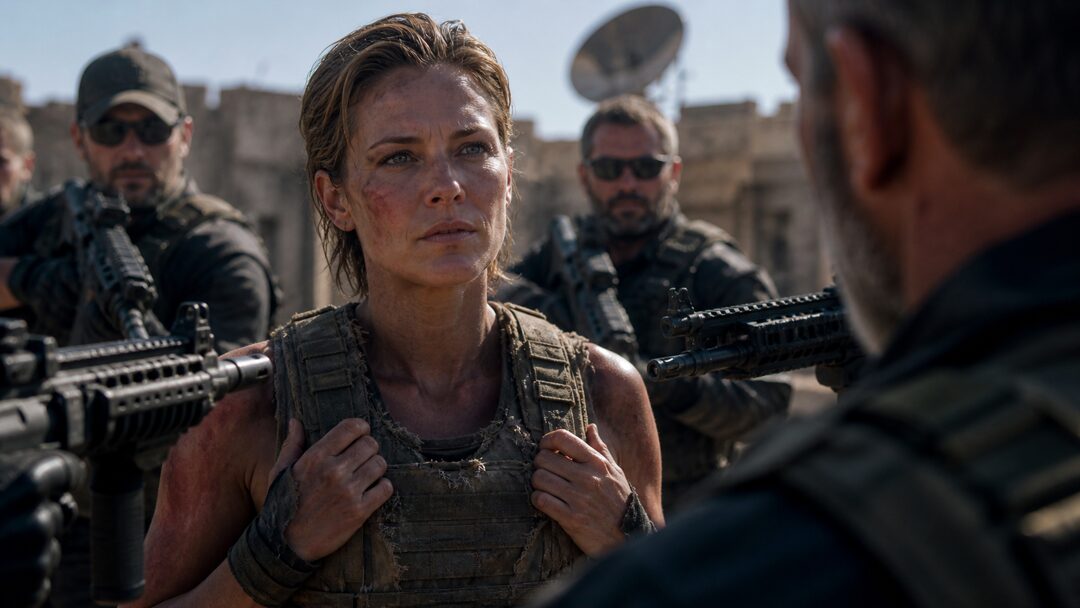
Sarah Mitchell stood in the courtyard with six rifles aimed at her chest and a man she used to trust telling her not to move.
“Hands off the vest,” Robert Hayes said. “Slow.”
His voice had not changed much in nine years. It still had that flat command weight, the kind that made younger men straighten their backs before they understood they had obeyed. He stood ten feet away, broad shoulders squared beneath contractor gear too clean for the place around them, his rifle steady, his beard gray at the chin.
Sarah kept her hands near the straps of her tactical vest.
Not touching. Not surrendering.
Near enough to make every man around her nervous.
The courtyard of Relay Station Nine shimmered under hard desert light. One wall had collapsed inward. A dish antenna turned by tiny degrees above the roofline, clicking whenever the wind caught it. Broken stone crunched beneath boots. Somewhere inside the station, Robert’s men were tearing through the server room, searching for the one thing he thought Sarah had beaten him to.
Her lip was split. One eye was swelling. Blood had dried along her jaw and neck in a stiff brown line. Her left shoulder burned when she breathed. She had learned, years ago, not to measure pain while people were still deciding what to do with you.
The youngest contractor stood to her right. Clean-shaven. Nervous eyes. Newer kit than the others. His rifle was pointed at her center mass, but the barrel trembled whenever Robert spoke.
Sarah looked at him once.
He looked away.
Robert noticed.
“Eyes on her, Carter.”
The young man corrected his grip. “Yes, sir.”
Sir.
That word landed harder than the rifles.
Robert was not Army anymore. Not officially. But some men carried rank after they removed it, like a scent that stayed in the fabric.
Sarah swallowed dust and tasted metal.
Robert took one step closer.
“The station is offline,” he said. “Your team is gone. The inspection convoy is twenty minutes out, maybe less. They’ll find rubble, heat damage, and insurgent debris. That’s all they need to find.”
Sarah said nothing.
Robert’s eyes moved to her vest.
“Give me the authentication key.”
The wind dragged grit across the courtyard. It tapped against Sarah’s cheek like fingernails.
She asked, “Where’s Miller?”
For half a second, Robert’s jaw locked.
It was small. Almost nothing.
But Sarah had spent half her career reading almost nothing.
“Miller died in the blast,” Robert said.
Sarah breathed in once.
That was the first lie he had told badly.
Before Robert’s men dragged her across the courtyard, before one of them shoved her to her knees and Robert told them to bring her upright because “Captain Mitchell deserves the courtesy,” Sarah’s radio had cracked alive for less than two seconds.
David Miller’s voice had come through crushed by static.
“Hayes burned us.”
Then nothing.
No coordinates. No explanation. No goodbye.
Just a name, and enough truth to make the whole world narrow.
Sarah looked at Robert, then past him, toward the dark opening of the relay station.
Inside, metal slammed against stone.
One of his men shouted, “No drive in here!”
Robert did not turn.
Sarah saw his confidence tighten into calculation.
Good, she thought.
You’re running out of time.
Part II — Old Debts
Robert lowered his rifle by an inch, not enough to mean safety, only enough to suggest reason.
“You’re hurt,” he said. “You’ve been through a lot. Don’t make this worse.”
Sarah almost smiled.
Men like Robert always called it worse when consequences began moving toward them.
“You said my team is gone,” she said. “Say their names.”
The young contractor, Carter, shifted his weight.
Robert’s eyes hardened.
“This isn’t a memorial service.”
“No,” Sarah said. “It’s a cleanup.”
One of the men on her left muttered something under his breath. Robert lifted two fingers without looking. The man shut up.
That was Robert Hayes. Even ruined, even exposed, even standing in a courtyard full of things he could not fully control, he still knew how to make a room obey him.
He had made entire convoys obey him once.
Sarah remembered Kandahar in pieces she had never been able to file properly.
A road turning white in the blast.
Her hands trying to open a door that was no longer shaped like a door.
Smoke inside her throat.
Robert’s voice from outside the vehicle, calm as a range instructor.
Mitchell. Look at me. Not at the fire. Me.
He had pulled her out by the back of her vest. Dragged her across glass and gravel. Pressed his palm over the cut in her thigh until medics arrived. Later, in the field hospital, when she was still half-drugged and shaking, he stood beside her bed and told her, “You don’t owe me anything except staying alive.”
She had believed him.
That had been the first debt.
The second came later, quieter.
Reports he signed.
Mistakes he buried for her when she was young enough to confuse mercy with protection.
Recommendations he wrote.
Doors he opened.
Every favor had felt clean at the time. Every rescue had seemed separate from the next.
Until one day she realized he had built a leash out of gratitude.
Robert stepped close enough now that Sarah could see sweat darkening the collar under his gear.
“I saved your life,” he said.
There it was.
Not shouted. Not dramatic. Just placed between them like evidence.
“You did,” Sarah said.
“And I’m trying to save it again.”
“No,” she said. “You’re trying to save yours.”
His expression did not change, but his trigger finger flexed once against the frame of the rifle.
The dish above them clicked again.
Sarah listened.
One click.
Pause.
Another.
Not enough to know. Enough to hope.
Robert glanced toward the roofline, and Sarah knew he had heard it too.
He raised his voice. “Find the archive casing. Tear out the floor panels if you have to.”
From inside the station came another crash.
Carter swallowed. Sarah heard it.
She turned her head slightly, not enough to alarm the others.
“You’re new,” she said to him.
Carter’s rifle lifted a fraction. “Don’t talk to me.”
Robert snapped, “She talks to me.”
Carter went red under the dust.
Sarah filed it away.
Young. Still reachable. Afraid of being seen as afraid.
Robert saw people as tools. Sarah saw them as pressure points. There was a difference.
Robert moved into her line of sight again.
“Your key,” he said.
“I don’t have it.”
“Then where is it?”
Sarah let her gaze drop to his boots, to the cracked stone, to the scrape mark where they had dragged her in.
The dead-man clip had snapped somewhere between the broken arch and the center of the courtyard.
She had felt it go.
A small tug at her belt.
A piece of Miller’s panic becoming Miller’s plan.
She looked back up.
“You tell me where Miller is,” she said, “and I’ll tell you what you’re already too late to stop.”
Robert stared at her for a long moment.
Then he smiled without warmth.
“You always were better at sounding brave than being practical.”
Sarah felt the old sting of it, because he knew where to place the blade.
She said, “David said the same thing.”
At Miller’s first name, something in Robert’s face shut.
Not grief.
Not guilt.
Recognition.
Part III — What the Station Remembered
The night before everything went wrong, David Miller had sat on an overturned equipment crate inside Relay Station Nine and tapped his field tag against his radio.
Click. Click. Click.
“Official channels,” he had said, mocking her voice badly. “Captain, with respect, official channels are where evidence goes to get a haircut.”
Sarah had been too tired to laugh.
They had been awake thirty hours, running signal checks in a territory everyone had agreed to stop fighting over only after there was almost nothing left worth fighting for. The ceasefire was supposed to hold by dawn. Inspectors were coming in two days. Command wanted the station secured, the archive verified, the shelling logs sealed and transferred.
Miller wanted them copied and sent immediately.
“You don’t leak classified battlefield data,” Sarah had said.
“You don’t bury proof because the people with shovels have better rank.”
“They’ll review it.”
He had looked at her then, sharp-eyed and young and too angry to hide how scared he was.
“Sarah, they already reviewed it. That’s why they sent us alone.”
She had hated him for saying it.
Not because he was wrong.
Because some part of her had known he might be right.
Now, in the courtyard, Robert was using the same language she had used against Miller.
“Think,” Robert said. “You push this out, and what happens? The ceasefire breaks. Every unit that followed fire coordination gets dragged through hearings. Names go public before facts get sorted. Good soldiers become headlines.”
Sarah’s left knee wanted to fold. She locked it.
“Civilians died.”
“Civilians die in bad grids, bad weather, bad intelligence. You know that.”
“My team died.”
His face moved then. A flash of something old. Not regret exactly. More like irritation at regret for arriving.
“They died in a war that was compromised before you ever put on a uniform.”
“That’s your defense?”
“That’s reality.”
A man inside the station shouted, “Major, you need to see this.”
Robert did not correct the title.
Major.
Not Mister Hayes. Not Robert. Major.
The word moved through the armed men like permission.
Sarah felt the moral shape of the courtyard sharpen.
This was not just Robert cleaning up evidence. This was Robert preserving the world that still called him sir.
He stepped closer.
“Your own superior signed the strike release,” he said quietly. “You understand that? You think this ends with me? You think somebody pins a medal on you for telling the truth? They will cut you loose, Sarah. They will say you were concussed. Unstable. Grieving. They will make you look like a woman who lost her team and needed someone to blame.”
The words landed because they were not empty.
Sarah knew exactly how a report could ruin a person while sounding kind.
Captain Mitchell displayed signs of acute stress response.
Captain Mitchell’s recollection may have been affected by blast exposure.
Captain Mitchell acted outside protocol.
Protocol.
Miller had spat the word like bad food.
She heard his field tag again in memory.
Click. Click.
“You confuse discipline with courage,” he had told her that night.
She had snapped back, “And you confuse impulse with integrity.”
Miller had stood then, radio in one hand, tag swinging at his chest.
“No,” he said. “I confuse silence with silence.”
That was the last full sentence she remembered him saying before the shelling started.
The first round had not hit the station. It had hit the village road beyond it. The second took the outer wall. The third took the east room where Miller had gone to boost the emergency relay.
Sarah remembered white dust.
A sound that swallowed all other sound.
Then Miller’s hand on her belt while she tried to crawl.
He had fastened something there with shaking fingers.
“Clip,” he’d said.
“What?”
“Don’t let them search you first.”
Then static. Heat. Robert’s men shouting her name like they were rescuing her.
Like rescue and capture could not wear the same face.
Back in the courtyard, Robert watched her eyes and knew memory had reached her.
“You waited too long,” he said softly.
Sarah’s throat tightened.
That one landed deeper than the rest.
Because it was true.
She had waited.
She had filed. Logged. Escalated. Requested review.
She had believed the machine would correct itself if she fed it enough proof.
Miller had known better.
Robert tilted his head.
“You want to honor him?” he said. “Don’t turn him into a match.”
Sarah looked at the dish above the roof.
Click.
Pause.
Click.
She said, “You don’t get to say honor.”
Part IV — The Wrong Place
A contractor came out of the station holding a blackened casing the size of a lunch box.
“Archive bay’s empty,” he said. “Drive’s gone.”
Robert’s eyes went straight to Sarah’s vest.
All six rifles tightened toward her.
Carter’s barrel shook again.
Sarah lifted her chin.
Robert’s voice went cold. “Cut it off her.”
The man on Sarah’s left moved first. Older. Thick hands. Face closed in the way men closed themselves before doing something they did not want to remember.
Sarah looked past him to Carter.
“Don’t,” she said.
The older man stopped.
Robert barked, “I didn’t give that order to you, Mitchell.”
Sarah kept her eyes on Carter.
“Not him,” she said. “You.”
Carter blinked.
Robert turned just enough to see him.
Sarah said, “You take one more step toward me, and he makes you part of it.”
Carter’s mouth opened, then closed.
“Part of what?” he asked.
Robert snapped, “Shut up.”
That was the mistake.
Not the anger. Robert was allowed anger.
It was the fear under it.
The men heard it.
Sarah heard it.
Even the courtyard seemed to hear it, the air tightening around the clicking dish.
Robert recovered fast. “She’s stalling.”
“Yes,” Sarah said.
His gaze cut back to her.
She let him see the truth in her face. Not all of it. Enough.
Robert’s eyes dropped to the scrape mark across the stone. To the broken plastic piece lying near Sarah’s boot, half-buried in dust.
Miller’s clip.
For the first time since she had known him, Robert Hayes looked honestly unsure.
He stepped around Sarah without lowering his rifle and crouched near the broken piece. He did not touch it. He did not have to.
His radio crackled.
A voice said, “Beacon pulse detected. Emergency channel. It’s weak, but it’s live.”
The courtyard went silent.
Sarah closed her eyes for half a second.
Not relief.
Not victory.
A thank-you she would never get to say where it belonged.
Robert stood slowly.
“You activated it.”
Sarah opened her eyes. “No.”
His face darkened.
“Miller did.”
The name moved through the men differently now.
No longer just a dead teammate. A presence. A hand still inside the machinery.
Robert stared at Sarah’s vest, and she saw him understand how completely he had misread her.
All this time, he thought her hands were guarding the key.
They were guiding his eyes away from the ground.
Away from the broken clip.
Away from the fact that his own men had dragged her far enough, hard enough, to finish what Miller started.
The contractor with the closed face took one step back.
Robert lifted his rifle higher.
“How much went out?”
No one answered.
He shouted into his radio. “How much?”
“Unknown,” the voice said. “The array’s damaged. Upload’s pulsing in fragments. It hasn’t completed.”
Robert looked at Sarah.
There it was again: control returning because there was still something to control.
“You can abort it,” he said.
Sarah did not answer.
“You have a command phrase.”
Still nothing.
Robert’s voice lowered.
“Sarah.”
The first name was worse than the rifle.
“You think Miller wanted this? You think he wanted you dead in a courtyard over a file?”
Sarah’s jaw tightened.
Robert took another step.
“He was alive after the strike.”
The world narrowed so fast Sarah nearly missed the next breath.
Robert saw it and pressed.
“He was alive,” he repeated. “East room. Pinned under the relay frame. He had maybe ten minutes. Maybe less.”
Sarah heard nothing but the clicking tag.
Click. Click.
Her mouth felt full of sand.
“You said he died in the blast.”
“He died after.”
The difference was a grave opening under her feet.
Robert’s eyes stayed on hers.
“He begged for medevac,” he said. “You want the whole truth? There it is. He begged. And I denied it.”
Carter whispered, “Major…”
Robert ignored him.
Sarah did not move.
If she moved, she would break.
Robert said, “Pulling him out would have exposed the strike before the ceasefire inspection. We had hostiles moving, bad air, command breathing down our necks—”
“You left him.”
“I made a decision.”
“You left him alive.”
“I made a decision soldiers make.”
Sarah’s grief came up quiet. That was the worst of it. No sob. No scream. Just a coldness behind her ribs where something human had stepped away to keep her standing.
Miller had not been reckless.
He had been dying and still thinking ahead.
Don’t let them search you first.
Not help me.
Not tell my mom.
Not I’m scared.
He had used his last clear seconds to make sure silence did not win.
Sarah looked at Robert.
“You don’t know what soldiers make,” she said. “You only know what you make them carry.”
Part V — The Question
Robert’s face changed.
Not dramatically. Not enough for anyone else to name.
But Sarah saw the man from Kandahar vanish, and the contractor commander remain.
“Abort the beacon,” he said.
“No.”
“If that file completes, you won’t control who it hurts.”
“I know.”
“You’ll lose your career.”
“I know.”
“They’ll bury you with it.”
Sarah breathed through the pain in her shoulder.
“They can try.”
Robert’s rifle came up fully now, the barrel centered on her chest.
The semicircle tightened.
Carter did not move with the others.
Robert noticed.
“Carter,” he said.
The young man’s rifle lifted, but not far enough.
“Carter.”
Sarah looked at him. His eyes were wet with sweat or fear or both.
She said, “You don’t have to be brave forever. Just for the next minute.”
Robert swung toward her. “Don’t talk to my men.”
“They’re listening.”
“They follow orders.”
Sarah glanced around the courtyard, at the men with rifles and dust on their faces, at the broken wall behind them, at the station that had recorded more truth than any of them wanted.
“Then give them one you can live with,” she said.
Robert’s mouth tightened.
His radio crackled again.
“Upload at seventy-eight percent.”
Robert’s eyes sharpened.
“You have a phrase,” he said. “Say it.”
Sarah did not.
“Say it, Sarah.”
No.
Not because she was fearless. She was afraid of dying. She was afraid of surviving too. She was afraid of the report that would call her unstable, the hearings that would turn Miller into a footnote, the quiet rooms where men with clean hands would discuss whether truth had arrived at an inconvenient time.
But fear was not a command.
Robert stepped close enough that the shadow of his rifle crossed her vest.
“You owe me your life,” he said.
Sarah looked at him then, really looked.
At the gray in his beard.
At the sweat under his eyes.
At the man who had once reached into fire and pulled her out.
At the man who had later left David Miller under metal and dust because saving him would have told the wrong story.
“You saved my life once,” she said. “You don’t own what I do with it.”
His expression flinched.
The radio crackled.
“Ninety-one percent.”
Robert’s finger moved.
Carter saw it.
So did Sarah.
The old silence opened around them. Not empty. Full.
Full of Miller tapping his tag against the radio.
Full of the night Sarah chose procedure over urgency.
Full of Robert saying, You don’t owe me anything except staying alive, before he learned how useful debt could be.
Full of all the names that became easier to manage after nobody living insisted on saying them aloud.
Sarah lowered her hands an inch from her vest.
Every rifle jumped.
Robert barked, “Don’t.”
She stopped.
Dust slid down the side of her face.
Above them, the relay dish clicked again.
Sarah looked at each man in the semicircle. The cruel one. The closed one. The one who would follow anything if someone else signed the order. Then Carter, whose rifle had lowered by the width of a breath.
Finally, she looked at Robert.
Quietly, clearly, with no anger left to spend, Sarah asked, “You sure you wanna do this?”
No one breathed.
The line did not sound like a threat.
That made it worse.
It sounded like mercy.
Robert stared at her over the rifle.
If he fired, the upload would complete without her override. If he did not, the upload might complete anyway. If he ordered Carter to act, Carter would have to choose in front of everyone. If he lowered his weapon, he would become what he feared most: a man who had lost command of the story.
The radio clicked.
“Complete.”
Carter lowered his rifle first.
It was not dramatic. The barrel simply dipped toward the ground, like his arms had become too tired to keep carrying someone else’s decision.
Robert turned on him. “Raise your weapon.”
Carter did not.
The closed-faced contractor lowered his next.
Then another.
Then another.
The semicircle broke without anyone moving their feet.
In the distance, beyond the collapsed outer wall, engines grew through the heat shimmer. White inspection vehicles appeared on the road, small at first, then undeniable.
Robert still held his rifle.
For a few seconds, that was all he had left.
Sarah stayed standing until the first vehicle entered the compound.
Only then did her knee give out.
She went down slowly, one hand catching stone, the other still near the vest that had never held what Robert feared.
Part VI — What Remained
The medics wanted Sarah on a stretcher before anyone asked her questions.
Sarah wanted water.
Nobody gave her water until she gave them the first sentence of the report.
“Relay Station Nine transmitted unauthorized strike logs and command correspondence at 1427 local,” she said.
Her voice sounded strange to her. Flat. Official. Alive.
An inspector with tired eyes knelt beside her, recording every word. Behind him, Robert stood with two monitors and one contractor beside him, no longer surrounded by his men, no longer giving orders that changed the air.
His rifle was gone.
His hands looked wrong without it.
Carter sat on the ground near the broken arch, staring at nothing. No one had restrained him. No one had thanked him. His small act had not made him clean. It had only stopped him from becoming dirtier.
Sarah understood that difference better than she wanted to.
The medic wrapped her shoulder. Pain arrived in layers now, demanding attention because danger had stepped back. She let it come. She had no rank left to give it.
Someone brought out evidence bags from the station.
Blackened casing.
Fragments of relay hardware.
A strip of melted plastic from the dead-man clip.
Then a small clear bag with a warped metal tag inside.
Sarah knew it before she saw the stamped letters.
Miller.
The tag was burned along one edge. The chain had fused into a dark twist. It looked too small to have carried so much.
The inspector followed her gaze.
“This belonged to Sergeant David Miller?”
Sarah closed her eyes.
Not for long.
“Yes.”
“Can you confirm the spelling?”
The question was routine. Necessary. Almost cruel because it was so small.
Sarah looked at the tag.
Miller had been impatient. Loud when tired. Bad at hiding fear. Good at finding signals where no one else thought to listen. He had accused her of confusing discipline with courage, and she had hated him for being right too early.
He had died alive.
That would not fit cleanly in a box.
But his name could.
Sarah gave it carefully.
“David Miller,” she said. “D-a-v-i-d. M-i-l-l-e-r.”
The inspector wrote it down.
Sarah watched his pen move until the last letter was finished.
Only then did she let the medic guide her back.
As they lifted her into the vehicle, she saw Robert one last time through the open rear doors.
He was standing in the same courtyard where he had aimed a rifle at her chest, but he looked smaller now. Not harmless. Never that. Just reduced to the shape of a man whose version of events had stopped obeying him.
Their eyes met.
For a second, Sarah saw Kandahar again.
Smoke. Glass. His hand pulling her out.
Then the present returned.
Dust. Engines. Miller’s tag in a bag.
Robert looked away first.
The medic reached to close the doors.
Sarah stopped him.
“Wait.”
Beyond the vehicles, the relay dish turned once more in the hot wind.
Click.
A small sound. Almost nothing.
Enough.
Sarah lay back against the stretcher and let the doors close.
She had not saved Miller.
She had not saved all of them.
But his name was moving now through channels Robert could not shut down, attached to a record he had tried to erase, carried by a signal that had crossed the desert before anyone thought to lower their rifles.
For the first time all day, Sarah took her hands off her vest.