The Smallest Screen in the Room
Part I — The Watch
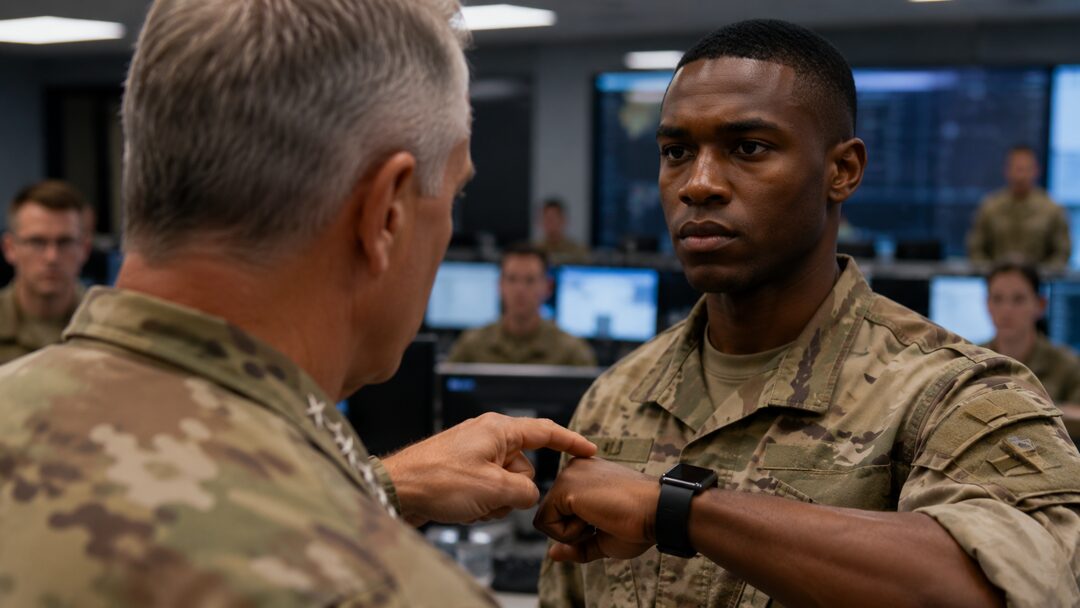
“Take the watch off.”
General Robert Hayes stopped the briefing with those four words.
Every monitor in the operations room kept glowing. Every analyst kept breathing. But the room itself seemed to lock around Specialist Anthony Uhapeski’s left wrist.
Anthony looked down at the black smartwatch strapped beneath the cuff of his uniform.
Then he looked back at Hayes.
“Yes, sir.”
He did not argue. He did not explain. He only unfastened the band with his right hand while thirty people pretended not to watch.
That was impossible, of course.
In a secure operations room, people noticed everything they were not supposed to notice.
The room had no windows. Fluorescent lights flattened every face. Rows of desks faced a wall of large displays showing route overlays, unit status blocks, supply timings, and live exercise updates. Nothing on the screens was meant to be casual. Nothing in the room was meant to leave the room.
And Anthony had walked into it wearing a personal device.
Hayes stepped closer.
He was tall, square-jawed, graying at the temples, the kind of senior officer who did not need to raise his voice because the room always lowered itself for him. His uniform was sharp enough to look carved. Aviation wings sat above his chest pocket. The stars on his collar caught the light.
Anthony held out the watch.
Hayes did not take it immediately. He pointed at it.
“Personal devices aren’t allowed in here.”
“I understand, sir.”
Colonel Linda Brooks turned from the main console. Her auburn hair was tucked neatly under her cap, tablet pressed to her side like armor. She looked first at the watch, then at Anthony, then at Hayes.
That order mattered. Watch. Soldier. General.
Anthony saw it.
He saw Sergeant Daniel Price at the rear technician station go still too, headset around his neck, fingers frozen over the keyboard. Daniel’s eyes dropped quickly, as if looking away might protect him from being pulled into the moment.
It would not.
Hayes finally took the watch.
It sat in his palm, black screen blank, band hanging loose.
For a second, Anthony felt absurdly aware of his own wrist. Bare skin. No weight. No small pulse of vibration under the cuff. Nothing.
He had worn the watch into the room because the official system was already late.
Not visibly. Not enough for Brooks to admit. Not enough for anyone on the wall of screens to panic.
But the lag was there.
Four seconds between the convoy route and the logistics feed. Eight between the weather overlay and the communications map. Sometimes twelve if the readiness module refreshed out of sequence.
Twelve seconds was not much in a slide deck.
It was a lifetime in a decision.
Hayes turned the watch over.
“You forgot where you were, Specialist?”
Anthony kept his shoulders still.
“No, sir.”
That answer moved through the room more sharply than denial would have.
Hayes looked up.
Brooks’s mouth tightened.
Daniel Price stared at his workstation.
Hayes held the watch between two fingers. “Then why is it on your wrist?”
Anthony knew the correct answer.
There wasn’t one.
Not one that would survive the room.
So he said the only true thing he could safely say.
“It’s not connected to an outside network, sir.”
Hayes’s eyes narrowed.
“That was not my question.”
“No, sir.”
The large display behind Hayes updated another convoy marker.
Three seconds late.
Anthony did not look at it.
He did not need to.
The watch had already told him.
Part II — Turn It On
Hayes could have ended it there.
He could have handed the device to security, removed Anthony from the room, and turned the incident into a paragraph in a report. Most officers would have. A junior soldier in a secure room with an unauthorized device was not a clever misunderstanding. It was a violation.
But Hayes did not move away.
That was what made Anthony’s stomach tighten.
The general was not only angry.
He was curious.
Hayes weighed the watch once in his hand. “This is heavier than it should be.”
Brooks stepped forward. “Sir, we should have it secured and inspected outside the room.”
“We will.”
“Now would be best.”
Hayes did not look at her. “In a moment.”
Anthony felt Brooks’s attention turn toward him like a blade.
Hayes held the blank watch out. “What is this?”
Anthony’s mouth went dry.
“A diagnostic device, sir.”
Someone in the second row shifted.
Brooks said, “Specialist, you brought a diagnostic device into a restricted exercise cell without authorization?”
Anthony did not answer her. His eyes stayed on Hayes.
“Yes, ma’am.”
Brooks’s expression hardened. “That is not better.”
“No, ma’am.”
Hayes looked almost amused now, but not warmly. The expression was dangerous because it meant the room had become interesting to him.
“A diagnostic device for what?”
Anthony heard the official system refresh behind him.
Another delay.
He could feel the shape of the problem like pressure under the floor.
“For feed consistency, sir.”
Brooks laughed once.
Not because it was funny.
Because laughing first was sometimes how senior people decided what counted as ridiculous.
Hayes turned the watch over again. “You built this?”
Anthony hesitated.
That hesitation cost him.
Brooks caught it. “General, this needs to be removed from the room.”
Hayes looked at Anthony. “Did you build it?”
“Yes, sir.”
Daniel Price exhaled quietly at the back console.
Too quietly for most people.
Not for Hayes.
The general glanced toward him. “Sergeant Price.”
Daniel straightened. “Sir.”
“You know about this?”
Daniel’s face went pale. “Not officially, sir.”
That answer was worse than yes.
Brooks’s eyes closed for half a second.
Hayes’s voice flattened. “Not officially.”
Daniel swallowed. “I’ve seen parts of what it flags, sir. Latency mismatches. Not the device itself.”
Anthony felt something sink in his chest.
Daniel had not meant to betray him.
That did not change the result.
Hayes extended the watch toward Anthony.
“Turn it on.”
The room sharpened.
Brooks said, “Sir—”
Hayes cut her off with one look.
Anthony took the watch.
His fingers were steady. He hated that. He knew the room would read steadiness as confidence. Maybe arrogance. They would not know how much practice it took to keep fear out of your hands.
The screen faced him, dark and small.
One thumb press.
For a breath, nothing happened.
Then blue light bloomed across the glass.
Not the cheerful face of a consumer smartwatch. Not steps. Not messages. Not weather.
A compact interface opened in layered blue lines: feed timing, route overlays, communications confidence, readiness values, conflict warnings. Tiny bars shifted in real time. A red marker pulsed beside Route Silver-3.
Hayes leaned closer.
His face changed.
The sternness did not vanish. It cracked around surprise.
“What the hell?”
For the first time all morning, Anthony almost smiled.
He did not.
On the wall of official monitors, Route Silver-3 still showed green.
On the tiny screen in his hand, it was already warning yellow.
Small things saw plenty when no one bothered to look down.
Part III — The Lag
Brooks moved first.
She crossed the room and stood beside Hayes, tablet up, eyes cutting over the blue display.
“That interface is not validated,” she said.
Anthony kept the watch angled so Hayes could see it. “No, ma’am.”
“It has no authority in this exercise.”
“No, ma’am.”
“Then it should not be influencing decisions.”
“It already is,” Hayes said.
Brooks went still.
Hayes did not take his eyes off the watch. “It influenced Specialist Uhapeski to violate my room.”
Anthony felt the small hope die before it could embarrass him.
Hayes looked at him. “Side room. You. Brooks. Price.”
Brooks said, “General, the exercise clock—”
“Continues.” Hayes handed the watch back to Anthony. “Screen off.”
Anthony powered it down.
The blue vanished.
The operations room seemed larger without it and somehow less certain.
They moved into the small conference room adjoining the main floor. Glass walls looked back into the operations cell, but the soundproofing cut away the noise. Inside, the silence was worse.
Hayes stood at the head of the table.
Brooks remained standing too.
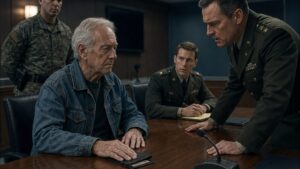
Anthony did not sit until Hayes pointed at a chair.
Daniel Price slipped in last, headset now in one hand, shoulders tight.
Hayes placed both palms on the table.
“Start simple.”
Anthony nodded.
“The readiness platform pulls from multiple feeds,” he said. “Routing, logistics, comms coverage, weather, fuel estimates, unit status. The main display smooths conflicts before surfacing them.”
Brooks cut in. “It prioritizes verified conflicts.”
“Yes, ma’am.”
“Words matter.”
“They do,” Anthony said.
Hayes looked at him.
Anthony continued more carefully. “The system sometimes delays conflicts when two feeds disagree. It waits for confirmation. That protects against false alarms.”
“And your watch does not?” Brooks asked.
“My watch doesn’t make decisions. It flags mismatches.”
Hayes said, “Why build it?”
Anthony looked through the glass wall.
The official monitors showed confident lines, neat colors, a room full of people trusting scale.
He saw a different room.
Eight months earlier. A training rotation in Nevada. A logistics package routed through a dry corridor because the fuel status had updated late. Nothing catastrophic. Not on paper. No one died. No headline. No investigation that mattered.
But the after-action review had blamed the junior analysts.
Missed indicators. Poor attention to sequencing. Failure to elevate inconsistency.
Anthony had been one of them.
Daniel too.
Brooks had not run that rotation, but her system had.
Anthony remembered sitting at the end of a table while a major he barely knew said, “At some point, specialists have to learn to read the room.”
Anthony had wanted to say: The room was wrong.
He had not.
Instead, he went back to his barracks and began building something small enough to notice what large rooms preferred to smooth over.
Hayes waited.
Anthony gave him the compressed version.
“Because the last time the system lagged, the lowest people in the room took the blame.”
Daniel looked down.
Brooks’s expression shifted. Not softening. Defending.
“That rotation was reviewed.”
“Yes, ma’am.”
“And closed.”
“Yes, ma’am.”
Hayes turned to Daniel. “You saw the lag?”
Daniel’s throat moved. “Yes, sir.”
“Did you report it?”
Daniel looked at Brooks, then away. “We described it as a brief delay.”
Hayes’s jaw tightened. “Was that accurate?”
Daniel did not answer quickly.
That was answer enough.
Anthony looked at the table.
Brooks said, “General, this is exactly why unauthorized tools are dangerous. They create parallel realities. They let people believe they’re seeing truth before validation.”
Anthony finally looked at her.
“Sometimes validation is just truth arriving late.”
The room went very still.
Brooks’s face closed.
Hayes pointed at Anthony. “Careful.”
“Yes, sir.”
But he did not take it back.
Outside the glass, one of the wall monitors refreshed.
Daniel saw it first.
His head snapped toward the operations floor.
Anthony followed his gaze.
Route Silver-3 blinked once.
Still green.
But not steady.
Daniel moved toward the door. “Sir, I need to check something.”
Hayes did not hesitate. “Go.”
Daniel left at a near-run.
Brooks watched him with visible irritation.
Anthony felt the dead watch against his palm.
The small screen was dark.
The problem was not.
Part IV — What the Room Missed
Daniel returned in under three minutes.
He had no headset now. No clipboard. No safe technician face.
“Sir,” he said, “we have a timing mismatch.”
Brooks turned sharply. “Where?”
“Silver-3. Comms confidence and convoy routing.”
Brooks lifted her tablet. Her fingers moved fast.
“That route is clear.”
Daniel said, “On the main overlay, yes, ma’am.”
“Then what are you seeing?”
“The comms layer is lagging behind the convoy update. If the route moves as scheduled, Blue convoy enters a simulated dead zone while command still sees them as reachable.”
Brooks stared at him.
The room beyond the glass continued operating like nothing had changed.
Hayes’s eyes moved to Anthony’s wrist.
The watch was off.
But everyone in the room could feel it.
Brooks said, “How long before the system validates?”
Daniel swallowed. “Unknown.”
“That is not an answer.”
“It’s the honest one, ma’am.”
Anthony looked at him.
Daniel did not look back.
Good, Anthony thought.
Good.
Hayes stepped toward the glass. “Exercise window?”
Daniel answered. “Nine minutes before convoy execution.”
Brooks’s voice sharpened. “We cannot alter a route based on an unauthorized device.”
Anthony said, “You don’t have to.”
She turned on him. “Excuse me?”
“Use the official feeds. The mismatch is in them.”
“It has not validated.”
“It exists before validation.”
Brooks stepped closer. “Specialist, you are already standing in a very deep hole.”
Anthony felt the old training room return. The closed review. The polite blame. The way official language could turn a system failure into a junior soldier’s personal shortcoming.
He should have stopped.
He did not.
“Then someone should look down here,” he said. “The view is different.”
Hayes made a sound that might have been a warning or might have been the beginning of a laugh.
Brooks did not appreciate either possibility.
“General,” she said, “if we let a homemade device influence a live readiness exercise, we undermine the entire validation chain.”
“If we ignore a real mismatch,” Hayes said, “what do we validate?”
Brooks had no quick answer.
The main operations room changed around them.
A voice called for confirmation on Silver-3. Someone else asked why comms confidence had dipped. A third person said the route still showed clear. The smooth machine began to stutter.
Anthony watched it happen with no satisfaction.
Being right felt different when everyone else finally got scared.
Hayes turned to him.
“What does your watch see that my room does not?”
There it was.
Not permission. Not absolution.
A question with consequence.
Anthony powered the watch back on.
Blue light returned, small and bright in his palm.
He set it on the conference table, not hiding it now.
“The convoy route updated from the latest terrain model,” he said. “The comms layer is still reading the prior relay assumption. The system is treating them as compatible because both feeds are individually valid.”
Hayes listened without moving.
Anthony pointed to one pulsing line. “Together, they’re false.”
Brooks looked at the display despite herself.
Anthony continued. “If the exercise continues, the report will show command maintained reachability. It won’t be true. The unit will look ready for a condition it never actually tested.”
Daniel added, “The official backend shows the same timestamp gap, sir.”
Brooks looked at him.
Daniel held her stare this time. “It’s there.”
Hayes stood silent for three seconds.
In command rooms, three seconds could feel like a verdict.
Then he opened the door.
The noise of the operations floor rushed back in.
Hayes stepped out, and everyone turned.
“Freeze Silver-3 execution,” he ordered. “Reconcile route and comms layers through official system only. Treat Specialist Uhapeski’s display as a diagnostic lead, not an authorized source.”
Brooks followed him out, face rigid.
Anthony remained in the doorway.
He had imagined this moment too many times.
Not this exact one, not the general, not the watch on a table under fluorescent light. But the feeling of someone higher-ranking finally saying: Check the room.
He had thought it would feel like winning.
Instead it felt like finally putting down something he should not have had to carry alone.
Part V — Official Channels
The correction took seven minutes.
The argument took longer.
By the time the official monitors updated, Silver-3 was no longer green. The convoy route shifted, the comms overlay adjusted, and the exercise cell began speaking in clipped, careful voices.
No one mentioned the watch.
That made the watch feel louder.
Anthony stood at the rear of the room beside Daniel, hands clasped behind his back, wrist bare. Hayes had taken the device again after the corrective order. It now sat powered off in a clear evidence pouch on the main table.
Small. Black. Contained.
Brooks kept glancing at it like containment was not enough.
At the end of the exercise block, Hayes dismissed half the room and kept the rest. Senior staff. Brooks. Daniel. Anthony.
The fluorescent lights hummed overhead.
Hayes stood before them.
“The secure-room device policy remains in full effect,” he said. “No exceptions. No personal hardware. No unsanctioned diagnostics. No clever interpretations.”
Anthony kept his face still.
There it was.
The door closing.
Hayes turned slightly.
“Specialist Uhapeski violated that policy.”
Anthony’s spine tightened.
“He will receive a formal reprimand.”
Daniel’s eyes flicked toward him.
Anthony did not look back.
He had known consequence would come. Knowing did not make it painless. A reprimand was not the end of a career, but it was a stain inside a system that loved clean records almost as much as clean answers.
Brooks looked relieved.
Then Hayes picked up the evidence pouch.
“That said,” he continued, “the official readiness platform failed to surface a real conflict in operational time. We will review why.”
Brooks’s relief disappeared.
Hayes looked at her. “Colonel Brooks, your team will produce a timeline of the lag, the validation delay, and the assumptions that allowed incompatible feeds to appear clean.”
“Yes, sir.”
The words came out sharp enough to cut.
Hayes turned to Daniel. “Sergeant Price, you will assist.”
Daniel blinked. “Yes, sir.”
Then Hayes looked at Anthony.
“And Specialist Uhapeski will be assigned, under supervision, to the prototype review cell for diagnostic tools.”
Anthony almost missed the sentence.
For one second, all he heard was the hum of the lights.
Then the meaning arrived.
Not forgiven.
Not free.
But inside.
Hayes walked toward him with the evidence pouch.
He held it out.
Anthony took it carefully.
The watch was sealed, powered off, untouchable through plastic.
“Do not wear it again,” Hayes said.
“No, sir.”
“Do not bring unauthorized equipment into my room again.”
“No, sir.”
Hayes leaned in just slightly.
“Next time, bring the idea before you bring the device.”
Anthony looked at him.
There was no apology in Hayes’s face. No softness. No public embrace of misunderstood brilliance.
Anthony respected him more for that.
“Yes, sir.”
Hayes released the pouch.
Anthony felt the weight of the watch through the plastic.
It seemed heavier than when he had walked in.
Brooks gathered her tablet and left without looking at him.
Daniel lingered.
When Hayes moved away, Daniel stepped beside Anthony.
“You okay?”
Anthony looked down at the sealed watch.
“I think I’m in trouble.”
Daniel gave a breath of a laugh. “You are absolutely in trouble.”
Anthony looked at him.
Daniel’s tired face shifted into the smallest smile.
“But you’re in the room.”
That was the line that stayed.
Not Hayes’s command. Not Brooks’s warning. Not even the startled “What the hell?” when the blue screen first lit up.
You’re in the room.
Anthony carried the pouch out through the secure door, signed the exit log, and surrendered the watch to the evidence locker.
His wrist felt bare again.
This time, it did not feel empty.
In the hallway outside, away from the monitors and the fluorescent lights and the eyes of people deciding what kind of mistake he was, Anthony stopped.
He let one breath leave him.
Then, finally, he smiled.
Not because he had gotten away with it.
He had not.
Because the smallest screen in the room had been sealed away, and still, somehow, what it saw had entered the record.