The Twelve Seconds That Remained
Part I — The Sound Before the Story
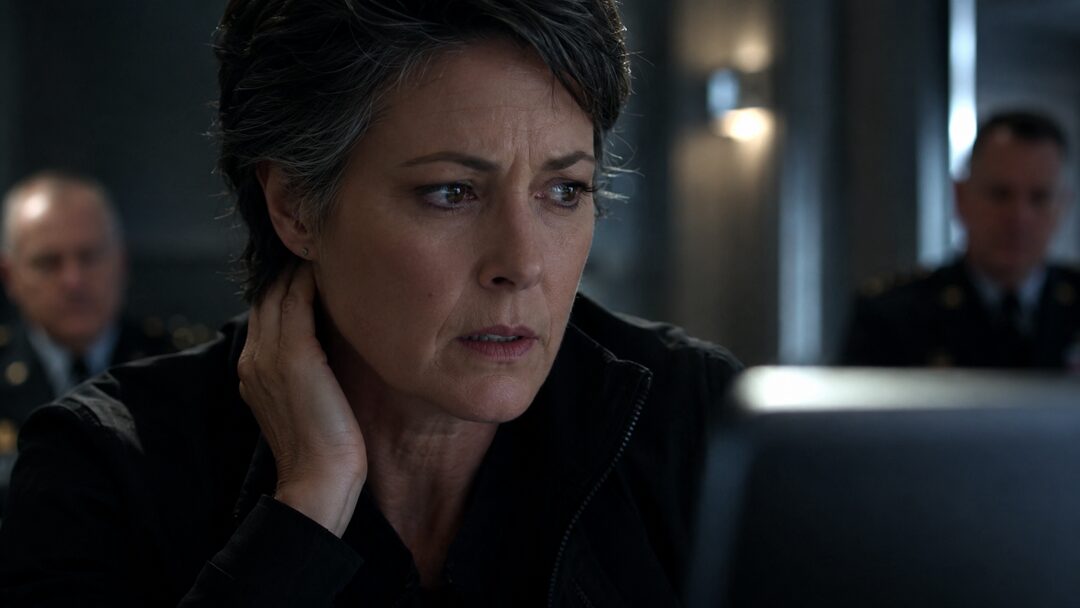
Sarah Miller heard the first second before anyone told her what it was, and her hand went straight to the side of her neck.
Not to her headphones.
Not to the laptop.
To the thin raised line beneath her jaw, where a piece of metal had opened her skin twelve years ago on a road that officially had no name.
The room stayed quiet except for the audio.
One second.
A hard burst of chaos. Too much energy packed into too little time. Static, impact, pressure, a tearing rush of air.
Then Captain Emily Carter paused the file.
Across the table, Colonel James Walker watched Sarah’s hand lower from her neck. He was in uniform, silver hair clipped close, shoulders square, hands resting flat on the table as if the room belonged to him even while he was being investigated inside it.
Emily noticed the gesture too. She pretended not to.
Sarah pulled off the headphones.
“Again?” Emily asked.
Sarah looked at the waveform frozen on the screen. Twelve point fourteen seconds of sound. No image. No subtitles. No transcript. No clean voice line to hang a story on.
Just sound.
“Not yet,” Sarah said.
Emily’s jaw tightened. She was younger than Sarah by almost a decade, blonde hair pulled back hard enough to sharpen her face, navy suit pressed but tired at the elbows. Her folders were arranged in a careful row, each tab a different color. People who wanted the truth usually arrived with facts.
People who wanted a certain truth arrived with systems.
Colonel Walker said nothing.
Sarah turned the laptop slightly toward herself. The file name was a string of numbers attached to an evidence code. Beneath it sat the duration.
00:00:12.14
“That’s all of it?” Sarah asked.
“All of the recoverable stream,” Emily said. “The video is corrupted. No embedded thumbnail. No closed captions. No usable transcript.”
“No other recorder?”
“None that survived intact.”
Sarah heard the word survived and did not look at Walker.
Emily continued. “The file came from Operation Ashfall. Failed extraction. Eastern border province. North alley team separated during withdrawal. Official report says radio contact was lost before Colonel Walker gave the order to leave the zone.”
Walker spoke for the first time.
“That is not just the official report,” he said. “That is what happened.”
His voice had the calm weight of a man accustomed to being believed.
Emily opened a folder.
“Three medics and two local guides were left behind. The report states they were already unreachable.”
Sarah kept her eyes on the waveform.
“And you think this proves otherwise.”
“I think,” Emily said, “it may.”
Walker’s fingers did not move.
Sarah put the headphones back on but did not press play. Not yet. Her body had answered too quickly the first time. That bothered her.
A sound analyst’s first duty was not to hear bravely.
It was to hear honestly.
“Before we start,” Sarah said, “I’m not here to tell either of you what you want this file to mean.”
Emily’s mouth closed around whatever she had been about to say.
Walker looked at Sarah as if he had just recognized something useful.
Sarah pressed play.
The first second hit again.
This time she did not touch her neck.
But she wanted to.
Part II — No Picture to Hide Behind
By the fourth replay, Emily had stopped watching Sarah’s face and started watching Walker’s.
Sarah could feel both of them trying to hear through her.
That was always the danger with damaged recordings. People treated absence like an empty chair and rushed to sit in it.
She played the file in sections.
“Zero to one second,” she said. “Immediate high-energy event. Broad-spectrum noise. Could be impact. Could be nearby structural failure. Could be multiple overlapping sources.”
“Incoming fire,” Walker said.
Sarah did not look up. “Could be.”
Emily leaned forward. “But not definitely?”
“Not definitely.”
Walker’s eyes hardened by a fraction.
Sarah moved the cursor.
“One point zero to one point five. Brief drop. Not silence. Just a dip in energy.”
The room seemed to listen with her.
“One point five to two point five. Second rise. Less violent than the opening, but organized enough to suggest movement near the recorder.”
“Movement by whom?” Emily asked.
Sarah let the question sit long enough to become its own warning.
“I don’t know.”
Emily looked down.
Sarah continued.
“Two point five to four. Lower noise floor. Still messy. Four point five to six, major lift. Loudest point occurs around five and a half to six seconds.”
“That is the attack,” Walker said.
Emily said, “Or a voice being drowned out.”
Sarah removed one side of the headphones.
“No.”
Both of them looked at her.
“No to both?” Emily asked.
“No to certainty.” Sarah tapped the table once. “The peak masks whatever is underneath it. That means it is the worst place to make a confident claim.”
Walker’s expression did not change, but something in his eyes settled. Not relief exactly.
Recognition.
Emily did not like it. “So the loudest part tells us nothing?”
“The loudest part tells us to be careful.”
“That’s not enough.”
“It may be all it can say.”
Emily looked as if she had been handed a locked door and told to admire the craftsmanship.
Sarah moved the cursor again.
“Eight to nine seconds. Noticeable quiet beat.”
Walker’s gaze shifted down to the laptop.
Just once.
Sarah noticed.
“Then nine to eleven seconds. Energy returns. Final push. Eleven to twelve point one four, taper.”
She stopped the playback.
For a moment the room held the shape of the vanished sound.
Emily opened another folder and slid a map across the table. “This is the extraction zone. North alley team was here. Colonel Walker’s convoy was here. The gap between them was less than two blocks.”
“Under hostile conditions,” Walker said.
Emily ignored him. “A surviving radio operator wrote in a private note that north alley was still transmitting after the official loss-of-contact time.”
Walker turned to her. “A private note written three weeks later by a man who had been concussed.”
“Still a note,” Emily said.
“Not evidence.”
Sarah looked between them.
There it was. The real file beneath the file.
Not twelve seconds of battlefield audio.
Twelve seconds of institutional appetite.
Emily wanted the recording to open like a witness.
Walker wanted it to remain noise.
Sarah wanted, with sudden weariness, to be back in her apartment where the loudest thing was the refrigerator turning on at night.
But Emily slid a casualty summary forward next.
The top page held a photograph clipped to a form.
Five faces.
One was a young man with sandy hair and a broad, unguarded smile. A medic patch showed at the edge of the image. Beneath the photo, his name appeared in block letters.
MARK DAVIS.
Sarah looked only once.
Then she looked away.
“What do you need from me?” she asked.
Emily’s answer came too fast.
“A conclusion.”
Walker’s answer came more slowly.
“The truth.”
Sarah almost laughed.
People loved that word when they believed it would choose their side.
Part III — The Quiet Beat
Sarah spent the next six hours alone with the file.
Not in the review room. She requested a smaller analysis office with no windows, no observers, and no one breathing moral urgency over her shoulder.
Emily gave her access.
Walker gave her nothing.
The file did not improve.
That was the first thing Sarah accepted. Some damaged things did not become clearer because you needed them to.
She marked what could be marked.
The opening burst. The dip. The second rise. The low bed of noise. The major lift at six seconds. The quiet beat. The final push. The taper.
She did not label the unknowns as voices.
She did not label them as impacts.
She did not call fear a frequency.
Still, the file began to change.
At 5.5 seconds, beneath the loudest peak, there was a brief human sound.
Not a word. Not even a syllable she would testify to.
But human.
Close to the recorder.
Too close to be dismissed as distant radio traffic.
Sarah replayed the half-second until her temples ached. On the tenth pass, her hand drifted toward her neck again. She stopped it halfway.
Her own memory came in pieces, the way bad audio did.
A road bleached white by sun.
A young lieutenant named David standing beside a stalled vehicle, frozen so completely that even his blinking had stopped.
Sarah on the radio, reporting movement east, impact west, casualties unknown.
Leaving out the part where David had not answered an order.
He had been twenty-three. He had lived. The report had not ruined him.
That was what she told herself for years.
The truth can punish.
But omissions can rot.
Sarah pushed the memory down and returned to the file.
At 8.0 seconds, the world in the recording dropped away.
Not silence.
Almost silence.
That was worse.
Sarah isolated the band, lowered the surrounding noise, and listened without breathing.
There.
A tiny mechanical click.
She pulled the headphones off.
The office hummed around her. Air vent. Cheap fluorescent light. Someone moving in the hallway.
She put the headphones back on.
Again.
At the start of the quiet beat: a faint release. A small, familiar interruption.
Push-to-talk.
Someone had been transmitting, then stopped.
Sarah sat back.
The most important part of the file was not the loudest part.
It was the place everyone had been calling empty.
Her phone buzzed once on the table. A message from Emily.
Any progress?
Sarah stared at the words.
Then another message appeared.
Board wants preliminary opinion tomorrow morning.
Of course they did.
Truth was always urgent to people who would not have to carry its limits.
Sarah typed: I have a finding. Not a conclusion.
Emily replied almost instantly.
That may not be enough.
Sarah looked at the waveform.
“It has to be,” she said to the empty room.
The door opened without a knock.
Walker stood in the hallway.
He had removed his cap. Without it, he looked older. Not weaker. Just more human, which was inconvenient.
“I was told you were still here,” he said.
Sarah took off the headphones. “That doesn’t mean you should be.”
“I’m not here to interfere.”
“That’s usually what people say when they’re about to.”
A thin smile crossed his face and disappeared.
He stepped inside but did not sit.
“Captain Carter wants a public failure,” he said. “A clean villain. A clean line.”
“She wants the record corrected.”
“She wants the record to bleed.”
Sarah’s eyes sharpened. “Careful.”
Walker accepted the warning with a small nod. “Poor choice of words.”
“Yes.”
He looked at the frozen waveform.
“You were there once,” he said. “Not Ashfall. Somewhere like it.”
Sarah said nothing.
“You know there are moments when command is not a moral exercise. It is arithmetic under fire. If I stayed, we could have lost thirty-seven more people.”
“And if you changed the timeline afterward?”
His stillness changed.
It was subtle, but Sarah heard silence for a living.
“I made the only decision that kept the convoy alive,” he said.
“That wasn’t my question.”
Walker’s jaw tightened.
For the first time, she saw it: not guilt exactly, not innocence either. A man pressing both hands against a door he had already closed.
He said, very quietly, “Do not let her turn twelve seconds into a weapon.”
Sarah looked back at the screen.
“Twelve seconds already did something,” she said. “I’m just trying to hear what.”
Walker left without answering.
Sarah waited until his footsteps faded.
Then she played the quiet beat again.
The click was still there.
Part IV — The Name on the Recorder
The next morning, Emily arrived with coffee Sarah had not asked for and a folder she clearly had.
Her face was pale with the kind of sleeplessness that usually meant discovery.
“You need to see this,” she said.
Sarah did not touch the coffee.
Emily opened the folder and placed two documents side by side.
The first was the chain-of-custody form for the damaged recorder.
The second was an equipment assignment sheet.
Sarah read the serial number once.
Then again.
Her stomach dropped with the clean efficiency of an elevator cable snapping.
“It wasn’t anonymous,” Emily said.
Sarah did not answer.
“The recorder was assigned to Mark Davis.”
The room narrowed around the name.
Sarah looked at the casualty summary again. Mark Davis. Twenty-seven. Combat medic. Official time of death logged before Walker’s withdrawal order.
Before the recording.
“That can’t both be true,” Emily said.
“No,” Sarah said.
Emily’s eyes flashed. “So the report is false.”
“The timeline is false.”
“That is the report.”
“It is part of the report.”
Emily pushed away from the table. “Why do you do that?”
Sarah looked up.
“Do what?”
“Pull back from the obvious.”
“The obvious has sent innocent people to prison and guilty people home.”
“This isn’t a philosophy seminar.”
“No,” Sarah said. “It’s a room where everyone keeps trying to make a damaged file say complete sentences.”
Emily’s anger broke through her professional polish.
“Mark Davis’s mother has written twelve letters asking why her son’s last location changed three times in three different notices. Twelve. Do you know what the final reply said?”
Sarah waited.
Emily’s voice lowered. “It said, ‘The record is consistent with available information.’”
The sentence lay between them, clean and horrible.
Sarah looked down at Mark’s photo.
Broad smile. Sandy hair. Medic patch. Two strips of white tape visible across the edge of his helmet.
A detail too ordinary to bear much weight.
A detail that now had to.
Sarah put the headphones back on.
“Play from nine seconds,” Emily said.
“I know where to play.”
Sarah started at 8.7.
Quiet beat. Click.
Then the final push.
Not as loud as the six-second peak. Messier. Lower. A scrape. A jolt. Another surge of noise.
Sarah listened again.
And again.
On the fourth pass, she stopped breathing.
Two impacts.
Not external. Not distant.
Close contact with the recorder casing.
Tap.
Tap.
Her chest tightened.
She played it again, isolating the lower register.
Tap.
Tap.
Emily whispered, “What is that?”
Sarah closed her eyes.
Not because it helped. Because it hurt less when there was no room to see.
“Medics used a nonverbal emergency signal when they couldn’t speak over open comms,” she said. “Two strikes on gear or casing. It meant alive. Unable to transmit clearly. Need extraction.”
Emily sat down slowly.
“You can prove that?”
“I can prove the pattern is consistent with two close-contact strikes on the recorder casing. I can testify to the protocol. I can say it occurs after the point where the report says Davis was already dead.”
Emily’s face changed.
Not victory.
Something more dangerous.
Hope with teeth.
“So he was alive.”
Sarah opened her eyes.
“The audio supports that at least one living person was near that recorder.”
“Sarah.”
“That is what I can say.”
Emily pressed her palms to the table. “His name was on the recorder.”
“Yes.”
“His signal is on the file.”
“The signal is consistent.”
Emily stared at her as if restraint were cruelty.
Sarah let the look land.
Then she said, “If we overclaim, they will bury the true part under the exaggerated part.”
Emily looked away first.
That was the moment their argument changed.
Not ended.
Changed.
Because Emily understood.
And hated that she did.
Part V — What the Room Wanted
By the night before testimony, everyone wanted Sarah to become simpler.
Walker’s legal liaison sent a memo suggesting the file was “too degraded for meaningful evidentiary value.”
Emily sent a draft question list that used the phrase “proof of abandonment” three times.
The review board requested “a clean technical conclusion.”
Sarah read all three at the small desk in her hotel room and laughed once, without humor.
Clean.
There was no clean.
There was only less false.
She opened the file again.
The laptop speakers were muted. She watched the waveform first, its jagged shape familiar now in a way no image could be.
Twelve point fourteen seconds.
A whole life could vanish inside a shorter gap.
She put on the headphones.
Opening burst.
Her fingers twitched, but did not rise.
Dip.
Second rise.
Low bed.
Peak near six.
The hidden human sound under it.
Quiet beat.
Click.
Final push.
Tap.
Tap.
Taper.
She played it again, this time with the mission timing beside it.
Convoy movement.
Radio checks.
Reported loss of contact.
Withdrawal order.
Official death entry.
The rhythm aligned badly with the report.
No, not badly.
Honestly.
The recording did not capture the whole disaster. It did not show Walker’s face when he gave the order. It did not show Mark Davis. It did not show the alley, the convoy, the wounded, the guides, the dust, the impossible arithmetic Walker had described.
It captured only the last twelve seconds before the order sealed the story into a lie.
Sarah leaned back and closed her eyes.
David, the young lieutenant from years ago, returned again.
His frozen face.
Her report.
Her omission.
No one had asked her about it later. No one had punished him. No one had praised her. The lie had worked exactly as mercy was supposed to work.
That was the problem.
Some lies saved a person once and taught a system how to ask for more.
The next morning, the hearing room was colder than the review room.
Three board members sat behind a long table. Walker sat to the left with counsel. Emily sat to the right with her folders aligned like a barricade.
Sarah sat alone in the center.
Someone swore her in.
Someone summarized her credentials.
Someone said Operation Ashfall in a careful, polished voice that made the words sound less like people had been involved.
Then they played the file.
Through room speakers, it sounded worse. Flatter. Brutal without intimacy.
The opening burst filled the room.
Sarah did not flinch.
Not because she was untouched.
Because she was listening.
When it ended, the senior board member looked at her.
“Ms. Miller, can this recording establish that Colonel Walker knowingly ordered withdrawal while members of the north alley team were still alive?”
There it was.
The answer everyone wanted in one direction or the other.
Sarah glanced at Emily.
Emily’s face was tight with need.
Sarah looked at Walker.
His hands were still flat on the table, but his eyes had changed since the first day. He looked less like a commander awaiting vindication than a man standing very still near a ledge.
Sarah turned back to the board.
“No,” she said.
Emily’s expression broke.
Walker’s counsel exhaled.
Sarah continued.
“It cannot establish what Colonel Walker knew in his mind at the moment of the order. The file has no video stream. No visual scene can be reconstructed from it. There are no subtitles, no confirmed speech transcript, and no image-based evidence.”
Walker’s counsel leaned toward him.
Sarah kept speaking.
“But the recording can establish several material facts.”
The room tightened.
“At approximately five and a half to six seconds, the highest-energy event masks a brief human sound close to the recorder. At approximately eight to nine seconds, beneath the drop in sound energy, there is a mechanical release consistent with a push-to-talk radio control. In the final push, there are two close-contact strikes against the recorder casing, consistent with a medic distress signal used when verbal transmission is not possible.”
Emily’s eyes lifted.
Sarah placed the equipment sheet beside the waveform.
“The recorder serial number corresponds to equipment assigned to Specialist Mark Davis.”
Walker’s counsel began to speak. “The assignment records—”
Sarah did not raise her voice.
“I am not finished.”
The board member gestured for silence.
Sarah looked at Walker now.
“The official timeline lists Specialist Davis as dead before this recording could have occurred. The audio does not prove why that timeline was written incorrectly. It does not prove Colonel Walker’s emotional state. It does not prove every action in the alley.”
Walker met her eyes.
For one second, she thought he might interrupt.
He did not.
Sarah said, “But it proves the report is false.”
No one moved.
The sentence had no drama in its shape.
That was why it landed.
Sarah added, quieter, “The absence of video does not erase what the audio can still carry.”
Emily looked down.
Walker closed his eyes once, slowly.
Not confession.
Not absolution.
Only the first visible sign that the official story no longer had enough weight to hold him upright.
Part VI — The Taper
Walker was relieved of command pending further inquiry two days later.
The statement was short. Administrative. Careful in all the ways institutions were careful when they were frightened of their own records.
It did not say Mark Davis had signaled.
It did not say the north alley team had still been alive.
It did not say the dead had been made convenient.
It said the findings warranted reopening the matter.
Emily called Sarah after the notice went out.
For several seconds neither of them spoke.
Then Emily said, “It’s not enough.”
“No,” Sarah said.
“But it’s something.”
“Yes.”
Emily breathed out. “I hated you a little in that room.”
“I know.”
“I may hate you again when the next memo comes.”
“That would be consistent with available information.”
Emily was silent.
Then, unexpectedly, she laughed.
It was small and tired and gone almost at once.
“Mark’s mother asked whether she would receive a corrected finding,” Emily said.
Sarah looked at the envelope already sitting on her desk.
“Yes.”
“You don’t have to be the one to send it.”
“I know.”
After the call, Sarah printed the final page herself.
Not the whole report. Not the appendices. Not the analysis charts.
Just the corrected finding.
The record now reflected that Specialist Mark Davis was alive and signaling after the official time previously listed.
Sarah placed it in the envelope with a note written by hand.
Mrs. Davis,
The record now shows he was alive and signaling.
Sarah Miller
She read the line twice.
It was not comfort.
It was not enough to warm a kitchen table or answer twelve letters or return a son to the doorway.
But it was no longer nothing.
At the post office, the clerk asked if she wanted tracking.
Sarah almost said no.
Then she thought of records. Of gaps. Of official language polishing pain until no one could hold it.
“Yes,” she said. “Tracking.”
That night, in her apartment, Sarah opened the file one last time.
The room was dark except for the laptop. Her refrigerator clicked on. Somewhere upstairs, someone crossed a floor too heavily. Ordinary sounds. Living sounds.
She put on the headphones.
For a moment, her finger hovered over the key.
She was not trying to solve it now.
That was the difference.
She pressed play.
The first second struck.
Her hand stayed on the table.
The dip came.
The second rise.
The low stretch.
The peak at six seconds, loud enough to hide a person and not strong enough to erase him.
The quiet beat.
The click.
The final push.
Tap.
Tap.
Then the taper.
This time, Sarah let it fade all the way out.
She did not name what she could not know.
She did not build a picture over the missing one.
She sat with the sound until the room returned.
And in that return, for the first time, the silence did not feel empty.