The Name That Came Back
Part I — The Wrong Place
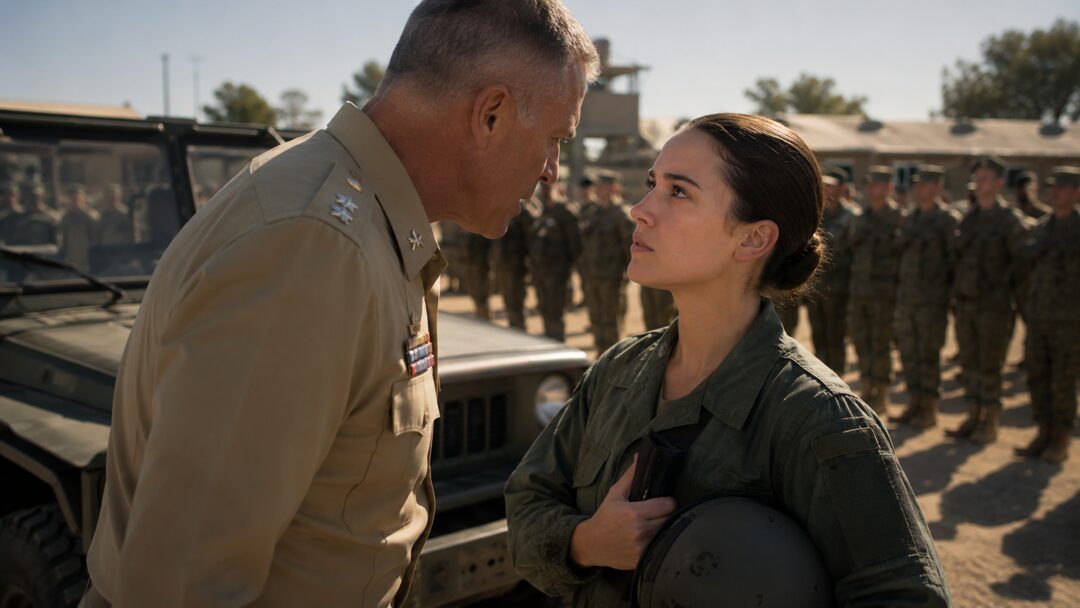
Sarah Mitchell was standing alone at the edge of the formation when Colonel Robert Hayes climbed down from his dust-streaked jeep and decided, in front of six hundred people, that she did not belong there.
He did not ask her name first.
He did not ask for orders.
He looked at the helmet tucked against her ribs, the patch on her sleeve that did not match his battalion, and the sealed packet in her left hand.
Then he said, loud enough for the rear rank to hear, “Who lost you?”
The morning went still.
Sarah kept her eyes forward.
The soldiers behind her stood in long, rigid rows beneath the hard Texas light. Boots aligned. Shoulders squared. Faces blank in the practiced way of people trained not to react when power turns ugly.
Hayes stepped closer.
He was tall, broad through the chest, his tan service uniform sharp except for the red range dust smeared along one cheek. It gave his face a raw, weathered look, as if the field itself had marked him. His voice was the kind that had been obeyed for decades.
“You deaf, Specialist?”
“No, sir.”
“Then answer the question.”
Sarah’s voice stayed even. “Specialist Sarah Mitchell reporting as directed, sir.”
Hayes looked at the packet in her hand. “Directed by whom?”
Sarah offered it.
He did not take it.
Instead, he looked at Major David Collins, standing two steps behind him with a clipboard pressed to his side.
“Major, did we request administrative help for inspection?”
“No, sir,” Collins said carefully.
Hayes’s mouth tightened. “Then somebody sent me a lost clerk.”
A few soldiers shifted without moving. That was how discomfort showed in formation: a throat clearing, a blink held too long, a jaw tightening where no one was supposed to notice.
Sarah noticed.
She also noticed Staff Sergeant James Walker in the second row. Lean. Sunburned. Left hand still even though the fingers carried an old burn scar that had pulled the skin shiny across the knuckles.
When Hayes said “lost clerk,” Walker’s jaw locked.
Sarah filed it away.
Hayes turned back to her. “This is a battalion inspection, Specialist. Not a reception desk. Not a records closet. Not wherever you came from.”
“Yes, sir.”
“That all you have?”
“No, sir.”
“Then explain yourself.”
Sarah lifted the sealed packet a fraction. “My orders are inside, sir.”
“Your orders.” Hayes gave a short, humorless laugh. “You think I haven’t seen orders before?”
He snatched the packet then, tore his eyes across the front, and stopped.
Not at her name.
At the authority code stamped across the seal.
His expression changed so quickly most people might have missed it.
Sarah did not.
It was not fear. Not yet.
It was recognition refusing to become recognition.
Hayes looked up slowly. “Where did you get this?”
“It was issued to me, sir.”
“I didn’t ask what the paperwork says. I asked where you got it.”
Sarah did not answer.
That, more than anything, angered him.
Hayes stepped closer until the shadow of his brim crossed her face. “You come onto my field, wearing the wrong patch, carrying sealed paperwork, and you think silence is discipline?”
“No, sir.”
“Then what is it?”
Sarah’s right hand rested near the inside pocket of her uniform jacket.
She did not move it.
“Sir,” she said, “you should dismiss the formation.”
The sentence landed harder than a shout.
Even Collins looked at her then.
Hayes stared at Sarah as if she had reached up and removed rank from his collar.
“You’re giving me advice now?”
“No, sir.”
“It sounded like advice.”
“It was an opportunity.”
The silence after that was alive.
Hayes’s face darkened.
“Major Collins,” he said, still looking at Sarah, “escort Specialist Mitchell to administration. Find out what desk lost her, and then find out why that desk thought I had time to entertain it.”
Collins hesitated only a second.
Sarah turned her head slightly toward him. “Major, I would not recommend touching that packet.”
Hayes moved before Collins could. He reached for the papers in her hand with the sharp impatience of a man used to having doors open before he knocked.
Sarah let him come close enough.
Then she opened the black leather wallet from inside her jacket and held it between them.
The badge caught the morning light.
No speech could have done what that small flash of metal did.
Hayes froze.
The battalion saw it.
The man who had filled the entire field with his voice suddenly had none.
Sarah held the credential steady. Her face did not change.
“Special Agent Sarah Mitchell,” she said. “Army Criminal Investigation Division. Colonel Hayes, you are a named subject in an active inquiry concerning falsified casualty documentation connected to Operation Red Valley.”
The rear ranks could not have heard every word.
They did not need to.
They saw the badge.
They saw Hayes’s eyes.
They saw the space between them change hands.
Sarah lowered her voice so only Hayes and Collins could hear the rest.
“Now, sir,” she said, “you may dismiss the formation.”
For the first time that morning, Colonel Robert Hayes obeyed someone else.
Part II — The Missing Line
In the conference room behind battalion headquarters, Hayes became quieter, which made him more dangerous.
The blinds were half-closed. Morning light cut the table into bright bars. Collins stood by the door, pretending not to listen until Hayes ordered him out.
When the door shut, Hayes remained standing.
Sarah sat.
It was not disrespect. It was procedure.
Hayes saw it as both.
“You enjoyed that,” he said.
Sarah opened a folder on the table. “No, sir.”
“You pulled a badge in front of my people.”
“You created the audience.”
His jaw worked once.
There were men who shouted because they had no control. Hayes shouted because control had always answered him. Quiet was where his anger became more precise.
“Red Valley was reviewed,” he said. “Three times.”
“Yes, sir.”
“Then read the reviews.”
“I have.”
“Then you know the report was correct.”
Sarah removed a photograph from the folder and placed it on the table.
A young man in uniform. Dark hair. Easy smile. The kind of face families kept on mantels because it still looked like it might walk through the door.
Hayes did not look down.
Sarah waited.
At last, his eyes dropped.
“Sergeant Daniel Price,” she said.
“I know who he is.”
“You signed the casualty summary.”
“I signed dozens.”
“No,” Sarah said. “You signed this one twice.”
His eyes came up.
That struck.
She slid another page forward. “The first version referenced a final radio transmission logged at 0317. The second version removed that line.”
Hayes did not touch the paper.
“Communications were compromised,” he said.
“That is in the report.”
“Then why are you asking?”
“Because the raw log shows the transmission existed.”
For a moment Hayes’s expression held. Commander’s face. Inspection face. The face that had looked over rows of soldiers and found every crooked strap.
Then something moved under it.
Not guilt exactly.
Something older and more defended.
“The raw log was incomplete,” he said.
Sarah took a small recorder from her bag and set it beside the folder. She did not turn it on yet.
“Colonel, Daniel Price’s mother has requested clarification for four years.”
His gaze shifted toward the blinds.
“She received clarification.”
“She received language.”
“That is what the Army gives families.”
“No,” Sarah said. “That is what people give families when they want them to stop asking.”
Hayes looked back at her.
The room tightened.
Sarah expected anger. She was prepared for it. Anger was easy. Anger moved in straight lines.
But Hayes said, “Do you have children, Agent Mitchell?”
“No, sir.”
“Then don’t use a mother as a lever unless you understand the weight.”
Sarah held his stare.
“I understand someone removed her son’s last words from the file.”
Hayes’s hand closed on the back of a chair. His knuckles whitened.
“There were no last words worth putting in a file.”
It was the wrong thing to say.
They both knew it as soon as it left his mouth.
Sarah turned on the recorder.
“Let’s start there.”
Hayes sat across from her then, not because he had softened, but because his legs had remembered something he had not given them permission to remember.
He gave her the official version first.
Bad weather. Fragmented visibility. Broken comms. Unit under pressure. Withdrawal ordered. Price separated during movement. Recovery impossible. No misconduct found.
He spoke like a report because reports had saved him from speaking like a man.
Sarah let him finish.
Then she opened another folder.
“Staff Sergeant James Walker was present.”
Hayes’s eyes sharpened. “Walker has said all he needs to say.”
“Not to me.”
“You stay away from him.”
“That sounds like an instruction.”
“It’s a warning.”
Sarah leaned back slightly.
There it was: the first real fracture.
Not when she showed the badge.
Not when she named Daniel Price.
When she named James Walker.
Hayes stood so quickly the chair scraped the floor.
“You came here thinking you found some neat little lie,” he said. “A bad colonel. A clean correction. A mother crying over a document. You think truth is a door. You open it, light comes in.”
Sarah said nothing.
Hayes leaned over the table, but his voice dropped.
“Sometimes truth is a room full of people you can’t bring back.”
Sarah looked at the photograph again.
Daniel Price smiled up from the table, forever unaware of what had been done in his name.
“That may be true,” she said. “But he is still in the room.”
Part III — What James Remembered
James Walker did not ask for water when Sarah sat across from him.
He did not ask whether he needed a lawyer.
He asked, “Is Colonel Hayes in trouble?”
Sarah looked at his left hand. The burn scar tightened when he flexed his fingers.
“That depends on what happened,” she said.
James almost smiled.
Not because it was funny.
Because he knew better than anyone that what happened and what got written down were rarely the same thing.
They were in a small interview room with a clock that clicked too loudly. James sat straight, boots flat, eyes on the table. He wore his uniform with perfect care, but not with pride. More like debt.
“You were present during Operation Red Valley,” Sarah said.
“Yes, ma’am.”
“You were in Sergeant Price’s squad.”
“Yes, ma’am.”
“You gave a statement four years ago.”
“Yes, ma’am.”
“And left out the 0317 transmission.”
His scarred hand stopped moving.
Sarah waited.
James looked at the recorder between them. “Is this on?”
“Not yet.”
“Turn it on.”
She did.
For three seconds, he said nothing.
Then he said, “Daniel wasn’t lost.”
Sarah did not move.
James swallowed. “That’s the first thing. He wasn’t lost.”
The word sat there, plain and terrible.
Lost was soft. Lost could happen to anyone. Lost meant fog, error, confusion, bad luck.
James looked up.
“He stayed.”
Sarah let the silence do its work.
James spoke in pieces, as if every sentence had to pass through a checkpoint.
Red Valley had not been part of the official route. Hayes had moved the convoy outside approved boundaries because local families were trapped near the old schoolhouse. Civilians, mostly old people and children, though James never used the word children. He said “families” and looked away.
The road out collapsed behind them after the first vehicle crossed.
The unit had minutes, maybe less.
Price took the radio and climbed to higher ground with a damaged transmitter because the enemy fire was tracking the main column. He drew their attention away. Misdirected them long enough for the last trucks to pull out.
Sarah listened.
She had read hundreds of files built from grief. Most were written in the same clean vocabulary. Movement. Contact. Casualty. Recovery. Regret.
None of those words contained a man choosing to stay behind.
“Did Colonel Hayes order him to remain?” Sarah asked.
James’s head came up fast. “No.”
“Did Sergeant Price volunteer?”
“Yes.”
“Did Colonel Hayes accept?”
James closed his eyes.
There was the wound.
Not the staying.
The accepting.
“He told Daniel no at first,” James said. “Daniel said if nobody pulled their eyes off the road, nobody was getting out. Hayes said he wasn’t leaving a man behind. Daniel said—”
James stopped.
Sarah waited.
“He said, ‘Sir, then don’t leave them all.’”
The clock clicked.
James pressed his scarred fingers into his palm.
“I heard him until the end,” he said. “On the radio. Everyone says comms broke. They didn’t. Not right away.”
“What did he say?”
James looked at the wall.
“Mostly coordinates. Corrections. Warnings.” His throat moved. “Then he asked if Walker made it.”
Sarah’s pen paused.
“You?”
James nodded once.
“I was hit. Arm was useless. Daniel had dragged me behind the second truck before he went up the ridge. I don’t remember that part right. I remember his glove on my collar. I remember being angry at him because he was smiling.”
He breathed in, but it did not seem to help.
“The last thing I heard him say was, ‘Tell my mom I wasn’t alone.’”
Sarah felt something in her chest shift, not break, not soften exactly.
Shift.
“And that was removed,” she said.
James’s voice flattened. “Everything was removed.”
“Why?”
“Because we weren’t supposed to be there.”
Sarah already knew. But confession mattered. Sequence mattered. A person saying it mattered.
James looked at the recorder as if it were a second witness.
“If Hayes reported it straight, they would ask why we went off route. They would ask who authorized it. They would make Daniel’s choice evidence in a hearing. Hayes said the civilians would become numbers, Daniel would become a mistake, and the rest of us would spend the rest of our lives explaining why we lived.”
“Did you agree?”
“At the time?”
“Yes.”
James laughed once, empty. “At the time, I was twenty-nine, half-medicated, and Colonel Hayes had just brought most of us home. If he told me silence was loyalty, I believed him.”
“And now?”
He looked at his hand.
“Now I think silence is a second place to leave somebody.”
That was the line that stayed with Sarah.
Not because it was polished.
Because it sounded like it had cost him four years to say.
Part IV — The Bargain
Hayes found her outside the records annex just after sunset.
The day had cooled, but the pavement still held heat. Across the base, the flag lowered in the distance. No ceremony reached them here, only the faint metallic complaint of a chain against a pole.
Sarah had James Walker’s signed statement in her bag.
Hayes knew it without asking.
“Agent Mitchell.”
She stopped.
He stood ten feet away, hands clasped behind his back. No audience this time. No formation. No jeep. No red dust catching the light.
Without soldiers watching, he looked older.
“I assume Sergeant Walker talked,” he said.
“He told the truth.”
Hayes’s face tightened. “That word gets easier when you don’t have to carry what comes after it.”
Sarah said, “You had four years to carry what came after the lie.”
His eyes moved across her face, searching for softness and finding only attention.
“You think I don’t know that?”
“I think you got used to calling it protection.”
That hit harder than she expected.
Hayes looked away.
For several seconds, neither of them spoke.
Then he said, “There were thirty-two civilians in those trucks.”
Sarah knew the number. She had read the annexed humanitarian memo, the one routed badly, filed late, and marked irrelevant to the casualty correction.
Hayes continued. “Fourteen of my soldiers would not have made it if Price hadn’t done what he did. Walker was one of them. Collins too, though he won’t talk about it.”
Sarah said nothing.
“I broke the route,” Hayes said. “I made that call. Not headquarters. Not some clean voice in a room with air-conditioning. Me. I saw people who would be gone by morning, and I moved my unit.”
“And then Daniel Price paid for it.”
Hayes flinched at the name.
Not visibly enough for most people.
Enough for her.
“Yes,” he said. “He did.”
“Then why erase him?”
His eyes came back sharp.
“I did not erase him.”
“You removed his transmission.”
“I kept him from being turned into misconduct.”
“You don’t know that.”
“I know exactly how these rooms work.”
“So do I.”
“No,” Hayes said, and now his voice carried something almost pleading beneath the control. “You know files. You know interviews. You know the clean end of ugly things. I know what happens when people who were not there decide what a man’s last choice means.”
Sarah stepped closer.
“And Mary Price knows what happens when people who were there decide she cannot be trusted with her son.”
That stopped him.
Not rank. Not law. Not evidence.
A mother’s name.
Hayes looked down at the pavement.
“I wrote to her,” he said.
“I’ve seen the letter.”
“I meant every word.”
“You left out the only words she needed.”
His mouth hardened, but the anger did not fully return.
“She wants peace.”
“She wants an answer.”
“She thinks those are the same.”
Sarah let that sit.
Then Hayes said what he had come to say.
“File it as a correction. Omitted transmission due to communications review. Restore the line. Leave the route decision out. Leave Price’s choice clean.”
Sarah looked at him.
There it was.
The bargain dressed as mercy.
“Sir, you’re asking me to replace one partial truth with another.”
“I’m asking you to spare people who already gave enough.”
“You don’t get to decide that alone anymore.”
Hayes’s face changed.
For a moment, she saw the man from the parade ground again, the one who would rather fill the air with force than let silence accuse him.
But the force did not come.
Instead, he said, “They’ll relieve me.”
“Yes.”
“They’ll drag Walker back through it.”
“Probably.”
“They’ll put Price under a microscope.”
“Maybe.”
“And his mother?”
Sarah held his gaze.
“She has already been living under one,” she said. “She just didn’t know who was holding it.”
The chain at the flagpole tapped again in the distance.
Hayes closed his eyes briefly.
When he opened them, the commander was back. Not the bully from the field. Something colder. Cleaner.
“Then do your job, Agent Mitchell.”
Sarah nodded.
“I intend to.”
He walked past her without another word.
But as he reached the door, he stopped.
“Price was not afraid,” he said.
Sarah turned.
Hayes did not look back.
“I have told myself that matters.”
Then he went inside.
Part V — A Name Spoken Plainly
The review convened three mornings later in the same outdoor space where Hayes had humiliated Sarah.
That was not Sarah’s choice.
It was Hayes’s.
She understood why only when she saw the table set at the front of the formation.
A plain table. Three chairs. A folder. A pitcher of water no one touched.
Behind it, the battalion stood again in rows.
Sarah wore the same fatigues. The same patch. Her hair pinned the same way. The black credential wallet rested inside her jacket.
Hayes arrived without the jeep.
That mattered.
He walked across the field alone.
His tan uniform was immaculate. No dust on his cheek now. No accidental mark to make him look larger than himself.
Major Collins stood to one side, pale with tension.
James Walker stood in formation, eyes forward, scarred hand closed at his side.
Hayes sat at the table.
Sarah sat across from him.
For a moment, the field held the exact shape of the opening: authority at the front, soldiers watching, Sarah silent under the weight of a public moment.
But this time the silence belonged to everyone.
A reviewing officer read the administrative language. Sarah barely heard it. Inquiry. Correction. Supplemental statement. Command responsibility. Operational variance.
Words built to keep emotion from leaking through.
Then Hayes was asked to speak.
He unfolded a prepared statement.
Sarah saw the first line from where she sat.
On the night of the incident, communications were limited—
She knew then.
He was still trying to manage it.
Hayes began reading.
“On the night in question, communications were limited by terrain and weather conditions. Sergeant Price’s location could not be fully verified during the withdrawal—”
James Walker’s jaw tightened.
Sarah reached into her jacket.
She did not interrupt.
She did not accuse him.
She took out the black leather wallet and placed it on the table between them.
Closed.
Quiet.
Hayes stopped.
The field seemed to stop with him.
He looked at the wallet for a long time.
The first time she had shown it to him, it had been a blade. A bright, clean reversal. Proof that he had misjudged her.
Now it was something else.
Not threat.
Witness.
Hayes set the prepared statement down.
His hands rested flat on the table.
When he spoke again, his voice was lower, but it carried.
“Sergeant Daniel Price was not lost during withdrawal.”
No one moved.
Sarah saw James close his eyes.
Hayes did not look at the papers.
“He remained behind by choice to divert attention from the convoy. I initially refused that choice. He made clear that without diversion, the rest of the unit and the civilians under our protection would not clear the valley.”
A wind moved over the field and did nothing to cool it.
Hayes swallowed once.
“I authorized movement outside the approved route to retrieve civilians near the Red Valley schoolhouse. That decision was mine. The consequences of it were mine.”
His voice held.
Barely.
“Sergeant Price’s final transmission was received. It was omitted from the casualty summary under my authority. That omission was wrong.”
The sentence did not sound dramatic.
That made it worse.
Hayes looked out at his soldiers.
For the first time since Sarah had met him, he seemed to see them not as a formation, not as a reflection of his command, but as individual people who had trusted his silence.
“Daniel Price asked if Staff Sergeant Walker made it.”
James’s face folded for half a second before he forced it still.
“He was told yes.”
Hayes looked down.
Then back up.
“His final message was for his mother.”
The field had no sound in it now.
Hayes’s voice roughened.
“He said, ‘Tell my mom I wasn’t alone.’”
That was all.
No speech about honor. No defense of context. No plea.
Just the name. The choice. The words.
Sarah watched him sit there after saying it, a man suddenly smaller and more human than the rank on his shoulders.
The reviewing officer took over.
Administrative action would proceed. Command status would change pending further determination. Official records would be corrected.
The machinery resumed.
But the real thing had already happened.
The name had returned to the air.
Afterward, Hayes stood.
For a moment, Sarah thought he might speak to her.
He did not.
He looked once toward James Walker.
James did not salute.
He did not turn away either.
That was the mercy he could give.
Hayes accepted it with the smallest nod.
Then he walked off the field alone.
Part VI — What She Could Give
Mary Price lived in a small white house with clean windows and two empty planters beside the front steps.
Sarah noticed the planters before she knocked.
People waiting for answers often kept things ready without knowing what they were ready for.
Mary opened the door before the second knock.
She had silver hair pinned loosely at the back of her head and hands that held the edge of the door with careful strength. She wore a plain blue cardigan despite the warm afternoon.
“You’re Agent Mitchell,” she said.
“Yes, ma’am.”
Mary looked at the folder in Sarah’s hand.
For four years, she had been asking for paper.
Now that it had arrived, she did not reach for it.
“Would you like to come in?”
The living room was neat. Not frozen, not shrine-like. There were books on a side table, a folded blanket on the arm of the couch, and one framed photograph on the mantel.
Daniel Price, younger than his file. Smiling in a backyard. One arm around his mother, the other lifted like he was waving someone into the picture.
Sarah sat where Mary indicated.
Neither woman spoke for a moment.
Then Sarah placed the folder on the coffee table.
“This is the corrected statement,” she said. “And a copy of the recovered transmission log.”
Mary looked at it.
Her lips moved slightly, but no sound came.
Sarah had delivered hard truths before. Some people grabbed the documents. Some cried before they read them. Some became angry at the paper because paper was safer than the world.
Mary Price sat very still.
“My son was always calling me late,” she said finally.
Sarah waited.
“He would forget the time difference. Or pretend to. He’d say, ‘You awake?’ And I’d say, ‘No, Daniel, I’m answering in my sleep.’”
A small smile touched her mouth and vanished.
“They told me communications were down.”
Sarah said, “They were not down at first.”
Mary’s hands folded in her lap.
“He sent something?”
“Yes, ma’am.”
Sarah opened the folder, turned one page, and slid it across.
Mary did not look immediately.
She looked at Sarah instead.
“Was he alone?”
That was the question.
Not about procedures. Not about who would be punished. Not about what line changed in which record.
The question beneath every letter she had written.
Sarah could have answered gently and vaguely. She could have said what people said when they wanted grief to soften around the edges.
Instead, she gave Mary what everyone else had taken from her.
“No,” Sarah said. “They heard him until the end.”
Mary closed her eyes.
Her hands did not fly to her mouth. She did not collapse. She did not perform the size of the wound.
A breath left her body as if she had been holding it for four years.
When she opened her eyes, they were wet, but steady.
“He asked about someone?”
Sarah nodded. “Staff Sergeant James Walker. He wanted to know if he made it.”
Mary looked toward the mantel.
“That sounds like him.”
Sarah did not say anything.
Mary read the page then.
Slowly.
Once, her fingers stopped over a line.
Tell my mom I wasn’t alone.
Her face changed, but not into relief. Relief was too simple. It was a room with more space in it, but the same absence.
“He shouldn’t have had to say that,” Mary whispered.
“No, ma’am.”
Mary touched the page again.
“And someone heard him.”
“Yes.”
“Did Colonel Hayes tell you that?”
Sarah thought of Hayes at the table. The closed wallet between them. Daniel’s name forced back into daylight.
“He did,” she said.
Mary absorbed that.
“I was angry at him for a long time,” she said.
Sarah did not ask how she knew whom to blame. Mothers often knew where the locked doors were.
“I may still be,” Mary added.
“That would be fair.”
Mary almost smiled. “Fair has not been very useful.”
“No, ma’am,” Sarah said. “It usually arrives late.”
For the first time, Mary looked at her with something like warmth.
Not gratitude exactly.
Recognition.
“You’re very young,” Mary said.
Sarah had heard that as an insult from Hayes.
From Mary, it sounded like concern.
“Sometimes,” Sarah said.
Mary folded the corrected statement with careful hands and held it against her chest for one brief second before placing it back in the folder.
“What happens to Colonel Hayes?”
“He has been relieved of command pending review.”
Mary nodded slowly.
“Will that bring Daniel back into the record?”
“Yes, ma’am.”
“That is not the same as bringing him back.”
“No.”
Mary looked at the photograph on the mantel.
“No,” she said again, softer. “Of course it isn’t.”
Sarah stood to leave.
At the door, Mary touched her arm.
It was light. Almost nothing.
But Sarah stopped.
“Agent Mitchell?”
“Yes, ma’am?”
“Thank you for not making him sound small.”
Sarah’s throat tightened before she could stop it.
She nodded once.
Outside, the afternoon had gone gold around the edges. Sarah walked to her car and sat for a moment with both hands on the wheel.
The black credential wallet lay on the passenger seat.
For the first time since Fort Mercer, it looked smaller to her.
Not weaker.
Just smaller than what people needed.
A badge could open a file. It could stop a powerful man mid-sentence. It could force a name back onto paper.
But it could not give Mary Price another phone call.
It could not take James Walker back to the moment before silence became loyalty.
It could not return Robert Hayes to the man he had been before one decision saved many lives and cost one mother the truth.
Sarah picked up the wallet and closed it.
Then she looked at the copy of Daniel’s final message resting in her bag.
Some names did not come back loudly.
Some came back in corrected lines, in a room where a mother finally breathed, in a field where a commander said plainly what he had spent years hiding.
Sarah started the car.
Behind her, Mary Price’s front door remained closed.
Inside that quiet house, Daniel’s name had returned to the air.
And this time, no one was taking it out.