The Table Between Them
Part I — The Toast No One Wanted to Interrupt
Michael raised his beer like the night belonged to him, and for almost everyone at the table, it did.
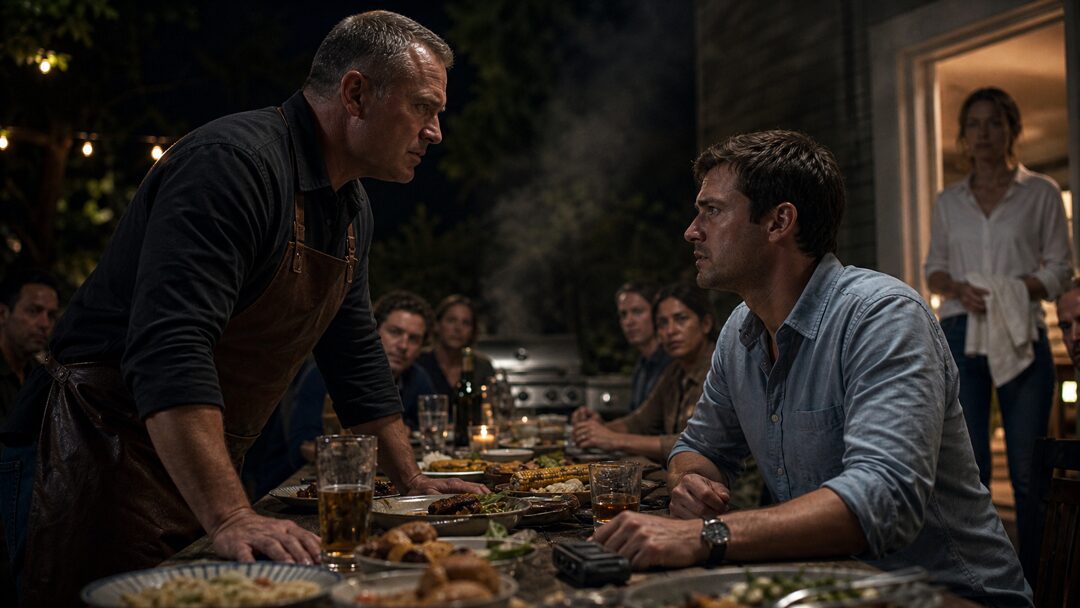
Smoke rolled behind him from the grill in slow gray sheets. The ribs were already cut and shining on their platters. Corn cooled in foil. Whiskey glasses caught the patio lights. Someone had set old unit patches beside the paper napkins as if memory could be folded neatly and placed by the forks.
“To the ones who made it home,” Michael said.
The men around the table lifted their drinks.
Daniel did not.
Michael saw it before anyone else did. Of course he did. He had built a life out of noticing the one man who moved wrong.
Daniel sat near the end of the table in a pale blue button-down with the sleeves rolled to his elbows, looking less like a guest than a man who had stopped by to return something he did not want to touch. He had not worn a unit shirt. He had not told the old jokes. He had smiled only when people looked straight at him.
Michael’s grin stayed in place.
“And,” he continued, voice warming, “to the one who made sure we did.”
The table softened.
That was always the line.
Every year, it landed the same way. Paul bowed his head. Robert blinked hard and reached for his glass. Someone whispered James’s name, not too loud, because Sarah was in the house.
Except Sarah was not in the house.
She stood in the open back doorway, framed by the kitchen light, wearing a white blouse and jeans, a folded towel in one hand. Her hair was tied back loosely. Her face held the practiced calm of a woman who had learned that grief made other people nervous.
Michael turned slightly toward her.
“To James,” he said.
“To James,” the table answered.
Glasses lifted.
Daniel’s stayed on the table.
It was only a small refusal. One beer bottle left untouched among raised hands.
But the night changed around it.
Paul noticed next. He was heavyset now, softer than he’d been years ago, with a unit tattoo disappearing under the sleeve of his polo. His eyes flicked from Daniel to Michael, then toward Sarah, then back to the food, as if brisket could rescue a room.
Michael laughed.
It was a good laugh. Big, easy, generous. A laugh that told everyone there was no problem unless he decided there was one.
“Daniel,” he said, “you become too civilian to toast properly?”
A few men chuckled.
Daniel looked up.
“No,” he said. “I just heard the words.”
The laughter thinned.
Michael kept his bottle raised for one more second, then lowered it with careful good humor.
“You heard a toast.”
“I heard the version.”
The patio went quiet enough for the grill to speak in little hisses.
Sarah did not move from the doorway.
Michael’s smile held, but it no longer warmed his face.
“Long drive from your place,” he said. “Maybe you’re tired.”
Daniel rested one hand flat on the table beside his untouched bottle.
“Is that still how you tell it?”
No one breathed right after that.
Not because they all knew what he meant.
Because some of them did.
Part II — The Version
Paul reached too fast for the platter of ribs.
“Before this gets weird,” he said brightly, “can we all agree Michael finally learned how not to ruin meat? Remember Fort Irwin? Man turned chicken into boot leather.”
A few men laughed because Paul needed them to.
Michael turned his grin toward him with gratitude that was almost warning. “That chicken was perfectly fine.”
“It had corners,” Paul said.
More laughter.
Daniel did not help them.
Michael set his beer down. The bottle touched the table with a small, final sound.
The dinner had been beautiful before that. Sarah had made potato salad because James used to hate every store-bought version and pretend he didn’t. Paul had brought bourbon he could not afford. Michael had arrived early with coolers, folding chairs, and the leather apron he wore at every reunion, the one everyone teased him about because it made him look like a steakhouse owner trying to command a battalion.
He had taken over the grill because he always took over whatever room he entered.
Sarah had allowed it because resisting Michael required more energy than she liked to spend on memorial days.
Besides, the men needed him.
That was the part Daniel hated most.
They relaxed when Michael stood.
They laughed when Michael laughed.
They believed the past was still organized when Michael told it.
“You want to say something,” Michael said.
It was not a question.
Daniel looked at the table before answering. His eyes moved over the plates, the sauce, the sweating glasses, the little patch beside his napkin. He turned it over with two fingers so the emblem faced down.
“No,” Daniel said. “I wanted you not to.”
Paul’s mouth tightened.
“Dan.”
Daniel did not look at him.
Michael leaned one hand on the back of his chair. The apron creaked slightly across his chest. Behind him, smoke kept lifting into the dark.
“Every year,” Michael said, “we honor him. Every year, Sarah opens her home to us. Every year, we remember the man who gave us a chance to sit at this table. So if you’ve got a problem with that, maybe say it clean.”
Sarah lowered the towel an inch.
Daniel finally looked at her.
Then away.
“That’s the problem,” he said. “You made it clean.”
The words did not land loudly.
They landed deeply.
Robert pushed back from the table. “I’m going to get some water.”
“No one needs water,” Michael said without looking at him.
Robert stopped.
There it was again. The old voice. Not raised. Not angry. Just certain enough to make grown men obey before they knew they had.
Daniel’s jaw shifted.
“You said he held the road.”
“He did.”
“You said he stayed at the roadblock during extraction.”
Michael’s eyes narrowed. “He did.”
“You said he bought us three minutes.”
“He bought us our lives.”
Daniel nodded once, almost to himself.
“What about the eastern alley?”
Paul put his fork down.
Sarah’s fingers closed around the towel.
Michael’s smile was gone now. Not faded. Gone.
“This isn’t the place,” he said.
“That’s what you said then.”
The line moved through the table like a wire pulled tight.
Paul’s voice dropped. “Daniel, stop.”
Daniel looked at him. “You remember the second flare?”
Paul swallowed.
“Don’t do this.”
“You heard it too.”
“I heard a lot that night.”
“And you forgot all of it except the part that made us look brave?”
Paul flinched as if Daniel had reached across the table.
Michael stepped away from his chair.
“You come into her yard,” he said, “sit at her table, eat her food, and decide tonight is the night you spit on her husband’s name?”
Sarah’s face changed then.
Only a little.
Enough.
Daniel saw it, and the guilt almost stopped him.
Almost.
“I’m not spitting on James,” he said.
Michael moved closer. “Then choose your next words like you remember who he was.”
Daniel’s voice stayed low.
“I do remember.”
He reached into his pocket.
Every man at the table watched his hand.
What he brought out was not dramatic. Not a letter tied with string. Not a medal. Not anything that belonged in a movie.
It was a small black digital recorder, scratched across one corner, the plastic dulled from years in a drawer.
Michael looked at it.
For the first time all night, he looked afraid.
Part III — The Recording
Sarah left the doorway.
Not forward. Back.
Into the kitchen, where the light washed her white blouse and then lost her.
Daniel watched her disappear and almost put the recorder away.
That would have been easier.
He had been choosing easier for years.
After the mission, he had packed everything into plastic bins and stacked them in his garage. Boots. Letters. A cracked watch. A photo of James asleep in a chair with medical tape stuck to his sleeve. The old body camera had been in a pouch he never opened. He told himself it was broken, which was true. He told himself there was nothing on it, which was not.
Three weeks ago, looking for a socket wrench, he had found the pouch.
The recording was damaged. Half static. Half breath. Enough to make him sit on the garage floor until morning with his hand over his mouth.
Enough to bring him here.
Michael pointed at the device.
“Put that away.”
Daniel’s thumb rested on the side.
“You know what it is.”
“I know what you think it is.”
Paul stood. “Nobody needs to hear anything tonight.”
“That’s right,” Michael said quickly. Too quickly. “This is not a hearing. This is not some board where we drag every second out and pretend clean hindsight gives men clean choices.”
Daniel looked at him.
“There it is.”
“What?”
“The speech you give before the lie.”
Michael’s hand curled.
Around the table, men shifted in their chairs. Wives and girlfriends who had been smiling politely twenty minutes earlier now sat frozen, trying to understand a language made of half-sentences and old fear.
Paul moved toward Daniel.
“Give it to me,” he said softly.
Daniel shook his head.
“You don’t want this,” Paul said.
“No,” Daniel answered. “I don’t. That’s why I know I should have brought it sooner.”
Michael’s voice cut in.
“You found something broken, and now you want to build a story out of static because you never forgave yourself.”
Daniel looked up sharply.
Michael had found the wound.
He always did.
“That might be true,” Daniel said.
The admission unsettled Michael more than denial would have.
Daniel placed the recorder on the table between the beer bottles.
“I didn’t listen for years,” he said. “I thought if I didn’t hear it, then maybe I remembered it wrong.”
Paul whispered, “Dan.”
“But I didn’t.”
Michael took one step forward.
Daniel pressed play.
At first, there was only wind and damage.
Static cracked through the tiny speaker. Someone breathing hard. A distant thud. Men shouting over one another, the words warped at the edges.
Then Michael’s younger voice came through.
Not as smooth. Not as broad. Tight with command.
“Move west. Now.”
More static.
Daniel’s own voice, younger too: “What about the alley?”
Michael: “Leave it.”
A burst of interference.
Then James.
“Sir, there are people in there.”
Michael’s answer came like a door closing.
“We do not have time.”
The table did not move.
The recording broke apart into noise. A scrape. A cough. Someone saying James’s name.
Then Michael again, louder.
“James, that is an order.”
The static swallowed the rest.
Daniel stopped it.
No one asked him to play more.
No one could have survived more.
Michael stared at the recorder as if it had placed itself on the table without human hands.
Daniel said, “He didn’t die holding the road.”
Michael’s eyes lifted.
Daniel’s voice shook once, then steadied.
“He went back.”
The words did not explain everything.
They explained enough.
A chair scraped. One of the women covered her mouth. Paul sat down slowly, all the brightness gone from him.
Michael breathed through his nose, heavy and controlled.
“You think that little piece tells the whole night?”
“No.”
“You think you can fit that night in a black box on Sarah’s patio?”
“No.”
Michael jabbed a finger toward the recorder.
“You hear me give one order and you think you know command. We were cut off. We had wounded. Comms were garbage. Extraction was already moving. We had six men who could still run and two who couldn’t. That alley was a guess. Everything was a guess.”
Daniel said nothing.
Michael’s voice grew rougher.
“If James obeys, he lives. Maybe those people don’t. Maybe they were already gone. Maybe we all die trying to find out. You want that version? You want me to stand here and say he disobeyed a direct order and got himself killed?”
Daniel’s face tightened.
Michael turned toward the house where Sarah had vanished.
“You think that would have been kinder?”
No one answered.
Michael’s chest rose under the leather apron.
“I wrote what I wrote because a dead man can’t defend the shape of his own courage. I gave him a story that would hold. I gave her a husband the world could honor.”
Daniel’s eyes were wet now, but his voice was hard.
“You gave yourself a version you could stand next to.”
Michael went still.
And the night found its edge.
Part IV — The Pointing
Michael moved so fast Paul barely got his chair out of the way.
One moment he was at the head of the table, framed by smoke and patio light.
The next he had Daniel by the front of his blue shirt.
The recorder skittered against a plate. Someone gasped. A glass tipped, struck another, and shattered across the table in bright pieces. Bourbon spread through barbecue sauce and into the folded napkins.
Daniel did not raise his hands.
That was what made it worse.
Michael’s fists twisted in the fabric below his collar. His face was close enough for Daniel to smell smoke, beer, and the mint gum he always chewed when he was trying not to lose control.
“You don’t get to do this,” Michael said.
Daniel’s voice came thin but clear.
“I’m already doing it.”
“You don’t get to tear apart a dead man’s name in front of his wife.”
Daniel looked past him.
“She’s the reason I’m saying it.”
Michael’s grip tightened.
“Don’t you dare.”
Daniel lifted one arm.
Not to push Michael away.
Not to defend himself.
He pointed past Michael’s shoulder, across the broken table, across the yard, toward the doorway.
Sarah had come back.
She stood exactly where she had been before, white blouse bright in the kitchen light, towel still folded in her hand.
Only now her face had no hostess calm left in it.
Only recognition.
Michael turned his head.
For one second, no one spoke. Even the summer insects seemed to draw back from the patio lights.
Sarah looked at Michael’s hands gripping Daniel’s shirt.
“Let him go,” she said.
It was not loud.
It did not need to be.
Michael released Daniel like his fingers had been cut loose. He stepped back, breathing hard. Daniel smoothed nothing. He let his wrinkled shirt stay wrinkled.
Sarah walked into the yard.
The men moved for her without being asked. Chairs shifted. Knees pulled in. Paul stood halfway and then sat, unsure what respect required now.
Sarah stopped beside the broken glass.
She looked down at it, then at the recorder, then at Michael.
“How long did you think I didn’t know?”
Michael’s face changed.
Not shock.
Something worse.
A tired understanding that the room he had been guarding had never had a locked door.
Daniel turned toward her. “Sarah—”
She lifted one hand, and he stopped.
Michael swallowed. “What did he send you?”
The question told everyone enough.
Sarah’s mouth trembled once. She pressed it still.
“A message,” she said. “The night before.”
Paul closed his eyes.
Michael looked away.
Sarah set the towel on the table beside the broken glass. Carefully. As if the mess still deserved manners.
“He laughed at the beginning,” she said. “That’s what I remember most. Not what he said first. The laugh. He sounded embarrassed to be serious.”
No one moved.
“He said he was tired.”
Her gaze shifted from Michael to Daniel to the men who had come every year to sit in her yard and make grief manageable.
“He said he was tired of medals going to men who learned how to survive by calling fear discipline.”
Michael’s face hardened, then broke, then hardened again.
“That’s not fair,” he said.
“No,” Sarah said. “It wasn’t.”
The sentence found more than one target.
She reached into her back pocket and took out her phone.
Daniel looked at the ground.
Michael’s voice dropped. “Sarah, please.”
That was the first time all night he sounded like he was asking instead of ordering.
She looked at him for a long moment.
“I protected you too,” she said.
Michael had no answer.
“I let you come here every year and tell it your way because the town needed a clean hero, and the unit needed one, and maybe I did too at first.”
She touched the phone screen but did not play anything yet.
“But after a while, the story stopped comforting me.”
Her voice stayed steady.
“It started replacing him.”
Part V — The Man, Not the Statue
Sarah played only a piece.
The phone speaker was small, and James’s voice came through softer than memory should have been allowed to be.
At first there was a rustle, then a breath, then his laugh.
Not heroic.
Not polished.
Just James, tired and trying not to sound scared.
“Hey, Sarah. I know it’s late. Don’t be mad.”
A few men bowed their heads. Robert pressed his fist to his mouth.
James breathed again.
“If anything happens, do me a favor. Don’t let them make me a statue, okay?”
Sarah’s eyes stayed on the table.
“I mean it. I’m scared all the time. I go anyway. That’s the whole trick.”
A broken little laugh.
“I don’t want to be a slogan. I want you to remember I complained about powdered eggs and cried when the dog got old in that movie you made me watch. Tell people that. Tell them I was scared and went anyway.”
Sarah stopped the message.
The silence afterward was bigger than the sound had been.
No one asked to hear the rest.
Some truths arrive complete in fragments.
Michael lowered himself into the nearest chair. Not his chair at the head of the table. Just the nearest one.
The apron bunched awkwardly against his lap.
“I couldn’t write that,” he said.
His voice had lost its command shape.
Daniel looked at him.
Michael stared at the broken glass. “I sat with the report for six hours. I wrote, ‘disobeyed order.’ Deleted it. Wrote, ‘returned east against instruction.’ Deleted that too. I knew what they’d do. I knew how they’d make him smaller to make the decision cleaner.”
His jaw worked.
“So I made him bigger.”
Sarah’s eyes lifted.
Michael’s hands opened on his knees.
“I told myself I was saving his name.”
Daniel said, “You were saving yours.”
Michael nodded once.
The table absorbed it.
“Yes.”
The word did not heal anything.
But it entered the yard like something that had been waiting years to be allowed in.
Michael looked at Sarah. “I was afraid if people knew he went back after I ordered him not to, they’d ask why he could and I couldn’t.”
Sarah said nothing.
That silence was not mercy.
It was space.
Michael took it like a man taking off weight he had mistaken for skin.
“I made the practical call,” he said. “I still think it was practical. I had men alive in front of me. I had no map worth trusting. I had no time. I can defend the order.”
His voice cracked just slightly.
“I cannot defend what I let them turn it into.”
Daniel’s face tightened.
For years, he had imagined Michael denying it. Mocking him. Calling the recording broken. Ordering the room back into silence.
He had not imagined this.
He had not imagined confession making him feel worse.
Daniel looked at Sarah.
“I obeyed,” he said.
She turned to him.
He forced himself not to look away.
“When James went back, I stayed with the group. I heard him. I heard him say there were people. I heard Michael tell him no. And when James moved, I didn’t follow.”
His voice almost failed.
“I let myself hate Michael because it was easier than remembering I listened.”
Paul made a sound, small and wounded.
Daniel looked at him too.
“I’m sorry,” he said, though it was not clear who could receive it.
Sarah’s fingers rested against her phone.
“You all made him carry something he never asked to carry,” she said. “You made him simple.”
No one defended themselves.
Outside the circle of patio light, the yard was dark and ordinary. A neighbor’s dog barked once. Somewhere down the street, a car passed.
Life kept proving it had not stopped for their grief.
That felt unfair too.
Michael reached behind his neck and untied the leather apron.
The motion drew every eye.
He pulled it off slowly, folded it once, and laid it over the back of the chair beside him.
Without it, he looked smaller.
Not weak.
Just no longer costumed as the man in charge of everyone’s hunger, everyone’s memory, everyone’s version of the night.
Sarah watched him do it.
Then she reached into the pocket of her jeans and took out James’s old unit coin.
It was worn at the edges from years of being touched.
She placed it on the table.
Not in the clean space.
Beside the broken glass.
The coin caught the patio light. The glass did too. Honor and fracture, side by side, neither canceling the other.
Sarah looked at Michael.
“The ceremony can still happen,” she said.
He closed his eyes.
“But not with that speech.”
“No,” he said. “Not with that speech.”
Part VI — Tell It Right
The dinner did not recover.
No one said, “Let’s eat before it gets cold.”
No one reached for the bourbon.
The food sat under the patio lights, rich and untouched, while the men who had survived together learned there were some kinds of silence that were not loyalty at all.
One of the wives quietly gathered her purse. Robert left first, touching Sarah’s shoulder on his way out without making her comfort him. Two others followed. Their departures were not dramatic. That made them sadder.
Paul stayed.
He stood near the end of the table, staring at the broken glass like it had given him instructions he did not know how to follow.
“I should have said something,” he murmured.
Sarah looked at him. “Maybe.”
He nodded, accepting the smallness of the word.
Daniel picked up a stack of plates because his hands needed a task or they would shake. Sauce had run into the cracks between the table boards. A shard of glass had landed in the potato salad. He took the bowl away without asking whether anyone wanted it saved.
Sarah joined him.
For a few minutes, they worked like people cleaning after any dinner. Plates stacked. Napkins gathered. Bottles moved aside. The ordinary motions made the night hurt more, not less.
Michael remained seated.
No one told him he could leave.
No one told him he could stay.
At last he stood.
The movement made Daniel glance over.
Michael looked at Sarah, and without the apron, without the bottle, without men waiting for him to decide the shape of the room, he seemed almost unfamiliar.
“Should I go?” he asked.
Sarah held a plate against her hip. The white towel was still on the table, stained now with sauce and bourbon at one corner.
For a moment, she looked past Michael, toward the house, as if the answer might be waiting in the doorway where she had stood all night.
Then she looked back.
“Not yet.”
Michael’s throat moved.
Sarah set the plate down.
“Sit down,” she said. “And tell it right.”
No one mistook that for forgiveness.
Michael did not either.
He returned to the chair that was not at the head of the table.
Daniel stayed standing.
Paul sat slowly across from them.
Sarah picked up James’s coin from beside the glass. She held it in her palm for one breath, then placed it in the center of the table where everyone could see it.
Michael looked at it for a long time.
When he finally spoke, his voice was quieter than any toast he had ever given.
“His name was James,” he said. “And he was scared.”
Sarah closed her eyes.
Daniel looked down.
Paul covered his face with one hand.
Michael kept going.
“He complained more than any medic I ever knew. He cheated at cards badly. He wrote his wife messages he thought were funny and usually weren’t.”
A sound escaped Sarah then.
Not quite a laugh.
Not quite anything else.
Michael heard it and almost stopped.
She opened her eyes.
“Keep going,” she said.
So he did.
Not cleanly. Not perfectly. Not without reaching now and then for the old safe sentences and forcing himself away from them.
He told them James had heard voices from the alley.
He told them Michael had said no.
He told them James had gone anyway.
He told them Daniel had stayed because Daniel had been ordered to stay, and because fear can look exactly like obedience from the inside.
He told them the report had become easier to write once he stopped writing the parts that made him ashamed.
No one interrupted.
The night deepened around them.
The grill cooled. The smoke thinned. The table, once crowded with laughter and food and the comfort of repeated lies, became something else.
Not a courtroom.
Not a memorial.
Not yet a place of peace.
A beginning, maybe.
Sarah listened with one hand resting near James’s coin and the other on the stained towel.
She did not cry.
That was not because she was untouched.
It was because for years, everyone had brought their grief to her door and expected her to keep it from spilling. Tonight, for once, she let it sit on the table where it belonged.
When Michael reached the part where James disappeared into the alley, his voice failed.
Daniel took over.
Only for one sentence.
“He went because someone had to decide those people were real.”
Michael nodded.
Sarah looked at both of them, and something in her face loosened—not healed, not repaired, but released from holding a shape it had never chosen.
Much later, after Paul had carried out the trash and Daniel had swept the last visible glass from the patio, Michael stood again.
This time, he did not ask whether to leave.
He simply looked at Sarah.
“I’m sorry,” he said.
It was too small.
They both knew it.
But it was also the first thing he had said all night that did not try to manage what came after it.
Sarah picked up the folded leather apron from the chair and handed it to him.
He accepted it like something he had not earned back.
At the gate, Daniel paused beside him.
For a second, they stood shoulder to shoulder without looking at each other.
“I hated you for a long time,” Daniel said.
Michael nodded.
“I know.”
Daniel looked toward the patio, where Sarah was turning off the string lights one by one.
“I hated you because it gave me somewhere to put myself.”
Michael did not answer.
There was nothing useful enough to say.
Daniel walked out first.
Michael followed more slowly.
Behind them, Sarah remained in the yard until the last guest was gone. She cleared the final bottle, wiped the table once, then stopped when the towel reached the place where the glass had broken.
A few tiny pieces still caught the light.
She could have swept them away.
Instead, she picked up James’s coin and held it against her chest.
The table was not clean.
Neither was the story.
But for the first time in years, when Sarah stepped back into the house, she did not feel like she was leaving her husband outside with men who needed him to be easier than he was.
She turned off the kitchen light.
The yard went dark.
And the truth, unfinished but finally spoken, stayed behind them like a chair someone had pulled out and refused to push back in.