What the Room Remembered
Part I — The White Gloves
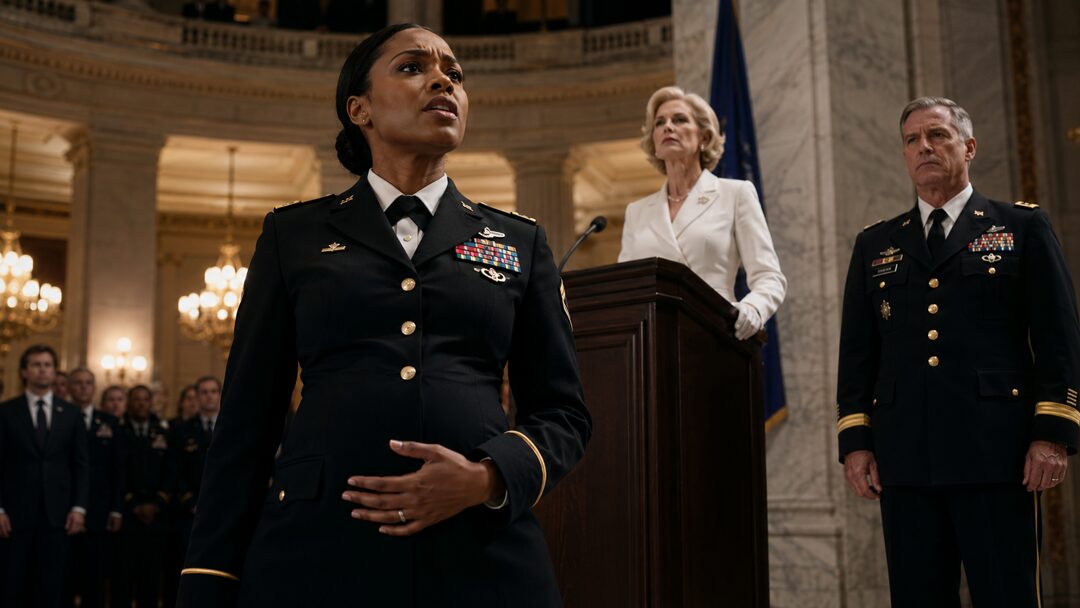
Major Sarah Mitchell knew something was wrong before Patricia Hayes touched her.
It was not the chandeliers above the capitol rotunda, bright enough to make every medal on every chest glitter like proof. It was not the cameras aimed toward the marble staircase, or the senators lined beneath the flags, or the row of families seated in black and navy, holding folded programs with careful hands.
It was Patricia.
She walked one step behind Sarah in a flawless white suit, pearls at her throat, white gloves pulled smooth over both hands.
Too close.
Sarah kept one hand low beneath the heavy front of her dress jacket, where her daughter shifted hard against her palm. Eight months along, and still the uniform fit because a tailor had made it fit, because ceremonies liked women better when even their discomfort looked disciplined.
“Almost there, Major,” Colonel James Walker murmured from below.
Sarah tightened her grip on the rail.
The applause had started too early. It rose around her in waves, polite and reverent, as if everyone had already agreed what this day meant.
Honor.
Sacrifice.
Legacy.
All the clean words people used when the real ones would not survive a microphone.
Patricia leaned close enough that Sarah felt her breath near her ear.
“Smile for him.”
Sarah stopped for half a second.
No one else heard it. The room kept clapping.
Him.
Captain Michael Hayes.
Patricia’s son.
The man whose name was printed in gold on the citation waiting at the podium.
The man Sarah had tried to save.
The man whose final moments had been buried under a report so polished it no longer resembled memory.
Sarah turned her head slightly. Patricia’s face was smooth, almost kind, but her eyes were fixed on Sarah with a private brightness.
She knew.
She could not have known. Sarah’s testimony had been sealed. The questions had been asked behind closed doors. The answers had been softened, amended, filed, protected.
Patricia lifted her right hand.
It looked like a gesture of support, a widow helping a pregnant officer down the last steps.
The white glove settled on Sarah’s shoulder.
Pressure.
Sharp, precise, wrong.
Sarah’s breath vanished. Heat flashed under her collar. Her knees broke before she understood what her body was doing.
She turned far enough to see Patricia’s mouth curve.
Then the marble came up.
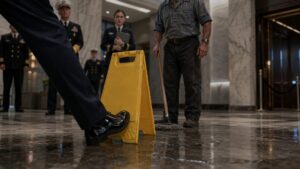
Someone gasped. Someone shouted her rank. Her cheek struck the floor, hard enough to burst pain through her jaw. The medals on her chest slammed against her ribs. Warmth spread near her mouth.
For a terrible second, Sarah could not move.
Her hand found her stomach.
Move, she begged silently. Please move.
The baby kicked once, fierce and furious.
Above her, the applause had died into a sound worse than silence: hundreds of people deciding what they had seen.
Sarah blinked through the blur.
Patricia stood over her in white gloves, untouched by the fall, looking down with a sorrowful little smile made for cameras.
That was when Sarah understood the attack had not interrupted the ceremony.
It had become part of it.
Part II — The Official Explanation
Sarah woke beneath the capitol, in a medical holding room with no windows.
Not a hospital.
That was the first thing she noticed.
The second was the sound of her daughter’s heartbeat on a monitor beside the bed, fast and steady, a small galloping insistence in a room full of men trying not to look ashamed.
Her lower lip felt split. Her shoulder burned beneath the seam of her jacket. Someone had opened the front of her uniform, but her medals were still pinned there, crooked and accusing.
“Sarah,” Colonel Walker said.
He stood near the foot of the bed, tall and gray-haired, his dress uniform immaculate except for one unfastened cuff. His eyes looked older than they had on the staircase.
“Where is she?” Sarah asked.
“The baby is stable.”
“Not the baby.”
Walker’s jaw tightened.
On Sarah’s right, Robert Fields adjusted the monitor strap across her abdomen. He was lean, quiet, with close-cropped hair and rolled medical sleeves under a formal event jacket. He had the steady hands of someone who had learned panic was a luxury.
“Your pressure dropped,” Robert said, not looking at Walker. “You hit hard. Lip split on impact. No sign of abdominal trauma so far.”
“So far,” Sarah repeated.
Robert’s mouth tightened. “So far.”
Walker stepped closer. “The public statement will say you experienced stress-related syncope complicated by pregnancy.”
Sarah stared at him.
The monitor kept galloping.
“Say that again,” she said.
Walker did not flinch. “It is the safest explanation.”
“For who?”
He lowered his voice. “For everyone.”
Sarah tried to sit up. Pain tore through her shoulder so fast her vision sparked white.
Robert caught her elbow. “Easy.”
“She touched me,” Sarah said. “You saw her.”
Walker glanced toward the closed door.
That glance answered before he did.
“She is Patricia Hayes,” he said. “If you accuse her without evidence, this becomes something you cannot control.”
Sarah laughed once, but it came out broken because of her lip.
“I was face down on the marble.”
“And by tomorrow,” Walker said, “half the country will have seen that footage with five different captions. Exhaustion. Pregnancy. Trauma. A decorated officer pushing herself too hard. You know how quickly a story grows teeth.”
Sarah looked at him for a long moment.
He cared. That was the cruelest part. James Walker cared enough to stand in a basement room telling her to swallow a lie while her blood was still drying.
The door opened.
A young aide entered carrying a vase of white lilies.
Sarah’s stomach tightened before the aide even spoke.
“These arrived for Major Mitchell.”
Robert took the card first. He read it, then looked at Walker.
Sarah held out her hand.
The envelope was thick cream paper. Patricia’s handwriting was delicate and slanted.
For the child. May she inherit courage.
Sarah closed her fingers around the card until the edge bent.
“She threatened my daughter,” Sarah said.
Walker’s face darkened. “It’s not a threat on paper.”
“That’s the point.”
Robert’s gaze moved to Sarah’s left shoulder. “Major, where exactly did she touch you?”
Sarah reached for the collar of her uniform. Her fingers shook once, then steadied.
Robert helped ease the fabric aside.
Beneath the seam, just above the curve of her shoulder, the skin was marked with a small darkened puncture-like bruise. Not large. Not dramatic. Something meant to vanish under fabric and authority.
Robert’s eyes changed.
He pulled out his phone and took a photo before Walker could speak.
Walker said, “Fields.”
Robert slipped the phone into his pocket. “Medical documentation.”
Sarah looked at him.
For the first time since waking, she felt less alone.
Then the hallway outside quieted in a way that made everyone turn.
Patricia Hayes appeared at the open door.
Still in white.
Still gloved.
She did not look surprised to see Sarah awake.
“My dear,” Patricia said softly. “They told me you were asking to return.”
Sarah felt the baby move again, lower now, as if bracing with her.
Patricia smiled with perfect concern.
“Are you composed enough?”
Walker stepped between them. “Mrs. Hayes—”
“It’s all right, Colonel. Major Mitchell and I have already shared a private moment today.”
Sarah’s shoulder throbbed under the hidden mark.
Patricia’s eyes dropped briefly to Sarah’s stomach.
“Some women,” she said, “carry history more carefully than others.”
The room went still.
Sarah swung her legs over the side of the bed.
Robert said, “Major, medically, I don’t recommend—”
“I know.”
Walker’s voice hardened. “Sarah.”
She stood anyway. The room tilted. She caught the bed rail and waited until the floor returned.
Patricia watched her with something almost like admiration.
Sarah fastened her jacket over the mark. Her medals sat crooked. She did not straighten them.
“I’m going back upstairs,” she said.
Walker’s face went pale with anger and fear. “If you speak recklessly, you could lose your clearance. Your career. There is an ongoing inquiry, and your custody stability—”
“My custody?”
The word cut the air.
Walker looked away.
Sarah nodded once, as if he had confirmed something she had not wanted to believe.
“They already wrote that line too,” she said. “Before I even woke up.”
No one answered.
Sarah picked up the card from Patricia’s flowers and tucked it inside her jacket, over her heart.
Then she walked toward the door.
Patricia moved aside only at the last possible second.
Part III — The Line in Gold
The applause was different when Sarah returned.
Not warm. Not proud.
Careful.
It traveled through the rotunda in small, uncertain claps as she appeared at the side entrance with Walker on one flank and Robert on the other. People stared at her split lip, then away. Some looked at her stomach and softened their faces, as if pity could erase suspicion.
Patricia had already reclaimed the front of the room.
She stood beside two senators and a four-star general beneath the largest chandelier, her white gloves folded at her waist. A photographer caught her profile: dignified widow, concerned citizen, guardian of grief.
Sarah wanted to walk straight at her.
Instead, she took the assigned seat in the front row.
Discipline had saved Sarah before.
Discipline had also taught her to sit in rooms where lies wore better shoes than truth.
A man at the podium cleared his throat.
“Ladies and gentlemen, we will continue.”
Continue.
As if a woman had not fallen.
As if blood could be mopped out of history if the program stayed on schedule.
The speaker lifted a folder trimmed in gold.
“Today we honor the extraordinary courage of Captain Michael Hayes during Operation Blue Lantern.”
Sarah’s fingers tightened around the armrest.
The name did not bring a face first. It brought heat. Dust. Static. A voice in her earpiece saying the corridor was clear when it was not. A convoy stalled at a broken wall. Children crouched under blankets in the back of a transport. Michael Hayes at the extraction point, pale under grime, shouting that new orders had come down.
Hold position.
Wait for command.
Do not move the convoy without authorization.
Sarah had looked at the map. Looked at the smoke rising behind the civilian shelter. Looked at the medic Emily Carter sprinting back through debris because someone was still calling for help.
Then Sarah had made the choice that later became two paragraphs in a sealed file.
“Captain Hayes,” the speaker read, “held the eastern corridor until all civilians were clear.”
Sarah closed her eyes.
No.
Beside her, Walker’s hand flexed once against his knee.
Patricia was watching Sarah, not the podium.
“His unhesitating sacrifice,” the speaker continued, “preserved the honor of the mission and the lives of countless evacuees.”
Sarah felt the card against her chest.
For the child. May she inherit courage.
The baby shifted sharply, as if objecting.
When the speaker paused for applause, Patricia crossed the short space between them with a grace that made room for itself.
She bent down as if to check on Sarah.
Cameras loved gestures like that.
“You look pale,” Patricia murmured.
“You look pleased.”
Patricia’s smile did not move.
“Grief teaches posture, Major. You should learn that before your daughter arrives.”
Sarah looked up at her.
Patricia’s eyes brightened.
“Yes,” she said. “Emily, isn’t it?”
The air seemed to leave the rotunda.
Sarah had told almost no one.
Robert, standing behind the front row, looked sharply at Patricia.
Walker went completely still.
Patricia tilted her head. “Beautiful name. Though I wonder if you chose it out of love or guilt.”
Sarah’s hand moved to her stomach before she could stop it.
Patricia saw.
There it was. The real touch. Not the glove on her shoulder. This.
“You don’t know anything about her,” Sarah said.
“About your child?” Patricia asked. “Or about the medic who died chasing after my son?”
Sarah said nothing.
Patricia leaned closer.
“Heroes are not made by truth,” she whispered. “They are made by what survivors agree to bury.”
Then she stood, placed one gloved hand over her heart for the cameras, and returned to the front.
Sarah sat frozen as applause started again.
For years, she had told herself the softened report was mercy. The families needed something clean to hold. Michael’s mother needed a son who had died brave, not frightened. Emily’s parents needed to believe their daughter had not run toward a failed officer because no one else would.
But truth did not disappear when buried.
It changed owners.
And Patricia had made herself queen of the grave.
Part IV — What the Record Could Not Hold
In the side corridor outside the rotunda, Walker finally said the thing he had avoided for two years.
“I pushed you to soften it.”
Sarah stood near a marble column, one hand against the stone, breathing through a tightening low in her body that she refused to call by its name.
Robert was three paces away, pretending not to listen while watching her face too carefully.
Walker’s voice was low. “The operation implicated command decisions above both of us. Delays. Contradictory orders. Bad maps. Bad timing. If the full account went public then—”
“Families would ask why their children came home in boxes with medals instead of answers.”
Walker flinched.
Sarah was glad.
Then she hated herself for being glad.
“I thought I was protecting them,” he said.
“No,” Sarah said. “You thought you were protecting the institution.”
“I thought those were the same thing.”
“That’s the problem.”
Robert stepped closer. “Major, your contractions—”
“They’re not contractions.”
He gave her a look.
“They might be stress response,” he said. “They might not.”
Sarah laughed without humor. “That’s very comforting.”
Robert’s phone buzzed.
He checked it, and whatever he saw made his expression close.
“What?” Sarah asked.
He did not answer quickly enough.
Walker said, “Fields.”
Robert looked up. “Security took my phone for review while I was checking the med kit. Routine chain-of-custody request, they said.”
Sarah already knew.
“The photo?”
“Gone,” Robert said. “Not deleted in front of me. Just gone when they returned it.”
Walker swore under his breath.
Sarah looked through the corridor archway toward the ceremony. Patricia was at the front speaking with a senator, her white glove resting lightly on his sleeve. Comforting him. Guiding him. Owning him.
Robert said, “There’s something else.”
Sarah waited.
“I was there after Blue Lantern.”
Her eyes moved to him.
“You never said.”
“No one asks medics what they remember unless they need nightmares confirmed.”
Walker looked down.
Robert’s voice stayed even. “Emily Carter reached Michael Hayes before the second collapse. He was alive. Panicking, but alive. She stayed with him longer than she should have.”
Sarah saw it again: Emily’s red hair dark with dust, one knee down beside Michael, shouting into the radio that she needed extraction, refusing to leave him though the eastern road was already gone.
“She knew he froze?” Sarah asked.
Robert nodded. “She knew. She went anyway.”
The corridor seemed to narrow around Sarah.
That was the part no report had held.
Not Michael as hero. Not Michael as coward.
Michael as a terrified man whom a braver woman still believed was worth saving.
Sarah pressed both hands to her stomach.
For two years, she had thought truth would split the dead into saints and failures. She had feared becoming the person who took comfort from mothers and replaced it with shame.
But Emily’s truth was larger than Michael’s failure.
And Patricia had buried Emily to polish him.
A young aide hurried toward them, tablet in hand. He stopped when he saw Walker.
“Colonel, the press statement has gone out.”
Walker took the tablet.
Sarah watched his eyes move across the screen.
He did not hand it to her.
So she took it.
The statement was brief, elegant, devastating.
Major Sarah Mitchell experienced a medical episode related to exhaustion and late-stage pregnancy. Mrs. Patricia Hayes has expressed deep concern for Major Mitchell’s privacy and asks the public to honor her service without speculation.
Below it was a photo from ten minutes earlier.
Patricia, one gloved hand pressed to her heart, face full of practiced sorrow.
Sarah, in the background, being helped from the floor.
Reduced. Framed. Explained.
“She attacked me,” Sarah said. “Then she asked them to respect my privacy.”
Walker’s face was gray.
Robert said, “That statement makes any objection look unstable.”
Sarah handed the tablet back.
In the rotunda, a bell chimed softly, calling the room toward the final award.
Patricia Hayes would accept a foundation medal in Michael’s name. A new initiative would carry his story into scholarships, speeches, memorial walls, children’s essays, annual dinners.
A lie with a budget.
Sarah felt another tightening. This one made her grip the column until her knuckles ached.
Robert moved beside her. “Heartbeat is still steady. But you should leave now.”
Walker nodded. “You’ve done enough.”
Sarah looked at him.
“No,” she said. “I’ve done exactly enough to let this happen.”
Patricia passed through the corridor on her way to the podium.
She paused close to Sarah, close enough for perfume and cold silk.
“Sit down,” Patricia whispered, “before you make her fatherless too.”
Sarah’s body went very still.
Her husband had died in the same theater, a year before Blue Lantern. Not in the operation. Not in the reports Patricia should have read. A roadside loss, folded into private grief, carried quietly because Sarah had learned early that military widows were allowed one public moment and then expected to become symbols.
Patricia knew that too.
Sarah looked into the older woman’s face and finally saw the shape of her grief.
Not absence.
Possession.
Patricia did not just want her son remembered. She wanted everyone else’s dead arranged around him.
Sarah took one breath.
Then another.
“My daughter,” she said, “will not inherit your silence.”
Patricia’s smile flickered.
Only once.
Then she walked into the light.
Part V — The Room Listened
Patricia Hayes stepped to the podium beneath the chandeliers as if the room had been built for her arrival.
The applause came full and relieved. People wanted her to restore the ceremony. They wanted the fall, the whispers, the strange interruption of Sarah’s body to become something unfortunate and past.
Patricia gave them exactly what they wanted.
“My son believed courage was not a single act,” she began, voice smooth and low. “It was a lineage. A promise handed from one generation to the next.”
Sarah stood at the edge of the aisle.
Robert said quietly, “Major.”
“I know.”
Walker appeared beside her. “Sarah, don’t do this this way.”
“There isn’t another way. You helped make sure of that.”
His face broke for half a second.
Onstage, Patricia continued.
“Michael gave his life so others could come home. Today, through this foundation, his example will guide families who understand the cost of service.”
Sarah stepped into the aisle.
Her first step made the nearest row turn.
Her second made the cameras adjust.
By the third, Walker had to choose whether to stop her.
He did not.
Patricia saw Sarah approaching and paused with perfect theatrical concern.
“Major Mitchell,” she said into the microphone, making Sarah’s interruption part of her performance. “Please. You should be resting.”
Sarah stopped halfway down the aisle.
“I need the citation read again.”
A murmur moved through the rotunda.
Patricia’s smile held. “This may not be the time.”
“It is exactly the time.”
Someone near the podium whispered to the general. A senator looked at Walker.
Sarah kept her eyes on the folder trimmed in gold.
“The line about the eastern corridor,” she said. “Read it again.”
Patricia’s fingers tightened around the podium edge.
Walker stepped forward.
Every camera found him.
The general said sharply, “Colonel?”
Walker looked at Sarah.
She did not plead.
That mattered.
If she had begged, he might have protected her from herself. If she had shouted, he might have protected the room from her.
But she only stood there, one hand under her medals, split lip dark, face steady.
Walker turned toward the podium.
“The line,” he said, “was based on an incomplete report.”
The room changed temperature.
Patricia stared at him.
Walker swallowed. His voice roughened. “The record should have been corrected.”
Sarah felt something inside her unlock, and it hurt more than she expected.
Patricia leaned toward the microphone. “Colonel, grief deserves dignity.”
Sarah answered before Walker could.
“So does truth.”
The words were not loud, but the rotunda carried them.
Sarah walked closer. Robert moved with her, not touching her, close enough to catch her if her body failed.
She looked at the families in the front rows first.
Not at Patricia.
Not at the generals.
At the people who had been handed clean sentences because everyone thought they were too fragile for broken ones.
“Captain Hayes did not hold the eastern corridor until all civilians were clear,” Sarah said.
Patricia made a sound, small and sharp.
Sarah continued before it could become a performance.
“He received conflicting orders. He froze at the extraction point. Command delayed. The convoy was exposed. I rerouted it.”
A senator stood. “This is inappropriate—”
“No,” Sarah said, and the word stopped him. “What was inappropriate was asking the dead to carry what the living would not admit.”
Her stomach tightened again. Harder.
Robert whispered, “Breathe.”
Sarah breathed.
“The medic Emily Carter went back for Captain Hayes,” Sarah said. “She knew the corridor was failing. She went anyway. She stayed with him. She tried to keep him alive.”
A woman in the second row covered her mouth.
Sarah knew that face from letters never sent. Emily’s mother.
Sarah looked at her and almost lost the thread.
Almost.
“I let the official version stand,” Sarah said. “Because I thought families needed heroes more than facts. Because I thought a softer lie would hurt less than the whole truth.”
Her voice broke there.
Only there.
“I was wrong.”
Patricia stepped away from the podium, eyes bright and furious.
“You do not get to do this,” she said.
There was no microphone now. Her voice carried anyway.
“You do not get to take my son from me twice.”
Sarah looked at her.
“I’m giving him back as he was.”
“A coward?”
“A man,” Sarah said. “A frightened man someone still tried to save.”
Patricia moved toward her, not with a raised hand, but with all the force of a woman whose grief had been obeyed for too long.
“You liar,” Patricia said. “You disgraceful, ungrateful—”
Her gloved hand struck the podium edge as she turned. The fabric caught on a sharp corner of the medal stand.
A small tear opened across the palm.
Patricia jerked her hand back too quickly.
Too late.
The glove peeled enough for the front row to see the narrow pressure ring beneath it, pale metal against skin, fitted with a tiny darkened point along the inside curve.
Robert saw it first.
“Her hand,” he said.
The words were quiet.
The cameras heard anyway.
Patricia closed her fist.
Sarah reached up and pulled open the collar of her uniform.
The puncture-like bruise on her shoulder had darkened.
Same height. Same shape. Same ugly little truth.
The room finally did what it had refused to do before.
It looked.
Not at Sarah’s stomach.
Not at her split lip.
Not at Patricia’s pearls.
At the glove.
At the hand.
At the distance between public concern and private harm.
Patricia’s face changed in pieces. First the smile left. Then the polish. Then the authority.
What remained was grief, raw and old and furious, standing where power had been.
Walker gave one order, low but clear.
“Secure the glove.”
No one moved for a second.
Then Robert stepped forward.
Patricia backed away from him as if he had struck her.
“Don’t touch me,” she said.
Robert stopped.
He did not reach for her.
He only looked at the general.
“Then ask her to remove it herself.”
That was the cruel mercy of the moment.
No force. No spectacle.
Just Patricia Hayes in front of everyone, peeling off one white glove with shaking fingers.
When it came free, she looked smaller.
Not innocent.
Not redeemed.
Only smaller.
Sarah’s knees weakened.
Robert caught her elbow this time, and she let him.
Walker came toward her, but stopped before touching her.
“I’m sorry,” he said.
Sarah looked past him to Emily Carter’s mother, who had begun to cry silently into both hands.
“Change the record,” Sarah said.
Walker nodded once.
“It will take time.”
“Then start.”
Another contraction took her breath.
Robert’s grip tightened.
“Now,” he said, and this time nobody argued.
As they led Sarah out, the rotunda did not applaud.
For once, the room understood that silence was not respect.
Sometimes silence was only the sound of people learning what they had helped protect.
Part VI — What Remained
The hospital room was quieter than the capitol.
No chandeliers. No flags. No podium. No polished sentences pretending to be enough.
Just dim lights, a plastic water cup, a folded blanket, and Sarah’s daughter sleeping against her chest with one fist tucked beneath her chin.
Emily Mitchell was six pounds, four ounces, angry at the cold, and alive.
Sarah had expected to cry when they placed her daughter in her arms.
Instead she had gone very still.
There were kinds of relief too large for tears.
Robert visited once, standing awkwardly at the door until Sarah told him to come in. He looked at the baby, then away, as if tenderness required privacy.
“She has strong lungs,” he said.
“She objected to the whole day.”
“Smart girl.”
Sarah smiled despite the ache in her lip.
Later, Walker came alone.
He wore no jacket. Just shirt sleeves, rolled unevenly, as if he had finally lost interest in looking untouched.
For a while he stood beside the bed without speaking.
Sarah did not help him.
At last he said, “The official record will change.”
She looked at him.
“Slowly,” he added. “Messily. People will fight it. Some will say you were confused. Some will say I was pressured. Some will say Patricia was grieving and the rest is unclear.”
Sarah rested her hand over Emily’s back.
“She was grieving.”
Walker nodded. “Yes.”
“That doesn’t make her harmless.”
“No.”
The baby shifted in her sleep, mouth pursing at some dream too new to have words.
Walker looked at her and swallowed.
“I should have told the truth sooner,” he said.
Sarah closed her eyes for one breath.
There were many things she could have said. That his apology was late. That Emily Carter’s parents had deserved better. That Michael Hayes had deserved better than sainthood built on omission. That Sarah herself had deserved a commander who did not call silence protection.
Instead she said, “So should I.”
Walker did not forgive her. She did not forgive him.
That felt honest enough for the room they were in.
On the bedside table, beside Sarah’s removed medals, lay a sealed evidence bag.
Inside it was one white glove.
Without Patricia’s hand inside, it looked almost delicate. Almost meaningless.
That was the trouble with objects. They never looked as heavy as what they had carried.
Sarah shifted Emily higher on her chest.
Her daughter made a small sound, then settled.
The medals beside the glove caught the hospital light. For the first time all day, they did not feel like proof. They felt like weight. Earned, flawed, unfinished.
Sarah touched one ribbon with her fingertip, then withdrew her hand.
Emily needed both arms.
Outside the room, footsteps passed. Voices lowered. Somewhere, a television replayed a ceremony that would never again belong to the people who planned it.
Sarah did not ask if Patricia had been arrested.
She did not ask who had resigned.
She did not ask whether the headlines used her name kindly.
There would be time for ugliness. Time for statements. Time for men in offices to discover new ways to make truth sound complicated.
For now, Sarah watched her daughter breathe.
At the capitol, she had held her stomach like a shield.
Here, she held Emily like a promise.
Not that the world would be gentle.
Not that truth would save everyone.
Only that her daughter would not be handed a polished lie and told to call it honor.
Sarah lowered her face until her lips brushed the soft dark hair at the top of Emily’s head.
The baby slept through it.
On the table, the glove remained sealed beside the medals.
One thing taken from the room.
One thing Sarah had carried out.
And between them, small and warm against her heart, the future opened its eyes.