The Man by the Gate Knew What the Red Light Remembered
Part I — The Wrong Gate
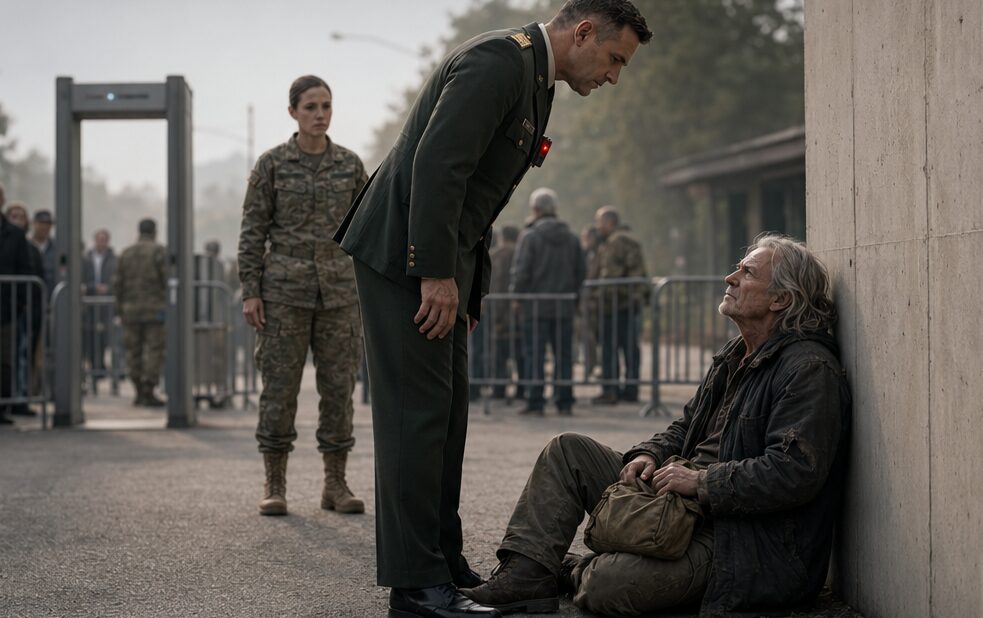
The old man was sitting against the concrete wall when Colonel Kevin Bennett found him, one boot unlaced, gray beard tangled, both hands folded over a canvas pouch like it was the last thing in the world that still knew his name.
The base was already under lockdown.
Two guards stood near the restricted entrance. A line of visitors waited behind temporary barriers for the dedication ceremony scheduled that morning. Beyond the gate, the new training wing gleamed with polished glass and fresh flags.
And there, beneath all that order, sat the old man.
Colonel Bennett stopped in front of him.
His uniform looked cut from discipline itself. His boots held a shine. His posture made younger men straighten without thinking. On his chest, clipped beside his ribbons, a small red emergency beacon blinked once every few seconds.
The old man watched that light.
Not Bennett’s face.
The light.
Bennett bent down, close enough that the guards and two nearby enlisted soldiers could hear him.
“You picked the wrong gate to sleep at.”
The words landed hard in the cold morning air.
The younger corporal beside the checkpoint, Jacob, shifted his weight and looked away. Sergeant Sandra Carter, standing near the entry scanner, kept her eyes on the old man.
The old man did not flinch.
He lifted his gaze slowly from the red device to Bennett’s face.
“That beacon isn’t yours.”
No one moved.
Bennett’s expression did not change at first. Then the corner of his jaw tightened.
“What did you say?”
The old man’s fingers closed around the canvas pouch. His hands were thin, knuckled, marked with age and weather. But they were steady.
“That beacon,” he said. “It isn’t yours.”
Jacob gave a short, nervous laugh that died when Bennett turned his head.
“Sergeant Carter,” Bennett said, without looking away from the man on the ground, “remove him from the restricted area.”
Sandra stepped forward. “Sir.”
The old man stayed seated.
“I need to speak to command.”
Bennett’s eyes narrowed. “You are speaking to command.”
“Then you need to listen.”
It was not loud. It was not defiant in the way young men were defiant. It was worse than that.
It was certain.
Bennett straightened. That made him taller, made the old man smaller. Behind them, visitors whispered. A boy in a blue blazer pointed until his mother pulled his hand down. Somewhere past the gate, a loudspeaker clicked and announced that all guests for the dedication of Bennett Hall should proceed through security.
The old man heard the name.
Bennett Hall.
His eyes changed.
Only Sandra seemed to notice.
Bennett saw it too, but he understood it differently.
“Is that why you’re here?” he asked. “You heard there was a ceremony?”
The old man said nothing.
Bennett looked him over: torn field jacket, dirty cuffs, a beard that had not seen a razor in weeks, maybe months. His face hardened into something that looked almost like disappointment.
“Looking for attention?” Bennett asked. “Money? A warm room?”
Sandra’s eyes flicked toward him.
Jacob gripped his radio.
The old man’s mouth moved once before sound came. When he spoke, his voice was rough but clear.
“I came because you’re about to say the wrong man’s name into a microphone.”
The red beacon blinked between them.
Once.
Twice.
Bennett’s hand rose toward it, almost without his permission.
Then he dropped his hand.
“Get him inside,” he said.
Sandra stepped closer to the old man, softer than the order required.
“Sir,” she said to him, not knowing what else to call him, “can you stand?”
The old man looked at her.
For a second, something like embarrassment crossed his face.
“I can,” he said.
But he did not.
Not yet.
He put one hand to the wall and pushed himself up with a controlled effort that made the watching soldiers go quiet. He rose slowly, painfully, but under his own power.
When he finally stood, he was still shorter than Bennett.
But he no longer looked small.
Part II — The Pouch
Inside the outer security room, the old man stood beneath fluorescent light that made every frayed seam and dirty fold of his coat visible.
Jacob positioned himself near the door with one hand resting on his radio, trying to look useful. Sandra sat at the security terminal. Bennett remained standing, arms at his sides, impatient with the whole room.
“Name,” Bennett said.
The old man looked at the red beacon again.
“James.”
“Full name.”
“James Hayes.”
Sandra typed it in.
Bennett gave a humorless breath. “Do you have identification, Mr. Hayes?”
James opened the canvas pouch.
Jacob leaned forward as if expecting contraband.
Inside were folded papers, a pencil shaved down almost to nothing, an old photograph so faded the faces looked half-erased, and a strip of cloth with numbers written in permanent ink.
Sandra saw the numbers first.
She stopped typing.
“Sir,” she said.
Bennett glanced over.
“There’s a service number written inside the pouch.”
“That doesn’t prove anything,” Bennett said.
“No, sir. But it’s formatted correctly for the period.”
James watched her enter it.
The database took longer than it should have.
The screen blinked.
A partial record appeared.
Sandra read silently at first. Her brow tightened.
“James Hayes,” she said. “Communications specialist. Attached to an intelligence support unit. Most of the file is restricted or incomplete.”
Jacob looked at James again, differently now, but only a little.
Bennett’s voice stayed flat. “Plenty of men served. That does not give them permission to sit outside a restricted entrance during lockdown.”
James closed the pouch.
“I didn’t come for permission.”
Bennett stepped closer. “You came to interrupt a dedication ceremony honoring my father.”
At the word father, James’s fingers tightened.
It was small.
Sandra saw it.
Bennett did too.
“You knew his name,” Bennett said.
James said nothing.
Bennett’s face changed in a way that was worse than anger. It became personal.
“My father’s name is on that building because he kept men alive when everything failed. If you came here to attach yourself to that story, choose your next words carefully.”
James looked tired then. Not frightened. Not guilty.
Tired.
“I already chose them forty-three years ago.”
Jacob’s radio crackled. He jerked slightly, then pressed the side button.
“Outer post secure,” a voice said. “Dedication guests moving through east line.”
Bennett looked at the clock.
Two hours.
He had two hours before he stood in front of families, veterans, officers, local officials, and a row of cameras to speak about Major Larry Bennett, his father, the man whose photograph hung in three buildings on base and in one private hallway of Kevin Bennett’s house.
A man Kevin barely remembered except through stories.
A man he had spent his whole life trying not to disappoint.
James looked at the red beacon again.
Bennett caught it.
“This?” Bennett touched the device clipped to his uniform. “This belonged to my father.”
“No,” James said.
The room went still.
Bennett’s voice dropped. “You don’t get to say that.”
James did not look away.
“Redline beacon,” he said. “Third pattern. Field-cut casing. Not ceremonial.”
Sandra’s hands paused over the keyboard.
Jacob’s eyes moved to the device.
Bennett laughed once, sharp and cold.
“You read that somewhere?”
“No.”
“You steal military artifacts and learn a few names?”
“No.”
“Then what exactly are you claiming?”
James looked down at the pouch.
When he spoke again, his voice was quieter.
“I’m saying your father didn’t carry it out of Red Harbor.”
The name hit the room like a door slamming.
Operation Red Harbor was not discussed casually. Not in the old public files. Not in lectures. Not even in the dedication materials, except in polished sentences about courage under blackout conditions and a final transmission that led survivors home.
Bennett’s face flushed.
“You’re done.”
Sandra turned from the screen. “Sir—”
“He’s done,” Bennett said. “Remove him.”
James lifted one hand.
It trembled now.
Not from fear.
From effort.
“Check the serial mark.”
Bennett did not move.
James reached into his pouch and withdrew a folded field inventory sheet, its creases soft from age. He held it out, but not to Bennett.
To Sandra.
“Check it before you put that light behind glass.”
Part III — The Number That Would Not Move
Sandra did not take the paper at first.
Bennett’s silence filled the room.
Then she reached for it.
“Sergeant,” Bennett said.
She stopped.
James let his arm remain extended.
The paper shook slightly in the air.
Sandra looked from the old man to the colonel. “Sir, if he’s making a false claim, checking the number will settle it.”
Bennett stared at her long enough to make Jacob look down at his boots.
Then Bennett unclipped the beacon from his uniform.
The red light blinked in his palm.
Small. Unimpressive. Almost cheap.
But Bennett held it like bone.
“Go ahead,” he said.
Sandra took the inventory from James. The paper smelled faintly of dust and canvas. At the bottom, beneath a block of faded equipment entries, was a handwritten serial number.
She lifted the beacon and turned it gently until she found the mark etched beneath the worn casing.
The numbers matched.
Not almost.
Not close.
Exactly.
Sandra read them twice.
Jacob leaned in despite himself.
Bennett saw her face before she said anything.
“No,” he said.
Sandra swallowed. “Sir…”
“No.”
“The number matches the inventory.”
Bennett snatched the paper from her hand. He read it. His eyes moved fast, then slow, then fast again, as if speed could change ink.
“This proves he had access to an inventory sheet,” Bennett said. “Nothing else.”
James nodded once, almost sadly.
“That’s what I told myself for years too. Paper proves less than people want.”
Bennett turned on him. “Do not make this sound noble.”
James folded his hands in front of him. “I’m not.”
“You expect me to believe my father’s beacon somehow belonged to you?”
“I expect you to check the archive.”
“There is no archive for what you’re implying.”
“There was an emergency frequency archive,” James said. “Redline relay logs. Backup recordings. If anyone kept them, they’ll be under command communications, not ceremony records.”
Sandra was already searching.
Bennett saw her.
“Sergeant Carter.”
She froze.
“Stop.”
The order was clear.
But the screen loaded before she could obey.
A list of archived files appeared. Most were corrupted. Some were sealed. One had a label that made Sandra’s hand go cold.
RED HARBOR — EMERGENCY RELAY — FINAL SIGNAL.
Jacob read it over her shoulder.
His grip tightened on the radio at his belt.
Bennett’s face had gone pale beneath the controlled anger.
“That file is restricted,” he said.
Sandra said nothing.
James did.
“It was made by frightened men,” he said. “Most records are.”
Bennett turned toward him slowly.
“What is that supposed to mean?”
James looked at the beacon in Bennett’s hand.
“It means someone wrote what they needed to live with.”
The room fell into a silence that no one wanted to be responsible for breaking.
Then the loudspeaker outside clicked again.
“All guests for the Bennett Hall dedication should proceed to the main entrance. Ceremony begins in ninety minutes.”
Bennett closed his fingers around the beacon until his knuckles whitened.
“This ceremony is not being derailed by an old man with a folder and a story.”
James met his eyes.
“I didn’t bring a story.”
He tapped the pouch once.
“I brought what was left.”
Sandra looked at Bennett.
“Sir,” she said carefully, “if the beacon is going into the display today, and there is a dispute—”
“There is no dispute.”
“The serial number—”
“My father earned that ceremony.”
James answered before Sandra could.
“Yes,” he said.
Bennett stopped.
James’s face did not soften, exactly. It seemed to fold inward around something old.
“Your father earned more than the story gave him,” he said.
For the first time, Bennett looked unsure.
Only for a second.
Then he buried it.
“Play the file,” he said.
Sandra hesitated.
Bennett’s voice sharpened. “If this is nonsense, we end it now.”
She opened the archive.
Static filled the room.
Jacob flinched.
The sound was damaged, broken into waves of hiss and clipped distortion. Beneath it, far away, a young voice emerged.
“…relay down… visibility gone… need corridor markers…”
Sandra increased the volume.
Another burst of static.
Then, clear enough for every person in the room to hear:
“Major Bennett is down. I have the beacon. I’m staying on signal.”
No one breathed.
The voice was young.
Steady.
Terrified under the steadiness.
James closed his eyes.
Bennett stared at the speaker as if it had insulted him.
Sandra looked at James, then at the old file, then at the red light blinking in Bennett’s clenched hand.
Jacob’s radio slipped halfway from his grip before he caught it.
Bennett stepped back once.
“That could be anyone,” he said.
James opened his eyes.
“No,” he said. “It couldn’t.”
Part IV — The Promise Under the Noise
They moved to the communications archive room because Bennett did not want the file playing in the security office where any passing guard might hear.
That was what he said.
No one argued.
The archive room was narrow and cold, with metal cabinets and a workstation that looked older than Sandra. Jacob stood by the door, quieter now. He kept touching his radio as if checking that the present still worked.
Sandra ran the old file through restoration software. It cleaned nothing completely. Static remained. Gaps remained. Whole sentences broke apart.
But enough came through.
A young James Hayes directed scattered units through blackout conditions. He repeated coordinates. He corrected panic. He told men to follow the red signal pulses. Once, in the background, someone screamed his name. Once, a voice that might have been Larry Bennett’s said something too distorted to understand.
Then came the fragment that changed everything.
“…take it, Hayes…”
Static.
“…my boy…”
Static.
“…keep them alive.”
Bennett looked as if the room had tilted under him.
“Stop it.”
Sandra stopped the file.
The silence after the recording felt worse than the noise.
Bennett’s hand was on the back of a chair. He had not sat down.
James had.
Not because he wanted to. Because his knees had started to fail.
Sandra noticed but did not mention it.
Bennett did.
“You’re enjoying this.”
James looked up.
The accusation had more pain than anger in it now.
“You think I came here to watch you lose him?” James asked.
Bennett’s mouth tightened.
“You waited forty-three years.”
“I promised him.”
“You promised my father to let everyone think he did what you did?”
James looked toward the speaker.
“No.”
“Then what?”
James’s eyes moved back to Bennett.
“I promised him his son would know he did not fail.”
Bennett went still.
The words entered him slowly.
James continued, each sentence plain and costly.
“He was hurt before the final relay. Bad. He knew he couldn’t stay conscious. He gave me the beacon. He gave the last order. I carried it out.”
Bennett’s face twisted. “The report says he transmitted until extraction.”
“The report made sense of what no one wanted to remember clearly.”
“That’s convenient.”
“Yes,” James said. “It was.”
The bluntness took the air out of Bennett’s anger.
James leaned forward, elbows on his knees, hands clasped.
“When rescue came, I still had the beacon. Your father was gone. Men were shouting. Others were counting who had made it. Somebody asked who kept the signal open. Somebody answered with the name they needed to hear.”
“Why didn’t you correct them?”
James looked at him then, not with accusation, but with something more unbearable.
“Because you were six.”
Bennett’s face went blank.
Jacob looked down.
Sandra stopped breathing for a second.
James rubbed one thumb across the back of his other hand.
“There was a photograph in his breast pocket. You had a missing front tooth. You were holding a plastic boat. He made me look at it before I took the beacon.”
Bennett’s eyes shone, but he did not blink.
“He said, ‘Tell him I held.’”
James swallowed.
“I could tell a six-year-old boy his father held. Or I could tell him his father gave an order and fell before the world finished writing it down.”
Bennett’s voice came out low. “You had no right.”
“No,” James said.
The answer surprised everyone.
James nodded once, to himself. “I didn’t. Not to all of it.”
Bennett stepped away from the chair.
His grief was becoming anger because anger knew where to stand.
“You let my family build a life around a lie.”
James looked at the red beacon on the table.
“I let your family keep the shape of him.”
“That wasn’t yours to give.”
“No,” James said again. “It wasn’t.”
Sandra looked at the clock.
The ceremony began in less than an hour.
Outside, people would already be taking seats. There would be programs printed in dark blue ink. There would be a display case waiting near the front. In it, a small label had already been prepared:
REDLINE BEACON CARRIED BY MAJOR LARRY BENNETT DURING HIS FINAL TRANSMISSION.
James stared at nothing.
Bennett stared at him.
Neither man looked victorious.
That was when Jacob, still by the door, spoke for the first time in several minutes.
“Sir.”
Bennett turned.
Jacob’s voice was quieter than usual. “There’s another file.”
Sandra checked the archive list.
Jacob pointed. “After the final relay. Medical recovery note.”
Bennett said, “Open it.”
Sandra did.
The file was not audio. It was a scanned field note, damaged at the edges.
Sandra read aloud only the lines that were clear.
“Recovered: Communications Specialist James Hayes. Severe shock. Hands locked around Redline beacon. Repeating phrase: ‘He gave the order.’”
No one spoke.
The red light blinked on the table between them.
James did not look at the note.
He did not need to.
He had lived inside that sentence longer than anyone else had known it existed.
Part V — Before the Glass
Bennett wanted to postpone the ceremony.
He did not say cancel. He said postpone, investigate, verify, handle this properly.
Properly meant privately.
James knew that tone. Men used it when truth had arrived at a bad time.
“No,” James said.
Bennett turned on him. “You don’t command anything here.”
“I’m not trying to.”
“You want to walk into a room full of people and tell them my father didn’t do what they came to honor him for?”
James stood slowly from the chair.
Sandra moved half a step forward, then stopped herself.
James did not want to be helped.
“No,” he said. “I want to stop you from putting that beacon behind glass with the wrong words under it.”
Bennett’s face tightened.
James reached for the table. Not for support.
For the beacon.
Bennett’s hand came down first.
For one second, both men touched it.
Old fingers and commander’s fingers.
The red light blinked between them.
Bennett did not let go.
Neither did James.
“My father is not being disgraced today,” Bennett said.
James’s voice was barely above a whisper.
“Then don’t disgrace him.”
Bennett flinched as if the old man had raised a hand.
James let go of the beacon first.
“He saved men before he fell,” James said. “He gave the order that saved the rest. If you need him to have done everything alone, that’s not honor. That’s loneliness wearing a uniform.”
The room went quiet again.
Sandra looked down at the restored audio file on the screen. Jacob stared at the floor.
Bennett picked up the beacon.
For a moment, he looked not like a commander, not like a son of a legend, but like a boy standing in a hallway beneath a framed photograph, trying to grow tall enough to reach it.
Then the loudspeaker clicked overhead.
“Dedication ceremony begins in fifteen minutes.”
Bennett closed his eyes.
When he opened them, he had put command back on his face.
“Sergeant Carter,” he said, “prepare the restored segment.”
Sandra nodded once.
“Corporal Miller,” Bennett said, “bring Mr. Hayes to the rear entrance of the hall.”
Jacob’s eyes widened.
Bennett looked at James.
“You will not ambush my father’s ceremony.”
James held his gaze.
“No.”
“If this is spoken, it is spoken carefully.”
“Yes.”
“And if you turn this into accusation—”
James interrupted him.
“I kept my promise to your father longer than you’ve been angry at me.”
Bennett had no answer to that.
James took one step toward the door.
His body betrayed him on the second.
His knee buckled slightly. Sandra reached out, but he steadied himself against the wall.
“I can walk,” he said.
No one argued.
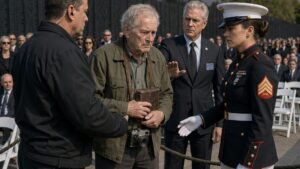
The hall was already full when they reached the rear entrance.
Guests sat in rows. Officers stood near the front. Families held programs. A glass case waited beside the podium with a velvet stand inside it, empty for the moment.
Above the stage, in polished letters, was the new name:
BENNETT HALL.
James stopped in the doorway.
For the first time that morning, fear crossed his face plainly.
Not fear of Bennett.
Not fear of the crowd.
Fear of taking something from the dead that he had spent his life protecting.
Sandra stood beside him.
“You don’t have to say more than the truth,” she said.
James looked at her.
“That’s usually more than people want.”
At the front of the hall, Bennett stepped to the podium.
He had the beacon in his hand.
The prepared speech rested in front of him, pages aligned, sentences polished by committees and grief.
He looked down at them.
Then he looked toward the back of the hall.
At James.
The old man stood there in his worn coat, holding the canvas pouch.
Everyone else saw a stranger.
Bennett now saw the man from the field note.
Hands locked around the beacon.
Repeating the same sentence.
He gave the order.
Bennett looked down at the speech again.
He did not turn the first page.
Part VI — What the Light Carried
“My father,” Bennett began, then stopped.
The microphone carried the silence.
People shifted in their seats.
Sandra moved to the side control panel with the restored audio ready. Jacob stood near the aisle, one hand on his radio.
Bennett looked at the beacon in his palm.
“For most of my life,” he said, “I believed I knew what this was.”
The room stilled.
James did not move.
Bennett continued, each word harder than the one before.
“I believed it was proof of a final act by one man. My father. Major Larry Bennett.”
A few heads turned toward the display case.
Bennett’s jaw tightened.
“This morning, before this ceremony, a man came to the gate and told me I was wrong.”
Whispers moved through the audience.
James lowered his eyes.
Bennett looked toward the rear doors.
“Mr. Hayes,” he said.
The old man did not move at first.
Then he stepped into the aisle.
No one clapped. No one understood.
That made it harder.
James walked slowly, visibly, past rows of polished shoes and pressed sleeves and curious faces. His coat brushed the aisle seats. His unlaced boot dragged once, then corrected.
At the front, Bennett stepped back from the microphone.
James stood beside the podium.
He did not look at the crowd.
He looked at the beacon.
Bennett placed it on the wood between them.
The red light blinked.
James put one hand beside it but did not pick it up.
“Major Bennett saved men before he fell,” James said.
His voice was rough, but the microphone found it.
“He kept order when order was gone. He gave one last instruction.”
The hall was so quiet that Jacob could hear the soft static from his own radio.
James looked at Bennett then.
“Keep them alive.”
Bennett’s face tightened.
James touched the beacon with two fingers.
“I obeyed him.”
Sandra pressed play.
Static filled the hall.
People looked up, startled.
The recording cracked, hissed, nearly vanished.
Then a young voice came through the speakers.
“…south corridor blocked… follow redline pulse… stay low…”
A burst of noise.
“…Major Bennett is down. I have the beacon. I’m staying on signal.”
The sound moved through the room like weather.
Bennett’s hand slackened.
Jacob’s radio slipped from his belt and hit the floor with a sharp plastic crack.
No one turned toward him.
The young voice continued, breaking through decades.
“…not leaving the relay…”
Static.
“…he gave the order…”
Static.
“…keep them alive…”
James closed his eyes.
For one breath, the old man and the young voice existed in the same room.
Then Sandra stopped the recording.
No applause came.
That was right.
Some truths did not ask for applause. They asked people to stop moving long enough to feel what they had stepped over.
Bennett looked at the crowd, then at James.
“My father gave the order,” Bennett said.
His voice almost failed.
He recovered it.
“James Hayes carried it.”
The name moved through the hall.
James Hayes.
Not a trespasser.
Not a nuisance.
Not a man sleeping at the wrong gate.
A man who had kept the line open.
Bennett turned to the display case. He lifted the printed label from inside it. For a second, everyone could see his hand shaking.
He tore the label once.
Not dramatically.
Just enough that it could not be used.
Then he picked up the beacon and turned back to James.
“This should not have been mine alone,” Bennett said.
James looked at the device.
For a moment, he seemed older than he had all morning.
Then he took it.
Not like a prize.
Like something heavy being returned to the correct hands.
Bennett faced the room again.
“The wing will keep my father’s name,” he said. “He earned that. But the signal room inside it will bear another name. The name of the man who kept the relay open when everyone else needed the light to mean home.”
James stared at him.
Bennett did not look away.
“I was wrong at the gate,” he said.
The apology was not large.
It did not heal forty-three years.
But it stood in public, where the insult had begun.
James put the beacon into his canvas pouch.
Then he leaned toward the microphone one last time.
“Your father did not fail,” he said.
Bennett’s face changed.
Not relieved.
Not forgiven.
Changed.
“He gave the order,” James said. “I carried it.”
He stepped back.
The room remained silent. But this silence was not the one from the gate. It did not look down on him. It made space around him.
Bennett came around the podium and stood beside James.
For the first time that morning, he was not towering over him.
“Will you walk with me into the wing?” Bennett asked.
James looked toward the doors beneath the new sign.
He seemed to consider refusing. Not from anger. From exhaustion. From the old habit of leaving before anyone had to decide what to do with him.
Then he looked at Bennett.
“Only if you stop trying to carry ghosts that aren’t yours.”
Bennett lowered his eyes.
Then he nodded.
They walked together.
Slowly.
James’s boot was still unlaced. His coat was still torn. His beard was still wild. Nothing about him had become polished enough to satisfy the room.
But as he passed the rows of people, men and women who had once looked through him now lowered their eyes, not in pity, and not because someone ordered them to.
At the doorway, Sandra stood aside.
Jacob picked up his radio from the floor and held it against his chest, suddenly unsure what to do with his hands.
James paused beneath the sign.
For a breath, he looked back at the hall, at the podium, at the empty display case, at the place where the wrong words had almost become permanent.
Then he turned forward.
The red light blinked once inside his pouch.
And this time, no one mistook it for decoration.