The Old Man in the Green Shirt Remembered What the File Forgot
Part I — Too Close
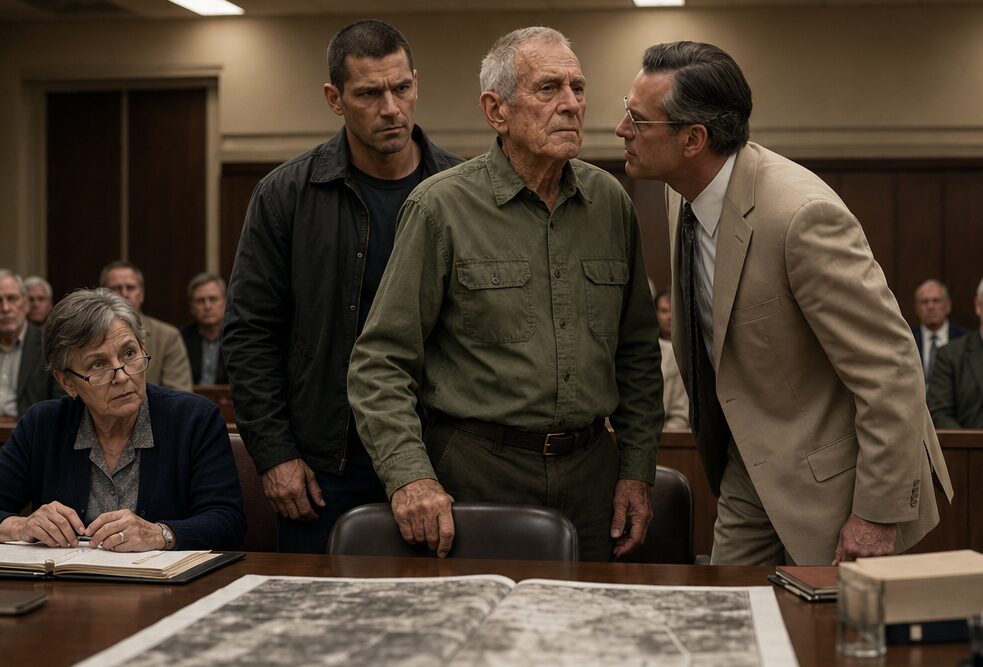
Larry stepped so close to George that the old man could see the tiny scratch on the rim of his silver glasses.
“Sergeant Major,” Larry said, soft enough to sound polite and sharp enough to cut, “this board needs facts, not battlefield nostalgia.”
The room went still.
George’s right hand tightened on the back of the chair in front of him. His knuckles had gone pale years ago and stayed that way, all bone and ridge beneath weathered skin. His faded green field shirt was buttoned to the throat, too plain for the polished hearing room, too old for the beige walls and framed county seal.
Behind him, Scott shifted.
Not much. Just half a step.
George raised one hand without turning around.
Stop.
Scott stopped.
That was the first thing Larry noticed. Not the old man’s tremor. Not the uneven gray buzz cut or the hearing aid tucked behind his left ear. He noticed the hand.
The younger man obeyed it like it was still an order.
Larry’s controlled smile thinned.
Three board members sat behind the long table. A county clerk typed with her shoulders hunched. A few people waited along the back row, pretending not to stare. The room smelled like paper, floor polish, and old coffee.
George had been in harder rooms.
That was what he told himself.
But harder rooms did not always hurt more.
Larry tilted his head. “Can you hear me clearly, Mr. George?”
“Sergeant Major George,” Scott said before he could stop himself.
George’s hand rose again.
Scott’s mouth closed.
Larry glanced at him, then back to George. “Retired titles are not necessary for this proceeding.”
George looked at Larry’s tie. Navy blue. Perfect knot. Not a wrinkle anywhere.
“No,” George said. “They usually aren’t.”
A faint scrape came from the table as Ruth, the board member in the navy cardigan, shifted her folder closer. She had been watching George since he entered. Not kindly, exactly. Carefully.
Larry turned toward the table. “For the record, this is a secondary review regarding Mr. Scott’s benefits appeal. The previous review determined that Mr. Scott failed to substantiate his claimed injury and related trauma as connected to the event he described.”
Scott’s jaw flexed.
George felt it behind him more than saw it.
Larry continued. “His account also conflicts with official documentation regarding his conduct during Operation North Gate.”
The name hit the room and disappeared into the fluorescent hum.
George kept his eyes forward.
North Gate had been a file name before it was a memory. Then it became a memory no file could hold. A courtyard. Diesel. Dust. A radio handset cracked down the middle. A girl’s red backpack swinging from a shoulder too small for it.
He moved his thumb over the scratched face of his old watch.
Larry saw that, too.
“Mr. George,” he said, “you’re here today as a voluntary witness for Mr. Scott, correct?”
“Yes.”
“You were his senior enlisted advisor at the time.”
“Yes.”
“And you believe his statement that he was ordered to abandon two local interpreters during a withdrawal.”
George did not answer at once.
Scott’s breath changed.
Larry leaned closer, just enough for everyone to feel it. “You believe that, despite the official report stating no such order was given.”
George looked up.
“I believe what happened,” he said.
Larry’s smile returned.
“That is not always the same as what can be proven.”
No one spoke.
Then Larry stepped back, as if he had been generous.
“Let’s begin.”
Part II — The Courtesy Review
They made Scott sit.
They let George stand.
The difference seemed accidental until it wasn’t.
Scott took the chair behind George’s right shoulder, his dark jacket creasing under his clenched hands. He looked too large for the seat and too tired for his age. Thirty-one, the file said. He looked older around the eyes and younger everywhere else, like part of him had stopped in the wrong year.
George remained standing because sitting made his back lock if he had to rise quickly. He had not explained that. He had only rested his palm on the chair and let the room decide what it wanted to think.
Larry wanted to think weakness.
George let him.
“This review,” Larry said, “is not a retrial of overseas command decisions. It is an administrative determination.”
Ruth glanced at him. “It is also an appeal.”
“Of course,” Larry said, without looking at her. “A courtesy appeal.”
Scott’s eyes lifted.
George felt the word pass through him.
Courtesy.
There were words people used when the answer had already been chosen.
Larry opened a folder. “Mr. Scott claims persistent injuries related to an unauthorized movement from his assigned position during the North Gate withdrawal. He claims he moved in response to an order he considered unlawful. He further claims that two local interpreters were left behind contrary to prior extraction agreements.”
George’s grip tightened.
Larry flipped a page.
“The official report states Mr. Scott broke formation, disregarded command direction, and abandoned his assigned post during a hostile and confused withdrawal.”
Scott stared at the table.
“Mr. Scott,” Ruth said gently, “you understand that this board is reviewing documentation, not assigning blame.”
Scott gave a small laugh with no humor in it. “Ma’am, documentation is how blame survives.”
Ruth looked down.
Larry’s pen paused. “That kind of remark does not help your appeal.”
“No,” Scott said. “It never has.”
George turned his head slightly.
Scott looked at him, and something passed between them that the room could not read.
Not apology.
Not permission.
A warning.
Larry noticed. “Mr. George, let’s test the reliability of your recollection.”
George looked back at him.
“Date of the event?”
“October 18.”
“Year?”
George answered.
“Local time of departure from the compound?”
“Planned or actual?”
Larry’s pen stopped.
“Actual.”
“Seventeen hundred was planned. We did not move at seventeen hundred.”
“Why?”
George heard the question as it had sounded the first time, over a radio net full of clipped voices and static.
Why aren’t you moving?
Why is the alley blocked?
Why are there civilians in the north courtyard?
Why is Price not in position?
He swallowed.
“Convoy delay,” George said.
Larry wrote something. “How long?”
“Thirty-seven minutes.”
Ruth looked up.
Larry did not. “Exact number.”
“Yes.”
“But you cannot provide the exact wording of the supposed order to abandon the interpreters.”
George’s eyes settled on him.
“I can provide the meaning.”
“The meaning is not the wording.”
“No.”
“And yet the wording is what would matter.”
George’s mouth went flat.
In the back row, someone coughed.
Larry turned a page. “Coordinates of the compound?”
George gave them.
“Coordinates of the checkpoint?”
George gave those, too.
“Call sign of the responding unit?”
George paused.
Larry waited.
George closed his eyes for half a second.
“Viper Two,” Scott said.
Larry snapped his gaze toward him. “Mr. Scott, you will not coach the witness.”
George’s hand rose.
Scott leaned back, breathing through his nose.
George opened his eyes. “Viper Two was on the original tasking. The responding element changed after the route was altered.”
Larry’s expression sharpened. “To?”
George said nothing for one beat too long.
Larry nodded as if the silence had been expected. “You see the difficulty, Mr. George. Some details are extremely precise. Others appear to shift.”
“They don’t shift,” George said. “They hurt.”
The room changed around the sentence.
Not dramatically. No one gasped. No one moved.
But the clerk stopped typing for one breath.
Larry’s face did not soften. “Pain is not evidence.”
“No,” George said. “But sometimes it’s where evidence goes when nobody wants to store it.”
Ruth looked at him then.
Really looked.
Larry closed the folder. “Let’s keep to facts.”
George almost smiled.
He had known men who said that before making facts disappear.
Part III — The Wrong Paper
Larry brought out the packet after forty minutes.
By then he had asked George the same question six different ways. He had asked about smoke conditions, vehicle order, radio channels, line-of-sight, who stood where, who ran, who didn’t, who heard what.
Each answer made George look either too certain or not certain enough.
That was Larry’s gift. He could make memory sound suspicious no matter what shape it took.
“You have a personal attachment to Mr. Scott,” Larry said.
“I know him.”
“That was not my question.”
“No,” George said. “But it was my answer.”
A few people in the back row shifted.
Larry’s smile flickered. “Did you or did you not remain in contact with him after discharge?”
“Yes.”
“Did you encourage this appeal?”
“Yes.”
“Did you help draft his statement?”
“I read it.”
“Did you correct it?”
George hesitated. “One name.”
Larry leaned in. “Whose name?”
George looked at the table.
Ruth’s pen hovered.
“An interpreter,” George said.
Larry glanced down at his notes. “Yes. Mr. Alim Rahad.”
George’s face changed.
It was small.
Only Scott saw the whole of it.
Ruth saw enough.
George said, “Rahim.”
“I’m sorry?”
“His name was Rahim. Alim Rahim.”
Larry waved one hand lightly. “The spelling varies in the documents.”
“The man didn’t vary.”
Silence.
Larry’s eyes cooled. “This is exactly what concerns the board. We are not here to memorialize every individual involved in an overseas incident. We are here to evaluate Mr. Scott’s claim.”
George’s jaw worked once.
Scott’s chair scraped.
George did not raise his hand this time. He did not need to. Scott stopped himself halfway forward, hands gripping his knees.
Larry opened another folder. “Let’s discuss the map.”
The clerk passed copies down the table. Ruth took one. Another board member slid his glasses lower. Larry kept the original in front of him.
George did not reach for his copy at first.
He knew maps. He had spent half his life looking at places reduced to lines, grids, blocks, arrows. A map could save you. A map could betray you. A map could make a clean liar out of a dirty night.
“According to the official route,” Larry said, tapping the paper, “Mr. Scott’s assigned position was here. The withdrawal line was here. His unauthorized movement took him east, away from the convoy path.”
George looked down.
The page was badly photocopied. Grainy. Crooked at the edge. Someone had circled a compound in black marker. Someone else had drawn a neat arrow north.
His stomach tightened.
Larry kept talking. “This supports the original finding. Mr. Scott’s movement was not consistent with any approved evacuation route.”
George lifted the paper with both hands.
His right thumb trembled. The map made a soft clicking sound against his nail.
Scott saw it and leaned forward. “George?”
George did not answer.
He brought the paper closer.
There it was.
Not what had happened.
What they had planned before the southern road was blocked. Before the second vehicle lost steering. Before command rerouted them through the old market road, then changed it again after the call came in about the crowd.
This map had never held the night.
“Who submitted this?” George asked.
Larry looked annoyed. “It came from the command archive.”
“This map?”
“The official packet.”
“This map,” George said.
Larry removed his glasses, cleaned them with a cloth, and put them back on. “Mr. George, if you’re suggesting the United States command archive is somehow less reliable than your personal recollection—”
“I’m saying this is the wrong route.”
The room heard it.
Scott stopped breathing.
Ruth leaned forward. “Wrong how?”
George laid the paper on the chair in front of him and flattened the curl with his palm.
“This is the planned route,” he said. “Not the route taken.”
Larry’s mouth tightened. “The file identifies it as the withdrawal route.”
“The file is wrong.”
The words were simple.
They landed badly.
Larry looked toward the other board members, then back at George. “That is a serious assertion.”
“Yes.”
“Based on memory.”
George tapped the map once. “Based on the clinic.”
Ruth’s brow furrowed. “What clinic?”
George touched a square near the marked line. “This route passes the clinic on the west side. We never passed it. We came out by the burned bus shell near the north courtyard.”
Scott closed his eyes.
Just for a second.
Larry noticed that, too. “Mr. Scott’s reaction is not evidence.”
“No,” George said. “But the market road is.”
Larry’s voice lowered. “Be careful.”
George looked up.
There were many kinds of threats. Some wore boots. Some wore suits.
Ruth picked up her copy. “Is there another map in the packet?”
The clerk shuffled.
Larry said, “The packet before us is complete.”
George stared at the black arrow.
“No,” he said. “It isn’t.”
Part IV — The Name That Would Not Stay Buried
Larry called for a recess.
Ruth objected. The other board member muttered something about procedure. The clerk looked relieved.
George did not move.
Scott stood and came close behind him. “You don’t have to keep going.”
George folded the map along an old crease that was not there before. “Sit down.”
“They’ll twist it.”
“They already did.”
“George.”
That made the old man turn.
Scott’s face was drawn tight, his eyes bright with anger he was trying to hold still. He looked like he had looked that night after they dragged him back, one sleeve torn, one hand wrapped around a broken radio handset as if it were a bone from his own body.
“You don’t have to do this for me,” Scott said quietly.
George’s eyes moved over him.
At twenty-three, Scott had been all shoulders and impulse. The kind of young man who still believed a promise became more real when spoken by someone wearing rank.
At thirty-one, he looked like a man who had learned promises could be archived incorrectly.
George said, “I should have done it then.”
Scott flinched.
The recess ended before either of them could say more.
Larry returned with the same smooth face and a slightly harder voice. He did not sit. He stood at the end of the table, file in one hand, the map in the other.
“After consultation,” he said, “the board will note the witness’s objection to the route document. However, absent corroborating documentation, we cannot treat unsupported recollection as overriding the official packet.”
Ruth said, “We can ask for supplemental records.”
“We can,” Larry said. “But this hearing concerns Mr. Scott’s present claim, not a full reconstruction of past operations.”
George heard the trap.
Keep it narrow.
Keep it clean.
Keep it about forms and signatures and whether the old man could remember the correct call sign under fluorescent lights.
Larry turned back to him. “Mr. George, you stated earlier that Mr. Scott did not desert his assigned post.”
“Yes.”
“Yet by your own description, he broke formation.”
“Yes.”
“And moved in a direction not authorized by command.”
“Yes.”
Scott looked at him sharply.
Larry’s expression almost warmed. “So we agree on that.”
George said, “No.”
“We agree he disobeyed.”
“Yes.”
“And that disobedience led directly to the injury he now claims.”
George’s hand tightened on the chair.
Larry took one step closer.
“Isn’t it possible, Mr. George, that your guilt over a difficult night has led you to reinterpret Mr. Scott’s misconduct as bravery?”
Ruth said, “Mr. Larry.”
Larry did not look away from George.
“Isn’t it possible,” he continued, “that age has a way of turning regret into certainty?”
The room held its breath.
George stared at him.
For a moment, he was not in the hearing room. He was in the north courtyard.
Diesel.
Dust.
A woman shouting from a doorway.
The little red backpack.
Alim Rahim beside the gate, one hand raised, trying to get the second interpreter’s family through the crowd. The other man’s name, spoken into the radio and swallowed by static.
Then the order.
Not in clean words. Orders rarely came clean when men wanted to survive them later.
No room. Move now.
George had challenged it.
Once.
Not loud enough.
Not long enough.
Thirty-two soldiers pinned down. Daylight bleeding out of the alleys. A convoy that had to move or become a list of names read in a gymnasium back home.
He had told himself the living were the mission.
Scott had not accepted that.
Scott had heard what George heard. He had looked at the gate, then at George, and for one terrible second the younger man had waited for his sergeant major to become the man he thought he was.
George had looked away first.
Scott ran.
That was the part the report called unstable.
George came back to the room with Larry still in front of him.
Too close again.
“Step back,” George said.
Larry blinked. “Excuse me?”
“Step back.”
The words were not loud.
They did not need to be.
Larry’s face colored. “Mr. George, you don’t direct this proceeding.”
George straightened.
His back hurt. His right knee burned. His heart beat with the slow, stubborn force of a fist against a door.
“No,” he said. “But I know when a man is using position because he doesn’t have truth.”
Ruth’s pen stopped.
Scott whispered, “George, don’t.”
George did not turn around.
Larry said, “You are out of order.”
“Not yet.”
“Mr. George—”
“His name was Alim Rahim,” George said. “He had a daughter with a red backpack. She kept a yellow scarf tied to the zipper because she was afraid someone would take it by mistake. The second interpreter was Sameer Haddad. He had a cracked tooth on the left side because he laughed with his mouth open and never cared who saw.”
No one moved.
George’s voice did not rise. It settled.
“The radio handset Scott carried back was broken across the lower casing. Not from his fall. From the first doorway. He hit it against the stone frame when he turned to go back.”
Scott covered his mouth.
Larry looked toward the clerk. “Do not enter that as—”
“Enter it,” Ruth said.
Larry turned. “Ruth.”
She looked at him over her glasses. “Let him finish.”
Part V — What the Record Could Not Hold
Larry’s control cracked for the first time.
Not much. Just enough.
“This hearing,” he said, “is not a tribunal for every difficult decision made overseas.”
George nodded once. “No. It’s the place you decided to call him a liar.”
Scott stood. “George, stop.”
George finally turned.
The younger man’s face was open now in a way it had not been all morning. Fear, shame, gratitude, fury — all of it fighting for space.
“I don’t want you to do this,” Scott said. “Not for me.”
George looked at him for a long moment.
Then he said the line that broke what was left of the room’s distance.
“You already paid for my silence once. I won’t ask you to do it again.”
Scott sat down like his legs had failed.
George turned back to the board.
“My statement,” he said, “is this. Scott did not desert his post. He disobeyed an order after I failed to stop it.”
Larry went still.
Ruth’s eyes changed.
George continued before anyone could interrupt.
“The route in that packet was not the route used. The mission changed after the southern road was blocked. We moved toward the north courtyard. The interpreters were there. They were supposed to be extracted with us. There was no room after the delay and the vehicle change. Command told us to move.”
Larry said, “Who gave the order?”
George paused.
The old reflex came up.
Names belonged to reports. Reports belonged to consequences. Consequences found families, pensions, graves, reputations. The chain held because men inside it knew when to stop talking.
Then George looked at the photocopied map.
A neat black arrow pointed through a place they had never been.
The file had kept its clean line.
The people had vanished.
“I heard the order over the radio,” George said. “I challenged it. I was told to keep the convoy moving.”
“By whom?” Ruth asked.
George gave the call sign.
The clerk typed. This time, every key sounded loud.
Larry’s mouth opened, but George kept going.
“I did not challenge it again. That was my failure. Not Scott’s. He heard the same thing I heard and did the thing I should have had the courage to do. He broke formation and went toward the gate.”
Scott’s head dropped.
“He was not running from his assigned position,” George said. “He was running toward the people we had promised to bring out.”
The room was quiet enough for the fluorescent lights to buzz.
Larry said, “This is an extraordinary claim based entirely on late testimony.”
George looked at him.
“Late,” he said. “Yes.”
That single word carried more than defense. It carried eight years.
Eight years of not sleeping through October. Eight years of beginning letters and not sending them. Eight years of calling Scott every few months and talking about the weather, rent, jobs, appointments, anything but the moment between order and obedience.
George had believed silence was his punishment.
Only now did he see how selfish punishment could become.
“I should have spoken when the report came out,” he said. “I should have spoken when his first claim was denied. I should have spoken before he had to sit in this room and be measured against a map that never knew where he stood.”
Larry’s face hardened again, as if hardness could still save him. “Mr. George, your remorse does not automatically validate Mr. Scott’s version.”
“No,” George said. “The wrong map does. The missing route does. The names missing from the report do. The radio log, if anyone asks for the unedited traffic, will do more. And if that log is gone, then write that down too.”
Ruth turned to the clerk. “Enter the witness’s objection to the completeness of the archive packet. Enter his statement regarding the alternate route and the two omitted individuals.”
Larry said, “We cannot simply—”
“We can request supplemental records,” Ruth said. “And we can attach sworn testimony.”
Larry looked at the other board member.
The other man, who had said almost nothing all morning, looked down at the map. “I’d like the packet reopened.”
Larry’s jaw shifted.
George saw the exact moment Larry understood that the room had moved without his permission.
It was not victory.
It was smaller than that.
But sometimes a door did not need to swing open. Sometimes it only needed to stop being locked.
Larry turned to the clerk. “Enter the statement as disputed witness testimony pending additional review.”
Ruth said, “Enter it as sworn testimony.”
Another silence.
Then Larry said, “As sworn testimony.”
The clerk typed.
George’s hand finally released the chair.
His fingers ached.
Part VI — Side by Side
No one applauded.
George was grateful for that.
Applause would have made it too easy. It would have turned the room into a story people could leave feeling clean about. Nothing clean had happened there. Not eight years ago. Not now.
The hearing ended with phrases that sounded smaller than the truth they were trying to hold.
Supplemental review.
Archive request.
Statement attached.
Claim pending.
Scott sat through all of it without moving. When the board adjourned, he remained in the chair for a moment, staring at the table as if someone had placed a part of his own life there and he did not yet trust himself to pick it up.
Larry gathered his papers carefully. He avoided George’s eyes until he could not.
At the door, he stopped.
“Mr. George,” he said.
George looked at him.
Larry seemed to search for a sentence that would repair nothing and still allow him to leave.
He found only, “The process will continue.”
George nodded. “It usually does.”
Larry left.
Ruth remained by the table with the map in her hand. She folded it once, then stopped, as if folding it further would be disrespectful.
“I’ll make sure the request is filed today,” she said.
George believed she meant it.
He also knew what systems could do to meant things.
“Thank you,” he said.
Ruth’s eyes moved to his green shirt, then back to his face. “I should have asked about the map sooner.”
George picked up his old watch from where it had slid loose on his wrist and fastened it tighter.
“We all have things we should have done sooner.”
She accepted that without trying to soften it.
Outside the hearing room, the hallway was too bright. A vending machine hummed near the elevators. Someone laughed behind a closed office door, a normal sound from a normal day, and Scott flinched as if normal could be an insult.
For a while, neither man spoke.
Then Scott said, “You shouldn’t have had to say that in there.”
George leaned against the wall, not because he wanted to, but because his knee had decided the morning was over.
“Yes,” he said. “I should have.”
Scott shook his head. “You know what I mean.”
“I do.”
“I didn’t want your name in it.”
George looked at him. “My name was always in it.”
Scott’s eyes shone, but he did not cry. George was glad. Not because crying was weak. Because the hallway was not worthy of it.
“I hated you for a while,” Scott said.
George nodded.
“I know.”
“I kept thinking, if you had said one word—”
“I know.”
“—just one word, when they wrote me up—”
“I know.”
Scott looked away. “I also kept waiting for you to call.”
“I did call.”
“You talked about weather.”
George’s mouth moved, almost a smile and not one. “I’m not good at weather.”
“No,” Scott said. “You’re terrible at it.”
For the first time all morning, the air shifted.
Not lighter.
Just less trapped.
George pushed himself off the wall.
“There’s something else,” he said.
Scott looked tired enough to refuse anything.
George took out a folded piece of paper from his shirt pocket. It was worn soft at the edges. Not official. Not stamped. Just a printed page from a memorial website he had visited more often than he had admitted to anyone.
Two names.
One spelled wrong.
One missing a family note.
Scott stared at it.
George said, “I don’t know if it matters.”
Scott took the paper carefully.
“It matters,” he said.
“I thought maybe we could add what’s missing.”
Scott swallowed. “Now?”
George looked toward the glass doors at the end of the hallway. Outside, afternoon light lay flat across the parking lot.
He had entered the building with Scott behind him, close enough to catch him if he stumbled.
He did not want to leave that way.
“Now,” George said.
They walked toward the exit.
At first, Scott moved behind him out of habit. One step back. Just off his shoulder. The old formation of protection, guilt, and silence.
George stopped.
Scott stopped too.
“What?” Scott asked.
George did not look at him. He looked at the doors, at their reflections in the glass: the old man in the green shirt, the younger man in the dark jacket, both of them thinner somehow than they had been that morning and more solid at the same time.
“Beside me,” George said.
Scott said nothing.
Then he stepped forward.
Together, they walked out of the county building and into the ordinary light, carrying names the file had not wanted, and a truth that had arrived late but had arrived walking.