What the Silence Carried
Part I — The First Silence
At 2:13 in the morning, Emily Carter played the twelve-second recording for the forty-seventh time and heard, again, the silence that should not have been there.
The room around her was built to swallow sound. No windows. No clocks with ticking hands. No vents loud enough to blame for interference. Just gray walls, a locked door, one cold desk, and the recording on her screen: 12.14 seconds, jagged as a broken tooth.
She clicked play.
The first two seconds hit hard.
A shout.
Impact.
A breath dragged through dust.
Static tearing through a voice.
Then—
Nothing.
Not a natural nothing. Not a dropout from damaged equipment. Not the lazy blank of corrupted data.
A held nothing.
Emily paused the file and leaned closer, as if the waveform might confess if she stared long enough.
Her reflection hovered in the dark monitor beside the audio track: tired eyes, short dark-blond hair pulled back too tightly, a gray sweater under her uniform jacket. The small burn scar across her knuckles looked pale in the screen light.
She backed the file up.
Played it again.
Burst. Shout. Impact. Breath. Static.
Silence.
Her fingers went still.
Someone had made room inside the noise.
The door opened behind her without a knock.
Emily did not jump. She had spent too many years learning not to.
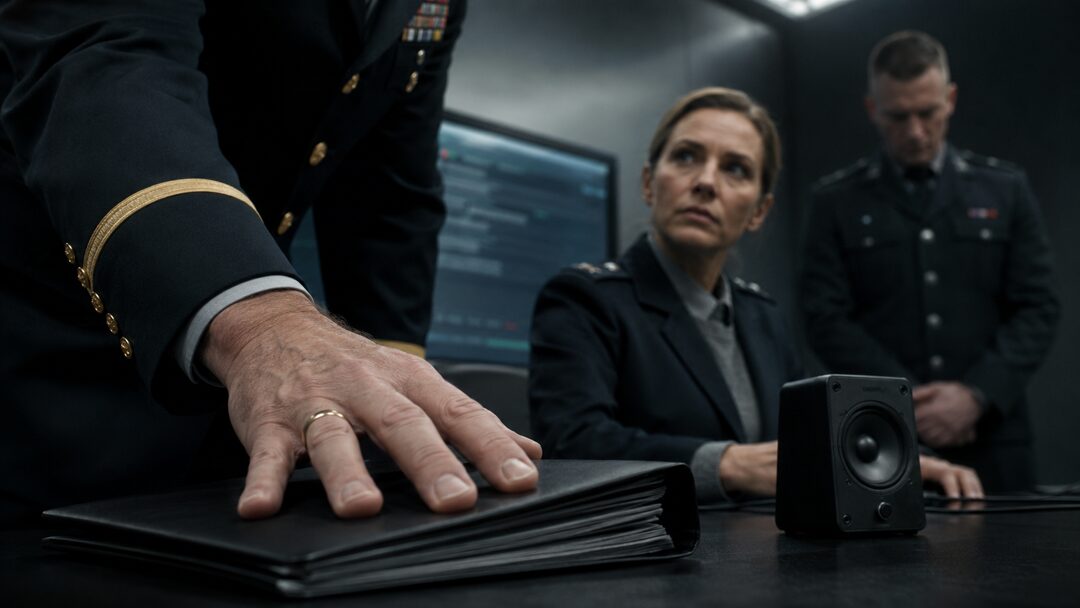
Colonel David Miller stepped in, immaculate at an hour when most people looked partly erased. Tall, silver-haired, uniform clean enough to feel accusatory. His face carried no obvious grief, which made the grief harder to look at.
“You’re still here,” he said.
Emily removed one headphone. “Yes, sir.”
“The file was reviewed.”
“Not completely.”
“It was reviewed by three systems and two analysts.”
“Systems don’t hear intent.”
That made his eyes move, briefly, to the waveform. He did not look at it long.
The recording came from a failed extraction near the border, from a patrol that had gone into a collapsing district to bring out trapped civilians and two wounded personnel. Four had not returned. One of them was Lieutenant Ryan Miller.
The colonel’s son.
But David Miller had not mentioned that once in the review room. He spoke of the incident, the patrol, the signal, the record. Never Ryan. Never my son.
That was the first thing Emily had noticed.
The second was that he always stood where he could see the file but not the speakers.
“The morning board needs your sign-off,” he said. “Ambush. Communications failure. No recoverable intelligence.”
“You’re asking me to certify noise.”
“I’m asking whether you can prove it is anything else.”
There it was. Not what did you hear.
Can you prove it?
Emily looked back at the waveform. The audio sat on the screen like a question someone had tried to bury under static.
“Not yet,” she said.
Miller’s jaw tightened by a fraction.
“Emily.”
He rarely used her first name. When he did, it was not warmth. It was pressure made polite.
“You made your reputation by being exact,” he said. “Stay exact.”
She knew what he meant.
Three years earlier, she had heard a pattern in a transmission others had dismissed. She had been right about the pattern and wrong about its meaning. A unit changed route because of her analysis. Two people did not come back.
Since then, Emily had trusted sound more than herself.
“I am being exact,” she said. “There’s a gap at two seconds.”
“There are gaps throughout.”
“No. There are absences throughout. This one has shape.”
Miller looked at her then. Fully.
For a second, she saw the father under the colonel, and it was worse than anger. It was a man holding a door shut from the inside.
“Pattern-hunting inside grief,” he said quietly, “is still pattern-hunting.”
Emily let that land. She deserved part of it.
Then she put the headphone back over one ear and clicked to the first silence.
“Maybe,” she said. “But grief didn’t put that pause there.”
Part II — The Man Who Wouldn’t Listen
Sergeant Mark Hayes arrived at 6:40 with his boots polished too perfectly.
That was what Emily noticed first. Not the scar along his jaw, though it was new and still angry at one edge. Not the way his uniform hung loose on him, as if he had lost weight faster than his body could admit. The boots.
A man who could not sleep had spent time making them shine.
He stood in the doorway of the review room and looked at the speakers.
Not at Emily.
Not at Miller.
The speakers.
“Sit down, Sergeant,” Miller said.
Mark sat.
He folded one hand over the other on the table. The top hand was steady. The one hidden beneath it trembled.
Emily kept her voice even. “I need you to confirm call signs in the extracted audio.”
Mark nodded once.
“You understand this is not a disciplinary interview.”
His mouth shifted. Almost a smile, but not enough to become one.
“No, ma’am.”
Miller remained by the wall. Arms behind his back. Eyes fixed on the table.
Emily loaded the file.
Mark’s breathing changed before she pressed play.
That, more than anything, made her careful.
“This is the original,” she said. “Uncleaned.”
Mark stared at the screen, where the waveform waited in its small blue violence.
Emily clicked play.
The first two seconds cracked through the room.
A shout.
Impact.
Breath.
Static.
Mark’s chair scraped backward so fast it struck the wall.
“Stop.”
Emily stopped it before the silence.
The room held itself.
Mark was standing now. One hand pressed flat against the edge of the table. The other had curled near his side, not quite a fist.
Miller did not move.
Emily watched Mark’s face. His eyes were open, but they were not in the room anymore.
“You didn’t hear the gap,” she said.
Mark swallowed.
“I heard enough.”
“It’s only twelve seconds.”
“Then you won’t need me.”
Miller’s voice cut in. “Sergeant.”
Mark straightened, but the movement cost him.
Emily said, “I’m not asking you to relive the incident. I’m asking about the voices.”
“There were a lot of voices.”
“One of them says something at the beginning.”
“No.”
“You don’t know which one I mean.”
His eyes snapped to hers.
And there it was.
Not ignorance. Recognition.
Emily felt the room narrow.
Miller saw it too. His expression did not change, but his wedding ring turned once beneath his thumb.
Mark sat slowly.
Emily lowered the volume and isolated the opening burst. She played only the first second.
A voice under static shouted something like, “Move—”
Mark closed his eyes.
Emily stopped it.
“Is that Lieutenant Miller?” she asked.
Miller’s head lifted.
Mark’s eyes opened, raw and furious.
“Don’t do that.”
Emily did not soften. Softness could become cruelty if it let the wrong silence survive.
“I need to know.”
“You don’t need his name for the report.”
“No,” Emily said. “I need his name for the truth.”
Mark looked at Miller then.
It was the first time since entering the room that he had faced him directly.
The colonel looked back with the discipline of a man refusing to ask the question that was killing him.
Mark turned away first.
“I can’t help you,” he said.
Emily replayed the first second in her mind. Not through the speaker. She did not need to. Her memory held sound too well.
Move.
Not panic. Command.
“You were the only one who came out of that service passage,” Emily said.
Mark flinched.
Miller’s voice hardened. “Carter.”
But Emily had already seen it.
Service passage was not in the summary she had been given. It was in a buried location tag attached to the raw signal. Mark should not have reacted unless it mattered.
She opened the file again, not pressing play. Just letting the waveform sit between them.
“There’s more in here,” she said.
Mark stared at the twelve seconds.
For a moment, he looked younger than twenty-nine. For a moment, he looked like someone who had been ordered to keep breathing and hated himself for obeying.
“He doesn’t need this,” Mark said.
Emily knew he did not mean himself.
Miller knew it too.
But neither of them answered.
Part III — The Shape in the Noise
By noon, the recording had become a room Emily could not leave.
She broke it into pieces.
0.00 to 2.00: opening burst.
2.00 to 2.25: the first silence.
2.25 to 7.75: movement, scraping, overlapping distortion, breath too close to the microphone.
7.75 to 8.00: second dip.
8.00 to 10.00: renewed noise.
10.00 to 11.00: almost nothing.
11.00 to 12.14: final surge.
She listened until the sounds stopped sounding like sounds and started feeling like pressure against her ribs.
The long middle stretch bothered her most.
There was metal in it. Not a weapon report. Not machinery. A scrape, then a drag, then something like a hinge taking weight it was never built to carry.
Under that, someone repeated a clipped syllable.
“H—”
Or “hold.”
Or nothing.
Emily removed her headphones and pressed her fingers into her eyes.
The old fear came easily. It knew the way in.
What if she was building meaning out of damage again?
What if the silence felt shaped because she needed it to?
On the desk beside the keyboard sat the printed summary Miller wanted signed. Its language was clean. Clean language was often where ugly things went to disappear.
Communications degradation rendered final transmission unrecoverable.
Unrecoverable.
Emily hated that word. It sounded objective. It often meant tired people had stopped trying.
The door opened.
Miller entered with no file in his hand. That alone told her he had come as a person and not as process, though he would never admit it.
“You requested Hayes again,” he said.
“I requested the mission training logs.”
“I denied that request.”
“I noticed.”
His eyes moved to her screen. She had the waveform enlarged now. The first silence was marked in yellow.
“You’re crossing from analysis into advocacy,” he said.
“Only because analysis is being rushed.”
“The board convenes tomorrow morning.”
“Then we have tonight.”
“No,” he said. “You have until seventeen hundred to submit your finding.”
Emily turned toward him. “Why?”
“Because delay invites speculation.”
“Speculation from whom? The board? The unit? You?”
That changed the air.
Miller stepped closer to the desk. Not fast. Not dramatic. Just close enough for hierarchy to fill the space.
“You are not here to interrogate command decisions.”
“No, sir. I’m here to determine whether the audio contains recoverable information.”
“And does it?”
Emily looked at the waveform again.
The silence at 2.00 seconds.
The dip at 7.75.
The near-absence at 10.00.
“Yes,” she said. “I think it does.”
Miller’s face stayed still.
Only his right hand changed. The thumb found his wedding ring and turned it once.
“You think.”
“That’s why I need more time.”
“What you need,” he said, “is proof.”
A sharp little anger moved through her. Not loud. Useful.
“Then stop taking away the ways I might get it.”
For the first time, Miller looked tired.
Really tired.
Not as a commander kept awake by paperwork. As a father who had not slept since someone brought him a folded flag he refused to unfold.
“My son is not a theory, Ms. Carter.”
Emily did not answer quickly.
There it was. The word he had avoided.
Son.
It changed the room, though nothing moved.
“No,” she said. “That’s why I’m still listening.”
Miller looked away first.
On-screen, the final surge waited at the end of the file, bright and jagged.
Emily clicked into it after he left.
She filtered the low-end rumble. Reduced the static. Pulled the burst apart by frequency bands. She did not trust the software to tell her what mattered. She trusted repetition, and doubt, and the discipline of not wanting an answer too much.
At 16:22, she heard it.
Not fully.
Not cleanly.
A voice buried under the last surge.
“Tell him I held—”
Emily froze.
The room seemed to drop away from the edges.
She played it again.
Static. Impact. Breath.
“Tell him I held—”
Not enough. Too broken. Too human.
Her scarred knuckles hovered above the keyboard.
She should have been relieved.
Instead, she felt sick.
Because a mystery was one thing.
A message was another.
Part IV — What Mark Remembered
Miller listened to the recovered phrase once.
Only once.
Emily had expected disbelief. Anger. Demand for validation.
Instead, he reached across her desk and stopped the playback himself.
“Shut it down,” he said.
“Sir—”
“Shut it down.”
The command was quiet enough to be dangerous.
Emily stood. “That is a voice.”
“It is not verified.”
“It says, ‘Tell him I held.’”
“It could say anything.”
“It doesn’t.”
Miller’s face had gone the color of old paper.
For a moment, Emily thought he might ask whose voice it was. For a moment, she thought he might finally let himself be a father before a colonel.
He did not.
“Seal the file,” he said. “Do not circulate the extraction.”
“Colonel—”
“The board receives the original conclusion. Communications failure. No recoverable intelligence.”
The words struck harder because they were almost calm.
Emily stared at him.
“You heard him.”
That broke through.
His eyes flashed.
“You do not know what I heard.”
Then he left.
Mark was outside the review room when Emily opened the door twenty minutes later.
He was standing against the opposite wall, shoulders squared, face empty.
“You played it for him,” he said.
“Yes.”
Mark closed his eyes.
“He told you to seal it.”
Emily did not ask how he knew.
“Come inside.”
“No.”
“Mark.”
He looked at her then, and the name felt like a risk. Until that moment he had been Sergeant Hayes, witness, survivor, missing piece. Mark was worse. Mark was human.
“He doesn’t need another way to lose his son,” he said.
Emily held the door open.
“He already lost him. This might be the only way he gets to know what happened.”
Mark laughed once. No humor in it.
“That’s what people say when they don’t have to carry the knowing.”
But he came in.
He did not sit this time. He stood by the wall, as far from the speakers as the room allowed.
Emily did not play the file.
She waited.
That was what finally did it.
Mark pressed his thumb hard into the scar along his jaw.
“There was a passage,” he said. “Service tunnel under the east block. Narrow. Concrete. Half-collapsed.”
Emily stayed silent.
“The order came to withdraw. The structure was going. Colonel Miller gave the right order.”
The right order.
He said it like he had repeated it in the dark until the words lost meaning.
“Ryan heard civilians on the lower stairwell,” Mark continued. “Two wounded with us. One couldn’t walk. The passage door was damaged. Wouldn’t stay open without someone holding it off the frame.”
Emily saw none of it, but the recording changed in her mind.
The scrape.
The drag.
The hinge.
“Ryan told me to move them through,” Mark said.
“And you did.”
“I told him I’d take the door.”
“But he ordered you out.”
Mark’s throat worked.
“He smiled.”
That was the detail that hurt him. Emily could hear it.
“Not big,” Mark said. “Just enough to make me mad. Like we were arguing over who had to take the last bad coffee.”
His hand covered his mouth for a second.
Then dropped.
“He said, ‘Go, Hayes.’ I said no. He said it again. Then he used my first name.”
Emily waited.
Mark’s voice lowered.
“He said, ‘Mark, don’t make me waste it.’”
The room became very still.
“That’s why I left,” Mark said. “Not because I thought I’d live. Because he made it an order.”
Emily thought of Miller standing by the wall, demanding proof because proof was safer than grief.
“Why didn’t you tell the board?” she asked.
Mark looked at the speakers again.
“Tell them what? That the colonel’s son disobeyed the colonel’s order? That he stayed behind when command told him to withdraw? That I came out because he didn’t?”
His mouth tightened.
“There’s no version of that story that doesn’t punish somebody.”
Emily glanced at the waveform.
The silences were still marked in yellow.
“Maybe that’s why he left the message,” she said.
Mark’s eyes cut to her.
“He didn’t have time to leave messages.”
“No,” Emily said. “Not the way we usually mean.”
She pulled up the old training logs she had finally gotten through a back channel she would pay for later. Ryan’s unit had used pressure gaps during radio suppression drills. Not formal code. Not doctrine anyone would brag about. A field habit. A way to mark short confirmations when voice transmission was compromised.
Three pauses.
Three placements.
Not random.
Mark went pale as she showed him.
“The gaps line up,” she said. “Two seconds. Seven-point-seven-five. Ten.”
Mark stared at the screen.
“No,” he whispered.
“You recognize it.”
He covered his face with both hands.
For the first time, the trembling was not hidden.
Emily did not touch him.
“He was pinned down,” she said gently. “The microphone was damaged. He used what he had.”
Mark lowered his hands.
His eyes were wet, but his voice came out steady enough to break something.
“He was always better at making bad tools work.”
Part V — The Whole Message
At 5:58 the next morning, Emily unlocked the review room and found Miller already inside.
He stood in front of the blank screen, hands clasped behind his back.
Mark sat at the table.
Neither man looked at the other.
For one second, Emily almost turned around.
There were easier truths to carry. Cleaner ones. Truths that corrected records and punished liars and made everyone feel brave afterward.
This was not one of them.
This truth would not save Ryan Miller.
It would not absolve David Miller.
It would not give Mark back the version of himself who had entered that service passage believing courage meant staying.
Emily set her folder on the table.
“The board meets in thirty-two minutes,” Miller said.
“Yes.”
“You were ordered to seal the file.”
“Yes.”
Mark looked down.
Emily plugged in the speakers.
Miller turned, slow and controlled. “Ms. Carter.”
She met his eyes.
“I’m not playing this to challenge your command,” she said. “I’m playing it because he asked to be heard.”
Miller’s expression shifted at the word asked.
Not much.
Enough.
Emily dimmed the screen until only the waveform glowed.
“I’ll play the cleaned sequence once,” she said. “Then you can decide what the board receives.”
No one agreed.
No one stopped her.
She clicked play.
The opening burst cracked through the room.
This time, the layers were clearer.
Ryan’s voice came first, strained but unmistakable.
“Move, Mark!”
Behind it, another voice shouted. A dragging sound. A cry cut short by static.
Mark bent forward, elbows on knees, both hands locked behind his neck.
Miller did not move.
The first silence came.
Two-tenths of a second.
A held gap.
Emily watched Miller hear it.
Not with his ears. With whatever part of a father knows when a child is trying not to be afraid.
The long middle stretch followed.
Metal screamed against concrete.
A breath shoved hard through clenched teeth.
One voice, farther away, yelled, “Clear!”
Another: “Keep going!”
Under it all, Ryan made a sound that was not quite a word.
“H—”
The damaged hatch groaned.
Emily had heard that middle section hundreds of times by then. In the final reconstruction, it no longer sounded like chaos.
It sounded like weight.
At 7.75 seconds, the second pause opened.
A small, deliberate absence.
Mark made a sound and stopped himself.
Miller’s hand found the edge of the table.
The renewed noise came at 8.00 seconds.
Ryan inhaled sharply. Something struck near the microphone. Static flared and broke apart.
Then the near-silence at 10.00.
One second.
Almost nothing.
A breath.
Emily had nearly erased that breath during cleaning. It had seemed like interference at first. A soft distortion before the final surge.
Now she knew better.
It was Ryan gathering the last of himself around the thing he needed to say.
The final surge rose.
Static. Impact. The equipment clipping under pressure.
Then the voice, pulled from the storm.
“Tell him I held the door.”
The file ended.
No one spoke.
The room’s silence after the recording was not like the silences inside it.
This one had no code.
No hidden message.
Only three living people left with what they had asked sound to give back.
Miller’s fingers were white against the table.
His face had not broken. That almost made it worse.
Mark looked at him.
“Sir,” he said, barely audible. “I tried to stay.”
Miller shut his eyes.
Emily thought he might say, I know.
Or, You should have.
Or, My son.
Instead, Miller opened his eyes and looked at Mark as if seeing the cost of the living for the first time.
“He ordered you out,” he said.
Mark nodded once.
Miller’s mouth tightened. His voice dropped lower.
“Then you obeyed.”
Mark’s face twisted, but he did not cry.
Emily looked away.
Some permissions hurt more than accusations.
Miller turned toward the screen.
“Play the final line again.”
Emily hesitated.
He did not look at her.
“Please.”
So she played only the last 1.14 seconds.
Static rose.
Ryan’s voice came through.
“Tell him I held the door.”
Miller absorbed it without moving.
When it ended, he remained still for so long Emily thought he might ask for it again.
He did not.
He straightened his jacket.
The colonel returned piece by piece, but not all the way.
“What was the exact wording of the report line?” he asked.
Emily opened the file.
Miller dictated without looking at either of them.
“Lieutenant Miller remained in position to preserve evacuation flow.”
Emily typed it.
The sentence was not enough.
It was also everything he could give.
Mark stared at the table.
Miller turned to him.
“Sergeant Hayes.”
Mark stood so quickly the chair nearly tipped.
“Yes, sir.”
Miller looked at the scar on his jaw, the too-polished boots, the hands that still did not know what to do with survival.
“My son trusted you with the living,” he said.
Mark’s breath caught.
Miller held his gaze.
“Do not make that smaller than it was.”
Then he left for the board.
The door closed behind him with a soft mechanical click.
Mark remained standing.
Emily did not ask if he was all right. It would have been an insult to the truth.
After a while, he said, “Can I hear it alone?”
Emily nodded.
She reset the file.
This time, she left before pressing play.
Part VI — What Remained
From the hallway, Emily heard the recording begin again.
Muffled through the door, the first burst sounded almost ordinary. Just noise through a wall. Something damaged. Something easy to misunderstand.
Then silence.
Then the long middle stretch.
Then silence again.
Emily stood outside with her hand on the access panel and realized she was holding her breath in the same places Ryan had left gaps.
Inside the room, Mark listened to the whole thing.
Once.
Then a second time.
Then, after a long pause, a third.
When he opened the door, his face looked older and less ruined.
Not healed.
That would have been too much to ask of twelve seconds.
But altered.
In his hand was a small unit patch, worn soft at the edges. Emily had seen it earlier on the inside of his folder, tucked behind paperwork like something hidden from weather.
He stepped back into the room and placed it beside the speaker.
Not on top of the machine.
Beside it.
As if the recording had become a person who should not sit alone.
“He gave me that after training,” Mark said. “Said I kept losing mine.”
Emily nodded.
Mark looked embarrassed by the tenderness of it, so she did not make him carry more.
“I’ll make sure it stays with the file until you want it back,” she said.
He shook his head.
“It can stay a while.”
Down the corridor, doors opened and closed. The building had entered morning. People moved with coffee, folders, clean language, the daily machinery of official things.
In the review room, the twelve seconds sat on the system drive under a new classification tag.
Emily returned to her desk after Mark left.
The cleaned version was ready for archive. So was the original.
Her software offered, as it always did, to remove nonessential gaps.
She stared at the prompt.
Remove silence?
Emily thought of all the times she had believed clarity meant cutting absence away.
She thought of Miller’s face when the first pause landed.
Mark’s hands when the second one came.
Ryan’s breath before the final line.
Some silences were not empty.
Some silences were the last shape a person could make.
Emily selected the original file.
She preserved it whole.
The burst.
The first impossible pause.
The long stretch of weight and breath.
The second gap.
The renewed noise.
The near-nothing before the end.
The final surge.
All 12.14 seconds.
Before closing the archive, she added one note in the analyst field.
Original timing retained. Pauses assessed as intentional signal components. Do not smooth.
She read it once.
It sounded too technical for what it meant.
But maybe technical was all right. Maybe that was her way of being careful with grief. Not by making it beautiful. Not by making it larger. By refusing to erase where it had gone quiet.
At 7:12, Colonel Miller returned.
He did not enter fully. He stood in the doorway, holding a folder in one hand.
“The board accepted the amended line,” he said.
Emily stood. “Thank you for telling me.”
He nodded once.
Neither of them mentioned Ryan.
Then Miller looked past her, toward the speaker.
“Does the original remain?”
“Yes, sir.”
“With the gaps?”
“With everything.”
His face changed, not enough for anyone else to name.
“Good,” he said.
He turned to leave, then stopped.
For a second, Emily saw the man who had taught his son discipline and lost him to conscience. The commander who had made the correct call and still would spend the rest of his life hearing a door held open in the dark.
Without turning back, Miller said, “He hated being misunderstood.”
Emily’s throat tightened.
Most grief asked for impossible things. More time. A different ending. One more ordinary morning.
This grief asked only to be accurate.
“He isn’t,” she said.
Miller stood still.
Then he walked away.
Emily sat down after the sound of his steps faded.
On her screen, the archived file waited under its final name.
She did not play it again.
For the first time since 2:13 that morning, she did not need to.
The silence had already spoken.