The Old Man at Gate Seventeen Carried a Backpack No One Knew How to Touch
Chapter 1: The Backpack Opened Under Airport Lights
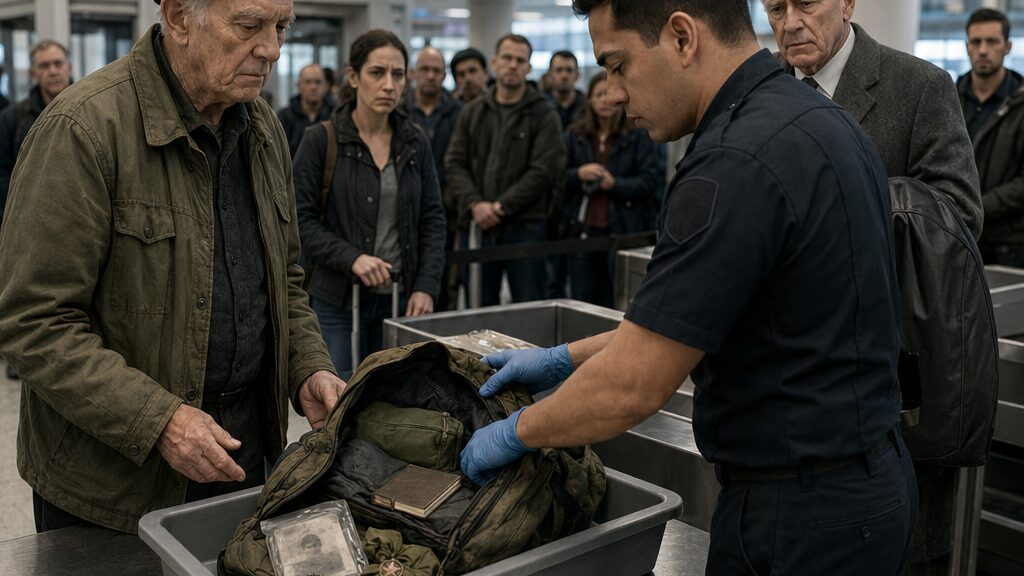
The gray tray hit the metal inspection table hard enough to make Donald Mitchell’s hands close around the straps of his backpack.
“Sir, I need the bag.”
The young officer did not raise his voice. He did not have to. The line behind Donald had already gone still in the way crowds do when they smell delay and decide whose fault it is.
Donald looked at the tray, then at the blue gloves stretched tight over the officer’s fingers. Beyond him, a belt carried shoes, laptops, jackets, and small plastic bins beneath the white wash of airport lights. A child cried somewhere near the body scanner. A business traveler sighed with theatrical patience. The announcement above them called for passengers on a flight to Denver to proceed to Gate Twelve. Donald’s flight would leave from Gate Seventeen, and the number had been sitting in his chest since dawn like a small hard stone.
He loosened his grip.
The backpack was olive canvas, faded nearly gray at the seams, with one side pocket mended by black thread and a strip of tape near the bottom where fabric had worn thin. It had never looked like much. It had sat in closets, beside hospital chairs, under bus seats, and on the passenger floor of Donald’s old pickup. It had crossed more years than miles.
The officer took it by one strap.
“Careful,” Donald said.
The word came out too quickly. Too bare.
The officer glanced up. He was young, clean-shaven, with a square face still soft around the eyes. The name on his uniform read Rodriguez. His expression stayed professional, but Donald saw the small tightening at the mouth. Another old man being particular. Another passenger who thought his bag was different from everyone else’s.
“I need to inspect it, sir.”
Donald nodded once.
Behind him, someone muttered, “Come on.”
Donald kept his eyes on the bag.
The officer set it in the tray and unzipped the main compartment. The sound of the zipper seemed too loud, a long tearing across the noise of the checkpoint. Donald’s right hand moved halfway toward the table before he stopped it and let it hang open at his side.
Inside the bag, things were layered in the order he had kept for years. Not in the order a person packed for travel. The gray shirt wrapped around the edges. The folded wool cloth on the left. The green pouch tucked low, flat as a sleeping animal. The small book pressed against the back panel. The tied bundle at the center, covered in dark green fabric gone soft from handling.
Officer Rodriguez removed the shirt first and placed it in the tray.
Then the book.
Then the pouch.
Donald watched each item leave the dark of the bag and enter the public light.
The line shifted. Wheels clicked against tile. A woman with a carry-on leaned slightly to see what had caused the holdup. A man in a suit checked his watch, then looked at Donald’s shoes as if the answer might be there.
Donald’s shoes were black, polished badly. His knees had stiffened during the drive before dawn, and his left foot still dragged a little when he had to turn quickly. He knew what he looked like. Old knit cap. Olive jacket. Hands with raised veins and nails cut short. A man who had not bought new luggage because new luggage would have meant deciding what to leave behind.
Officer Rodriguez lifted the green pouch.
“What’s this?”
“Medical pouch.”
“Is there anything sharp inside?”
“No.”
“Medication?”
“No.”
The officer opened it anyway. Donald watched the blue gloves press against the old canvas. There were no bandages left in it, no scissors, no morphine syrettes, nothing anyone would understand as useful. Only a folded strip of cloth, a pencil stub, and a paper packet sealed long ago with yellowed tape.
Rodriguez frowned slightly and set the pouch aside.
The gray tray was filling. Donald felt the people behind him not as faces but as heat. Their impatience moved over his back and neck. He had stood in worse places with worse eyes on him, but that had been a young man’s body. This body took insult differently. It did not burn so clean. It sank.
“Sir, did you pack this bag yourself?” Rodriguez asked.
“Yes.”
“Has it been with you at all times?”
“Yes.”
“Do you know what’s inside?”
Donald looked at the open bag.
“Yes.”
The answer was small enough to irritate the officer. Donald could see that too. He could see rules moving behind the young man’s eyes: suspicious items, incomplete answers, unclear passenger behavior, secondary inspection.
Rodriguez reached deeper.
Donald’s breath paused before the officer’s hand closed around the tied green bundle.
It was no larger than a lunchbox, wrapped in faded cloth and bound with cord so old it had darkened at the knots. A small metal pin, dulled by years of air and skin, was fastened near the top fold. Donald had meant to remove it before traveling, then could not bring himself to disturb the cloth again. He had tied it the night before with hands that would not stop shaking, then untied it, then tied it again.
Rodriguez lifted the bundle.
Donald’s hand rose.
“Sir,” the officer warned.
Donald stopped. His fingers remained open in the air, empty and ashamed.
“I’m not touching,” he said.
Rodriguez put the bundle in the tray. The pin clicked softly against the plastic.
The sound took Donald out of the airport for half a second. Not far. Just enough that the fluorescent lights thinned and the smell of coffee became wet earth, metal, antiseptic, and smoke. He saw a hand, not his, closing over the same pin. He heard a voice saying his name like there was still time to be ordinary.
“Sir?”
Donald blinked.
Rodriguez had pulled a small black-and-white photograph from the side pocket of the bag. It had been kept in a clear sleeve, but the edges had curled inside it. The young man in the picture wore fatigues and a crooked smile. His eyes looked past the camera, amused by whoever had taken too long to press the shutter.
Rodriguez held it between gloved fingers.
“Is this yours?”
Donald swallowed. The question had more meanings than the officer knew.
“No,” Donald said.
Rodriguez waited.
Donald added, “Not exactly.”
The officer’s face changed. Not softened. Sharpened.
Behind Donald, the business traveler let out another breath, louder than before. “Some of us have flights.”
Donald did not turn around. He had spent enough years learning that turning toward every voice gave the voice more room.
Rodriguez placed the photograph in the tray beside the green pouch. Then he reached into the front pocket of the backpack. His fingers found the chain first.
Metal slid against fabric.
Donald heard it before he saw it.
The dog tags came free in a dull silver loop, one tag darkened more than the other. They swung from Rodriguez’s hand under the checkpoint lights, turning slowly, catching white on one edge and shadow on the stamped letters.
The officer looked at them. Then at Donald.
The old man felt the whole line looking too.
For a moment no one moved. The tray held his gray shirt, the book, the pouch, the photograph, the tied bundle, and now the tags. They lay there as if a life could be sorted by category: harmless, suspicious, forgotten, explainable.
Rodriguez’s voice came quieter, but not kinder yet.
“Whose is this?”
Donald looked at the tags in the young man’s blue-gloved hand.
His own name was not on them.
That was the part that still had teeth.
Chapter 2: Please Be Careful With That
Mark Rodriguez had learned to distrust hesitation.
Hesitation made passengers miss questions they had heard. Hesitation made people joke when they should answer plainly. Hesitation made hands drift toward pockets, bags, belts, places that turned an ordinary morning into paperwork, panic, and someone’s mother crying into a phone.
The old man in the olive jacket had been hesitation from the moment his backpack entered the scanner.
Not aggressive. Not loud. Not drunk or belligerent or clever. Just still in the wrong places, careful in the wrong way, answering as if every word cost something.
Mark held the dog tags up enough to read the stamped name, then realized he should not read it aloud. The name did not match the passenger’s boarding pass.
“Sir,” he said, “I need you to tell me whose tags these are.”
Donald Mitchell’s eyes did not leave the chain.
“A friend’s.”
“What friend?”
Donald’s jaw worked once.
“A man I served with.”
That changed the air around the table, but not enough for Mark to let go of procedure. Everyone had a story at a checkpoint. Some were true, some were confused, and some were designed to make an officer feel bad before the rules had been followed.
“You were military?” Mark asked.
Donald nodded.
“Do you have identification showing that?”
“My driver’s license.”
“I mean military identification.”
“No.”
“Retired card?”
“No.”
“VA card?”
Donald’s mouth tightened. “Not with me.”
Mark heard the business traveler behind the old man say, “Unbelievable,” under his breath. Mark did not look back. He did not like passengers who performed impatience, but he also did not like being pulled into a situation where everyone expected him to choose between mercy and policy. Policy was built so that he did not have to trust his feelings.
He set the tags down in the tray.
The old man’s fingers twitched.
Mark opened the small book next. It was not a passport. Not a Bible. A field notebook, maybe. The cover had softened and cracked at the corners. He flipped it open and found handwriting, cramped and faded, but the first page had water stains that made most of it unreadable.
The old man said nothing.
Mark turned another page.
“Please don’t,” Donald said.
Mark paused.
It was the way the old man said it that made Mark look at him fully for the first time. Not angry. Not demanding. There was no old-man bluster in it, no “I know my rights,” no attempt to win the room. Just a small containment, like the sentence had slipped out before he could lock it back.
“Sir, I have to inspect anything I can’t identify.”
Donald lowered his eyes.
Mark closed the notebook but did not put it back. He moved to the tied bundle. The cord was knotted twice. A small metal pin was fastened into the cloth, round and worn smooth at the edges except where the raised shape still caught his glove.
He lifted the bundle by its sides.
Donald’s hand came up again.
“Sir.”
“I know.” Donald drew the hand back toward his chest. “Please be careful with that.”
The line had gone quieter. Not silent. Airports never went silent. But attention had narrowed. Mark could feel it on his neck, the hungry public watchfulness of people who had already decided something was happening and wanted to know what kind.
The business traveler stepped out from behind a family and said, “Can somebody open another lane?”
A woman a few places back, dark hair pulled into a tired knot, touched the handle of her carry-on and frowned at him, but said nothing.
Mark turned the bundle in his hands. He did not want to untie it in front of everyone. He also did not want to ignore whatever had caused the scanner operator to flag the bag. Something inside had a shape dense enough to require a look.
“Sir, I’m going to open this.”
Donald’s face changed so little that no one else might have noticed. Mark noticed because his job had trained him to watch hands, shoulders, eyes. The old man’s shoulders fell half an inch, not in surrender but in some older defeat.
Before Mark could pull the knot loose, a voice came from the side.
“Officer.”
The man who spoke stood just outside the lane, tall despite his age, white-haired, carrying a garment bag over one arm. He wore a gray overcoat and polished shoes, and he had the bearing of someone accustomed to being listened to without needing to say much.
Mark turned. “Sir, I need you to stay behind the marked line.”
“I understand.” The man’s eyes were not on Mark. They were on the pin. “May I ask what you have there?”
“This is an inspection area.”
“I can see that.”
“Then I need you to step back.”
The older man did not move. “The pin on that cloth. May I see it from here?”
Mark almost refused. Then he saw the man’s expression. Not curiosity. Recognition, sudden and unpleasant, as if someone had opened a door in front of him and there was weather on the other side.
Donald had gone completely still.
The older man looked at him now. “Sir, were you with Third Battalion?”
Donald did not answer.
The name tag on the man’s boarding pass holder swung forward as he stepped closer. Robert White. His hand, resting on the garment bag, had tightened until the knuckles stood out.
Mark looked from him to Donald. “Do you two know each other?”
“No,” Robert said.
Donald said, “No.”
Both answers came at once. That made the line stir.
Robert lowered his voice. “But I know that pin.”
Mark looked down at the small metal piece fixed to the cloth. It was not a medal exactly. More like a unit marker, old and plain, with an insignia Mark did not recognize. He had been expecting something decorative, something people bought at surplus stores or inherited in boxes. He had not expected an old man in a gray overcoat to look as though he had just been struck.
“Officer,” Robert said, and this time the word had no challenge in it, only care, “don’t pull on the knot from that side. You’ll tear the cloth.”
Mark looked at his own hands.
Blue gloves. Tight grip. Bundle tilted wrong.
He felt heat rise in his face.
He set the bundle flat in the tray.
Donald’s eyes flicked toward him. Not grateful. Watching.
Mark adjusted his voice without meaning to. “Sir, is there something inside that could be damaged?”
Donald’s gaze stayed on the bundle. “Yes.”
“What is it?”
“A promise.”
The business traveler made a small scoffing sound. Nicole Clark, the woman with the tired knot of hair, turned and looked at him so directly that he stopped.
Mark had heard all kinds of answers. He had never had to mark “promise” on an inspection form.
The TSA supervisor approached from the next lane, drawn by the slowdown and the strange attention gathering at Mark’s table. “Rodriguez?”
Mark straightened. “Secondary inspection on flagged carry-on. Passenger has military items, nonmatching tags, sealed cloth bundle.”
The supervisor looked at Donald, then at Robert, then at the watching line. “Sir,” he said to Robert, “are you part of this party?”
“No.”
“Then please return to your lane.”
Robert nodded once, but did not leave. “I will. But that pin belonged to men who did not come home whole. Whatever your procedure is, follow it. Just don’t treat it like junk.”
The word hung there.
Junk.
Mark looked down at the tray. The old shirt. The pouch. The notebook. The photograph of a young man whose smile had outlived him badly. The tags with a name that was not Donald Mitchell. The tied bundle that might contain nothing dangerous and still be the most dangerous thing on the table because of what careless hands could do to it.
He picked up the pin again, not by the bundle this time, but gently between thumb and forefinger.
Donald’s palm opened without request.
Mark hesitated.
Then he placed the pin and the edge of the cloth back down, careful not to scrape the metal against the tray.
His voice came lower. “Mr. Mitchell, I’m going to ask permission before I move anything else. But I still have to complete the inspection.”
Donald looked at him then. His eyes were pale, tired, and hard to read.
“All right.”
Robert White’s gaze moved from the pin to Donald’s face. Something passed there, some calculation of age against memory.
He stepped half a pace closer, ignoring the supervisor’s look.
“Were you there,” Robert asked quietly, “when they carried the corpsman out?”
Donald’s hand closed slowly over nothing.
The crowd behind him ceased being a crowd for one breath. It became a room full of people waiting for an old man to decide whether he would open a door.
Chapter 3: The Man in the Faded Photograph
They put Donald in a small interview room with a table bolted to the floor and a clock that clicked too loudly.
His backpack sat on the chair beside him, not on the floor, not in the tray. Mark Rodriguez had asked before moving it. The question had been awkward, almost stiff, but he had asked. Donald had nodded, and Mark had carried the bag with both hands as if its weight had changed.
On the table lay the photograph.
Donald had placed it there himself.
Not because anyone demanded it. Not because Robert White watched from the wall with his hands folded in front of him. Not because the TSA supervisor waited near the door with the careful blankness of a man thinking about reports. Donald placed it there because the picture had already been seen under the airport lights, and putting it back too quickly would have felt like a kind of panic.
The young man in the photo smiled up at the room.
Stephen Johnson had been twenty-three when the picture was taken. He had hated that photograph. Said his hair looked stupid. Said his mother would frame it and make everyone at church look at it. Said if he died, Donald had better find a better picture to send home, because a man should not be remembered looking like he had just been tricked into standing still.
Donald had laughed then.
He remembered that he had laughed.
The memory arrived with a sharpness that made him look down at his hands.
The hands on the table were old and spotted. One knuckle had swollen after an accident with a toolbox years ago. The left thumb did not bend right when the weather turned. They did not look like hands that had once lifted a radio in the rain, pressed gauze to torn skin, dragged a man by the straps of his gear because standing upright had become impossible.
Robert White broke the silence first.
“I shouldn’t have asked that out there.”
Donald did not answer.
“I saw the pin,” Robert said. “And the pouch. I thought—” He stopped. “I thought I knew the story.”
“You don’t.”
“No.”
The simple agreement made Donald look up.
Robert did not defend himself. He had taken off his overcoat and folded it over the back of a chair but had not sat down. He looked older without it, narrower through the shoulders. Whatever authority had followed him to the inspection table had thinned inside this room.
Mark stood near the supervisor, not quite at attention, not quite relaxed. His gloves were gone. Donald noticed that. The young man’s bare hands hung at his sides, uncertain what to do without a task.
The supervisor checked his tablet. “Mr. Mitchell, we need to confirm there’s nothing prohibited in the wrapped item or pouch. We can do that here, privately.”
Donald looked at the clock.
His boarding time had already started eating itself.
“How long?”
The supervisor hesitated. “That depends.”
Donald let out a breath through his nose. “It always does.”
No one smiled.
Mark shifted. “Sir, your flight to Cedar Rapids starts boarding in forty minutes. Gate Seventeen. If we can clear the bag quickly, you might still make it.”
Might.
Donald had lived long enough to know how much weight the word carried when said by someone who did not have to pay for it.
Robert looked at the photograph. “Is he the corpsman?”
Donald’s hand moved to the edge of the table. The old urge came back: close the book, tie the cloth, put everything where no one could turn it into questions.
Instead he touched the photograph’s plastic sleeve with one finger.
“Stephen Johnson.”
Mark looked down.
Robert closed his eyes briefly. “Navy?”
“Corpsman attached to Marines.”
“How old?”
“Twenty-three.”
The supervisor’s face softened in a way he tried to hide by looking at the tablet again.
Donald did not want their softness. That was the danger of telling even a small piece. People leaned toward grief as if leaning made them kinder. They did not know that pity could be another hand in the bag.
Robert pulled out the chair across from Donald and stopped. “May I sit?”
Donald heard the question for what it was. Not about furniture.
He nodded.
Robert sat.
Mark stayed standing.
The supervisor said, “Mr. Mitchell, if the bundle contains remains, weapons, or organic material, there may be additional rules.”
“It doesn’t.”
“What does it contain?”
Donald looked at the green cloth.
“A shirt. Letters. A notebook. His tags. The pin.” He paused. “Things that should’ve gone home before I did.”
The words made the room smaller.
Mark spoke carefully. “The tags in the tray have his name?”
Donald nodded.
“But you also have the photo and the pouch.”
“The pouch was his.”
Robert leaned forward slightly. “He treated you?”
Donald almost said no because the word treated was too clean.
“He stayed with me.”
The clock clicked three times.
Donald kept his eyes on the photo.
“There was an evacuation route that stopped being a route. Rain, smoke, too many wounded, not enough hands. I carried the radio. He carried everything else. He was always carrying something.” Donald’s mouth bent, not quite a smile. “Bandages, water, letters people gave him because they thought he was safer than they were.”
Stephen had been good at making men believe tomorrow had a shape. He could swear at a wound and make the wounded man laugh. He could write a letter for someone who had lost three fingers and pretend not to see tears drop on the paper. He had once traded cigarettes for a little girl’s broken toy because she would not stop crying near the road, then spent an hour repairing it with wire.
Donald did not say those things.
He said, “He saved my life.”
Robert’s gaze stayed lowered.
Mark said, “And you’re taking his belongings to Anna Johnson?”
Donald looked up sharply.
Mark held both hands open. “It was on your contact card in the side pocket. I didn’t mean—”
“You read it.”
“I had to check travel purpose and contact information once the bag was flagged.”
Donald’s face warmed. He knew it was not reasonable to be ashamed of a card with a name on it. Still, the thought of Anna’s name passing through airport procedure made him feel as if he had failed before reaching her door.
The supervisor stepped in. “Mr. Mitchell, no one here is trying to expose anything unnecessarily.”
Donald looked at the table, at the photo of Stephen, at the bag beside him.
“That already happened.”
The sentence landed harder than he meant it to.
Mark looked away.
Donald regretted it, not because it was false, but because truth could bruise people who were only beginning to understand where they had stepped.
Robert folded his hands. “Why now?”
Donald could have told them about the first letter returned unopened in 1974. About the second address, found through a veterans’ group years later, that led to an empty lot. About his wife, who had written names down because Donald forgot papers but never voices. About her saying, before she died, You don’t have to carry everyone forever, Don.
He said, “I found her.”
“Anna?”
“Yes.”
“Stephen’s daughter?”
Donald nodded.
“How old was she when he died?”
“Not born yet.”
Mark’s mouth parted slightly, then closed.
Donald reached for the photograph and turned it so the young man’s face pointed toward the others.
“He never saw her. He had one letter started. No address. No envelope. Just her name. Anna, if your mother lets that stand.” Donald’s finger rested near the photo’s corner. “Her mother did.”
Robert’s face shifted. He understood that kind of wound, or enough of it.
The supervisor cleared his throat softly. “Mr. Mitchell, I’m sorry, but we still need to complete the inspection. We can request a private screening of the wrapped contents with minimal handling.”
“Will I make my flight?”
The supervisor did not answer quickly enough.
Mark looked at the clock, then at the tablet in the supervisor’s hand. “If we move now, maybe.”
“Maybe,” Donald repeated.
Robert leaned back. “If you miss it, I’ll get you on another.”
Donald looked at him.
Robert stopped, hearing himself.
Donald did not have to raise his voice. “No.”
“I only meant—”
“I know what you meant.”
Robert’s jaw tightened with embarrassment.
Donald slid the photograph back toward himself. “This is not something another man carries because he has better shoes.”
The room went quiet again.
Mark lowered his eyes, and for the first time Donald saw that the young officer was not angry at being corrected. He was listening.
The supervisor checked the tablet one more time, then spoke in the tone people used when bad news had to be made official.
“Mr. Mitchell, if we cannot clear the bundle in the next few minutes, the delay may make you miss the only flight that reaches Anna Johnson today.”
Donald looked at the backpack beside him.
For years, it had waited because he had asked it to wait.
Now everyone was asking it to hurry.
Chapter 4: A Promise Delayed By Fifty Years
Robert White had spent most of his adult life learning when not to step forward.
In uniform, that restraint had been called discipline. After retirement, it had become a habit others mistook for calm. He had watched men argue at airline counters, watched young officers overreach, watched strangers embarrass themselves in public, and had stayed out of it because one old man inserting himself into every wrong thing did not make the world better. Sometimes it only made the wrong thing louder.
But when he saw the pin on the green cloth, he had stepped forward before choosing to.
Now he stood beside an airport customer service counter with his overcoat over one arm and Donald Mitchell sitting three seats away, the worn backpack upright between his shoes. Not beside him. Not under the chair. Between his feet, where the old man could feel it if anyone came too close.
The security area hummed behind them. Passengers flowed around the waiting area in anxious streams, rolling bags, carrying coffees, glancing at screens. No one knew that a small room behind the checkpoint had held a dead man’s name for ten minutes. No one knew that a flight to Cedar Rapids had become more than a flight.
Donald looked smaller in the waiting area than he had at the inspection table. Not weaker. Just folded inward. His cap shadowed his eyes, and his hands rested on the backpack’s top handle with a stillness Robert recognized from men who had learned that gripping something was better than shaking.
The TSA supervisor had cleared the bag after private inspection. The bundle had not been fully opened. Donald had untied one side himself, enough to show cloth, paper, and the outline of a small notebook sealed in waxed paper. The supervisor had examined only what procedure required. Mark Rodriguez had stood back and said very little.
That had mattered.
Robert looked toward the airline counter, where a clerk was typing with the urgency of someone trying to make a computer perform mercy. Mark stood near the counter, not in charge of anything now, which seemed to bother him. He kept looking at the departure board. Gate Seventeen was still posted. Boarding had begun.
Robert had a first-class seat on a later flight to Dallas. A funeral for a man he had not seen in fifteen years waited at the other end of it. He had thought that would be the burden of the day. Now it felt like an appointment compared with what sat at Donald’s feet.
He moved closer but stopped two chairs away.
“Mr. Mitchell.”
Donald did not look up. “Donald.”
“Donald,” Robert said.
The old man’s eyes lifted.
Robert held the garment bag against his side. “I spoke too quickly in there.”
“You already said that.”
“I did.” Robert looked at the backpack. “I’m saying it again because I almost did the same thing they did.”
Donald’s face gave nothing.
Robert lowered himself into the chair two spaces away, leaving one empty between them. “I saw the pin and thought I knew what you needed. I don’t.”
Donald’s hands remained on the bag.
The clerk at the counter said something to Mark, who leaned in, listening. The young officer’s shoulders had changed since the inspection table. Less square. Less sure of themselves. He was trying to help, but still from the edge of a system that had already taken too much time.
Donald watched him for a moment, then said, “People like to help by taking things.”
Robert sat with that.
Outside the wide windows, a plane moved slowly across the tarmac, its nose turned away from the terminal. Morning light glared against the glass and flattened the world into silver and concrete.
“When I was a lieutenant,” Robert said, “I thought leadership meant carrying the heaviest piece.”
Donald’s mouth moved slightly. “Then you became a captain.”
Robert glanced at him.
Donald was not smiling, but something dry had passed between them.
“Yes,” Robert said. “Then I learned men don’t always want the burden taken. Sometimes they want someone to stop adding to it.”
Donald looked back at the departure board.
The flight still said Boarding.
Robert waited.
“My wife found the first address,” Donald said.
Robert did not move.
Donald’s voice stayed low, almost swallowed by the terminal noise. “Nineteen seventy-four. Letter came back. No forwarding. I was working nights then. Warehouse outside St. Louis. I put the envelope in the bag. Told myself I’d try again.”
He rubbed the backpack handle once with his thumb.
“Second time was the eighties. Veterans group gave me an address in Ohio. I drove there. House was gone. Grocery store where it used to be. I sat in the parking lot two hours like a fool.”
Robert listened.
“After that, life got loud.” Donald’s eyes narrowed, not at Robert, but at some place too far away for the airport. “Work. Kids that didn’t stay kids. My wife getting sick. My knees going. You don’t forget. But you start learning how to walk around what you haven’t done.”
“Until now.”
Donald nodded. “Until now.”
“What changed?”
Donald opened the side pocket of the backpack and took out a folded printout. He handled it more casually than the bundle, but still with care. “Her name came up in a reunion notice. Stephen’s family. Someone posted that his daughter was looking for anyone who remembered him as a person, not a line on a wall.”
Robert felt the sentence settle between them.
Donald put the paper away. “I wrote. She answered the same day.”
“And asked you to come?”
“No.” Donald’s eyes remained on the zipper. “I asked her if I could.”
The empty chair between them suddenly seemed necessary.
Robert turned his boarding pass over in his hand. “You tried twice.”
“Not enough.”
“Fifty years is a long time to punish yourself for not finding an address.”
Donald looked at him then, and Robert saw the boundary. Not anger exactly. A warning.
“Don’t make it smaller so it fits in your mouth.”
Robert accepted the hit with a nod.
The clerk at the counter called, “Mr. Mitchell?”
Donald began to rise. Robert stood before he could think, then stopped himself from reaching out. Donald pushed up from the chair with one hand on the armrest and one on the backpack. Slow, but not helpless. The distinction mattered.
Mark came back from the counter holding a paper slip. His face carried bad news arranged as hope.
“They can still get you to the gate,” Mark said. “The flight’s nearly full. There’s one standby seat that may clear because of a missed connection.”
Donald’s eyes flicked to the slip.
“But?” Robert asked.
Mark looked at him, then at Donald. “Because of the late boarding and cabin space, the gate agent may require larger carry-ons to be checked.”
“No,” Donald said.
It was not loud. It ended the discussion anyway.
Mark swallowed. “I told them there were fragile personal items.”
Donald took the backpack by both straps and lifted it onto his shoulder. The movement pulled at his face before he hid the pain.
“I’m not checking it.”
Robert said, “No one’s saying you should.”
Donald looked at him.
Robert corrected himself. “No one here is going to ask you to.”
Mark’s eyes moved toward the gate corridor, measuring distance and time. “We should go now.”
The wheelchair attendant waiting nearby stepped forward with an empty chair. “Sir, we can get you there faster.”
Donald looked at the chair.
Robert saw the old calculation again. Pride was not the right word. Men used pride when they wanted to dismiss pain. This was different. Donald had been moved enough that morning. Pulled aside, inspected, watched, delayed. The chair was practical. It also meant surrendering his pace to someone else’s hands.
Donald adjusted the backpack strap.
“I’ll walk.”
The attendant did not push.
Mark looked as if he wanted to argue and was learning not to. “Then I’ll clear a path.”
Donald began moving toward Gate Seventeen.
Robert walked half a step behind, not beside, not leading. That was the distance Donald seemed to allow. Mark moved ahead through the current of travelers, speaking quietly to staff, opening space without making a scene.
As they passed the security lanes, Nicole Clark, the woman from the line, stood near a coffee kiosk with her carry-on beside her. She saw Donald, saw the backpack on his shoulder, and moved her bag out of the walkway before anyone asked. The impatient business traveler stood near the same kiosk, phone to his ear, watching with the sour embarrassment of a man who wanted to be forgiven without apologizing.
Donald did not look at him.
Robert did.
Not long. Just enough.
The man turned away.
At the mouth of the concourse, Donald slowed. Robert saw his hand tighten on the strap. The old man’s breathing had changed, shallow but controlled.
“We can stop,” Robert said.
Donald shook his head. “If I stop, everybody starts helping again.”
Robert almost smiled. “Fair.”
They kept walking.
Gate Seventeen appeared ahead, its sign bright blue and ordinary. People clustered near the counter, restless with the tiny dramas of boarding groups, overhead space, and seat assignments. The airplane waited beyond the glass, white and indifferent.
Donald stopped ten feet from the counter.
For the first time since Robert had seen him, the old man looked afraid.
Not of flying. Not of missing the flight.
Of reaching the end of what had kept him moving.
Robert stood beside him now, close enough to speak softly.
“I won’t carry it,” he said.
Donald looked at him.
“I won’t explain it for you. I won’t tell them who you are.” Robert folded his boarding pass and put it in his coat pocket. “But I can stand here while you do it.”
Donald’s eyes shifted toward Gate Seventeen.
Mark came back from the counter, his expression tight.
“There’s one standby seat,” he said. “They can put you on.”
Donald’s shoulders eased by a fraction.
Mark looked at the backpack, then back at Donald. “But there may be a problem with the bag.”
Chapter 5: The Bag He Would Not Let Go
By the time Mark Rodriguez reached Gate Seventeen, he had already imagined three versions of an apology and rejected all of them.
I’m sorry for earlier.
Too small.
I didn’t realize what those things were.
Too much about him.
Thank you for your service.
Too late and too easy.
He stood at the edge of the gate counter while the agent searched the computer for a seat that might not exist in time. Donald Mitchell waited several feet away with the old backpack on his shoulder, Robert White near him but not hovering. The woman from the line, Nicole Clark, had arrived too, pulling her carry-on behind her and watching the gate with the focused exhaustion of a nurse coming off a long shift.
Mark was not supposed to still be involved. Security had cleared the bag. The passenger had been released. The delay had moved from his side of the airport to the airline’s side, where different rules and different badges applied. He could have gone back to his lane and let the morning fold over itself.
Instead he stood there with his radio clipped to his belt and the feeling that he had placed his hands on something and left a mark.
The gate agent looked up. “Mr. Mitchell?”
Donald stepped forward.
The agent smiled quickly, professionally. “Good news. We have one seat. It’s a middle seat near the back, but we can get you there.”
Donald nodded. “Thank you.”
“We do need to board you now. The door is closing soon.” Her eyes moved to the backpack. “Because the flight is full, we may need that bag gate-checked.”
Donald’s hand closed over the strap.
“No.”
The agent’s smile stayed but thinned. “Sir, I understand. But overhead space is limited, and if the bag doesn’t fit under the seat—”
“It fits.”
“May I see the size?”
Donald did not move.
Mark saw the agent glance at him, silently asking whether this was a security issue, a difficult passenger, or simply an old man with a bag. He hated that he understood the glance. He had used glances like that.
“It cleared security,” Mark said. “There are fragile personal items inside.”
“I’m not questioning that,” the agent said, a little defensively. “I just have to follow cabin storage policy.”
Donald took one step back.
For a second Mark thought he might leave. The old man’s face had closed in a way Mark recognized now as containment, not confusion. His eyes went to the window, to the plane, then down to the backpack.
Robert spoke softly. “Donald.”
Donald shook his head.
“No,” he said again.
The agent looked pained. “Sir, if you refuse to board because of the bag, I can’t hold the flight.”
Mark stepped closer. “Could it go in a closet?”
“Not on this aircraft.”
“Under the seat?”
“If it fits.”
“It fits,” Donald said.
The agent looked at the backpack. It was not large by normal standards, but it was soft-sided and misshapen, full in places that made its dimensions hard to judge. It looked like the kind of bag people shoved into bins until straps caught and seams tore.
Mark remembered his gloved hand lifting the tied bundle by the wrong side.
He looked away.
Nicole stepped forward. “I’m in an aisle seat. Boarding group already called. My roller can go overhead. If his bag fits under his seat, mine doesn’t need that space.”
The agent looked at her. “Ma’am, that’s kind, but the issue is under-seat fit, not overhead.”
Nicole nodded. “Then let him try before you tag it.”
The business traveler from the line appeared near the end of the boarding queue, still on his phone. He looked at the scene, recognized Donald, and turned his body slightly away as if distance might erase his earlier impatience.
The gate agent hesitated.
Mark said, “Please.”
He heard the word after he said it. Not an order. Not procedure. A request.
The agent looked at him for a beat, then printed the boarding pass. “All right. We’ll let the flight attendant make the final call at the aircraft door. But if it doesn’t fit—”
“It will,” Donald said.
The agent handed him the pass.
His fingers did not reach for it right away. Mark saw his hesitation, then realized Donald was balancing the backpack and his cane-less stance, trying not to fumble under everyone’s eyes.
Mark reached for the boarding pass, stopped himself halfway, and looked at Donald.
“May I?”
Donald studied him.
Then nodded.
Mark took the pass from the agent and held it out flat, not tucked under the old man’s fingers, not pushed into his chest. Donald took it.
“Thank you,” he said.
Mark felt the words land heavier than he deserved.
The jet bridge door opened. The agent scanned Donald’s pass. A small green light flashed.
“Have a good flight, Mr. Mitchell.”
Donald stepped through.
Robert followed to the edge but stopped before the scanner. “I’m not on this one.”
Donald turned.
Robert held out a small card. “My number. If you need anything when you land.”
Donald looked at it but did not take it.
Robert lowered the card slightly. “Not to carry anything. Just in case.”
After a moment, Donald took it and placed it in the side pocket of the backpack.
That pocket was still open from the inspection. Mark noticed a corner of the green medical pouch inside. Something folded rested beneath its flap, yellowed and thin.
“Sir,” Mark said.
Donald paused.
“The pouch flap is caught.”
He stepped closer, then stopped. “May I fix it?”
Donald shifted the bag slightly. For a moment Mark thought he would refuse. Then the old man turned enough to let him see the pocket.
Mark used two fingers to ease the canvas flap free. Inside the pouch, he glimpsed a folded field note with a name written in faded pencil. Anna. The letters were careful, young, and unfinished-looking, as if the hand that wrote them had been interrupted.
He closed the flap gently.
Donald saw that he had seen.
Neither spoke.
The flight attendant appeared at the aircraft door down the jet bridge. “Sir, we’ll need to move quickly.”
Donald nodded and continued.
Mark stayed at the gate entrance, watching him walk down the blue-gray tunnel. The backpack rode high on one shoulder. The old man’s steps were uneven but determined. Halfway down, he paused, not from weakness this time. He looked back toward the bright mouth of the terminal.
Mark stood straighter without meaning to.
Not a salute. He did not have the right to make the moment about that. He simply stopped leaning on the counter, brought his hands together in front of him, and gave the old man his full attention.
Donald saw it.
Then he turned and boarded.
The gate agent closed the boarding lane behind him and spoke into the phone. The line resumed its ordinary complaints. The business traveler boarded without looking at anyone.
Mark should have returned to the checkpoint.
Instead he waited.
Several minutes passed before the gate agent looked up from her screen. “The bag fit.”
Mark let out a breath he had not known he was holding.
Nicole, still standing near the counter, smiled faintly. “Good.”
Robert White had remained beside the windows, looking out at the plane. Mark walked over to him.
“I mishandled it,” Mark said.
Robert did not look away from the aircraft. “Yes.”
Mark nodded. He had not expected comfort, and the absence of it steadied him.
“I thought he was being evasive.”
“He was.”
Mark looked at him.
Robert turned then. “He was protecting something. You assumed the reason.”
The words went in clean.
Out on the tarmac, a baggage cart rolled past with orange lights blinking. A worker lifted suitcases one after another into a hold. Mark watched the bags disappear and thought of Donald’s backpack under a seat, touching the old man’s shoes.
“I want to do something,” Mark said.
Robert’s expression sharpened slightly, wary of the same impulse he had caught in himself.
Mark corrected the thought before Robert could. “Not for show. Not to make him talk to me. I just—he almost missed the flight because I didn’t know what I was touching.”
Robert looked back at the plane. “Then learn what you’re touching.”
The jet bridge pulled away.
Mark stood by the window until the aircraft began to move. He watched it turn, slow and white under the afternoon light, carrying one old man, one backpack, and a field note addressed to a daughter who had waited her whole life for a voice she had never heard.
When the plane rolled from the gate, Mark’s radio crackled.
“Rodriguez, status?”
He pressed the button. “Returning to checkpoint.”
But he stayed one more second.
Just long enough to see Gate Seventeen empty.
Chapter 6: The Seat Beside the Window Stayed Empty
Donald sat in a middle seat with the backpack under the seat in front of him, pressed against the tips of his shoes.
The man by the aisle fell asleep before takeoff, chin sunk into his chest, earbuds glowing faintly blue. The woman by the window kept the shade open until the plane rose through the cloud cover, then lowered it halfway against the glare. She had offered Donald the armrest with a quick smile and then returned to her magazine. No one asked about the bag.
For the first time all morning, no one wanted anything from him.
That should have brought relief.
Instead, it left too much room.
The engines settled into their long steady roar. The seat belt sign stayed on. Donald could feel the vibration through the floor and into the backpack. The canvas touched both his shoes, a pressure so familiar he almost forgot it was there. Almost.
He bent carefully, ignoring the complaint in his knees, and touched the top handle with two fingers.
Still there.
The plane tilted, and morning dropped away beneath them.
He closed his eyes.
Rain came first. It always did. Not the sound of gunfire, not shouting, not the smell. Rain on leaves. Rain on torn canvas. Rain hitting a metal radio casing while Donald tried to keep the handset dry with his own body. He had been twenty-two and angry at everything: the weather, the mud, the weight of the radio, the officers whose maps did not match the ground, the fact that Stephen Johnson kept singing under his breath while men bled.
“You sing again,” Donald had told him, “I’m leaving you here.”
Stephen had grinned without looking up from bandaging a Marine’s arm. “You won’t. You need my charming personality.”
“I need quiet.”
“You need a medic.”
“Corpsman.”
“See? You do listen.”
Donald opened his eyes.
The cabin was dimmer now. A drink cart clinked somewhere up front. The window woman had fallen asleep with her hand open on the tray table. The aisle man snored softly.
Donald unbuckled the top pocket of the backpack and removed the green medical pouch. He kept it low, shielded by his jacket, though there was no reason to hide it here. The pouch had once been a brighter green. Stephen had written his initials inside the flap, then scratched them out because, he said, if someone stole it he did not want them sending it back with a bill.
Donald opened the flap.
Inside lay the folded field note.
He did not remove the sealed page beneath it. That one was for Anna. It had her name written on it in Stephen’s hand, and Donald had spent fifty years not opening it by pretending he had never been tempted.
The note on top was different. It had been written in pieces, on paper that had gone soft at the folds. It was not a letter exactly. More like Stephen leaving himself instructions.
If I don’t get a clean sheet, tell her I wanted to see her hands.
Donald had read that line so many times he could see it when his eyes were closed.
Tell her I was scared but not every minute.
Tell her I owed Mitchell five dollars and he should not lie about it.
Donald’s mouth moved before he knew whether it would become pain or a smile.
He did still owe him five dollars. Or Stephen owed him. They had argued about it while waiting for resupply, both wrong, neither willing to surrender. Stephen had claimed Donald cheated at cards by looking like a man too honest to cheat.
Donald touched the paper with one finger.
The day Stephen stayed had not looked like heroism when it began. It looked like delay. Confusion. Men moving the wrong direction because the path ahead had been cut off and the path behind had become rumor. Donald had taken shrapnel low in the side and refused to believe it until his leg stopped obeying him. He remembered being furious that the radio was damaged. More furious about that than the blood.
Stephen had found him half under a broken stretcher frame.
“You picked a stupid place to nap,” Stephen said.
Donald had tried to answer, but the world had narrowed to rain and the weight in his chest.
Stephen pressed something hard against the wound and shouted for help that did not come. Men were being moved. Names called. Smoke crawled low. Someone yelled that they had to go now, now, now.
Stephen did not go.
Donald had hated him for it later.
Not at first. At first there was only fever, morphine blur, a helicopter floor, and the shame of waking without the man who had kept him alive long enough to be lifted out. Later, when the facts found him one by one, he hated Stephen for staying and himself for being the reason.
The seat belt sign chimed off.
Donald folded the note along the old creases and returned it to the pouch. His hands were steadier now than they had been at the checkpoint, but not by much.
The aisle man woke and shifted. “You need to get out?”
“No.”
The man nodded and closed his eyes again.
Donald looked down at the backpack.
For decades, it had given him something to do with survival. A place to put the parts of Stephen that history had not collected properly. A reason to search old addresses, write careful letters, keep his own children from throwing away a bag they thought was full of useless military junk. His wife had understood before he did. She had never called it junk. She had called it your unfinished errand.
He had hated that too.
Because an errand could be completed.
A burden could be kept.
The flight attendant stopped beside his row. “Something to drink?”
“Water, please.”
She handed him the cup. His fingers brushed hers, and he saw her notice the tremor. She did not comment. That small mercy felt larger than it should have.
He drank slowly.
The clouds outside the half-lowered shade were bright as bone. Somewhere below them, Anna Johnson was waiting in a house Donald had only seen in a photograph she had emailed. White porch rail. Small maple tree. Wind chime near the door. She had written, Take your time. I’ll be here.
He took Robert White’s card from the side pocket and looked at it. A phone number. A name. No rank printed under it, only Robert White. Donald respected that.
Then he took out the folded printout with Anna’s last message. The paper had softened from being opened and closed.
I don’t need him to be a hero, she had written. I just want to know if anyone remembered the sound of his voice.
Donald stared at that sentence until the letters blurred.
He remembered Stephen’s voice too well. That was the trouble. He remembered it young. Younger now than Donald’s grandchildren. He remembered complaint, teasing, fear hidden under jokes. He remembered Stephen saying Anna like the name itself was a promise he might get home to keep.
Donald folded the paper and put it away.
The plane began its descent in the late afternoon. The cabin changed around him: seat backs raised, bags checked, trays clicked shut. Ordinary obedience. Ordinary arrival.
Donald kept one hand on the backpack.
When the wheels hit the runway, the woman by the window startled awake and laughed under her breath. The aisle man checked his phone before they had fully slowed. Donald waited until the plane reached the gate and the first wave of passengers stood too early, crowding the aisle with bent necks and impatient bags.
He stayed seated.
No one could move yet. There was nowhere to go. Still, everyone stood.
The backpack remained under the seat, touching his shoes.
When his phone buzzed, he took it from his jacket pocket slowly.
A message from Anna Johnson filled the screen.
I’ll wait as long as you need.
Donald read it once.
Then again.
Around him, passengers pulled luggage from overhead bins and complained about connections. The aisle man stepped out and offered to get Donald’s bag.
Donald looked down at the worn canvas, at the handle darkened by years of his own hand.
“No,” he said softly. “I’ve got it.”
He bent, took the backpack himself, and lifted it into his lap.
Chapter 7: She Opened the Bundle Herself
Anna Johnson’s house had a white porch rail, a small maple tree, and a wind chime that moved before the wind reached Donald’s face.
He stood at the bottom of the steps with the backpack hanging from his right hand. The taxi had already pulled away. Evening settled over the street in a quiet blue layer, softening the parked cars and clipped lawns. Somewhere a dog barked twice and stopped. Inside the house, a lamp glowed behind thin curtains.
Donald had crossed an ocean once with less fear in his throat.
He looked at the house number again, though he had checked it twice from the sidewalk. The numbers matched the paper in his pocket. The little maple matched the picture Anna had sent. A child’s bicycle lay on its side near the porch, one handlebar turned toward the sky.
He lifted the backpack onto his shoulder and climbed the steps.
Before he knocked, the door opened.
Anna Johnson stood there with one hand still on the knob. She was in her late fifties, maybe early sixties, with brown hair threaded with gray and eyes that searched his face before she seemed to know what she was looking for. Behind her, a teenage boy stood in the hallway, tall and awkward, pretending not to stare.
“Mr. Mitchell?” she said.
“Donald,” he answered.
Her mouth changed at the sound of his voice, as if the name had made him real in a way messages could not.
“I’m Anna.”
He nodded.
For a moment neither of them moved. Donald became aware of the backpack strap cutting into his shoulder, of the porch boards beneath his shoes, of the wind chime making a small glass sound over his head.
Then Anna stepped back. “Please come in.”
The house smelled faintly of coffee and laundry soap. Family pictures lined the hallway, school portraits and vacation snapshots, none of them old enough to include the man in Donald’s bag. That absence struck him harder than he expected. Stephen Johnson’s face had lived in Donald’s backpack for fifty years, but not on his daughter’s wall.
Anna led him to the kitchen.
It was a modest room with a round table, four chairs, a fruit bowl, and a stack of mail pushed aside as if space had been made at the last minute. The teenage boy stayed near the doorway until Anna touched his arm.
“This is my son,” she said.
The boy gave Donald a quiet nod. “Ma’am said you knew my grandfather.”
Anna glanced at him, and the boy corrected himself. “Mom said.”
Donald set the backpack beside one chair. “I knew him.”
Anna looked at the bag.
He could see the question in her face, the fear that the thing she had waited for might be too much, or too little, or not what she had imagined. He knew something about that. All the way from the airport, the bundle had seemed to grow heavier because it was nearly no longer his to carry.
“Would you like coffee?” she asked.
“No, thank you.”
“Water?”
“No.”
She nodded too quickly. “All right.”
The boy shifted. “I can go upstairs.”
Anna looked at Donald.
Donald said, “He can stay if you want him to.”
Anna’s face tightened. She turned to her son. “Stay.”
The three of them stood around the kitchen table as if waiting for instructions from someone who was not there.
Donald pulled out a chair but did not sit. He lifted the backpack onto the table, then stopped.
At the airport, the bag had looked poor and suspicious under fluorescent lights. Here, on Anna’s kitchen table, it looked suddenly too rough, too military, too much like weather brought inside. He brushed the bottom with his palm even though there was nothing on it.
Anna noticed.
“It’s okay,” she said.
Donald unzipped the main compartment.
The sound was softer here.
He removed the gray shirt, folded around the edges to protect what lay inside. Then the green medical pouch. Then the small field notebook wrapped in waxed paper. Then the photograph, still in its clear sleeve. He placed the picture on the table last, turning it toward Anna.
She did not touch it.
Her hands went to the back of a chair.
The boy leaned closer, then caught himself and looked at his mother.
Anna stared at the young man in the picture. The crooked smile. The eyes turned slightly away from the camera. The face that had been younger than her son when it disappeared from her life.
“My mother had one picture,” she said. “But not this one.”
Donald nodded.
“She said he made jokes when he was nervous.” Anna’s voice was thin.
“He did.”
“What kind?”
Donald looked at the photograph. “Bad ones.”
The boy smiled before he meant to. Anna let out a sound that was almost a laugh and almost not.
Donald reached into the backpack again and removed the tied green cloth bundle. He set it in the center of the table. The unit pin caught the warm kitchen light differently than it had caught the airport light. Less like evidence. More like a small piece of a door.
Anna looked at the cord.
Donald rested his hand beside the bundle, not on it.
“These are his,” he said. “What I could keep safe.”
Anna’s eyes lifted to his. “You never opened it?”
“I opened it when I had to. To make sure nothing was ruined. To keep paper dry.” He paused. “But it should be yours to open.”
Her fingers hovered over the knot, then drew back.
Donald understood.
At the airport, men had wanted to open it because procedure required it. Here, Anna had the right and could not make her hands obey.
Donald moved his chair back a little and sat. His knees thanked him with pain. He kept both hands flat on his thighs.
“Take your time.”
She looked at him then, sharply, because the sentence echoed hers from the message.
The boy came to stand beside her, not touching, close enough that she could lean if she chose.
Anna untied the first knot.
The cord resisted. Donald almost reached to help, then held still. She worked it loose with the careful irritation of someone unwrapping something too old to hurry. The second knot gave more easily. The cloth opened in four soft folds.
Inside lay a faded undershirt, two sealed letters, the dog tags, a small notebook, and a folded paper packet.
Anna touched the dog tags first.
Her breath caught, but she did not cry. Not yet. She ran her thumb over the stamped letters, learning the shape of a name she had carried without metal.
The boy whispered, “Is that him?”
Anna nodded.
Donald removed the green medical pouch and placed it near the bundle. “This was his too.”
Anna looked at the pouch, then at Donald. “You said he was a corpsman.”
“He was.”
“Did he save you?”
The question had waited all day in other people’s mouths. From Mark. From Robert. From the supervisor who had pretended not to listen. It sounded different from Anna.
Donald looked down at his hands.
“Yes.”
Anna sat slowly.
“He stayed with me when he could’ve moved with the others,” Donald said. “I was hit. Radio smashed. Couldn’t stand. He patched me enough that I made it onto the last lift from that position.”
“And he didn’t.”
Donald shook his head.
The boy lowered his eyes.
Anna touched the notebook but did not open it. “Did he know about me?”
Donald’s throat closed.
He reached for the sealed page in the pouch. The name Anna was still visible, faded but careful. He placed it beside her hand.
“He knew your name.”
Anna put her fingers over her mouth.
“He didn’t know if your mother would keep it,” Donald said. “But he hoped.”
She took the folded page. For a long moment she only held it.
Donald looked away toward the kitchen window. Outside, the evening had deepened. His reflection in the glass looked ghostlike, an old man at someone else’s table, his backpack open and nearly empty.
Anna opened the page.
Her eyes moved over the writing once, then again more slowly. Whatever Stephen had written there belonged first to her. Donald kept his gaze on the window and listened to the small sounds of paper, breath, the wind chime beyond the door.
When Anna finally spoke, her voice had changed.
“He wrote that I should never let anyone tell me he was brave every minute.”
Donald closed his eyes.
“He said,” Anna continued, and now a tear slipped down without changing her face, “he was scared plenty. But he wanted to be the kind of man I could know anyway.”
Donald pressed one hand against his knee.
Anna looked at him across the table. “You kept that from disappearing.”
“No,” Donald said.
“Yes.”
“I was late.”
“Yes,” she said, and the truth of it did not strike like blame. It simply stood in the room. “You were.”
He nodded.
Anna folded the letter with shaking care. “But you came.”
Donald could not answer.
She reached across the table, not for his hand, but for the old backpack. She touched the worn top handle with two fingers.
“My father was in that bag longer than he was in my life,” she said.
Donald looked at her.
“I don’t mean that cruelly.”
“I know.”
“You made him heavy,” she said softly. “But you also made him real.”
The boy wiped at his face with the heel of his hand and pretended he had not.
Donald pushed the field notebook toward Anna. “There are names in there. Some stories. Not enough.”
Anna placed her hand on it. “Then you can tell me the rest.”
Fear rose in him, old and reflexive.
“I don’t know if I can.”
“Not tonight,” she said. “Not all of it. Just one thing.”
Donald looked at the photograph.
Stephen’s grin had not aged.
“He cheated at cards,” Donald said.
Anna blinked.
Donald’s mouth moved, and this time it became a smile. Small, cracked, but real. “Badly. Claimed I owed him five dollars. He was wrong.”
Anna laughed then. It came out broken and bright at once.
The boy looked at the photograph and said, “He looks like he would cheat.”
“He did,” Donald said. “But with confidence.”
For a few minutes, the kitchen held them that way: not healed, not emptied of grief, but joined by something ordinary enough to survive being spoken.
Later, when Anna gathered the bundle’s contents together, Donald did not reach to retie the cloth. He watched her choose a shallow wooden box from a cabinet and lay each item inside: shirt, tags, letters, notebook, pouch, photograph. She handled everything as if someone had taught her before she was born.
The backpack sat open on the chair beside Donald.
When it was time for him to leave, Anna walked him to the door. The boy carried the box to another room without being asked.
Donald picked up the backpack.
It was almost weightless.
At the porch, Anna touched his arm. “Thank you for bringing my father home.”
Donald looked down at her hand.
“I brought what I had.”
“You brought what he gave you.”
The wind chime moved again.
Donald stepped onto the porch, the empty backpack hanging from one hand. At the bottom of the steps, he stopped because his body had forgotten what to do without the weight pulling against his shoulder.
For fifty years, his hands had known where to go.
Now they hung at his sides, uncertain and free.
Chapter 8: What Respect Looked Like Afterward
Mark Rodriguez did not mention Donald Mitchell’s name in the new officer briefing.
He stood beside the same inspection table where the gray tray had hit metal days earlier and held up an ordinary backpack borrowed from lost and found. The recruits watched him with the guarded attention of people who wanted rules, not stories.
“Soft-sided bags can hide dense objects in seams, pockets, or wrapped clothing,” Mark said. “You follow procedure every time. You inspect what needs inspecting. You document what needs documenting.”
He placed the backpack in the tray.
“Procedure does not require carelessness.”
The recruits looked at him.
A supervisor stood near the lane with arms crossed, saying nothing. The morning rush had not yet peaked. Shoes and laptops moved along the belt. Somewhere beyond the checkpoint, Gate Seventeen waited under its blue sign, ordinary again.
Mark unzipped the backpack.
“When you remove personal items, you do not toss them. You do not make jokes. You do not hold them up for the line to see unless safety requires it. If the passenger asks you to be careful, you hear the request before you hear inconvenience.”
He took out a folded sweater and placed it flat in the tray.
“You may still have to inspect it. You may still have to say no. But there is a difference between control and disrespect.”
One recruit, young enough to remind Mark uncomfortably of himself, asked, “What if they’re using emotion to avoid screening?”
“Then you screen,” Mark said. “Carefully.”
The recruit nodded.
Mark closed the borrowed bag. His hands moved slower now at the table. Not weakly. Deliberately. He had discovered that speed looked more professional from a distance than it felt up close.
After the briefing, the supervisor approached.
“That was new.”
Mark waited.
“Not bad,” the supervisor said. “Just new.”
Mark looked toward the line where an elderly woman struggled to lift a gray bin onto the belt before a traveler behind her reached around impatiently. A different officer stepped in and said, “Take your time, ma’am,” then gave the traveler a look that ended the reach.
Mark watched the woman’s shoulders loosen.
“New might help,” he said.
The supervisor made a small sound, almost agreement, and walked away.
At break, Mark sat in the employee room with his phone in his hand. Robert White had sent one message the day after the flight.
He made it.
That was all.
Mark had not asked for Anna’s address. He had not asked for details. He had typed three different replies and deleted them before sending only, Thank you.
Now another message waited on his screen, from a number he did not know.
Mr. Rodriguez, this is Anna Johnson. Donald said you helped him keep the backpack with him. He said you asked before touching it. I wanted you to know he got here. My father’s things are home.
Mark read it twice.
Then he set the phone face down on the table and leaned forward with his elbows on his knees. The employee room smelled of microwaved food and burnt coffee. A television mounted in the corner showed weather with the sound off. Two officers talked near the vending machine about schedules.
No one saw Mark cover his mouth with one hand.
When he returned to the lane, an older man in a worn baseball cap was placing a small leather case in a bin. The man’s hands trembled with the zipper.
Mark stepped closer.
“Would you like a moment, sir?”
The man looked up, suspicious at first, then relieved. “Just sticks sometimes.”
“No rush.”
There was, of course, a rush. There was always a rush. The line lengthened, the belt moved, the airport swallowed patience and sold it back in small paper cups of coffee. But Mark stood there until the man freed the zipper himself.
The case held eyeglasses, a pill bottle, and a folded photograph.
Mark did not look at the photograph longer than needed.
“Thank you,” the man said.
Mark nodded. “You’re welcome.”
Several states away, Donald Mitchell hung the empty backpack by the door to his small house and stood looking at it as if it had become a stranger.
He had returned late the night before. Anna had wanted him to stay in the guest room. Robert had called and offered to arrange a hotel. Donald had refused both, not sharply, but with the quiet certainty of a man who needed to enter his own house carrying less than he had left with.
Now morning light lay across the hallway. Dust showed on the small table where his keys rested. The house held its usual sounds: refrigerator hum, pipes ticking, a branch scraping once against the siding.
The backpack hung from a hook where his jacket usually went.
It had never hung there before. It had always sat somewhere close to the ground: closet floor, chair leg, truck floorboard, under the bed. Ready to be lifted. Ready to accuse.
Donald made coffee and forgot to drink it.
He walked back to the hall.
The empty bag looked smaller. The tape near the bottom curled slightly away from the canvas. The side pocket still held Robert White’s card and the printed boarding pass from Gate Seventeen. Donald removed both.
He set Robert’s card on the table.
The boarding pass he held longer.
A plane, a gate, a seat number. Proof not of service, not of sacrifice, not of anything that could be framed, but of one day when the world had tried to delay him and he had gone anyway.
His phone rang near the coffeepot.
He let it ring twice before answering.
“Mr. Mitchell?” Mark Rodriguez’s voice sounded younger over the phone.
“Donald.”
A pause. “Donald. This is Mark Rodriguez. From the airport.”
“I know.”
“I hope it’s all right that I called. Anna passed along your number. She said I should ask first, but then she gave it to me anyway.”
Donald almost smiled. “That sounds like her.”
Mark breathed out softly. “I won’t keep you.”
Donald looked at the backpack. “All right.”
“I just wanted to say I changed something at work. Not because of a complaint. Not because anyone told me to. I’m training new officers to ask before handling certain personal items when safety allows. To slow down where they can.” Another pause. “I thought you should know that.”
Donald said nothing.
Mark continued, quieter. “I’m not telling you so you’ll forgive me.”
“Good.”
The honesty seemed to surprise him. Then Mark gave a small laugh, not happy exactly, but relieved of pretense. “Yes, sir.”
Donald sat at the kitchen table.
“Did you finish what you went to do?” Mark asked.
Donald looked toward the hall, where the hook held the bag in morning light.
“Yes.”
“I’m glad.”
Donald heard voices behind Mark, the echo of the airport, the old river of urgency continuing without him.
“Officer Rodriguez.”
“Yes?”
“You asked before touching it.”
On the other end, Mark was silent.
“That mattered,” Donald said.
When the call ended, Donald sat for a while with the phone in his hand.
Later, he found an old paper travel tag in a kitchen drawer, the kind airlines used before everything became screens and barcodes. It was blank except for a thin loop of elastic. He stood in the hallway and threaded it through the backpack’s top handle.
He did not write Stephen’s name on it.
He did not write his own.
He left it blank.
Not every carried thing needed a label. Not anymore.
Donald placed his hand on the worn canvas one last time, not to check that the bag was still there, but to feel that it no longer had to be ready.
Then he closed the door gently behind him and stepped into the morning.
The story has ended.