They Tried to Move the Old Veteran Until the General Recognized His Green Ledger
Chapter 1: The Chair They Had Already Given Away
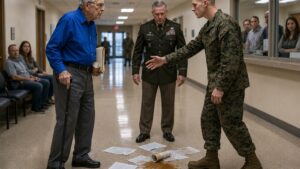
Brian Clark released the brake on Edward Walker’s wheelchair without asking.
“The front aisle is for confirmed honorees,” he said, already turning the chair away from the white-clothed tables. “We need to keep it clear.”
Edward tightened both hands around the green ledger resting against his chest. The movement brought a tremor into his right wrist, but his voice remained level.
“My chair was there.”
Brian glanced toward the place Edward meant. A brass card holder stood at the end of the second table, but the name card had been removed. In its place sat a folded program and a glass of ice water already sweating onto the linen.
“That section is reserved.”
“It was reserved for him,” Christine said.
She held her phone toward Brian, but he was watching a junior protocol assistant hurry past with a stack of menus. Behind them, the ballroom shone with chandeliers and polished wood. Uniformed officers moved between the tables in dark formal coats, their ribbons forming narrow bands of color beneath the lights. A string quartet tuned near the far wall. Every sound seemed controlled except for the scrape of Edward’s rear wheel against the floor.
Brian stopped the chair beside a service station.
“Ma’am, I understand what the email says. The registration list is what controls seating tonight.”
“The email came from your office.”
“And I’m telling you he isn’t on the final list.”
Christine’s thumb moved over the screen. “Edward Walker. Two guests. Medical Corps Heritage Dinner. Submission reviewed.”
Brian leaned close enough to read but not close enough to apologize.
“That confirms receipt. It doesn’t confirm placement.”
Edward looked past him toward the second table. Three men in formal uniforms were taking their seats. One wore the insignia of the medical service. Another had a cane tucked beneath his chair. The fourth place—the place Edward had been given in the diagram attached to his first confirmation—was now occupied by a foundation donor whose name Edward had seen printed in large type near the back of the program.
“The medics are at Table Two,” Edward said.
Brian gave him a quick, professional smile. “Those are invited veterans and current officers.”
“Yes.”
“The public seating is behind the columns.”
“I’m not looking for public seating.”
Brian’s smile thinned. He crouched just enough to make his words private, though several nearby guests could still hear them.
“Mr. Walker, this isn’t an open veterans’ event. It’s a ticketed foundation dinner. We’ve had people come in from the lobby before because they see uniforms and assume—”
“He did not assume anything,” Christine said.
Edward felt her hand settle on his shoulder. She did that when she believed he might tire, or when she believed he might speak too sharply. Tonight he could not tell which.
Brian stood. “I’m trying to avoid embarrassing anyone.”
The ledger’s frayed cloth spine pressed into Edward’s palm. He had wrapped it in a towel for the drive, then removed the towel in the hotel lobby because the book felt dishonest when hidden. Its green cover had faded unevenly, darker beneath the brass corners that had fallen off decades ago. Six paper tabs protruded from the pages.
Edward had cut them himself that morning.
“Ask them about the memorial request,” he said.
Christine looked down at him. “Dad, I already showed him.”
“Not the reservation. The request.”
Brian’s attention shifted to the book for the first time. “What request?”
“The names.”
“What names?”
Edward watched a color guard member cross the ballroom carrying a polished wooden case. Near the podium stood a small memorial bell. Beside it rested a printed list in a black frame.
Six names were not on it.
Christine opened another email. “He submitted an attachment for tonight’s reading. It says the materials were reviewed by the program office.”
Brian took the phone this time. His brow tightened as he scrolled.
“There’s no attachment.”
“There was,” Edward said.
Brian turned the screen toward Christine. Beneath the line reading SUBMISSION REVIEWED was an empty space where the file icon should have been.
“This is exactly why we require records through the portal,” he said. “Without documentation, we can’t add names to a military memorial.”
“They were in the documentation.”
“What unit?”
Edward did not answer.
“What year?”
Still Edward held the book.
Brian exhaled through his nose. “Sir, if you can’t provide basic verification, there’s nothing I can do ten minutes before the program.”
Christine’s grip tightened on Edward’s shoulder. “He can provide it. He’s tired.”
Edward looked up at her. She had begun using that sentence after his second fall in the garage. At the pharmacy. At the bank. Once at church when he had simply decided not to answer a man who called him Eddie.
“I know where I am,” he said.
“I didn’t say you didn’t.”
“You were about to.”
Christine’s hand withdrew.
Brian glanced at his watch. “We have an overflow table with accessible space. I’ll make sure he has water.”
Edward looked again at Table Two. “The empty place beside the medical service officer was assigned to me.”
“It isn’t empty anymore.”
“No,” Edward said. “It isn’t.”
For the first time, Brian seemed to hear the accusation beneath the words. His face changed, but only slightly.
“The seating chart was revised.”
“Who revised it?”
“I did.”
“And my request?”
“I didn’t review memorial submissions.”
“Then find the person who did.”
The quartet stopped tuning. A microphone clicked at the podium, followed by a brief pulse of feedback. Guests began moving toward their places. Brian looked toward the ballroom doors, where a decorated officer had appeared with two aides.
“I cannot hold up the room over an unverified walk-in.”
Edward’s fingers went still on the ledger.
Christine stepped between them. “Don’t call him that.”
Brian lowered his voice. “I’m not trying to be disrespectful. I have two hundred guests, a live program, elderly attendees, security requirements, and a schedule that has already been cut by twelve minutes. I need people where they belong.”
Edward looked toward the green ledger, then toward the place where his name card had been.
“I belong where the names can be heard.”
Brian’s expression hardened with the patience of a man who believed patience itself proved kindness.
“The program is locked.”
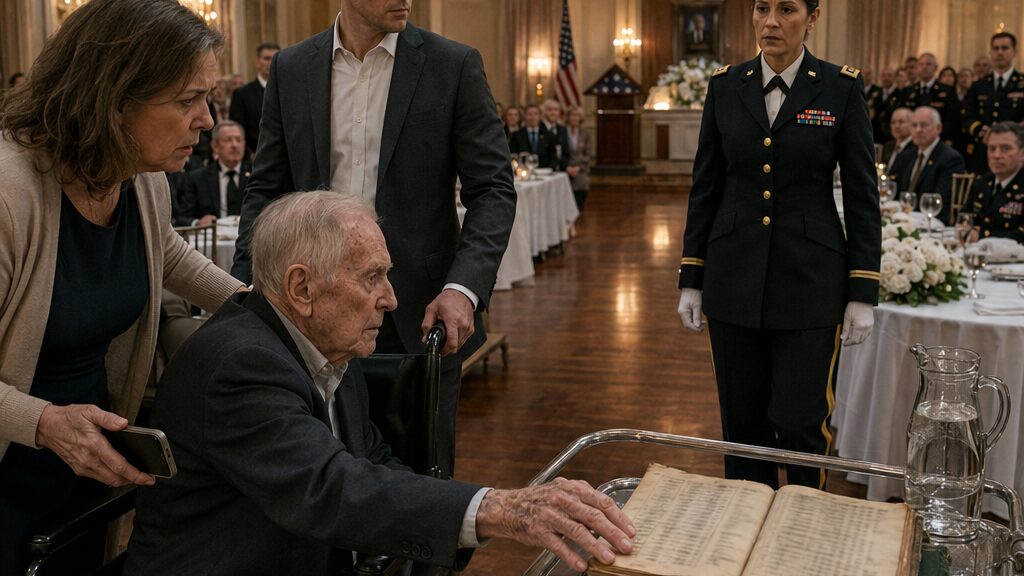
He reached down and lifted the ledger from Edward’s lap.
Edward’s hand followed too slowly.
“Don’t.”
“I’m putting it somewhere safe while we move you.”
“Give it back.”
The tremor spread from Edward’s wrist into his forearm. Brian had already set the book on the service cart beside a silver water pitcher and a stack of folded napkins.
“Please don’t handle that,” Christine said.
“I have it.”
“No,” Edward said. “You don’t.”
Brian released the chair brake again and turned Edward toward the columns.
The ledger shifted behind them.
Its worn cover caught against the base of the water pitcher. The book slid sideways, struck the cart’s raised edge, and opened with a dry crack of paper.
Several pages fanned beneath the chandelier light.
Edward twisted in the chair, but his body no longer obeyed urgency. The six tabs shook in the air. A page lay exposed, ruled in faded pencil with boxes, times, arrows, and abbreviations written in two different hands. Across the lower margin, a sentence appeared again and again beside separate names.
NAME CARRIED FORWARD.
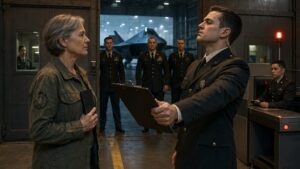
The decorated officer at the ballroom entrance was speaking to an aide when she passed the cart.
She stopped in the middle of a word.
Chapter 2: The General Read the Page Upside Down
Maria Sanchez read the phrase upside down.
NAME CARRIED FORWARD.
The faded block letters were turned away from her, but the structure around them was unmistakable: evacuation times, pulse marks, plasma notation, grid references, priority codes written before the codes had been standardized. One corner contained a small boxed letter used by field medics in records too temporary to survive transport.
Maria’s aide nearly walked into her.
“General?”
Maria lifted one hand without looking away.
Brian was pushing the elderly man toward the columns. The man had twisted in his chair and was reaching toward the service cart, his arm trembling with the effort.
“Who authorized you to move him?” Maria asked.
Brian stopped.
The question carried farther than Maria intended. Conversation thinned across the nearest tables. The quartet remained silent.
“General Sanchez,” Brian said. “There’s been a registration issue.”
“That isn’t what I asked.”
Brian set the brake. “I did.”
Maria moved to the cart. Her white ceremonial glove hovered above the open ledger, then stopped before touching it.
The page smelled faintly of dust and machine oil. Near the top, an old water stain had blurred a date. Six narrow tabs divided the later entries. The exposed sheet listed three treatment stations and a sequence of movements that could not have been copied from any museum display. Whoever had written it had recorded decisions while the decisions were still happening.
Maria turned toward the man in the wheelchair.
His dark suit hung loosely from his shoulders. His face had the fine, collapsed look of great age, but his eyes were fixed on the book, not on her rank or uniform.
“Is this yours?” she asked.
He glanced at Brian, then back at the ledger. “It’s in my keeping.”
Maria removed her right glove one finger at a time. She had learned long ago that gloves made every gesture look official, even when the moment required care instead.
“May I close it?”
The old man’s mouth tightened.
“Please don’t close that page.”
Maria bent closer. “All right.”
Inside the front cover, written in blue ink newer than the rest, was a name and address.
EDWARD WALKER.
She straightened only enough to face him.
“Mr. Walker, may I bring the book to you?”
A faint shift passed through the people watching. Brian’s posture changed as if he had heard a command, though Maria had not raised her voice.
Edward nodded.
Maria slid one hand beneath the ledger and supported the broken spine with the other. The cover was lighter than she expected. She carried it to him as she would have carried an unsecured record from a casualty station: flat, steady, without placing anything on top.
When she laid it across his knees, he set his left palm over the open page. His right hand continued to tremble.
“Thank you,” he said.
Maria looked at Brian. “Why was the book removed from him?”
“To move the chair safely.”
“Did he ask you to?”
“No, General.”
“Then you did not move it safely.”
Brian’s face reddened. “Understood.”
Maria shifted her attention to Edward. “May I ask whether you served in Army medicine?”
Edward looked down at the page.
“I worked where they sent me.”
It was not an answer meant to impress anyone. That, more than the notation, told Maria what she needed to know.
She crouched until her face was level with his. The polished floor pressed hard beneath one knee.
“Mr. Walker, I’m Maria Sanchez. I’m hosting tonight’s program.”
“I know who you are.”
“I’m sorry we did not know who you were.”
Edward’s fingers rested over one of the six tabs. “Knowing me isn’t the problem.”
Maria followed his gaze toward the framed memorial list by the podium.
“What is?”
“The names aren’t there.”
Behind her, an aide murmured that opening remarks were due in four minutes. Maria ignored him.
“Which names?”
Edward lifted one tab, exposing a narrow column. Maria read four enlisted ranks, the designation of a helicopter crew chief, and a sixth entry with no rank at all. Beside the last was only a first name and the word interpreter.
She looked toward the official program in the hands of a nearby guest. The memorial section listed officers, physicians, and decorated evacuation crews. None of the six names appeared.
“Were these submitted?” she asked.
Christine stepped forward, phone in hand. “Twice. The second email says reviewed, but the attachment is gone.”
Brian said, “General, unverified additions to the memorial were excluded during final production. That is standard.”
Maria rose.
“Were you responsible for excluding them?”
“I was responsible for consolidating submissions. The historical office verifies names.”
“Did you forward this one?”
Brian hesitated.
Before he answered, the ballroom doors opened wider. A retired officer entered from the foyer, adjusting the cuff of his dinner jacket. Maria recognized Gregory Allen, the foundation board’s medical history adviser.
Edward’s open ledger shifted as Christine steadied it. A tab fell aside, revealing another line.
JONATHAN ALLEN — DELAY ACCEPTED — NAME CARRIED FORWARD.
Maria felt the shape of the evening change.
Gregory was still several yards away. He had not yet seen the book. She lowered her voice.
“Mr. Walker, what happened to these people?”
Edward looked at the memorial bell.
“That is what I came to ask them to remember.”
“Were they members of your unit?”
“Some.”
“And the others?”
“Necessary.”
The word landed without ornament.
Maria had spent months preparing remarks about service across generations. She had approved a video tribute, reviewed the donor sequence, and insisted that the evening include enlisted medical personnel rather than only surgeons and commanders. Yet the printed program in her hand told a cleaner story than the ledger on Edward’s knees.
She had seen that difference before: the space between what an institution honored and what it could bear to record.
Her aide leaned close. “General, the foundation chair is asking whether we should delay.”
“No delay yet.”
Brian gestured toward the ballroom. “We can seat Mr. Walker at the head table. There’s an open commemorative place beside the podium.”
Edward looked at him. “Will the names be read from there?”
Brian did not answer.
Maria saw the trap in her own first impulse. A better chair. A public introduction. Perhaps a private conversation after dinner. Every gesture respectful, every difficult fact postponed.
She touched the handle of Edward’s wheelchair, then withdrew her hand.
“May I move you to a quieter place while I review this?”
Edward watched her for a long moment.
“You can move me if the book stays open.”
“It will.”
“And if my daughter comes.”
“Of course.”
Maria stood and turned to Brian. “Mr. Clark, no one touches the chair or the ledger without Mr. Walker’s permission. Find the original submission and bring it to the side salon.”
“Yes, General.”
“And restore his place at Table Two.”
Brian glanced toward the donor sitting there.
“That seat has been reassigned.”
“Then correct your revision.”
A few guests looked away, pretending not to have heard. Others stood straighter. One active-duty medical officer near the aisle brought his heels together and raised a brief salute toward Edward.
Edward did not return it. He placed his trembling hand over the exposed names.
Maria understood. The salute recognized him. His attention remained with those who were absent.
Gregory Allen reached the edge of the group.
“What is causing the delay?” he asked.
Then he saw the open page.
The blood drained from his face so quickly that Maria thought he might fall.
His gaze fixed on the line bearing his family name. He did not approach Edward. He did not ask where the ledger had come from.
Instead, he looked directly at Maria and spoke with the authority of someone accustomed to being obeyed inside rooms like this one.
“Close that book before the microphones go live.”
Chapter 3: Six Names Missing From the Program
Maria offered Edward the empty chair beside the podium.
He looked through the open salon doors at the unused microphone and asked, “Will it be turned on?”
No one answered immediately.
The side salon had been arranged for private donors before dinner. Silver coffee urns stood along one wall. Through the doorway, Edward could see the edge of the ballroom stage, the memorial bell, and the black stem of the microphone rising above the lectern.
Maria remained standing beside him. Brian had taken a position near the door with his tablet held against his chest. Gregory stood by the fireplace, far from the ledger.
“The seat would identify you as an honored guest,” Maria said.
“That wasn’t my question.”
“No,” she said. “It wasn’t.”
Christine shifted behind the wheelchair. Edward heard the faint click of her thumbnail against her phone case. She had done it since childhood when trying not to interrupt.
Maria lowered her voice. “I can recognize your service tonight. I can correct the seating and arrange a formal introduction. I can also order a review of the names after the dinner.”
“After the dinner, the bell will already have been rung.”
“The review would be documented.”
“The omission is documented now.”
Edward lifted the first paper tab. The ledger’s binding gave a small complaint.
“Larry Brown,” he said. “Private first class. Field medic.”
He touched the second.
“Jonathan Allen. Specialist. Medical aid station.”
Gregory turned from the fireplace. “Do not present him that way.”
Edward’s finger remained on the tab.
“How should I present him?”
“As a casualty whose record has already been settled.”
“Records settle paper.”
Gregory crossed the room, then stopped beyond arm’s reach. He was broad through the chest despite his age, with a surgeon’s habit of keeping his hands still while speaking.
“My brother’s service is not an unresolved anecdote for this evening.”
Edward looked at him. “I didn’t call it one.”
Maria stepped between their lines of sight without fully blocking either man.
“Mr. Walker, who are the other names?”
Edward opened the third tab.
“Brian Wright. Corporal. Medic.”
Brian Clark’s head came up at the shared first name, then lowered again.
“Jonathan Roberts. Specialist. Medic. Gregory Lewis, crew chief.”
At the sixth tab Edward paused.
The entry contained only MARIA, written in a hand different from his own. No surname. No rank. Beneath it, in pencil: interpreter, water, compresses, stayed.
“She wasn’t enlisted,” Edward said. “She was not on the flight manifest. But the station would have failed without her.”
Maria Sanchez looked at the page bearing her own first name. Something moved in her expression, quickly contained.
“These are the six you submitted?”
“Yes.”
“Why are none of them in the official list?”
Brian cleared his throat. “The program criteria require verifiable service records or approved casualty documentation. The submission arrived as a personal scan without citations.”
Christine turned on him. “You said you didn’t review memorial requests.”
“I didn’t verify them. I consolidated the packet.”
“Meaning?”
Brian’s jaw worked once. “Meaning I removed incomplete entries before sending the packet to the historical office.”
The room became quiet enough for Edward to hear the applause beginning in the ballroom as an announcer welcomed the guests.
Maria looked toward the doorway. Opening remarks had started without her.
“You deleted the attachment,” Christine said.
“I removed it from the review packet. The system retained the submission status.”
“You made the email say it was reviewed.”
“The submission was reviewed for completeness.”
Edward rested both hands on the ledger. “You decided the names were incomplete.”
“I decided the documentation was.”
“You did not ask.”
Brian’s face hardened, then softened again. “Sir, we receive family stories, handwritten lists, photographs without dates, names with no unit information. Some are accurate. Some are not. If we put every unverified claim into a memorial program, we risk dishonoring the people we’re trying to honor.”
It was the first thing he had said that Edward believed Brian himself considered true.
“You could have answered,” Edward said.
“I had three hundred submissions and six weeks.”
“You had my phone number.”
Brian looked down.
Christine moved closer to Edward. “Dad, you never told me there were six names.”
He traced the edge of the interpreter’s tab. “You knew I brought the book.”
“You said you wanted to attend the anniversary.”
“I did.”
“You let me think this was about you seeing the medical corps display.”
Edward looked at the coffee urn reflecting a distorted image of the room.
“It wasn’t about me.”
“That doesn’t mean you get to tell me nothing.”
Her voice did not rise, but it struck harder than Brian’s impatience. Edward had asked her to drive four hours, pack his medication, check the wheelchair ramp, and sit through a formal dinner. He had told her only that it mattered.
He had mistaken her obedience for understanding.
Maria knelt beside him again, not as ceremony now but because the room had become crowded with standing people.
“Why tonight?” she asked.
Edward looked through the salon doors. Two gray-haired women had entered the ballroom together, each escorted by a younger relative. He had recognized them in the foyer from photographs mailed decades earlier.
“Two families are here,” he said. “One for Larry Brown. One for Brian Wright. Both women wrote asking whether anyone remembered the station. One has stopped answering letters. The other told me this is the last anniversary she can travel to.”
Christine’s hand went still on his chair.
“You’ve been writing to them?”
“Some of them.”
“For how long?”
Edward closed the ledger halfway.
“Long enough.”
Gregory stepped forward. “And what exactly do you plan to tell them about Jonathan?”
Edward looked at the tab bearing his name.
“The part that belongs with the others.”
“There is no part that belongs in a ballroom.”
“There is a name missing from the ballroom.”
“My brother’s name is in the official memorial archive.”
“Not for the station.”
“Because the station record was destroyed.”
Edward’s right hand tightened until the tremor became a visible shaking of the page.
Gregory saw it and mistook it for weakness.
“You have an unofficial book, altered over time, with no chain of custody. If you stand at that microphone and imply Jonathan was abandoned, you will reopen an accusation that hurt my family for years.”
Maria turned toward him. “What accusation?”
Gregory kept his eyes on Edward.
“That wounded men were left behind so others with better survival odds could be evacuated.”
Christine looked down at her father.
Edward did not defend himself.
Brian shifted near the door. “General, the first course is being served. We need a decision.”
Maria rose. “Mr. Walker, I can place you at the head table and acknowledge your service. I cannot add disputed names to a live memorial without understanding what is being alleged.”
Edward looked past her at the microphone.
“A chair is not the same as a voice.”
“No,” Maria said quietly. “It isn’t.”
Gregory’s expression tightened. “Ask him what he wrote beside Jonathan’s time.”
Edward opened the ledger again.
Before he could find the page, Gregory spoke the words from memory.
“Delay accepted. Breathing assisted. Two moved before return.”
He had not looked at the book.
He did not need to.
Edward raised his eyes.
Gregory’s hands, so carefully still until then, had begun to shake.
“Tell them the next line,” Edward said.
Gregory stared at the closed space between them.
Then he said, “There was no next line when I saw it.”
Chapter 4: The Man Gregory Said Was Left Behind
“Did you write the time beside my brother’s name before or after you left him?”
Gregory’s question followed Edward into the corridor before the salon door had fully closed.
The dinner had begun without them. Through the ballroom wall came the muted rhythm of silverware and a speaker’s amplified voice praising a century of battlefield medicine. In the corridor, a hotel employee pushed a cart past without looking at the four people gathered beneath a framed photograph of uniformed doctors.
Edward held the ledger flat across his knees.
“After I made the decision,” he said.
“That wasn’t what I asked.”
“It’s the answer.”
Gregory stepped nearer. Maria moved with him, not blocking his path but narrowing it.
“We need privacy,” she said.
“There’s a records office at the end of the hall,” Brian said.
He had followed them from the salon, though no one had invited him. He opened a narrow door with an event key. Inside, filing boxes occupied one wall beside a desk and an unplugged printer. The air smelled of paper and old coffee.
Christine wheeled Edward in only after asking him with her eyes. He nodded.
Gregory remained standing.
“Show me the page.”
Edward opened the ledger to Jonathan Allen’s tab. The paper had become soft at the edges. Near the lower corner, a dark stain had soaked through two sheets and dried almost black.
Gregory looked at it without touching.
The entry began with Jonathan’s name, pulse, breathing rate, and injuries written in compressed lines. Three times appeared in the margin. The first two were clear. Between the second and third was a blank space, narrower than a thumb but large enough to have governed Gregory’s family for fifty years.
Gregory pointed to it.
“That gap wasn’t there when I first saw this.”
Edward’s hand tightened over the spine.
Maria looked from one man to the other. “When did you see the ledger?”
“Twenty-seven years ago,” Gregory said. “At a medical corps reunion. He brought it to a records table, then took it away before anyone could copy the full page.”
“I offered the names,” Edward said.
“You offered a version.”
“I offered what I could prove.”
Gregory gave a short, humorless breath. “And now you want to stand in front of families with a book you admit has changed.”
Christine moved closer to Edward. “Dad?”
Edward studied the altered line. He had imagined this confrontation many times, always with firmer hands and more complete sentences.
“I added the sequence marks later,” he said.
Maria’s face sharpened. “How much later?”
“Four years.”
Gregory turned toward her. “There. That is why this cannot go near a microphone.”
“I did not change who moved,” Edward said. “Or when the aircraft departed.”
“You changed the page.”
“I marked the order.”
“After four years.”
“Yes.”
“Why?”
Edward’s thumb passed once across the darkened corner.
Because the blank had widened each time he opened the book. Because it had become a place where Jonathan breathed alone. Because Edward had begun waking with the certainty that if he did not draw the arrows, he would forget which direction he had run.
“I could not bear the empty space,” he said.
No one answered.
Gregory’s anger did not leave, but it lost its clean edge.
Maria pulled the desk chair forward and sat opposite Edward. “Tell me only what happened at the station.”
Edward looked toward the closed door.
The amplified speech beyond the wall reached a phrase about no soldier ever being left behind.
“There were four litter cases when the helicopter came,” he said. “Space for two.”
Gregory’s jaw tightened.
“One had a chest wound. One was losing blood faster than we could replace it. Jonathan was conscious. His breathing was assisted, but he could hold pressure himself.”
“And you chose the other two,” Maria said.
“I chose the two who would die first.”
Gregory’s voice lowered. “You left him.”
“I delayed him.”
“You left him.”
“Yes.”
The word remained in the small office without defense.
Christine’s hand rose toward her father’s shoulder, then stopped. Edward noticed and was grateful.
“What happened after the helicopter departed?” Maria asked.
“The station took fire. We moved Jonathan and the others into the lower room. The local interpreter kept bringing water and compresses after the supply crates caught. When the second aircraft did not arrive, I went to the ridge to signal.”
Gregory’s eyes stayed on the ledger. “The official report says the station was evacuated by ground convoy.”
“It was.”
“You said you returned.”
“I did.”
“To Jonathan?”
“Yes.”
“There is no record of that.”
“The station log burned.”
“How convenient.”
Edward turned the ledger toward him. “Nothing about it was convenient.”
Gregory flinched, almost imperceptibly.
Edward placed one finger beside the third time in the margin.
“I returned at twenty-one forty. He was awake. Angry that I had taken so long. He asked whether the two had made the flight.”
“Did they?”
“One did.”
Gregory looked away.
Edward continued because stopping now would be another blank.
“Jonathan helped move the others to the trucks. He could not stand alone, but he directed the loading. He knew the station better than the replacement team. He was alive when the convoy left.”
Gregory turned back sharply. “My family was told he died at the station.”
“He died during the convoy.”
“Then why was that never reported?”
“I reported it.”
“To whom?”
“The surgeon receiving casualties.”
“Name?”
Edward shook his head. “I don’t remember.”
Gregory laughed once. “You remember times to the minute but not the officer who received my brother?”
“I remember what I wrote when my hands still worked.”
“That is not proof.”
“No.”
The answer stopped Gregory more effectively than an argument.
Edward did not ask to be believed. That had always been part of the problem. He had spent years refusing to defend what could not be verified, then resenting the versions that replaced his silence.
Maria leaned toward the page. “What is the next line Gregory referred to?”
Edward’s finger moved beneath the sequence of times. The writing there was lighter than the original entries.
RETURNED. PATIENT AWAKE. DELAY ACCEPTED.
Gregory stared at the words.
“You added that too.”
“Yes.”
“From memory?”
“From the back page.”
Edward turned several brittle sheets. Near the binding, faint pencil marks crossed beneath a list of supplies. The words were cramped, some nearly erased.
Gregory bent despite himself.
“Whose handwriting?”
“Mine. Written that night.”
“Then why copy it forward?”
“So the name and the decision stayed together.”
“So you could make the decision look agreed to.”
Edward met his eyes. “No decision like that is agreed to.”
Gregory’s face changed.
For years, perhaps, he had carried a simple image: his brother lying abandoned while someone else decided his life was worth less. Edward had no image clean enough to replace it. Only the sound of rotors, two litters lifted, one man saying go before he changed his mind.
A knock came at the door. Brian opened it a few inches.
“The memorial reading begins in forty minutes.”
Maria nodded for him to leave.
When the door closed, Christine reached to steady the ledger. Her thumb caught beneath a folded section of the back cover.
“What’s this?”
Edward’s breath stopped.
The cloth lining had separated, revealing a narrow pocket. Christine drew out a square of paper folded twice, its edges the same yellow as the ledger pages.
“Dad?”
Edward reached for it, but his hand shook too badly.
Christine unfolded the paper on the desk.
Three lines appeared in pencil. The first was nearly illegible. The second named two wounded men. The third was darker, pressed hard enough to score the sheet beneath it.
Tell Gregory I chose the wait.
Gregory did not move.
Christine looked at Edward.
“Why,” she asked, “did you never give him this?”
Chapter 5: The Promise Edward Never Delivered
“How many families thought you had nothing to tell them?”
Christine’s voice was quiet, but the empty coatroom gave it nowhere to soften.
They had moved there when a banquet employee needed the records office. Coats hung in numbered rows behind them, dark sleeves touching like people standing shoulder to shoulder. From the ballroom came the clink of plates being cleared.
Edward sat with the ledger open across his knees. Jonathan’s note lay on top of it.
Gregory stood near the door, refusing both the chair Maria had offered and the paper Christine had held toward him.
Edward looked at his daughter.
“I wrote to families.”
“That wasn’t my question.”
“No.”
“How many?”
“I don’t know.”
Christine lowered herself onto the bench opposite him. Her anger had not made her loud. It had made her precise.
“You kept addresses. You kept dates. You kept every name you could find. But you don’t know how many people believed you had nothing to say?”
Edward ran his thumb along the ledger’s broken spine.
“Some letters came back.”
“And the others?”
“Some were answered.”
“Did you tell them what happened?”
“What I could.”
Christine gave a small shake of her head. “You mean what you could bear.”
Edward looked up.
She held his gaze, then glanced at Jonathan’s note.
“Was this the only one?”
“No.”
Gregory shifted near the door.
“How many notes?” he asked.
“Three written by the wounded. Two dictated. Some messages were only names.”
“And you delivered those?”
“Most.”
“Most.”
Edward closed his eyes for a moment.
Jonathan had written the note while waiting for transport, using the ledger against his knee. The pencil had torn the paper where he pressed the word chose. Afterward, he had made Edward promise something broader than a message to one brother.
Record the people who kept us here.
Not just soldiers. Not just those whose forms would survive.
Edward opened the hidden fold beneath the back cover. Christine supported the spine without taking the book from him. Inside were thin sheets covered in lists: supply bearers, drivers, enlisted medics, a helicopter crew chief, and the interpreter known only as Maria.
“He asked me to keep them together,” Edward said. “The people at the station. The ones the report would call support.”
Gregory’s mouth tightened. “My brother was dying, and he gave you an archival assignment?”
“He knew records.”
“He was twenty-three.”
“He knew who would disappear.”
Edward’s finger stopped beside the interpreter’s name.
“She translated pain when we could not understand it. She boiled instruments. Held pressure. Found two children to carry water after the pumps failed. No service number. No surname in any report.”
Christine studied the pages. “And that’s why you came tonight.”
“They were reading the station history.”
“You could have told me.”
“Yes.”
The admission seemed to unsettle her more than an excuse would have.
“Why didn’t you?”
Edward looked at the rows of coats. “You would have tried to arrange it.”
“Of course I would.”
“And if they said no, you would have told me before we came.”
“So you used me as transportation.”
“No.”
“What, then?”
He searched for a truthful answer that did not sound kinder than the truth.
“I needed to get through the door.”
Christine sat back.
Edward had not intended cruelty, but intention did not remove it. He had allowed her to pack his medication and worry over his breathing while withholding the only reason the journey mattered.
“I’m sorry,” he said.
She looked down at his hands.
Gregory spoke from the doorway. “The note.”
Christine picked it up. “Take it.”
“No.”
“It was written to you.”
“It was written fifty years ago and kept by him.”
Edward said, “I tried once.”
Gregory’s face remained closed.
“I went to your parents’ house,” Edward continued. “Seven years after.”
Gregory’s eyes narrowed. “I was there.”
“I know.”
The coatroom seemed to shrink.
Edward remembered standing on a porch with the ledger under his arm. Through the screen door came voices from the dining room. Gregory’s mother was telling a relative that Jonathan had died peacefully at the aid station, never conscious enough to know he had been left. Gregory, younger then, had said the official account proved no one had made him wait.
“I heard your family talking,” Edward said.
“And?”
“They had a version they could live with.”
“So you left.”
“Yes.”
“You decided for us.”
“Yes.”
Gregory took one step into the room. “You decided which wounded men flew. You decided when to rewrite the page. Then you decided my family was too fragile for the truth.”
Edward felt each statement find its place.
“Yes.”
Christine’s expression shifted. Until then, some part of her had been waiting for the explanation that would restore her father to the man she believed him to be. Edward watched that hope leave.
It hurt. It also felt cleaner.
“I thought silence was restraint,” he said. “Sometimes it was fear.”
Gregory looked at Jonathan’s note again but kept his hands at his sides.
“And now?” he asked. “Now you bring it into a ballroom full of donors and cameras?”
“I did not bring it for you.”
“That is supposed to help?”
“I brought the six names.”
“You brought my brother’s accusation.”
“It is not an accusation.”
“It says he chose to wait. That clears you.”
“No.”
Edward opened to Jonathan’s treatment entry.
“I chose. He accepted what had already been chosen.”
Gregory’s breath caught, but his voice remained hard.
“You expect me to believe he spared you.”
“I expect nothing.”
“Then why show it?”
“Because his name is being used tonight without the people beside him.”
Gregory moved closer. Christine held out the note again.
This time he looked at the handwriting for several seconds.
Then he stepped back.
“No.”
Maria, who had remained silent near the coatroom counter, said, “Gregory.”
“He wants this read publicly.”
Edward shook his head. “I did not say that.”
“You don’t have to. The note makes you the burdened medic who returned. It makes my brother the brave man who volunteered to suffer. Everyone gets a clean role.”
“There were no clean roles.”
“But there will be after a three-minute speech.”
Gregory’s hand closed around the door handle.
“If that note goes near the microphone, I will challenge its custody in front of the room.”
He left before anyone answered.
Christine watched the door swing shut. Then she turned to Edward.
Normally, she would have told Maria that he was exhausted. She would have asked for water, suggested postponement, translated his silence into a decision that protected him from having to make one.
Instead, she placed the note back on the ledger and asked, “What do you want to do?”
Edward listened to the memorial bell being tested beyond the wall. One clear strike, then silence.
“I want the names read.”
“And the rest?”
“The decision was mine. I’ll say that if I have to.”
Maria stepped forward. “The foundation may not permit an unscheduled statement.”
Edward looked at her.
“Then they can have security remove me after I read them.”
Chapter 6: Three Minutes Before the Memorial Bell
The memorial bell was being placed on the podium when the foundation chair told Maria that changing the script could cost her the archive project.
They stood in the narrow passage behind the stage. Through a gap in the curtain, Maria could see the ballroom tables and the reflection of the chandeliers on raised glasses. An aide had set the approved program on a utility table beside Edward’s green ledger.
Two records of the same evening. Only one contained the people Edward had come to name.
“The donors approved a historical preservation initiative,” the foundation chair said. “Not a public dispute over an undocumented field account.”
Maria kept her voice low. “The submitted material was removed before historical review.”
“By an events contractor responding to incomplete documentation.”
“He did not ask for clarification.”
“That is an administrative issue. Address it tomorrow.”
“The memorial is tonight.”
“And the institution will still exist tomorrow if you do not embarrass it tonight.”
Maria looked through the curtain. Gregory sat at a table near the aisle, his dinner untouched. He had chosen a place from which he could leave without crossing the room.
The foundation chair followed her gaze.
“Recognize Walker privately. Give him a photograph, a letter, whatever is appropriate. Do not hand him a microphone.”
“You have not heard what he intends to say.”
“Neither have you.”
That was true.
Edward had refused Maria’s offer to prepare remarks for him. He had agreed only to answer questions about timing. Three minutes, perhaps less. Six names. No account of medals, rank, or decorations.
But she did not yet know whether Jonathan Allen’s note would appear.
The foundation chair adjusted his cuff.
“The command has supported your archive proposal because it promotes confidence in the medical corps. If tonight becomes a debate over abandoned casualties and altered records, that support will be reconsidered.”
He walked toward the head table before Maria could respond.
Brian stood at the far end of the passage, pale beneath the stage lighting.
“General.”
“What?”
He held out his tablet.
On the screen was Edward’s original submission. The missing attachment icon had been restored from the event system’s deleted files. A scanned ledger page filled the display.
Maria looked at him.
“You told us the attachment was absent.”
“It was absent from the packet.”
“Because?”
Brian swallowed. “Because I removed it.”
The admission did not surprise her. Its timing did.
“Why are you telling me now?”
“Because Mr. Walker said I had his phone number.”
“That was enough?”
“No.”
Brian glanced toward the ballroom.
“Last year I managed a scholarship dinner. A family member was added at the last minute. He spoke for twenty-six minutes, accused the foundation of hiding records, and the stream was cut while he was still at the podium. I lost two contracts. This one was supposed to prove I could control a military program.”
“So you saw a handwritten page and decided it was the same problem.”
“I saw names I couldn’t verify and an elderly man asking for memorial time. I thought I knew how it would go.”
“You labeled him confused.”
Brian’s face tightened.
“The staff needed a reason not to redirect him repeatedly.”
“You gave them the wrong one.”
“Yes.”
He opened the event communication panel. A yellow alert remained attached to Edward’s registration: ELDERLY WALK-IN; POSSIBLE CONFUSION; ESCORT TO OVERFLOW.
Brian deleted it.
Then he typed a correction.
EDWARD WALKER IS A CONFIRMED GUEST. DO NOT MOVE HIS CHAIR OR HANDLE HIS MATERIALS WITHOUT PERMISSION. PRIOR ALERT WAS INCORRECT.
He pressed send.
“I’ve restored the original submission to the official event record,” he said. “It won’t put the names in the printed program.”
“No.”
“But it will show why they were excluded.”
Maria studied him. There was no request for absolution in his face, only the discomfort of a man who had finally stopped calling control a form of care.
“Send copies to the historical office and my aide.”
“Yes, General.”
“And do not issue a statement.”
Brian looked surprised.
“This does not become publicity tonight.”
He nodded.
At the utility table, Edward sat beside Christine. Gregory had joined them but remained standing.
“If the note is read,” Gregory said, “I leave.”
Edward’s hands rested on the closed ledger.
“It won’t be.”
Gregory’s expression shifted. “You expect me to trust that?”
“No.”
“Then what are you going to say?”
“The names.”
“And Jonathan?”
“That he waited.”
“Why?”
“Because I sent the aircraft with two others.”
Gregory looked toward Maria. “That is an accusation against himself designed to sound honorable.”
Edward’s chin lifted a fraction.
“It did not feel honorable.”
Christine placed one hand beneath the ledger’s broken spine. She did not speak for him.
Maria brought the approved memorial program to the table and laid it beside the book. The printed page contained twelve names beneath a gold heading. Edward’s tabs marked six more.
“What do you want from the room?” she asked.
“Attention long enough to write.”
“Not recognition?”
“They recognized the wrong list.”
“Do you intend to read Jonathan’s note?”
“No.”
“Do you intend to accuse the foundation?”
“No.”
“Gregory?”
Edward looked at him. “No.”
Gregory’s shoulders lowered, but only slightly.
Maria opened the ledger to the six tabs.
“What will you say about the altered entry?”
“If asked, the truth.”
“And if you are not asked?”
Edward’s right hand trembled against the page.
“The decision was mine. That belongs with his name.”
A chime sounded in the ballroom. Dinner plates were being cleared. The memorial segment was six minutes away.
The foundation chair appeared at the curtain.
“General, we are proceeding with the approved text.”
Maria picked up the program.
For months she had believed leadership meant making room for truth without allowing truth to damage the room. Now she saw the vanity hidden inside that belief. Sometimes the room was what had prevented the truth from entering.
Gregory looked at the ballroom doors.
“If this becomes a spectacle, I will not sit through it.”
Maria said, “That is your decision.”
His eyes flashed. “You are willing to let an unofficial ledger override verified history?”
“No. I am willing to let a witness identify what the verified history does not contain.”
The memorial bell was carried onto the stage.
Maria opened the podium binder. The approved page waited beneath her introduction, each line timed in the margin.
She removed it.
The foundation chair caught her wrist.
“Think carefully.”
Maria looked down at his hand until he released her.
“I am.”
She placed the page face down beside the ledger.
Then she bent to Edward’s level.
The ballroom announcer was saying her name, inviting her to the podium.
Maria held Edward’s gaze.
“Which names come first?”
Chapter 7: The Names He Chose Before His Own
Edward reached the microphone and left Maria’s prepared introduction untouched.
The sheet lay on the lectern beneath her gloved hand. It contained his name, branch of service, years served, and a line describing him as an honored medical corps veteran. Edward looked at it once, then opened the green ledger over it.
The microphone caught the dry movement of paper.
Across the ballroom, forks rested against plates. Gregory remained seated near the aisle. The foundation chair stood behind the head table with one hand on the back of his chair, as though he had not decided whether to sit or intervene.
Christine stood beside Edward. She supported the ledger’s broken spine with both hands. She did not touch his arm.
Maria adjusted the microphone downward.
Edward looked at the first tab.
“My name is Edward Walker,” he said. “I was asked to speak for three minutes.”
His voice sounded smaller through the speakers than it had in the coatroom. The room seemed to lean toward him to compensate.
“I brought six names. They were submitted for tonight’s memorial and did not reach the people who verify the program.”
Brian stood against the wall. At that sentence, he lowered his eyes but did not leave.
Edward touched the first line.
“Private First Class Larry Brown. Field medic.”
A gray-haired woman at Table Six turned toward him. Her hand rose to her throat, then settled on the tablecloth.
“Larry kept a surgical airway open with equipment that should have failed. He stayed at the station when he could have boarded the first aircraft.”
Edward paused.
“Name carried forward.”
The phrase entered the room without ceremony.
He moved to the second tab.
“Corporal Brian Wright. Field medic. He organized the blood supplies after the refrigeration unit stopped. The labels in the official report call those supplies recovered material. Brian called them by the names of the men they matched.”
At another table, a younger woman gripped the hand of the elderly woman beside her.
“Name carried forward.”
Edward read Jonathan Roberts next, then Gregory Lewis, the helicopter crew chief who had flown through weather that grounded two other crews. For each, he gave only one action. No decoration. No claim that courage had erased fear.
After each name, he said the same words.
“Carried forward.”
The tremor in his hand worsened as he reached Jonathan Allen’s tab.
Gregory shifted in his seat.
Edward could have omitted the disputed details. He could have said Jonathan had served at the field station and died during evacuation. The room would have accepted it. Gregory might have remained silent. Maria’s decision might have looked wise instead of dangerous.
The old discipline rose in him: say only what can be defended; protect the family; do not turn pain into explanation.
That discipline had kept the note hidden for half a century.
“Specialist Jonathan Allen,” Edward said.
Gregory’s face became unreadable.
“Jonathan was wounded while helping move casualties into the aid station. When an aircraft arrived, there were four litter patients and room for two.”
Edward’s finger rested beside the blank interval on the page.
“I made the decision that Jonathan would wait.”
A chair creaked near the rear of the room.
Edward forced himself to continue before anyone could reshape the sentence for him.
“The two I sent had less time. One survived. One did not.”
He heard Christine take a breath beside him.
“Jonathan did not volunteer before I chose. He did not order me to take the others. The decision was mine.”
Gregory looked toward the ballroom doors.
Edward saw the moment when he might leave. Gregory’s palm flattened on the table. His chair moved an inch backward.
Then stopped.
“After the aircraft departed,” Edward said, “Jonathan asked whether the two had made the flight. He accepted the delay after it was already his. He helped move the remaining wounded when the station came under fire. I returned to him before the convoy left.”
The foundation chair leaned toward Maria, but she did not turn.
“No surviving station log confirms my return,” Edward continued. “The entry in this ledger was copied from notes I made that night. I altered the sequence markings four years later because I could not bear the empty space on the page. That alteration was mine too.”
The ballroom had become so quiet that Edward could hear the faint hum of the sound system.
“I am not asking this room to treat an unofficial ledger as a perfect record. I am asking it not to treat an incomplete official record as a complete memory.”
Gregory stood.
Christine’s grip tightened under the ledger.
For one second, Edward believed Gregory had chosen to leave.
Instead, Gregory walked toward the lectern.
He did not look at the audience. He stopped beside Christine and removed the folded note from his jacket pocket. At some point after refusing it in the coatroom, he had taken it.
His fingers rested over the crease.
“I have not read all of it,” he said.
His voice was not amplified, but the microphone caught enough.
Gregory placed Jonathan’s note beside the open ledger.
Then he returned to his table.
Edward looked at the paper without unfolding it. The note did not clear him. It did not restore the official log or explain every missing hour. It proved only that Jonathan had been conscious long enough to write and had understood that someone would have to carry the account home.
Edward moved to the sixth tab.
The entry was shorter than the others.
“Maria,” he said.
General Sanchez lifted her head.
“No surname recorded. Civilian interpreter. She carried water, translated instructions, held compresses, and remained after the roads were cut.”
Edward’s voice caught on the next line.
He tried again.
“We do not know what happened to her after the convoy.”
The words blurred before him. Christine shifted her hands beneath the book, taking more of its weight but none of his.
Edward placed his trembling finger beside the single recorded name.
“She had no service number. She had no uniform. She does not appear in the casualty lists. But wounded men lived long enough to leave that station because she stayed.”
His mouth had gone dry. He looked at the water glass beside the lectern but did not reach for it.
Maria brought it closer and waited until he nodded before placing it in his hand.
Edward drank once.
“Name carried forward,” he said.
The last words were nearly a whisper, but the microphone held them.
No applause followed.
The absence did not feel empty. Pens moved across programs. An active-duty medical officer at Table Two wrote the six names in the margin of the printed memorial list. The two women Edward had recognized in the foyer leaned together over one page.
Maria stepped to the microphone.
“The official program is incomplete,” she said. “The medical corps historical office will open a review of these entries and invite family records, testimony, and corrections.”
The foundation chair stiffened.
Maria continued.
“Tonight, we will add the six names to the memorial reading with the record status stated honestly.”
She reached toward the bell.
“Please stand.”
Chairs began to move.
Edward raised one hand.
“General.”
Maria stopped.
He looked across the rising room, at uniforms, dark suits, medals, donor ribbons, and the printed programs being folded closed.
“Not yet.”
The nearest guests remained half-standing.
Edward turned the ledger toward Maria and pointed to the interpreter’s entry.
“First, write down the name we still don’t know.”
Chapter 8: Respect After the Uniforms Went Home
After the guests left, a foundation assistant brought Edward a donation form already marked permanent transfer.
The ballroom had been stripped of ceremony with surprising speed. Half the tables were bare. Banquet employees stacked chairs beneath chandeliers that had shone over uniforms an hour earlier. The memorial bell remained on the podium, but the microphone had been disconnected.
Edward read the form beneath a small table lamp.
The green ledger rested beside it.
“This allows immediate preservation,” the assistant said. “The foundation can take custody tonight and deliver it to the military archive in the morning.”
Edward looked at the checked box.
PERMANENT TRANSFER OF OWNERSHIP.
“No.”
The assistant glanced at Maria.
Maria had removed her ceremonial gloves. “What terms would you accept, Mr. Walker?”
Edward picked up the pen. His fingers shook too much for the fine point, so Christine slipped a wider pen from her purse and laid it beside his hand.
She did not put it into his fingers.
Edward chose it himself.
He drew one line through permanent transfer. Beneath it, in uneven block letters, he wrote:
SHARED STEWARDSHIP.
The assistant frowned. “That is not one of the standard options.”
“Then it needs another form.”
“The archive cannot preserve an object without clear custody.”
“It can preserve a copy.”
Edward tapped the ledger.
“The families must be allowed to add records. Corrections stay attached to the original entries. Unverified names stay marked unverified. No page is removed because it causes difficulty.”
Maria pulled out a chair and sat across from him.
“And ownership?”
“Mine while I am living. Then Christine’s until the family review is complete.”
Christine looked at him. “You’re asking me now?”
“Yes.”
A trace of tired amusement moved across her face.
“Good.”
The assistant gathered the form but did not leave. “The foundation will want an announcement.”
“No announcement,” Maria said.
The assistant hesitated. “General, tonight’s moment will already be circulating.”
“Then the work should begin before the publicity.”
Brian approached from the empty aisle. He had removed his event badge and carried a printed schedule covered in handwritten changes.
He stopped beside Edward’s chair.
“Mr. Walker, may I move you closer to the lobby? The service crew needs this section.”
Edward looked toward the workers waiting near the folded tables.
“Yes.”
Brian placed one hand near the wheelchair handle but did not touch it until Edward nodded again.
“The two family representatives agreed to verification meetings,” Brian said. “I scheduled separate sessions so no one has to respond in front of the other families. The historical office will attend remotely.”
Edward studied him.
“And the publicity release?”
“Canceled.”
“By the general?”
Brian looked toward Maria. “No. By me.”
There was no pride in the answer.
“I also restored your full submission history,” he said. “Including the date I removed the attachment and the reason I entered.”
Edward closed his hand over the ledger.
Brian waited.
“I’m not asking you to excuse it,” he said.
“No.”
“I know.”
He moved the chair carefully toward the lobby.
Near the ballroom doors, Gregory stood alone with Jonathan’s note. His dinner jacket hung open. The confident board member who had ordered the book closed was gone, but nothing simpler had replaced him.
He approached Edward.
“I still haven’t read the whole note,” he said.
“You don’t have to tonight.”
Gregory looked down at the folded paper. “Part of me wants it to say exactly what my family believed.”
Edward said nothing.
“And part of me wants it to condemn you,” Gregory continued. “That would also be easier.”
“Yes.”
Gregory took a thick envelope from inside his jacket.
“These are copies of Jonathan’s letters. There are references to the station. Names, maybe. My mother kept the originals.”
He held the envelope toward Maria rather than Edward.
“I want the family to retain ownership.”
Maria accepted it with both hands. “That will be part of the agreement.”
Gregory nodded. He looked at Edward but did not offer forgiveness, and Edward did not ask for it.
“I’ll attend the review,” Gregory said.
Then he left through the revolving doors.
The following morning, the archive office had prepared a padded cradle for the ledger.
Edward sat beside the worktable while an archival records clerk adjusted the supports beneath the damaged spine. Christine stood behind him. Maria and Brian remained near the wall, present but no longer directing the room.
The clerk opened the book to the interpreter’s page.
“We can begin imaging here,” she said.
Edward studied the single name.
Maria.
No surname. No official status. No destination after evacuation.
The record remained insufficient.
That no longer meant it had to remain alone.
The clerk placed a blank digital-record worksheet beside the ledger. Its fields waited for unit, service number, family contact, and verification source. Most would remain empty for now.
Brian set a folder on the table.
“Family annotations,” he said. “And a public request for information, with no photographs or claims beyond what the ledger records.”
Edward looked at Maria.
She said, “Nothing will be published until you and the participating families approve the language.”
Respect had looked different the night before. A corrected name. A lowered voice. A general kneeling beside his chair. A man deciding not to leave.
This morning it looked like blank fields left honestly blank.
The archival clerk lowered the transparent cover of the cradle but stopped before closing the outer box.
“Mr. Walker?”
Edward understood the question.
He placed his palm on the green cover. The cloth felt rough beneath his skin, familiar as an old tool handle. For decades he had believed that keeping the book close was the same as keeping the people inside it safe.
Now other hands waited, not to take it, but to help carry what it contained.
Edward closed the ledger himself.
Maria lowered the box lid only after his hand was clear.
Christine touched the blank digital worksheet.
“Whose name goes on the first page?”
Edward looked at the sealed box, then at the line waiting on the screen.
“Not mine,” he said. “The one we still have to find.”
The story has ended.