They Laughed When the Old Armorer Touched the Rifle, Until the Desert Range Went Silent
Chapter 1: The Old Man Heard Something on the Table
Tyler Moore laughed loud enough for the whole line to hear.
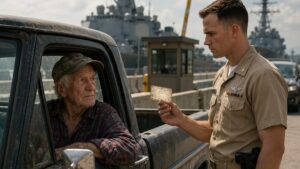
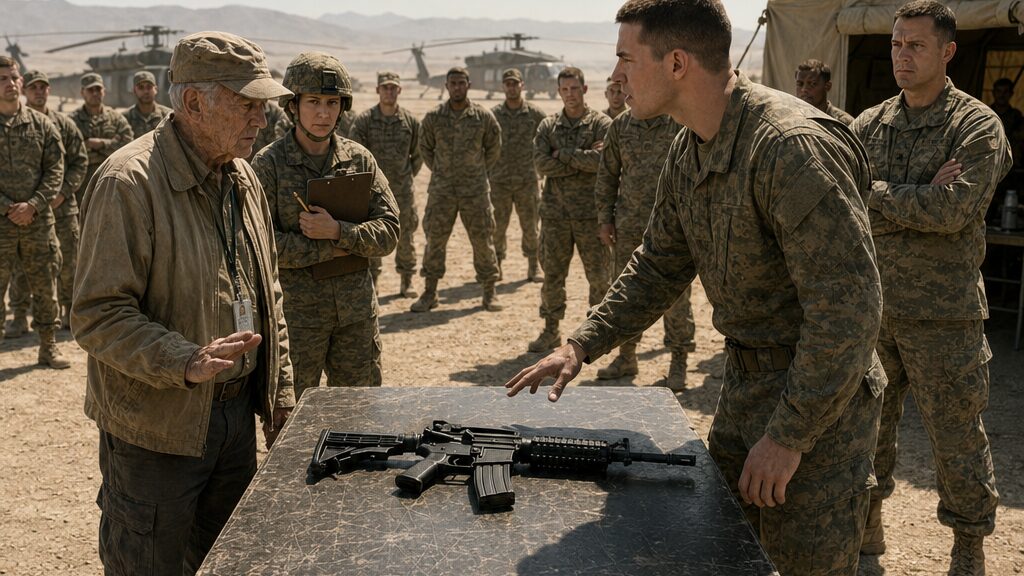
The sound cut across the dusty range, sharper than the helicopter blades ticking down behind the formation. A few soldiers glanced at one another. One looked at the black rifle on the scratched metal table. Another looked at the old man standing beside it in a tan field jacket with a faded ID badge hanging crooked from his neck.
“You’re slowing us down over that?” Tyler said.
Thomas Allen did not answer right away.
He had one hand resting near the table, two fingers loose, palm open. He was small next to Tyler, narrower in the shoulders, slower in the knees. The desert light drew every line in his face. White hair showed at the edge of his cap. Dust had settled in the creases of his jacket as if the range itself had mistaken him for part of the old equipment.
The rifle lay between them.
It had landed on the table a moment earlier with a sound almost no one noticed. Not a clatter. Not a clean metal slap. A thin, uneven note beneath the contact, gone as soon as it arrived.
Thomas had heard it.
Tyler had not.
“Leave it on the table,” Thomas said.
Tyler’s hand stayed near the rifle. “It’s cleared. It’s tagged. It’s on the sheet.”
“Leave it.”
A few soldiers shifted in their formation-like clusters. They were young enough to show impatience before they knew they were showing it. The training lane had been set since dawn: weapons table under a shade net, inspection tent behind it, command vehicle to the right, helicopters sitting farther back in the heat shimmer like dark insects. Everyone had been told the evaluation would move fast.
Thomas knew what fast did to people.
Tyler leaned forward, his forearm nearly touching the rifle. “Sir, with respect, this isn’t how we run the lane anymore.”
The word respect landed wrong. Several soldiers heard it and lowered their eyes.
Thomas looked at Tyler’s hand, then at the rifle, then at Patricia Lewis standing behind the table with her clipboard pressed against her chest. She had been writing until the laugh. Now her pencil hung still above the page.
“Patricia,” Thomas said, “mark this one for hold.”
The pencil did not move.
Brian Carter, the range commander, stood several paces away near the inspection tent, talking with a radio operator. At Thomas’s words, Brian’s head turned.
Tyler gave a short smile, not quite a grin, worse because he tried to make it look professional. “For what reason?”
Thomas reached toward the rifle but stopped before touching it. He was careful with the pause. Careful enough that the soldiers could see he was choosing not to snatch, not to argue, not to turn the table into a show.
“For now,” he said, “because it does not belong in the active line.”
Tyler looked around, inviting the others to hear how thin the answer was. “Because it doesn’t belong?”
A soldier in the second row exhaled through his nose. Another looked away, embarrassed for the old man or for himself. Thomas saw both. He had spent too many years in range lanes not to recognize the sound of a group deciding who was worth listening to.
He placed two fingers lightly on the table beside the rifle.
Tap.
The metal gave back a dry, shallow sound.
Then Thomas lifted the rifle just enough to settle it back down, controlled and level.
Tap.
This time the table answered with the same wrong thread beneath the sound, like a small rattle trapped where no rattle should be.
Tyler’s smile thinned. “That’s your inspection method?”
“No,” Thomas said. “That is the part before inspection.”
A murmur moved through the soldiers. Tyler heard it and stiffened. He was the squad weapons lead. He had been given that position because he worked harder than the rest, stayed later in the arms room, could recite the evaluation sequence under pressure. He was not about to let an elderly contractor make him look careless in front of his people.
“With all due respect,” Tyler said again, louder this time, “we don’t tap rifles on tables and guess anymore. We have checklists.”
Thomas nodded once. “Then use one.”
Tyler blinked.
“But do not use that rifle.”
The silence after that stretched farther than Thomas wanted. The old anger rose in him, not hot but familiar, a pressure behind the ribs. It told him to stop. It told him he had said enough. Men who wanted to listen would listen. Men who did not would make you spend your dignity proving what should have been obvious.
He had believed that once.
Patricia’s pencil touched paper, then stopped again.
Brian walked over before she could write. His boots made quick flat sounds in the dust. He was not angry yet. That was part of his skill. He carried irritation like another piece of equipment, clipped down, secured, ready if needed.
“What’s the issue?” Brian asked.
Tyler answered before Thomas could. “Mr. Allen wants to hold a cleared rifle because he doesn’t like the way it sounds on the table.”
A few soldiers stared straight ahead. One swallowed a smile.
Brian looked at Thomas. “Is that accurate?”
Thomas could have explained more. He could have asked for the log. He could have told Brian about contact sounds, transfer, table memory, the difference between a clean settle and a hidden shift. But the watching soldiers had already become a wall, and Thomas felt his old habit closing his mouth.
He did what he had done for years. He made the smallest true statement.
“It needs to be held.”
Brian waited. “For?”
“Secondary check.”
“Based on?”
Thomas looked down at the rifle. The black surface had a film of range dust where Tyler’s hand had been. A number tag hung near the table edge. The scratched metal beneath it showed years of use: dragged corners, old gouges, half-moon scars from hurried hands.
“Based on the fact that it told me to,” Thomas said.
This time Tyler laughed with disbelief, and the sound was public enough to become permission. Not everyone joined him, but enough faces changed. Enough shoulders loosened. Enough eyes slid from Thomas to Brian, asking whether the interruption would be allowed to continue.
Patricia’s mouth tightened.
Brian looked toward the line, then the helicopters, then the schedule board clipped to a stand near the tent. “Mr. Allen, I respect your experience. But we are on a timed evaluation, and I need actionable grounds.”
“There they are.” Thomas pointed, not at paperwork, not at rank, not at himself, but at the rifle.
Brian’s jaw shifted. “That is not actionable.”
Thomas felt the weight of the badge at his chest. The plastic had yellowed at the edges. Civilian Consultant, Range Safety. His name printed beneath a photograph too old to match his face. On mornings like this, the badge did not feel like access. It felt like a label hung there to remind everyone what he was not anymore.
Tyler reached for the rifle.
Thomas’s open hand rose before he thought about it.
Not grabbing. Not blocking. Just enough.
Tyler stopped, eyes narrowing. “Are you ordering me?”
“No.”
“Then what are you doing?”
Thomas looked at the young soldier’s hand, strong and steady and too confident for the question in front of it.
“I am asking you not to make speed your proof.”
That landed differently. The soldiers did not laugh. Tyler’s face changed, just for a second, because the words sounded less like a complaint and more like a warning meant for him alone.
Brian stepped closer. “The rifle has a cleared tag?”
“Yes,” Tyler said.
“Logged?”
“Yes.”
“On the readiness sheet?”
Tyler’s answer came half a beat late. “Yes.”
Brian turned to Patricia. “Evaluator?”
Patricia glanced at Thomas. Her pencil hovered again. “It is listed.”
“That wasn’t my question.”
She looked down. “Yes. It is on the readiness sheet.”
Brian nodded. “Then the evaluation continues. If Mr. Allen can provide an official discrepancy, we’ll stop and document. Until then, we do not hold the line on instinct.”
Thomas let his hand fall.
Instinct. He had heard that word used by men who thought experience was a feeling, not a record written into the bones.
Tyler picked up the rifle and set it back down with more force than needed.
The table answered.
That same thin wrong note passed under the metal, soft enough to hide beneath pride, clear enough to make Thomas’s fingers curl once at his side.
Patricia heard it this time. Thomas saw her eyes flick down.
Not enough.
Brian pointed toward the lane. “Proceed.”
Tyler lifted the rifle, his face set hard, and carried it toward the staging rack. The watching soldiers parted slightly, then closed behind him. Their silence felt worse than their laughter. Silence could pretend innocence.
Thomas turned toward the readiness table.
His signature sat on the bottom of the morning sheet beside Patricia’s initials and Brian’s approval line. Thomas looked at it for a long moment. The ink was dark, clean, official. The kind of thing people trusted after they stopped trusting the person who had written it.
He took Patricia’s pen from the table.
She looked up sharply. “Mr. Allen?”
He drew one careful line through his own name.
Not through Patricia’s.
Not through Brian’s.
Only his.
Then he placed the pen down beside the black mark and stepped away from the sheet as Brian’s voice cut across the range.
“Tyler, proceed with lane one.”
Thomas did not look at the soldiers.
He looked at the scratched metal table, still holding the echo of a sound no one wanted to hear.
Chapter 2: The Clipboard Mark Nobody Wanted
Patricia Lewis stared at the black line through Thomas Allen’s signature while Brian Carter stood close enough to see whether her pencil moved.
The readiness sheet fluttered once in the dry wind. Thomas’s name was still legible beneath the strike, but the meaning had changed. It no longer looked like an approval. It looked like a warning left in a place where no one could say they had not seen it.
“Evaluator,” Brian said.
Patricia lifted her eyes. “Yes, sir.”
“We’re not turning one crossed-out signature into a range delay.”
“No, sir.”
But her pencil had already made a small mark beside the rifle’s line number. Not a formal hold. Not yet. Just a tight little check mark with a dot beside it, the kind of private notation she had told herself she did not make anymore.
Brian noticed the movement. “Is that an issue?”
“Tracking,” Patricia said.
He held her gaze long enough to let her know he understood the difference between tracking and agreeing. Then he turned toward the range lane, where Tyler Moore was already talking to his squad with too much energy.
Patricia looked after him.
Tyler had the rifle on the side rack now, mixed with other cleared items for the first rotation. He was speaking to three soldiers, one hand moving in clipped shapes as he described sequence and timing. When one of them glanced back toward Thomas, Tyler gave a small shake of his head.
“Contractor nervous,” he said, loud enough for the nearest cluster to hear.
The phrase moved quickly.
Not officially. Not cruelly shouted. Just repeated in half smiles and low voices as soldiers adjusted gloves, checked straps, looked toward the old man standing at the edge of the weapons table. Contractor nervous. It made Thomas smaller without anyone needing to insult him directly.
Patricia felt heat climb up the back of her neck.
She had seen older consultants become obstacles before. Some clung to habits that belonged to ranges long gone. Some hated new systems because the systems no longer needed them. Some wrapped memory around themselves like rank.
But Thomas was not acting offended.
That was what bothered her.
He had not defended his pride. He had removed his name.
Patricia flipped to the inspection page. The rifle’s number sat cleanly in the column: active line, cleared, evaluation batch. Next to it, Tyler’s initials. Above it, armory release. Below it, her own pre-check.
Everything looked right.
That was often the most dangerous kind of wrong.
She moved away from Brian’s sight line and walked toward the shade tent, where folding tables held binders, water jugs, spare tags, and the armory clerk’s temporary station. Dust had already gathered along the binder edges. The range smelled of hot metal, canvas, oil, and sweat.
Thomas stood near the scratched table, hands at his sides, watching the lane without expression.
Patricia stopped beside him. “You heard something?”
“I heard enough.”
“That won’t hold on a report.”
“No.”
She waited for him to add more. He did not.
“Mr. Allen, if I mark that rifle officially, I need a reason that survives review.”
Thomas looked at her clipboard, not her face. “Then don’t mark it officially until you have one.”
“That sounds like you’re asking me to carry doubt without cover.”
His mouth moved slightly, not quite a smile. “That is usually where doubt starts.”
From the lane, Tyler called a command. The first group began a dry sequence under the eyes of the evaluators. No live fire yet. No immediate danger. That fact should have comforted Patricia.
It did not.
She looked at the table. The metal top was scarred in every direction. “What did you do with it?”
Thomas touched the edge with two fingers.
“Set it down,” he said.
“That’s all?”
“That’s enough to tell me I wanted another look.”
Patricia almost asked him how. Instead, she watched his fingers. He did not drum. Did not fidget. They rested lightly, as if remembering weight.
“Do you always check that way?”
“When I have a table honest enough to talk back.”
She glanced at him.
This time, he did smile faintly, but there was no humor in it. “Old habit.”
Patricia wrote nothing. Across the range, Tyler moved too sharply, too aware of being watched. Brian stood with his arms folded near the lane boundary, keeping the evaluation alive by the force of his posture.
A soldier from Tyler’s group returned to the table for another item. He avoided looking at Thomas. Patricia watched him reach to the side rack, pause, then take a different rifle than the one Tyler had carried over. The black rifle remained where Tyler had placed it, third from the end.
“Why is that one there?” Patricia asked.
Thomas followed her gaze. “You tell me.”
“It’s active line.”
“It was on the table.”
“Everything comes through the table.”
“Not everything stays on it after release.”
She looked at her sheet again. The table assignments and side rack positions were supposed to match the lane order. The rifle Thomas had flagged should have been second in sequence if Tyler’s paperwork was right. On the rack, it sat third. That could mean nothing. A simple shift. A soldier setting one item down out of order. A correction made during staging.
Patricia had built a career on not treating small mismatches as nothing.
She walked to the armory clerk’s station and asked for the release log.
The clerk slid a binder toward her without looking up. “Everything’s signed.”
“I know.”
The clerk did look up then.
Patricia opened to the morning batch. The paper had the clean indifference of official things. Line numbers, release times, initials, condition codes. She found the rifle’s number halfway down the page.
Cleared.
Released.
Ready.
Beside the earlier inspection block, she saw a set of initials written in a tight, controlled hand.
T.A.
Her thumb stopped on the page.
The old man’s initials.
For a moment, Patricia heard Tyler’s laugh again, then Thomas’s calm voice asking her to mark the item for hold. She looked across the range. Thomas had moved away from the table and stood alone at the edge of the shade, his badge lifting and falling softly in the wind.
If the log was right, Thomas himself had once cleared the rifle.
If Thomas was right, the rifle did not belong in the active line.
Both things could not mean what everyone wanted them to mean.
Patricia closed the binder halfway, then opened it again and checked the date of the inspection. Not this morning. Earlier. Not old enough to ignore. Not fresh enough to settle the question.
Behind her, Brian’s voice carried from the lane.
“Keep it moving.”
Tyler answered quickly, “Moving.”
Patricia took the pencil and made a second private mark beside the rifle number on her clipboard. This one was darker.
She told herself it was still only tracking.
Then she turned the page just enough to hide Thomas Allen’s initials from the next person who might look over her shoulder.
Chapter 3: The Rifle Passed on Paper
Tyler Moore saw Thomas Allen’s initials in the log and felt relief so sharp it almost made him angry.
T.A.
There it was, written beside the prior inspection block in the armory trailer, neat as a trap. Tyler stood with the binder open under the weak buzz of a hanging light, dust on his sleeves, sweat cooling beneath his collar. Outside, the range kept moving. Soldiers called sequence numbers. Equipment shifted. Helicopter crews worked in the distance. The day had not stopped for the old man’s little performance.
Good.
Tyler pressed his thumb near the initials.
“You cleared it,” he muttered.
The armory clerk looked up from a stack of tags. “What?”
“Nothing.”
But it was not nothing. It meant Thomas Allen had either forgotten his own work or had decided, after the fact, to make a problem out of something already documented. Tyler did not know which version was more irritating.
He had spent six months getting his squad ready for this evaluation. Six months taking the extra lane assignments no one wanted. Six months staying late with checklists, cleaning schedules, equipment flow, timing drills, correction sheets. He knew what the older soldiers said when he walked past: intense, ambitious, stiff. He accepted it. Let them talk. Someone had to care whether the unit looked ready when command watched.
And then an old consultant with a sun-faded badge had touched a table twice and made Tyler look like a careless child.
The trailer door opened behind him.
Brian Carter stepped inside, ducking slightly under the frame. He did not waste time looking around. His eyes went to the binder, then to Tyler.
“You find what you needed?”
Tyler straightened. “The rifle passed prior inspection.”
“I know that.”
“Allen’s initials are on it.”
Brian’s expression did not change, but something in his shoulders eased. “That helps.”
“It should end it.”
“It helps,” Brian repeated.
Tyler closed the binder. “Sir, he crossed out his signature in front of the evaluator.”
“I saw.”
“That makes it look like the lane lead missed something.”
“Did you?”
The question hit harder because Brian asked it quietly.
Tyler looked toward the trailer door. Through the gap, he could see the edge of the range, the shade tent, the scratched metal table. Patricia Lewis stood there with her clipboard angled against her hip. Thomas was not beside her anymore.
“No,” Tyler said.
Brian waited.
Tyler felt the binder cover under his palm. “Everything was staged. Cleared. Tagged. I verified the active batch.”
“All of it?”
“Yes.”
Brian kept watching him.
Tyler hated the pause. He hated that the answer was true in the way answers were true when you left out the part that made them complicated.
Before dawn, the supply lane had jammed. A transport cart had been parked wrong. The hold bin and active rack had sat too close together because someone moved the shade frame during setup. Tyler had seen the delay forming like a stain across the schedule. His squad was supposed to run first. If they missed the slot, they might be pushed to the afternoon, and afternoon winds made everything uglier: dust in eyes, timing off, evaluators tired, command impatient.
So he had helped move the equipment.
Not alone. Not secretly. Nothing dramatic. He had simply told two soldiers to shift the cleared batch to the table while the armory clerk fixed paperwork. He had matched numbers. He was almost sure he had matched numbers. The tags were there. The rack was crowded. People were calling for water, lane flags, sequence cards. He had kept the morning from turning into a mess.
That was leadership.
Wasn’t it?
Brian stepped closer. “I need the chain clean, Tyler.”
“It is clean.”
“If Patricia asks, you verified the active batch from release to table.”
Tyler’s jaw tightened. “I did.”
Brian’s voice lowered. “I’m not asking you to lie. I’m asking whether your confidence survives review.”
Tyler looked at the binder again. T.A. stared back from the page even though the binder was closed. “Yes, sir.”
Brian nodded, but not with satisfaction. More like he had accepted a weight he did not like carrying. “Then keep your people focused. Allen has experience, but experience does not get to disrupt a timed evaluation without documentation.”
Tyler should have felt supported.
Instead, he felt the old man’s two-finger tap somewhere behind his teeth.
When Tyler came out of the trailer, two soldiers near the water cans stopped talking too quickly. One of them glanced toward the shade tent. Tyler knew that look. Something had already spread.
“What?” he said.
The nearer soldier shook his head. “Nothing.”
Tyler stepped closer. “Say it.”
The soldier hesitated. “Evaluator marked something, I think.”
“Marked what?”
“I don’t know. The old man’s rifle thing.”
Tyler looked toward Patricia. She was writing, then turning a page, then writing again. Not official writing, maybe. But enough. Enough to keep the problem alive. Enough to let everyone wonder whether Tyler had pushed past a warning because he didn’t want to be corrected by a man old enough to be ignored.
His face burned.
He walked to the side rack and found the rifle still in place. For a moment he considered taking it out of rotation quietly. That would solve the immediate problem without giving Thomas the satisfaction of being right.
Then he imagined Brian asking why he had removed a cleared item after insisting the chain was clean.
He left it there.
The next hour moved in pieces. Dry handling. Lane reset. Evaluator checks. The rifle stayed out of the live sequence while other timing issues were cleaned up, but not because of Thomas. Tyler told himself that. It was just order. Just rotation. Just Brian keeping the morning smooth.
Still, every time Tyler passed the rack, he saw the black shape waiting.
Patricia’s mark became gossip without becoming fact. A soldier said Thomas had “pulled his name.” Another said he had heard the old man caught something by sound. Someone else said Patricia had written a hold and then erased it. None of it was official. That made it worse. Official accusations had edges. Gossip seeped.
By afternoon, Tyler was tired of the rifle looking at him.
He grabbed it during a non-live handling drill, partly to prove to himself that it was nothing, partly because avoiding it had begun to feel like fear. The soldiers near him went quiet. He hated them for noticing.
“Reset drill,” he said. “No live sequence. Basic handling.”
No one argued.
He carried the rifle to the scratched metal table. The sun had shifted, putting half the table in shade and half in hard white light. The surface was hotter than it looked. Old scars crossed new ones. Dust had gathered along the edges where hands did not usually wipe.
Thomas was nowhere nearby.
Good, Tyler thought.
He set the rifle down.
Tap.
Clean enough.
He adjusted his grip, lifted it, and set it down again, a little closer to the table’s center where Thomas had touched it.
Tap.
Underneath the sound came a thin, dry little rattle.
Not loud.
Not dramatic.
Not enough for anyone else to jump back or gasp or admit anything.
But Tyler heard it.
His fingers stayed on the rifle. The soldiers across from him waited for the next command. One of them looked at his face.
Tyler lifted it again.
He wanted the sound to disappear.
He set it down a third time, gentler now, the way Thomas had.
Tap.
There it was.
A wrong note hiding under the right one.
For several seconds Tyler did not move. The table, the rifle, the dust, the watching soldiers, all of it seemed to pull tight around that small sound.
Then Patricia’s voice came from behind him.
“Sergeant Moore?”
Tyler’s hand closed around the rifle before he turned.
“I heard it too,” she said.
Chapter 4: The Sound Thomas Could Not Forget
Thomas Allen came back to the weapons table after the range had gone quiet and found the rifle missing.
For a moment, he stood still under the shade net, one hand resting on the edge of the scratched metal. The empty space where the black rifle had been seemed brighter than the rest of the table. Dust had gathered in a narrow outline. A careless hand had dragged something across it recently, cutting a clean streak through the grit.
He looked toward the side rack.
Empty.
Toward the inspection tent.
No rifle.
The helicopters sat dark and silent beyond the lane markers. The soldiers had gone to evening chow. The range flags hung loose. In the late light, the whole training area looked abandoned except for the table, the clipboards inside the tent, and Thomas with his old badge turned backward by the wind.
He touched the empty space with two fingers.
Tap.
The table answered clean.
He moved his fingers an inch.
Tap.
Clean again.
Then he pressed where the rifle had rested that morning and tapped twice, slow.
The second sound brought back another range, another table, another day when a small wrong note had entered the air and nobody important had wanted to hear it.
“Mr. Allen.”
Thomas did not turn.
Patricia Lewis stood at the edge of the shade, clipboard hugged against her side. She had removed her helmet. Her hair was pulled tight, and there was a red pressure line across her forehead where the band had been. Her eyes went first to the empty table, then to Thomas.
“It was moved,” she said.
“Yes.”
“Did you move it?”
“No.”
She stepped closer. “Did Sergeant Moore?”
“I didn’t see.”
“That’s not what I asked.”
Thomas looked at her then. There were many kinds of accusation in the Army. Loud ones were the easiest. Patricia’s was quiet, careful, and almost reluctant. That made it harder to dismiss.
“You have the log,” he said.
“I do.”
“Then you have what people will believe.”
Her jaw tightened. “Your initials are in it.”
He nodded once.
“You cleared that rifle before.”
“I cleared a rifle with that number before.”
Patricia looked down at the clipboard as if the distinction irritated her because it mattered. “You understand what that sounds like?”
“It sounds like I signed something.”
“It sounds like you cleared it, forgot, then challenged the soldier using your own inspection as the reason he was wrong.”
Thomas let that sit between them. He had earned some of it. Not the forgetting. Not the carelessness. But the silence that had allowed the space around him to fill with whatever story others preferred.
“You want me to say I remember every mark I made,” he said.
“I want you to tell me why I should keep pushing this.”
Thomas looked past her toward the lane where Tyler had stood that morning. He could still see the young soldier’s shoulders squared against embarrassment, the hand on the rifle, the laugh meant to protect him from looking uncertain.
“Because you heard it,” Thomas said.
Patricia’s fingers tightened around the clipboard.
He had his answer.
She exhaled. “I heard something.”
“That is usually enough to stop and look.”
“It is not enough to accuse.”
“I didn’t accuse.”
“You crossed out your signature.”
“I removed my approval.”
“That is an accusation in ink.”
Thomas looked at the table again. He had not meant to make Patricia carry his refusal. That was the flaw in his old way. He had spent years believing that a clean action spoke for itself. Remove a signature. Mark a hold. Step in front of a mistake. Men with sense would understand. Men without it would not be improved by explanation.
But standing there with Patricia’s eyes on him, he saw what his silence had done. It had not made the truth clearer. It had made everyone else guess.
He took a slow breath and tapped the table once more.
“When metal settles wrong,” he said, “you don’t always know why. Not at first. You just know the story it tells you does not match the paper.”
Patricia waited.
“There are sounds you learn because you checked ten thousand clean ones before the bad one came along.”
“Is that what happened before?” she asked.
The question was too direct. Thomas’s fingers stilled.
The range seemed to shrink around the table. The heat, the dust, the old oil smell, the dead quiet after a training day—all of it closed in. He saw a younger man in another uniform, one he had not allowed himself to picture fully for years. He saw hands moving too fast because a convoy time had changed. He heard himself say, Not yet. Heard someone above him say, We are already late. Heard himself say nothing more.
Patricia’s voice softened, which somehow made it worse. “Mr. Allen?”
Thomas looked at the scratches in the table until they blurred.
“I once let a small warning become somebody else’s decision.”
She did not write.
He appreciated that.
“It was not this rifle,” he said. “Not this place. Not this unit. No mystery there for your report. But I knew something was wrong. I had enough to stop the line for ten minutes. I had enough to make myself unpopular. I had enough to be louder.”
“And you weren’t?”
“No.”
The word came out dry and plain. He had said it to himself in many rooms, but rarely aloud.
Patricia looked toward the empty range. “What happened?”
Thomas shook his head once. “Enough.”
“That isn’t an answer.”
“It is the answer I can give without making a dead man useful.”
Patricia’s face changed. Not pity. He would have ended the conversation if it had been pity. It was something closer to recognition of a boundary, and of the cost of standing near it.
He touched the badge at his chest without meaning to. The lanyard twisted under his fingers. Civilian Consultant. Range Safety. A small plastic rectangle people used to decide how much weight his voice carried.
“I have been wrong before,” he said. “That is why I don’t enjoy being right.”
A truck door closed somewhere beyond the tents. Both of them turned.
Brian Carter walked between the command vehicle and the inspection tent, phone in one hand, schedule folder in the other. He did not come toward them at first. He stopped near the board, pulled down the morning sequence card, and pinned up another.
Patricia saw it before Thomas did. Her shoulders went rigid.
“What is he doing?” Thomas asked.
She crossed the dust fast enough that Thomas had to follow several steps behind.
Brian looked up when she reached him. “Evaluation start is moved to first light.”
Patricia stared at the card. “It was set for midmorning.”
“Command wants the lane clear before wind picks up.”
“Or before the hold question gets formal.”
Brian’s eyes narrowed. “Careful.”
Thomas stopped beside Patricia. His knee ached from the quick walk, but he kept his face still.
Brian looked at him. “Mr. Allen, you’ll have an opportunity to provide documentation before start. If not, the line runs.”
“The rifle has been moved,” Thomas said.
“It’s secured.”
“Where?”
“In the armory trailer.”
“Held?”
“Secured,” Brian repeated.
Patricia flipped open her clipboard. “Did you log the movement?”
Brian’s patience thinned. “Evaluator, this is becoming circular. A consultant objected. We reviewed the log. The item passed. I moved the start time to preserve the evaluation window. That is command responsibility.”
“And if the item was in the wrong batch?” Patricia asked.
“Then bring me proof before first light.”
Thomas looked toward the table.
Something pale showed beneath the far lip of the metal, snagged where the top curled under. He had missed it in the shadow. Patricia saw his gaze and followed it.
She crouched before Brian could ask what they were doing.
Her fingers reached under the table edge and pinched something small free from a burr in the metal. A torn piece of tag, dust-darkened and stiff. Not enough to read fully. Just a broken corner, striped by use, with a partial mark across it.
Patricia stood slowly.
Brian’s expression hardened.
Thomas looked at the fragment in her hand and felt the old warning rise again, no longer a sound but a shape.
Patricia held the broken tag between two fingers.
“This didn’t come from an active-line tag,” she said.
Chapter 5: The Quarantine Tag Under the Dust
Patricia Lewis matched the broken tag fragment before sunrise, and the missing corner lined up so perfectly with the hold-bin record that her stomach dropped before her mind finished the thought.
She stood in the armory trailer under a dim strip light, the clipboard open beside the binder, the fragment laid flat under her thumb. The hold-bin sheet had a torn adhesive strip still attached to one line. It was not dramatic. No confession. No smoking proof. Just paper, dust, and a missing piece that belonged to a place no active rifle should have left.
Outside, engines coughed awake. Soldiers were already moving through the blue-gray dark with water cans and lane markers. Brian’s advanced schedule had turned the range into a place where everyone hurried before they had enough light to see what they were doing.
Patricia pressed the fragment beside the torn strip again.
It fit.
The armory clerk watched from the opposite table, arms folded. “That could be from anything.”
“It came from under the weapons table.”
“A lot of things come off that table.”
“Not hold-bin tags.”
The clerk looked toward the trailer door. “I’m not saying it’s clean. I’m saying don’t put that on me without the full chain.”
Patricia heard the fear beneath the defensiveness. Nobody wanted to become the first official person attached to a failure. Not the clerk. Not Tyler. Not Brian. Not her.
She wrote the time beside her private mark and circled it.
The clerk’s eyes followed the pencil. “Is that formal?”
“It is now.”
The word made the trailer smaller.
A boot hit the step outside. Tyler Moore appeared in the doorway, helmet under one arm, face drawn from too little sleep. He saw Patricia, the binder, the tag fragment, and stopped.
“What is that?” he asked.
Patricia did not move her thumb. “A piece of a hold tag.”
Tyler looked at the clerk. Then at the record. Then back at Patricia. His eyes did not ask what it meant. They asked how much she knew.
“Where’s Mr. Allen?” Patricia asked.
Tyler’s face tightened. “Why are you asking me?”
“Because you handled the active batch yesterday morning.”
“I verified it.”
“From release to table?”
He swallowed once. “Yes.”
Patricia let the silence do work.
Outside, a soldier called for the first sequence markers. Someone laughed, half-awake, unaware that the morning had already cracked open inside the trailer.
Patricia slid the binder toward Tyler. “Show me.”
He stared at the page.
“Show me the movement from hold bin to active table,” she said. “Not the inspection. Not the prior clearance. The movement.”
Tyler’s jaw set. “I didn’t move anything from the hold bin.”
“I didn’t say you did.”
“You implied it.”
“I asked you to show the chain.”
The clerk shifted. “There was a cart jam before dawn yesterday.”
Tyler shot him a look.
Patricia turned to the clerk. “Say that again.”
The clerk lifted both hands slightly. “I’m just saying the racks got crowded. The shade frame was moved. Hold bin ended up closer to the active side than usual. We were sorting it.”
“We?” Patricia asked.
The clerk looked at Tyler.
Tyler’s voice went low. “I helped move cleared equipment to keep the lane on time.”
Patricia’s pencil stopped over the page.
There it was. Not a confession of sabotage. Not stupidity. Not malice. Something more common and more dangerous: a good soldier trying to keep a schedule from falling apart.
“Did you verify every tag?” she asked.
“Yes.”
The answer came too fast.
Tyler heard it too. His eyes dropped.
“I thought I did,” he said.
Patricia closed the binder halfway. “Thought is not a chain.”
The words sounded harsher than she intended. Tyler flinched as if she had said them in front of his squad.
Then Brian Carter entered the trailer and took in all of them in one glance.
“No,” he said.
No one had asked a question.
Patricia picked up the fragment. “This matches the hold-bin record.”
“It matches part of a tag.”
“It was caught under the table where the rifle sat.”
“Part of a tag,” Brian repeated. “Not an item. Not a full number. Not a completed discrepancy.”
“Sir—”
Brian stepped close enough that the clerk looked away. “Do you understand what happens if we stop the evaluation on a torn corner and a sound?”
Patricia did. That was the problem. Reports. Delay. Command review. Questions about chain control, safety oversight, readiness pressure. People would protect themselves in the order they had learned to protect themselves. The fragment would become ambiguous. Thomas would become difficult. Tyler would become careless. Brian would become the man who let a consultant derail the range.
Brian turned to Tyler. “Did you knowingly move a held item into active use?”
“No, sir.”
“Did you verify the batch?”
Tyler looked at Patricia before answering. “I verified the cleared items I believed were in the batch.”
Brian’s eyes sharpened. “That is not the same answer you gave me yesterday.”
“No, sir.”
The trailer went silent except for the hum of the light.
Patricia saw Tyler’s hands. They were still, but the knuckles had whitened around his helmet. Pride was still there. Fear too. The fear mattered because it meant he understood what the morning could become.
Brian lowered his voice. “Sergeant Moore, if we stop now, your squad loses the slot. The unit takes a readiness hit. The chain gets reviewed. Your name will be in it. Mine too. So before everyone starts acting noble, understand the cost.”
Tyler’s face closed.
There it was again: schedule becoming proof, consequence becoming pressure, fear dressing itself as discipline.
Patricia looked toward the open door. Thomas stood outside in the first gray light, not close enough to intrude, close enough to hear the tone. His tan jacket looked almost colorless before sunrise. His badge hung still. He was watching the range line, not the people arguing about him.
“What does Mr. Allen say?” Patricia asked.
Brian’s answer came clipped. “Mr. Allen is not in command.”
“No. But he was right enough to make us find this.”
Brian looked at her then as if she had stepped across a line he had thought she would respect. “Evaluator, you are here to evaluate. Not advocate.”
“I’m here to document whether the line is safe to run.”
“And is it unsafe?”
Patricia looked down at the torn tag fragment. It proved less than she wanted and more than Brian wanted. That was the worst kind of evidence.
“It is unresolved,” she said.
Brian let out a controlled breath. “Then resolve it quickly.”
Tyler’s voice cut in, quieter than before. “I can pull that rifle.”
Brian turned. “And say what?”
“That we’re rotating another item.”
“After the consultant objected? After the evaluator marked it? You think no one asks why?”
Tyler had no answer.
Patricia saw the last door closing in him. If he admitted the rushed move, his squad’s evaluation could out a controlled breath. “Then resolve it quickly.”
Tyler’s voice cut in, quieter than before. “I can pull that rifle.”
Brian turned. “And say what?”
“That we’re rotating another item.”
“After the consultant objected? After the evaluator marked it? You think no one asks why?”
Tyler had no answer.
Patricia saw the last door closing in him. If he admitted be damaged. If he denied it, the rifle stayed a ghost in the middle of the line. He looked young suddenly, not weak, just young enough to believe one mistake could erase all the work that came before it.
Brian pointed toward the door. “We start in twelve minutes. Unless there is a documented full-number match to that hold tag, the line runs.”
He left with the schedule folder under his arm.
The clerk looked relieved and ashamed at the same time. Tyler stood frozen.
Patricia gathered the fragment and the binder sheet. She walked to the door.
Thomas was no longer outside the trailer.
At first she thought he had gone back to the table. Then she saw him farther downrange, moving with that slow, steady gait toward the active line where soldiers were forming around the weapons table and Brian was raising his hand to begin the morning brief.
“Mr. Allen,” Patricia called.
He did not stop.
He walked past the lane marker and into the open space before the table, placing himself between the waiting soldiers and the rifle rack before Brian could give the first command.
Chapter 6: He Refused to Sign the Morning Line
Brian Carter announced the evaluation start with his hand still raised, but Thomas Allen was already standing in front of the weapons table and shaking his head.
The gesture was small.
It stopped the range anyway.
Soldiers who had been tightening gloves and checking sequence cards went still. Tyler stood near the front of his squad with his helmet under one arm, the color gone flat in his face. Patricia came up from the armory lane carrying a binder and the torn tag fragment. Behind them, the helicopters waited in the pale morning light, quiet witnesses to a silence no one had scheduled.
Brian lowered his hand. “Mr. Allen.”
Thomas looked at him. “Do not open this line.”
The words were not loud. They carried because nothing else moved.
Brian stepped toward him, anger controlled but visible now. “You were told to bring documentation before start.”
“I brought myself.”
“That is not documentation.”
“No,” Thomas said. “It is responsibility.”
A few soldiers looked at one another. Tyler’s eyes stayed on the table.
Brian closed the distance between them. “If you obstruct this evaluation, I will remove you from the range.”
Thomas nodded once. “That may be necessary.”
The answer unsettled Brian more than resistance would have. Patricia saw it from the side: the smallest pause, the recalculation. Thomas was not bluffing for authority. He was offering to pay what his refusal cost.
Brian turned to Patricia. “Evaluator, do we have a full discrepancy?”
Patricia held up the fragment. “We have a hold-tag match to the record, a broken piece recovered from under the active table, an unsigned readiness line, and an unresolved chain movement.”
“Full discrepancy,” Brian repeated.
“Not yet.”
“Then the line is not officially stopped.”
Thomas reached for the readiness sheet clipped to the table. Brian’s hand moved as if to stop him, but Thomas did not take it. He only turned it so the crossed-out signature faced the formation.
“My name is not on this line.”
Brian’s voice sharpened. “Your name is not required to start.”
“No. But hers is.” Thomas looked at Patricia. “And yours is.”
Patricia felt the whole formation turn toward her without moving.
Brian said, “Do not put this on her.”
“I’m not,” Thomas said. “I put mine down yesterday and removed it when the line stopped being clear. Everyone else must decide what their name means.”
The words struck harder than accusation. Tyler looked away.
Brian’s jaw worked once. “This is exactly the problem. You give fragments. Hints. Old habits. Now you’re making it a moral test in front of my soldiers.”
Thomas’s eyes moved to the soldiers behind him. Young faces, tired faces, proud faces, bored faces now waking to danger. He saw himself in some of them. He saw men who would trust the loudest voice because it was easier than carrying doubt.
“You are right,” Thomas said.
Brian blinked.
Thomas looked down at the scratched table. “I give fragments. I expect people to understand what took me forty years to learn because I am tired of explaining it to people who laugh first.”
No one spoke.
The admission opened something in the air. Thomas felt it under his ribs, the old place he kept sealed because if he opened it fully, the past would walk out and stand beside him.
He put two fingers on the table.
“When Sergeant Moore set the rifle here yesterday, it did not settle clean.”
Tyler’s head lifted.
Thomas tapped the table.
Clean.
He picked up a cleared training item from the rack and set it down gently.
Tap.
Clean again, solid and ordinary.
Then he looked at Tyler. “Bring the rifle.”
Brian said, “No.”
Tyler did not move.
Thomas waited.
Patricia spoke quietly. “Sergeant Moore.”
Tyler swallowed, then turned to the side rack. He lifted the black rifle with both hands and brought it to the table. The walk was only several steps, but it changed him. The confidence he had worn the day before did not return. Neither did defiance. He carried the rifle like a question he had delayed answering.
He set it down.
Tap.
The wrong note hid beneath the first sound.
Several soldiers heard it this time. Thomas saw it pass through the line: not understanding, not yet, but recognition that there was something to hear.
Thomas lifted the rifle and set it down again, slower.
Tap.
A dry, faint rattle threaded through the metal.
Thomas did not point triumphantly. He did not look at Tyler to see shame land. He kept his fingers near the table and spoke to the formation.
“That sound does not tell you the whole problem. It tells you there is one.”
Brian folded his arms. “And what is the problem?”
“The problem is that this rifle is telling a different story than the paperwork. That means the next step is not to trust the rifle or the paper. The next step is to stop and rebuild the chain.”
Patricia opened the binder. “The hold tag fragment aligns with a hold-bin record.”
Brian’s face hardened, but he did not interrupt.
Thomas continued. “The prior inspection with my initials shows condition at that time. It does not prove proper placement today. A cleared record can become a bad assumption if the item moves wrong after it.”
Tyler’s shoulders sank slightly.
Brian looked at him. “Sergeant Moore.”
The formation tightened.
Tyler’s mouth opened, then closed.
Thomas saw the young man’s fight. Pride was not always arrogance. Sometimes it was the last shield a person had before shame got in. He could have let Tyler stand there and bleed in front of his squad. Yesterday, part of Thomas might have wanted that. Not revenge exactly. Correction. A clean return of public pain.
That was the old bitterness talking.
Thomas turned slightly, enough to draw the formation’s eyes back to him instead of Tyler.
“Schedule pressure makes careful people skip quiet steps,” he said. “I know because I have done it.”
Brian’s expression changed.
Thomas had not planned to say that much. The words had come because the line in front of him looked too much like another one. Men waiting. Time pushing. A small sign dismissed because nobody wanted to be the person who stopped the day.
He looked at Tyler. “Did you move equipment yesterday morning?”
Tyler stared at the table.
“Yes.”
The word was quiet, but it reached everyone.
Brian’s face tightened. “Sergeant—”
“I moved cleared items from the crowded rack to keep the lane on time,” Tyler said, faster now, afraid he would lose the nerve. “The hold bin was too close. The cart was blocking the lane. I checked tags. I thought I checked all of them.”
Patricia wrote, but not quickly. She gave the admission room to exist before the report swallowed it.
Tyler looked toward his squad, then forced his eyes back to Thomas. “I heard it yesterday afternoon.”
A soldier in the front row shifted.
“The sound,” Tyler said. “I heard it. I didn’t report it.”
The last sentence cost him. Thomas saw it in the way his chin tightened and his hand opened at his side.
Brian took one step back. Not retreat. Adjustment. The line he had been holding had moved beneath him.
Patricia said, “That makes the chain unresolved.”
Brian looked at the soldiers, the table, the binder, the old man. For a moment he seemed ready to keep fighting the word. Then the radio operator at the command vehicle called that the unit commander was asking for status.
Brian did not answer immediately.
Thomas placed the rifle back on the table, carefully.
Tap.
This time nobody smiled.
“When I was younger,” Thomas said, “I believed being right was enough if I put the evidence in front of people. Then I believed silence was dignity. Both can become laziness if someone gets hurt while you protect yourself.”
His voice stayed even. That was the only way he could say it.
“Years ago, I heard a warning sign. I let a higher voice overrule it. I told myself the chain had spoken. A man paid for that. Not because one person was evil. Because several of us were in a hurry and nobody wanted to be difficult.”
The formation held its breath.
Thomas looked at Brian. “I will not sign a line that teaches these soldiers to ignore a small wrong thing because the schedule is loud.”
The radio operator called again. Brian turned his head just enough to show he had heard, then faced Patricia.
“Document a safety pause,” he said.
Patricia’s pencil moved.
The sound of it was small, but to Thomas it was cleaner than the table had been all morning.
Brian looked at Tyler. “Pull the batch. Rebuild the chain from hold bin to active rack. Full verification.”
“Yes, sir,” Tyler said.
His voice was rough.
“And Sergeant Moore,” Brian added, “you will remain available for review.”
“Yes, sir.”
The words struck, but Tyler accepted them.
Soldiers began to move, slower now, more deliberate. The old rhythm of the morning broke apart and reformed into something less efficient and more honest. Patricia marked the pause. The armory clerk was called forward. The supply sergeant came running from the trailer with keys and a face already preparing explanations.
Thomas stepped back from the table.
His knee trembled once. He hid it by shifting his weight. He had stopped the line. He had said more than he meant to. The cost would arrive later, in offices, in reports, in polite phrases about contract review and range disruption. For now, the only thing in front of him was the table, the rifle, and a young soldier who would have to live with the morning without being crushed by it.
Tyler remained beside the table after the others moved.
He did not look at his squad. He looked at the black rifle.
“I thought you were trying to embarrass me,” he said.
Thomas looked at him. “I know.”
Tyler’s face worked as if the next words had no proper military shape. “I was embarrassed before you touched it.”
Thomas waited.
“I couldn’t afford to look unsure,” Tyler said.
“Most dangerous sentence on a range.”
Tyler gave a short breath that was almost a laugh and not close to one. He looked at the scratched metal table, then at Thomas’s two fingers resting near its edge.
“What did I miss?” he asked.
Thomas did not answer quickly. The whole formation, though moving now, seemed to hear the silence around the question.
Tyler lifted his eyes.
This time, he did not ask to be spared.
“Show me what I missed.”
Chapter 7: The Young Soldier Tapped the Table First
The soldiers went silent when Tyler Moore tapped the rifle on the scratched metal table.
One week earlier, that sound had made him tighten his grip and look for someone else to blame. Now he stood at the head of the revised inspection formation, with Patricia Lewis beside him holding a fresh evaluation packet and Brian Carter watching from near the command vehicle. The helicopters were parked in the same distant row. The same shade net sagged over the table. The same dust worked its way into every seam and folded sleeve.
But nobody laughed.
Tyler lifted the cleared training rifle, set it down again, and waited.
Tap.
Clean.
He did not rush the next step. He did not turn to see whether Thomas Allen approved. He let the silence do what he had once been afraid it would do: reveal whether he actually knew what he was doing.
“Again,” Thomas said.
Tyler did it again.
Tap.
Clean.
Thomas stood at the edge of the shade, not at the center. His tan field jacket looked no newer. His badge still hung from the same worn lanyard. The line across his old signature had not been erased from the copied report Patricia had filed. Nothing about him had been polished for the morning. That seemed to matter more than if someone had tried.
Tyler looked at the front row. “You do not tap because sound is magic. You tap because a quiet irregularity is a reason to stop pretending the paperwork has answered everything.”
A soldier near the middle shifted, perhaps surprised by the phrasing. Tyler heard how close it sounded to Thomas. He did not apologize for that.
He pointed to the table. “One clean contact does not clear an item. One odd contact does not convict it. It tells you to slow down and rebuild the chain.”
Patricia wrote without looking up.
The revised procedure had not come easily. The investigation had found three items temporarily displaced during the rushed rack move. Only one had carried enough uncertainty to require full hold review. No one had called it a disaster. That was part of what unsettled Tyler most. The whole thing had been small enough to explain away until it wasn’t. A crowded rack. A blocked cart. A tag corner. A wrong sound. A young soldier too proud to say he was not sure.
Brian had kept his command, but his voice had changed in the meetings afterward. Less clipped. More exact. He had accepted the safety pause in the final report, though not without hard conversations behind closed doors. Tyler had been formally counseled. Patricia had documented the chain failure without turning him into the only cause. Thomas had been asked to stay through the next training cycle.
Asked, not ordered.
That morning, Brian walked toward the table with a folder under his arm. The soldiers straightened by habit.
“Continue,” he said to Tyler.
Tyler nodded and gestured to the next soldier. “You.”
The soldier stepped up, younger than Tyler, nervous in the way soldiers became nervous when the lesson had a story attached to it. He picked up the rifle too fast and set it down too hard.
Tap.
The sound was clean, but the soldier winced anyway.
Tyler almost snapped at him.
He felt the old impulse rise: correct sharply before anyone thought he was soft, tighten the lane before uncertainty spread. Then he saw Thomas watching him, not warning, not judging, just waiting to see what he would choose when speed offered itself as shelter.
Tyler lowered his voice. “Do it again. Not harder. Slower.”
The soldier adjusted his grip.
“Don’t perform the step,” Tyler said. “Listen to it.”
This time the soldier settled the rifle carefully.
Tap.
Clean.
A few soldiers in the back row leaned forward, not because it was exciting, but because the quiet demanded attention. Tyler understood then that Thomas had not been trying to make the table special. He had been trying to make the room stop pretending listening was weakness.
Brian came beside Thomas while the next soldier stepped forward.
“I have language for your file,” Brian said.
Thomas kept his eyes on the table. “That sounds dangerous.”
Brian gave a dry breath through his nose. Not quite humor, but nearer to it than he had been a week earlier. “Formal commendation line. Civilian safety intervention, procedural refinement, preservation of readiness standards. Clean enough for people who need clean language.”
Thomas’s gaze moved from the table to the folder. “No.”
Brian’s eyebrows rose. “No?”
“No commendation line.”
“Mr. Allen, I’m trying to put the correction where it belongs.”
“Then put it in the procedure.”
“It is.”
“Then we’re done.”
Brian looked at him for a long second. “You understand people may read the report and never know what you did.”
Thomas watched Tyler guiding another soldier through the check. “If they do it right, that is knowing enough.”
Patricia heard that. Her pencil paused, then moved again.
Brian closed the folder halfway. “You don’t make it easy to thank you.”
“I have been told.”
“I was wrong to push the line.”
Thomas did not answer immediately.
Brian seemed prepared for silence, but not for the kind Thomas gave him. It was not punishment. It was inspection. The same way he had listened to the table, he seemed to be listening to whether Brian’s words settled clean.
Finally Thomas said, “You were trying to protect readiness.”
“I used that word to protect schedule.”
“Yes.”
Brian accepted the correction with a nod that cost him something. “It won’t happen that way again on my range.”
Thomas looked at the table. “Make sure it doesn’t happen that way when I’m not standing here.”
That landed harder than Brian expected. His face shifted, not dramatically, but enough to show he understood the difference between honoring a man and depending on him.
Across the table, Tyler called the next soldier forward. This one was confident, almost casual. He tapped the rifle once, heard a clean sound, and reached for the checklist.
Tyler stopped him with two fingers raised.
The soldier froze.
“What did you hear?” Tyler asked.
“Clean contact.”
“What else?”
The soldier frowned. “Nothing.”
“Nothing is not an answer. It’s a guess wearing a uniform.”
A few soldiers looked down, hiding smiles, but not cruel ones.
Tyler caught himself. The line had come out sharper than intended. He glanced at Thomas, who gave no rescue. Fair enough.
Tyler softened his tone. “Say what you can confirm.”
The soldier looked at the rifle, then the table. “I heard a clean contact. No secondary rattle. No shift after set-down.”
“Good. Now match that to tag, rack, and log. Sound does not replace the chain. It tells you when to respect it.”
The soldier nodded and began again.
Thomas felt something in his chest loosen, not with pride exactly. Pride still made him wary. Pride had teeth. This was quieter. A small proof that the lesson had left his hands and survived first contact with another man’s voice.
Patricia stepped beside him. “The report credits the procedure change.”
“Good.”
“It also notes your objection.”
Thomas glanced at her.
“Not as a spectacle,” she said. “As sequence. Warning. Hold request. Signature withdrawal. Safety pause.”
He looked back toward Tyler. “That is fair.”
“I left out the part where everyone stared.”
“Best part to leave out.”
Patricia closed the packet. “You know he asked to lead this block.”
Thomas did know. Tyler had not said it to him directly. He had arrived early, set the table himself, arranged the rack with more care than anyone required, and asked Patricia whether Thomas would be watching. That was the apology before the apology. Thomas had accepted it by not making him repeat it.
“He should lead it,” Thomas said.
“He still thinks you hate him.”
Thomas gave her a sideways look. “He’ll survive being wrong twice.”
Patricia smiled faintly, then let it go.
The morning moved with a different rhythm. Slower, but not weak. The soldiers checked the table contact, the tag, the rack position, the log. They spoke what they confirmed and what they did not. Twice, Tyler stopped the line because a soldier guessed. Once, Brian did not interfere when the pause stretched longer than comfortable.
At the end, Tyler carried the final rifle back to the table and set it down.
Tap.
Clean.
He turned to the formation. “This is not the old way replacing the new way. This is the old mistake reminding the new system to stay awake.”
Thomas looked at the dust by his boots.
He had not taught Tyler that sentence. That mattered too.
When the formation broke, soldiers did not gather around Thomas. No one applauded. No one asked for a story from his service years. A few nodded as they passed. One young soldier paused near the table, touched the edge with two fingers, and listened to the small sound his own glove made against the metal before moving on.
Tyler remained.
He stood on the opposite side of the table from Thomas, the same place where he had laughed a week earlier. The memory crossed his face before he spoke.
“I wanted everybody to forget that morning,” Tyler said.
Thomas waited.
“Now I think they shouldn’t.”
“No,” Thomas said. “They shouldn’t.”
Tyler nodded, accepting the weight of it. “I don’t know how to carry it without making it about me.”
“You teach the step.”
“That’s it?”
“You teach the step. You tell the truth when it costs less than hiding it. Later, when it costs more, you’ll have practice.”
Tyler looked down at the table. “You make it sound simple.”
“No. I make it short.”
For the first time, Tyler smiled without defending himself.
Brian called for Tyler from the command vehicle. Patricia was already walking the packet over. The morning was moving again, but not running over itself. Tyler picked up the rifle, checked the tag, and turned toward a younger soldier who had been lingering near the back.
“Come here,” Tyler said.
The soldier hurried over.
Tyler set the rifle down between them. “Before you touch the checklist, listen.”
Thomas stepped back from the shade.
His knee caught slightly. He steadied himself with one hand on the table edge, and Tyler noticed. For a second, the young soldier started to move toward him. Thomas saw it and almost waved him off out of habit.
Then he stopped himself.
Tyler’s hand hovered, not grabbing, only ready.
Thomas gave him a small nod that allowed help without making ceremony of it.
The moment passed. Tyler turned back to the younger soldier.
“Slow,” he said. “Let the table answer before you do.”
Thomas walked toward the edge of the range, his badge quiet against his jacket. Behind him came the sound of the rifle meeting metal.
Tap.
A pause.
Then Tyler’s voice, steady and patient.
“Now tell me what you heard.”
The story has ended.