The Old Man at Aisle Eight Placed His Card Down Twice and Said Nothing
Chapter 1: The Card Under the Aisle Eight Sign
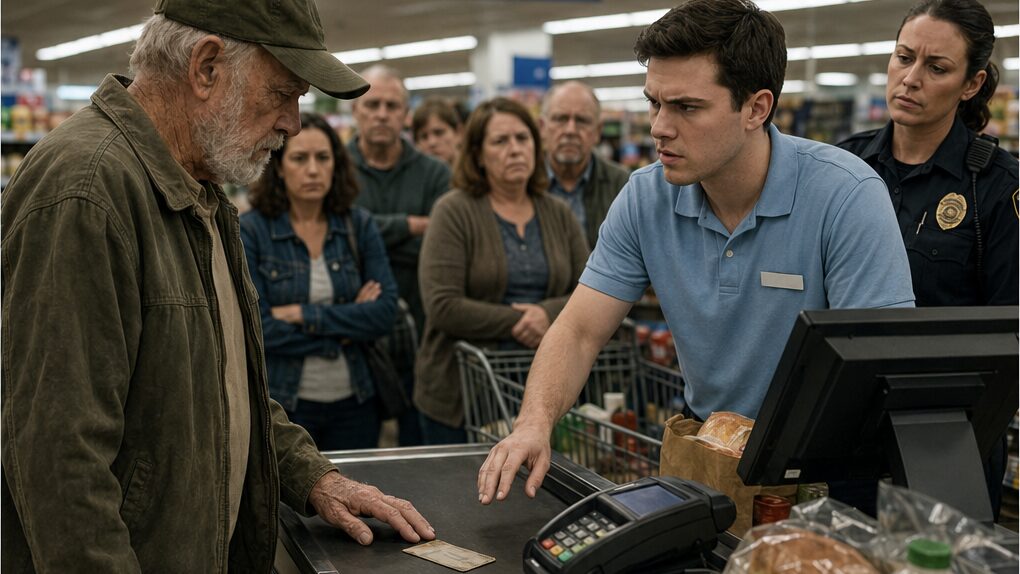
The card reader beeped red before Ronald Walker had even moved his hand away.
It was a thin little sound, hardly louder than the hum of the freezer cases behind him, but it changed the air around the checkout lane. The young cashier looked down at the screen, then at the worn card lying beside the reader, then at Ronald’s face as if the problem must be there.
Ronald kept his palm flat on the counter.
Above them, the blue sign for AISLE 8 hung from two silver chains, trembling slightly whenever the automatic doors opened at the far end of Green’s Market. Behind him, a woman with a basket of cereal shifted her weight. A child in the next lane dragged a sneaker across the floor. Somewhere near the deli, someone laughed too loudly.
The cashier, Jerry Taylor, picked up the card between two fingers.
“What is this?” he asked.
Ronald looked at the card, not at the boy’s face. The plastic had yellowed at the corners. The lamination had lifted in one place where years of wallet heat had worked under the edge. On the front was Ronald’s name, faded nearly gray, with a small store stamp so worn it looked more like a bruise than ink.
“It’s mine,” Ronald said.
Jerry gave a small breath through his nose. “I can see that it has a name on it. I’m asking what it is.”
Ronald’s groceries sat between them in careful rows: a half gallon of milk, a loaf of wheat bread, two cans of peaches, coffee, oatmeal, a small bag of apples, a carton of eggs, and a packet of chicken thighs he had stood too long deciding over. He had also put back the laundry detergent before reaching the checkout. He had put back the good coffee too, then changed his mind and put it back in the cart because Michelle would notice if he bought the cheap kind again.
“Courtesy card,” Ronald said.
Jerry turned the card over. “We don’t take this.”
“You might have to look at the back.”
“I looked.”
Ronald’s eyes moved to the card. Jerry had not looked. Not really. He had flipped it the way a man might flip a dead leaf off a windshield.
The line behind Ronald tightened. He could feel it without turning: the small impatience of people who believed a delay belonged to the person in front of them, not to the machine, not to the rule, not to whatever had been lost before they arrived.
Jerry tapped the screen. “Sir, if this is a rewards card, it’s not in the system. If it’s a discount card, we don’t do handwritten discounts.”
“It isn’t handwritten.”
Jerry held it up a little higher. “There’s a handwritten eight on the back.”
“That was put there by the store.”
Jerry’s mouth pressed into a line. He looked toward the front of the store, then raised his hand slightly.
Ronald knew that gesture. Not from combat, not from anything dramatic. From warehouses, hospitals, waiting rooms, pharmacy windows. A young person asking for help with an old person who had become inconvenient.
The uniformed security officer near the lottery machine looked over. She was tall, maybe in her thirties, with dark hair pulled back and a badge clipped to her shirt. Nicole Adams, her name tag said. She came with the careful walk of someone trained to make her approach visible.
“Everything okay?” she asked.
Jerry did not answer Ronald’s way. He angled his body toward Nicole, making a small wall out of his shoulder.
“He’s trying to use some kind of card we don’t accept,” Jerry said. “It’s not scanning, and he says it’s from here.”
Ronald looked at Nicole, then back to the counter. “It is from here.”
Nicole’s eyes softened for half a second, then returned to the card. “Sir, do you have another form of payment?”
“Yes.”
Jerry’s shoulders loosened, as if that settled the matter.
Ronald reached into his wallet. The leather had cracked along the fold years ago. He took out his debit card, then paused with it between his fingers. The courtesy card still lay near Jerry’s hand.
“It isn’t about whether I can pay,” Ronald said.
Jerry’s face changed. Not much. Just enough. He glanced at the customers waiting behind Ronald, then at the small row of groceries. “Then what is it about?”
Ronald heard the edge in the question. He heard the thing beneath it too: Don’t make this bigger than it is.
The woman behind him sighed. “Some of us are in a hurry.”
Ronald’s thumb rubbed once along the side of the debit card. He did not turn around.
Jerry pushed the old card back across the counter. It slid badly, catching where the lamination had bubbled. “Sir, I can’t just accept something because you say it’s real.”
Ronald let the card stop in front of him.
He could have said a dozen things. He could have said he had been shopping at Green’s Market before Jerry was born. He could have said the old owner knew every man on the card list by name. He could have said the first time he used it, his hands had been shaking for a different reason, and the cashier back then had not raised her voice or called anyone over.
He said none of it.
Instead, he picked up the card, turned it over, and placed it down again with the back facing up.
He did it carefully.
The handwritten 8 sat in one corner, faint but still there. Beneath it was a purple stamp: GREEN’S MARKET COMMUNITY COURTESY, the outer letters nearly gone. Below the stamp, in smaller writing, was a line too faded for most eyes.
Ronald put two fingers beside the stamp, not on it.
“Look at the back,” he said quietly. “Before you decide.”
Jerry did look then, but only because Nicole leaned closer.
“It’s old,” Jerry said.
Ronald nodded. “Yes.”
“That doesn’t make it valid.”
“No.”
The answer seemed to bother Jerry more than argument would have. His eyebrows pulled together. “Then why are we doing this?”
Ronald lifted his gaze. His eyes were watery from the store lights, not from anger. “Because someone said it would be honored.”
A silence settled in the lane.
Not a large silence. Not the kind people remember because someone said something grand. Just the kind that made the beeping registers nearby sound farther away for one breath.
Nicole’s gaze moved from Ronald’s face to his hand. His fingers were bent slightly at the knuckles. There was a thin pale scar across the back of his right hand, running from wrist to thumb.
Jerry looked away first. “I can call a manager, but she’s at lunch. And I’m not holding up the line over this.”
Ronald pulled the card toward himself.
“That won’t be necessary.”
He slid the debit card into the reader. The machine accepted it with a pleasant green chirp that felt, somehow, less polite than the red one had been. Jerry bagged the groceries quickly, too quickly for the eggs, and Ronald moved them himself before they could press against the cans.
The total was higher than he had hoped, lower than it could have been. He took the receipt, folded it once, and put it in his jacket pocket with the old card.
“Sir,” Nicole said.
Ronald paused.
She seemed ready to ask something, but Jerry had already turned to the next customer with a bright voice that did not match the moment.
“Next.”
Ronald picked up the two bags he could carry. The third, with the cans and the coffee, he left on the counter for a moment while he adjusted his grip.
“I can get that,” Nicole said.
“I’ve got it.”
He did, but only just.
The automatic doors opened with a rush of warm afternoon air. Ronald stepped through them slowly, the plastic handles cutting into his fingers. The parking lot shone white under the sun. His old sedan sat three rows away, half in shade, half out.
At the doorway, he stopped and looked down at the bags.
He had not bought the peaches for himself.
He had not bought the oatmeal for himself either.
Inside the store, Nicole remained near the checkout lane. Jerry had already started scanning the next order, his movements sharp with leftover embarrassment. The woman who had sighed was watching her items move down the belt as if nothing important had happened.
Nicole turned slightly, looking toward the automatic doors.
On the counter, just before Ronald had taken the card back, she had seen what Jerry had missed.
On the back of the old plastic, under the faded stamp and the handwritten 8, there had been a line in small block letters.
Not a discount.
Not a reward.
Not a coupon.
A promise.
Chapter 2: The Groceries He Chose Not to Buy
Ronald set the grocery bags on his kitchen table one at a time, as if they were heavier than they were.
The kitchen was narrow, with pale cabinets and a window over the sink that looked out at the side of the neighbor’s fence. The afternoon sun touched only the far corner of the table. Everything else sat in the dull blue light of a room that had been waiting for him.
He took out the milk first and put it in the refrigerator. Then the eggs. Then the chicken, which he placed on the bottom shelf where Michelle had told him it belonged. The apples went into a ceramic bowl. The bread stayed on the counter.
The two cans of peaches remained in the bag.
Ronald looked at them for a long moment before taking them out. He placed them beside a folded sheet of notebook paper. The paper was headed in his own slow handwriting: Friday list.
Milk
Eggs
Bread
Coffee
Peaches
Oatmeal
Chicken
Detergent
Tea
Dog food
He had no dog.
He crossed nothing off. He had learned long ago that crossing things off too early made a man feel more finished than he was.
The old courtesy card came out of his jacket pocket with the receipt. He laid both beside the list. The receipt curled against the card, white and new, trying to cover it. Ronald flattened it with his fingers.
His phone rang while he was still standing there.
He let it ring twice before answering.
“Dad?” Michelle’s voice came through bright with worry disguised as impatience. “You home?”
“Yes.”
“You didn’t call me from the store.”
“I didn’t need to.”
“You always say that after needing to.”
Ronald looked at the detergent on the list. “I got most of it.”
“Most of it means you didn’t get something. What did you skip?”
“Nothing important.”
“That’s not an answer.”
He picked up the peaches and turned one can until the label faced forward. Yellow halves in syrup, glossy as summer. Donald Martin’s widow liked them chilled. She had once told Ronald that canned peaches tasted like church suppers from before everyone started talking about sugar.
“I’ll go back tomorrow,” Ronald said.
Michelle went quiet in the way she did when choosing whether to push. “Did something happen?”
“No.”
“Dad.”
He closed his eyes briefly. Her voice had her mother’s weight when she said that. Not the sound, but the way it found a chair inside him and sat down.
“The card didn’t scan,” he said.
“The old one?”
“Yes.”
“And?”
“They didn’t know it.”
“Who didn’t?”
“The cashier.”
“Was a manager there?”
“No.”
“Did you ask for one?”
“No.”
“Why not?”
Ronald moved the card a fraction of an inch so it lined up with the edge of the paper. “There was a line.”
Michelle exhaled. “There is always a line. That doesn’t mean you have to disappear inside it.”
“I didn’t disappear.”
“You came home without everything you needed.”
“I came home with what I paid for.”
“That’s not what I mean.”
He said nothing.
On the other end, Michelle softened. “I can come over.”
“You have work.”
“It’s Friday.”
“You have work after work.”
“That’s called laundry, Dad.”
“I have laundry too.”
“You didn’t buy detergent.”
Ronald almost smiled. It did not quite arrive.
“I’ll get it,” he said.
“You shouldn’t have to keep proving things to people half your age.”
“I wasn’t proving.”
“What were you doing?”
He looked at the card. The plastic had taken the shape of his wallet over time, slightly curved, as if still trying to stay close to him.
“Using what was given,” he said.
Michelle did not answer right away. When she did, her voice was lower. “Maybe some things stop being given.”
Ronald’s hand stilled.
“That doesn’t mean they should,” he said.
At Green’s Market, Nicole Adams sat in the small security office behind the customer service desk and wrote the incident report three different ways before choosing the least troublesome one.
Customer attempted to use unrecognized card.
She stared at the sentence.
Attempted made the old man sound like he had tried to get away with something.
Customer presented unrecognized card.
Better.
Customer presented old store-issued card.
She paused. That was not something she knew. It only looked store-issued. A faded stamp and a handwritten number did not make a thing official. She had learned that during training, after a woman came in with a photocopied coupon and cried when it was refused. Tears did not make paper real. Anger did not either.
Still, the old man had not cried or gotten angry.
Nicole leaned back in the chair. Through the half-open office door she could see the end of Jerry’s lane. He was laughing now with another cashier, but his laugh had too many corners. The kind people used when they wanted witnesses that they were fine.
She pulled the blank incident form closer and wrote:
Elderly male customer. Green jacket. Old laminated card. Name appeared to read Ronald Walker.
She stopped again. Appeared to read was safer than did read. But she had seen it clearly enough.
The back had bothered her most.
Not because of the handwritten 8. People wrote numbers on things. Not because of the stamp. Old stamps could be copied.
Because of the line beneath it.
Honor quietly.
That was what she thought it said.
Nicole rubbed her thumb against the edge of the desk. She had stood beside Jerry with her hands folded, looking official. She had asked Ronald whether he had another form of payment. The question had been reasonable. It had also turned him, in front of everybody, into the delay.
She clicked the store database open. Nothing came up for “courtesy card.” Nothing for “veteran card.” Nothing for “community courtesy.”
The weekend assistant manager passed the open door carrying a clipboard.
“Everything all right?” the assistant manager asked.
“Just finishing the lane eight report.”
“That old guy?”
Nicole looked up. “You heard about it?”
“Jerry said somebody tried to pass a fake discount card.”
Nicole’s hand tightened around the pen. “He didn’t say fake.”
The assistant manager shrugged. “Same thing if it’s not in the system.”
After the assistant manager left, Nicole pulled the form back. She crossed out unrecognized and wrote possible old store card. Then she copied the stamp name onto a sticky note from memory.
GREEN’S MARKET COMMUNITY COURTESY
HANDWRITTEN 8
RONALD WALKER
HONOR QUIETLY?
She stared at the question mark.
At Ronald’s kitchen table, the phone call with Michelle had ended, but her concern stayed in the room like a coat hung over the wrong chair. Ronald folded the grocery list and unfolded it again.
He took a small paper bag from under the sink and put the peaches inside. Then the oatmeal. He paused before the coffee, then added it too.
For himself, he kept the cheaper silence of the house.
Before dark, he drove two blocks to a small brick duplex with a ramp over the front steps. He left the paper bag by the door, knocked once, and was halfway back to the car when the porch light came on behind him.
“Ronald?” a woman’s voice called.
He lifted one hand without turning fully. “Evening.”
“You come in here.”
“Can’t tonight.”
“You always say that.”
He opened the car door.
“You forgot the tea,” she called, not unkindly.
Ronald looked at the steering wheel before getting in. “Tomorrow,” he said.
Back at Green’s Market, Nicole folded the incident report and placed it in the tray marked for Sandra Green.
Then she took the sticky note with the stamp name, copied it once more onto the back of her own receipt from lunch, and slipped it into her pocket before routine could swallow it.
Chapter 3: The Manager Recognizes the Forgotten Stamp
Sandra Green found the incident report under a stack of vendor invoices and almost signed it without reading.
Saturday mornings at Green’s Market were built to punish attention. The bakery case needed labels. The produce misting system had started clicking again. A corporate loss-prevention representative had sent another email with the phrase discount integrity in bold, as if bold letters could run a neighborhood grocery store better than people could.
Sandra lifted the top page, saw Nicole’s handwriting, and stopped at the words possible old store card.
She sat down.
The office behind customer service had once been her father’s. It no longer looked like it. The wood desk was gone, replaced by a gray laminate workstation. The framed newspaper clipping about the store’s opening had been moved to the hallway near the bathrooms. The old safe still sat in the corner, but now it held payroll envelopes, spare keys, and a box of outdated gift cards no one had permission to throw away.
Sandra read the report once.
Then again.
Elderly male customer. Ronald Walker. Old laminated card. Stamp may read Green’s Market Community Courtesy. Handwritten 8 on back. Customer advised cashier to look at back before deciding.
Sandra lowered the page.
Her father had used that phrase.
Not often. Not as a slogan. He used it when someone came to the counter with a problem that looked small to the person behind it.
Look at the back before deciding.
A check might have a note. A photograph might have a date. A man might have a reason.
Sandra stood so quickly the chair rolled into the cabinet behind her. She went to the safe and opened it. The gift cards were in the front, bound with rubber bands. Behind them sat a metal recipe box full of old keys. Behind that was a flat cardboard file she had not touched since the year after her father died.
The tab had faded to a tired brown.
COMMUNITY.
Sandra carried it back to the desk.
She told herself not to make a story out of coincidence. Her father had stamped everything. Store picnic flyers, donation receipts, employee lunch vouchers. Green’s Market had once run on stamps and handshake systems that would make corporate faint now. A faded card did not automatically mean obligation.
Still, her fingers were careful opening the file.
Inside were old photographs, ledger sheets, yellow envelopes, and a few handwritten notes clipped together with rusted paper clips. She found holiday food drive records. Storm credit accounts. Names of families allowed to buy on tab during layoffs. Most were crossed out and marked paid. Some were not.
Near the back was a smaller envelope.
On its front, in her father’s block handwriting, were three words:
AISLE 8 CARDS.
Sandra sat very still.
Outside the office, the store moved on without reverence. Registers beeped. Cart wheels rattled. Someone called for a price check on canned tomatoes. The ordinary noise made the envelope feel more private, not less.
She opened it.
There were photocopies inside, not the original cards. Each copy showed a small laminated rectangle with a store stamp on the front and a handwritten number on the back. Sandra counted eight copies. On the top sheet was a note:
For those who won’t ask twice. Honor quietly. No speeches. No questions in line.
Sandra’s throat tightened before she was ready for it.
Her father had not been a soft man in the way people used that word. He had been brisk, practical, and impossible to impress. He believed apologies should come with replacement parts and that charity without discretion was only another form of vanity. If he had written No questions in line, he had meant it.
Sandra turned the first few copies.
Donald Martin.
Andrew Johnson.
Larry Davis.
Ronald Walker.
She stopped.
The copy of Ronald’s card was clearer than whatever Jerry and Nicole had seen. Ronald Walker’s name sat in the center, typed on a manual labeler. Beneath it was the old store stamp. On the back, in her father’s handwriting, was the number 8.
Sandra touched the photocopy with two fingers.
She had been in college when her father started remodeling the old store. She remembered arguments about moving canned goods from the back wall to Aisle 8 because older customers could reach them more easily there. She remembered veterans from the neighborhood drinking coffee by the loading door after morning deliveries. She remembered one winter when the heat failed in half the block and her father came home late for weeks smelling like cardboard and coffee.
She had not remembered cards.
A knock came at the open door.
Nicole stood there, one hand on the frame. “You saw it?”
Sandra nodded.
“I wasn’t sure if I should have written it up that way.”
“You should have.”
Nicole’s shoulders eased, then tightened again. “Jerry told people it was fake.”
Sandra looked down at the copy with Ronald’s name. “Was he cruel?”
Nicole considered the question. Sandra appreciated that she did not answer too quickly.
“He was sharp,” Nicole said. “Not cruel. But sharp in a way that made the customer smaller.”
Sandra closed her eyes for a second.
That was worse, somehow. Cruelty knew itself. Sharpness could pretend it was just policy.
“Where’s Jerry?” Sandra asked.
“Lane three today.”
“Send him back when he takes break.”
Nicole did not move. “Was the card real?”
Sandra turned the photocopy toward her.
Nicole stepped closer. Her eyes found the line beneath the stamp.
Honor quietly.
Her face changed. Not dramatically. Just enough that Sandra knew the words had landed where they should have landed yesterday.
“I stood over him,” Nicole said.
“You were doing your job.”
“I know.” Nicole looked toward the wall, where old schedules were pinned under a magnet. “That doesn’t make it sit right.”
Sandra gathered the papers and slid Ronald’s photocopy free. “Do we have his number?”
“Not from the transaction. He paid debit, but I don’t have access to that.”
Sandra looked at the report again. “Address?”
“No.”
“Then I’ll start with the old customer files.”
“You still have those?”
Sandra almost laughed. “My father kept warranty cards for freezers we threw out twenty years ago.”
After Nicole left, Sandra searched the file cabinet beside the safe. Most of the folders were useless for present-day business and priceless for remembering. She found Ronald Walker in a box marked Local Accounts, not because he owed money, but because her father had kept notes on the cardholders.
Beside Ronald’s name was an address, probably old, and a short line in pencil:
Quiet. Ask Donald if he needs more before asking R.
Sandra did not understand it. Not yet.
She copied the address anyway.
A few minutes later, Jerry came into the office wearing the defensive look of someone who had already prepared his innocence.
“You wanted me?”
Sandra did not offer him the chair.
“Tell me about yesterday.”
Jerry glanced at the paper in her hand. “The old man with the fake card?”
Sandra laid the photocopy on the desk between them.
Jerry stopped.
“It wasn’t fake,” Sandra said.
His face flushed in uneven patches. “It didn’t scan.”
“No. It wouldn’t.”
“Then how was I supposed to know?”
Sandra heard the fear under the challenge. She had heard it all month from cashiers after corporate’s warning: if it doesn’t scan, don’t improvise; if you improvise, you own the loss.
“You weren’t supposed to invent certainty,” she said. “You were supposed to call someone.”
“I did. I called Nicole.”
“You called security.”
Jerry looked at the floor.
Sandra pushed the photocopy a little closer. “Did he ask you to look at the back?”
Jerry swallowed. “Yes.”
“And did you?”
He said nothing.
The office was quiet except for the printer warming up by itself, clicking as if clearing its throat.
Sandra looked at the old copy again. Ronald’s typed name. Her father’s stamp. The handwritten 8.
She had spent years updating the store, cleaning out the past one file at a time. Now a man had stood under the sign her father had marked on the back of his card, and her store had treated him like a trick.
Jerry’s voice came smaller. “Am I fired?”
Sandra looked up.
For a moment she thought of saying something hard. Something that would make him feel the size of what he had done. But the paper in front of her seemed to forbid that too.
“No,” she said. “Not today.”
He let out a breath.
“But you’re going to learn why that answer isn’t mercy.”
Jerry looked confused.
Sandra picked up Ronald’s photocopy and turned it so the back faced them both.
At the bottom of the old card, beneath the faded stamp, her father had written the line she could no longer pretend was only about groceries.
Honor quietly.
Sandra set it down.
Then she turned to the ledger beneath the envelope and found Ronald Walker’s name again, written on a page marked Aisle 8.
Chapter 4: The Promise Behind the Faded Plastic
Michelle was on Ronald’s porch before he finished making coffee.
He saw her car through the kitchen window, saw the way she parked too close to the curb because worry always made her hurried. She came up the walk with her purse over one shoulder and her phone in one hand, dressed in the same blouse she wore when she promised she was not working on Saturday and then answered emails between spoonfuls of soup.
Ronald opened the door before she knocked.
“You didn’t have to come,” he said.
“I know.”
She kissed his cheek and stepped inside anyway.
The house smelled of coffee and old wood. Ronald had wiped the kitchen table after breakfast, but the grocery list was still there, folded beside the courtesy card. Michelle noticed it at once. Her eyes went to the card before they went to him.
“You left it out,” she said.
“I was looking at it.”
“You were brooding over it.”
Ronald poured coffee into two mugs. “That sounds fancier than what I was doing.”
Michelle picked up the card. She held it more gently than he expected, as if it had become fragile in the night.
“I hated this thing when I was little,” she said.
Ronald turned from the counter.
“You never told me that.”
“You never asked.”
He carried the mugs to the table. “Why did you hate it?”
“Because whenever it came out, you got quiet.”
Ronald sat across from her. The morning light made the card look thinner in her hand, almost transparent at the corners.
“I was quiet plenty without it.”
“No,” Michelle said. “Not that way.”
He put both hands around his mug and let the heat settle into his fingers.
Michelle turned the card over. “Honor quietly,” she read. “I used to think that meant don’t talk about it because it was shameful.”
“It meant don’t make a man perform his need.”
She looked at him. “Then why won’t you tell people what it means?”
Ronald gave a small breath. “Because that can become a performance too.”
Michelle sat back. “Dad, they embarrassed you in a grocery line.”
“They made a mistake.”
“They called security.”
“Nicole was already there.”
“That is not better.”
He did not answer. Outside, a mower started somewhere down the block, then died with a cough. The silence after it felt unsteady.
Michelle set the card down between them. “Tell me the whole thing.”
Ronald looked toward the living room. On the small shelf by the television was a photograph in a plain wooden frame: four men standing beside the old loading entrance of Green’s Market, their coats zipped against winter. Ronald was the youngest-looking of them, though even then his face had already learned reserve. Beside him stood Donald Martin, narrow-shouldered and smiling like he had gotten away with something.
Michelle followed his gaze.
“Donald?” she asked.
Ronald nodded.
She softened, but not enough to surrender. “What did he have to do with it?”
Ronald took a drink of coffee. It had cooled faster than he wanted.
“That winter the pipes froze over on Carter Street,” he said. “You were in school. Maybe twelve.”
“Thirteen.”
“Thirteen, then.”
“You remember the pipe but not my age.”
“I remember the pipe because Donald slipped on the ice carrying canned beans and spent three weeks pretending his ribs didn’t hurt.”
Michelle’s mouth moved toward a smile and stopped.
Ronald looked at the card. “There were men around here then who had come home and kept coming home for twenty years. From wars, from hospitals, from jobs that used up their backs. Some had checks. Some had pride. Some had both until the heat bill came.”
“Veterans?”
“Mostly. Not all.”
“And Green’s gave them cards?”
“Your grandfather’s age men didn’t like signing up for charity. Donald hated the word. He would rather sit in a dark kitchen than stand in a line with a box of donated food where everybody could see. So Sandra’s father made this.”
Ronald touched the edge of the card.
“He said it was a courtesy card. Said a man could bring it in, set it down, and the store would know what to do. No announcement. No questions in line. Sometimes it covered part of the bill. Sometimes it meant they put certain things aside and settled it later. Sometimes it meant nothing more than someone looked a man in the eye and didn’t make him ask twice.”
Michelle’s anger changed shape. It did not leave; it lost its sharpest point.
“And Aisle 8?” she asked.
Ronald turned the card over with one finger. “That winter, Sandra’s father moved staples there. Canned goods, oatmeal, coffee, soup. Lower shelves. Easier reach. He put the eight on the back so cashiers would remember where to send someone if the store was busy.”
“That’s all?”
Ronald looked up. “That was not small.”
Michelle glanced away.
He knew she did not mean to make it small. She lived in a world where help had forms, links, call centers, claim numbers. She did not know what it meant for a man to be spared the sentence: I can’t afford what I came for.
“Donald asked me to keep mine,” Ronald said. “After he got sick.”
“Why?”
“Because programs disappear when the people who remember them stop using them.”
Michelle frowned. “But if nobody at the store knows—”
“Then maybe yesterday was proof he was right.”
She stared at him. “You should have said that. Right there. You should have told that cashier exactly what he was holding.”
Ronald picked up his mug, then set it down without drinking. “There was a child behind me.”
“So?”
“So I wasn’t going to teach him that dignity means winning a fight at a register.”
Michelle’s eyes shone, but her voice stayed firm. “And what did he learn instead? That people can push you aside if you don’t raise your voice?”
Ronald did not have an easy answer.
For years he had called restraint strength because it was the tool he knew best. But sometimes, in the quiet of the house, he wondered if Michelle saw something he did not: how a man could hide inside dignity until the world mistook his silence for permission.
He reached into the drawer beneath the table and pulled out an old envelope. From it, he took a narrow grocery list written in another man’s hand.
Peaches
Tea
Oats
Dog food if R forgets again
Michelle read it and blinked. “Donald wrote this?”
“Before he died. He made lists for Sandra’s father even when he couldn’t drive. Said it kept him useful.”
“You kept it all this time?”
Ronald nodded.
“And yesterday’s groceries?”
“Some were for his widow.”
Michelle covered her mouth with her hand, not dramatically, just as if she needed to hold something in place.
“I forgot the tea,” Ronald said.
That was the sentence that broke her. Not loudly. A few tears came, and she turned her face toward the window, angry at them.
Ronald put Donald’s old list beside the courtesy card. Two pieces of worn paper and plastic on a clean kitchen table. Neither looked strong enough to carry the weight they held.
Michelle’s phone buzzed.
She ignored it.
It buzzed again, then a third time.
She wiped under one eye and looked down. Her face changed before she spoke.
“What is it?” Ronald asked.
She lifted the phone slowly.
On the screen, paused mid-motion, was Ronald at the checkout counter. Jerry’s finger was raised. Nicole stood beside him. The card lay on the counter under the blue blur of the Aisle 8 sign.
Someone had added words across the top of the video.
LOOK WHAT THEY DID TO THIS OLD VETERAN AT GREEN’S MARKET.
Michelle looked at Ronald, and this time her anger had nowhere gentle to go.
“Dad,” she said, “someone filmed it.”
Chapter 5: When the Internet Pointed Back
By Saturday night, Ronald’s silence had learned to shout without him.
The video was everywhere Michelle knew how to look and in places she did not. At first it was one post shared by a local community page. Then a veteran support group reposted it. Then a stranger cut it shorter, made Jerry’s finger freeze in the air, added sad piano music, and slowed the moment when Ronald placed the card down the second time.
Michelle watched it once with her hand over her mouth.
Then again with her jaw tight.
By the fifth time, she was reading comments aloud in Ronald’s living room while he sat in his recliner with the lamp off beside him.
“They should be ashamed.”
Ronald looked at the dark television screen.
“Fire that cashier.”
He folded his hands.
“Somebody find the old man. I’ll pay for his groceries.”
He closed his eyes.
Michelle stopped reading. “People care.”
“They don’t know what they care about.”
“They saw enough.”
“No,” Ronald said. “They saw twenty seconds.”
On the screen, his own image stood small and hunched beneath the store lights. He looked older than he felt and weaker than he believed himself to be. That bothered him more than Jerry’s finger. The clip had taken his restraint and made it look like defeat. Or maybe it had shown what others saw all along.
Michelle sat on the couch, phone glowing in both hands. “Green’s Market posted a statement.”
Ronald opened his eyes.
She read, “‘We are aware of a customer-service interaction circulating online. We are reviewing the matter internally and remain committed to serving every member of our community with respect.’”
Ronald grunted.
“That means nothing,” Michelle said.
“It means they are scared.”
“They should be.”
He looked at her. “Should they?”
She lowered the phone. “Dad.”
“You want them scared because I was embarrassed.”
“I want them accountable because you were humiliated.”
“There’s a difference.”
Michelle stood and paced to the window. “Why are you protecting them?”
“I’m not.”
“You are. Every time I say someone did wrong, you make room around it.”
Ronald looked toward the kitchen table, where the card and Donald’s list still lay. “Room is not forgiveness.”
At Green’s Market, Jerry Taylor sat alone in the break room with his lunch untouched.
Someone had printed a screenshot of the video and left it near the time clock. Not officially. Not with a name. Just Jerry’s face turned slightly toward Ronald, his finger extended, his mouth open around words the camera had not clearly recorded.
By noon, customers had started recognizing him.
One man refused to enter his lane. A woman placed her items on the belt, looked at his name tag, and moved to another register without speaking. Another customer stared at him through an entire transaction, then said, “My father served,” as if Jerry had argued otherwise.
Jerry wanted to say he had never mocked the man’s service. He hadn’t known. He wanted to say the card did not scan, that the system gave him nothing, that last month a fake coupon ring had cost the store hundreds and a corporate loss-prevention representative had made all the cashiers sign a warning sheet. He wanted to say that if he had accepted the old card and been wrong, Sandra would have had his badge in a drawer by the end of the shift.
But every explanation sounded smaller after the video.
Sandra called him into the office just after closing. Nicole was already there, standing by the filing cabinet.
Jerry did not sit.
Sandra’s computer screen showed emails stacked like weather warnings. The corporate loss-prevention representative wanted names, timestamps, transaction logs. A local news page wanted a comment. Two people had called asking whether Ronald Walker needed donations. One caller had asked for Jerry’s schedule.
Sandra looked tired in a way Jerry had not seen before.
“You’re not to respond online,” she said.
“I didn’t.”
“You’re not to argue with customers about it.”
“I haven’t.”
Nicole looked at him. He looked away.
Sandra folded her hands on the desk. “I’m going to ask you something, and I want a plain answer. When Ronald Walker asked you to look at the back of the card, why didn’t you?”
Jerry’s throat moved.
“I thought it was a trick.”
“Why?”
“Because people try things.”
“That’s not an answer.”
He stared at the floor mat, at the place where the edge had curled up.
“Because if I looked too long, everybody behind him would think I didn’t know what I was doing,” he said.
The room went quiet.
It was the first true thing he had said about it, and it embarrassed him more than all the accusations.
Nicole shifted her weight.
Sandra leaned back. “So you chose certainty.”
Jerry nodded once.
“And borrowed Nicole’s uniform to make it look official.”
He flinched.
Nicole’s face tightened, but she did not deny it.
Sandra opened the old Community file. Ronald’s photocopied card lay on top. “This store trained you to distrust what doesn’t scan. That part is on us. You decided an old man’s hesitation meant he was wasting your time. That part is on you.”
Jerry swallowed. “What do you want me to do?”
“I don’t know yet.”
He looked up. “You don’t?”
“No. Because what you want to do right now is make the internet stop looking at you. That isn’t the same thing as making it right.”
At Ronald’s house, Michelle’s phone kept lighting up.
She had stopped reading comments aloud, but Ronald could see them moving across her face. Outrage. Satisfaction. Then something like fear.
“What?” he asked.
“They’re posting Jerry’s full name.”
Ronald sat forward.
“And someone says they know where he parks.”
“Turn it off.”
Michelle hesitated.
“Turn it off,” he repeated.
She did.
The living room fell into a quiet so complete the refrigerator sounded loud from the kitchen.
Ronald stood slowly. His knees objected, but he ignored them. He went to the table and picked up the courtesy card. The card looked absurdly small in his palm for something causing so much noise.
“Dad?”
He slipped it into his wallet.
“What are you doing?” Michelle asked.
“Going tomorrow.”
“To the store?”
“Yes.”
“They’re closed soon.”
“Tomorrow.”
“You are not going back there to make them feel better.”
Ronald reached for Donald’s old list and folded it once along an old crease. “No.”
“Then why?”
He looked at the paused phone in her hand, at the dark square where strangers had turned twenty seconds of his life into a weapon.
“Because I know what it is,” he said, “to have people decide who you are while you’re standing right in front of them.”
Michelle’s expression shifted.
He picked up his keys from the hook by the door.
“You’re not driving tonight,” she said.
“I said tomorrow.”
She looked relieved and angry at the same time. “I’m coming with you.”
Ronald put his hand on the doorknob, though he was not leaving yet. The habit steadied him.
“No,” he said.
“Dad.”
“If you come angry, they’ll answer your anger. Then the card becomes something else.”
“What about what they did?”
He turned back to her.
“I’m going before the crowd decides the ending for me.”
Chapter 6: The Man Who Would Not Point Back
Ronald returned to Green’s Market at the hour when the store was too busy to pretend privacy was possible.
Sunday sunlight spread across the front windows, turning the automatic doors into bright, shifting mirrors. Carts clattered in their long metal rows. A display of paper towels leaned dangerously near the entrance. Someone had overfilled the bakery case, and the smell of sugar sat heavy above the usual grocery-store mixture of floor cleaner, produce, and warm plastic.
Michelle waited in the parking lot because Ronald had asked her to.
She had not liked it. He could still see her through the window of her car, arms folded, watching him with the same furious love that had followed him since she was a child pretending not to worry when he climbed ladders.
Ronald took one grocery basket.
Not a cart.
He wanted to carry only what he meant to buy.
Aisle 8 looked the same as it had Friday. Canned peaches at shoulder height. Oats lower down. Coffee halfway along, next to filters and powdered creamer. The sign above the aisle hung level and blue, its number clean and ordinary.
Ronald stood beneath it for a while.
A woman reaching for soup glanced at him, then away. He took two cans of peaches, a box of tea, oatmeal, coffee, and the detergent he had left behind. At the end of the aisle, he added a small bag of dog food, though he still had no dog.
When he reached the front, Lane 3 was open.
Jerry was working it.
The young cashier saw him before Ronald joined the line. His hands stopped above a carton of strawberries. For a moment he looked exactly as young as he was.
The customer in front of Ronald turned, recognized him, and whispered something to the person beside her. The whisper moved faster than a cart wheel with a bad bearing. Heads turned. Phones did not rise, not yet, but hands found them.
Nicole stood near customer service. Sandra came out of the office before Ronald had unloaded his basket.
Jerry finished the customer ahead of him with careful politeness. Too careful. He handed over the receipt with both hands, as if manners could be stacked high enough to hide behind.
Then Ronald stepped forward.
He placed his items on the belt.
Peaches. Tea. Oatmeal. Coffee. Detergent. Dog food.
Jerry scanned them one by one. Each beep sounded too sharp.
“Good afternoon, Mr. Walker,” Jerry said.
Ronald looked at him. “Afternoon.”
Sandra approached the end of the lane. “Mr. Walker, we can step into the office if you’d prefer.”
Ronald shook his head.
The customers nearby grew still. Not silent, exactly. A grocery store never managed silence. But the usual noises thinned until every bag rustle seemed deliberate.
Jerry reached the total and did not say it aloud.
Ronald took out his wallet.
He removed the old card.
The movement was small, but it pulled every eye around him. Ronald felt the attention land on his shoulders, on the back of his neck, on his bent fingers. He did not hurry. He placed the card low on the counter, beside the reader, exactly where he had placed it Friday.
This time, he turned it over himself.
The handwritten 8 faced up.
Jerry stared at it.
Ronald kept his hand flat beside the card. “Look at the back,” he said.
No one moved.
Then Jerry leaned forward.
He looked.
Not a glance. Not a flip. He looked until the words could not be avoided.
Honor quietly.
His face reddened, but he did not look away this time. “I’m sorry,” he said.
The words came out low. Not performative. Not enough to satisfy the watching customers if they wanted a scene. But Ronald heard them.
Sandra stepped closer. “Mr. Walker, I found the records. My father’s records. The card should have been handled differently. You should not have been questioned in line.”
A murmur moved behind Ronald.
He could feel the story turning toward the version people liked. The old man proved right. The store caught. The cashier humbled. The crowd ready for its portion.
Ronald picked up the card.
Several faces sharpened, waiting.
He looked at Jerry. The young man’s hands were resting near the scanner, fingers curled inward, no pointing left in them.
“Do you know why I came back?” Ronald asked.
Jerry’s mouth opened, then closed. “No, sir.”
“Not to get you fired.”
Jerry looked startled.
A phone lifted near the candy rack. Nicole saw it too and took one step in that direction, not threatening, only present. The phone lowered.
Ronald turned slightly, enough that Sandra and Nicole were included, but not so much that he addressed the whole store.
“I don’t need a line of people to know I was right,” he said. “I needed you to know that when an old person puts something on a counter with shaking hands, the first question should not be how fast you can make them move.”
Jerry’s eyes dropped.
Ronald continued, his voice steady but not loud. “Friday, I had money. Some won’t. Friday, I could stand here and take the look. Some can’t. That card was made so men who had already swallowed enough pride would not have to swallow more in front of strangers.”
Sandra’s face changed at the word made. She glanced at the card as if seeing her father’s hand on it.
“I should have known,” she said.
Ronald looked at her. “No. You should have had a way for your people to know.”
The sentence landed harder than accusation.
Sandra nodded slowly.
Nicole stepped forward. “Mr. Walker, I also owe you an apology. I stood there like you were something to manage.”
Ronald studied her. He remembered her face Friday, careful and official. He remembered the question: Do you have another form of payment?
“You were doing what you were told to do,” he said.
“That’s not all I was doing.”
He accepted that with a small nod.
Jerry’s voice came thin. “I thought if I didn’t act sure, I’d get in trouble.”
Ronald looked at him for a long moment. “Acting sure is not the same as being right.”
Jerry swallowed. “No, sir.”
A customer behind Ronald muttered, “He should still be fired.”
Ronald turned then.
The man who had spoken looked away, suddenly interested in a rack of gum.
Ronald did not stare him down. He did not raise his voice. “If every person who made me feel small lost their job, half this town would be unemployed and I’d still have to buy groceries.”
No one laughed. It had not been said as a joke.
He turned back to Sandra. “I’m asking for three things.”
Sandra straightened. “Yes.”
“Don’t make anyone explain a card like this in line.”
“Yes.”
“If your system does not know something, teach your people to pause without making the customer the problem.”
Sandra nodded again.
“And if there are others left with these cards, find them before they have to find you.”
The store seemed to inhale around them.
Sandra’s eyes shone, but she kept her voice even. “We’ll do that.”
Ronald looked at Jerry. “And you.”
Jerry met his gaze with effort.
“The next time a man asks you to look at the back, look before you decide.”
Jerry nodded once. “I will.”
Ronald placed his debit card into the reader. Jerry looked at Sandra, then at the old card.
Sandra spoke softly. “The courtesy applies, Mr. Walker. Today and going forward.”
Ronald’s hand paused over the machine.
He could have let her adjust the total. He could have let the moment become clean and satisfying for everyone watching. He could have let the store pay for the peaches and the tea and the dog food Donald’s widow still expected him to remember.
Instead, he removed the debit card and picked up the old courtesy card.
“Not at the register,” he said.
Sandra understood before anyone else did.
She looked toward the line, then back at him. “No. Not at the register.”
Ronald paid the full amount.
Jerry bagged the groceries slowly, placing the eggs apart from the cans though Ronald had not bought eggs this time. His hands were careful now for the right reason.
When he handed Ronald the receipt, he did not push it across the counter.
He placed it near Ronald’s hand.
Ronald picked up his bags.
Sandra stepped aside, not to clear him out, but to give him room. Nicole did the same.
As Ronald walked toward the automatic doors, he heard the store return to itself in pieces: one scanner, then another, a cart rattling, a child asking for gum. The world did not transform. No one applauded. No music rose.
At the door, Ronald stopped and looked back toward the blue sign.
Aisle 8 hung where it had always hung.
This time, Sandra was looking at it too.
“Fix the process,” Ronald said, not loudly.
“I will,” she answered.
He nodded once.
“Before another old person has to explain themselves under a sign.”
Chapter 7: Aisle Eight Learns to Remember
Sandra Green did not sleep much the week after Ronald Walker came back.
It was not the kind of sleeplessness that came from fear of bad publicity. That had been there at first, sharp and practical, with emails waiting in the morning and corporate language gathering like dust on every surface. But by Tuesday night, when the worst calls had slowed and the store had returned to selling milk, batteries, and rotisserie chickens, Sandra still found herself awake at her kitchen table with her father’s old Community file open beside a cup of untouched tea.
No questions in line.
She had read the phrase so often the words no longer looked like handwriting. They looked like instruction.
On Wednesday morning, she called Jerry and Nicole into the office before the doors opened.
Jerry arrived with his uniform shirt tucked too neatly, his name tag straight enough to look nervous. Nicole stood near the filing cabinet, arms at her sides, not crossed. Sandra had Ronald’s photocopied card on the desk, but she had placed it face down.
“This does not become a wall display,” Sandra said.
Jerry looked confused.
Nicole understood first. “The card.”
“The card, the file, Mr. Walker’s name, any of it. We are not turning private help into store history for people to admire while they buy paper towels.”
Jerry’s face colored. “I wasn’t going to.”
“I’m saying it because I almost did.” Sandra tapped the file. “I thought about putting a little sign near Aisle 8. Something about community. Something about honoring veterans.”
Nicole’s eyes flickered toward the hallway.
Sandra shook her head. “My father would have hated it.”
Jerry looked down at his hands.
“The point was privacy,” Sandra continued. “So the fix has to protect privacy.”
By nine-thirty, the weekend assistant manager had joined them, along with the bookkeeper on the office phone and a corporate loss-prevention representative whose voice sounded as if it had been trained to avoid surprise.
Sandra explained the courtesy cards without dressing them up. Old local program. Few remaining cards. No open-ended discounts at register. No public questioning. Private verification through customer service or manager approval. A small store fund, capped and documented, for emergency grocery assistance tied to the original Community file.
The corporate loss-prevention representative objected to nearly every sentence.
“What prevents abuse?”
“Training,” Sandra said.
“What prevents unauthorized discounts?”
“Manager approval.”
“What prevents customers from demanding similar treatment?”
Sandra looked at the old safe in the corner. “Human judgment.”
There was a pause over the phone.
“That is not a control system.”
“No,” Sandra said. “It is what the store used before control systems forgot what they were controlling.”
Nicole lowered her eyes, but Sandra saw the corner of her mouth move.
By Thursday, they had a procedure no one loved and everyone could live with. Any old courtesy card would be verified away from checkout, never in front of a waiting line. Cashiers would be trained to say, “Let me get someone who knows this program,” not “We don’t take that.” Security would not be called unless there was a safety concern, not confusion, slowness, or embarrassment. Sandra created a small record in the office computer, but the file names were plain and discreet. No customer names appeared on anything visible from the front desk.
The first scanned copy was Ronald’s card.
Sandra placed it on the flatbed scanner herself. The old plastic looked vulnerable beneath the bright glass, every crack and lifted edge made too clear. She almost apologized to it.
Jerry stood in the office doorway.
“You want me to do the next one?” he asked.
“There may not be a next one.”
He nodded.
Then, after a moment, he said, “I didn’t know being careful could still be wrong.”
Sandra looked up from the scanner.
Jerry’s face was different from Friday’s. Not transformed. Not suddenly wise. Just less armored.
“Careful with the store and careless with the person,” she said. “That was the problem.”
He accepted it without arguing.
Later that afternoon, Ronald came in through the side entrance near produce. Sandra had called Michelle, not him, to ask whether he would be willing to look at the new process. Michelle had brought him, then stayed near the front pretending to compare apples.
Ronald carried his old cap in his hands. He did not look pleased to be needed, but he did not look angry either.
Sandra showed him the office copy, the new instruction sheet, and the small notation in the system. She did not ask him to approve the words honor quietly. She had left them off the training page. Instead, the first line read:
If a customer presents an older store card or document, do not challenge it in line.
Ronald read it twice.
“This is better,” he said.
Sandra felt her shoulders drop.
“Not finished,” he added.
She almost smiled. “No?”
He tapped the paper. “What happens when the cashier is new?”
“They call a manager.”
“What happens when the manager is busy?”
“Customer service calls me or whoever is assigned.”
“What happens when the customer is too embarrassed to wait?”
Sandra looked at him.
Ronald folded the instruction sheet once, not creasing it hard. “You need a way for them to step aside without feeling sent away.”
Nicole, who had been standing near the door, said, “A courtesy hold?”
Ronald turned to her.
She straightened slightly. “We pause the transaction, bag the items, and ask if they’d like to finish at customer service. Quietly. Not like they did something wrong.”
Sandra wrote it down.
Ronald nodded once. “That would do.”
Jerry had been restocking bags at the front lanes. Through the office window, Sandra saw him watching Ronald without staring. When Ronald stepped back into the store, Jerry moved toward his register as if deciding something.
He did not speak to Ronald. Not yet.
Instead, he helped an elderly shopper whose coupons had scattered near the card reader. He came around the lane, picked them up, and said, “Take your time,” so softly that only the woman and Nicole, passing nearby, heard.
Nicole stopped walking.
Jerry returned behind the register without looking to see whether anyone had noticed.
The next day, Sandra held a short staff meeting before opening. She kept it practical. No speeches. No poster. No dramatic retelling. She did not say Ronald’s name.
She held up a blank sample card instead.
“You may see old documents,” she said. “You may not know what they are. You may be busy. There may be a line. None of those things gives us permission to make a customer feel accused before we understand what they’re showing us.”
The assistant manager shifted on one foot. A cashier near the bakery counter looked skeptical. Jerry stood at the back, listening with his arms loose at his sides.
Sandra ended with the only sentence that felt close enough to her father’s without stealing it.
“If you have to pause, pause kindly.”
The store opened ten minutes later.
By noon, the policy had been used once, not for a courtesy card but for an elderly woman whose checkbook register did not match her total. Jerry called Sandra without raising his voice. Nicole stood away from the lane, not beside the woman. The customer service desk finished the transaction in private.
No one applauded. No one posted anything.
Sandra decided that was the first sign it might be working.
On Friday afternoon, Jerry was assigned to Lane 3 again. The rush came in waves. School snacks. Weekend charcoal. Milk, eggs, beer, diapers, flowers. He worked steadily, a little slower than before but not enough to draw complaints.
Then the automatic doors opened, and Ronald Walker entered the store.
Jerry saw him immediately.
Ronald took a basket from the stack and walked toward Aisle 8.
No phone was pointed at him. No customer whispered loudly enough to be heard. Nicole, near the lottery machine, glanced at Jerry once and then looked away.
Jerry looked down at his register screen.
The next time Ronald reached his lane, nobody would tell Jerry what kind of man he was.
There would be no crowd to blame, no video to answer, no statement to hide behind.
Only the card, the counter, and whether he had learned how to look.
Chapter 8: The Card Stayed Low on the Counter
Two Fridays after the first red beep, Ronald Walker stood again beneath the Aisle 8 sign and reached for canned peaches.
The shelves had been faced that morning. Labels forward, rows straight, sale tags clipped neatly under the prices. Oats sat on the lower shelf where his knees did not like him bending but his shoulders preferred it to reaching. Coffee waited halfway down the aisle. Tea was beside it, a plain black box with small gold letters.
Ronald put each item into his basket without hurry.
This time he carried the whole list.
Milk. Eggs. Bread. Coffee. Peaches. Oatmeal. Chicken. Detergent. Tea. Dog food.
He had written it again on the same kind of notebook paper, but the letters were steadier. Or maybe he only noticed them less. The list sat folded in his shirt pocket, close to the card in his wallet.
At the end of Aisle 8, he paused.
A small sign had been added near customer service, not above the aisle and not near the register. It was no bigger than a recipe card.
Questions about older Green’s Market courtesy programs may be handled privately at customer service.
No names. No veterans. No honor printed large for strangers to admire.
Ronald read it once and moved on.
Michelle had offered to drive him. Then she had offered to wait in the parking lot. Then she had offered not to offer if that was what he wanted. He had told her he would come by after and bring coffee. She had pretended that was payment enough for letting him go alone.
Lane 3 was open.
Jerry Taylor was behind it.
Ronald could have chosen another lane. There were two open, and one had a shorter line. He stood for a moment between the candy rack and a display of batteries, feeling the old habit of avoiding unnecessary trouble rise in him like a hand.
Then he stepped into Jerry’s lane.
Jerry saw him and did not freeze.
That was the first thing Ronald noticed.
Not because Jerry became casual. He did not. His shoulders straightened, and his face grew careful. But his hands did not stop above the scanner. He finished ringing up the customer ahead, placed the receipt near her hand, and wished her a good afternoon.
Then he looked at Ronald.
“Good afternoon, Mr. Walker.”
“Afternoon.”
Ronald unloaded the basket.
Jerry scanned the milk, eggs, bread, coffee, peaches, oatmeal, chicken, detergent, tea, and dog food. He put the chicken in its own bag without being asked. He set the eggs on top of the bread, not beside the cans. Small things. Ordinary things. The kind of care that did not ask to be praised.
When the total appeared, Ronald opened his wallet.
The old card slid free with a familiar resistance. The cracked lamination caught for a second against the leather edge, then released.
Ronald placed it low on the counter.
Not held up. Not announced. Not displayed like proof.
Just placed.
Jerry looked at it, then at Ronald.
“I can handle that privately for you,” he said.
Ronald watched him.
Jerry did not reach for security. He did not glance at the line. He did not speak loudly enough for the customer behind Ronald to understand. He touched a key on the register, and the transaction paused without the red beep.
“We can finish at customer service,” Jerry said, “or I can call Ms. Green to approve it here without discussing it in line. Your choice.”
Your choice.
The words settled gently because they carried no performance.
Ronald looked toward customer service. Sandra was there with a clipboard, speaking to the assistant manager. Nicole stood near the entrance, helping a child pull a stuck cart loose from the row.
No one had arranged themselves for a moment. No one was waiting to witness his dignity being returned. That made it easier to receive.
“Here is fine,” Ronald said.
Jerry nodded once and lifted the phone by the register. “Ms. Green, Lane 3 for a courtesy approval.”
That was all.
Sandra came over, not fast enough to alarm anyone, not slow enough to make Ronald wait. She smiled at him, but not sadly.
“Mr. Walker.”
“Sandra.”
She looked at the card on the counter. “May I?”
Ronald nodded.
She turned it over, saw the handwritten 8, and placed it back exactly where it had been. She entered a manager code without saying the amount. The register adjusted part of the total into the store’s private courtesy account.
The customer behind Ronald looked at a magazine cover. The child near the carts laughed. A scanner beeped in another lane.
The world continued, and this time that felt like mercy.
Ronald paid the balance with his debit card. The machine chirped green. Jerry bagged the last items and set the receipt down.
Then he reached under the counter.
For one second Ronald thought he was bringing out a form, and his chest tightened.
But Jerry only took out a small paper bag. Inside were two cans of peaches and the tea Ronald had bought two weeks before, the items Sandra had quietly told him had been left off the first list.
“Ms. Green said these were set aside,” Jerry said. “They’re already covered.”
Ronald looked toward Sandra.
She did not explain. She did not make it a gift in front of anyone. She simply gave a small nod and returned to customer service.
Ronald took the paper bag.
“Thank you,” he said.
Jerry’s hands rested on the counter, open this time.
“Mr. Walker,” he said, then stopped.
Ronald waited.
Jerry looked down at the card. “I’m sorry I made you put it down twice.”
The line moved around them quietly. No one sighed.
Ronald picked up the card and ran his thumb once along the lifted edge.
“You looked the second time,” he said.
Jerry’s mouth tightened, not quite a smile, not quite pain. “I should’ve looked the first.”
“Yes,” Ronald said.
There was no cruelty in it. No comfort either. Just truth, set down plainly.
Jerry accepted it.
As Ronald gathered his bags, an elderly shopper in the next lane began searching through her purse with growing panic. Receipts, tissues, a coin purse, a church bulletin, a folded envelope. Her cashier waited with visible impatience, fingers tapping near the scanner.
Jerry saw it.
So did Ronald.
Before the cashier could speak sharply, Jerry stepped out from his lane.
“Ma’am,” he said to the elderly shopper, “would you like a moment at customer service? We can hold the order for you.”
The woman looked up, embarrassed. “I had it right here.”
“I believe you,” Jerry said. “We’ll help you look without holding everyone over your shoulder.”
The other cashier’s tapping stopped.
Nicole, near the entrance, watched but did not move in like authority. Sandra looked over from the desk and gave the smallest nod.
Ronald stood with his bags in hand and felt something in him loosen that had not loosened when Sandra found the file, or when Jerry apologized, or when the card was honored.
This was different.
This was the promise walking without him carrying it.
He slipped the old card back into his wallet.
Outside, the afternoon had the same bright glare as the day of the first confrontation. His sedan waited in the lot. The bags were heavy, but evenly packed. The detergent did not crush the bread. The peaches did not press into the eggs. The dog food sat in the paper bag with the tea.
He loaded the trunk slowly.
Before getting into the car, he opened the paper bag and looked at the peaches. Donald Martin’s widow would tease him for being late. She would say tea tasted better when a man remembered it without being reminded. He would let her.
Ronald sat behind the wheel but did not start the engine right away.
Through the store windows, he could see the blue edge of the Aisle 8 sign. Not all of it. Just the bottom of the number, cut by reflection and light.
For years, he had thought keeping the card meant keeping a promise alone. A private duty folded into a cracked wallet. A small plastic witness to men who had not wanted to ask twice.
Now the card felt no less worn, no less fragile. But it no longer felt like the last surviving piece.
His phone buzzed.
Michelle.
He answered.
“You done?” she asked.
“Yes.”
“You okay?”
He looked at the store doors opening and closing, people entering with lists of their own, their private worries tucked into pockets and purses.
“Yes,” he said.
“Really?”
Ronald turned the key halfway, just enough for the dashboard to wake.
“They remembered how to pause,” he said.
Michelle was quiet a moment.
Then, softly, “That’s good.”
“Yes.”
“You coming by?”
“I have peaches and tea.”
“And coffee?”
He looked at the bag beside him on the passenger seat. The good coffee sat at the top, dark and square and ordinary.
“Yes,” he said. “Coffee too.”
He drove first to the brick duplex with the ramp.
The porch light was off because it was still afternoon. He carried the paper bag to the door and knocked once. When Donald’s widow opened it, she looked into the bag before she looked at him.
“You remembered the tea.”
Ronald lifted one shoulder. “Had help.”
She studied him for a second, then stepped aside. “Come in, Ronald.”
This time, he did.
Behind him, Green’s Market kept working beneath its bright signs and ordinary noise. At Lane 3, Jerry Taylor returned to his register. At customer service, Sandra Green filed the updated courtesy sheet in a drawer, not on a wall. Near the doors, Nicole Adams watched the store without making every uncertain person feel watched.
And in Ronald Walker’s wallet, the old laminated card stayed low and quiet, carrying less weight than it had before.
The story has ended.